‘NAZA’ Exposes Gaza’s Killing Machine—and the People Who Want It Hidden
October 5, 2026, Joshua Scheer, https://scheerpost.com/2026/10/05/naza-exposes-gazas-killing-machine-and-the-people-who-want-it-hidden/
Israel’s leaders have threatened the filmmakers. The documentary’s deeper challenge is to a society that treats technical expertise as an escape from moral responsibility.
A government confident in its account of a war should be able to withstand a documentary. Benjamin Netanyahu’s response to NAZA has been to threaten the citizenship of people who expose what Israeli soldiers say happened in Gaza.
According to Reuters, Netanyahu pledged to pursue legislation allowing citizenship revocation for those who defame Israeli soldiers, alongside sharply increased financial penalties. Directed by Yuval Abraham and Rachel Szor, NAZA draws on anonymous military and intelligence testimony alleging that civilian deaths were routinely incorporated into targeting decisions. Netanyahu and the military reject those allegations.
The threat raises an obvious question: If the testimony is false, why reach for the power to strip people of their citizenship?
The film’s significance extends beyond Netanyahu. In his October 2 essay for +972 Magazine, Israeli academic Sebastian Ben Daniel argues that NAZA challenges the comforting assumption that responsibility for Gaza’s destruction belongs exclusively to Israel’s openly extremist politicians and settlers.
His focus is on the prestigious institutions that make military violence possible: intelligence units, the Air Force and the professional culture connecting military service to Israel’s technology industry. The people operating that machinery can consider themselves educated, reasonable and politically opposed to the far right while participating in its devastating consequences.
That is a challenge Americans should recognize. We, too, have learned to discuss war through the reassuring vocabulary of expertise: intelligence assessments, precision weapons, operational requirements. The language sounds clean because it removes the people underneath the bombs.
NAZA confronts liberal Israel with an accusation it cannot comfortably assign to Netanyahu and the far right: The destruction of Gaza depends on prestigious institutions staffed by educated, secular professionals who consider themselves the extremists’ opposite. Political moderation does not erase responsibility, and expressions of anguish cannot redeem participation in mass killing. Ben Daniel also describes liberal media commentators attacking a film they have not watched and questioning anonymous testimony—the same kind of sourcing routinely accepted when it serves the military’s narrative. That selective skepticism protects the institutions under scrutiny while shifting attention away from the Palestinians whose lives those institutions have destroyed.
A targeting system does not bury a child. People authorize an attack, carry it out and defend its consequences. Dividing those actions among departments cannot make responsibility disappear.
For some viewers, the testimony has brought historical questions of obedience and accountability into immediate focus. Reporting for Vulture, Rachel Corbett quoted attendee Roland Lewis: “I couldn’t stop thinking about the Nuremberg trials.”
That comparison is an audience member’s reaction, not a judicial finding. Its force lies in the question it raises: How much moral shelter can anyone claim from a chain of command?
Palestinians should not have to wait for Israeli testimony to make their suffering credible. Their reporting, their photographs and their accounts of families destroyed deserve attention on their own terms.
What NAZA can do is confront another audience with testimony from inside the institutions whose assurances it has accepted. The obligation that follows belongs to viewers, journalists and governments—including Washington, whose support for Israel demands scrutiny alongside the conduct of the Israeli military.
Watching a documentary is a beginning. Accountability requires following the chain of responsibility beyond the screen.
This commentary draws on Sebastian Ben Daniel’s essay in +972 Magazine, Rachel Corbett’s reporting in Vulture and Reuters’ coverage of threats against the filmmakers. Readers can read them here Vulture, MS NOW and +972 Magazine.
Israel to divide central West Bank with settler-only highway
The move is expected to further fragment and isolate the central metropolitan West Bank governorate, which has already been fragmented by Israeli settlements, military outposts, checkpoints and gates.
Aseel Saleh, October 2 2026, https://breakthroughnews.org/2026/10/02/israel-to-divide-central-west-bank-with-settler-only-highway/
In late September, Israeli media reported that Netanyahu’s government intends to adjust access to key routes in the central West Bank. It plans to reopen Route 463 to settler-only traffic in the governorate of Ramallah and Al-Bireh.
Yisrael Gantz, the leader of the Yesha Council (an umbrella organization representing Israeli municipal councils across Israeli settlements in the West Bank and the Jordan Valley) confirmed that plans to reopen the road received preliminary approval and funding.
Preparations are also underway by the Israeli military to complete “the security, legal, and logistical” steps required to reopen the route (also known as Wallerstein Road).
History of the road
The road was paved in 1994 under the directions of Pinchas Wallerstein, a founder of the settlement movement, to connect the illegal settlements of Beit El (north-east of Ramallah and Al-Bireh) and Dolev (north-west of Jerusalem).
However, following the outbreak of the Second Intifada in 2000, the Israeli army barred Israeli people from using the road for security reasons. They also placed a locked iron gate on its end near Ein Qiniya village, northwest of Ramallah.
Why has the reopening of the route raised concerns among Palestinians in the West Bank?
Experts argue that Israel’s move will impact not only the governorate itself, but the entire occupied West Bank because of its central location, major metropolitan status, and role as a commercial hub.
To understand the repercussions of the route reopening, BreakThrough News spoke with Jamal Jumaa, a Palestinian activist, expert on Israeli settlement and apartheid-related issues, and coordinator of the Palestinian Grassroots Anti-Apartheid Wall Campaign (Stop the Wall).
Aside from dividing the governorate’s northern and southern halves, Jumaa noted that reopening the road is dangerous because it will block the center of Ramallah and Al-Bireh from two-thirds of its villages, which are situated to the west.
The prominent Palestinian activist added that when Israel builds such roads for settler traffic, it fences them off on both sides and prohibits the use of adjacent lands. The Israeli authorities consider those lands a buffer zone, citing the security of the settlers as their reason.
“This entails setting up military towers and checkpoints. The road will cut off continuously inhabited Palestinian villages north-west and south-west of Ramallah. Therefore, we are talking about the establishment of roughly four military checkpoints along the road,” he continued.
Jumaa pointed out that the road will complicate the life of Palestinians by restricting their access to vital healthcare and education facilities, including the Istishari Arab Hospital, Birzeit University, and the Arab American University.
He also noted that the intended reopening of the road “is part of dividing and dividing more Palestinians from each other.”
On the political level, Jumaa suggested that the road “hits the heart of the West Bank, which gives a clear signal to the Palestinian Authority that it has no sovereignty over anything.”
It is worth noting that since its establishment, the Palestinian Authority has designated Ramallah and Al-Bireh as a de facto administrative capital. Yet, this has not prevented the Israeli authorities from fragmenting and isolating the governorate by establishing illegal settlements, military outposts, checkpoints, and gates.
Israeli occupation forces near completion of ‘massive trench’ to partition Gaza: Report
Israeli forces are occupying around 70 percent of Gaza while intensifying the siege and continuing the genocide that is entering its third year
News Desk, OCT 5, 2026, https://thecradle.co/articles/israeli-occupation-forces-near-completion-of-massive-trench-to-partition-gaza-report
The Israeli military is expanding its blockade, occupation, and partitioning of Gaza by nearly “completing” the formation of a massive “earthen embankment” or trench across the strip, the Ynet news site reported on 5 October.
“Israeli forces are completing an anti-vehicle barrier consisting of a wide trench and an earthen embankment, while drilling into the ground at regular intervals to ensure no cross-border tunnels into Israel have been missed,” the Israeli outlet wrote.
“The work is taking place east of the Yellow Line, which divides areas under [Israeli occupation] from those controlled by Hamas,” it added.
Ynet went on to say that Tel Aviv continues “targeted strikes” against “terrorists,” referring to the ongoing genocide which has killed over 1,000 Palestinians since the US-brokered October 2025 ceasefire agreement.
“We will act against operatives and kill them one by one. We wait patiently for the right moment to strike with very low collateral damage. There were opportunities when we did not strike immediately because of those considerations,” the report cites Israeli officials as saying.
The report also writes that Hamas remains intact and in control of parts of the strip despite three years of genocidal war aimed at defeating the resistance.
“Three years after 7 October, Hamas still rules Gaza,” the headline reads.
The construction of a massive barrier aimed at splitting the besieged strip in half was initially reported in July this year.
Satellite imagery at the time showed that occupation forces were building a ground barrier extending hundreds of meters beyond the so-called “Yellow Line.”
The barrier is mainly a trench that has allowed Israel to expand its control and occupation of Gaza.
In one part of southern Gaza, the barrier extends beyond the Yellow Line by more than a kilometer, according to Haaretz reporting from earlier this year.
In Khan Yunis, part of the new Israeli barrier extends about 400 meters beyond the line – stretching along the Salah al-Din Road that connects the northern and southern parts of the strip.
Haaretz said that in one area in Rafah, the barrier pushes beyond the line by approximately 1,300 meters. Tel Aviv has been steadily expanding the trench for several months.
The Yellow Line was meant to act as an initial perimeter to which troops would withdraw as part of the agreement last year.
Israeli occupation forces have been pushing beyond it and erecting permanent outposts along the line since the launch of the US October 2025 ‘peace plan’ and so-called ceasefire.
Further withdrawals are contingent on “progress” regarding the disarmament of Hamas, which the Palestinian resistance, as a whole, rejects until the formation of an independent Palestinian state.
Meanwhile, in violation of the US ceasefire plan, the siege of Gaza has intensified. The flow of aid into the strip remains critically low as Israeli forces continue to bar the entry of much-needed medical equipment and supplies – including wheelchairs and other items.
Haaretz said that in one area in Rafah, the barrier pushes beyond the line by approximately 1,300 meters. Tel Aviv has been steadily expanding the trench for several months.
The Yellow Line was meant to act as an initial perimeter to which troops would withdraw as part of the agreement last year.
Israeli occupation forces have been pushing beyond it and erecting permanent outposts along the line since the launch of the US October 2025 ‘peace plan’ and so-called ceasefire.
Further withdrawals are contingent on “progress” regarding the disarmament of Hamas, which the Palestinian resistance, as a whole, rejects until the formation of an independent Palestinian state.
Meanwhile, in violation of the US ceasefire plan, the siege of Gaza has intensified. The flow of aid into the strip remains critically low as Israeli forces continue to bar the entry of much-needed medical equipment and supplies – including wheelchairs and other items.
On 4 October, Israel killed the Palestinian head of a Turkish aid group in a strike on the vehicle he was riding in while in central Gaza’s Deir al-Balah.
Over 1,450 Palestinians have been killed since the US ceasefire plan took effect, according to the Gaza Health Ministry.
Why the Iran War Equation Is Changing, and Why a Third War May Be Closer Than It Seems
October 1, 2026, Mohammad Amin Ahmadi, https://www.juancole.com/2026/10/equation-changing-closer.html
Tehran (Special to Informed Comment; Feature) – It appears that the main actors involved in the previous 40-day war are increasingly moving toward another confrontation for their own reasons. The regional equation has changed significantly in recent weeks, and that change is making the continuation of the current ceasefire less attractive. Iran is under growing economic pressure because it cannot export its oil normally. The Houthis have moved closer to controlling the approaches to Bab el-Mandeb. Israel is approaching an important election. And the United States is facing a decision over whether to continue the current stalemate or return to major military operations.
The argument here is simple: when the equation changes, the policies that made sense under the previous equation may stop making sense. The longer the new conditions continue, the stronger the incentives for the main actors to change them.
Iran Has an Incentive to Break the Siege
Iran’s most immediate problem is economic. The US-led naval blockade and the disruption around the Strait of Hormuz have sharply reduced Iran’s ability to sell and export oil. in September Iran was facing one of the most severe economic crises in its history, with the blockade and sanctions causing shortages of foreign currency, declining imports and rising prices. Trump has also said that the blockade has prevented Iranian oil exports.
For Iran, the calculation is straightforward. If Iran cannot sell its oil, it cannot maintain normal economic activity. If the blockade continues, the economic cost will continue to rise. Therefore, Tehran has an increasing reason to change the situation rather than simply continue under the same conditions.
A political agreement could restore oil exports and reduce the pressure. But if negotiations fail, Iran could also consider military action to break the blockade and reopen its export routes. That does not mean Iran has decided to start another war. It means that the economic situation is creating a direct incentive to take stronger action. If military force becomes the chosen way to break the siege, the result could be a new phase of war.
Bab el-Mandeb Is Creating a Second Front
The biggest change in the regional equation, however, may be taking place in Yemen. The Houthis have recently expanded along Yemen’s Red Sea coast. They captured Mocha and then moved toward the islands around Bab el-Mandeb. On September 11, Houthi forces reached Perim, or Mayun, Island in the strait, after government forces withdrew. Other reports said the group had also reached the Hanish islands. These positions are important because Bab el-Mandeb is a major shipping route connecting the Red Sea with the Gulf of Aden.
This matters because Iran already has leverage over the Strait of Hormuz. If the Houthis consolidate their positions around Bab el-Mandeb, an Iran-aligned force could also threaten the second major maritime route linking Middle Eastern energy producers to global markets.
That would change the strategic calculation for every major actor in the region. Saudi Arabia is particularly exposed. Its East-West pipeline normally allows it to move oil from the eastern fields to Yanbu on the Red Sea, bypassing Hormuz. But on September 13 drone attacks had shut the pipeline, which can carry around four million barrels per day. Saudi oil production had also fallen sharply, while available stocks at Yanbu were limited.
Saudi Arabia is therefore losing some of its ability to bypass the crisis. If Hormuz remains heavily disrupted while Bab el-Mandeb becomes another pressure point, the ability of Gulf producers to move oil to international markets becomes much more vulnerable. For the Houthis, this creates an opportunity to increase their leverage. For Iran, it creates a potentially valuable second pressure point. For Saudi Arabia, Israel and the United States, it creates a reason to prevent the new situation from becoming permanent.
Brent crude has already moved above $100 a barrel, while oil flows through Hormuz remain below normal levels. If both Hormuz and Bab el-Mandeb were simultaneously subjected to serious military pressure, the effect on oil markets would be much larger than the disruption of either route alone.
Israel and the United States Also Have Reasons to Act
The third change is political. Israel’s national election is scheduled for October 27. Recent polling shows a highly competitive race, with no clear path for either major bloc to form a government. Reuters reported that the opposition bloc was ahead in polling averages, although the final political balance remains uncertain.
The election does not mean that Israel will choose war, but it creates a deadline. If the Israeli government believes that the regional balance is changing against it, waiting may become less attractive. A government facing an election has a reason to consider whether it should change the strategic situation before the political environment changes.
The United States faces a similar problem, although for different reasons.
President Donald Trump said on September 17 that he was approaching a “big decision” over whether to resume major attacks on Iran. Trump has also said that he hopes the war is nearing its end, but his latest comments show that a return to major military operations remains under consideration. Washington therefore has two reasons to reconsider the current situation: continuing the war is costly, while waiting gives Iran and the Houthis more time to strengthen their positions.
This is the central point of the changing war equation. Iran has a growing reason to break the economic blockade. The Houthis have a reason to consolidate their gains around Bab el-Mandeb. Saudi Arabia has a reason to restore secure oil-export routes. Israel has a political deadline and a reason to prevent further deterioration of its strategic position. And the United States has to decide whether the current stalemate is preferable to another military operation.
The actors are not simply waiting for the previous war to end. They are responding to a new set of conditions, and those conditions are giving them new reasons to change the status quo. The danger is not that another war could begin without anyone having a reason to fight. The opposite is true. Several actors now have their own reasons to change the current situation, and some of those reasons directly conflict with the interests of the others. As the equation continues to change, maintaining the status quo becomes harder. That is what makes a third war more plausible than it appeared only a few weeks ago.
The Mask of Civilization, the Face of Apartheid: Netanyahu at the UN
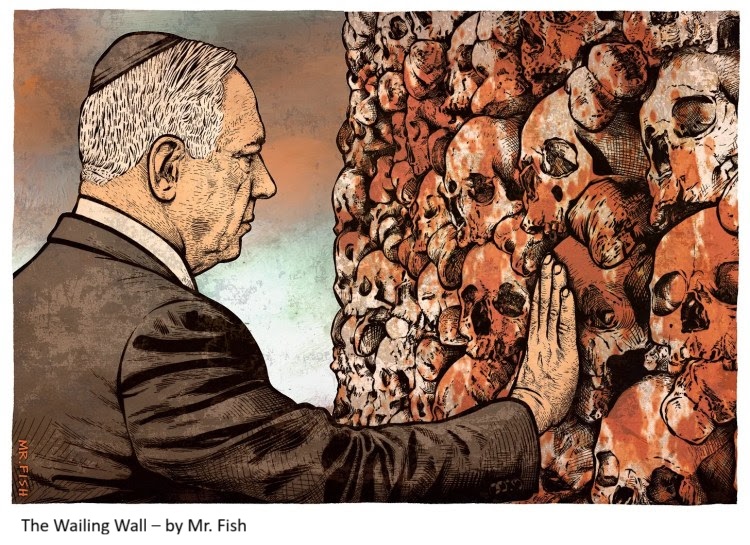
October 2, 2026, Reza Fani Yazdi Informed Comment, https://scheerpost.com/2026/10/02/the-mask-of-civilization-the-face-of-apartheid-netanyahu-at-the-un/
From the heart of a Middle East that has bled for decades under the boots of colonialism, indiscriminate bombardments, systematic assassinations, and the medieval sieges imposed by the Zionist regime, Benjamin Netanyahu’s speech before the United Nations General Assembly was nothing less than the naked embodiment of “the most brazen form of inversion of truth, fascist propaganda, and systematic justification of genocide.”
Before being portrayed as a political event, this speech was a nauseating spectacle: an “accused man wanted by the International Criminal Court” making his escape, as it were, from the defendant’s seat in a criminal court to the podium of the United Nations General Assembly.
What follows is my examination of the criminal rhetoric of this man accused of genocide.
The Greatest Inversion in History: The Accused Perpetrator Posing as Prosecutor
The height of audacity in Netanyahu’s speech lies in his deliberate and deranged reversal of the roles of “perpetrator and victim.” A man for whom the Pre-Trial Chamber of the International Criminal Court (ICC) found reasonable grounds to issue an arrest warrant on allegations including the war crime of using starvation as a method of warfare and crimes against humanity—the killing and systematic infliction of suffering upon hundreds of thousands of people in Gaza—stands calmly behind the podium and calls the victims of his own war machine “terrorists,” while presenting himself as a “defender of civilization.”
This is linguistic colonialism at its most extreme: 78 years of occupation, the bombing of hospitals and refugee camps, and the massacre of tens of thousands of innocent women and children are called “legitimate self-defense,” while the resistance of a people fighting to reclaim their land and human dignity is branded “barbarism.”
An accused man who should have the handcuffs of justice around his wrists stares the world in the face and mocks every standard of human rights.
Invoking Ancient Myths to Legitimize Ethnic Cleansing
Netanyahu’s reliance on the Torah and on narratives dating back thousands of years to justify modern colonialism, illegal settlements in the West Bank, and the occupation of the Golan Heights is a blatant affront to the United Nations Charter and international law.
If geographical borders and the sovereign rights of nations are to be rewritten on the basis of ancient religious scrolls, then no place on Earth will ever be secure.
This approach lays bare the fascist, racist, and apartheid nature of the Tel Aviv regime—a regime founded upon the “dispossession of the indigenous population” and “ethnic cleansing,” and one that brazenly links its crimes to supernatural commandments in an attempt to portray the spilling of human blood as permissible.
Emboldened by Imperialism and Brazen Defiance of the International Community
Netanyahu’s arrogant and insulting tone toward representatives of countries who walked out of the United Nations chamber in protest against the presence of a war criminal—and his branding of them as “moral cowards”—is the product of years of ironclad immunity granted to him by the United States and by Western colonialism and global imperialism.
He proudly speaks of violations of the airspace of countries across the region, targeted assassinations, the bombing of facilities, and wars on multiple fronts.
Such a complete abandonment of even the pretense of diplomatic restraint demonstrates the extent to which the international legal order has surrendered before naked force and imperial vetoes.
The silence or implicit support of Western governments for such positions makes them complicit in every drop of blood spilled in Gaza, Lebanon, Iran, and throughout the Middle East.
Projecting Severe Domestic Crises into Regional Terror and Conflict
Netanyahu bellows about “strategic victories” and the “end of insecurity” while the settler society under his rule struggles with profound psychological crises, economic deterioration, structural protests, and political deadlock.
In order to postpone his domestic trials on corruption charges and prevent the collapse of his fragile coalition, he must keep the machinery of war permanently running and drag the region toward the precipice of a global war.
Bringing technological devices—such as Starlink—to the podium of the United Nations General Assembly and issuing threats against the great nation of Iran is a vulgar spectacle staged by a politician who knows that once the war ends, the final chapter of his political life and his inevitable downfall will begin.
Wait Until the Dawn of Your Downfall Breaks
History has demonstrated with unmistakable clarity that no occupying empire has ever achieved immortality through cluster bombs, indiscriminate killing, rhetoric at the United Nations, and the support of its Western patrons.
What came from the throat of this wanted criminal in New York was not the voice of strength or authority. It was the terrified roar of a declining project and a decaying structure confronted by the iron will of the peoples of the region.
Gaza, Lebanon, and a steadfast Iran stand as living witnesses that the Zionist killing machine will ultimately drown in the quagmire of its own structural crimes.
Israeli authorities order total shut down of West Bank
Many Palestinians feel that the comprehensive closure Israel imposed aims to push them to permanently leave their homeland by escalating the already stifling restrictions on movement in the occupied West Bank.
Aseel Saleh, September 30 2026, https://breakthroughnews.org/2026/09/30/israeli-authorities-order-total-shut-down-of-west-bank/
On Sunday, September 27, the Israeli occupation authorities announced a multi-day comprehensive closure of all crossings into and out of the West Bank, coinciding with the Jewish holiday of Sukkot.
The closure will continue until at least Saturday, October 3, further exacerbating already stifling restrictions on movement across the occupied territories.
The move came days after the Israeli forces blocked the main entrances and exits to the central West Bank governorate of Ramallah and Al-Bireh, which constitutes a major commercial hub and connects the territory’s northern governorates with those to the south.
In recent days, thousands of Palestinians were stranded at Israeli military checkpoints due to these restrictions that eventually culminated with the holiday-related closure. This includes vulnerable people such as patients, elderly people, pregnant women, and even preschoolers unaccompanied by their parents.
On Friday, September 25, media outlets reported that kindergarten students waited at the Atarah military checkpoint in northern Ramallah for nine hours the previous night, with their bus finally managing to bring them home after 10:30 PM.
Meanwhile, BreakThrough News documented the delay an ambulance of the Palestine Red Crescent Society (PRCS) faced at the same checkpoint on Monday, September 28.
BreakThrough News also spoke to some Palestinian citizens at the checkpoint, who affirmed that they had to wait for many hours at each checkpoint inside the governorate on a daily basis.
A cargo driver from the southern governorate of Hebron, who travels to Ramallah every day, said that he sometimes has no other choice but to sleep in his car when facing extended delays.
Another Palestinian, who spoke on condition of anonymity, suggested that the Israeli measures in place aim to make the Palestinian people in the West Bank feel frustrated about their daily life, pushing them to leave their homeland permanently.
Illegal Israeli settlers storm different parts of Ramallah during the holiday
The provocative acts related to the current holiday were not limited to the comprehensive closure. On Tuesday, September 29, over 100 illegal Israeli colonists stormed the town of Beitunia and the nearby Ein Jaryout area, west of Ramallah, under protection of the Israeli forces.
Palestinian movement was heavily restricted and the entrances to the targeted areas were blocked by the Israeli military to clear the way for a large convoy of settler vehicles.
Moreover, the event involved the assault and detention of Palestinian residents and damage to property, alongside a religious march and prayers by settlers.
Journalists were also reportedly prevented from covering the events, under the direct threat of firearms.
On that same day, a group of settlers entered the Al-Tireh neighborhood and the adjacent town of Surda, situated just a short distance from Beitunia. During the incident, they raised Israeli flags at Al-Awda Square, obstructed traffic intersections, and hurled stones damaging vehicles.
The incursions in Ramallah were carried out one day after Israel’s National Security Minister Itamar Ben-Gvir led hundreds of Israelis in a raid on Al-Aqsa Mosque.
During the assault, they performed dances inside the courtyards of the Al-Aqsa Sanctuary.
Referring to the Al-Aqsa Mosque as the Temple Mount (a biblical name), Ben-Gvir declared from there:
“October 7 was massive and enormous pain, great pain. But today, three years later, on the holiday of Sukkot. We can rejoice in many things.We are the masters of the Temple Mount. We are the masters of the prisons. We turned the lives of terrorists into hell.”
The statement of Ben-Gvir is seen by analysts as nothing but a blatant affirmation that Israel is an apartheid colonial state, which systematically seeks to ethnically cleanse Palestinians.
40 years later: The Abduction of Mordechai Vanunu
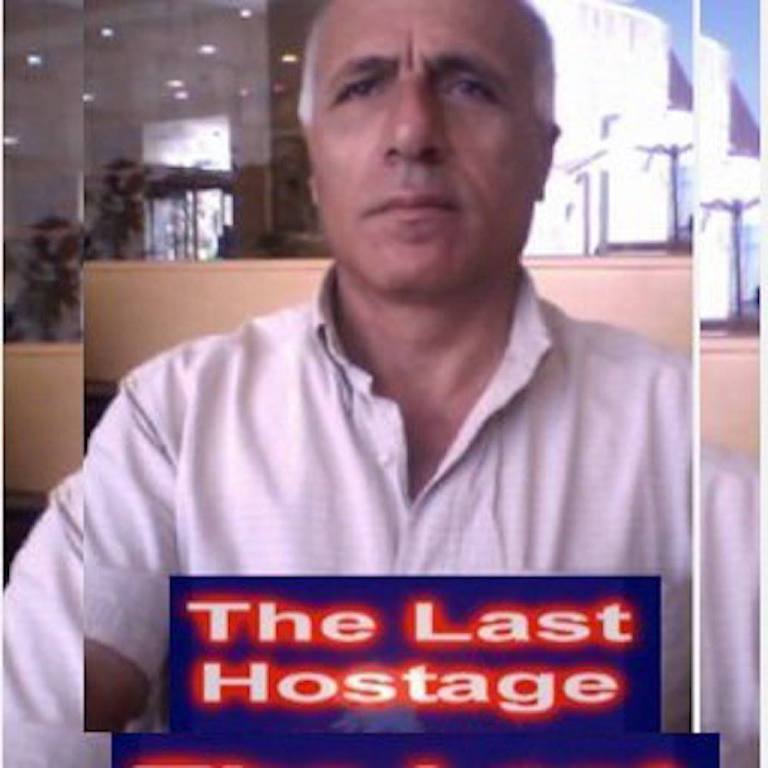
Vanunu began to become critical of government policy, opposing the 1982 Lebanon war and campaigning for equal rights for Arab-Israelis.
In September 1986, Vanunu handed over these photographs and shared his knowledge of the Israel nuclear programme with the British newspaper The Sunday Times.
Daniel Ellsberg, the Pentagon Papers whistleblower, called Vanunu “the preeminent hero of the nuclear era”
September 29, 2026, by Xanthe Hall, https://peaceandhealthblog.com/2026/09/29/40-years-later-the-abduction-of-mordechai-vanunu/
Few whistleblowers have risked as much as Mordechai Vanunu did when he handed over covertly taken photographs of the Dimona nuclear facility in Israel to The Sunday Times in 1986. 40 years ago, on 30 September 1986, he was drugged and abducted by Mossad, taken back to Israel and sentenced to 18 years in prison, 11 of them in solitary confinement. Vanunu was released in 2004 but has not been allowed to leave the country or speak to a foreign person. For 40 years he has been punished for telling the world that Israel has nuclear weapons.
Mordechai Vanunu aka John Crossman is a former Israeli nuclear technician, born on 14 October 1952 in Marrakesh. Vanunu was the son of a Jewish-Moroccan grocer, who moved with his family to Israel in 1963. After serving with the Israeli army during the Yom Kippur war, he began studying physics in Tel Aviv but did not complete his studies.
In 1976 he began working at the highly secret Negev Nuclear Research Center in the Negev Desert, south of Dimona. He began to study economics at Ben-Gurion University in Beersheba in 1979, and in the early 1980s he travelled through Europe and North America, the latter of which was not allowed by the Nuclear Research Center as his employer.
At around this time Vanunu began to become critical of government policy, opposing the 1982 Lebanon war and campaigning for equal rights for Arab-Israelis. During 1984 he was questioned three times by the security office at Dimona, once after a trip to France. In early 1985 he was laid off from the Nuclear Research Center but got his job back with the help of the trade union.
After resuming work at Dimona, Vanunu covertly took photographs of the site before quitting his job on 27 October 1985. In September 1986, Vanunu handed over these photographs and shared his knowledge of the Israel nuclear programme with the British newspaper The Sunday Times.
Vanunu’s information led to the conclusion that Israel, among other things, was producing tritium, enriching uranium and processing plutonium, enough for up to 150 nuclear weapons. Although the information was not new to informed circles in the UK and US, it was the first time that the extent of the Dimona secret nuclear weapons programme became known to the public. There was deep concern about the fact that Israel, not a member of the Non-Proliferation Treaty, was in possession of nuclear weapons.
Two leading nuclear experts — Frank Barnaby and Theodore Taylor — needed weeks to verify the information. But before the information could be published, Mordechai Vanunu was drugged and abducted by Mossad agents while he was in Rome. He had been lured there by a Mossad ‘honeytrap’ operation, using a woman calling herself ‘Cindy’ who was posing as a tourist from the USA. From there he was taken to Israel. While he was held on a cargo ship travelling to Israel, The Sunday Times published the information he had given them, on 5 October 1986. Two days later, Vanunu was in Gedera prison being interrogated. A month later, after first denying it to the British authorities, Israel confirmed they had him in detention.
Vanunu was released on 21 April 2004 but was prohibited from leaving Israel, and of speaking to foreigners without permission. He was not allowed to come within 500 metres of an airport or border crossing, or 90 metres from a foreign embassy. His phone and internet continue to be monitored.
He returned to prison for three months in 2010 after he was convicted in 2007 of having contact with foreigners and violating the terms of his release.
An application for asylum to Norway was turned down, as were applications to Sweden and Ireland, because applications cannot be considered from outside of the asylum country. Repeated calls by supportive organisations for him to be allowed to leave Israel have been rejected by Israel, including by the Supreme Court. On 19 May 2015 Vanunu married Norwegian professor Kristin Joachimsen in Jerusalem and in August 2015 applied for family reunification to Norway via the embassy in Tel Aviv. The Israel High Court denied his application to have the restrictions on his movements lifted. He appealed to the Supreme Court. On 3 December 2019, the appeal was denied. The court cited as justification “a concern about the probability of closeness to the certainty that if the restrictions imposed on Vanunu are removed, he will act to publish this information”. The information that Vanunu had was, by then, more than 30 years out of date.
On the first day of every month, Vanunu posted on Twitter:
“One more year without freedom since 1986. Now I am waiting for my freedom, freedom to leave Israel. I will continue to wait until my freedom comes. Born to be free. See you in freedom.”
In July 2024 he posted that all restrictions had been renewed for another year and he would only write his next post when free. The account no longer exists.
Daniel Ellsberg, the Pentagon Papers whistleblower, called Vanunu “the preeminent hero of the nuclear era”. Now himself a world-famous whistleblower, Mordechai Vanunu has won several awards, including the Right Livelihood Award in 1987 and the Nuclear Free Future Award in 2002 in the category of “Resistance”. He was nominated for the Nobel Peace Prize in 2009 but removed from the nominations list on his own request, as Shimon Peres was also listed that year.
Sources and further reading………………………………………………………………………………………………………….
What is the Saudi nuclear deal really about?
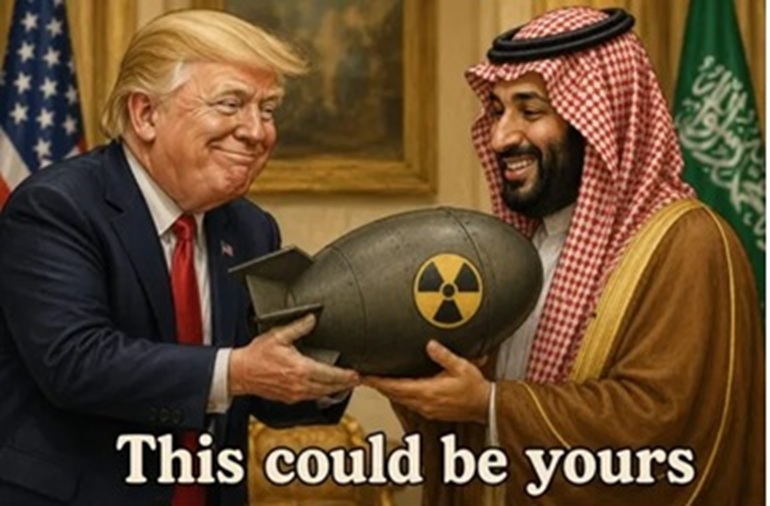
What is clearly in Trump’s Saudi deal is approval to provide Westinghouse AP1000 reactors to Saudi Arabia, a deal worth tens of billions of dollars to the company.
But all of the fanfare about how great this deal is for American business appeared to ignore the fact that Westinghouse is no longer actually an American company.
Today, Westinghouse is owned by two Canadian companies, Cameco and Brookfield Asset Management, a US-based company that is a subsidiary of Brookfield Corporation (formerly Brookfield Asset Management Inc.), a Canadian multinational investment company. Needless to say, the road from there leads straight back to the White House.
by beyondnuclearinternational, https://beyondnuclearinternational.org/2026/09/26/what-is-the-saudi-nuclear-deal-really-about/
Is it actually a boon for US companies, or another scheme to enrich Trump, his family and cabinet colleagues, asks Linda Pentz Gunter
On August 25, Trump sent his nuclear deal with Saudi Arabia to the US Senate for consideration. This started a 90-day clock during which time the Senate could choose to accept or reject the proposal.
But what exactly was in it? The usual Trump White House opacity — which often includes word not matching deed — prompted a letter on September 16 from 18 US senators, including two Republicans and one independent, asking for more details.
”Access to the full text is required for the Senate and the public to have a clear understanding of the commitments being made on the nation’s behalf and those being made by Saudi Arabia to the United States,” said the letter, led by Senators Ed Markey (D-MA) and Jeff Merkley (D-OR) and addressed to Secretary of State Marco Rubio and Energy Secretary Chris Wright
By September 25, six of the Democrats who had signed the first letter wrote again to Rubio and Wright.
“We are gravely disappointed to see the Trump Administration enter a deal to provide nuclear technology to Saudi Arabia that fails the Gold Standard nonproliferation test. The Gold Standard has longstanding bipartisan support and reflects internationally recognized best practices. By abandoning it the agreement would allow Riyadh to acquire the means to potentially produce weapons-grade nuclear materials without the strictest nonproliferation safeguards the U.S. has long championed as a condition of such cooperation.
“The U.S.-Saudi nuclear deal calls for a study lasting up to two years on uranium enrichment in Saudi Arabia. After that, the United States could build a uranium enrichment plant on Saudi soil. The United States has never directly transferred an enrichment plant to a non-nuclear-weapon state, let alone one whose leaders have threatened to pursue nuclear weapons. The recklessness of this arrangement underscores the importance of utilizing the most stringent safeguards and protections, as reflected by the Gold Standard.”
The reference to Saudi leaders threatening to pursue nuclear weapons refers to a statement made by Saudi Crown Prince Mohammed bin Salman during a March 15, 2018 interview with CBS News, during which he stated: “Saudi Arabia does not want to acquire any nuclear bomb, but without a doubt, if Iran developed a nuclear bomb, we will follow suit as soon as possible.”
In theory, the Saudi nuclear deal is what is known as a “123” agreement, a legally binding 30-year bilateral pact required by Section 123 of the U.S. Atomic Energy Act of 1954 that establishes the framework for significant civil nuclear cooperation between the United States and another nation.
What is clearly in Trump’s Saudi deal is approval to provide Westinghouse AP1000 reactors to Saudi Arabia, a deal worth tens of billions of dollars to the company.
Westinghouse is most notorious for going bankrupt and coming close to handing the same fate to its parent company at the time, Toshiba, while attempting to build four AP 1000s in South Carolina and Georgia. Construction began in 2013 but the South Carolina reactors were abandoned mid-constriction and the Georgia pair arrived seven years late and cost $36 billion, well above the original $14 billion estimate.
What is at issue, and which disturbed the senators, is whether the deal would allow for uranium enrichment within Saudi Arabia. Wright was quick to dismiss that concern at a press conference held the same day the deal was sent to the Hill.
“There’s no reason to bring uranium enrichment to Saudi Arabia,” Wright said at the press conference, which was announcing the equally reckless ATLAS project that would put nuclear reactors on commercial shipping as well as develop floating reactors. But, added Wright about the Saudi Westinghouse deal,“They don’t even have a nuclear reactor yet. So I would say that’s something many years down the road.”
The Westinghouse reactors are also likely to be “many years down the road” given the company’s track record. But all of the fanfare about how great this deal is for American business appeared to ignore the fact that Westinghouse is no longer actually an American company.
Today, Westinghouse is owned by two Canadian companies, Cameco and Brookfield Asset Management, a US-based company that is a subsidiary of Brookfield Corporation (formerly Brookfield Asset Management Inc.), a Canadian multinational investment company. Needless to say, the road from there leads straight back to the White House.
As the New York Times reported in July, Brookfield Asset Management “is a frequent business partner with Newmark, the real-estate firm run and owned in part by the sons of Commerce Secretary Howard Lutnick.”
Brookfield Asset Management also has connections with White House ‘senior envoy for peace’ and Trump son-in-law, Jared Kushner. In 2018, the Kushner family was struggling to maintain control of a Manhattan luxury property —the somehow appropriately numbered 666 Fifth Avenue tower block. It was Brookfield Asset Management that came to the rescue. As the New York Times revealed then, “The deal will be a boon to the Kushners, who are struggling to recoup their investments in their flagship building.”
Of further concern in the deal is that Saudi Arabia is not required to adopt the IAEA Additional Protocol. This is significant because without that extra power for the International Atomic Energy Agency to check Saudi Arabia’s nuclear sites for covert nuclear weapons activities, the pathway is of course a lot easier to do precisely that.
It’s also significant because Saudi Arabia has already talked about developing a full uranium fuel cycle, including uranium mining as well as making its own reactor fuel. Verifications and inspections are important to ensure that any country with a civil nuclear program is not developing nuclear weapons.
In addition to the genuine proliferation concerns surrounding the Saudi nuclear deal, it is also patently obvious that if Saudi Arabia really wanted to replace the oil it is currently burning with an alternative, less carbon-emitting energy source, it has absolutely no need to choose nuclear power, the most expensive, slowest and most dangerous energy source with an unsolved radioactive waste problem.
The kingdom is more than 90 percent desert, making solar and potentially also wind the obvious choice as an energy replacement for oil, which the Saudis claim they want to burn less of (or, more realistically, export more of abroad.) In fact, the Saudis already know this, given they have a 600-megawatt solar project that is currently supplying electricity at 1.04 US cents per kilowatt-hour, a world record for the lowest contracted price for solar power generation.
As Massachusetts Senator Ed Markey, then a Congressman, asked pointedly of then Energy Secretary Samuel Bodman back in 2008 during a hearing before the House Select Committee on Energy iIndependence, “But aren’t you suspicious that the Saudis don’t want a solar agreement? Saudi Arabia is the Saudi Arabia of solar. There it is. It sits there as a desert with sun 12 months a year, blistering hot. Why wouldn’t this administration be suspicious that they are asking for nuclear rather than solar power exchange in order to meet their long-term energy needs?”
Of course, it’s not clear whether, even if the deal is approved by Congress, the Saudis are actually going to sign off. Trump has made it a condition that the Saudis sign on to the Abraham Accords, which force them to normalize relations with Israel. Saudi Arabia has flatly rejected that demand so far, absent a viable path to an independent Palestinian state.
Israeli opposition leaders sign pact to replace Netanyahu

Opposition leaders pledge cooperation despite ideological differences ahead of the vote.
Sakina Fatima Follow on Twitter| 27th September 2026 , https://www.siasat.com/israeli-opposition-leaders-sign-pact-to-replace-netanyahu-3549129/
Yair Lapid, Gadi Eisenkot, Naftali Bennett, Avigdor Lieberman and Yair Golan signed the principles document at Lapid’s home in Tel Aviv on Saturday, September 26
The leaders acknowledged their ideological differences but agreed that forming a new government focused on “repair and rebuilding” was their shared objective.
Under the agreement, none of the leaders, or anyone acting on their behalf, will attack another party in the bloc or its leader until a new government is formed.
They also pledged to cooperate immediately after the election and work to increase voter turnout across different sections of the electorate.
Opposition bloc sets up three joint working groups
The pact requires three joint working groups to be established within 48 hours.
The first will handle voter mobilisation, election-day preparations and measures to safeguard the integrity of the vote.
The second will formulate the basic guidelines for a potential new government. Its agenda includes equal sharing of service obligations, a state commission of inquiry into the October 7, 2023 events, term limits for the prime minister, a constitution and a plan for the government’s first 100 days.
The third group will coordinate communications between the parties and work to counter fake news and smear campaigns.
Prime minister candidate decision deferred
The parties have not selected a joint candidate for prime minister. Disagreements over the issue have emerged particularly among Eisenkot, Bennett and Lieberman.
The agreement instead focuses on cooperation before and immediately after the election, leaving the leadership question to be addressed after the vote.
Benny Gantz’s Blue and White party was not part of the meeting.
Netanyahu responds
Netanyahu criticised the agreement in a post on X, claiming that Eisenkot would seek to form a government with the other opposition leaders and Arab parties.
He also shared an AI-altered version of the leaders’ group photograph that added United Arab List leader Mansour Abbas and Hadash-Ta’al leader Ahmad Tibi, neither of whom attended the meeting.
Israel is scheduled to elect all 120 members of the Knesset on October 27. The results will determine the composition of the next parliament and the parties involved in forming the government.
Iran Launches Surprise Attacks On US Bases As Trump Covers Up Soldier Casualties
September 24, 2026, Robert Inlakesh MintPress News, https://scheerpost.com/2026/09/24/iran-launches-surprise-attacks-on-us-bases-as-trump-covers-up-soldier-casualties/
Iran’s IRGC has been striking various US targets and an average of two to three tankers in the Strait of Hormuz on a daily basis, as gas prices hit working class Americans where it hurts. On this episode of The Target stream, Mint Press News’ Robert Inlakesh explains how these blows have been compounded by revelations that the Pentagon is concealing its Iran War casualties.
The Islamic Revolutionary Guard Corps (IRGC) carried out another ballistic missile attack against what they would later state was a US military base in Jordan, in the latest edition of The Target we cover the story before it was officially announced and put it together with a broader series of strikes on American military targets that are no longer even being acknowledged by US Central Command.
Tehran’s preemptive operations are not receiving much attention in the corporate media, despite visual confirmation of them occurring, alongside on the ground reports and later confirmations from Iranian military officials. Combined with the fact that multiple vessels are being targeted in the Strait of Hormuz by the IRGC’s naval forces on a daily basis, this spells a new regional equation.
So long as the Iranian attacks are not on a larger scale as to demand a response, the US military is simply pretending as if they are not happening at all. The previously announced equation was that Iran’s civilian infrastructure would be targeted each and every time a tanker is struck in the Persian Gulf.
Compounding the US’s declining hegemony and military embarrassments have been reports that the Pentagon has deliberately hid the deaths of a number of American military personnel. According to a bombshell report from the Washington Post, five sources who are familiar with the US’s casualty figures claimed that they knew about four deaths that were not publicly registered by the Pentagon, an additional source said that number could be five.
Meanwhile, gas prices are burdening working class Americans who are growing increasingly frustrated with the Trump administration’s mismanagement of the economy. A Reuters/Ipsos Poll, published this Monday, found that only 17% of US citizens say that they are happy with the federal government’s management of the economy.
Although it has remained largely out of the mainstream spotlight, Saudi Arabia’s war on Yemen continues to backfire as it faces new rounds of ballistic missile and drone strikes against their oil infrastructure. The Yemeni Armed Forces continue to liberate territory from Saudi-proxy forces, as airstrikes based upon intelligence granted to Riyadh by officials in Tel Aviv have resulted in a growing number of civilian massacres.
Also on the stream, Robert Inlakesh takes an in depth look at the Lebanon front and what its weapons arsenal could mean during the upcoming regional escalation, analysing the Israeli predicament on southern Lebanese occupied lands. Hezbollah had proven it possessed a large range of weapons during its 2024 war with Israel. In 2026, the Party has chosen not to use its strategic arsenal so far, indicating that it is following a carefully calibrated escalation ladder.
Israel Damaged 82 Percent of Gaza’s Buildings. Collapses Are Burying Us Alive.

Residents of the recently collapsed six-story high rise knew they were in danger but could find nowhere else to sleep.
By Shahad Ali , Truthout, September 23, 2026
Khaled Al Soutari, who was inside the six-story residential building in western Gaza City that collapsed on September 16, is now sleeping on the street without a tent, devastated by the loss of 21 of his neighbors.
“They were more than just neighbors to me,” Al Soutari told me when I interviewed him two days after the building collapse, sitting on the street with a group of his neighbors next to the collapsed building. “They were my best friends. We shared food and laughter and had endless talks despite the harsh reality we were living through. It is hard for me to imagine life without them.”
Al Soutari told me that for more than six months, the building, which had previously been damaged by Israeli bombardment, had been weakening further because of wastewater seepage. The walls had also developed deeper cracks, and pieces of concrete had begun to fall. Then, one night, the building itself suddenly crumbled.
“We were sleeping when suddenly the ground started to shake as if an earthquake had hit. I started screaming at my wife and children to jump through a hole in the wall, but we could not because the building collapsed,” Al Soutari told me. “I found myself under the rubble within seconds, surrounded by the screams of my family and others shouting, ‘We are here. We do not want to die. Help us.’ I could not breathe or shout. For a moment, I thought this was the end.”
“Luckily, one of my neighbors noticed me and managed to free me from the concrete pressing on my back,” he continued. “However, my wife and my three children spent hours under the rubble before the Civil Defense intervened and managed to rescue them.”
Al Soutari added that his daughter, Sham, suffered a leg injury in the collapse and had to undergo surgery to have a plate inserted.
The municipality had inspected the building a few days before it collapsed and asked residents to leave, Al Soutari said, explaining that his family tried to do so, but they could not find any other place to go.
“I always talked with my neighbors who lived in the building about my fear that it could collapse on us at any moment, but we were helpless. We could do nothing but stay,” he told me………………………………………………………….
As Winter Approaches, More Building Collapses Are Imminent
The collapse of the Al-Sadah building was not an isolated case. Mahmoud Bassal, spokesperson for Gaza’s Civil Defense, said in a statement after the collapse of the Al-Sadah building that around 2,000 other buildings across the Gaza Strip are also at risk of complete collapse………………………………………………………………………. https://truthout.org/articles/israel-damaged-82-percent-of-gazas-buildings-collapses-are-burying-us-alive/?utm_source=Truthout&utm_campaign=1319f0e1c1-EMAIL_CAMPAIGN_2026_09_23_08_15_COPY_01&utm_medium=email&utm_term=0_bbb541a1db-66fc42c01f-650192793
Iran sends peace terms to US

Tehran is awaiting US President Donald Trump’s response to its conditions for restarting negotiations, security chief Mohsen Rezaei has said
19 Sep, 2026 , https://www.rt.com/news/645996-iran-sends-peace-terms-us/
Iran has conveyed its peace terms to the US through Qatari mediators, the country’s top security official, Mohsen Rezaei, has said, arguing that it is in America’s interests to accept them.
The 60-day period provided under the US-Iranian memorandum of understanding to negotiate a settlement expired last month without a deal, while disrupted maritime traffic through the Strait of Hormuz continues to drive up energy prices.
“Seven conditions set by Iran for the start of any negotiations have been conveyed to the US administration. Tehran’s message is clear and unambiguous: If Washington wants to escape the predicament it has created for itself and avoid becoming further entangled in it, it has no choice but to recognize Iran’s rights and accept its conditions,” Rezaei wrote on X on Saturday.
In an interview with Al Jazeera, Rezaei, the secretary of Iran’s Supreme National Security Council, said the terms include “an end to the war on all fronts, the release of our frozen funds and an end to the naval blockade.”
Iranian officials previously said they are also seeking the withdrawal of US forces from the region and compensation for the US and Israeli strikes launched on February 28.
“Trump’s threats will not achieve any results. We are prepared for a decisive war,” Rezaei added.
US President Donald Trump said on Wednesday that “hopefully we are toward the end of the war” and suggested that Iran wants to make a deal. The following day, however, he once again threatened to “annihilate” the Iranian leadership if the conflict does not end on his terms.
The US military revealed on Friday that the nearly seven-month conflict has cost $43.6 billion, with nearly two-thirds of the bill going toward replenishing depleted munitions.
According to Bloomberg, widely reported ammunition shortages could delay arms deliveries to US allies by several years. Trump and Secretary of War Pete Hegseth have denied that the conflict has left the US short of missiles and bombs.
Walt Zlotow – How does US fund Israeli genocide? Let us count the billions
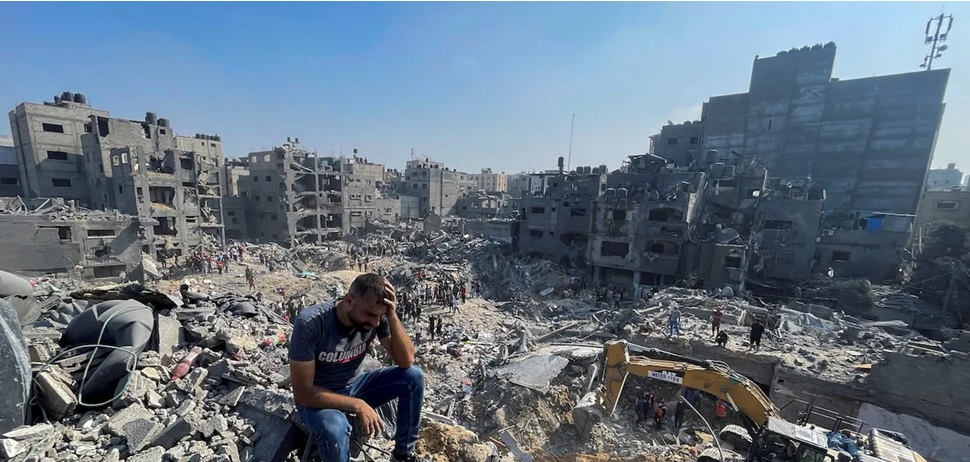
Walt Zlotow West Suburban Peace Coalition Glen Ellyn IL, 21 Sept 26, https://theaimn.net/how-does-us-fund-israeli-genocide-let-us-count-the-billions/
President Biden hopped on the Israeli genocide campaign to destroy Gaza and its Palestinian population the day after the October 7, 2023, Hamas attack on Isreal.
Approaching three years this October 8, Gaza’s 141 square miles are a pile of rubble covering up tens of thousands of dead Palestinians among the hundred thousand plus dead. The remaining 2.2 million survive agony in an ever tightening area as Israeli forces occupy over half of Gaza and shoot any Palestinian who get close to the Israeli zone.
None of this genocidal atrocity would have been possible without President Bidenn gifting Israel with over $20 billion in weapons to inflict the most grotesque genocide this century.
Even after the January 2025 ceasefire which released the remaining Israeli hostages, Israel continues to bomb and kill Palestinians daily.
Now President Trump, even tho running out of weapons to fight his lost war on Iran, plans to gift Israel with another $2.8 billion in 2,000 lbs. bombs to continue the slaughter of Palestinians in Gaza and Lebanese in Lebanon.
“The Trump administration’s proposed sale of 40,000 2,000-pound bombs, some of the most destructive munitions in our arsenal, raises grave, unresolved concerns about how these munitions could be used in densely populated areas of Gaza and Lebanon. The Trump administration has not provided sufficient assurances that these weapons will be used by the Netanyahu government in accordance with US law and with appropriate protections for civilians. I therefore will not clear this sale at this time.”
Rep. Meeks knows full well that the proposed $2.8 billion, just like the previous $20 plus billion from Biden, will be used to further obliterate Gaza and Southern Lebanon in furtherance of expanding Greater Israel.
Why Trump continues the weapons flow to Netanyahu after he suckered Trump into launching his disastrous attack on Iran will forever remain a mystery.
The US economy is facing disaster, possibly even collapse over Trump’s lost war against Iran. We’re not bombing Iran anymore because we’ve largely run out of weapons. Our debt has raced past $40 trillion. Inflation is out of control. Yet, Trump has enough loyalty to his masters in Israel to find $2.8 billion in genocide weapons for Israel to complete the project his predecessor enabled 3 years ago.
That is not ‘America First’. It is ‘Genocide First…America Last.’
Calls to quit NPT grow in Iran as critics warn of strategic trap
Maryam Sinaiee, Iran International, https://www.iranintl.com/en/202609165573
alls for Iran to withdraw from the Nuclear Non-Proliferation Treaty are gaining ground among hardliners after the IAEA referred the country to the UN Security Council and its nuclear chief was barred from attending the agency’s annual conference in Vienna.
The growing debate has exposed a divide within Iran’s political establishment between those who see NPT membership as offering little protection and others who warn that withdrawal would surrender one of Tehran’s remaining diplomatic and legal advantages.
Mohsen Rezaei, secretary of Iran’s Supreme National Security Council, appeared to threaten withdrawal from the treaty on Sunday, saying that “political and destructive actions” by the International Atomic Energy Agency would “push countries toward leaving the Nuclear Non-Proliferation Treaty.”
But President Masoud Pezeshkian reiterated the same day, during a visit to India, that Iran was not seeking nuclear weapons. “If we were seeking nuclear weapons, we would not have become a member of the NPT,” he said.
The debate intensified after Mohammad Eslami, head of Iran’s Atomic Energy Organization, was prevented from attending the IAEA General Conference in Vienna.
Austria had sought an exemption from a UN travel ban to allow Eslami to attend, but the sanctions committee did not approve it after a US objection.
Calls for immediate withdrawal
Supporters of immediate withdrawal say NPT membership has failed to protect Iran from international pressure or attacks on its nuclear facilities.
Continued membership, they argue, only makes sense if members’ nuclear rights are given equal weight alongside their obligations.
Sepehr Khalaji, who headed the Government Information Council under former President Ebrahim Raisi, questioned why Iran remained in the treaty.
“They bombed the nuclear facilities, martyred the scientists, sanctioned nuclear technology and say they will strike the remaining nuclear facilities. They referred Iran’s case to the Security Council, and they do not allow the head of the Atomic Energy Organization to enter the IAEA. So why are we still in the IAEA? Why don’t we withdraw from the NPT?” he wrote on X.
Parliamentary push
The debate has also reached parliament, where lawmakers are preparing a proposal for Iran to withdraw from the NPT.
Hassan-Ali Akhlaghi, a member of parliament, told the Fars news agency on Wednesday that lawmakers had prepared a triple-urgency bill that would be put to a vote if approved by the parliamentary leadership.
Given what he called the IAEA’s “entirely hostile and illogical” resolution, Akhlaghi said Iran should leave the treaty as soon as possible.
The proposal, however, has not yet formally reached parliament’s National Security and Foreign Policy Committee and is not currently on the parliamentary agenda.
Warnings of a trap
The conservative Khorasan newspaper on Wednesday warned that leaving the treaty could increase political and diplomatic pressure on Iran without producing significant security gains.
“On the surface, these positions may appear to be a revolutionary and deterrent response to the enemy; but when the pieces of the situation are put together, another worrying picture emerges,” it wrote.
Khorasan argued that the United States and Israel were deliberately trying to push Iran’s political debate toward more radical positions, including testing a nuclear weapon, changing its nuclear doctrine and immediately withdrawing from the NPT.
The newspaper said leaving the treaty before Iran had achieved deterrence could reveal Tehran’s intentions rather than demonstrate strength, potentially giving its opponents an opportunity to act.
“Iran has obtained an important part of the practical outcome without making an official and costly withdrawal: the IAEA no longer has its previous access, while Tehran continues to benefit from the legal protection of NPT membership and the political support of Russia and China,” Khorasan wrote.
“Official withdrawal would destroy this useful grey zone without creating a new strategic advantage.”
Reformist politician Rasoul Montajab-Nia made a similar argument.
“If the agency has not acted impartially toward Iran, we should not resort to disrupting the framework, because this would mean fuelling disputes and war with other countries.”
Montajab-Nia said withdrawal would not benefit Iran and would be “in line with Israel’s objectives.”
The nuclear threshold
At the outer edge of the debate, some advocates of developing nuclear weapons have argued that Iran should remain in the NPT unless it decides to change its nuclear doctrine — and then coordinate withdrawal with a nuclear test.
Foad Izadi, a hardline political commentator, told the Moj news agency that Iran had no need to leave the NPT while its current nuclear doctrine remained in place.
But if Tehran decided to change that doctrine, he said, Iran could withdraw from the treaty after a nuclear test or simultaneously with one.
The Peril of Trump’s Final Act: Would He Use a Tactical Nuclear Weapon in Iran?

The real straits of Trump are dire: He is trapped in a war that has already been lost, a reality that he will never allow himself to admit. Under Republican control, the House has voted repeatedly to end the war. With Democrats likely to take the majority in the midterms, Trump faces the prospect minimally of investigative hearings that will bare the true extent of the losses, costs, and internal military opposition to his folly. He has to find a way to declare victory and get out, and soon.
Trump is trapped in a war that has already been lost, a reality that he will never allow himself to admit.
Robert L. Borosage, https://www.thenation.com/article/world/trump-iran-war-tactical-nuclear-weapon/
Donald Trump is trapped: His war of choice against Iran is lost, an abject strategic catastrophe. Now Trump has to choose: sustain another forever war until Iran breaks, a strategy his own generals oppose, or produce a grand finale to get out without admitting defeat. And there is the rub.
Reality has shattered Trump’s conceits. Instead of a few days, the war has lasted six months and counting. Instead of regime change and popular uprising, the Iranian regime stands with new hardened leadership. Instead of another display of US military prowess, the US military has been driven out of major bases across the region, stockpiles of vital offensive and defensive missiles have been depleted, and the US Navy has been overstretched and exhausted.
And Iran keeps ratcheting up the pressure. It controls the Strait of Hormuz, and its Houthi allies have just seized control of the alternative route through the Bab el-Mandeb Strait and blown up Saudi Arabia’s key east-west pipeline. Crude oil is now over $110 per barrel and rising; the price of diesel—the fuel of commerce—is at record levels. The cost of fertilizer, fuel, and virtually anything that requires transport is going up, with the global economy at risk.
In response, Trump grows ever more delusional. “The failing Nation of Iran,” he claims, “wants to make a deal, quickly and badly.” He suggests that Iran is waiting until after our midterm elections to sue for peace, at which point the price of gasoline will “drop like a rock.” Then he muses that we might just stay in Iran: “We’ll ultimately get out, unless we decide to stay and keep the oil like Venezuela.” He turned to Oman as a mediator on reopening the Strait of Hormuz and then threatened that if it “gets in the way, we’ll bomb the shit out of them.”
He dismisses the war as “small potatoes,” claims full control of the Strait, suggests that the “Countries of the World…should and will reimburse the United States of America when this SCAM Confligration [sic] is over,” and jokes that he might rename the Strait “Trump Strait,” saying, “I should get something out of it.”
The real straits of Trump are dire: He is trapped in a war that has already been lost, a reality that he will never allow himself to admit. Under Republican control, the House has voted repeatedly to end the war. With Democrats likely to take the majority in the midterms, Trump faces the prospect minimally of investigative hearings that will bare the true extent of the losses, costs, and internal military opposition to his folly. He has to find a way to declare victory and get out, and soon.
Many experts report that the United States and Israel are gearing up to launch another full-scale operation, probably just after the US midterms. The Trump administration has just approved a $2.8 billion Israeli arms package that includes 40,000 bombs, half of which are 2,000-pound bombs. Even so, skeptics question how much a new bombing wave could achieve, given the depletion of US weapons stocks, naval power, and base support, without the use of nuclear weapons.
And that caveat makes the situation truly alarming.
Recently released satellite photos are said to show renewed construction activity under Iran’s remote Pickaxe Mountain. Heavily fortified underground facilities are thought to be located there beneath hundreds of meters of solid granite rock, a ceiling deemed impenetrable by conventional weapons. This makes it a natural spot for Iran to rebuild its nuclear program. Trump recently warned that the US would be bombing the mountain “very soon.”
At the same time, Hegseth’s Pentagon has been moving to integrate tactical nuclear weapons into conventional war strategy. The aim, as Under Secretary of Defense Elbridge Colby put it in the chilling language of the megadeath intellectuals, is to provide “credible, rational nuclear options that a President of the United States adopting the simple principle of being a normal human being with common sense would actually implement.”
The United States, the only country ever to drop a nuclear weapon, has repeatedly refused to adopt a “no first use” policy. The president has sole authority to order the use of a tactical nuclear weapon. Neither Congress nor the public would be given prior notice. Would Trump use a tactical nuclear weapon on relatively isolated Pickaxe Mountain in Iran as his exit line?
According to the Bulletin of the Atomic Scientists, using a nuclear weapon against a non-nuclear nation is a violation of international customary law. But Trump, as his noxious deputy chief of staff, Stephen Miller, infamously asserted, dismisses international law and treaties as “international niceties,” arguing that “the real world…is governed by strength, by force…by power.” Trump boasts that the only limit on his international power is “one thing. My own morality. My own mind. It’s the only thing that can stop me.”
Long-standing US policy, reaffirmed in the Trump administration’s 2018 Nuclear Posture Review, states that the United States “will not use or threaten to use nuclear weapons against non-nuclear weapons states that are party to the NPT [Nuclear Nonproliferation Treaty] and in compliance with their nuclear nonproliferation obligations.” This promise extends to over 190 countries, including Iran —at least until last week, when the Trump administration pushed through an International Atomic Energy Agency resolution declaring Iran in violation of its obligations under the treaty. Iranian analysts warned, probably correctly, that the move presaged an imminent attack on Iranian nuclear facilities.
Dropping a nuclear weapon on Iran would not only be criminal; it would be incredibly dumb. Iran would respond by unleashing an assault on oil and desalination and energy platforms across the Emirates and an unprecedented assault on Israel.
It would also set off a race for nuclear weapons, as countries across the globe would understand that the reason Iran was targeted and not North Korea is that the latter has nuclear weapons and the former does not. Trump made that clear when he bizarrely told the zealots gathered at the Republican Midterm Convention that if Iran had nuclear weapons, “I’d be calling the supreme leader, and I’d be saying, ‘Mr. Supreme Leader, how are you, sir? Is there anything we can do for you?’ as opposed to bombing the crap out of him.” As one commentator noted, the video of that could serve as a nuclear proliferation promo ad.
Use of a tactical nuclear weapon would set a precedent for Russia or China to invoke if they chose to use or threaten the use of nuclear weapons against Ukraine or Taiwan or other adversaries. It would put the nuclear arms race, already gaining dangerous momentum, into hyperdrive. And it would indelibly brand the US as a dangerous, pariah nation, feared but despised across the globe.
For these and other reasons, it is hard to imagine any president making that decision. But Trump, trapped, desperate, angry, delusional, intent on punishing his enemies and displaying his prowess, could well be tempted. And the anticipated Democratic election victories this fall will corner him—and that will make him even more dangerous, as we saw with the sacking of the Capitol after his 2020 loss in the presidential race.
These harrowing prospects should intensify efforts to bring the war to an end, and to warn clearly against escalation. The war is already opposed by a growing majority of Americans. Congress will be out of session until the midterms, but citizens can make certain that candidates are pressed on this issue as they campaign. Editorialists should weigh in against escalation. China’s President Xi, slated to meet with Trump in September, could put ending the war high on the agenda. US Arab allies in the region have an existential stake in avoiding a final cataclysm in this misbegotten war and should both demand restraint from the US and intensify negotiations with Iran and its Houthi allies. Recently, progress toward a settlement on Iranian “administration” of the Strait of Hormuz was interrupted by the Houthi offensive in Yemen and attacks on Saudi Arabia. European leaders could play a role, publicly warning Israel’s Netanyahu not to sabotage negotiations.
The last weeks of reduced military activity and apparent stalemate have been misleading. The economic costs of the war—now with oil transport through both Hormuz and the Red Sea constricted—are escalating. The pressure on Trump to escalate, to unleash another round of bombing in order to declare victory and get out, is rising. Without a concerted movement toward a settlement, the unimaginable is becoming more conceivable.
1 This Month
23-25 October – on Zoom – World BEYOND War’s annual global conferenc


Shut down the radiation-damaged Heysham nuclear reactors now
To see nuclear-related stories in greater depth and intensity – go to https://nuclearinformation.wordpress.com

Say No to NASA’s Reckless Nuclear Reactor on the Moon
Say No to NASA’s Reckless Nuclear Reactor on the Moon

-
Archives
- October 2026 (231)
- September 2026 (339)
- August 2026 (330)
- July 2026 (355)
- June 2026 (287)
- May 2026 (306)
- April 2026 (356)
- March 2026 (251)
- February 2026 (267)
- January 2026 (308)
- December 2025 (358)
- November 2025 (359)
-
Categories
- 1
- 1 NUCLEAR ISSUES
- business and costs
- climate change
- culture and arts
- ENERGY
- environment
- health
- history
- indigenous issues
- Legal
- marketing of nuclear
- media
- opposition to nuclear
- PERSONAL STORIES
- politics
- politics international
- Religion and ethics
- safety
- secrets,lies and civil liberties
- spinbuster
- technology
- Uranium
- wastes
- weapons and war
- Women
- 2 WORLD
- ACTION
- AFRICA
- Atrocities
- AUSTRALIA
- Christina's notes
- Christina's themes
- culture and arts
- Events
- Fuk 2022
- Fuk 2023
- Fukushima 2017
- Fukushima 2018
- fukushima 2019
- Fukushima 2020
- Fukushima 2021
- general
- global warming
- Humour (God we need it)
- Nuclear
- RARE EARTHS
- Reference
- resources – print
- Resources -audiovicual
- Weekly Newsletter
- World
- World Nuclear
- YouTube
-
RSS
Entries RSS
Comments RSS

