The Nuclear Lie at the Center of U.S. Foreign Policy
May 19, 2026, Joshua Scheer, https://scheerpost.com/2026/05/19/the-nuclear-lie-at-the-center-of-u-s-foreign-policy/
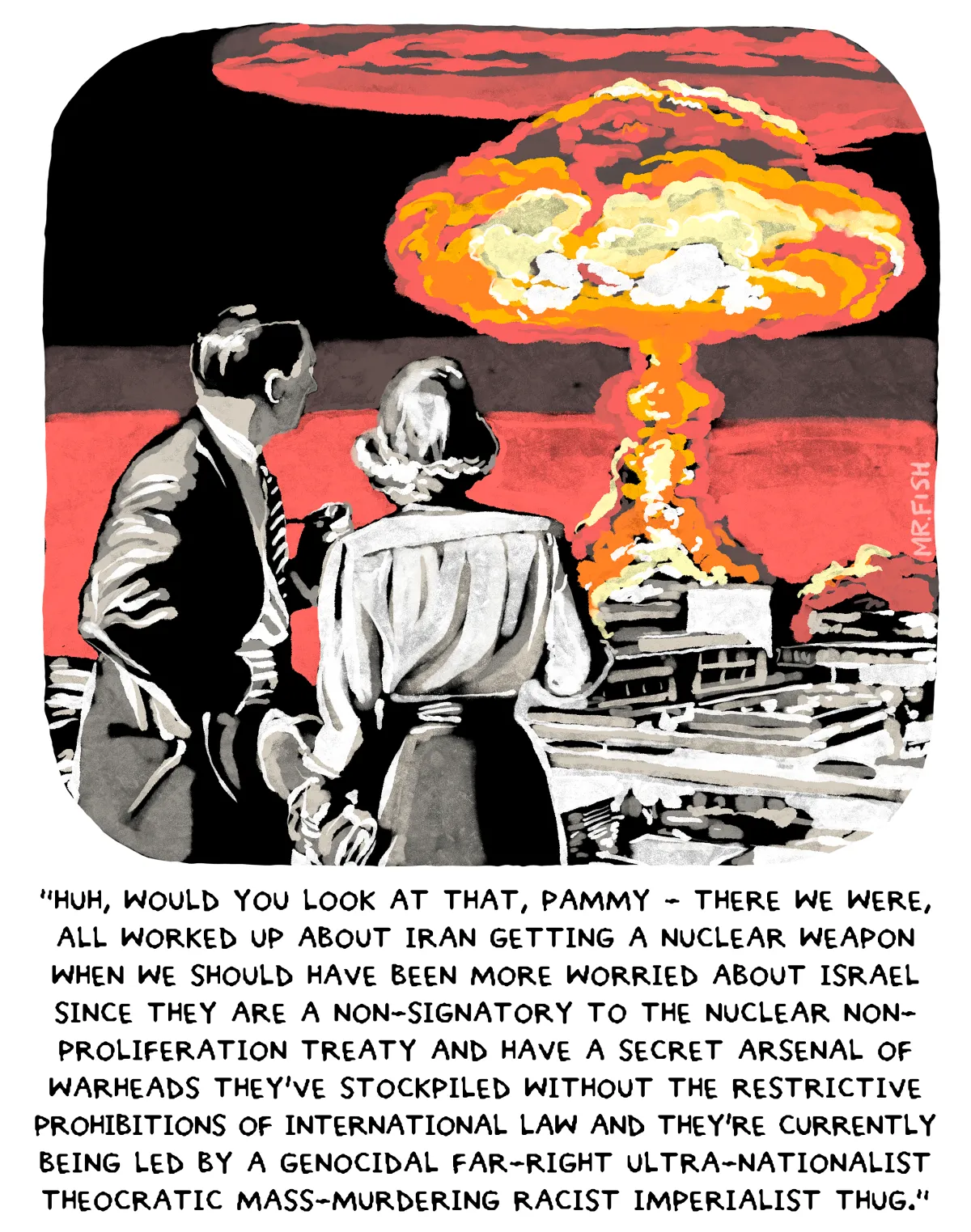
“One country is sanctioned, threatened, bombed, and demonized over the fear of nuclear weapons. The other already has them — and the world is expected to look away.”
Mr. Fish’s cartoon stuck in my head because it cuts straight through the insanity of the entire conversation. One country already has nuclear weapons and the world is told not to talk about it, while another country that still doesn’t have them is treated like an immediate threat to civilization. The more I sat with the image, the more I started digging into the history underneath it — and the hypocrisy only got harder to ignore.
For decades we’ve been told to panic about the country that doesn’t have nuclear weapons while pretending not to notice the country that actually does. Iran gets sanctions, assassinations, bombings, and endless media hysteria over what it might someday build. Israel sits on an undeclared nuclear arsenal outside the Nuclear Non-Proliferation Treaty and the political/media class acts like everyone is supposed to politely shut the hell up about it.
Mr. Fish’s cartoon cuts through that theater with a sledgehammer.
Israel has never officially acknowledged its nuclear weapons program, yet experts and watchdog groups estimate it possesses roughly 90 nuclear warheads and maintains one of the most secretive nuclear infrastructures on Earth. Unlike Iran, Israel is not a signatory to the Nuclear Non-Proliferation Treaty, and international inspectors have never had full access to the Dimona facility believed to anchor its nuclear program.
The roots of Israel’s nuclear program stretch back decades. The Israel Atomic Energy Commission was established in 1952, and its first chairman, Ernst David Bergmann, openly argued that nuclear weapons would ensure “that we shall never again be led as lambs to the slaughter,” according to the Jewish Virtual Library. As with so much of Israel’s national security doctrine, the trauma and memory of the Holocaust were invoked as a central justification for building and maintaining the program.
Documents show that as far back as 1968, the CIA had already informed President Lyndon B. Johnson that Israel either possessed nuclear weapons or was on the verge of developing them. But instead of confronting the issue publicly, Washington chose silence. President Richard Nixon later struck a secret understanding with Israeli Prime Minister Golda Meir: Israel would neither officially acknowledge nor test its nuclear arsenal, and in return, the U.S. would back off demands for inspections and oversight. From that point on, one of the world’s worst-kept secrets became official policy — don’t ask, don’t tell.
They weren’t guessing. Even reporting from the 1970s pointed to what U.S. intelligence already knew. As The New York Times later revealed, the CIA disclosed in a 1974 assessment that Israel had already developed nuclear weapons — partly using uranium obtained “by clandestine means.”
Meanwhile, Iran — despite years of sanctions, assassinations, cyberwarfare, and bombing campaigns — remains under constant international scrutiny precisely because it is formally inside the nonproliferation framework. Even members of the U.S. Congress have begun openly questioning the contradiction, warning that America’s policy of “official ambiguity” around Israel’s arsenal makes any coherent nonproliferation policy nearly impossible.
That’s the uncomfortable truth sitting underneath the mushroom cloud in Mr. Fish’s illustration: the issue has never simply been nuclear weapons. It has always been about who is allowed to have power, who is allowed to threaten annihilation, and whose violence is treated as “security” instead of extremism.
The cartoon’s suburban couple staring calmly into apocalypse captures the moral numbness at the center of the debate. Entire populations have been conditioned to panic over hypothetical weapons programs while accepting real arsenals, real occupations, and real mass death as background noise. The danger isn’t only the bomb — it’s the normalization of permanent double standards enforced through military dominance and political silence.
The Council on Foreign Relations directly undercuts the claim that Iran is an imminent nuclear threat. CFR writes that “many foreign policy experts warn that a nuclear-armed Iran would destabilize the Middle East and nearby regions,” and argues that Israel viewed Iran’s potential possession of nuclear weapons as a “major, perhaps existential, threat” — a fear used to justify Israel’s June 2025 attacks on Iranian nuclear and military facilities, followed by the joint U.S.-Israeli strikes in February 2026.
But even CFR acknowledges a critical fact often buried beneath the war rhetoric: Iran does not currently possess a nuclear weapon. The organization notes that while Iran has the scientific knowledge and infrastructure to potentially build one fast, there is no confirmed evidence that its leadership has decided to do so.
Adding to that reality, the claim that Iran posed an imminent nuclear threat sharply conflicts with decades of U.S. intelligence assessments. The 2007 U.S. National Intelligence Estimate concluded that Iran halted its structured nuclear weapons program in 2003. Successive American intelligence officials — including former CIA Director William Burns — have repeatedly stated that Iran had not made the decision to build a nuclear bomb. International Atomic Energy Agency (IAEA) inspectors, including former chief Mohamed ElBaradei, likewise reported finding no evidence of an active Iranian nuclear weapons program.
Even Trump’s own Director of National Intelligence, Tulsi Gabbard, recently contradicted the administration’s escalation narrative. In Senate testimony, Gabbard stated that Iran had not rebuilt a nuclear weapons program after the 2025 strikes — directly undercutting claims used to justify continued confrontation and military escalation.
She months later changed of position came after Donald Trump publicly claimed she was “wrong” and insisted U.S. intelligence showed Iran had amassed a “tremendous amount of material” and could build a nuclear weapon “within months.” Of course what has been stated here over and over again Iran doesn’t have a nuclear weapon.
The lie, of course, is that Israel is not treated as a legitimate nuclear and existential threat while Iran — which still does not possess a nuclear weapon — is framed as the ultimate danger. This, of course, is the same logic that has fueled decades of endless war: the claim that Iran could build a weapon someday is treated as justification for permanent aggression today. Yet Iran still does not possess a nuclear weapon — and one reason may be obvious: countries like North Korea learned that once you do obtain one, you become untouchable, while nations without them remain at the mercy of the empire’s next target.
Within the last week, members of Congress have started asking the same question — because who can’t see what’s right in front of our faces anymore? As lawmakers pressed the State Department for transparency over Israel’s undeclared nuclear arsenal, the hypocrisy at the center of U.S. foreign policy became increasingly difficult to ignore.
In a letter sent to Secretary of State Marco Rubio, Democratic lawmakers pointed directly to the U.S.-Israel war on Iran as evidence that greater clarity is urgently needed.
“Congress has a constitutional responsibility to be fully informed about the nuclear balance in the Middle East, the risk of escalation by any party to this conflict, and the administration’s planning and contingencies for such scenarios,” the letter, signed by 30 members of Congress, stated. “We do not believe we have received that information.”
The lawmakers also warned that maintaining “official ambiguity” around one state’s nuclear capabilities while threatening war over another’s makes genuine nonproliferation impossible in the Middle East.
“A policy of official ambiguity about the nuclear capabilities of one party to this conflict makes coherent nonproliferation policy in the Middle East impossible,” the letter stated, “for Iran, for Saudi Arabia, and for every other state in the region making decisions based on their perceptions of the capabilities of their neighbours.”
“This initiative is taking place against the backdrop of the US-Israeli war of aggression against Iran,” said Josh Ruebner of the Institute for Middle East Understanding Policy Project. “One of Trump’s goals for ending this war involves negotiations to lift sanctions against Iran in exchange for an Iranian commitment not to develop nuclear weapons.”
“Members of Congress are right to question why Israel’s development of nuclear weapons gets a free pass while we’re trying to prevent Iran from acquiring them,” Ruebner added.
Of course, throughout the 1970s and ever since, Israeli officials have maintained the same carefully worded line: “Israel will not be the first country to introduce nuclear weapons to the Middle East.” It’s a statement built on ambiguity — one that allowed everyone to pretend not to see what was already obvious.
But now, as the world edges closer to what increasingly feels like a third world war and the Doomsday Clock sits nearer to midnight than ever before, the real question is no longer whether these weapons exist. The question is when — and under what leadership — they could be used.
That fear becomes even more dangerous under a U.S. president whose mental fitness has become a serious public concern, and who has repeatedly used apocalyptic rhetoric about “’blown off the face of the earth’” Because if Israel is treated as an undeclared nuclear power beyond accountability, the United States remains the ultimate nuclear superpower — the empire standing behind it with the largest arsenal on Earth.
Remember how all of this started — with an Mr. Fish cartoon forcing us to stare directly at the hypocrisy and madness surrounding nuclear weapons, war, and empire. Thanks for making people think. And here’s his work: The Independent Ink Archive
A national analysis of the impact of proximity to nuclear power plants on lung, breast and colon cancer mortalities in the U.S., 2000–2020
Significance
This national-scale analysis provides new evidence that proximity to nuclear power plants is associated with increased mortality from major cancers in the U.S. The magnitude and consistency of the findings highlight the importance of updated risk assessments, sustained surveillance, and strengthened public health planning for communities living near nuclear facilities.
- Yazan Alwadi,
- Joel Schwartz,
- David C. Christiani,
- Marco Kaltofen,
- Brent A. Coull,
- John S. Evans,
- Yaguang Wei &
- Petros Koutrakis
Journal of Exposure Science & Environmental Epidemiology (2026) 20 May 2026, https://www.nature.com/articles/s41370-026-00922-2
Abstract
Background
Nuclear power plants emit low levels of ionizing radiation, an established risk factor for breast, colon, and lung cancers, yet the long-term effects of chronic environmental exposure in U.S. populations remain unclear.
Objective
To evaluate sex- and age-specific associations between proximity to nuclear power plants and mortality from the three most common cancers in the U.S.: breast, colon, and lung cancer.
Methods
We quantified county-level proximity to nuclear power plants using the sum of inverse distances from each residence county’s population-weighted center to all plants within 200 km, updated annually from 2000 to 2020. Cancer-specific mortality data (breast, colon, and lung) from the CDC were analyzed by sex and five age groups (45–54, 55–64, 65–74, 75–84, 85 + ). Relative risks (RRs) were estimated using generalized estimating equations with a Poisson link. Models were adjusted for sociodemographic factors, urbanicity, region, and temporal trends.
Results
Proximity to nuclear power plants was associated with elevated mortality from breast, colon, and lung cancers. From 2000 to 2020, an estimated 39,767 female deaths (95% CI: 9312–69,381), representing 2.01% (95% CI: 0.47–3.50%), and 38,124 male deaths (95% CI: 16,106–59,600), representing 2.33% (95% CI: 0.98–3.64%), were attributable to this proximity. Lung cancer accounted for the largest burden in both sexes, followed by breast and colon cancer in females and colon cancer in males. Mortality risks declined with increasing distance, becoming negligible beyond 50 km.
Significance
This national-scale analysis provides new evidence that proximity to nuclear power plants is associated with increased mortality from major cancers in the U.S. The magnitude and consistency of the findings highlight the importance of updated risk assessments, sustained surveillance, and strengthened public health planning for communities living near nuclear facilities.
Impact
- This study provides the first national assessment of sex- and age-specific mortality from breast, colon, and lung cancers in relation to proximity to U.S. nuclear power plants, revealing consistent patterns not previously demonstrated. These findings fill a major gap in environmental epidemiology and underscore the need for cohort studies, refined exposure assessments, and pathway-specific analyses to strengthen causal interpretation. As nuclear power gains momentum in national energy planning, establishing clearer evidence on potential health impacts is increasingly essential for guiding research priorities and public health preparedness.
Never again. Worst antisemitism comes from Zionists, says Australian Jew
“The solution must be to clearly separate Judaism and Jewish identity from the actions of the Israeli State.”
by Judith Treanor | May 16, 2026, https://michaelwest.com.au/submission-to-royal-commission-on-antisemitism-and-social-cohesion/
“I am Jewish, and the antisemitism I experience comes from Zionists and far-right supporters of Zionism because of my outspoken opposition to the actions of the Israeli state.” Judith Treanor on the Royal Commission.
Judith Treanor on the Royal Commission.
I am a Jewish dual citizen of Australia and the United Kingdom of Ashkenazi heritage. Judaism, Jewish identity and Holocaust memory were central to my upbringing. From the time I first learned about the horrors of the Holocaust, I became deeply preoccupied with how such evil could occur and how ordinary people could allow it to happen.
The phrase “Never Again” carried profound meaning for me. Antisemitism terrified me. Still does. Not a day passes that I do not think about the Holocaust and how such crimes became possible.
Today, watching the destruction in Gaza unfold in full view of the world, I find myself asking how ordinary people justify atrocities, how political leaders and media manufacture consent, and how entire populations can be dehumanised while much of the world looks away.
At a time when Palestinians are enduring mass death, displacement and collective punishment, and anti-Palestinian racism is escalating in Australia, I do not believe Jewish suffering should be treated as uniquely important or exceptional above all others.
Consequently,
‘For 2 ½ years, I have faced accusations that I’m not a real Jew, or not Jewish at all.’
Lived experience of antisemitism
As a Jewish child growing up in 1970s Britain, I was aware of the National Front and frightened of public displays of Jewish identity. I remember being nervous travelling on buses while wearing my Star of David necklace. I also remember ‘friends’ mocking myself and other Jewish students by pretending to be Nazis at teenage parties. That has stayed with me until today.
Aside from those childhood memories in the U.K, I have never experienced antisemitism from non-Jews.
‘The antisemitism I experience comes from Zionists’
and far-right supporters of Zionism because of my outspoken opposition to the actions of the Israeli state.
I am a member of Jews Against the Occupation ’48 (JAO48). I publicly oppose the brutal occupation of Palestine, the horrific treatment of Palestinians under apartheid rule, and Israel’s devastating military actions in both Gaza and Lebanon, which many international legal scholars, United Nations experts and human rights organisations have described as involving war crimes, crimes against humanity and acts amounting to a “plausible genocide” before the International Court of Justice (ICJ, 2024).
Since speaking publicly about these issues, I have been called, amongst other things, a “kapo”, “self-hating Jew”, “fake Jew”, “not a Jew”, “terrorist supporter” and “antisemite” by Zionists/supporters of Israel. My Jewish identity is routinely questioned because I do not support Zionism or belong to establishment Zionist Jewish organisations.
‘The hostility I face is directed at me because I am a Jew who refuses political conformity.’
Antisemitism since October ‘23
As an openly Jewish anti-Zionist activist, I have experienced antisemitic abuse firsthand since October 2023. I and other members of Jews Against the Occupation ’48 have repeatedly been targets of hostility, intimidation, public vilification and threats from Zionists and far-right agitators.
This abuse is experienced online and in person. What follows are examples from my own experience over the past 2+ years. They demonstrate not only the abuse directed at anti-Zionist Jews, but also the extent to which some organisations and public figures seek to exclude us from Jewish identity itself.
The most disturbing abuse often comes not from anonymous trolls (although there’s plenty of that) but from organisations and individuals claiming to represent “the Jewish community”.
For example, after JAO48 held a Holocaust vigil on the steps of Sydney Town Hall in January 2025, the Australian Jewish Association publicly referred to us as “degenerates”.
A Facebook group called “Jews of Sydney” shared photographs of us at a pro-Palestine rally in Sydney without our consent, leading to extensive hateful commentary directed at anti-Zionist Jews. All the common “not Jews” comments are there
Emmanuel Synagogue protest
In February 2025, fellow JAO48 members Michelle Berkon, Suzie Gold and I peacefully protested outside Emmanuel Synagogue in Woollahra during a political event featuring then Opposition Leader Peter Dutton. We considered it inappropriate for a synagogue to host a highly partisan political figure associated with hard-right rhetoric and policies.
CSG guards told us we couldn’t be near the gates of the shul. Within seconds, police were called. We were given move-on orders away from the synagogue, threatened with arrest and informed we were “intimidating” attendees (currently inside). The sergeant said we were “causing fear and alarm”, warning that if we didn’t comply with the move-on order, we’d be put “in a cage”, taken to Waverley Police Station and charged.
Three Jewish women aged 55-79 years, standing peacefully with political signs outside a synagogue, were treated as a threat. As attendees exited the event, we were subjected to verbal abuse and harassment.
The above is just one of many examples.
“How Jewish are you?”
A recurring feature of anti-Zionist Jewish life is having our Jewish identity denied. In January, somebody on X publicly asked me: “How Jewish are you?” Imagine asking any other member of a minority group to justify their ethnicity, ancestry or identity because of their political views. Imagine asking a Zionist Jew this same question.
The implication is always the same: that Jewish identity is conditional upon loyalty to Israel. This is deeply dangerous. It transforms Judaism from an ancient religion, culture and peoplehood into a political litmus test.
‘It’also implicates all Jews in support of Israel’s crimes.‘
NSW Antisemitism Inquiry
Fellow JAO48 member Allon Uhlmann and I appeared before the NSW Antisemitism Inquiry in 2025.
Allon is Israeli. Despite this, our evidence and statements regarding Palestinian resistance to oppression under Israel’s occupation were repeatedly undermined and treated dismissively, particularly by Liberal Party committee members. That evening Sky News presenters mocked us publicly. Andrew Bolt commented, “How stupid some people can be?”
Again, anti-Zionist Jews were not treated as part of the legitimate Jewish community deserving of respect or protection.
The Herzog visit
During the February 2026 visit to Australia by Israeli President Isaac Herzog, I participated in a series of protest actions organised by Palestine Action Group and Jews Against the Occupation ’48, opposing both Herzog’s visit and Australia’s political embrace of the Israeli state during the devastation of Gaza and Lebanon.
Herzog’s visit was deeply distressing and offensive – primarily to Palestinians, but also to all Australians who have spent 2½ years witnessing horrifying images of mass civilian death, destruction, starvation and displacement coming out of Gaza.
Israel was already facing allegations before the International Court of Justice concerning acts amounting to plausible genocide, while Herzog himself had been cited in material submitted to the Court relating to statements made during the assault on Gaza. We’d all seen images of him signing an artillery shell as well.
Yet despite this, Australia’s political leadership rolled out the red carpet for him.
Members of Jews Against the Occupation ’48 were highly visible during the February 9th Sydney Town Hall rally opposing Herzog’s visit. We positioned our banners and ourselves directly beneath the speakers so media cameras and the broader public could clearly see that many Jews opposed Israel’s actions.
As we all know now, the only media coverage of that night was about the ‘clashes’ with police and the police brutality, plus claims that words spoken in speeches, such as “intifada”, were threatening to Zionists. Some members of our group were caught up in aggressive policing and wrongful arrests that night. Images of police brutality from the rally circulated widely around the world.
Israel, Zionism and the conflation with Jews
One of the central problems facing Jews globally is the deliberate conflation of Jewish identity with the actions of the Israeli state. Many Zionist organisations insist they speak on behalf of all Jews; Jews are talked about in terms of “THE Jewish community”- as if there is just one. Israel formally defines itself as “the Jewish State”.
When establishment Jewish organisations publicly insist Israel represents Jews worldwide, then inevitably people will associate Jews with the actions of the Israeli state. That does not justify antisemitism. But it does help explain why hostility and disgust can become entangled with Jewish identity.
The solution cannot be to silence criticism of Israel.
“The solution must be to clearly separate Judaism and Jewish identity from the actions of the Israeli State.”
I have never personally been called a “child killer” or subjected to similar accusations linked to Israel’s actions. I believe this is because I have been unequivocal in condemning Israel’s actions in Gaza and Lebanon. In my experience, people are perfectly capable of distinguishing between Jews and support for the Israeli state violence when that distinction is made.
Criticising Israel is not inherently antisemitic. Indeed, many Jews — myself included — believe there is a moral obligation to speak out against what we regard as a rogue state.
Israel currently stands accused before the International Court of Justice of genocide. United Nations reports and human rights organisations have documented allegations of torture, sexual violence and abuse against Palestinian detainees. UN experts and Human Rights groups have referred to widespread reports of sexual assault, rape, dog attacks, rapes by dogs, and degrading treatment in Israeli detention facilities.
Reuters reported in July 2024 that the UN High Commissioner for Human Rights cited testimonies involving waterboarding and the release of dogs on detainees. Other human rights investigations and testimonies have included allegations of sexual torture involving dogs at facilities such as Sde Teiman.
‘!I will not remain silent in the face of such horrific reports.’
Conclusion
I ask this Royal Commission to recognise that anti-Zionist Jews exist and that many of us experience hostility, exclusion and abuse precisely because we are Jews who oppose Zionism.
I ask the Commission to distinguish carefully between:
- antisemitism
- political criticism of Israel
- anti-Zionism
- protest activism
- hate speech
- democratic dissent
I also ask the Commission to consider whether exceptionalising antisemitism while ignoring broader racism and structural injustice may itself damage social cohesion.
Jews should not be placed above other communities. Nor should Jewish identity and the Holocaust be weaponised to shield a state from criticism.
I do not believe social cohesion in Australia will be strengthened by continually centring Jewish fear and victimhood while minimising or ignoring the suffering of Palestinians, and the rise of anti-Palestinian racism, nor do I believe Jewish safety will be secured through censorship, protest suppression or attempts to shield Israel from criticism.
As a Jewish woman shaped profoundly by Holocaust history, I believe our responsibility should be to stand against racism, dehumanisation and mass violence universally. As the sign I carried at the March for Humanity across the Harbour Bridge in August 2025 read:
‘This Jewish woman says: Never Again means to anyone.’
As support for Israel declines in the U.S., the ‘Special Relationship 2.0’ is starting to take shape.

This can be presented as an investment in American jobs in partnership with Israel rather than as taxpayer assistance to a foreign government.
Benjamin Netanyahu and his allies in Congress have begun calling for an end to U.S. aid to Israel, but this won’t end the “special relationship” between the two countries. In fact, recent signs suggest it may only deepen U.S. military ties to Israel.
By Mitchell Plitnick Mondoweiss, May 17, 2026
This month, Israel and the United States are expected to begin negotiations on a new memorandum of understanding (MOU) that would outline the United States’ plans to support Israel after the current MOU expires in 2028. Chances are this will look like a very different conversation than in the past.
In recent months, there’s been a lot of noise around the idea of ending U.S. military aid to Israel. It’s an idea that has long been pursued by Palestine solidarity activists and, in the past, has also been floated by the Israeli right and their fellow travelers, who thought the aid wasn’t worth restricting Israel’s “freedom to act.” But surprisingly, the current proposal to end the annual grant of Foreign Military Financing (FMF) to Israel—which makes up most, though not all, of the annual aid package—comes from none other than Israeli Prime Minister Benjamin Netanyahu and is championed in Washington by South Carolina Republican Senator Lindsey Graham, the biggest hawk in the Senate.
What explains this?
Back in January, the Institute for Middle East Understanding’s Policy Project published a timely and detailed backgrounder on what is actually going on here.
What emerges is a plan to continue aid to Israel in a different form. Instead of sending money to Israel, which they have to spend with American corporations, Congress would appropriate money for joint development and production projects instead. This can be presented as an investment in American jobs in partnership with Israel rather than as taxpayer assistance to a foreign government.
The time to make such a move is now. Israel’s popularity has plummeted, and the once-certain annual military aid package is now up for debate. While the current Congress is still inclined to fund an unimpeded tidal wave of weapons and money to Israel, growing opposition in both parties makes even the near future of such aid uncertain………………………………………………………………………………………………………………………………………………………………………………………………………………………………………………………….. https://mondoweiss.net/2026/05/as-support-for-israel-declines-in-the-u-s-the-special-relationship-2-0-is-starting-to-take-shape/
Golden Dome or Golden Scam?

19 May 2026 – A report by the International Physicians for the Prevention of Nuclear War,
Back from the Brink, and Physicians for Social Responsibility
On May 19, PSR along with International Physicians for the Prevention of Nuclear War and Back From The Brink, released a new report on the proposed Golden Dome defense system. Organizations hosted a press conference in DC with the Up In Arms campaign, Senator Ed Markey, and Congressman Jim McGovern.
The false promise of strategic missile defense…………………………………….
Will the Golden Dome Protect us?
This brief report looks at what the United States would get from a $3.6 trillion
system that falls short of 100 percent effectiveness. Specifically, it considers what
would happen in a war with Russia if the U.S. had an 80% effective missile
defense system in place. The technology required to shoot down an
intercontinental ballistic missile is much more complex than that used to take out
the relatively primitive short-range rockets used in the current wars in the Middle
East. [3] Given the track record of the last 40 years, an 80% success rate is almost
certainly an unrealistically optimistic goal. But examining this “best case
scenario” sheds important light on the real value, or lack of value, of the Golden
Dome.
If the U.S. were to build a missile defense system that could shoot down 80% of
the current Russian nuclear arsenal, Russia could simply build many more
warheads and decoys to overwhelm this system, or redeploy some of the nearly
three thousand warheads it has put into storage. But for the purposes of this
scenario, we use the more conservative assumption that Russia is financially
unable to do so and simply retargets all its currently deployed warheads at U.S.
cities to exact an unacceptable price in any war with the U.S.
The current Russian nuclear arsenal contains an estimated 1718 deployed
warheads: 430 warheads with the destructive power of 800 kilotons (Kt)—50
times the explosive yield of the Hiroshima bomb, 200 warheads with the power
of 250 kilotons (Kt) , and 1088 100 kiloton (Kt) warheads. [4] There are many
different targeting scenarios Russia could choose to maximize damage with
this arsenal despite the existence ………………………….of the Golden Dome.
Let’s consider one of them.
If the US had the ability to shoot down 80% of all incoming Russian warheads,
then, in order to achieve a 95% probability of hitting a given population center,
Russia would have to target that city with 13 warheads. [5]…………………………………………………………………..
CONCLUSION
The Golden Dome will not protect
the American people. Even if the
system achieved an extremely
optimistic 80% success rate, it
would leave the 132 largest
population centers open to attack
with 75 million Americans in the
zones of total destruction. Such an
attack would also cause global
climate disruption and lead to
famine that would kill 1.4 billion
people worldwide
What the Golden Dome will do is to
squander $3.6 trillion creating a
dangerous, false sense of security.
This is money that could be spent on
education, housing, health care, and
food security– social services that
are currently being cut because we
are told we can’t afford them.
Developing and deploying the
Golden Dome will also exacerbate
the danger of nuclear war by
blocking progress towards nuclear
disarmament and further fueling the
new and destabilizing arms race as
Russia and China build more
weapons to overcome any ability the
Golden Dome has to intercept some
of their current warheads. This is not
a hypothetical concern. U.S.
determination to pursue Star Wars
during the 1980’s derailed the
attempt by Presidents Reagan and
Gorbachev to reach an agreement to
eliminate all nuclear weapons at the
Reykjavik Summit in 1986. [9]
There is no technical fix to the threat
posed by nuclear weapons
We have survived this far into the nuclear era
because, according to former
Defense Secretary Robert
McNamara, “We lucked out….It
was luck that prevented nuclear
war.” The United States cannot rely
on our luck lasting forever, and it
cannot rely on a mythical Golden
Dome to protect us. The only way to
confront the growing danger of
nuclear war and to guarantee that
our world is not destroyed by these
weapons is to eliminate them
The United States should enter
negotiations now with the other 8
nuclear armed states for a
verifiable, enforceable agreement
to eliminate all of their nuclear
arsenals according to an agreed
upon timetable. We cannot know
in advance if this effort will
succeed, but we do know what
will happen if we don’t eliminate
these weapons. So there is every reason to try
…………………………………………………….. https://psr.org/wp-content/uploads/2026/05/golden-dome.pdf
‘Buffer Zone’ Is Media’s Euphemism for Israeli Occupation
Gregory Shupak, FAIR, May 19, 2026
Since October 2023, Israel has occupied vast stretches of territory in Gaza, Syria and, most recently, Lebanon. Corporate media have been reluctant to use clear, direct language to characterize US-backed Israeli land grabs in each of these places, preferring to describe Israel’s policies with euphemistic terminology.
“Buffer” is chief among these. For instance, a Wall Street Journal article (4/9/26) told readers that “Israeli forces now hold buffer zones inside Gaza, Lebanon and Syria.”
Merriam-Webster defines a “buffer zone” as “a neutral area separating conflicting forces.” The UN defines it as “neutral space created by the withdrawal of hostile parties or a demilitarized zone.”
The Journal‘s uncritical use of the term makes it sound as if these Palestinian, Lebanese and Syrian lands are demilitarized zones, when in reality they have been taken over by a belligerent foreign army that intends to remain for the long term.
‘Setting up a buffer zone’
A Boston Globe piece (4/5/26) noted that
Israel has said even after the war with Hezbollah, it plans to occupy part of southern Lebanon, setting up a buffer zone inside the area and keeping security control over the territory. Some analysts say that the move could lead to the permanent displacement of communities from the region.
“Setting up” is part of the same obfuscatory process as “buffer zone.” Amnesty International’s Kristine Beckerle (3/6/26) offered this account of the evacuation orders Israel issued to over 100 villages and towns in Lebanon’s south and east, and the entirety of Beirut’s southern suburbs, key components of how Israel has gone about “setting up a buffer zone”:
The sweeping evacuation orders have sown panic and terror, displaced hundreds of thousands of people and fueled yet another humanitarian catastrophe for a population already exhausted and reeling from multiple crises.
And it’s not just “some analysts” who say that creating this “buffer” could lead to “permanent displacement.” Israeli Defense minister Israel Katz (BBC, 3/31/26) said that the state plans to maintain control over Lebanon south of the Litani River, a 19-mile stretch of territory, even after Israel’s current war on the country ends. Katz added that Israel will demolish “all houses” in Lebanese villages near the Lebanon/Israel armistice line, a move that would make the displacement of the residents of those houses seem awfully permanent. That’s not a “buffer zone”—that’s occupation.
A Washington Post report (4/12/26) noted that Israel was “continuing military operations in south Lebanon, where it says a bigger buffer zone is needed to prevent strikes by Hezbollah on northern Israel.” The article amplified Israel’s benign description of its policies in Lebanon without offering anything to contradict this description.
Another Post report (4/20/26) said “the Israeli military published a map Sunday delineating a buffer zone in southern Lebanon that it called a ‘forward defense line.’” By the time this article was published, it was clear that Katz’s threats had been actualized. A team of UN experts described Israeli actions in Lebanon thusly:
The issuance of blanket evacuation orders, combined with the destruction of urban and village housing that displaced persons would have returned to, is consistent with the pattern of domicide that was initiated during the genocide in Gaza.
“Delineating a buffer zone” sounds like part of a peace-making process, but what the UN described were acts of war.
‘Security zone’
“Security zone” is another euphemism. Who, after all, wouldn’t want to live somewhere secure? The trouble is that the “security” being created isn’t for the zone’s inhabitants. CNN anchor Lynda Kinkade (4/2/26) told viewers:
The United Nations says more than a million people, that’s about 20% of Lebanon’s population, have now been displaced. Many of them won’t be able to return home right away, even after the war, because Israel plans to set up a security zone in much of the south of Lebanon.
As Human Rights Watch (3/23/26) noted, those displaced people “have sought refuge with friends and relatives or in government-run shelters, or have simply set up camp along the coastline of Beirut, itself the site of a recent Israeli strike.”
In sum, Israeli aggression drove Lebanese people from the south of the country, causing some to camp on a beach that Israel then bombed, and CNN blithely adopted Israel’s language to sanitize it as “set[ting] up a security zone.”
A front-page Chicago Tribune piece (4/17/26) read:
Netanyahu said Israeli troops will stay in an expanded security zone in southern Lebanon “much stronger, more extensive and more continuous than before.”
“That is where we are, and we are not leaving,” he said.
The article offered no counter to Netanyahu’s characterization, nor did it put the term “security zone” in quotation marks. After a two-paragraph interval, the authors wrote, “It’s unclear when the 1 million people displaced by the war will be able to safely return.”
Netanyahu said Israeli troops will stay in an expanded security zone in southern Lebanon “much stronger, more extensive and more continuous than before.”
“That is where we are, and we are not leaving,” he said.
The article offered no counter to Netanyahu’s characterization, nor did it put the term “security zone” in quotation marks. After a two-paragraph interval, the authors wrote, “It’s unclear when the 1 million people displaced by the war will be able to safely return.”
But the million people weren’t simply “displaced by the war.” Nor were they displaced, as in CNN‘s formulation, by some unidentified force. They were displaced by Israel’s US-backed military. Without such obscurantism, the fiction that Israel is simply “setting up a security zone” would fall apart.
Ethnic cleansing erased
Such accounts also omit a rather important facet of what Israel has done in its war on Lebanon, which is to target Lebanon’s Shia Muslims. As Human Rights Watch (3/23/26) pointed out:
On March 16, Israeli Defense Minister Israel Katz said, “Shiite residents of southern Lebanon who have evacuated…will not return to their homes south of the Litani area until the safety of Israel’s northern residents is guaranteed.” Through this lens, the displacement of the Shia population looks less like a temporary military necessity and more like a move to permanently displace the civilian population based on their religion.
“Permanently displac[ing] the civilian population based on their religion” is another way of saying “ethnic cleansing,” a point raised by the UN experts (4/15/26) who condemned Israel’s forced displacements as war crimes and crimes against humanity .
BBC Verify (4/16/26) said that satellite and video images they obtained showed that “towns and villages in southern Lebanon are being leveled by Israeli demolitions.” The outlet quoted professor Ben Saul, UN Special Rapporteur on counter-terrorism and human rights:
IIn places the pattern of attacks appears aimed to “cleanse” predominantly [Shia] villages and populations from the south, collectively punishing civilian populations within which Hezbollah fighters may be mingled…………………………………………………………………………………………………………………………………………………………………………………………………………………………. https://fair.org/home/buffer-zone-is-medias-euphemism-for-israeli-occupation/
The CIA’s Cuba Ultimatum: Regime Change With a Diplomatic Smile
create the crisis, punish the population, scare off investment, then demand political surrender from the government you have spent decades trying to brea. – — force Cuba to bend to Washington’s will.
SCHEERPOST, May 19, 2026.
The CIA did not sneak into Havana this time. It landed in broad daylight.
Peter Kornbluh reports in The Nation that CIA Director John Ratcliffe led a high-level U.S. delegation to Cuba on May 14, delivering what amounted to a blunt Trump administration ultimatum: Washington is willing to “engage” on economic and security issues, but only if Cuba makes “fundamental changes.”
The message is hard to miss. After decades of sabotage, sanctions, assassination plots, covert operations and economic strangulation, the U.S. is now packaging regime-change pressure as diplomacy. Cuba is facing severe fuel shortages, blackouts and growing hardship — conditions Washington’s policy has helped intensify — while Trump officials tighten sanctions, target foreign investors and float military threats.
This is not diplomacy. It is submission politics.
Kornbluh’s piece lays out the old imperial script in its newest form: create the crisis, punish the population, scare off investment, then demand political surrender from the government you have spent decades trying to break. The CIA’s public trip to Havana may look different from Bay of Pigs secrecy or Operation Mongoose sabotage, but the goal remains painfully familiar — force Cuba to bend to Washington’s will.
The danger now is that economic warfare is being paired with open military signaling. Reports of increased U.S. intelligence flights near Cuba, threats involving aircraft carriers, possible indictments of Cuban leaders and leaked claims about Cuban drones all point toward a familiar pretext-building machine.
Once again, the United States claims to be defending freedom while tightening the noose around an island it has never forgiven for refusing to obey.
The CIA has spent decades trying to overthrow the Cuban government through covert operations, assassination plots, sabotage, and economic warfare — from the Bay of Pigs to Operation Mongoose and countless regime-change schemes. But now Washington isn’t even pretending anymore. CIA Director John Ratcliffe’s very public trip to Havana marks a dangerous new phase in the long U.S. campaign to force Cuba into submission politically and economically.
According to reports, Ratcliffe delivered what was essentially a “do or die” ultimatum from the Trump administration: either Cuba accepts Washington’s demands for change, or the window for diplomacy closes. He reportedly pointed to what happened in Venezuela after Maduro refused to bend to Trump’s threats, making clear the White House is prepared to “enforce its red lines” if Cuba refuses to capitulate.
The timing says everything. Ratcliffe arrived just one day after Cuba publicly admitted the country has effectively run out of fuel. “We have absolutely no fuel oil, and absolutely no diesel,” Cuba’s energy minister said on state television. That crisis didn’t happen in a vacuum. Cutting off Cuba’s access to fuel, electricity, and basic economic survival has become central to Trump’s pressure campaign against the island.
As one analyst put it, previous administrations tried to lure Cuba with carrots. Trump’s strategy is to beat Cuba with a stick until it collapses. And with U.S. military activity escalating around the region, it’s becoming harder to ignore the possibility that Washington is preparing for something even more dangerous if Cuba refuses to surrender to its imperial demands.
Read The CIA Goes to Cuba from Peter Kornbluh at The Nation
Trump Sends CIA Chief — Not Diplomats — To Deliver Cuba Threat
……………………………………………………………………………………………………………… https://scheerpost.com/2026/05/19/the-cias-cuba-ultimatum-regime-change-with-a-diplomatic-smile/
From Asia to the Middle East, US Bombs Are a Failed Foreign Policy Choice
The only reliable products of US airpower are devastated civilian populations and suppression of internal movements.
By Christine Ahn , Truthout, May 19, 2026
The U.S.-Israeli war on Iran opened not with a declaration, not with diplomacy exhausted, but with airstrikes.
Among the first confirmed casualties were more than a hundred schoolchildren killed in a strike on their elementary school in southern Iran. Within a month, 850 U.S.-made Tomahawk missiles were used to strike Iran. President Donald Trump has delivered on his promise to bomb Iran “back to the Stone Ages,” with U.S. and Israeli missiles targeting bridges, pharmaceutical and steel plants, and civilian infrastructure like schools and hospitals. The bombing campaign has struck civilian oil infrastructure in Tehran, engulfing a city of 10 million people in toxic black rain. Thousands of Iranians and Lebanese have been killed, and hundreds of thousands of workers have lost their jobs as factories and basic infrastructure have been destroyed.
Washington calls this national security. The historical record calls it something else entirely.
For more than 75 years, the United States has reached for airpower as its preferred instrument of foreign policy — a tool that promises decisive results without the political costs of ground occupation; the illusion that enough bombs, dropped with enough precision, can produce the outcomes that diplomacy did not. Korea, Vietnam, Laos, Cambodia, Afghanistan, Iraq, and now Iran: the targets have changed, the doctrine has not.
The Failure of U.S. Doctrine
As a Korean American, Cathi Choi of Women Cross DMZ knows this history personally. From 1950 to 1953, during the Korean War, U.S. forces dropped 635,000 tons of bombs and 32,000 tons of napalm, burning 80 percent of North Korean cities to the ground. One year into the war, U.S. Maj. Gen. Emmett O’Donnell testified in the Senate, “There are no more targets in Korea.” More than 4 million people were killed, the overwhelming majority of them Korean civilians. Choi, whose grandfather fled the north during the war, is among millions of Koreans from separated families. The division of the peninsula left an estimated 10 million Koreans cut off from relatives on the other side, unable to exchange phone calls or letters or reunite, with the exception of a few state-sponsored family reunions during periods of détente. Seventy-three years later, the war has only ended in a ceasefire, not a treaty, and the peninsula has remained in a stalemate ever since.
“The Korean War didn’t just leave its mark on the peninsula,” Choi explained. “It left deep scars among divided families, inaugurated the U.S. military-industrial complex, quadrupled the Pentagon budget in three years, and set a course from which Washington has never turned back.” Today, the Trump administration is proposing a $1.5 trillion Pentagon budget while slashing investments in diplomacy, development, and domestic programs like Medicaid and food stamps. Meanwhile, 1.2 million land mines are still buried across the world’s most militarized border, keeping Korean families — like Choi’s — separated, and both sides heavily militarized while on the precipice of nuclear war.
Danae Hendrickson, chief of mission advancement and communications at the advocacy group Legacies of War, has spent years documenting what the United States left behind in Laos, Cambodia, and Vietnam — not as history, but as present danger. …………………………………………………………………………………………………………………………………………………………………………………………………………………………………. https://truthout.org/articles/from-southeast-asia-to-middle-east-us-bombs-are-a-failed-foreign-policy-choice/?utm_source=Truthout&utm_campaign=0f6b169c87-EMAIL_CAMPAIGN_2026_05_19_09_10&utm_medium=email&utm_term=0_bbb541a1db-0f6b169c87-650192793
The President of Peace Makes War on the Planet
SCHEERPOST Tom Engelhardt TomDispatch, May 19, 2026
“………………………………………………………………………………………………………………………………………………………………………………………………………………………………………………………. I almost forgot to mention one more Trumpian set of acts of war, undoubtedly by far the most important and devastating of all: those he’s launched against planet Earth itself. I mean, we’re talking about the president who has done his — and this word couldn’t be more appropriate — damnedest to shut down wind farms of any sort, cut solar energy projects, and expand the burning of fossil fuels in just about every way imaginable, including by opening up 1.3 billion acres (no, that is not a misprint!) of U.S. coastal waters to further oil and natural gas drilling.
New York Times reporter Maxine Jocelow caught this Trumpian moment on Planet Earth perfectly in a recent piece on the “triumphant resurgence in Mr. Trump’s Washington” of climate-change denial. She summed up the Trumpian viewpoint this way: “Climate change is a hoax perpetrated by ‘leftist politicians.’ Fossil fuels are the greenest energy sources. More carbon dioxide in the atmosphere will be harmless.”……………………………………………
There really can’t be any question that this president is distinctly intent on nothing less than making war not just on specific nations like Iran, or on ships in the Caribbean Sea, or on anyone in or near the Strait of Hormuz, but on this very planet in every way imaginable……………………….
Defeat on Land, at Sea, and Anywhere Else Imaginable
Once upon a time, such wildly futuristic madness would have been left to the most dystopian of science-fiction novels — and undoubtedly not very popular ones at that, since such a plot and such a president would (once upon a time) have seemed far too unrealistic even for fiction. But now, thanks to President Donald J. Trump, the United States of America, in addition to all its other warring acts of recent months, is distinctly at war — and there’s no other adequate word for it — with Planet Earth (at least as a habitable place for future versions of us).
Someday, if anyone is still making TV series (since by then they’ll all undoubtedly be AI-created), I wonder if there will be one that young people, along with their parents, would be able to catch called not Defeat at Sea, but something far larger and more definitive like Defeat on Planet Earth. After all, we now have a president of the United States who seems ready not just to make war on Iran, but on more or less everything…………………………………
Trump and crew, while working as hard as they can to launch a thoroughly useless fleet of naval vessels, have also been doing their damnedest to heat this planet to the boiling point. He has literally decided to transform himself into a hell-on-earth president at a moment when renewable energy has beaten out coal as the primary source of energy globally for the first time ever.
…………………………………………………………………………………………………………………………………………………. Donald Trump, of course, is distinctly intent on making war on planet Earth (including, by recently making war on Iran, pouring yet more greenhouse gases into the atmosphere). War, after all, may be the world’s most efficient producer of such gases and the U.S. military, even in peacetime (which, unlike during his first term in office, is no longer Trump time), remains the largest institutional emitter of greenhouse gases on this planet. In the process, he’s doing his damnedest to take both his country and the planet down with him.
All too sadly, if he’s successful, American children of tomorrow, when they turn on their machines (whatever they may be), could witness not Victory, but Defeat at Sea, on Land, and Anywhere Else You Might Imagine. https://scheerpost.com/2026/05/19/the-president-of-peace-makes-war-on-the-planet/
1 This Month





PLEASE OPPOSE HR 8255 AND S.3639 – bills would accelerate satellite deployment, with no environmental review or safeguards – https://ncstd5li.quorum.us/campaign/169331/
To see nuclear-related stories in greater depth and intensity – go to https://nuclearinformation.wordpress.com
-
Archives
- October 2026 (58)
- September 2026 (339)
- August 2026 (330)
- July 2026 (355)
- June 2026 (287)
- May 2026 (306)
- April 2026 (356)
- March 2026 (251)
- February 2026 (267)
- January 2026 (308)
- December 2025 (358)
- November 2025 (359)
-
Categories
- 1
- 1 NUCLEAR ISSUES
- business and costs
- climate change
- culture and arts
- ENERGY
- environment
- health
- history
- indigenous issues
- Legal
- marketing of nuclear
- media
- opposition to nuclear
- PERSONAL STORIES
- politics
- politics international
- Religion and ethics
- safety
- secrets,lies and civil liberties
- spinbuster
- technology
- Uranium
- wastes
- weapons and war
- Women
- 2 WORLD
- ACTION
- AFRICA
- Atrocities
- AUSTRALIA
- Christina's notes
- Christina's themes
- culture and arts
- Events
- Fuk 2022
- Fuk 2023
- Fukushima 2017
- Fukushima 2018
- fukushima 2019
- Fukushima 2020
- Fukushima 2021
- general
- global warming
- Humour (God we need it)
- Nuclear
- RARE EARTHS
- Reference
- resources – print
- Resources -audiovicual
- Weekly Newsletter
- World
- World Nuclear
- YouTube
-
RSS
Entries RSS
Comments RSS

