Scotland’s radiation contaminated zone has high rate of cancer
 the increase in rates of two types of the disease – liver cancer and lymphoma – is of genuine concern.
A full investigation to establish the extent of links between radioactive contamination and cancer rates, if any, is now required.
A compelling case for transparency on radiation risk, Herald Scotland 12 Nov 12 The slow drip of worrying news about the radioactive contamination at Dalgety Bay does nothing for the people of Fife but engender fear. Today’s revelations in the Sunday Herald that Government scientists have discovered a near-doubling in the incidence of cancers among people living near the contaminated zone will inevitably cause disquiet locally. Continue reading
50 years of shocking neglect- the danger of UK’s Sellafield nuclear site
The plant is the UK’s largest and most hazardous nuclear site, storing enough high and intermediate level radioactive waste to fill 27 Olympic-sized swimming pools.

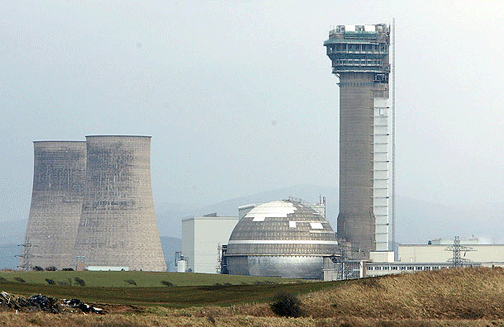 Sellafield nuclear waste storage poses ‘intolerable risk’ http://www.bbc.co.uk/news/uk-england-cumbria-20228176 7 November 2012 Sellafield is the UK’s largest and most hazardous nuclear site An “intolerable risk” is being posed by hazardous waste stored in run-down buildings at Sellafield nuclear plant, a watchdog has found.
The National Audit Office (NAO) also said that for 50 years, the operators of the Cumbria installation failed to develop a long-term plan for waste. Costs of plant-decommissioning has also spiralled out of control, it said. Operator Sellafield Ltd, said it welcomed the report’s findings and was “making improvements”. Continue reading
Britain’s ultimate phallic symbol – useless, expensive Trident nuclear missile
many defence experts now argue that a replacement deterrent is something that the UK neither needs nor can afford
the role of Britain’s nuclear deterrent is linked to the political and military establishment’s perception of the country’s place at the world’s top table “more a matter of national virility than national security”

 UK nuclear deterrent plan triggers divisions Announcement of an extra $565m for improved nuclear weapons capacity worries critics in an era of austerity. Aljazeera, Simon Hooper 06 Nov 2012 London, UK – At an unknown location somewhere deep beneath the world’s oceans, a British submarine sits primed to launch up to 40 nuclear warheads with a collective destructive power almost 300 times greater than the atomic bomb dropped on Hiroshima in 1945.
Since the late 1960s Britain’s nuclear deterrent strategy has required that at least one of the Royal Navy’s four-strong fleet of Vanguard submarines be operational and fully armed at all times, providing, according to the navy’s website, a “round-the-clock insurance policy”.
Only a British prime minister has the authority to order a nuclear attack. But, in the event that a submarine commander loses radio contact and suspects his homeland has been wiped off the map, orders contained in an onboard safe reputedly offer a choice to either “let them have it”or “sail to New Zealand if it’s still there”, according to documents unearthed by Peter Hennessy, a veteran historian of British state secrets. Continue reading
More doublespeak from UK Energy Minister about nuclear subsidies
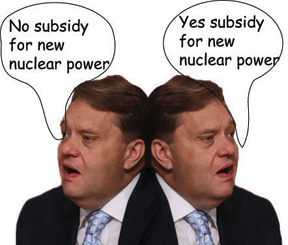 Hayes today reiterated that “there should be nothing available for nuclear that’s not available for other technologies”
(A subsidy is a subsidy is a subsidy – even if other forms of energy get one, too)
U.K. Will Reject EDF Nuclear Deal That Puts Burden on Consumers, Bloomberg By Sally Bakewell – Nov 6, 2012 The U.K. government is prepared to walk away from a deal with Electricite de France SA over plans to build the first nuclear plant in the country since the 1980s if the power price demanded by the utility is too high.
The government would “absolutely” refuse a deal that placed too great a burden on consumers, Energy Minister John Hayes said today in London . He held talks yesterday with Vincent de Rivaz, chief executive officer of EDF’s local unit.
Britain and EDF are negotiating the terms of a contract that would guarantee the price of power generated at Hinkley Point in Somerset. Continue reading
Westmill Solar Co-operative – the whopper community owned energy project
World’s Largest Community Owned Solar Project http://www.energymatters.com.au/index.php main_page=news_article&article_id=3455 by Energy Matters, 7 Nov 12 Last week, Westmill Solar Co-operative in the UK completed the acquisition of Westmill Solar Park, making the project the largest community-owned solar power station in the world.
The £16.5million facility is a 5MW solar farm covering 30 acres and consisting of over 20,000 solar panels. The power station is located near Watchfield, on the Wiltshire/Oxfordshire border.
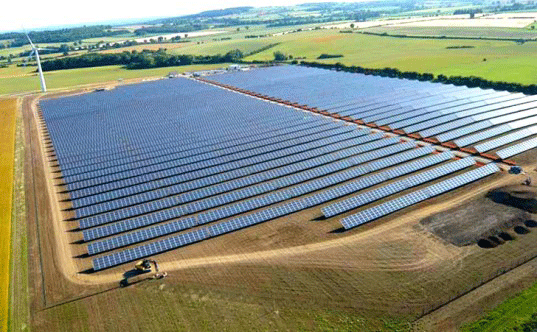
Westmill Wind Farm is adjacent to the site, which was also started as a 100% community owned renewable energy project.
In the last year, the solar farm has generated 4,900 MWh of clean electricity, enough to power 1,500 households and avoiding over 2,000 tonnes of carbon dioxide emissions.
“Westmill represents the best of what low carbon investment and renewable energy can offer and hopefully will inspire others to realise that when we get together we can make change happen and can engage positively with the threat of climate change,” said founder director Adam Twine.
The Westmill Solar Co-operative share offer attracted around 1650 investors in just 6 weeks- 50% more than was required. More than half of the Westmill members live within 40km of the project. Members will be entitled to a share in the profits generated by the electricity sold. Predicted internal rate of return to members is 9 – 11% over the 24 years of the project.
Aside from the environmental benefits and in addition to offering local residents a substantial return on their investment, the solar farm will boost the local economy by making sure the profits stay in the area, encourage tourism and raise the local area’s profile.
“Solar power will become the world’s greatest energy source in our lifetime; heralding a new era of sustainable and ‘democratic’ energy supply,” said Cooperative chairman Philip Wolfe.
“As the success of Westmill shows, solar energy enables ordinary people to produce clean power, not only on their roof tops, but also at utility scale.”
Community owned windfarms could be good for UK
 Windfarms: is community ownership the way ahead? http://www.guardian.co.uk/environment/2012/nov/05/windfarms-community-ownership
On the Danish island of Samsø many of the wind turbines are owned by the residents. Is that the way around nimbyism? Patrick Kingsley guardian.co.uk, 5 November 2012 “I can’t single-handedly build a new Jerusalem,” said John Hayes, the Tory energy minister, last week, “but I can protect our green and pleasant land.” What was he on about? Windfarms. He wants them stopped because he says locals don’t like them.
But that isn’t always the case. Take Samsø, a pretty island off the coast of Denmark. In the late 90s, Samsø’s 4,000 elderly farmers were famous for their early crop of new potatoes. Smothering their isolated Eden with windmills was far from a priority.
Yet 15 years later, that is exactly what’s happened. These conservative islanders have installed 11 onshore windmills, while another 10 lie just off the coast. Astonishingly, Samsø is now one of the world’s largest carbon-neutral settlements. To find how it happened, I visited the island this spring while researching my new book, How to be Danish. The answer? Community ownership. Sixteen of the 21 new turbines are owned either by local co-operatives, or by individual farmers. This means that the turbines haven’t been sprung on the locals. Instead, the latter are invested in the former, both emotionally and financially. The excess energy created by the turbines is sold back to the national grid – and the profit creates a handy annual dividend for each local. “There’s money in it,” smiles 66-year-old Erik Andersen, who owns a herd of rare Red Danish cows. “It’s a good investment.”
So wind power doesn’t always alienate locals. Denmark has over 6,000 turbines – 2,000 more than Britain, despite being a sixth of the size. This is partly down to its topography: it’s flat, so there’s a lot of wind. But it’s also to do with how the Danes involve local communities. Around 70-80% of those turbines are co-owned by local groups – little wonder there’s more of them.
Could it happen in Britain? An ICM poll suggests so: while only one in two Britons would back a windmill within two miles of their home, 68% would support one that was community-owned. John Hayes, take note.
How the UK’s new nuclear deal with Hitachi just can’t really work
 Another shotgun wedding for the UK nuclear lobby daryanenergyblog November 3, 2012 “…….There is a proposal in Japan for a referendum on Nuclear energy with three options on the table . Option one is 30% of Japanese electricity from nuclear (essentially business as usual but with a cap on future nuclear growth). Option two is 15% (many older reactors near fault lines closed, some new reactors later but only as a replacement for plants taken out of service and not on a like for like basis) and option three is 0% (a phase out of nuclear energy completely, which as I’ve previously shown is feasible). The Japanese government seems to favour the middle option but opinion polls suggest that it might be the zero nuclear option. Either of these last two would mean a massive cut in nuclear reactor orders in Japan, if not a complete halt.
So naturally Hitachi are having to hedge their bets and look overseas for buyers of their wares. This would explain the choice of reactors. While previously the Horizon deal had focused on French or American designed PWR‘s (Pressurised Water Reactor), Hitachi seem to be keen on BWR‘s (Boiling Water Reactor), notably their own brand ABWR reactoror the as of yet untested ESBWR. However, these reactors have never been certified for use in the UK. It will take a few years to get that paper work cleared and redesign the reactors as required. There have also been some technical problems with the ABWR‘swhich has led to them providing a much lower level than expected level of reliability and on-grid availability (as this table from the IAEA illustrates).
Also, the UK engineering firms will need time to plan for this change in reactor. While thebulk of reactor cores world wide might well come from the Japanese Steel Works (JSW) on Hokkaido Island, the majority of any UK based ABWR (the steam turbines, heat exchangers and auxiliary equipment) will be build by other contractors many here in the UK, notably companies such as Forgemasters and Rolls Royce. They need to be given time to retool and book spots on the production line before any plant can be built. Also there is a waiting list in JSW and by switching reactor types the UK may have just lost its place in the queue.
A Looming Energy Gap
This will explain why Hitachi are talking about a delivery date of the first new plant in the mid to early 2020′s. However, by this date the UK nuclear fleet will be down to between 1 and 3 reactors (Torness and Heysham retire in 2023, further Torness is in Scotland which may not be part of the UK by that date!) and a capacity of between 1,200 – 3,700 MW, from a present capacity of 10,500 MW and a former peak of 14,000 MW. While Hitachi seem to be proposing 6 reactors, it will take at least a decade or two (or three!) to bring this capacity online and even 6 ABWR’s would still fall well short of the historical maximum installed capacity (about 40% short in fact)…… http://daryanenergyblog.wordpress.com/2012/11/03/shotgun-wedding-hitachi-uk-nuclear/
UK’s planned new nuclear reactors all too close to Dublin, Ireland
New N-plant closer than Sellafield, warn Greens
http://www.herald.ie/news/new-nplant-closer-than-sellafield-warn-greens-3280668.html By Fiona Dillon, November 02 2012 THE GOVERNMENT is being called on to object to to plans to build a nuclear plant that’s closer to Dublin than the controversial Sellafield site.
Engineering giant Hitachi is in the process of buying Horizon Nuclear Power, which has rights to build reactors at Wylfa on Anglesey, North Wales.
The site is only 118km from Dublin, compared to Sellafield’s 217km. Continue reading
UK govt sneaking subsidy into new nuclear industry?
“A subsidy is still a subsidy, even if it is given to others.”
New nuclear reactors could be eligible for subsidies, says minister. John Hayes says there will be no market support ‘unless similar support is also made available to other types of generation’ Juliette Jowit, political correspondent guardian.co.uk, 1 November 2012 The nuclear industry could get subsidies from the taxpayer to build new reactors, the new energy minister has said, despite opposition in the coalition agreement and repeated assurances to the contrary. Continue reading
Renewable energy trumping nuclear in Britain
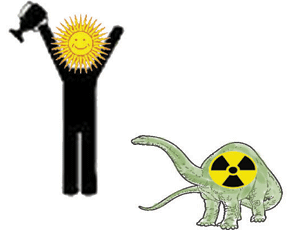 Renewable UK said that last year there were at least 137,000 people involved in the sector, with a further 654,500 jobs in ancillary industries.
Renewable energy will overtake nuclear power by 2018, research says Renewables will provide enough power for one in 10 British homes by 2015 if current growth rates continue Fiona Harvey, environment correspondent The Guardian, 30 October 2012 Renewable energy capacity will overtake nuclear power in the UK by 2018, if current rates of growth continue, and will provide enough power for one in 10 British homes by 2015, according to new research.
The amount of electricity supplied by wind energy alone is up by a quarter since 2010, in a surprisingly good year for the renewables industry. While the government has notably cooled on wind power – more than 100 Tory MPs signed a statement this year opposing new windfarms, and the chancellor of the exchequer, George Osborne, has queried the future of subsidies – the industry has continued to grow, with investment in offshore wind up by about 60% to £1.5bn in the past year. Planning approvals for onshore windfarms also rose, up by about half, to reach a record level, according to the trade association Renewable UK.
Despite the outspoken opposition from many Tory MPs against wind power, there was a rise in the amount of onshore wind capacity approved last year for the first time since 2008. Continue reading
Hitachi, desperate for nuclear sales, will own Britain’s nuclear power enterprise!
 Masaharu Hanyu, head of Hitachi’s nuclear division, hinted that the Japanese conglomerate had little choice but to win business abroad.
Hitachi enters Britain’s nuclear sector TOKYO, Oct. 31 (UPI) –– Japan’s Hitachi Ltd. will build up to six new nuclear reactors in the United Kingdom as part of its agreement to acquire Horizon Nuclear Power from German energy companies RWE and
E.ON.
The $1.1 billion deal announced this week propels Hitachi into the “new and uncomfortable” role as the owner of an entire atomic-power enterprise instead of just a contract reactor builder, says a report in the Financial Times.
Domestically, in the wake of the March 2011 Fukushima nuclear disaster, Japan aims to phase out nuclear power by 2040. Continue reading
UK nuclear power plants – safety problems not fixed
 Third of U.K. Nuclear-Safety Concerns Unresolved, Regulator Says http://www.bloomberg.com/news/2012-10-31/third-of-u-k-nuclear-safety-concerns-unresolved-regulator-says.html
The ONR will “if necessary, consider enforcement action to ensure that appropriate measures are implemented,” said Deputy Chief Inspector Andy Hall. Reactors must be better prepared to respond to natural disasters and other emergencies, the ONR said, calling for plant reinforcements, reviews of cooling systems and ventilation routes for combustible gases.
The regulator’s recommendations last year followed the results of so-called stress tests on U.K. reactors after the 2011 earthquake and tsunami in Japan caused a meltdown at Tokyo Electric Power Co.’s Dai-Ichi plant. The crisis triggered similar reviews in other countries and led some, including Germany, to decide to phase out nuclear power altogether.
“Much work is still to be done to implement the lessons from Fukushima,” the ONR report shows. “We expect the licensees to make proposals on how they intend to meet the required safety outcomes, and to justify why their proposal represents the safest reasonably practicable option for improvement.”
UK would not take part in illegal pre-emptive strike on Iran’s nuclear facilities
 Britain views pre-emptive strike on Iran nuclear facilities as illegal Telegraph UK, 26 Oct 12 Britain views a pre-emptive strike on Iran’s nuclear facilities as illegal under present circumstances and would not allow UK military bases to be used for this purpose, according to reports.
The Foreign Office declined to comment on suggestions that British ministers have been advised that a strike on Iran would breach international law because no imminent threat currently exists.
If the US were to attack Iran’s nuclear plants, it could request permission to use the RAF base at Akrotiri in Cyprus and the American military facilities located on the British territory of Diego Garcia in the Indian Ocean. However, The Guardian reports that the Britain would reject any such request under present conditions…..
http://www.telegraph.co.uk/news/worldnews/middleeast/iran/9636134/Britain-views-pre-emptive-strike-on-Iran-nuclear-facilities-as-illegal.html
UK govt – secret nuclear deals over “champagne and croissants.”?
 EDF Denies U.K. Nuclear Deal to Be Sealed in ‘Smoke-Filled Room’, Bloomberg News By Sally Bakewell October 23, 2012 Electricite de France SA rejected criticism that its one-to-one talks with the U.K. over the deal it’ll get to build nuclear plants in the country means officials setting rates in a “smoke-filled room” without open scrutiny….. Continue reading
Independent Scotland would demand removal of Trident nuclear base
 Nuclear weapons ‘outlawed’ in an independent Scotland, says Salmond, BBC News 21 Oct 12, The leader of the SNP has said that if his party won power in an independent government it would make nuclear weapons illegal.
Alex Salmond told the BBC’s Andrew Marr Show that Trident, which currently resides at Faslane Naval base on the Clyde, would have to go.
He also said a go-alone Scotland would remain a member of the European Union….. He said: “The UK government has two choices – they either relocate Trident to another part of the rest of the UK or alternatively they could use nuclear facilities in America or France.”
Mr Salmond made a further point that it was possible for a UK government to decide a “much better policy” and decommission its weapons system….. http://www.bbc.co.uk/news/uk-scotland-scotland-politics-20020839
1 This Month


Read the Public Inquiry Report, the Commissioners’ report, Surrendering Australia: The AUKUS Deception is available to download for free at aukuspublicinquiry.com. Or just watch the replay of the National Press Club Luncheon.



19 November – Webinar – The Reality of Reprocessing
Time: 11:00 AM Pacific Time (US & Canada) / 2:00 PM Eastern / 7:00 PM UK / 8:00 PM CET
Register for the Zoom Event Here



Shut down the radiation-damaged Heysham nuclear reactors now
To see nuclear-related stories in greater depth and intensity – go to https://nuclearinformation.wordpress.com

Say No to NASA’s Reckless Nuclear Reactor on the Moon
Say No to NASA’s Reckless Nuclear Reactor on the Moon
-
Archives
- November 2026 (119)
- October 2026 (302)
- September 2026 (339)
- August 2026 (330)
- July 2026 (355)
- June 2026 (287)
- May 2026 (306)
- April 2026 (356)
- March 2026 (251)
- February 2026 (267)
- January 2026 (308)
- December 2025 (358)
-
Categories
- 1
- 1 NUCLEAR ISSUES
- business and costs
- climate change
- culture and arts
- ENERGY
- environment
- health
- history
- indigenous issues
- Legal
- marketing of nuclear
- media
- opposition to nuclear
- PERSONAL STORIES
- politics
- politics international
- Religion and ethics
- safety
- secrets,lies and civil liberties
- spinbuster
- technology
- Uranium
- wastes
- weapons and war
- Women
- 2 WORLD
- ACTION
- AFRICA
- Atrocities
- AUSTRALIA
- Christina's notes
- Christina's themes
- culture and arts
- Events
- Fuk 2022
- Fuk 2023
- Fukushima 2017
- Fukushima 2018
- fukushima 2019
- Fukushima 2020
- Fukushima 2021
- general
- global warming
- Humour (God we need it)
- Nuclear
- RARE EARTHS
- Reference
- resources – print
- Resources -audiovicual
- Weekly Newsletter
- World
- World Nuclear
- YouTube
-
RSS
Entries RSS
Comments RSS

