Thorough examination by European Commission nto UK’s nuclear subsidy plan
analysts at Liberum Capital argued that the guarantees offered to EDF could prove to be “economically insane”. They said by agreeing an inflation-linked price Davey had made a huge bet the cost of fossil fuels would rocket by the time Hinkley Point starts operating in 2023.
 The House of Commons’ environmental audit committee has also criticised the government for refusing to admit that the Hinkley Point deal had subsidised EDF and its consortium partners.
“The government cannot escape that clear fact by talking about ‘support mechanisms’ and ‘insurance policies’ instead of ‘subsidies’,” the committee said in a report.
European commission inquiry into Hinkley Point deal could delay project Brussels to look at UK state aid for nuclear power plant after government offers EDF Energy a set price for 35 years The Guardian, Tuesday 3 December 2013 The government’s deal to underwrite the £16bn Hinkley Point nuclear power station plan faces delay and possible rejection after the European commission said it was ready to launch an in-depth inquiry into the agreement.
The EU competition commissioner said Brussels was likely to investigate the deal, which guarantees a minimum power price for 35 years, to make sure it conformed with state aid rules. The commission frowns on national governments offering deals to companies that stifle competition and distort the market.
Joaquín Almunia said: “We are starting to analyse what is in the British proposal. Probably we will open a formal investigation because many people are asking the same question [whether the UK’s agreement was too long].”
Energy secretary Ed Davey gave the go-ahead in October for a consortium led by France’s EDF Energy to build the Hinkley Point C plant in Somerset. Its two reactors will cost £8bn each and will provide enough power to supply 7% of Britain’s homes for 60 years.
Davey agreed a minimum price of £92.50 for every megawatt hour (MWh) of energy that Hinkley Point generates – almost twice the current wholesale cost of electricity. The deal with EDF was unprecedented and made the UK the first European country to offer a set price over 35 years for a new nuclear project……..
- Almunia gave no indication of how long an investigation might take but the commission sees the government’s deal with EDF, Areva and China’s General Nuclear Power as complex and highly novel. An investigation is therefore likely to be in-depth to investigate all aspects of the proposals……..
- The government’s proposals were always likely to receive attention from the commission but Almunia’s comments suggest they will be subjected to intense scrutiny.
The UK wants the EU to accept that nuclear power should be given special status like renewable energy but Germany and Austria oppose such a move and Hinkley Point is likely to be considered like any other state aid case.
Moves by the commission to block or radically alter the nuclear deal could spark a major dispute between London and Brussels. Many Conservative MPs and constituency parties are virulently opposed toEurope‘s influence over UK policy and David Cameron has pledged a referendum on UK membership of the EU if the Tories win the 2015 election……
- The government’s case was dealt a blow a month ago when analysts at Liberum Capital argued that the guarantees offered to EDF could prove to be “economically insane”. They said by agreeing an inflation-linked price Davey had made a huge bet the cost of fossil fuels would rocket by the time Hinkley Point starts operating in 2023.
The House of Commons’ environmental audit committee has also criticised the government for refusing to admit that the Hinkley Point deal had subsidised EDF and its consortium partners.
“The government cannot escape that clear fact by talking about ‘support mechanisms’ and ‘insurance policies’ instead of ‘subsidies’,” the committee said in a report.
EDF declined to comment.http://www.theguardian.com/business/2013/dec/02/european-commission-inquiry-hinkley-point-deal
March of surviving UK nuclear test veterans to Downing St.
“We’ve got 80 MPs backing our call for recognition and had an amazing response from the public. They have to hear us sooner or later.”
 In recent weeks Veterans’ Minister Anna Soubry has insisted there is ‘nothing unique’ about the atomic survivors, and said there were no plans to issue any formal thanks to them.
A court case suing the Ministry of Defence for negligence has been granted the go-ahead but is stalled by a lack of funding.
Now she’s been back – older, wiser, and twice as angry about the toxic legacy of Britain’s nuclear experiments. ‘My husband died because he served his country,’ she said. ‘We will not go away. We can’t – they have poisoned our families for generations to come.’
Her husband John was one of 22,000 men ordered to witness atomic bomb tests between 1952 and 1967, wearing nothing but cotton shirts and shorts as radioactive fallout showered down upon them. Fewer than 3,000 are still alive, suffering a catalogue of cancers, rare illnesses, and 10 times the normal rate of birth defects in their children.
This week 200 veterans and relatives marched on Parliament to demand an end to 60 years of injustice. They included a two-year-old in his pushchair, a wheelchair-bound mum-of-two born with twisted limbs, and Marilyn and her two sons. Continue reading
Support building for justice for UK nuclear veterans
Britain’s nuclear test veterans are inching towards the recognition they deservehttp://www.mirror.co.uk/news/uk-news/britains-nuclear-test-veterans-inching-2873338 They don’t want much. They want a thank you, they want to know their sick children will have care, they want medical research
The nuclear test survivors are the closest they have ever been to winning recognition.
In 10 years of covering their campaign I have never seen them nearer to finally getting the official salute they deserve.
They have 80 MPs, lawyers, and charity experts fighting to get them where they ought to be – front and centre in the national consciousness, just for a moment.
For 60 years Ministry of Defence bureaucrats have denied the obvious: that nuclear bombs could cause any harm to thousands of men stood below in nothing but cotton shorts.
They’ve never answered the question why, if it was so safe, they didn’t explode them over Surrey.
At test sites in Australia, America and the South Pacific men lived, slept, and ate for up to a year at a time in areas heavily contaminated by radiation.
We’d never do that now. We shouldn’t have done it then.
This is one story I find it hard to be objective about. You cannot help but hug a woman who tells you about six successive miscarriages, or weep for a daughter who tells you how she held her father’s hand as a rare kind of cancer ripped him from her .
I have met men whose health problems deserve their own hospital wing. One whose eyelashes are growing into his eyeballs, another with 200 different skin cancers, a third with pouches of fatty tissue the size of tennis balls all over his body.
There is no science that definitively proves they all came from one cause. Radiation causes random genetic changes, and is hard to pin down.
But anyone can see what happened to these men – and to their wives, children and grandchildren – was most likely the result of atomic tests.
And from speaking to them and fighting for them I can tell you they don’t want much. They want a thank you, they want to know their sick children will have care, they want medical research.
They need, and deserve, a salute from Her Majesty’s Government and the final order: to stand at ease.
PRISM – Power Reactor Innovative Small Module new nuclear magic gimmick
The plutonium stockpile poses enormous problems for the government. Not only is it highly radioactive and an immense potential danger to health, it is also a target for terrorist attacks and for anyone interested in stealing nuclear weapons-grade material.
The NDA’s report to DECC is understood to conclude that the Prism fast reactor is as credible as the two other options based on Mox fuel, even though GE-Hitachi has not yet built a commercial-scale plant for burning plutonium waste. DECC, however, has refused to release the report under a Freedom of Information request
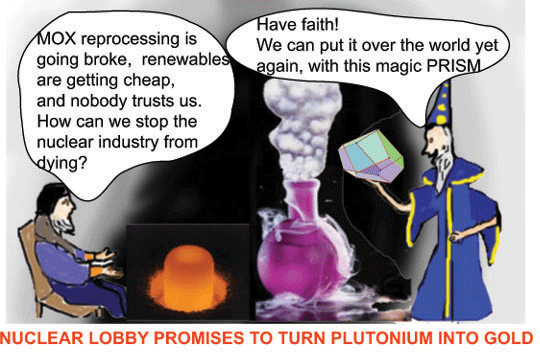
It is understood that the NDA has been impressed by proposals from GE-Hitachi to build a pair of its Prism fast reactors on the Sellafield site,
Revealed: UK Government’s radical plan to ‘burn up’ UK’s mountain of plutonium http://www.independent.co.uk/news/science/revealed-uk-governments-radical-plan-to-burn-up-uks-mountain-of-plutonium-8967535.html 28 Nove 13 A radical plan to dispose of Britain’s huge store of civil plutonium – the biggest in the world – by “burning” it in a new type of fast reactor is now officially one of three “credible options” being considered by the Government, The Independent understands. However, further delays have hit attempts to make a final decision on what to do with the growing plutonium stockpile which has been a recurring headache for successive governments over the past three decades.
The stock of plutonium, one of the most dangerous radioactive substances and the element of nuclear bombs, has already exceeded 100 tonnes and is likely to grow to as much as 140 tonnes by 2020, bolstered by a recent decision to include foreign plutonium from imported nuclear waste.
Ministers had pledged to resolve the plutonium problem in a public consultation but are sitting on a secret report by the Nuclear Decommissioning Authority (NDA) which is believed to confirm that there are now three “credible options” for dealing with the plutonium stored at the Sellafield nuclear reprocessing plant in Cumbria. Continue reading
UK government wins case to keep secret of Litvinenko radiation poisoning


The Guardian and other media groups had intervened in the case at an earlier stage to argue that open justice would be damaged if relevant material was not released.
There is due to be a pre-inquest review on Friday to prepare for further hearings if there is to be no public inquiry.
Alexander Litvinenko inquest: high court halts lifting of secrecy order http://www.theguardian.com/world/2013/nov/27/alexander-litvinenko-inquest-secrecy-order William Hague successfuly argues that airing secret documents about former KGB spy would harm national security Owen Bowcott, legal affairs correspondent theguardian.com, Wednesday 27 November 2013 Lawyers for the Foreign Office have succeeded in overturning a coroner’s ruling that secret documents should be released for the inquest into the death of the former Russian dissident and KGB spy Alexander Litvinenko.
In a unanimous decision, three judges at the high court accepted that the foreign secretary, William Hague, should not have to reveal material relating to the 2006 poisoning of Litvinenko on the grounds that it would be a risk to national security.
 Litvinenko, 43, consumed radioactive polonium-210 while drinking tea during a meeting with former Russian security colleagues at the Millennium hotel in Grosvenor Square, central London. He died three weeks later.
In May this year, the assistant coroner Sir Robert Owen agreed to exclude material from the inquest that suggested Russian state agencies were involved in Litvinenko’s death. He also agreed to keep secret evidence that considered whether or not the UK authorities could have prevented Litvinenko’s 2006 murder.
- But he said summaries of other documents should be disclosed despite an application by the Foreign Office that they should all be subject to a public interest immunity (PII) certificate. The coroner ruled that disclosure was necessary for a “fair and meaningful” inquest. Continue reading
Surviving UK nuclear veterans still fighting for justice
Veterans exposed to radioactive fallout take fight for justice to Number 10 NUCLEAR test veterans took their fight for justice to Downing Street yesterday more than 50 years after they were exposed to radioactive fallout. Express, 27 Nov 13 They are demanding formal recognition of their plight and the creation of a £25 million Government-funded Benevolent Fund to meet their medical needs.
Yet Britain is at the bottom of an international table for helping the veterans of nuclear countries. Even the Isle of Man has gone further than London.
More than 20,000 servicemen took part in the British Nuclear Test programme in the 1950s and 1960s but only about 3,000 are left alive…….. Continue reading
Scotland independence: Lizzie Windsor can stay – nukes gotta go
 Independent Scotland would keep queen, dump nuclear deterrent
Yahoo 7 News November 27, 2013,Glasgow (AFP) – An independent Scotland would keep the pound and the British monarchy but establish its own defence force, First Minister Alex Salmond said Tuesday as he unveiled detailed proposals ahead of next year’s referendum……In a key commitment, the blueprint says an independent Scotland would no longer host Britain’s Trident nuclear missile deterrent…….http://au.news.yahoo.com/world/a/20030691/independent-scotland-would-keep-queen-dump-nuclear-deterrent/
UK government turning its back on renewable energy industries
David Cameron’s attack on green policies threatens £12bn renewable sector, say Greenpeace, Express, By: Owen Bennett – Political Reporter November 21, 2013 DAVID CAMERON has been accused of risking jobs and investment in the renewable energy sector after reports claimed he had told aides to “get rid of all this green c**p”. It was claimed the Prime Minister was making a major U-turn on environmental issues, and ordering aides to strip out green levies which push up energy bills.
Prior to the 2010 election, Mr Cameron had urged Britain to “vote blue, go green” as he promised to lead the “greenest government ever.”
Downing Street deny the Prime Minister is turning his back on environmentalism, but Greenpeace said the comments show Mr Cameron is trying to claw back support with green sceptics in his party.
Greenpeace’s deputy political director Joss Garman said: “If David Cameron thinks the road to electoral victory will be found in attacking the very policies that he once passionately advocated then he is sorely mistaken.
“The British electorate are a sophisticated bunch who will see through his chameleon tendencies and conclude this attack is not an act of leadership but one of cowardice as he panders to the extreme wing of his own party and tries to claw back support from Ukip.
“The real crime is that every time David Cameron reaches for the dog whistle playbook he undermines thousands of jobs in the green energy sector and threatens future investment. Now that really is crap.” Continue reading
Nuclear reactor shut down by clogging seaweed
Seaweed shuts down Scottish nuclear reactor Seawater cooling system of Torness in East Lothian has become clogged with seaweed for the second time this year Rob Edwards theguardian.com, Friday 22 November 2013 A nuclear reactor near Edinburgh shut down on Thursday because its seawater cooling system became clogged with seaweed. This is the second time this year that reactors at Torness in East Lothianhave been forced to close because of excessive seaweed. In 2011 it was closed by a swarm of jellyfish. Continue reading
10MW-sized battery parks – a revolution in solar energy storage
The battery storage system that could close down coal power REneweconomy, By Giles Parkinson on 19 November 2013 (Editors note: This is part of a series of interviews and stories that will run over the next few weeks looking at Germany’s Energiewende, and the transition of Germany’s energy grid to one dominated by renewable energy. You can find them all in our Insight section).
You don’t have to go far inside the headquarters of German battery storage company Younicos, or even their website for that matter, to find out what they are about. “Let the fossils rest in peace,” the logo suggests. Another sign at their technology centre east of Berlin proclaims: “You are now leaving the CO2 producing sector of the world.”
This sign is designed to mimic those which adorned the checkpoints that separated the various sectors of east and west Berlin before the wall was torn down. Younicos believe they have a technology that is equally disruptive, and can break down one of the last barriers to 100 per cent renewable energy: the need to run fossil fuel generation to control the “frequency” of the grid, and the other system services such as voltage control.
The company, based in Berlin Adlershof, on the eastern outskirts of the capital, is developing 10MW-sized battery parks, using battery systems that it says can stabilise the grid faster, cheaper and with greater precision that conventional generation. Continue reading
Britain’s successful Community Funded Solar Power
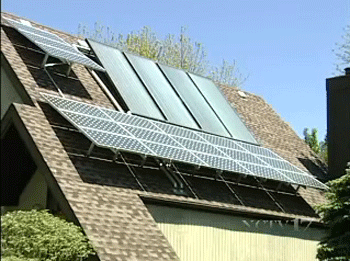 Community Funded Solar Powering Ahead In The UK http://www.energymatters.com.au/index.php?main_page=news_article&article_id=4029 19 Nov 13 The UK’s Brighton Energy Coop (BEC) has raised more than £200,000 in just 3 weeks for a 200kW rooftop solar panel system project – the largest in the city.
Like other solar co-ops, members of the community chip in for the installation of solar array. Revenue is generated through feed in tariffs and sale of the power generated to the “solar landlords”, the businesses where the systems are installed.
BEC offers cash payments to building owners of up to £10,000 to host solar panels, plus discounted electricity for 20 years.
Brighton Energy Co-operative intends to pay investors interest of 5% average per annum, commencing a year after installation ends. Investments may also qualify for 30% tax relief under the UK’s Enterprise Investment Scheme (EIS). Shares cost just £1 each and the minimum buy-in is £400.
“By taking the power into our own hands, BEC is showing that the roll out of renewable energy – such an obvious way of transforming our energy supply – can be done with the power of community support,” says the BEC’s Will Cottrell.
Last year, the BEC raised £240,000 for solar PV projects in Brighton and Portslade. At Shoreham Port, systems were installed on five buildings at the Hove Enterprise Centre. A 35kW system was also installed on City Coast Church in Portslade and a 10kw PV system on St George’s Church in Kemptown.
There are now more than 50 similar solar co-ops in the UK.
Nuclear power ” Very Disappointing “ – economists
 EdF’s major shareholder, the French government, is looking to reduce the share of nuclear in France’s generation to around 50 per cent from more than 70 per cent, and intends to fill that hole with (cheaper) renewables.
EdF has effectively handballed the risk of new nuclear to consumer and the UK government. The consumer is picking up the tab through higher electricity bills, and the UK government is using taxpayers money to guarantee 65 per cent of the project cost.
 Nuclear Energy Verdict:” Very Disappointing “ Clean Technica, Giles Parkinson, 112 Nov 13 (very good graphs, diagrams) …..we have received an analysis from Deutsche Bank, which makes some other observations about the cost of nuclear, the comparisons with gas, the price of abatement, and the cost of upkeep for France’s existing fleet.
The first point made by Deutsche is that this deal underlines the fact that nuclear is not cheap, but really, really expensive – a point that should not be forgotten in Australia, where there is still a push for nuclear in some quarters despite the abundant alternatives (in particular solar) that are not available to the UK.
As we have noted in the other article, the £92.50/MWh strike price is nearly double the current average cost of generation in the UK. Deutsche takes issue with the UK government’s claim that the contract is “competitive with other large-scale clean energy and with gas’. Continue reading
Consortium cleaning up Sellafied radioactive mess has been wildly over-spending
Sellafield nuclear complex clean-up contract winner criticised on spending Margaret Hodge and KPMG, working for the Nuclear Decommissioning Authority, accuse group of overspending Terry Macalister The Guardian, Saturday 9 November 2013 A five-year extension to the Sellafield nuclear decommissioning contract worth £5bn was handed to a private consortium even though its performance had been fiercely criticised by accountants.
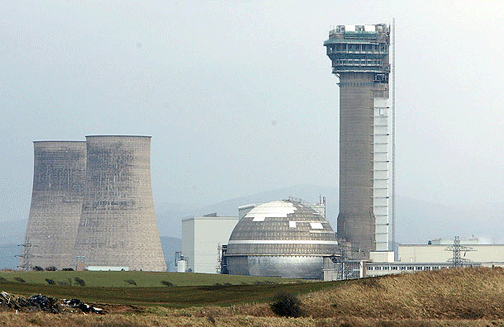 KPMG, working for the Nuclear Decommissioning Authority, accused the clean-up group of overspending, failure to reach operational targets and weak leadership at the atomic complex in Cumbria, according to documents seen by the Guardian.
Margaret Hodge, who chairs the parliament’s public accounts committee, said that in the light of the critical review it was “inexplicable” that the NDA was prepared to reward the Nuclear Management Partners (NMP) consortium for spending cash “like confetti”.
She also complained the critical KPMG report was not shown to her committee or the National Audit Office until the last minute. It had only been sent to the spending watchdogs via a member of the public who conducted a freedom of information request. “But having looked at the report it is inexplicable that the NDA would continue with this consortium after such a hugely critical assessment,” she added.
The NMP decommissioning consortium comprises Areva, the French engineering firm that is also working on the new Hinkley Point power station, in Somerset, which also includes URS of the US and Amec of Britain.
KPMG says it went through 28 out of 154 “bid commitments” at Sellafield and found 30% were deemed fully achieved and 4% partially achieved. KPMG added: “There is still considerable uncertainty in schedules and costs of the projects that account for 26% of annual spending” while the site manager “does not bear risks for delays and cost increases”.
There had been widespread speculation that the consortium would either see the renewal time shortened or be stripped of the work, which would be handed back to the public sector. But the decommissioning authority nevertheless gave the go-ahead to a further five years in October….http://www.theguardian.com/politics/2013/nov/08/sellafield-nuclear-margaret-hodge-kpmg-overspending
China will have controlling interest in UK’s nuclear power!
 Britain’s debt to foreign power: China’s nuclear revolution George Osborne has effectively handed the nation’s nuclear industry over to Chinese and French giants Telegraph, By Geoffrey Lean 18 Oct 2013 How’s this for a turn-up for the books? A Conservative Chancellor, promoter of free markets and defender of national sovereignty, is boasting of “allowing” (a euphemism, it seems, for “begging”) a totalitarian Communist country to build nuclear power stations in Britain.
It will all start – under a deal expected to be finalised next week – with the state-owned China General Nuclear Power joining the equally nationalised Electricité de France (EDF) in constructing a £14 billion brace of reactors at Hinkley Point in Somerset. The Chinese will have a minority share in the project, but have made it clear – and George Osborne accepts this – that they should have a controlling interest in future schemes.
So, much of Britain’s highly sensitive nuclear industry – which sprang from the atomic bomb programme – is effectively to be owned by two foreign powers, one the country’s oldest traditional enemy, the other a bitter Cold War opponent. Few other nations, and certainly not China, would dream of permitting anything of the kind. Doesn’t Mr Osborne see that this could be a bit radioactive, shall we say? Continue reading
Scotland’s “mass walk-on” protest against firing of depleted uranium weapons
 Dundrennan depleted uranium protest staged http://www.bbc.co.uk/news/uk-scotland-south-scotland-24835544 6 Nov 13 The last DU tests were carried out at Dundrennan five years ago Campaigners have held a “mass walk-on” at the Dundrennan range in protest at the test firing of depleted uranium (DU) weapons into the Solway Firth.
It was part of an international day of action and followed concerns about serious health issues resulting from the use of such weapons in war zones.
The last DU tests at the south of Scotland range were in 2008. Earlier this year the Ministry of Defence said it had no plans to restart firing in the area.
One of the campaigners, Rachel Thompson, said the protest had been well supported from across Scotland and beyond. “We have found that depleted uranium is one of those issues people really do care about,” she said.
“They knew when they started that Scottish people did not want this to happen.” She said the protest wanted to make the link between that objection and the consequences of the use of such weapons in Iraq.
1 This Month


Read the Public Inquiry Report, the Commissioners’ report, Surrendering Australia: The AUKUS Deception is available to download for free at aukuspublicinquiry.com. Or just watch the replay of the National Press Club Luncheon.



19 November – Webinar – The Reality of Reprocessing
Time: 11:00 AM Pacific Time (US & Canada) / 2:00 PM Eastern / 7:00 PM UK / 8:00 PM CET
Register for the Zoom Event Here



Shut down the radiation-damaged Heysham nuclear reactors now
To see nuclear-related stories in greater depth and intensity – go to https://nuclearinformation.wordpress.com

Say No to NASA’s Reckless Nuclear Reactor on the Moon
Say No to NASA’s Reckless Nuclear Reactor on the Moon
-
Archives
- November 2026 (109)
- October 2026 (302)
- September 2026 (339)
- August 2026 (330)
- July 2026 (355)
- June 2026 (287)
- May 2026 (306)
- April 2026 (356)
- March 2026 (251)
- February 2026 (267)
- January 2026 (308)
- December 2025 (358)
-
Categories
- 1
- 1 NUCLEAR ISSUES
- business and costs
- climate change
- culture and arts
- ENERGY
- environment
- health
- history
- indigenous issues
- Legal
- marketing of nuclear
- media
- opposition to nuclear
- PERSONAL STORIES
- politics
- politics international
- Religion and ethics
- safety
- secrets,lies and civil liberties
- spinbuster
- technology
- Uranium
- wastes
- weapons and war
- Women
- 2 WORLD
- ACTION
- AFRICA
- Atrocities
- AUSTRALIA
- Christina's notes
- Christina's themes
- culture and arts
- Events
- Fuk 2022
- Fuk 2023
- Fukushima 2017
- Fukushima 2018
- fukushima 2019
- Fukushima 2020
- Fukushima 2021
- general
- global warming
- Humour (God we need it)
- Nuclear
- RARE EARTHS
- Reference
- resources – print
- Resources -audiovicual
- Weekly Newsletter
- World
- World Nuclear
- YouTube
-
RSS
Entries RSS
Comments RSS

