UK scientists aim to get the public to be confident about nuclear waste disposal
 Researchers grapple with UK’s nuclear legacy http://phys.org/news/2014-01-grapple-uk-nuclear-legacy.html#jCp 9 Jan 14 The University of Leeds will lead a consortium of 10 universities in a national research programme looking at ways of dealing with Britain’s nuclear waste. The £8 million project, funded by the Engineering & Physical Sciences Research Council (EPSRC), will start in February and bring together the nuclear industry, the Government’s nuclear advisors and the country’s leading academic researchers.
More than 40 doctoral and post-doctoral researchers will work over the next four years on issues including how best to handle different types of spent fuels, packaging and storing waste, and dealing with nuclear sludges in ponds and silos at nuclear power stations.
Professor Simon Biggs, Director of the University of Leeds’ Institute of Particle Science and Engineering, who will lead the University consortium, said: “The project is primarily focused on developing new technologies and providing confidence in the safe storage and disposal of legacy waste. The UK is a technology leader in this field and the core aim of this project is to maintain and further develop that skill base.”
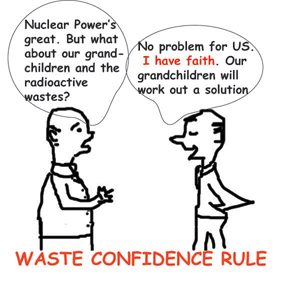
ed.note UK might have to copy the USA’s rule
He added: “This will be a truly interdisciplinary effort. We have civil engineers, chemists, chemical engineers, robotics experts, radiochemists, mechanical engineers and material engineers all working together on thirty different projects.”
The National Nuclear Laboratory (NNL), Nuclear Decommissioning Authority (NDA) and Sellafield Limited will be partners in the project, alongside the Universities of Leeds, Birmingham, Bristol, Imperial, Lancaster, Loughborough, Manchester, Sheffield, Strathclyde and UCL.
Much of the UK’s legacy waste is kept at the Sellafield site in Cumbria.
Sellafield Limited’s Research Alliance Manager Neil Smart said: “Today, Sellafield faces a challenge where there is no blueprint; emptying and demolishing some of the most difficult and complex nuclear buildings in the world – the decommissioning of historic reactors, reprocessing facilities and associated legacy ponds and silos.
“This massive challenge is however an opportunity to demonstrate that Sellafield is still at the forefront of the UK’s nuclear industry and we are delighted that the EPSRC is supporting appropriate academic research that will contribute to the scientific and technical underpinning of our mission. We look forward to engaging in these projects and benefiting from the outcomes, not only in terms of the science and technology but also the skilled people developed through these projects with the potential to enhance our workforce long into the future.”
Why Britain privatised URENCO
 The Downing of Flight 103 over Lockerbie: It was the Uranium, The Ecologist, Mystery continues to surround the 1988 downing of Panam Flight 103 at Lockerbie. Who did it, how, and why? UN Assistant Secretary-General and Commissioner for Namibia, Bernt Carlsson Died in the Crash By Patrick Haseldine, 7 Jan 14 “…….URENCO privatisation On 22 April 2013, David Cameron’s coalition government announced plans to sell its share in URENCO – the uranium enrichment company owned by Britain, Germany and the Netherlands – unleashing a new wave of privatisations in an attempt to cut the public debt.
The UK government’s one-third share in URENCO could fetch up to £3bn, making it one of the biggest privatisations in the UK in years.
Headquartered in the semi-rural Buckinghamshire village of Stoke Poges – where, appropriately enough given its atomic plot the James Bond film “Goldfinger” was partly shot – URENCO has a 31% share of the world’s uranium enrichment market.
This provides the fuel for nuclear power utilities and URENCO has enrichment plants in the US and the three investor countries, including one in Capenhurst, Cheshire.
“It’s a ridiculous idea”, says the GMB union’s national secretary for energy Gary Smith, who earlier this week complained to The Independent of the prospect of the Chinese investing in the nuclear new-build programme. “We’re flogging off precious nuclear assets instead of developing a strategy around nuclear. It’s absolute madness.”
But there is a logic to the move: by privatising URENCO, the British government hopes to bring closure to the Lockerbie affair, and put a distance between itself and the Thatcher administration’s criminal behaviour in processing Namibian Yellowcake contrary to United Nations Council for Namibia Decree No. 1….http://www.globalresearch.ca/the-downing-of-flight-103-over-lockerbie-it-was-the-uranium/5364222
Britain’s nuclear project means opposition to EU renewables targets, and potential job losses
UK opposition to new EU green eenergy targets could risk ‘half a million jobs’ theguardian.com, Thursday 2 January 2014 Britain’s demand to keep nuclear option open to reduce emissions will mean potential job losses, leaked report shows Adam Vaughan Over half a million new jobs over the next two decades could be at risk from the UK’s opposition to new EU targets for green energy, according to a leaked official report from the European commission.
Since last spring, European countries have been battling over what new climate change targets should be set to follow the existing ones for greenhouse gas emissions, renewable energy and energy efficiency, which run out in 2020. The UK, along with the Czech Republic, is strongly opposed to setting a new renewable energy goal for 2030, favouring an overall target for greenhouse gas emissions instead – which would entail an ambitious cut of 50% on 1990 levels. They want countries to be allowed the freedom to reach the target as they choose to, for example by relying heavily on nuclear power.
Energy and climate secretary, Ed Davey, has said: “We need a technology neutral approach to how individual countries meet their emissions targets … we will therefore oppose a renewable energy target at an EU level as inflexible and unnecessary.”
But a draft report, commissioned by the European commission on the impact of setting different targets and seen by the Guardian, says that including renewable energy and energy efficiency targets in addition to a greenhouse gas emissions target would create around 568,000 more jobs across Europe by 2030 than an emissions one alone. However, the cost of having renewable energy and efficiency targets would be 2.6% higher than with just an emissions target alone, the report notes.Germany, Denmark, Austria and Finland back a renewable energy target. A new energy efficiency target is considered unlikely.The wind industry said that not setting a renewable energy target would make it harder for developers to attract investment. ……
The new German government has already set a target of 40-45% of its electricity supply coming from renewable sources by 2025, higher than the 30-35% EU-wide target being discussed. By contrast, the UK has been one of the worst performers for share of energy generated by renewable sources, near the bottom of the European league table along with Malta and Luxembourg. http://www.theguardian.com/environment/2014/jan/02/uk-eu-renewables-targets
UK’s Hinkley nuclear reactor design failed the Generic Design Assessment

 Hinkley C: the Generic Design Assessment has failed Ecologist, Peter Lux 26th December 2013 The safety assessment for the Hinkley C reactor design has failed, reports Peter Lux. Faced with 724 unresolved concerns about the EPR design, the UK regulator went ahead and issued the licence anyway.The Generic Design Assessment (GDA) is a process which was set up in order to examine the designs for new power stations and iron out any flaws in them before the power stations are constructed. Continue reading
Renewables meet over 40% of Scotland’s electricity demands
19 Dec 13, Scotland’s renewable electricity output has reached record-high levels, according to official statistics released today. The figures, published by the Department of Energy and Climate Change, show that renewables met a record-breaking 40.3 per cent of gross electricity consumption in 2012, confirming that Scotland is on track to meet its interim target of 50% by 2015. http://www.enn.com/pollution/article/46805
Remembering UK’s Windscale Nuclear Disaster
The Windscale Nuclear Disaster, Today I Found Out, MELISSA DECEMBER 18, 2013 On the morning of Friday, October 11, 1957, workers at the nuclear reactor Windscale Pile 1 near Seascale, Cumberland, England, faced a terrible choice: allow a raging fire to burn itself out while it released dangerously high levels of ionizing radiation into the surrounding countryside; or, attempt to extinguish the conflagration with water, an option that could cause a hydrogen explosion (again, releasing dangerous levels of radiation, as well as blowing the workers to bits). Here’s the story of what they did:………
Aftermath
Still keen on getting their hands on the nuclear weapons designs, British leaders covered up the real cause of the accident and blamed it on Windscale’s heroic workers. The deceit was successful, and the U.S. shared its nuclear secrets with the British. Subsequent inquiries, by the BBC and others, have revealed that it was the government’s relaxed safety policies that were ultimately to blame.
Health wise, it was also a disaster. Although not on the scale with Chernobyl, the Windscale release of iodine-131, caesium-137 and xenon-133 are thought to have caused at least 200 cancer cases; it is believed that the numbers would be far higher were it not for the last-minute addition of the filters…….http://www.todayifoundout.com/index.php/2013/12/windscale-nuclear-disaster/
UK nuclear subsidies may be unnecessary, and could cost £17bn
 Subsidies for UK nuclear plant could reach £17bn and ‘may be unnecessary’ http://www.telegraph.co.uk/finance/newsbysector/energy/10525538/Subsidies-for-UK-nuclear-plant-could-reach-17bn-and-may-be-unnecessary.html
European Commission probes whether subsidies are needed for EDF’s Hinkley Point plant in Somerset and warns they could cost £17bn – more than the plant itself By Emily Gosden, Energy Editor
18 Dec 2013 British consumers could pay £17bn in potentially unnecessary subsidies to fund construction of the country’s first new nuclear plant in a generation, the European Commission has said.
The EC said it was assessing whether the planned subsidies for Hinkley Point in Somerset – which could exceed the £16bn cost of the plant itself – were needed at all, or whether energy companies would build the plant anyway without a penny of public support.
Ministers in October signed a landmark deal with energy giant EDF to fund the construction of the plant, which would see consumers pay billions of pounds in subsidies to the French company for decades to come.
On Wednesday the Commission opened a formal investigation into “whether the construction of a nuclear power station could not be achieved by market forces alone, without state intervention”. The Commission said its investigation, which threatens to delay or derail the plant altogether, will assess whether UK plans “to subsidise the construction and operation” of the plant are in line with EU state aid rules.
Taxpayer money for UK nuclear from French, as well as British?
 Areva may use French fund to help pay for UK nuclear plant –paper http://uk.reuters.com/article/2013/12/16/uk-areva-hinkleypoint-funds-idUKBRE9BF0KS20131216 (Reuters) – Areva is in talks with the French
 government to release some funds set aside for dismantling its nuclear installations in France to help the company finance a new British nuclear reactor, a newspaper reported.
Britain signed a deal with France’s state-owned utility EDF in October to build a 16-billion pound nuclear power plant at Hinkley Point in southwest Britain, the first new plant in Europe since the Fukushima disaster.d to help pay for UK nuclear plant – paper
PARIS Mon Dec 16, 2013 State-owned Areva is taking a 10 percent stake in the consortium that will build the facility, which also includes EDF’s Chinese partners China General Nuclear Corporation (CGN) and China National Nuclear Corporation (CNNC).
Warning that UK’s Hinkley nuclear power will be unaffordable
Ineos boss says Hinkley nuclear power too expensive, BBC News 15 Dec 13, Power from the new Hinkley C nuclear generator will be too expensive, the boss of one of the UK’s biggest energy consumers has warned.
Jim Ratcliffe, whose company Ineos owns the Grangemouth plant in Scotland, told the BBC that UK manufacturers would find the price unaffordable.
The government has guaranteed a price of £92.50 per megawatt hour (Mwh). Mr Ratcliffe said Ineos recently agreed a deal for nuclear power in France at 45 euros (£37.94) Mwh.
The government has guaranteed that the new Hinkley station, being development by France’s EdF and backed by Chinese investors, can charge the £92.50 minimum price for 35 years.
“Forget it,” Mr Ratcliffe said in an interview with the BBC’s business editor Robert Peston.
The existing Hinkley station currently produces about 1% of the UK’s total energy, but this is expected to rise to 7% once expansion of the Somerset plant is complete in 2023.
Ministers and EdF were in talks for more than a year about the minimum price the company will be paid for electricity produced at the site, which the government estimates will cost £16bn to build.
In the end, the government guaranteed the group a price for electricity in 2023 at twice the current level of wholesale prices……..http://www.bbc.co.uk/news/business-25390456
Japan joins the frenzy to sell uneconomic nuclear power to UK
 Westinghouse to buy 50 per cent stake in NuGen By Guy Chazan, Jim Pickard and George Parker 15 Dec 2013, Westinghouse, the Japanese-owned engineering group, will announce within days that it is buying a big stake in one of the UK’s three nuclear-building consortiums .

Westinghouse, which is owned by Toshiba, is expected to announce it is acquiring a 50 per cent share in NuGen, which owns the right to build a nuclear plant near Sellafield in Cumbria…. Continue reading
Probable illegality of Britain’s nuclear subsidy throws doubt on global nuclear industry
In the wider context the deal is important because the nuclear industry’s revival in democracies depends on it being classed as a low carbon generator, which can benefit from carbon credits and other subsidies in the same way as renewables. This has already been ruled out in most democratic countries outside Europe.
 Without state aid the large capital expenditure needed to build nuclear plants is hard to find from the private sector, and the time it takes to build reactors makes the return on capital long-term. Two stations being built in Finland and France are both up to seven years late and construction budgets have already doubled. They are the same design as the reactors intended for Britain.
‘Illegal UK state aid’ probe hits nuclear plans Eco Business, 14 Dec 13, An EU investigation into the UK’s financial support for new nuclear power stations is dividing Europe, with critics saying London is flouting EU rules by offering illegal subsidies.A full-scale investigation is being launched into whether Britain’s deal with French nuclear giant EDF, backed with money from Chinese nuclear generators, to build new stations at Hinkley Point in the west of England, is illegal state aid.
The investigation by the European Commission is a serious blow to the nuclear industry in Europe and across the western world, because it delays any expansion of the industry for at least a year and may possibly permanently damage its prospects. Continue reading
Slack security at UK’s nuclear bomb factory
Ministry of Defence security ‘asleep on the job’ guarding a nuclear bomb factory, By Vicky Smith Mirror, UK, 14 Dec 2013
Up to 50 MoD police are being probed for allegedly failing to carry out vital security patrols at the 225-acre complex which builds Trident warheads. Up to 50 Ministry of Defence police guarding a nuclear bomb factory are being probed for allegedly failing to carry out vital security patrols.
And last night it was claimed that some were sleeping on the job at the 225-acre complex which builds Trident warheads. Seven of the armed officers have resigned and others are facing disciplinary action amid claims they ignored key duties.
A source said: “At least some of the police were sleeping on the job when they missed the patrols.
“This is highly embarrassing at such a key facility.”
Peter Burt, of the Nuclear Information Service, which campaigns for nuclear safety, said: “The sheer scale of these claims are astonishing, especially given the highly sensitive nature of the complex.
“It handles radioactive materials, explosives and hazardous chemicals. ……..http://www.mirror.co.uk/news/uk-news/ministry-defence-security-asleep-job-2924587
UK Olympic sized nuclear cover up – and it has spread to Japan
 OP – ED Arclight2011 Nuclear-news.net 8 December 2013
The UK has decided to take the cheapest option for decommissioning according to a recent report by the badly named Department of the Environment and Climate Change (DECC), as 65 percent of their annual budget goes just on the costs of decommissioning it should be named British Nuclear Fools.
The processes involved with “decommissioning” are a “corporate secret” but a quick google says that the cheapest option is dissolution that involves melting everything in Nitric acid (or similar) and this has been the cause of high NO2 levels in the UK that are regularly blamed on other industries or countries. Though La Hague in France does contribute.
The UK has been reprimanded by the EU for the deaths caused by this NO2. And in the UK parliament we hear calls to cut the pollution detection monitors as they give the nuclear hazard away and threaten profits. These NO gases and particulates make it to even the arctic region of Russia (as Bellona has reported on many occasion whilst defending Norway from unjust blame)
As EDF and the French government begin the plans to reduce French nuclear and the shutting down of La Hague, they plan to increase use of Sellafield and other sites in the UK for these environmentally polluting nuclear processes.
The Irish Government has not been involved in the decisions for Hinckley, so An Taisce has formally lodged an appeal to the EU. The reaction of the UK and Ed Davey are well documented here… https://nuclear-news.net/2013/12/06/no-objection-by-ireland-uk-nuclear-hearing-told/
And as DECC were threatened with non co-operation if they asked for certain technical details or even the names of people involved, the Irish were likely not to be aware of the processes that the UK was planning to expand nor has their been a proper discussion concerning radionuclide’s and air quality issues being released due to these nuclear processes.
In fact not even the British public could be expected to know. In fact the UK NGO steering group who was supposed to be discussing this very issue over the past two years were not even allowed to know.
Who needs Leveson inquiry to silence information when the corporations and governments are doing the job so well anyway, I find myself asking.
I might point out that DECC also masterminded the Science Media Centre UK (SMC) to cover up or “manage” the Fukushima incident press coverage in 2011, which they then did and were rewarded by their sponsors (The big corporations and nuclear interests).
Bloggers and free press elements in Japan got too much truth out and the Japanese nuclear family had to close ranks with the USA and the Olympic Committee and have came up with the new “Secrets Act” , a shocking attack on free speech from a supposedly western country. It is now up to the Japanese Press to mobilize the people to reject this new Law, there are some signs of dissent in the media. We wish them well!
DECC has contracts of understanding with ROSATOM as well as some dubious eastern nuclear states. China, an authoritarian and pushy country will have the same leverage over DECC as the French and USA partners and therefore the Chinese communist (mostly)will have control of the information we hear on the news etc.. Have you heard the one about the Dalai lama recently? No? And you probably never will again!
Elements of the UK Media have had enough and are beginning to look a little harder at the Pro nuclear spin and analyse the sources of this drive for nuclear. The UK media is beginning to wake up to the deception but how deep will they dig?
It began after the crash of 2008 and 200 billion Euro moved directly into nuclear investments (A Norwegian insurance investment company has just sold its stocks in TEPCO at a massiviely reduced price and has beeen left licking its wounds). The Insurance and banking industry saw this as a safe bet for three more years and are heavily invested, in fact, the UK insurance industry will be proping up this PONZI scheme with a staggering 25 billion investment that is a curiously small amount considering the Total investment accrued in the Nuclear Industry by now. Just the normal monthly “Top Up” perhaps?
And if you dont think the Insurance Corporations view this as their own private nuclear “gravy train” why was the liability capped in Canada to only 1 billion? when the Japanese have paid TEPCO 50 billion in just the first year after the disaster. It seems it is the beleaguered Tax Payer is always the end recipient of this PONZI shaped dept burden.
Finally, the UK corporations have been supporting the Pro nuclear Corporations in Japan from the start and are still supporting Japan as it becomes a fascist state to protect their investments. These investments are very long term, measured in decades, and any country with nuclear power could be facing the same control of the population and of information.
Orwell would be not surprised perhaps at technology being used to enslave people by reducing their knowledge and controlling them totally.. No dissent, no illegal thoughts or 5 years in prison and a criminal history to stop you getting work for the rest of your life. Poor Japan! Poor UK!
Time for UK government to be honest about its subsidy to nuclear power
biggest criticism is over ministers’ insistence that the deal agreed by the Treasury and EDF to fund the construction of a new nuclear power plant at Hinkley Point in Somerset is not a subsidy.
 “New nuclear is being subsidised and the coalition should come clean and admit it,” said Walley. “The government cannot escape that clear fact by talking about ‘support mechanisms’ and ‘insurance policies’ instead of ‘subsidies’.”
be honest about oil, gas and nuclear subsidies and restate commitment to end fuel poverty Terry Macalister The Guardian, Monday 2 December 2013 The government has been urged to be more honest about the levels of subsidies given to oil and gas producers and the companies who will build a new nuclear power station at Hinkley Point.A parliamentary watchdog argued on Monday that ministers should admit they are already providing £12bn of annual subsidies to fossil fuel operations and windfarms while lining up more support for shale gas and nuclear.
The environmental audit committee (EAC) said subsidies to oil and other carbon fuels should be scaled back because of the impact on global warming, and also urged ministers to restate a previous commitment to ending fuel poverty.
A report on energy subsidies just published by the committee says the chancellor’s autumn statement later this week is an ideal chance to provide a “clear and comprehensive analysis of energy subsidies in the UK”. Continue reading
EU probe into Britain’s nuclear subsidy could take until 2020
EU state aid probe likely over British plan for EDF nuclear plant 7 News, December 3, 2013, By Barbara Lewis and Foo Yun Chee BRUSSELS (Reuters) – EU regulators are likely to open a formal investigation into whether Britain’s offer of state guarantees, to help finance a nuclear plant to be built by France’s EDF , conform with the bloc’s rules, its competition commissioner said on Monday.
Britain in October signed a deal with EDF to build a nuclear plant at Hinkley Point in southwest England and became the first European country to offer a guaranteed power price over 35 years for a new nuclear project.
“Two to three weeks ago we received notification from the UK,” EU Competition Commissioner Joaquin Almunia told a Brussels conference organised by Eurelectric, which represents the EU electricity industry.
“We are starting to analyse what is in the British proposal. Probably we will open a formal investigation because many people are asking the same question as you do,” he said when asked whether the British proposal for 35 years of a guaranteed energy price was too long under the terms of EU rules on state aid………The Commission is revising its state aid guidelines and is expected to finalise the rules for 2014-2020 next year.
It has said they will not specifically include nuclear energy, dealing another blow to Britain’s hopes of early certainty. Instead, each project will be assessed on its own merits………http://au.news.yahoo.com/world/a/20120325/eu-state-aid-probe-likely-over-british-plan-for-edf-nuclear-plant/
1 This Month


Read the Public Inquiry Report, the Commissioners’ report, Surrendering Australia: The AUKUS Deception is available to download for free at aukuspublicinquiry.com. Or just watch the replay of the National Press Club Luncheon.



19 November – Webinar – The Reality of Reprocessing
Time: 11:00 AM Pacific Time (US & Canada) / 2:00 PM Eastern / 7:00 PM UK / 8:00 PM CET
Register for the Zoom Event Here



Shut down the radiation-damaged Heysham nuclear reactors now
To see nuclear-related stories in greater depth and intensity – go to https://nuclearinformation.wordpress.com

Say No to NASA’s Reckless Nuclear Reactor on the Moon
Say No to NASA’s Reckless Nuclear Reactor on the Moon
-
Archives
- November 2026 (109)
- October 2026 (302)
- September 2026 (339)
- August 2026 (330)
- July 2026 (355)
- June 2026 (287)
- May 2026 (306)
- April 2026 (356)
- March 2026 (251)
- February 2026 (267)
- January 2026 (308)
- December 2025 (358)
-
Categories
- 1
- 1 NUCLEAR ISSUES
- business and costs
- climate change
- culture and arts
- ENERGY
- environment
- health
- history
- indigenous issues
- Legal
- marketing of nuclear
- media
- opposition to nuclear
- PERSONAL STORIES
- politics
- politics international
- Religion and ethics
- safety
- secrets,lies and civil liberties
- spinbuster
- technology
- Uranium
- wastes
- weapons and war
- Women
- 2 WORLD
- ACTION
- AFRICA
- Atrocities
- AUSTRALIA
- Christina's notes
- Christina's themes
- culture and arts
- Events
- Fuk 2022
- Fuk 2023
- Fukushima 2017
- Fukushima 2018
- fukushima 2019
- Fukushima 2020
- Fukushima 2021
- general
- global warming
- Humour (God we need it)
- Nuclear
- RARE EARTHS
- Reference
- resources – print
- Resources -audiovicual
- Weekly Newsletter
- World
- World Nuclear
- YouTube
-
RSS
Entries RSS
Comments RSS

