A boon for bankers (but no-one else) – UK’s China Hinkley Point nuclear deal
 the decision to involve Chinese companies – initially with EDF at Hinkley Point and then on their own at Bradwell and Sizewell – only makes sense if it is seen as part of a quid pro quo for the previously announced financial services deal.
 They put the Chinese Communist Party and military at the heart of strategic infrastructure. They interlink the British and Chinese financial systems at a time when the latter is structurally weak, poorly regulated, and struggling with corruption.
 Britain’s nuclear deal with China is a boon for bankers – and no one else, The Conversation, Jeffrey Henderson November 6, 2015 At first glance, it seems an almost inexplicable paradox. A right-wing British government has invited companies controlled by the Chinese Communist Party – and in one case, the Chinese military – into the heart of the UK’s strategically vital energy infrastructure. The nuclear deal between Britain and China goes against the advice of the security services, the military and the US government.
So to explain this paradox, we must look carefully at another major deal in the British government’s flirtation with President Xi Jinping: the inter-penetration of the two countries’ financial services.
There would seem to be no possible connection between Chinese companies building and operating nuclear power stations in 2020s Britain and a curious political role created in 1571. But the fact that the Remembrancer, a representative of the City of London Corporation, is allowed to attend and monitor debates in the House of Commons, says much about Britain’s priorities.
When considering economic and budgetary policy, the Remembrancer is at hand to ensure that our elected representatives remember that, whatever other interests they might serve, the needs of financial services must be paramount. And the near-invisible hand of the Remembrancer seems recently to have been at work ensuring that Britain’s infrastructure is made accessible to Chinese state-owned companies. Continue reading
UK’s Office for Nuclear Regulation (ONR) cosying up to the nuclear industry
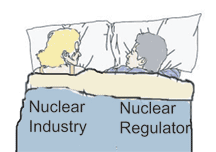 the Office for Nuclear Regulation (ONR) seemed to be dangerously edging towards the corporate financial interests of the nuclear industry rather than the public interests of ensuring national nuclear safety
Alarm over Government’s growth mandate for nuclear regulator, The Independent,
Last year, non-economic regulators were handed guidance entitled “Duty to have regard to growth” by the Department for Business, Innovation & Skills Mark Leftly Associate business editor @MLeftly Anti-nuclear campaigners fear regulators have been forced to cosy up to the industry and sacrifice some of their safety responsibilities as a result of government changes to their role.
At a meeting in Manchester last week, executives from the Office for Nuclear Regulation (ONR), which oversees civil reactors and decommissioning, told representatives from NGOs that they now have to encourage the industry’s economic growth in addition to promoting safety. Continue reading
Drastic risks to UK’s security, jobs, in the Hinkley Point C boondoggle
It is clear that this unprecedented handover of power and money to Chinese hands will prompt a justified reaction from those thousands of UK steel workers whose jobs are about to disappear due in part to the global dumping of steel by China.
Will the remnants of the steel industry and its workers see a fraction of the £76 billion to be spent by the Chancellor on his nuclear boondoggle? Not likely.
The nuclear option can and has been criticised in so many ways that the UK Government should think long and hard before proceeding with what many UK citizens will rightly consider an unpatriotic and unethical waste of money. It may even constitute a real and potent danger to our current lifestyle in Britain.
The Hinkley Point C boondoggle: a dangerous waste of money http://reneweconomy.com.au/2015/the-hinkley-point-c-boondoggle-a-dangerous-waste-of-money-57108 By Alex Russell and Peter Strachan on 2 November 2015 The UK Government’s pursuit of a new nuclear plant at Hinkley Point C represents not just a colossal waste of money, but could also be real danger to the UK’s national security, write Professors Alex Russell and Peter Strachan of Robert Gordon University. “Let us hope that the Prime Minister and Chancellor’s actions do not lead to the radicalisation of unemployed steel workers who are now being joined by unemployed renewable industry personnel.”
The Conservative government, arguably, has completely lost the plot in continuing to pursue its so called energy policy that depends so heavily on building a new fleet of nuclear power stations to keep the lights on in Britain. The government want to have 16 GW of new nuclear power stations built in the UK all using EDF’s troubled Generation-III design, of which Hinkley Point C (3.2 GW) is only the first installment.

With this project is George Osborne seeking an entry in the Guinness Book of Records as the first Chancellor of the Exchequer to commission the world’s most expensive nuclear power station? The Chancellor says the project represents good value for money. But the facts suggest otherwise. Further, and with the recent signing of a new nuclear accord as part of the State Visit of the President of China, not enough attention appears to have been given to national security issues.
Economic madness All in all, Hinkley Point C will cost an estimated £76 billion, for up to 3.2 GW of new generation capacity. Building costs are now estimated by EDF, the owner, at £24.5 billion. As a sobering thought, even offshore wind looks cheap when compared to the full commercial costs of this project.
This apparent blank cheque for new nuclear build is all the more surprising coming at a time when the Treasury has slashed support for onshore wind and solar power and other low carbon projects. Continue reading
Scientists confirm “elevated” raadioactivity levels in honey near nuclear power station
 Radioactive honey found near nuclear power station, Rt.com 2 Nov, 2015 Honey contaminated with nuclear waste has been found near a disused power station in Scotland, scientists have confirmed, with samples of the product testing positive for “elevated” radioactivity. The samples showed levels of radioactive caesium-137 that are 14 times higher than samples of honey from elsewhere in the UK, prompting scientists to call for an investigation into wider contamination at the site.
The plant, which closed in 1994, no longer produces nuclear energy. It is still in the process of being decommissioned, however.
Independent nuclear energy consultant John Large said bees are an important barometer of environmental health.“Bees are key indicators of what is happening in the environment. They forage in a three-mile radius around the hive and anything in the soil is drawn up into plants and into the nectar they collect.
“This reading is within the limit for human consumption, but caesium-137 should not be turning up in honey at all,” he added.
The results are included in the government’s Radioactivity In Food and the Environment report, published last week…….https://www.rt.com/uk/320505-nuclear-plant-honey-contamination/#.VjfDMS3IGhs.twitter
How the BBC advised Britons if there was a nuclear attack during the Cold War
Who, What, Why: What would the radio broadcast in a nuclear war?, BBC 3 Nov 15 Who, What, WhyThe Magazine answers the questions behind the news BBC newsreader Peter Donaldson, who has died aged 70, was to have been the voice of radio bulletins in the event of a nuclear attack. What would have gone out on the UK’s airwaves if the Cold War had turned hot?
“This is the Wartime Broadcasting Service. This country has been attacked with nuclear weapons. Communications have been severely disrupted, and the number of casualties and the extent of the damage are not yet known.”
So began the script, read by Peter Donaldson, which was to go out on British airwaves in the event of nuclear war.
The Wartime Broadcasting Service was run by the BBC on behalf of the government. It was intended to replace existing radio broadcasts in the event of a nuclear exchange.
According to declassified papers, the recording of Donaldson would have been broadcast from a nuclear bunker at Wood Norton in Worcestershire and transmitted from nearby Droitwich.
The script urged people to stay calm, remain in their homes, save water and make the most of tinned food supplies. It was hoped this would provide reassurance as well as information.
“If there had been a nuclear attack, people would still have heard the BBC and hopefully they would have taken heart,” Michael Hodder, who ran the Wartime Broadcasting Service, told the BBC’s The One Show in September.
The service would also be used to make official government announcements. It was intended that there would also have been regional services performing similar functions for regional seats of government.
BBC staff would have followed procedures set out in the War Book, a Cold War instruction manual that was declassified in 2009. “Engineers in charge of transmitters had it in their safes,” says BBC historian Jean Seaton.
Initially it was planned that music and light entertainment programmes including Hancock’s Half Hour, Round the Horne and Just A Minute would be broadcast too, but by the 1980s it was decided that only official announcements would be transmitted to preserve energy.
The use of a well-known presenter was considered crucial. In a June 1974 letter, Harold Greenwood from the Ministry of Posts and Telecommunications warned that an “unfamiliar voice” would lead listeners to conclude that “perhaps after all the BBC has been obliterated”.
Full script……
Strong vote by Scottish Labour against renewal of trident nuclear missile system
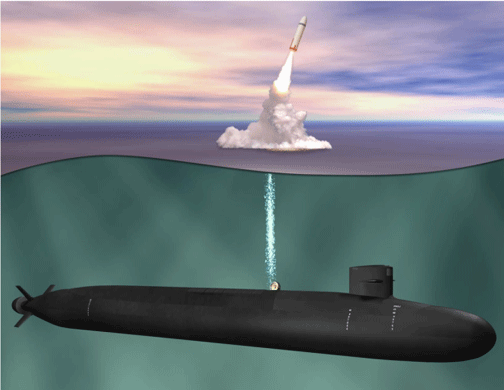
 Scottish Labour votes against renewal of Trident nuclear weapon system, Ft.com
 Mure Dickie in Perth, 1 Nov 15 Scottish Labour has voted emphatically against renewing the Trident nuclear weapon system, offering a major boost to supporters of unilateral disarmament in the UK party, including its leader, Jeremy Corbyn. Party members and union delegates to a conference in Perth both voted by 70 per cent to 30 to abandon plans to maintain a “massively expensive” and “militarily useless” submarine-launched ballistic nuclear missile system.
Ian Murray, Labour’s only MP in Scotland and a member of the UK shadow cabinet, said the more than two-thirds majority meant disarmament was now formal policy for the Scottish party. That would mean it must be considered by UK Labour policy planners and could be included as part of Labour’s platform for the Scottish parliamentary elections next May. “It should be in the manifesto,” Mr Murray said.
The vote highlights uncertainty about Labour’s policy on Trident since Mr Corbyn’s election and will be portrayed by the Scottish National party as evidence of deep divisions between him and the UK party’s mainstream.
But many Scottish Labour members praised the decision of Kezia Dugdale, the Scottish party’s new leader and an opponent of unilateral disarmament, to allow delegates to choose to debate and vote on Trident and other issues.
The vote came after a vigorous and often passionate debate in which opponents of Trident renewal stressed what many called the fundamental immorality of nuclear weapons while supporters focused on the threat that scrapping them would pose to thousands of well-paid jobs.
Union representatives were divided on whether to back Trident renewal, with many fearing that promised defence industry diversification would not deliver equivalent employment for highly skilled workers…….. delegate Stephen Low said scrapping nuclear weapons would free money to be spent in more economically productive ways.
“I’d rather have pie in the sky on my horizon than a mushroom cloud,” Mr Low said. “You get a lot of bang for your buck with Trident . . . but you don’t get that many jobs.”
Defence policy is decided by the UK party, but Bill Butler, a candidate for the party in next May’s Scottish parliamentary election, said it could help build momentum for nuclear disarmament……..http://www.ft.com/intl/cms/s/0/fb106dec-809b-11e5-84dc-31c8b3b18e5f.html#axzz3qGtjP1GJ
British MPs slam £25billion nuclear power station plan
MPs attack ‘desperate’ £25bn Hinkley nuclear power station plan http://www.thisismoney.co.uk/money/news/article-3298926/MPs-attack-desperate-25bn-Hinkley-nuclear-power-station-plan.html By NEIL CRAVEN, FINANCIAL MAIL ON SUNDAY, 1 November 2015 A group of MPs have slammed a plan to build a £25billion nuclear power station, as opposition to the Government’s nuclear energy policy gathers steam.
An Early Day Motion that calls the plan to build at Hinkley Point, in Somerset, as ‘an act of desperation’ has been signed by 16 MPs in just 10 days.
Paul Flynn, MP for Newport West, which lies across the Bristol Channel from the planned site, has tabled the motion.
It says that similar reactors in France and Finland have suffered ‘catastrophic delays and financial losses’.
Experts also say the plan could cost billions more than expected and produce electricity that is far more expensive than market rates.
French energy firm EDF and China Nuclear Power Corporation agreed last month to build the plant. But criticism has come from all sides.
Chancellor George Osborne’s father-in-law Lord Howell of Guildford described the scheme as ‘one of the worst deals ever’ for British consumers and industry.
The Nuclear Free Local Authorities (NFLA) – Hinkley Point C nuclear agreement wrong, and not finalised
 21st October 2015 NFLA notes only a participation agreement between China, UK and EDF is being agreed today for Hinkley Point C. Many hurdles still remain. NFLA calls instead for investment in renewables and decentralised energy. The Nuclear Free Local Authorities (NFLA) notes with dismay the announcement to sign an initial participation agreement between the Chinese and UK Governments and EDF over the proposed construction of a new nuclear power station at Hinkley Point, and future plans for new nuclear reactors at Sizewell and Bradwell.
 0161 234 3244 or 07771 930196.
Trident nuclear deterrent – Scottish Labor to vote on this
Scottish Labour to vote on abolishing Trident nuclear deterrent, Guardian, Severin Carrell, 31 Oct 15
Delegates back potentially divisive debate at conference on Sunday, as Jeremy Corbyn attacks SNP record The Scottish Labour party is to vote on abolishing Britain’s nuclear deterrent after delegates voted heavily in favour of a debate on the Trident missile system.
The decision to debate cancelling Trident’s replacement at Scottish Labour’s annual conference this weekend came as activists applauded calls from Jeremy Corbyn for the party to embrace “the sunshine of socialism”.
On Friday, delegates overwhelmingly backed calls from constituency parties to hold a potentially divisive vote on Trident’s renewal on Sunday: the party’s leadership is split on the issue, with unions and MSPs at loggerheads.
In his first speech to Scottish Labour as leader of the UK party, Corbyn attacked the Scottish National party’s track record in government in the runup to next May’s Holyrood elections, insisting only Labour had a vision for a more equalScotland……..
The Scottish Labour debate on Trident will present party leaders with a significant political challenge whichever way it goes, so they are putting heavy emphasis on the merits of the party reaching an open, democratic decision…….
While delegates to Labour’s UK conference saw Trident as a less important issue, and failed to debate it, scrapping Trident has risen much further up the political agenda on the Scottish left.
Voting to scrap Trident would appeal to many Scottish leftwing voters, helping Labour take on the SNP in the Holyrood elections,……
The wording of the Trident motion will not be finalised until Saturday and it remains unclear whether delegates to the Perth conference will vote to abolish it, but party leaders are bracing themselves for a heavy vote against Trident’s renewal……http://www.theguardian.com/politics/2015/oct/30/scottish-labour-conference-votes-debate-trident-nuclear-deterrent-renewal
Nuclear power worker was learning how to make abomb
Scots nuclear power plant worker caught studying BOMB-MAKING websites at work , Daily Record, 27 Oct 15 THE staff member was marched off the premises at Hunterston B, West Kilbride, this morning after a shocked colleague raised the alarm. A WORKER at a Scots nuclear power plant has been caught studying bomb-making websites at work.
The staff member was marched off the premises at Hunterston B, West Kilbride, this morning after a shocked colleague raised the alarm.
Police are now investigating the worker accessing “inappropriate material” while working at the nuclear facility.
The man, who is believed to be a Muslim who moved recently from England, has worked at the North Ayrshire facility for around four weeks.
He was spotted by a fellow colleague on Monday, who reported his concerns to management.
The contractor works as a ‘special entry assistant’ at the power station, and his role involves him going into the heart of the plant to assist tradesmen.
He was allegedly seen viewing inappropriate websites on homemade explosives on a laptop computer, which he slammed shut after being spotted by a work mate.
When he arrived for work on Tuesday, he was escorted from the premises by security guards and plant owners EDF called in police.
A source at the plant said: “The guy has only worked here for a short time.
“He is a low-level employee, but has access to the reactor, where he basically helps out tradesmen working on it.”……..
A spokeswoman for Police Scotland said the incident was being dealt with by the Civil Nuclear Constabulary (CNC).
No one from the CNC was available for comment. http://www.dailyrecord.co.uk/news/scottish-news/scots-nuclear-power-plant-worker-6716601
Cost of renewing UK’s Trident nuclear submarines balloons out to $256 billion
A final decision on replacing the existing vessels carrying the Trident missiles — four Vanguard-class submarines — is due next year and Cameron says he will press ahead with the renewal
UK nuclear deterrent to cost $256 billion, far more than expected, Reuters, LONDON | BY ELIZABETH PIPER, 25 Oct 15 The overall cost of replacing and maintaining Britain’s nuclear deterrent will reach 167 billion pounds ($256 billion), much more than expected, according to a lawmaker’s and Reuters’ calculations based on official figures.
The Scottish Nationalist Party, which wants Britain’s Scotland-based nuclear-armed Trident submarines scrapped, called the sum “unthinkable and indefensible” at a time when deep cuts under the government’s “austerity” policies mean “thousands of people across the UK are struggling to afford basics like food”.
Some military officials also oppose investment in Trident, saying the money would be better spent on maintaining the army and on more conventional technology, which have also faced cuts. Continue reading
Sell EDF shares, because of Hinkley nuclear costs – says leading broker
 Broker tells investors to sell EDF shares because of Hinkley Point costs, http://www.theguardian.com/business/2015/oct/22/broker-tells-investors-sell-edf-shares-hinkley-point-costs Guardian, Terry Macalister, 22 Oct 15,
Investec Securities has ‘long-term concerns’ about financial strain the £18bn nuclear project will put the French energy group under.A leading City broker has called on investors to sell their shares in EDF, saying it has “long-term concerns” about the financial stresses on the French energy group from the £18bn Hinkley Point C nuclear project in Somerset.
The sell note from Investec Securities comes a day after EDF signed a deal with China General Nuclear Corporation and said it would start work within weeks on the UK’s first new nuclear plant for 20 years.
The government has finally admitted what had been denied for years – that the contract for difference aid mechanism for the power station is effectively a state subsidy.
The fine print of a formal document from the Department of Energy and Climate Change said: “The government confirms that it is not continuing the ‘no public subsidy policy’ of the previous administration.”
Coalition ministers always argued that any new nuclear plants would only be constructed if they could be done without subsidy.
“A long-dated project is the last thing that EDF needs, given the existing pressures on its balance sheet. Unless favourable disposals materialise, we fear the dividend will be a casualty,” said a research note from Harold Hutchison, utility analyst with Investec.
EDF, which is largely owned by the French state, has still not taken an irreversible investment decision or received the final documentation from the government on the controversial subsidy system.
But the state visit to Britain of the Chinese president, Xi Jinping, was used as a platform to effectively launch the Hinkley scheme that EDF now says will be funded by debt and not underwritten by UK government guarantees.
Investec believes this will be difficult for EDF at a time when a new French energy law means the company must close some of its power stations while being encouraged to bail out its troubled engineering partner, Areva, through a merger.
EDF is also under financial stress because a new nuclear plant at Flamanville in Normandy, north-west France, has run far over budget and been hit by delays.
Opinion is polarised about whether Hinkley will provide useful baseload low carbon power or is a white elephant project that is far too expensive and stands little chance of being constructed on time. The first of two reactors is scheduled to open in 2025 and in theory could provide 7% of the UK’s electricity 24 hours a day for 35 years.
Sheer folly of UK government’s super costly nuclear deal with China, while cutting renewable energy
These nuclear power plans are bizarre in every way. Hinkley Point will be the most expensive plant in the world, at £24bn. To pay for it, monumental subsidies lasting until 2060 will dwarf any PFI ever devised. Osborne begs the Chinese to pay for this and for HS2 as well on a never–never bill for our grandchildren,
 This nuclear power deal with China is one of the maddest ever struck http://www.theguardian.com/commentisfree/2015/oct/21/nuclear-power-deal-china-uk Polly Toynbee
The decision to allow China to build nuclear power stations in the UK is sheer folly, especially at a time when Cameron is shutting the door on renewable energy.
UK nuclear deal is a golden handout to China
China bags gold with UK nuclear power station deal, Scotsman, SCOTT MACNAB 22 October 2015 DAVID Cameron has signalled a new “golden era” in the UK’s relationship with China after a deal was struck to build the first new UK nuclear power station in a generation.
The Prime Minister held talks with Chinese president Xi Jinping yesterday at Downing Street as part of a four-day state visit by the head of the People’s Republic.
About £40 billion of investment in the UK has been announced by China including a £660 million deal with Falkirk-based Alexander Dennis to build electric buses.
But the growing closeness between the two nations has prompted concerns over the UK’s nuclear security and China’s human rights record.
Concerns have been raised about giving China such a central role in UK energy generation. Aside from Hinkley Point, two other stations at Sizewell in Suffolk, and Bradwell in Essex, are set to follow. The plant at Bradwell will be Chinese-designed, and will provide China with its first western showcase for its nuclear technology.
However, the security services, as well as senior United States strategists, are among those to have voiced fears about the extent of the nuclear technology which China will now be getting its hands on. : http://www.scotsman.com/news/uk/china-bags-gold-with-uk-nuclear-power-station-deal-1-3924084#ixzz3pc0qK547
Solar and storage could supply as much electricity to UK, as nuclear, at half the subsidy cost
 New nuclear in the UK would require twice as much subsidy as solar – report, PV tech org news, 22 Oct 15. Solar and storage could provide as much electricity as a proposed new nuclear plant in the UK at half the subsidy cost, according to new analysis timed to coincide with expected news of a nuclear agreement between Britain and China this week……
The STA’s analysis compared the amount of subsidy required over the lifetime of Hinkley Point C with what would be needed to deliver the same amount of electricity through solar and storage over the same 35-year period.
It calculated that the subsidy needed for Hinkley C would come to £29.7 billion, compared to £14.7 billion for solar and storage – £3.8 billion for the solar element, £10.9 billion for storage.
Mike Landy, head of policy at the STA, said the association hoped the analysis would give the public cause to think about “how inexpensive solar has become” and “how competitive it is” against other forms of low-carbon generation.
“We are not saying that solar is the solution to all our energy problems, nor that it could completely replace other technologies. However the government needs to explain why it is drastically cutting support for solar energy whilst offering double the subsidy to Hinkley Point C.
“It also needs to explain why it is championing overseas state-backed utilities over British solar companies which given stable support would have considerable growth prospects,” Landy added.
The STA report comes just a day after environmental charity Greenpeace’s own analysis claimed that a fleet of three new nuclear reactors at Hinkley, Sizewell and Bradwell would add £33 per year to the average household energy bill for more than three decades. This would represent a 4.5-fold increase over the £6 cost per year associated with the solar feed-in tariff that UK’s Department of Energy and Climate Change is currently consulting on cutting for this reason.
During a hearing yesterday of the UK House of Commons’ Energy and Climate Change Select Committee with Andrea Leadsom, committee chair Angus Macneil put it to the energy minister that the government was being “miserly with renewables, but profligate with nuclear”, a claim which Leadsom rejected.
But Frank Gordon, senior policy analyst at the UK’s Renewable Energy Association, agreed with Macneil, telling PV Tech’s sister site, Solar Power Portal: “Well before Hinkley C is commissioned solar power will be generating electricity without subsidy. It will be able to produce baseload electricity as it combines with massively falling costs of energy storage.”
“Government support in its many forms is acting as an effective bridge to this future, but the proposed changes jeopardise some of the tremendous achievements of the past decade,” he added.http://www.pv-tech.org/news/new_nuclear_in_the_uk_would_require_twice_as_much_subsidy_as_solar_report
1 This Month





PLEASE OPPOSE HR 8255 AND S.3639 – bills would accelerate satellite deployment, with no environmental review or safeguards – https://ncstd5li.quorum.us/campaign/169331/
To see nuclear-related stories in greater depth and intensity – go to https://nuclearinformation.wordpress.com
-
Archives
- October 2026 (49)
- September 2026 (339)
- August 2026 (330)
- July 2026 (355)
- June 2026 (287)
- May 2026 (306)
- April 2026 (356)
- March 2026 (251)
- February 2026 (267)
- January 2026 (308)
- December 2025 (358)
- November 2025 (359)
-
Categories
- 1
- 1 NUCLEAR ISSUES
- business and costs
- climate change
- culture and arts
- ENERGY
- environment
- health
- history
- indigenous issues
- Legal
- marketing of nuclear
- media
- opposition to nuclear
- PERSONAL STORIES
- politics
- politics international
- Religion and ethics
- safety
- secrets,lies and civil liberties
- spinbuster
- technology
- Uranium
- wastes
- weapons and war
- Women
- 2 WORLD
- ACTION
- AFRICA
- Atrocities
- AUSTRALIA
- Christina's notes
- Christina's themes
- culture and arts
- Events
- Fuk 2022
- Fuk 2023
- Fukushima 2017
- Fukushima 2018
- fukushima 2019
- Fukushima 2020
- Fukushima 2021
- general
- global warming
- Humour (God we need it)
- Nuclear
- RARE EARTHS
- Reference
- resources – print
- Resources -audiovicual
- Weekly Newsletter
- World
- World Nuclear
- YouTube
-
RSS
Entries RSS
Comments RSS

