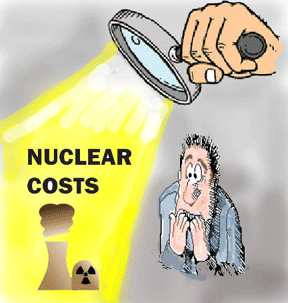
 Half of £24bn nuclear reactor investment will go to overseas suppliers More than £12bn of the UK government spend on two new power plants will go abroad, mainly to companies in France, a government adviser warns, Guardian, Terry Macalister, 7 Dec 15 More than half of the £24bn expected to be spent on the first British nuclear reactors for two decades could go abroad to foreign suppliers, a leading UK academic and government adviser has warned.
The issue is of extreme political sensitivity because George Osborne has already faced criticism for providing huge subsidies to Hinkley, which is being developed by EDF Energy of France.
It will be seriously tough for British manufacturers to meet the needs of EDF in line with the commitment that 60% of the value of the project will remain in this country,” said Sir Keith Burnett, who is a member of the Council of Science and Technology reporting to the prime minister, David Cameron.
Burnett, the vice-chancellor of Sheffield University, said that 40% of the total value of the work at Hinkley Point atomic plant would largely go to French firms.
At least £4bn worth of spending on items such as pipes and pumps – around 15% of the project by value – will be up for grabs for the UK but only if local companies can provide the higher specification supplies required by EDF. Burnett thinks that will be difficult to achieve…….
Part of the problem is that small and medium-sized British firms have not had the opportunity to supply equipment to a new nuclear power station since Sizewell C in Suffolk was completed in 1995.
The Hinkley Point C facility in Somerset is still awaiting the final investment decision from the largely state-owned EDF and its Chinese partners, although ground preparation is already under way………http://www.theguardian.com/business/2015/dec/06/nuclear-reactor-investment-pay-overseas-suppliers-hinkley-point
December 7, 2015
Posted by Christina Macpherson |
business and costs, UK |
Leave a comment
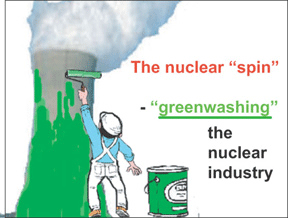
 Nuclear industry urged to woo public support for ‘low carbon, secure’ energy, Express and Star UK, 3
  Dec 15 “……Lord Hutton, chairman of the Nuclear Industry Association, launched a new drive to engage with the public as plans continue to build new nuclear power stations.
He told the association’s annual conference in London that the nuclear industry had “work to do” to help improve public awareness of nuclear power…….
“There is a world of opportunity opening up,” he said, adding that a new “concordat” launched today could help change public opinion about nuclear power.
“The industry already engages in public outreach, especially in areas where they operate, or plan to build. This can be through open public consultations or school events, but as an industry we need to get the message to a wider audience, to those people who aren’t in nuclear communities…..
The aim is to take the narrative beyond the media, by encouraging people to be proud of the sector and the work they do, having the confidence to talk to other parents in the school playground, or to family and friends.
Helping the wider public understand what nuclear is, can help change opinion about the sector.”… http://www.expressandstar.com/business/city-news/2015/12/03/nuclear-industry-urged-to-woo-public-support-for-low-carbon-secure-energy/
December 4, 2015
Posted by Christina Macpherson |
spinbuster, UK |
Leave a comment
NU CLearNews Dec 15 Last month we asked why the Government is persevering with the world’s most expensive power plant ever at the same time slashing support for renewable energy. (1) Renewable energy is going from strength to strength. Solar photovoltaics could provide the same amount of electricity as Hinkley Point C for half the subsidy cost (2) and we could have six times the power-generation capacity for the same money by investing in wind turbines instead of Hinkley. (3) Although the Government’s motivation is still a bit of a mystery – either it thinks we still need baseload; it wants to sustain a national nuclear industrial capability sufficient to maintain the UK’s nuclear-armed status; or it is prepared to pay over the odds to the nuclear industry to avoid democratising the energy industry.
This month we want to look at how likely the whole nuclear adventure is to go ahead. For all the claims that EDF’s ‘final investment decision’ on Hinkley Point C is a mere formality that will be made in a few weeks, there is more reason than ever to doubt it will go ahead anytime soon. As we pointed out last month the whole deal looks as though it’s stitched together with paperclips and sellotape and could fall apart at any moment.
Under the deal agreed with the European Commission, the Flamanville EPR project must be up and running before the guarantees come into effect. And until that time, the shareholders must provide billions in ‘contingent equity’ to cover the bondholders’ risk, protecting UK taxpayers. And if it is not operating by 2020 the guarantees will expire. (4) What this means, according to The Ecologist, is that there is now a near-zero chance of these guarantees ever actually being taken up. Under the terms of the European Commission’s decision on Hinkley, the UK Government may only be able to guarantee loans. It may not be able to underwrite equity – or capital put into the project by the shareholders. Osborne’s £2 billion promise in Beijing doesn’t appear to be able to go ahead under the terms of the EC decision.
Continue reading →
December 4, 2015
Posted by Christina Macpherson |
business and costs, politics, UK |
1 Comment
Britons seek to ban Donald Trump, eliminate nuclear weapons he might use as president,
Oregon Live, Douglas Perry 3 Dec 15 It’s beginning to look like Donald Trump really could win the Republican nomination for president, and the party’s mainstream leaders are starting to panic.
Across the pond, some Britons are way past panic. They’re rallying support to formally ban Trump from the British Isles. And, just in case the businessman/reality-TV star does become the U.S. commander in chief, there’s a separate effort from the Scottish National Party to end Britain’s Trident nuclear-weapon program, noting that the U.S. president is the de facto decider when it comes to NATO countries using nuclear weapons.
“The UK’s independent nuclear deterrent isn’t, I believe, all that independent,” SNP defense spokesman Brendan O’Hara said in Parliament last week. “In reality, it will be an American commander-in-chief who will ultimately decide, and in 18 months time that commander-in-chief could be President Donald Trump.”…….http://www.oregonlive.com/politics/index.ssf/2015/12/britons_seek_to_ban_donald_tru.html
December 4, 2015
Posted by Christina Macpherson |
UK, USA, USA elections 2016 |
Leave a comment
 Nu Clear News Dec 15 The Secretary of State for Energy and Climate Change, Amber Rudd, is living in a “fantasy world” where nuclear is affordable and fracking produces useful amounts of gas, according to Richard Dixon, director of Friends of the Earth Scotland. “Aiming to close down coal power stations is commendable but planning to replace them with a new fleet of gas-fired power stations will automatically lock us into a high-carbon power system, guaranteeing we won’t meet UK climate targets,” he added. (1)
In her “Energy Policy Re-Set” speech on 18th November, Rudd announced that the UK will close all coal-fired power plants by 2025 but they will be replaced largely with new gas and nuclear plants rather than renewables. Rudd acknowledged that gas and nuclear power generation would in effect need a government subsidy for building power plants, but insisted they were the most secure energy sources. (2) Meanwhile she is stopping support for renewable energy and energy efficiency even though (or perhaps precisely because) they are being delivered in substantial volumes.
Rudd compounded the fantasy by failing to provide any realistic policies for delivering her objectives, said reader in Energy Policy at Aberdeen University, Dr Dave Toke. (3)
The re-set speech exposed Rudd’s total failure to assemble a coherent energy strategy said Oliver Tickell writing in The Ecologist. It reveals the increasingly certain failure to meet EU renewable energy targets, proposes a new tax on wind and solar generation, and leaves the country facing the real prospect of lights going out in the next decade.
What she presented was a rag bag of missed opportunities, worn out ideas, wishful thinking, disconnected themes and downright bad news – like the prospect of a new tax on wind and solar – that only increase the chances of the ‘lights going out’. Even her headline announcement of ‘an end to coal’ was – while a clever way to confuse environmentalists – not all it seems. Coal power stations still have ten years to run under her proposals. And they would almost all have to close down within that time anyway in order to comply with EU pollution regulations.
December 4, 2015
Posted by Christina Macpherson |
politics, UK |
Leave a comment
 A former Defence Secretary has warned that the UK’s £31 billion nuclear weapon system could be shut down by hackers, Business Insider SAM SHEAD , 24 Nov 15, Former Defence Secretary Lord Browne has told the BBC that the UK’s nuclear weapon system, Trident, could be rendered obsolete by hackers.
The ex-Labour minister, who was Defence Secretary between 2006 and 2008, said “weak spots” in Trident need to be addressed — otherwise Prime Minister David Cameron won’t be able to rely on the nuclear deterrent “when he needs to reach for it.”
Trident, the UK’s nuclear programme, consists of four Vanguard-class submarines armed withTrident II D-5 ballistic missiles. It is the most powerful capability of the British military forces but at £31 billion it’s also the most expensive.
Lord Browne told BBC political editor Laura Kuenssberg that the Tory government has an “obligation” to assure MPs that all aspects of Trident have been assessed against the risk of a cyber attack and that the appropriate security measures were in place.
“If they are unable to do that then there is no guarantee that we will have a reliable deterrent or the prime minister will be able to use this system when he needs to reach for it,” he added……http://www.businessinsider.com.au/trident-at-risk-from-hack-lord-browne-nuclear-weapons-hacking-2015-11
November 25, 2015
Posted by Christina Macpherson |
safety, UK, weapons and war |
Leave a comment
Nuclear consensus comes under pressure in Commons vote, Ft.com John McDermott, Political Correspondent, 24 Nov 15 The fragility of Britain’s cross-party consensus on nuclear weapons was revealed on Tuesday in a sour debate on the renewal of the Trident deterrent, which Michael Fallon said would cost at least £6bn more than planned.
The defence secretary confirmed that the price tag for four new submarines to replace the Vanguard Class had risen to £31bn from £26bn, not including a £10bn contingency fund. David Cameron, prime minister, acknowledged on Monday that their delivery could take five years longer than planned.
Mr Fallon said there would be a vote on the principle of renewal of the submarines “next year” but that “our allies and adversaries will be watching” the Scottish National party-led debate in the Commons on Tuesday.
The debate was meant to showcase divisions in Jeremy Corbyn’s Labour party, meaning that concerns about the cost and timing of the government’s new plans were often replaced by squabbles and polemics.
Outside the Commons, however, senior defence figures raised questions about the Strategic Defence and Security Review, which Mr Cameron announced in parliament on Monday………http://www.ft.com/cms/s/0/62c6e428-92cd-11e5-bd82-c1fb87bef7af.html#axzz3sTiS5XiU
November 25, 2015
Posted by Christina Macpherson |
politics, UK, weapons and war |
Leave a comment
Boris Johnson attacks ‘disgraceful’ spending on Hinkley – just a month after David Cameron hailed the ‘flagship’ deal, Independent 21 Nov 15
Mayor of London said the estimated £18bn cost of Britain’s first nuclear power station in two decades was an ‘extraordinary amount of money’ Boris Johnson has attacked the £18bn cost of Britain’s first nuclear power station in two decades as “a disgrace” – just one month after David Cameron announced the deal and hailed it as a “flagship project of cooperation” between China and the UK.
In a surprisingly scathing criticism of the Government, Mr Johnson – who attends Mr Cameron’s political cabinet meetings and is George Osborne’s main rival to be next Tory leader – said their pledge to underwrite the deal with £2bn of taxpayers’ money was an “extraordinary amount of money to spend”.
November 23, 2015
Posted by Christina Macpherson |
politics, UK |
Leave a comment
Cracks in bricks at core of Hunterston nuclear reactor , BBC News 20 Nov 15 Cracks have been discovered in bricks which make up the core of one of two nuclear reactors at the Hunterston B power station in Ayrshire.
Operator EDF Energy said the cracks in three graphite bricks were found during planned maintenance on Reactor Three.
The firm insisted there were no safety implications and the finding had no impact on the operation of the reactor.
A similar issue – known as “keyway root cracking” was identified in Hunterston’s other reactor last year……….
‘Energy transition’
The core of the reactors is made up of thousands of graphite bricks.
The station began operating in 1976 and its working life has already been extended to 2023 – well beyond its planned closure date.
WWF Scotland director Lang Banks said the issue with cracks in both reactors emphasised the need “to embrace the clean energy transition”.
He said: “Despite the assurances given by the nuclear industry, with cracks now found in both reactors it’s clear the problem is spreading and that we can expect this facility to become even more unreliable in the future.
“News of more cracks in the country’s ageing fleet of nuclear power stations underscores why we’re right to be taking steps to harness cleaner, safer forms of energy.” http://www.bbc.com/news/uk-scotland-glasgow-west-34867312
November 20, 2015
Posted by Christina Macpherson |
incidents, UK |
Leave a comment
 Modi’s nuclear deal with Britain is hollow, but quite toxic, catch news, KUMAR SUNDARAM, 15 Nov 15
The deal
- Narendra Modi has just inked a nuclear deal with Britain
- He called it symbol of “our resolve to combat climate change’
- The deal comes when the British nuclear industry is in a crisis
The danger
- Britain has little to offer India in terms of nuclear energy
- It reinforces the myth that n-power is green, climate-friendly
- India is missing the shift from n-power to renewable energy
More in the story
- India is among the few nations on a nuclear shopping spree in the post-Fukushima world. Why?
- Nuclear energy isn’t a solution to climate change. Why is the industry peddling this myth?
Keeping to the script, Modi has just announced a civilian nuclear agreement with Britain.
The pact is largely symbolic. But it’s dangerous.
Spent force
Britain has little to offer India when it comes to nuclear energy. Its nuclear industry is facing a terminal crisis. The two power plants planned in Hinkley Point have been plagued by escalating costs, forcing the investors to abandon the project, as well as serious design risks.
Britain’s new nuclear plants in Hinkley Point are plagued by escalating costs, serious design risks
Continue reading →
November 16, 2015
Posted by Christina Macpherson |
India, politics international, UK |
Leave a comment
 Boris Johnson: Treasury is endangering community renewables, Guardian, Adam Vaughan, 12 Nov 15
Mayor of London calls on the government to reconsider plans to remove tax relief for investors in community energy projects Boris Johnson has warned the Treasury it is endangering efforts by local communities around the UK to build their own renewable energy projects.
In a letter to the financial secretary to the Treasury, David Gauke, the mayor of London and Tory MP called on the government to reconsider its proposals to remove various forms of tax relief for investors in community energy.
More than 100 green energy groups have already said the change will “decimate” the sector, which has installed community-owned solar panels on village halls, small hydro schemes on rivers and wind turbines on farms.
Johnson is concerned that “the proposals may endanger the expansion of the sector given the investment required for the upfront capital costs” and “there is a danger of unintended consequences”, wrote the deputy mayor for environment and energy, Matthew Pencharz.
The mayor also thought that while such schemes might be small individually, in aggregate they are important to the security of London’s future energy supply, and a key part of efforts to cut the capital’s carbon emissions.
The short-term nature of the tax changes – which are due to come into effect at the end of November – could also put an end to schemes that are already in development or fundraising, he said.
One high-profile scheme for a community-owned solar array in a West Sussex village that was at the centre of anti-fracking protests, has already been shelvedas a result of the Treasury’s plans, announced in the finance bill last month. A recent report found more than £100m worth of community energy projects were at risk from the changes…….http://www.theguardian.com/environment/2015/nov/11/boris-johnson-treasury-is-endangering-community-renewables
November 16, 2015
Posted by Christina Macpherson |
decentralised, UK |
Leave a comment

 Hinkley Point nuclear plan puts survival of EDF at risk, say employee shareholders http://www.theguardian.com/environment/2015/nov/13/hinkley-point-nuclear-plan-puts-survival-edf-at-risk-say-employee-shareholders
French energy firm should halt expensive UK project in which it has has nothing to gain and everything to lose, says association of employee-shareholders EDF’s £18bn project to build two nuclear reactors in Hinkley Point, Britain, is so expensive and so risky that it puts the survival of the French utility at risk, an association of employee-shareholders said on Thursday.
EDF Actionnariat salarié (EAS) said in a statement that the interests of EDF are gravely threatened by the Hinkley Point project, which it calls “a financial catastrophy foretold” in which EDF has nothing to gain and everything to lose.
“EAS asks the management of EDF to stop this risky project, whose financial risks are to big for our company and which could put EDF’s very survival at risk,” the association said.
EDF staff own 1.72% of the utility’s capital, making employees the second-largest shareholder after the state, which hold 84.5%, according to ThomsonReuters data.
Last month, EDF announced a partnership with Chinese utility CGN to build Hinkley Point, but the two companies have not yet made the final investment decision to go ahead with the project, which EDF reluctantly agreed to finance on its already stretched balance sheet after other partners pulled out.
EDF, which already has to borrow money every year to pay its dividend, faces a €55bn (£39bn) upgrade of its nuclear fleet over the next decade, will spend some €5bn to install Linky smart meters in coming years and needs to invest billions in the reactor unit of Areva, which it plans to buy next year.
Standard & Poor’s last month warned that it might downgrade EDF’s debt if it goes ahead with Hinkley Point, because of the project’s high execution risks and substantial investment needs.
November 14, 2015
Posted by Christina Macpherson |
business and costs, France, UK |
Leave a comment
 Published by Arclight2011
9 November 2015
Oped source;
http://www.europeannewweekly.wordpress.com
With some 18,000 subscribers Dana has been touted as a “leader” of the anti nuclear movement but as Fukushima 311 Watchdogs on Facebook gets some 11,000 subscribers, the Campaign for Nuclear Disarmament in the UK has some 30,000 members and this does not include a recent surge in membership from Scotland, Wales and England due to the promotion of no nuclear by The extremely popular Jeremy Corbin. I also do not include the tens of thousands Taiwanese activists, Indian activists, Japanese activists etc etc who visit many of the more moderate anti nuclear web pages and social media formats.
Dana remembered
Dana Durnsford occupies a small part of the nuclear debate. When his You Tube channel began streaming his show and saying that the west coast of Canada was a dead zone, to say the least I was a bit concerned! I was on the Rainbow Warriors on Facebook and we crowd sourced an investigation with some Canadian colleagues (including First Nations) to find out what the situation was. We quickly discovered over a couple of days that the coast was still the same as it was in previous years. This was testimony from witnesses that I have grown to trust so I was distrustful as to Danas Claims but decided to see what evidence he could supply.
Over the coming months he sought Funding for a boat and camera equipment but no radiation detectors of any sort. Further videos of people showing a thriving environment on You Tube made me doubt further the veracity of his claims. Also, his aggressive stance and lack of multiple sources for news weakened my interest and I quickly moved on.
A right to speak
My general attitude to Dana was that he was providing a service to those that thought that the effects from Fukushima were dire. Of course there are many viewpoints to the ultimate effects from the Fukushima Daichi nuclear disaster in march 2011.
My view was that there is room for debate on this issue. I also thought that the debatably entertaining way that Dana discusses nuclear matters might encourage people to learn more on the nuclear issue so the show had a more serious educational aspect to it (even though some of the science and posits might be questioned).
Sentenced to what?
So, to the issue of what might happen to Dana? The use of harassment is a thorny issue on social media. In the UK Chris Spivey was recently charged for a similar style of blogging. Leaving aside the issues on free speech for the moment I will quickly describe his present situation. 
Chris has a short suspended prison sentence hanging over him and is under instruction to not have on his website any information related to the court case (Lee Rigby) nor can he discuss this news publicly. Chris has continued his blogging as normal, still using an aggressive style but with some sensible caution. So Dana should take heart. My co host Jimmy Hagan contacted Chris Spivey for a statement and he said that if it is a first offence a prison sentence is unlikely and a suspended sentence with blogging restrictions would apply.
Of course the Pro nuclear media is trying to milk this for everything it is worth but we need to bear in mind that Dana`s views only represent a small fraction of the worlds anti nuclear campaigners. In the diverse world-wide web there is room for many opinions and views.
What learning can we all take from this?
There is an important point to be had here for bloggers more generally and that is the need for caution considering that harassment cases are an effective tool for corporate and government interests and we as bloggers should be mindful to avoid such pitfalls. We should be prepared to adapt to this sort of pressure on our freedom of speech. The main points we have to raise do not include personal attacks but science based evidence and personal testimonials and independent science research where science research is being suppressed.
How can you help Dana?
By following this link;
http://fukushimaemergencywhatcanwedo.blogspot.ie/2015/11/dana-durnford-arrested-and-charged-with.html
November 9, 2015
Posted by arclight2011part2 |
Arclight's Vision, civil liberties, UK |
26 Comments
Another option on the table is PRISM. Developed by GE Hitachi (GEH), PRISM is a sodium-cooled fast reactor that uses a metallic fuel alloy of zirconium, uranium, and plutonium. GEH claims PRISM would reduce the plutonium stockpile quicker than MOX and be the most efficient solution for the UK. The problem is, despite being based on established technology, a PRISM reactor has yet to be built, and the UK is understandably a little reluctant to commit in this direction. Seen as something of a gamble, it remains in the running alongside the currently more favoured MOX option.
Amid all the uncertainty, one thing is for sure. Regardless of what decision is taken, a proportion of the plutonium will end up as waste and will need to be safely disposed of.

 Unlike MOX and PRISM, immobilisation has no prominent industry backers. In comparison to exploiting the plutonium for our energy needs, there is no great fortune to be made from disposing of it safely. But immobilising the entire plutonium stockpile may in fact be a more economically sound approach than reprocessing
Sellafield plutonium a multi-layered problem, The Engineer UK, 6 November 2015 | By Andrew Wade “……..It takes somewhere in the region of 5-10kg of plutonium to make a nuclear weapon, so 140 tons is a slightly worrying amount to have sitting in a concrete shed in Cumbria. While everyone at the press conference was at pains to point out that there are no major safety concerns with the current storage, it is widely accepted that a long-term plan needs to be formulated. This, however, is where things get tricky. The potential energy of the plutonium if converted to nuclear fuel is massive, but there are several competing technologies vying for endorsement, none of which are well proven as financially viable.
Top of the list – and the government’s current preference – is for some application that uses mixed oxide fuel, or MOX. MOX is made by blending plutonium with natural or depleted uranium to create a fuel that is similar, but not identical, to the low-enriched uranium used in most nuclear plants today. MOX can be – and in several European countries is – used in thermal reactors alongside uranium. But despite past concerns, there is in reality no shortage of uranium today, so no huge need to supplement it with MOX in current reactors. Where MOX could in fact lead to greater efficiencies is in fast reactors, but these are costly and difficult to operate, and would not make economic sense unless the cost of uranium fell.
To complicate matters further, developing MOX is by no means a straightforward process. Continue reading →
November 9, 2015
Posted by Christina Macpherson |
Reference, reprocessing, UK, wastes |
Leave a comment
 Corbyn accuses defence chief of political bias in nuclear row, BBC News, 9 Nov 15 Jeremy Corbyn has accused the chief of the defence staff of political bias after he criticised the Labour leader’s anti-nuclear stance.
Gen Sir Nicholas Houghton told the BBC’s Andrew Marr that refusing to launch nuclear weapons would “seriously undermine” Britain’s “deterrent”.And he said he would be worried if such a view “translated into power”.
Mr Corbyn called on the defence secretary to “take action” against Sir Nicholas over his comments.
In a statement, the Labour leader said: “It is a matter of serious concern that the chief of the defence staff has today intervened directly in issues of political dispute.
“It is essential in a democracy that the military remains politically neutral at all times.
“By publicly taking sides in current political arguments, Sir Nicholas Houghton has clearly breached that constitutional principle. Accordingly, I am writing to the defence secretary to ask him to take action to ensure that the neutrality of the armed forces is upheld.”
November 9, 2015
Posted by Christina Macpherson |
politics, UK |
Leave a comment