Britain’s cost for new nuclear could buy 6 times the amount of wind energy

 For Nuclear’s Cost, U.K. Could Have Six Times the Wind Capacity, Bloomberg Reed Landberg RVLANDBERG October 21, 2015 Britain could have six times the power-generation capacity for the same money by investing in wind turbines instead of the 24.5 billion-pound ($37.9 billion) Hinkley Point nuclear reactor.
That’s the conclusion of Bloomberg New Energy Finance, a London-based researcher that estimates the cost of power from renewables in the U.K. are rivaling fossil fuels even without subsidy. Wind easily beats the more expensive nuclear plant that Electricite de France SA is building with the support of investment from China.
The findings highlights the trade-offs Prime Minister David Cameron weighed in his decision to support EDF’s bid to build the first new reactors in the U.K. in more than two decades……..
In some places, notably the U.K., wind is cheaper than nuclear. The new EDF plant at Hinkley Point will sell electricity for 92.50 pounds per megawatt-hour. That compares with lowest contract price of 79.23 pounds for supplies from onshore wind-power plants that the government awarded in February after a competitive auction.
Hinkley Point will supply 3.2 gigawatts of electricity to the grid. Spending the equivalent money on wind would give 21 gigawatts of capacity, said David Hostert, a wind energy analyst at BNEF in London.
Details emerge on UK’s nuclear deal with China
China to take one-third stake in £24bn Hinkley nuclear power station http://www.theguardian.com/environment/2015/oct/20/china-to-take-one-third-stake-in-24bn-hinkley-nuclear-power-station Details unveiled of deal signed between state-owned companies from China and France to build world’s most expensive plant on UK soil, Guardian, Damian Carrington, 20 Oct 15 China will take a one-third stake in a French-led project to build a new £24bn nuclear power station in the UK at Hinkley Point in Somerset, expected to be the most expensive ever built.
The deal was signed between state-owned companies from China and France just hours before the Chinese president, Xi Jinping , arrived in London for a state visit, and is due to be announced on Wednesday.
It will lead to a final investment decision – the point of no return – by the end of 2015, according to the Financial Times.
The companies – France’s EDF and China General Nuclear Power Corporation – will be the only investors, having failed to attract others. The new completion date for the two reactors at Hinkley Point is 2025, eight years later than first suggested. The deal is strongly backed by the chancellor, George Osborne. The government believes the new plant, which would deliver 7% of the UK’s electricity, represents good value for low-carbon electricity which, barring problems, is always on.
The plant has been promised £92 per megawatt hour (MWh) for 35 years, double today’s average wholesale electricity price, with any shortfall being paid by consumers via household energy bills. Hinkley Point will also be backed by up to £17bn of UK government loan guarantees.
The deal signed this week is also expected to mention Chinese involvement on additional nuclear plants at Sizewell in Suffolk and Bradwell in Essex. China hopes to build 110 nuclear power plants at home and wants to use its own designs at Bradwell as a showcase to help it sell its technology further afield.
But the nuclear push has many criticsover its cost, the time it takes to build and the possible threats to the UK’s national security of having China in control of a plant on UK soil. Osborne’s father-in-law, former energy minister Lord Howell, said the project was “one of the worst deals ever” for British consumers and industry.
Howell, and others, have warned the reactor design planned for Hinkley C has never been completed successfully, pointing to huge cost and time overruns at EDF’s projects at Flamanville in France and Olkiluoto in Finland .
EDF needs the Chinese investment as it is burdened with high levels of debt and is expected to sell €10bn of assets in the next five years, according to the Financial Times. Earlier in October, two of the world’s biggest ratings agencies warned the company it faced credit-rating downgrades if Hinkley Point goes ahead.
A Greenpeace poll this week showed 29% of the UK public supports the Hinkley project, with 34% against it.
A protest camp was set up outside the site this week and Alan Jeffery, a spokesman for the Stop Hinkley campaign said: “We remain mystified about why Osborne wants to throw good money after bad on this project. In the process, he has devastated the UK’s burgeoning renewable energy industry, threatening up to 20,000 jobs in the process. He is doing his best to kill off an innovative industry of the future in order to keep alive a technology of the past.”
However, the Institution of Mechanical Engineers have welcomed the Hinkley plan. “Nuclear is set to play a central and vital role in the UK’s energy future,” said the IME’s Jenifer Baxter. “Although the financial costs of nuclear power seem high, this power station will provide and modernise the diversification we so badly need in ensuring the UK’s lights stay on.”
UK government confirms that it is now subsidising nuclear industry, and cutting renewables
 Government finally admits it is subsidising nuclear – while cutting help for renewables, Guardian, Damian Carrington, 22 Oct 15 The official admission blows a hole in already bewildering UK energy plans, which back the failed and expensive over the cheap and successful.
The government confirms that it is not continuing the ‘no public subsidy policy’ [for nuclear power] of the previous administration.
That little footnote, tucked away at the end of the announcement of Wednesday’s French-Chinese deal to build a new nuclear power station at Hinkley point, detonates an atomic bomb under the UK government’s already bewildering energy policy and leaves ministers hunkered down in a nuclear bunker.
Just the day before, energy minister Andrea Leadsom said: “It is vital that industries over time stand on their own two feet. I don’t think anyone here would advocate an industry that only survives because of a subsidy paid by the billpayer.” She was justifying 87% cuts to subsidies for solar power, just as they are on the verge of becoming cheaper than gas.
The contradiction does not need spelling out. Nuclear power has had 60 years to stand on its own two feet. The admission it still needs subsidy (after five years of ministers denying precisely that) shows that traditional nuclear power can barely crawl. Whether this admission strengthens the EU challenge against the UK that it is providing illegal state aid remains to be seen.
Ministers argue that big nuclear power stations are key to energy security. Thespooks disagree, saying having a Chinese-run nuclear power station in the UK for half a century is a hostage to fortune.
Ministers also say they are committed to cutting carbon from the UK energy supply, but that protecting consumers from higher energy bills is vital. Not many would disagree, so why are ministers all but banning new onshore wind farms, the cheapest form of green energy?
It was a manifesto commitment, says the government, presumably included to appease the minority of people who oppose wind farms. On Wednesday night, the House of Lords disagreed and voted down the Conservative’s anti-wind rules.
It’s a mess. But don’t worry, say ministers, we will shortly be announcing new policies – a “reset”. Except this explodes the most precious of all commodities in the energy system: investor confidence.
“A reset is unnecessary and would create delays to investment and increase political risks,” say the energy policy experts Prof Rob Gross and Prof Jim Watson. Over 1,000 jobs have already been culled in the solar industry, with warnings of many more to come, while Leadsom was warned on Tuesday that the UK arm of an international energy company had suffered a credit rating downgrade following the government’s planned cuts to renewable subsidies…..http://www.theguardian.com/environment/damian-carrington-blog/2015/oct/22/hinkley-point-uk-energy-policy-is-now-hunkering-in-a-nuclear-bunker
UK govt trumpets nuclear deal with China, silently wages war on renewable energy
 Solar subsidies are slashed, but the sun always seems to shine on nuclear, Guardian, 20 Oct 15
Two events this week will throw the government’s contradictory attitudes to spending on green and atomic power into sharp relief. A glaring anomaly of British energy policy will be on display this week: the government will loudly trumpet a nuclear deal with China, and then will come a no-fanfare end to a controversial solar subsidy consultation.
President Xi Jinping will probably sign a heads of agreement with David Cameron that will allow the government to say that a new plant at Hinkley Point in Somerset is on its way.
The groundwork for the deal was done by George Osborne on his recent trip to Beijing, with the chancellor determined to roll away any obstacles that could halt China becoming a major investor at Hinkley – and beyond.
The chief developer of the new nuclear reactors in the south-west – the first for 20 years – is EDF, which has also been trying to woo state-owned Chinese companies to invest in the £24.5bn scheme.
Only by promising to allow the Chinese to build their own replacement plant at Bradwell in Essex have Osborne and Cameron finally won Beijing’s support for Hinkley. After that it will be up to EDF to press the final investment button and for construction to start in earnest…….
At the same time the Conservative government has been waging what looks like a determined war against solar and other renewables, highlighted by a proposed 87% cut in subsidies from 1 January on rooftop solar panel installations.
More than 1,000 jobs have been lost in the past 10 days as three major solar installers have closed their doors in anticipation that ministers will bring burgeoning demand for small solar schemes to an abrupt halt.
Unlike the warm words of encouragement and firm policy help for nuclear, there has been a relentlessly negative attack on the solar industry, which ministers have suddenly decided should now stand on its own feet. There have been constant references to hard-pressed bill payers, with the intermittent nature of solar and wind being highlighted by the Department of Energy and Climate Change against the advantages of constant power from nuclear.
These generalisations hide a different truth. Renewable energy is largely a new UK private-sector success story, where costs are falling fast and which deserves considered and time-limited support. Nuclear power is a mature technology run by state-owned companies from France and China where costs seem to constantly rise and where 35-year price commitments at double the cost of existing wholesale power should not be being given.
With power capacity margins falling so low that many warn the lights could go out this winter, you have to conclude that the government lacks competence as well as vision……http://www.theguardian.com/business/2015/oct/18/solar-subsidies-slashed-but-sun-shines-on-nuclear
Chinese firm seeking to build nuclear in UK has history of errors in construction
Errors revealed at Chinese nuclear firm seeking to invest in UK plants, Guardian, Emma Graham-Harrison, 19 Oct 15 Huge quantity of protective steel was left out of initial construction of China General Nuclear Corp’s first reactor, built close to Hong Kong in 1987. One of the Chinese nuclear power firms pushing for a stake in the UK’s energy industry left out hundreds of critical steel rods when building its first reactor nearHong Kong in 1987 because workers misread the blueprint.
The missing parts were added in a higher layer of the foundation, with extra steel to reinforce them, after the extraordinary mistake was discovered. The plant has now been operating safely for more than two decades.
But the nature and scale of the error raises serious questions about the rigour of Chinese nuclear firms and the country’s oversight regime, experts say.
“[This a prospective] partner who, when they built the first nuclear power station in China, forgot to put in a large percentage of the protective steel,” said Professor Steve Tsang, senior fellow of the China Policy Institute at Nottingham University. “Potentially we are putting ourselves in a very difficult situation.”
China General Nuclear Corp built and runs Daya Bay nuclear plant in Shenzhen. It is one of two Chinese power firms expected to invest in the UK’s Hinkley Point power station and potentially build and operate a future nuclear plant, along with China National Nuclear Corporation and French firm EDF.
Chancellor George Osborne, on a trade mission to China last month, said the government would provide £2bn in initial financing for the much-delayed project, which EDF has struggled to fund. ndustry observers believe the Chinese cash for Hinkley is conditional on allowing Chinese firms to build their own plant at Bradwell in Essex. That project would function as a showcase for Chinese technology.
“I understand what the Chinese want, which is to have a demonstration plant, to show they can build inexpensively, quickly and reliably,” said Theresa Fallon, senior associate at the European Institute of Asian Studies.
“But it’s at a time when energy is relatively inexpensive, and this plant is a bit untried technology. I understand there are rules, but there were rules in Hong Kong too when you had the problems in Daya Bay. You are not building a gazebo, it’s really dangerous, serious stuff.”
News of the problems at one of China’s first commercial nuclear power plants only reached neighbouring Hong Kong weeks after the mistake was discovered on 14 September 1987……
A leading Chinese scientist told the Guardian this year that China’s nuclear power expansion plans are “insane” because the country’s safety controls are notrigorous enough.
“China currently does not have enough experience to make sound judgments on whether there could be accidents,” said 88-year-old He Zuoxiu, who worked on China’s nuclear weapons programme. “The number of reactors and the amount of time they have been operating safely both matter.”……http://www.theguardian.com/environment/2015/oct/19/steel-rods-missing-at-chinese-nuclear-firm-seeking-to-invest-in-uk-plants
Jeremy Corbyn now vice-president of Campaign for Nuclear Disarmament
 Jeremy Corbyn named vice-president of Campaign for Nuclear Disarmament, Guardian, Matthew Taylor, 17 Oct 15
Labour leader due to address CND conference, described by organisers as the most important gathering of anti-nuclear activists in a generation. Jeremy Corbyn, the Labour party leader, is to accept a new role as vice-president of the Campaign for Nuclear Disarmament as figures show a sharp upturn in support for the organisation.
 Corbyn, who is currently vice-chair of CND, will accept the position during a two-day conference in London on Saturday. His acceptance of the role underlines his opposition to nuclear weapons in the face of criticism from within the shadow cabinet.
The Labour leader has long opposed nuclear weapons and said last month that he would tell defence chiefs never to use the Trident nuclear weapons system if he became prime minister…….
Kate Hudson, general secretary of the CND, welcomed the move and said the conference would be the most important gathering of anti-nuclear activists in a generation.
“[The] conference takes place at a moment when, for the first time in a generation, the opportunity not to replace Trident collides with a massive popular upsurge against the criminal waste and sheer anachronism of nuclear weapons,” she said.
“Austerity has led many more to question the need to spend £100bn on replacing a nuclear weapons system that doesn’t tackle the real security threats we face. Terrorism, climate change, pandemics and cyberwarfare require a fresh approach.”
CND has seen a big increase in support since Corbyn launched his election campaign. The organisation was attracting about 30 new members a month in June but now has a sign-up rate of more than 200 a month.
A spokesman said the support was still gathering pace, with more than 100 new members joining in the last seven days and thousands of non-paying supporters signing up since the summer……
The UK has four Trident ballistic missile submarines, and a final decision about whether to replace them is due to be taken in 2016. Previously both the Labour and Tory leaderships were committed to replacing the fleet, a project that is likely to cost well over £100bn over its 30-year lifespan. But now Corbyn has committed Labour to a review of its Trident policy, to be headed by Eagle.
Hudson welcomed Labour’s stance and said the anti-nuclear campaign would continue to gather momentum in the coming months. “Our own organisation has experienced its own surge in membership and we’re preparing for a major national Stop Trident demo ahead of the parliamentary decision in 2016,” she said. http://www.theguardian.com/politics/2015/oct/17/jeremy-corbyn-vice-president-campaign-nuclear-disarmament
Hinkley deal raises fears about China’s power over Britain’s nuclear project
 Security fears over China nuclear power deal, BBC News, 17 Oct 15 Downing Street is playing down security fears about plans to give China a stake in Britain’s nuclear power industry.
A final decision on the new nuclear plant at Hinkley Point, Somerset, could be announced next week during Chinese president Xi Jinping’s state visit.
Security sources have told The Times the scheme poses a threat to national security – and a senior Tory MP has called for an inquiry.
But No 10 said it would not sign the deal if it thought security was a risk.
Chancellor George Osborne has already announced a £2bn government guarantee to secure Chinese funding for the Hinkley Point C nuclear power station, to be jointly built with French energy giant EDF at an estimated cost of £24.5bn.
The final go-ahead for the deal could be announced next week – paving the way for a second new reactor to built by the Chinese and French consortium at Sizewell, in Suffolk.
If an agreement is reached, work could then start on the first Chinese-designed and built nuclear reactor in Europe, at Bradwell, in Essex, where a previous British-built reactor is in the process of being decommissioned.
How concerned should we be?………….
Construction of the first Hualong One reactor began in May in China’s Fujian province, according to World Nuclear News.
Gaining regulatory approval from the UK authorities for the design would be a major boost to the Chinese National Nuclear Corporation’s hopes of exporting the technology around the world.
‘Trapdoors or backdoors’
But senior UK defence and security sources reportedly are concerned that the state-controlled company, which helped develop China’s nuclear weapons, poses a national security risk.
They fear “trapdoors or backdoors” could be inserted into IT systems, allowing Beijing to bypass British security measures……..
‘Fait accompli’
Bernard Jenkin, Conservative MP for Harwich and North Essex, where the Bradwell plant would be built, has called for the government to produce a “comprehensive assessment of the national security implications” of the Chinese scheme……..http://www.bbc.com/news/uk-politics-34549478
Together Against Sizewell C (TASC) plan legal action against Hinkley nuclear power project
 Anti-nuclear group legal threat against Hinkley power plant, http://www.westernmorningnews.co.uk/Anti-nuclear-group-legal-threat-Hinkley-power/story-27984093-detail/story.html By WMN_PGoodwin October 14, 2015 Britain’s first new nuclear power station for 20 years, in Somerset, will waste billions of pounds without solving the country’s energy needs, a new report claims.
Hinkley Point C is expected to supply 7% of the UK’s electricity needs – powering around six million homes – and create thousands of jobs locally and more widely in the nuclear industry across the UK. The £20 billion scheme could get the green light next week when Chinese president Xi Jinping arrives in London on a state visit which could see a massive investment in the reactor agreed.
French state-owned energy firm EDF, who are behind the project, and the British Government have been hoping the president will visit the site which has been prepared next to the two existing nuclear power stations on the Bristol Channel.
TASC is threatening to take legal action if the Government fails to review its national policy statements for energy. Using data from the Department for Energy and Climate Change (DECC) the TASC study says every alternative to nuclear would “without exception” be an improvement, costing less, preventing power cuts, causing less pollution and meeting emissions targets.
Local campaign Stop Hinkley welcomed publication. Spokesman Roy Pumfrey added: “There are plenty of ways of providing our energy needs which are cheaper than any Government scenario for energy involving nuclear power.“The total savings to the UK economy of going for much more energy saving instead could be very large indeed and more successfully reduce greenhouse gases and provide energy security. “Nuclear power only hampers the achievement of these objectives.”
The construction came a step closer last month when Chancellor George Osborne approved an initial Government guarantee worth £2 billion for the proposed plant during a visit to China. Mr Osborne said that new nuclear power was “essential” to ensure the lights stay on as ageing nuclear and coal plants are retired.
Britain fawns over Xi Jinping – preparatory to China taking over UK’s nuclear industry
Why is Xi Jinping getting a royal reception in Britain? eji insight, Mark O’Neill, 15 Oct 15 “………..Britain wants to become the preferred European country for Chinese investment, state and private, and London the city where Chinese firms build their European headquarters and do business in renminbi.
Top of the agenda is Hinckley Point C, Britain’s first new nuclear power station for several decades, with a total cost of 24.5 billion pounds (US$37.9 billion). It will be the first of three such new plants.
For months, there have been intensive talks between Electricite de France (EDF) Energy, China National Nuclear Corp. and China General Nuclear Corp. Early this month, Vincent de Rivaz, head of EDF Energy, said he hoped the two Chinese firms would take a 40 per cent stake in the project, with an agreement to be signed during Xi’s visit. The project is backed by the governments of Britain, France and China.
But EDF and the two Chinese firms have been arguing over their respective shares and the financial burden they will take on.The next nuclear project is Bradwell in Essex with 1,000 megawatts; China is expected to take the lead role and take a majority stake.
The two plants are very capital-intensive, requiring enormous investment before the investors receive a return.
In western countries, nuclear plants are controversial and are vulnerable to a second Fukushima disaster.
These would be the first nuclear stations built by China in a western country and make it a front-line competitor with Areva, the world’s largest builder of nuclear power stations. Areva posted a loss of 4.8 billion euros (US$5.5 billion) last year.
China may take an equity stake in the ailing French firm. Osborne has promised a taxpayer guarantee of 2 billion pounds if Xi puts Chinese money into the Hinckley project………http://www.ejinsight.com/20151015-why-xi-jinping-getting-royal-reception-britain/
Overwhelming costs of Britain’s Trident nuclear submarines – cannot be measured
The Conservative government has not given an up-to-date estimate of the program costs. Previously, it has said the submarines would cost between £11 billion and £14 billion at 2006 prices and estimated an overall cost of up to £20 billion when infrastructure and other costs are wrapped in……….
The Labour Party, the main opposition party, has previously been committed to a credible nuclear deterrent, but the recent election of the left-winger Jeremy Corbyn as the party leader has thrown that policy into confusion…….
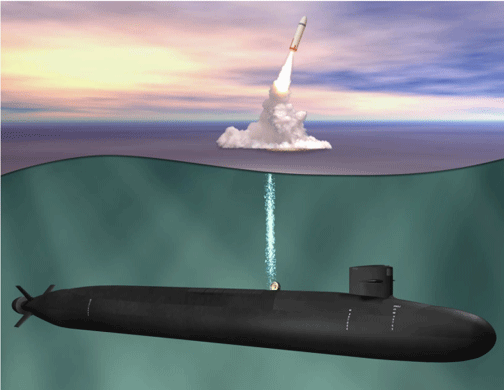 Nuclear Sub Project Poses UK’s Biggest Financial Challenge, Defense News By Andrew Chuter October 15, 2015 LONDON — Britain’s nuclear submarine effort is a monster-sized undertaking that keeps the Ministry of Defence’s top civil servant awake at night, the official admitted to the Parliamentary Public Accounts Committee Wednesday.
Jon Thompson, the permanent undersecretary at the MoD and the man responsible for keeping defense spending in check, told lawmakers that renewing Britain’s nuclear deterrent was the biggest project the ministry was ever going to tackle.
“The project I worry about the most in relation to future financial risk is the nuclear enterprise. It’s a significant element of the overall equipment plan … it most keeps me awake at night,” he told the committee during a session examining the MoD’s progress in improving financial management.
The defense nuclear enterprise covers the equipment, infrastructure and people required to deliver the UK deterrent and nuclear powered submarines, including the new Astute-class hunter killer boats and Trident missile boats. Continue reading
UK’s Hinkley C nuclear plan is not only a financial disaster: it fails on other counts too
Hinkley C’s claimed benefits evaporate under scrutiny http://www.theecologist.org/blogs_and_comments/commentators/2985648/hinkley_cs_claimed_benefits_evaporate_under_scrutiny.html Paul Dorfman 6th October 2015 To explain their desperation to commit an estimated £76 billion of public money to the Hinkley C nuclear project, writes Paul Dorfman, the Treasury and its Chancellor, George Osborne, claim there are other benefits that justify this vast expenditure. So what exactly are they? And do the claims survive critical examination?
So much has been written about the plan to build two new EDF reactors at Hinkley Point that you might think that it’s all been said [1].
So far, the main focus has been on the cost of the thing – but money is really only just part this nuclear deadlock.
Of course, Osborne knows Hinkley is much, much too expensive. That battle has been fought, and he lost it some time ago.
But the real nuclear war has just begun – as, when pushed, Osborne, the Treasury and DECC all say that the big picture is really about a rats nest of issues facing the UK energy market.
These are: security of supply; diversity of supply; decarbonisation – all set in the context of electricity price stability and affordability. So let’s take a look at each in turn and see if any make sense – just to make sure.

Security of supply
Osborne says that we need a secure supply of nuclear baseload electricity. But Steve Holliday, CEO of National Grid, the company that operates the power transmission networks in the UK and in the northeastern US, says the idea of large nuclear power stations to be used for baseload power is outdated:
“The world is clearly moving towards much more distributed electricity production and towards microgrids. The pace of that development is uncertain. That depends on political decisions, regulatory incentives, consumer preferences, technological developments. But the direction is clear.” [2]
And unlike Germany, who are cutting consumption, Osborne’s energy policy is based on the assumption that there will be increasing energy supply demand. But is he really unaware that since 2005 overall energy use in the UK has fallen by 18%?
Just in the last year, even while GDP grew by 2.8%, energy sales fell by 6.6%. In fact, we are now using 5% less energy than 50 years ago, even though our wealth has practically tripled. So serious energy efficiency policy scenarios show that the UK economy could flourish whilst using significantly less energy.
Osborne says that Hinkley is needed to ‘stop the lights going out’ – yet any ‘generation gap’ is already forecast by Ofgem before 2020. So the real security of supply challenge happens well before Hinkley could begin generation.
Putting aside the inevitable construction cost and time over-runs, the fact is that Hinkley wont make it on-time to help with our security of supply problem – since, according to EDF, it’s not supposed to come on-line until 2024 at the very earliest, and that date is looking more and more optimistic.
And there’s a misconception that all except one of the UK’s eight nuclear power plants will be closed in 2024. Rather, EDF, the owner of most of them, say that five of their seven operating UK reactors will continue to 2027-31 and even longer.
Diversity of supply
There is good evidence to predict that UK onshore wind and PV will be at zero operational cost by 2025, and offshore wind will have a far lower operational cost than nuclear [3]. In response, Osborne says he doesn’t prefer nuclear, its just that he needs it for a balanced portfolio of power sources.
But the flip side to investment in Hinkley is low investment in renewable energy generation. This is because the government Levy Control Framework imposes a strict cap on low carbon energy financed from the public purse (from levies on the bills of energy consumers) [4].
And because the government will be contractually obliged to provide on-going State Aid for the incredibly long 35 year Hinkley contract, there will simply be very little money left over for renewables – as the Levy Control Framework budget will have been already consumed by nuclear.
So Hinkley will crowd out investment in renewables. Greedy nuclear will have ‘eaten all the pies’ before renewables get a look in, and progress towards achieving overall targets for low-carbon renewable energy will inevitably falter.
All this being so (which it is), we can see why the government has been chopping and slashing at UK renewable funding, and why there is widespread concern at the failure to consider a purposeful energy efficiency stimulus for real diversity of supply.
Decarbonisation
Ramping climate change means we need to de-carbonise quickly. Osborne has reframed nuclear as a response to climate change. But Hinkley, together with its radioactive waste stores, including spent fuel, will be sited on the coast, increasingly vulnerable to sea-level rise, flooding and storm surge from climate change.
Sorry to say that, as the UK Institute of Mechanical Engineers state: “Nuclear sites based on the coastline may need considerable investment to protect them against rising sea levels, or even abandonment or relocation in the long term.” [5]
Osborne maintains that nuclear is low-carbon. Yet serious analysis shows that, factoring in the full nuclear life-cycle from uranium mining, through transport, fuel enrichment, plant construction and operation, decommissioning and waste management, nuclear CO2 emissions have a mean value of 66g CO2e/kWh.
That’s significantly higher than for wind (2,8-7,4 g/kWhel), hydropower (17-22 g/kWhel), photovoltaic (19-59 g/kWhel), and energy efficiency measures (which are at least ten times more cost effective) [6].
Affordability and price stability
Osborne says Hinkley is good value. But it’s difficult to comprehend how Hinkley might contribute to affordability, price stability and least-cost for the UK energy consumer.
In fact, Hinkley would be the most expensive piece of nuclear kit ever built [7], and the agreed price for its electricity must inevitably lead to significantly higher prices for the UK energy consumer [8].
However, it does remain true that the deal would prove very profitable to French and Chinese nuclear corporations during the lengthy 35-year Contract period, including the very generous proposals for an inflation-indexed deal.
Essentially, all this means that the Government is willing to add £19 billion to the deficit, and will impose £2 billion/year on the energy bills of hardworking families in order to support Chinese and French state owned industries provided wholesale electricity prices do not fall, in which case the imposition on bills will be even greater.
Signed, sealed, delivered?
Osborne says he will sign a deal with the Chinese President Xi JinPing in late October 2015. But there are problems for the boyish Chancellor. The governments of Austria and Luxembourg, and six German Stadtwerke have launched a legal challenge through the EC Court of Justice [9].
They say that UK nuclear State Aid subsidies runs counter to EU Law. Whatever the outcome, based on the average time-spans of similar cases, this legal action is likely to delay Hinkley for three to four years [10]. In any event, how on earth can any real decision about Hinkley be made when it’s subject to a serious European governmental law suit?
Also, it’s become clear that EDF have been aware for some time of critical anomalies in the EPR reactor planned for Hinkley [11]. France’s nuclear safety regulator, ASN, are still carrying out critical tests on ‘serious’ flaws in the steel housing in the reactor core – and if there’s one place you don’t want any flaws it’s the reactor pressure vessel itself.
So how can Osborne come to any decision about Hinkley before these fundamentally important, critical safety tests are carried out, and the results anaysed?
This means that, for key legal and technical safety reasons, anything Osborne may or may not sign just wont be sealed or delivered. On top of this, it’s clear that Osbornes ‘big arguments’ for Hinkley just don’t stack up. It won’t make a timely contribution to UK security of supply or decarbonisation, and won’t contribute to affordability, price stability and least-cost for the UK energy consumer.
The development of diverse, sustainable and affordable low carbon energy is a growing economic sector with huge potential for job creation in the UK.
To limit this diversity for political face-saving reasons through inflexible and costly support of nuclear power, at the expense of other, more flexible, safe, productive, cost-effective and affordable technologies seems, at the very least, unwise.
Dr Paul Dorfman is Honorary Senior Research Fellow at the Energy Institute, University College London (UCL); Joseph Rowntree Charitable Trust (JRCT) Nuclear Policy Research Fellow; Founder of the Nuclear Consulting Group (NCG); Executive Board Member of the International Nuclear Risk Assessment Group (INRAG).
References
How UK govt helped the nuclear industry hide the truth on the Fukushima catastrophe
 Revealed: British government’s plan to play down Fukushima Internal emails seen by Guardian show PR campaign was launched to protect UK nuclear plans after tsunami in Japan
Internal emails seen by the Guardian show how the business and energy departments worked closely behind the scenes with the multinational companiesEDF Energy, Areva and Westinghouse to try to ensure the accident did not derail their plans for a new generation of nuclear stations in the UK.
“This has the potential to set the nuclear industry back globally,” wrote one official at the Department for Business, Innovation and Skills (BIS), whose name has been redacted. “We need to ensure the anti-nuclear chaps and chapesses do not gain ground on this. We need to occupy the territory and hold it. We really need to show the safety of nuclear.”
Officials stressed the importance of preventing the incident from undermining public support for nuclear power.
The Conservative MP Zac Goldsmith, who sits on the Commons environmental audit committee, condemned the extent of co-ordination between the government and nuclear companies that the emails appear to reveal.
“The government has no business doing PR for the industry and it would be appalling if its departments have played down the impact of Fukushima,” he said.
Louise Hutchins, a spokeswoman for Greenpeace, said the emails looked like “scandalous collusion”. “This highlights the government’s blind obsession with nuclear power and shows neither they, nor the industry, can be trusted when it comes to nuclear,” she said…….
Tom Burke, a former government environmental adviser and visiting professor at Imperial College London, warned that the British government was repeating mistakes made in Japan. “They are too close to industry, concealing problems, rather than revealing and dealing with them,” he said.
“I would be much more reassured if DECC had been worrying about how the government would cope with the $200bn-$300bn of liabilities from a catastrophic nuclear accident in Britain.”……http://www.theguardian.com/environment/2011/jun/30/british-government-plan-play-down-fukushima
Britain’s national embarrassment – the failing Hinkley nuclear white elephant
 The Hinkley Saga is a National Embarrassment no2 nuclear power nuCLEARnews No 78 October 2015 Two of the world’s biggest ratings agencies have warned that EDF and its Chinese partners face credit-rating downgrades if they press ahead with the £24.5 billion Hinkley Point C nuclear project, according to The Times. And the Chinese appear to be refusing to take a 40% equity stake in the project – opting instead for 30% or less.
UK’s new National Infrastructure Commission – first casualty may be Hinkley nuclear
The National Infrastructure Commission nuCLEAR news No 2 nuclear power October 15 At the Conservative Party Conference George Osborne announced the establishment of a National Infrastructure Commission (NIC). (1) It looks as though this will take control over the entire energy policy brief out of the Department for Energy and Climate Change.
Oliver Tickell, writing in the Ecologist, asks if this could be a way out of the Hinkley C debacle for the Government. (2) Osborne told the Conference that he wants the NIC and its chairman Lord Adonis to begin work immediately: “to make sure Britain has the energy supplies it needs.” Tickell says: “It was notable that in his speech on Monday Osborne had absolutely nothing to say about nuclear power or Hinkley C – even though he had only just returned from a trip to China to drum up controversial Chinese investment in Hinkley C and other nuclear power stations.
That could reflect that fact that there is still no agreement over key elements of the proposed deal. Meanwhile questions proliferate – over safety fears, ballooning costs, why the UK energy consumer should be financing the Chinese Communist Party, and the wisdom of having the very company that makes China’s nuclear weapons running nuclear plants in the UK.”
 The first casualty of handing over decisions about energy to the NIC, which is answerable to the Treasury, could be Hinkley Point C. The Treasury’s information page on the NIC indicates some welcome strategic thinking on energy – something that has been almost entirely lacking in recent government policy. “The UK’s power sector has a growing problem in matching demand and supply, meaning that keeping the lights on requires a level of redundancy in the system – generation which is not always used.
The NIC will look at how to optimise solutions to this problem, including through large scale power storage – where innovation is needed to bring down costs; demand management – how to incentivise flexibility in demand so we don’t need as many power stations; and interconnection – how we best link the UK to the markets in the rest of Europe.” (3) ……..http://www.no2nuclearpower.org.uk/nuclearnews/NuClearNewsNo78.pdf
Dangers of UK-China plan for nuclear power at Bradwell Estuary
 Will Bradwell get a Chinese Reactor? nuCLEAR news No 2 nulcear power October 2015 It is now pretty clear that David Cameron will sign an agreement with the Chinese Government, at the time of the State Visit of President Xi Jinping on 20th October, that will enable two Chinese state-owned nuclear companies to develop the site at Bradwell which is currently owned by EdF, says the Blackwater Against New Nuclear Group. (BANNG)
The development could happen rather quicker than anyone might have imagined, says the group because of the financial problems and delays with Hinkley Point. “Cameron’s folly means the sacrifice of the Blackwater estuary,” said Professor Andy Blowers, Chair of the Blackwater Against New Nuclear Group (BANNG). “Basically, the estuary will be trashed if this goes ahead.”
“This love-in between the British and Chinese Governments takes absolutely no account of the impact and implications that will be unleashed on the Blackwater estuary. The obstacles, including the problems of cooling water from such a shallow estuary, are massive”. Barry Turner, Vice Chair of BANNG, commented: “For BANNG, the simple fact is that the Bradwell site is totally unsuitable for a new power station no matter who the developer might be.
The delicate Blackwater estuary cannot cope with the demands of a new nuclear power station without its effective destruction. The long-term risks from rising sea-levels and coastal change will be phenomenal leaving not only a power station with all its inherent dangers but an everlasting residue of dangerous radioactive wastes on a site that is likely to disappear over the next two centuries. There is no thought for the future in this and it is immoral to be undertaking such an enterprise on such a location.
Bringing such a monster to the Blackwater is nothing short of monstrous”. In return for helping out with the increasingly expensive Hinkley Point plant in Somerset, the Chinese have been told they can use the site of an old nuclear power station at Bradwell-on-Sea, on the Blackwater estuary, to build a reactor of their own design. “I am not worried about the Chinese. I am worried about us”, says Charles Clover writing in the Sunday Times.
For it is an open question whether British standards of regulation are up to the expectations of people who live in places such as West Mersea, just across the water from Bradwell. “We have some excellent regulations in Britain, but the problem is that all too often we choose to ignore them. I believe the public can live with the risks of the nuclear industry as long as there is transparency, and that there is not an instant return to the culture of secrecy and political influence over regulators that some of us remember from Sellafield in the bad old days. For if we wish to have both electricity and oysters, the problem is ourselves, not the Chinese.” (2) A peaceful protest including a flotilla of boats was held on Mersea Island by campaigners on 4th October. (3)…. http://www.no2nuclearpower.org.uk/nuclearnews/NuClearNewsNo78.pdf
1 This Month





PLEASE OPPOSE HR 8255 AND S.3639 – bills would accelerate satellite deployment, with no environmental review or safeguards – https://ncstd5li.quorum.us/campaign/169331/
To see nuclear-related stories in greater depth and intensity – go to https://nuclearinformation.wordpress.com
-
Archives
- October 2026 (49)
- September 2026 (339)
- August 2026 (330)
- July 2026 (355)
- June 2026 (287)
- May 2026 (306)
- April 2026 (356)
- March 2026 (251)
- February 2026 (267)
- January 2026 (308)
- December 2025 (358)
- November 2025 (359)
-
Categories
- 1
- 1 NUCLEAR ISSUES
- business and costs
- climate change
- culture and arts
- ENERGY
- environment
- health
- history
- indigenous issues
- Legal
- marketing of nuclear
- media
- opposition to nuclear
- PERSONAL STORIES
- politics
- politics international
- Religion and ethics
- safety
- secrets,lies and civil liberties
- spinbuster
- technology
- Uranium
- wastes
- weapons and war
- Women
- 2 WORLD
- ACTION
- AFRICA
- Atrocities
- AUSTRALIA
- Christina's notes
- Christina's themes
- culture and arts
- Events
- Fuk 2022
- Fuk 2023
- Fukushima 2017
- Fukushima 2018
- fukushima 2019
- Fukushima 2020
- Fukushima 2021
- general
- global warming
- Humour (God we need it)
- Nuclear
- RARE EARTHS
- Reference
- resources – print
- Resources -audiovicual
- Weekly Newsletter
- World
- World Nuclear
- YouTube
-
RSS
Entries RSS
Comments RSS

