Jeremy Corbyn could scrap UK’s nuclear weapons, in deal with Scottish National Party
 Jeremy Corbyn suggests he could SCRAP Britain’s nuclear weapons as the SNP demands he ‘gets rid’ of Trident missiles to win its backing in a government coalition, Daily Mail Labour leader said he wanted to add ‘realism’ to nuclear non-proliferation treaty Jeremy Corbyn suggests he could SCRAP Britain’s nuclear weapons as the SNP demands he ‘gets rid’ of Trident missiles to win its backing in a government coalition, Daily Mail Labour leader said he wanted to add ‘realism’ to nuclear non-proliferation treaty
By DAVID WILCOCK, WHITEHALL CORRESPONDENT FOR MAILONLINE 18 November 2019 Jeremy Corbyn today suggested he would be prepared to give up the UK’s nuclear weapons after the SNP signalled it would be part of their price for propping up his future government. The Labour leader said he wanted to add ‘realism’ to the nuclear non-proliferation treaty (NNPT), with discussions about ‘every country’s nuclear weapons’. He also had a dig at Nato, disagreeing with a claim last week by General Sir Nick Carter, the professional head of the British Army, that the alliance was the most successful in history. His BBC interview came after the Scottish National Party’s Westminster leader Ian Blackford had said the upcoming election was ‘an opportunity to get rid of Trident’ – the UK’s atomic missile system…… The SNP has made removing Britain’s nuclear submarine fleet – based on the Clyde – out of Scotland a mainstay of its party policy. And Mr Corbyn, a former chairman of the Stop the War Coalition, has long opposed Britain’s nuclear weapons programme…. https://www.dailymail.co.uk/news/article-7694603/Now-SNP-demands-Jeremy-Corbyn-scrap-Britains-NUCLEAR-WEAPONS-win-votes-coalition.html |
|
Likely delay in clean-up of radioactive contamination at Dalgety Beach
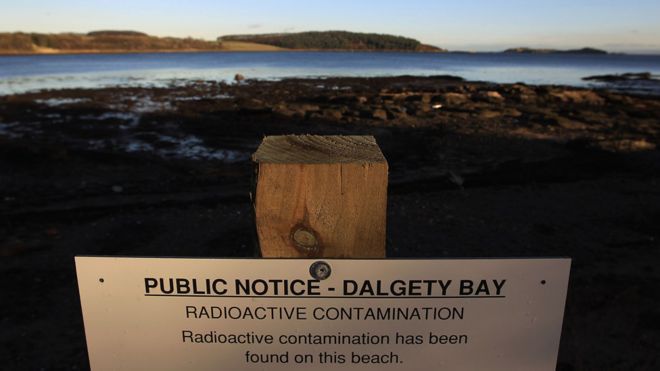
STV 13th Nov 2019, A clean-up operation to deal with radioactive contamination at a Fife beachis being held up by local landowners. Thousands of radioactive particles have been found on the shore at Dalgety Bay since 1990.
The objects are believed to come from eroded landfill that contains debris from Second World War aircraft that originally had radium dials. Stephen Ritchie told councillors: “We actually have had cabinet approval, ministerial approval – we have all the funding we need and authority to proceed. “However, the local stakeholders are dragging their feet. ”
We can’t get on the land to clean up the waste without the landowners’ permission. “There are four stakeholders for the area – one of which is the Crown, which is obviously not an issue. However, the other three have been dragging their feet.” Mr Ritchie told councillors that the MoD were looking to award the contract to a company to remove the waste by December 13, but if talks continued to stall, they could miss their window and the project would be delayed,meaning that the clean-up might not be able to happen in 2020.
https://stv.tv/news/east-central/1442361-work-to-clean-up-radioactive-beach-delayed-by-landowners/
New type of uranium nuclear fuel has safety risks
 Nuclear fuel alternatives after Fukushima have challenges ahead, https://www.manchester.ac.uk/discover/news/nuclear-fuel-alternatives-after-fukushima-have-challenges-ahead/ 15 Nov 19, Nuclear fuel alternatives after Fukushima have challenges ahead, https://www.manchester.ac.uk/discover/news/nuclear-fuel-alternatives-after-fukushima-have-challenges-ahead/ 15 Nov 19,
Research at The University of Manchester suggests that the preferred candidate fuel to replace uranium oxide in nuclear reactors may need further development before use. Dr Robert Harrison led the research, published in the journal Corrosion Science, with colleagues from the University and the Dalton Nuclear Institute. “Since the 2011 Fukushima accident,” explains Dr Harrison, “there has been an international effort to develop accident tolerant fuels (ATFs), which are uranium-based fuel materials that could better withstand the accident scenario than the current fuel assemblies.” One of these ATFs is a uranium silicon compound, U3Si2. This material conducts heat much better than the traditional uranium oxide fuels, allowing the reactor core to be operated at lower temperatures. In an emergency situation, this buys more time for engineers to bring the reactor under control. However, there are many unknowns about how U3Si2 will behave in the reactor core. “One of these unknowns,” says Dr Harrison, “is how it will behave when exposed to high temperature steam or air, as may happen during manufacturing or a severe accident during reactor operation.” To investigate just how accident tolerant ATFs are, Dr Harrison and his colleagues investigated how Ce3Si2 – a non-radioactive material analogous to U3Si2 – behaved under exposure to high-temperature air. Using advanced electron microscopy techniques, available at The University of Manchester Electron Microscopy Centre (EMC), the researchers were able to study the reaction products after Ce3Si2 was exposed to air at temperatures of up to 750oC. They discovered the material was prone to forming nanometre sized grains of silicon and silicon oxide, as well as cerium oxide. These nano-grains may allow for enhanced corrosion of the fuel material or the escape of radioactive gasses formed during reactor activity. This is because the formation of nano-grains creates more grain boundary areas – interfaces between grains, which provide pathways for corrosive substances or fission gases to migrate along. “Similarly,” adds Dr Harrison, “it would also allow for hazardous gaseous fission products produced during the splitting of uranium (such as xenon gas that would normally be trapped within the material) to diffuse out along these grain boundaries and be released, which would be potentially harmful to the environment.” While Dr Harrison stops short of saying that these ATFs are more unsafe under accident conditions than the current fuels they are looking to replace, he would argue they are currently not any better, and “aren’t as tolerant to accident conditions as once hoped”. Dr Harrison concludes “However, with the new insight developed in this work it will be possible to develop and engineer ATF candidates to better withstand these accident conditions, perhaps by adding other elements, such as aluminium, or manufacturing composite materials to give higher protection of the fuel material”. The full title of the paper is “Atomistic Level Study of Ce3Si2 Oxidation as an Accident Tolerant Nuclear Fuel Surrogate”, and the DOI is 10.1016/j.corsci.2019.108332
|
|
A UK Labour govt would make ‘collective’ decision over use of nuclear weapons?
|
General election: Labour government would make ‘collective’ decision over use of nuclear weaponsEmily Thornberry, the shadow foreign secretary, says Labour would maintain ‘ambiguity’ over circumstances in which Trident deterrent might be used , Independent Andrew WoodcockPolitical Editor @andywoodcock, 11 Nov 19
A Jeremy Corbyn-led Labour government would make a “collective” decision on whether to use nuclear weapons in response to an imminent threat, the party’s shadow foreign secretary has said. Emily Thornberry came under fire from Conservatives after suggesting that Mr Corbyn would share the decision on whether to press the nuclear button with senior colleagues. Labour’s official policy is to retain the UK’s independent Trident deterrent, but the party leader has previously said that he would not be willing to use nuclear weapons…… https://www.independent.co.uk/news/uk/politics/general-election-labour-nuclear-weapons-trident-corbyn-thornberry-deterrent-a9198881.html |
|
Scottish National Party could want scrapping of Trident nuclear system, in return for co-operating with minority Labor government
Questioned about whether the issue of Trident would stop the SNP holding negotiations with another political party in the case of a hung parliament, Mr Blackford said the SNP had been “pretty consistent” that they did “not wish to see nuclear weapons” on Scottish soil.
He explained how his party would “come up with a wish-list” of policies they would want to secure for a potential confidence and supply deal with a future UK Government…….
The SNP’s parliamentary candidate for Ross, Skye and Lochaber described Britain’s nuclear arsenal as “not fit for purpose,” explaining: “The simple fact of the matter is I’m not sure that we’re taking our responsibilities for conventional defences as seriously as we should be doing and to waste up to £200 billion on these weapons of mass destruction that can never be used is a fallacy.”
During campaigning last week, Nicola Sturgeon made clear she wanted nuclear weapons removed from Scotland “as soon as it is safely possible”. The First Minister explained: “When we’re talking about nuclear weapons, safety has to be the primary consideration but the SNP is implacably opposed to nuclear weapons.”
The First Minister explained: “When we’re talking about nuclear weapons, safety has to be the primary consideration but the SNP is implacably opposed to nuclear weapons.”……..
Although Jeremy Corbyn is well-known as being personally opposed to Britain retaining nuclear weapons and Scottish Labour has come out against Trident, the UK Labour Party backs the policy and included support for renewing the nuclear arsenal in its last manifesto……. https://www.heraldscotland.com/news/18026979.blackford-signals-scrapping-trident-part-snp-wish-list-support-corbyn-govt/
Boris Johnson and the UK plan for nuclear fusion
Boris Johnson’s nuclear energy pledge backed by UK firm with ‘answer to world’s problem’ By CALLUM HOARE. Express UK, Nov 5, 2019 A UK firm has pledged to build on Boris Johnson’s plans to take the “big step” in treading the path for nuclear energy which the Prime Minister claimed will be on sale “around the world” during the Conservative Party conference in Manchester.
The only thing that’s going to restrict us is capital.
“To an investor – no one wants to invest in fusion for safety, it’s very high risk – don’t worry about cracking fusion, it’s about cracking the finance.”
Pulsar Fusion recently opened up the UK’s biggest nuclear fusion centre in a secret location near Bletchley, Buckinghamshire.
Mr Dinan is confident his company will, during the next few months, create matter hot enough to replicate the temperature of the Sun in the UK.
A vacuum chamber will form the heart of the reactor and it is claimed it could soon reach temperatures above 100 million degrees Celsius.

UK firms given £18m for mini nuclear power stations

|
Firms handed £18m for mini nuclear power stations, Construction Enquirer , Aaron Morby, 8 Nov 19,
A consortium including BAM Nuttall and Laing O’Rourke has netted Government match funding to develop the next generation of compact nuclear power stations. The new small-scale power stations are being designed to be manufactured in sections in regional factories, before being transported to existing nuclear sites for rapid assembly inside a weatherproof canopy…… Firms involved include: Assystem, BAM Nuttall, Laing O’Rourke, National Nuclear Laboratory, Rolls-Royce, Atkins, Wood, The Welding Institute and Nuclear AMRC. The consortium ultimately aims to generate a joint investment of £500m focused on designing a first-of-its-kind small modular reactor, which would form the core of the new compact plants…… https://www.constructionenquirer.com/2019/11/08/firms-handed-18m-for-mini-nuclear-power-stations/ |
|
Small nuclear power station consortium targeting Cumbrian sites
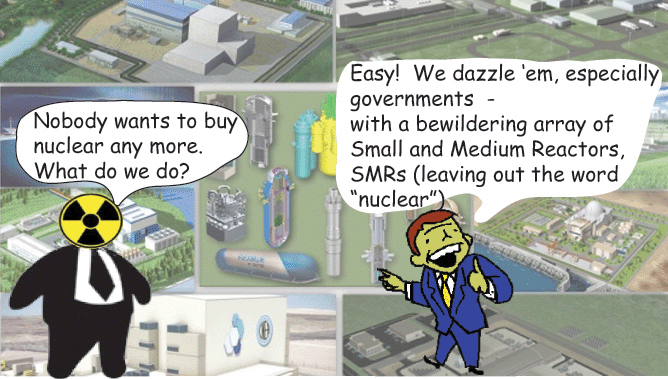 Small nuclear power station consortium targeting Cumbrian sites, The Mail 7th November, By Luke Dicicco @lukeadicicco Group business editor A consortium headed by engineering giant Rolls Royce has revealed it expects to develop its first-of-a-kind small nuclear reactors in Cumbria.
In July the Government said it will invest up to £18 million to support the design of the UK-made mini nuclear power stations. And this week UK Research and Innovation pledged to provide a further £18m, which will be matched by members of the consortium, to progress the project.
Both the Conservative Parliamentary Candidate for Copeland Trudy Harrison and Copeland Borough Council have vowed to up the ante on lobbying the Government to push for SMRs to be developed in Copeland, following the demise of plans for a large-scale nuclear power station at the Moorside site. ……
“We expect to build them on sites in Wales and particularly in Cumbria. That’s where we’re focusing, that’s where we’ll put our effort.”- Mr Woods …..
The SMRs are roughly the size of a one-and-a-half football pitches……..Construction is expected to take around four years per station, although the first unit would be longer, said Mr Woods.
The consortium says it is targeting a £1.8bn cost for each station…….
However, industry insiders still believe a large-scale plant is more suited to the vast Moorside site adjacent to Sellafield. And hopes remain high that a new development will come forward for the site once the Government unveils a new way of financially supporting new plants, with the most likely option a Regulated Asset Base Model. ……
“Unless you build a fleet, you will not do it. We want an industrial partnership between UK and China.” – Rob Davies, chief operating officer at CGN UK
CGN is already heavily involved in the UK’s nuclear new build plans.
It is a partner in the under-construction Hinkley Point C power station in Somerset, as well as planned developments for Bradwell B in Essex and Sizewell C in Somerset. https://www.nwemail.co.uk/news/18021450.small-nuclear-power-station-consortium-targeting-cumbrian-sites/
The mockery of justice that was Julian Assange’s extradition process
|
Julian Assange’s Extradition Process Is ‘A Charade’, The Real News Network, November 5, 2019
Interview Transcript GREG WILPERT: Julian Assange recently lost a court bid to have his upcoming February 2020 extradition hearing postponed. The hearing about the postponement took place on October 21, and according to observers who were present, he could barely speak in coherent sentences. Reacting to the hearing, UN Human Rights Rapporteur Nils Melzer warned last Friday that Assange continues to show symptoms of psychological torture. Melzer had visited Assange in May when he conducted an extensive review of his physical and psychological condition. In his statement on Friday, Melzer said, “Despite the medical urgency of my first appeal, and the seriousness of the alleged violations, the U.K. has not undertaken any measures of investigation, prevention, and redress required under international law.” In addition to the concerns about Assange’s treatment at Belmarsh Prison outside of London, many have also raised concerns about the impartiality of the proceedings against him. Assange was jailed last April when the Ecuadorian Embassy, where he had been given political asylum, allowed the police to arrest him. He then received a 50-week sentence for having skipped jail in 2012. The Trump Administration has since then requested Assange’s extradition on 17 charges of espionage for which he could receive a 170-year prison sentence in the United States. Joining me now to discuss the latest developments in the case of Julian Assange is John Pilger. He has been observing the Assange case very closely and was present at the October 21 court hearing…… John Pilger – “…..His physical condition has changed dramatically. He’s lost about 15 kilos in weight. To see him in court struggling to say his name, and his date of birth, was really very moving. I’ve seen that when I visited Julian in Belmarsh Prison where he struggles at first, and then collects himself. I’m always impressed by the sheer resilience of the man, because as Melzer says, absolutely nothing has been done to change the conditions imposed on him by the prison regime. Nothing has been done by the British authorities.
This was almost underlined by the contemptuous way that this court hearing recently was conducted by this judge, by this magistrate. There was a sense among all of us who were there that the whole charade, and it seemed a charade, was preordained. You had sitting in front of us, on a long table, four Americans who were from the U.S. Embassy here in London, and one of the prosecution team was scurrying backwards and forwards to get instructions from them. The judge could see this, and she allowed it. It was just absolutely outrageous.
When Julian did try to speak, and to say that basically he was being denied the very tools with which to prepare his case, he was denied the right to call his American lawyer. He was denied the right to have any kind of word process or laptop. He was denied certain documents. As he said, “I’m even denied my own writings,” as he called it. That is, his own notes and manuscripts. This hasn’t changed at all, and of course the effect of that on his morale, to say the least, has been very significant, and that showed in the court.
Greg Wilpert – ” ….district judge, Vanessa Baraitser, and one of the things that she did was completely dismiss Assange’s request for determination whether the extradition proceedings are even legal. That is, he cites according to U.K. law, “Extradition shall not be granted if the offense for which extradition is requested is a political offense”
JOHN PILGER quotes Julian’s lawyer Gareth Peirce – “….under law, it’s not a matter of opinion. They are political. All but one of the charges concocted in Virginia are based on the 1917 Espionage Act, which was a political piece of legislation used to chase off the conscientious objectors during the first World War. It’s political. There is no charge. There is no basis, no foundation, for allowing these extradition proceedings to go forward, and almost perversely the judge seemed to, if not acknowledged that in her contempt for the proceedings. Whenever Julian Assange spoke, she feigned a disinterest, a boredom, and whenever his lawyers spoke, the same thing. Whenever the prosecutor spoke, she was attentive. The theatrics of this hearing were quite remarkable. I’ve never seen anything like it. Then very hurriedly, when Julian Assange’s lawyer requested a delay in when the case actually starts from February, they said, “We’re not going to be ready in February,” and she dismissed that out of hand.Not only that, she said that the extradition case would be held in a court that is in fact adjoining Belmarsh prison. It’s almost part of the prison. It’s a long way out of London.
So you have, if not a secret trial, but a trial in which, or an extradition hearing in which very few seats are available to the public. It’s a very difficult place to get to. So every obstacle has been put in the way of Assange getting a fair hearing. And I can only repeat, this is a publisher and a journalist convicted of nothing, charged with nothing in Britain, whose only crime is journalism. That may sound like a slogan, but it’s true. They want him for exposing the kind of outrageous war crimes, Iraq, Afghanistan, that journalists are supposed to do. “
GREG WILPERT: “…….How do you explain this lack of concern among the media and human rights groups for Assange’s situation?
JOHN PILGER: Because so many human rights groups are deeply political, Amnesty International never made Chelsea Manning a prisoner of conscience. A really disgraceful thing. Chelsea Manning, who was effectively tortured in prison, and they haven’t, as you say, they haven’t elevated Julian’s case. Why? Well, they’re an extension. They’re an extension of an establishment that is now almost systematically coming down on any form of real dissent. In the last five, six years, the last gaps, the last bolt holes, the last spaces in the mainstream media for journalists, from average journalists for the likes Assange, not only Assange, for the likes of people like even myself and others, have closed. The mainstream media, certainly in Britain, always held open those spaces. They’ve closed, and there is generally I would think a fear, right throughout the media, a fear about opposing the state on something like the Assange case. You see the way the whole obsession with Russia has consumed the media with so many nonsensical stories. The hostility, the animosity towards Julian. My own theory is that his work shamed so many journalists. He does what journalists ought to have done, and don’t do any more. He’s done the job of a journalist. That can only explain it. I mean when you take a newspaper like The Guardian, which published originally the WikiLeaks revelations about Iraq and Afghanistan, they turned on Julian Assange in the most vicious way.
They exploited him for one thing. A number of their journalists did extremely well with their books, and Hollywood scripts, and so on, but they turned on him personally. It was one of the most unedifying sights I think I’ve ever seen in journalism. The same thing happened in the New York Times. Again, I can only surmise the reason for that. It’s that he shames them. We have a desert of journalism at the moment. There are a few who still do their jobs; who still stand up against establishment power; who still are not frightened. But there’re so few now, and Julian Assange is totally fearless in that. He knew that he was going to run into a great deal of trouble with the state in Britain, the state in the United States–but he went ahead anyway. That’s a true journalist…… https://therealnews.com/stories/julian-assange-extradition-process-charade
|
|
UK launches review of net zero emissions
Treasury 2nd Nov 2019, The Net Zero Review, the first of its kind, will assess how the UK can maximise economic growth opportunities from its transformation to a green economy. At its heart is a priority to ensure a fair balance of contributions from all those that will benefit, including considering how to reduce costs for low income households. This review is a major step
towards the UK achieving net zero emissions by 2050, after becoming the
world’s first major economy to legislate to do so earlier this year.
Ruthless and relentless – USA-UK destruction of Julian Assange

The charge against Julian is very specific; conspiring with Chelsea Manning to publish the Iraq War logs, the Afghanistan war logs and the State Department cables. The charges are nothing to do with Sweden, nothing to do with sex, and nothing to do with the 2016 US election; a simple clarification the mainstream media appears incapable of understanding.
The campaign of demonization and dehumanization against Julian, based on government and media lie after government and media lie, has led to a situation where he can be slowly killed in public sight, and arraigned on a charge of publishing the truth about government wrongdoing, while receiving no assistance from “liberal” society.
Unless Julian is released shortly he will be destroyed. If the state can do this, then who is next?
 The Annihilation of Julian Assange, https://www.truthdig.com/articles/the-annihilation-of-julian-assange/, Craig Murray “In Defense of Julian Assange,” edited by Tariq Ali and Margaret Kunstler, is now available for OR Books.
I was deeply shaken while witnessing yesterday’s events in Westminster Magistrates Court. Every decision was railroaded through over the scarcely heard arguments and objections of Assange’s legal team, by a magistrate who barely pretended to be listening.
Before I get on to the blatant lack of fair process, the first thing I must note was Julian’s condition. I was badly shocked by just how much weight my friend has lost, by the speed his hair has receded and by the appearance of premature and vastly accelerated aging. He has a pronounced limp I have never seen before. Since his arrest he has lost over 15 kg in weight.
But his physical appearance was not as shocking as his mental deterioration. When asked to give his name and date of birth, he struggled visibly over several seconds to recall both. I will come to the important content of his statement at the end of proceedings in due course, but his difficulty in making it was very evident; it was a real struggle for him to articulate the words and focus his train of thought.
Until yesterday I had always been quietly skeptical of those who claimed that Julian’s treatment amounted to torture – even of Nils Melzer, the UN Special Rapporteur on Torture – and skeptical of those who suggested he may be subject to debilitating drug treatments. But having attended the trials in Uzbekistan of several victims of extreme torture, and having worked with survivors from Sierra Leone and elsewhere, I can tell you that yesterday changed my mind entirely and Julian exhibited exactly the symptoms of a torture victim brought blinking into the light, particularly in terms of disorientation, confusion, and the real struggle to assert free will through the fog of learned helplessness. Continue reading
Residents of Gillingham UK unaware of proximity of nuclear waste dump
 Kent Live 30th Oct 2019, Gillingham Asda shoppers have no idea they’re parked metres away from a nuclear waste dump. Householders in Gillingham might be surprised to know that they live, work and sleep in the vicinity of vast tonnes of nuclear waste.
wooded area where the Ministry of Defence deposited more than 3,000 cubic
metres of radioactive waste between 1968 and 1986. That’s enough to fill
an Olympic swimming pool. Householders in Gillingham might be surprised to
know that they live, work and sleep in the vicinity of vast tonnes of
nuclear waste. Just off Pier Approach Road lies a small, unmarked and
fenced-off wooded area where the Ministry of Defence deposited more than
3,000 cubic metres of radioactive waste between 1968 and 1986. That’s
enough to fill an Olympic swimming pool.
https://www.kentlive.news/news/kent-news/gillingham-asda-shoppers-no-idea-3484975
Britain’s Dungeness nuclear reactors -extended outages, since corrosion found in pipes
|
Reuters 31st Oct 2019, EDF’s EDF Energy has extended outages at its Dungeness B21 and B22 nuclear reactors in Britain to around the end of January, its website shows. Dungeness B-21 reactor went offline in September 2018 and was scheduled to come back online in November. That outage has now been extended to January 2020.
Dungeness B-22 reactor went offline in August 2018 and was scheduled to come back in December. That has been extended to January 31. EDF Energy is carrying out inspection and repair of steam line pipes which carry steam from the boilers to the turbine. Corrosion was
identified during previous inspections. |
|
|
Nuclear costs escalate as wind prices keeps falling,
 WindEconomics: Nuclear escalates as wind prices keeps falling, WindPower monthly, 31 October 2019 by David Milborrow
Nuclear power is too expensive. That is the implicit conclusion of the UK government, which has issued a consultation document on possible ways of reducing the electricity price.
This would be possible if the government — which can borrow money cheaply –shouldered some of the risks and/or provided some finance.
The consultation focuses on “regulated asset base” models. The document describes these models as “typically used for funding UK monopoly infrastructure” and involving “an economic regulator who grants a licence to a company to charge a regulated price to users of the infrastructure”.
One of the advantages for developers is that charges can be levied before the project is completed.
The range of possible prices quoted in the consultation document, shown in the top below, bears out the maxim that “prices are what you want them to be”.
They range from a minimum of -£6/MWh, when the state shoulders all the risks and the rate of return for the government is 2%, to £137/MWh, when the investors demand a 12% rate of return and bear all the risks. In the first case, the cost to the taxpayer would be £18 billion.
The present contract for the under-construction Hinkley Point C power station, which has been widely criticised, is based on a 9% rate of return and an electricity price of £92.5/MWh (2012 prices). That is about £106/MWh (€119/MWh on 1 October) in 2019 prices.
It was announced on 25 September that the estimated cost of the project had risen by nearly 10% — to £21.5-22.5 billion.
The price of electricity to the consumer will not increase, but the profitability for developer EDF will be reduced. This gives a new benchmark price for nuclear of £6,750/kW, as the facility’s output will be 3.26GW.
The effects of moving away from state funding can be illustrated by looking back to the first public inquiry for Hinkley Point….. https://www.windpowermonthly.com/article/1663433/windeconomics-nuclear-escalates-wind-prices-keeps-falling
UK Government propaganda for nuclear war in the 1980s
Taras Young, author of a new history titled Nuclear War in the UK, estimates he has collected 500 booklets, pamphlets and posters produced by national and local government, volunteers and businesses.
“Until you see them all in one place, it’s hard to appreciate the scale of how much of this stuff was being produced,” he says. “There was so much more going on than Protect and Survive.”…..
“They were essentially advertising campaigns. For me as a marketer, it’s like the ultimate form of marketing – can you convince people that they’re going to survive when they won’t?”
The first pamphlet distributed to the public was Civil Defence and the Atom Bomb, published in 1952. In 1955, the Strath report – a government-commissioned investigation into how Britain would cope after a nuclear war – found that the country would be left on the brink of collapse with millions dead. This made the next pamphlet, 1957’s The Hydrogen Bomb, hugely popular.
By 1963, Advising the Householder on Protection Against Nuclear Attack had a print run of 500,000 copies. Meanwhile, councils across the UK were producing localised guides that imagined nuclear war decimating their high streets, with everywhere from Hull to Bristol getting their own dedicated pamphlets……..
The dilemma for the government since the 1950s, Young says, was that they knew that their guides “weren’t necessarily particularly useful.”
“But at the same time, they had to be seen to be producing something, as they couldn’t just admit that we’d all die,” he says. “If they produce the stuff, people will criticise it as being useless. If they don’t produce it, then they’ll be criticised for not doing anything.”…….
While researching his book, he found a note by one of the civil servants preparing Protect and Survive: “It said something like, ‘We must make people believe that they can survive.’ Not that they could survive, but they needed to believe they could – that kind of sums up the whole thing. And even if you did survive, then what? You’ve survived into hell on Earth. Is there any point in living with envy of the dead?”
……… the legacy of these cold war documents is quite interesting, because it’s just meant that the government no longer communicates with the public in that way any more. They are obviously trying to avoid any public reaction whatsoever.”
• Nuclear War in the UK by Taras Young is published by Four Corners Books. https://www.theguardian.com/books/2019/oct/30/uk-was-primed-for-nuclear-war-in-the-uk-taras-young-interview
1 This Month




PLEASE OPPOSE HR 8255 AND S.3639 – bills would accelerate satellite deployment, with no environmental review or safeguards – https://ncstd5li.quorum.us/campaign/169331/
To see nuclear-related stories in greater depth and intensity – go to https://nuclearinformation.wordpress.com
-
Archives
- September 2026 (339)
- August 2026 (330)
- July 2026 (355)
- June 2026 (287)
- May 2026 (306)
- April 2026 (356)
- March 2026 (251)
- February 2026 (267)
- January 2026 (308)
- December 2025 (358)
- November 2025 (359)
- October 2025 (375)
-
Categories
- 1
- 1 NUCLEAR ISSUES
- business and costs
- climate change
- culture and arts
- ENERGY
- environment
- health
- history
- indigenous issues
- Legal
- marketing of nuclear
- media
- opposition to nuclear
- PERSONAL STORIES
- politics
- politics international
- Religion and ethics
- safety
- secrets,lies and civil liberties
- spinbuster
- technology
- Uranium
- wastes
- weapons and war
- Women
- 2 WORLD
- ACTION
- AFRICA
- Atrocities
- AUSTRALIA
- Christina's notes
- Christina's themes
- culture and arts
- Events
- Fuk 2022
- Fuk 2023
- Fukushima 2017
- Fukushima 2018
- fukushima 2019
- Fukushima 2020
- Fukushima 2021
- general
- global warming
- Humour (God we need it)
- Nuclear
- RARE EARTHS
- Reference
- resources – print
- Resources -audiovicual
- Weekly Newsletter
- World
- World Nuclear
- YouTube
-
RSS
Entries RSS
Comments RSS

