UK election. Nuclear power is a hot topic in Wales
 General election 2019: Nuclear power in Wales – what will parties do? BBC News, 2 December 2019 Pick up any of the main parties’ election manifestos and it is hard to escape pledges on the environment and climate change.The Conservatives, Labour, Liberal Democrats and Plaid Cymru all make promises ranging from a “green industrial revolution” to “decarbonisation”. General election 2019: Nuclear power in Wales – what will parties do? BBC News, 2 December 2019 Pick up any of the main parties’ election manifestos and it is hard to escape pledges on the environment and climate change.The Conservatives, Labour, Liberal Democrats and Plaid Cymru all make promises ranging from a “green industrial revolution” to “decarbonisation”.
One question you have been asking is: What about nuclear power in Wales?….. Energy Island On Anglesey, nuclear has always been a hot potato of a topic – especially at election timeA lingering hope remains that a new plant will be built – and with it, more jobs – always a vote winner.
But there is also a vocal anti-nuclear lobby – they would rather see cash invested in wind, wave and solar technology, which is also a significant employer in a constituency that dubs itself ‘energy island‘…… The UK government’s research and innovation arm is pumping £18m into a consortium led by Rolls-Royce to develop low-cost, factory assembled small nuclear plants. Those involved hope they can use these sites to deliver “nuclear power at the price of wind”…… Where do the parties stand on nuclear? The Conservatives have been emphatically in favour of nuclear power – their manifesto states: “We will support gas for hydrogen production and nuclear energy, including fusion, as important parts of the energy system, alongside increasing our commitment to renewables.” Asked specifically about Wales – and Wylfa, the party said: “The Welsh Conservatives support Wyfla B and we believe that nuclear power will continue to play a vital role in meeting the energy needs of Wales and the UK in the coming decades. “We do not believe that Wales will need more nuclear power stations in addition to Wyfla.” Labour’s manifesto is equally clear in Wales – it is also backing nuclear power – insisting new nuclear is “needed for energy security”. On Wylfa Newydd – the party said: “The Tories have let down the people of Ynys Môn by failing to deliver the Wylfa project. Labour will work with people on the island to maximise its potential for new nuclear energy, alongside investment in renewables.” Plaid Cymru also addresses the issue – which is politically tricky for a party with an eye on recapturing Anglesey from Labour. Its manifesto states it will “oppose the development of new sites for nuclear power stations”. On Wylfa, the party said: “The question is hypothetical as the plans are currently suspended and no-one is proposing to underwrite the project. “Plaid Cymru opposes new nuclear projects and our priority is on the green jobs revolution – investing in renewables, creating tens of thousands of green collar jobs (including on Anglesey) and tackling the climate emergency.” The Liberal Democrats say they want to “decarbonise the power sector completely”. The party’s UK manifesto does not deal with the issue of nuclear energy directly – rather focusing on “supporting renewables”. But the Welsh party said there was currently “no economic or environmental case” to build any new nuclear plants in the UK. They went even further on Wylfa and new Welsh plants: “We therefore would not support a new nuclear site on Wylfa Newydd or new nuclear stations elsewhere in Wales.” However, because of the electoral pact with Plaid Cymru – the Welsh Liberal Democrats and the Green Party are not fielding candidates in Ynys Môn. The Green Party said nuclear energy was “a distraction from developing renewable energy”. It says it would “prohibit the construction of nuclear power stations” in its manifesto, ‘If Not Now, When’. UKIP’s manifesto states: “UK needs a mix of energy sources comprising nuclear, conventional and renewable”, while nuclear power does not feature in the Brexit Party’s election contract. https://www.bbc.com/news/election-2019-50559046 [ This site invites questions] |
|
Suffolk Coastal Labour opposes the development of new nuclear capacity at Sizewell
 Suffolk Coastal Labour 27th Nov 2019, Suffolk Coastal Labour does not support the concept of ‘The Energy Coast’. The branding itself puts at risk the visitor and tourist economy of East Suffolk which depends on The Suffolk Coast and Heaths Area of Outstanding Natural Beauty.
It conflicts with established identities such as ‘The Sunshine Coast’ and ‘The Heritage Coast’. The huge industrial projects proposed threaten the local economy and environment without bringing any benefits. Traffic congestion on the A12 and ruralroads will discourage visitors and compromise the quality of life of localresidents.
In Suffolk Coastal, Labour opposes the development of new
nuclear capacity at Sizewell. The Sizewell C development cannot be
undertaken without unacceptable impacts on the Suffolk Coast and Heaths
Area of Outstanding Natural Beauty. It will compromise the future of RSPB
Minsmere, and, especially during the construction period, other Sites of
Special Scientific Interest and the highly sensitive local environment. It
will threaten jobs and prosperity in the visitor and tourist economy, the
agricultural sector and food and drink industries. It offers very few new
permanent jobs for local people. Current proposals to mitigate the worst
effects of the construction project are grossly underfunded and will not
relieve the impact of huge numbers of vehicle movements for goods and
people on the A12 and surrounding rural roads. There are no proposals to
invest adequately in rail alternatives.
UK’s Labour and Greens parties have highly prioritised climate change action
David Lowry’s Blog 29th Nov 2019, A letter writer in today’s Times newspaper complained that politicians have not prioritized climate change in their manifestos.Your correspondent Lesley Boase asks “why isn’t urgent action climate
change at the top of [political parties’] manifestos”? The day before
the letter appeared, the Labour Party launched its 48-page manifesto for
the environment ‘A Plan for the Environment. At its launch in
Southampton, Mr Corbyn stressed” The reality is this election is our last
chance to tackle the climate and environment emergency,” in setting out
“Labour’s plan for real change to protect our planet and restore our
natural world.” He added: “We have no time to waste…we have a choice.
We can shut our eyes, cross our fingers and entrust our fate to a system
that has already driven our planet to the brink of catastrophe. Or we can
do everything possible to tackle the biggest threat we face.
http://drdavidlowry.blogspot.com/2019/11/political-parties-prioritise-climate.html
Scotland’s Nicola Sturgeon’s outspoken opposition to use of nuclear weapons
 We don’t make the world safer by making it more dangerous first.
We [the UK] should lead the way by scrapping nuclear weapons and investing that money in our communities and our public services.
|
The consequences of this position should be made clear. The only time nuclear weapons have been used in war was the destruction of Hiroshima and Nagasaki by the US at the end of the second world war. The atomic bombs killed tens of thousands instantly. Radiation sickness killed many more. The first bomb destroyed five square miles of Hiroshima. No country has launched a nuclear attack since, but the world shortly afterwards entered a dangerous arms race. The nuclear weapons around today dwarf the bombs dropped in Japan. The death toll from a modern nuclear strike would not be counted in the tens of thousands, but in the millions. There is a theory – and it is one I fundamentally disagree with – that nuclear weapons make us safer, as no country would pick a fight with a nuclear power. But even those who buy into the idea of mutually assured destruction should balk at the casual way in which political discourse on this topic has developed. If a mainstream politician unblinkingly said that they would use chemical weapons against civilians there would be uproar. If a self-proclaimed candidate for prime minister boasted that they would commit war crimes, it would be a national scandal. Nuclear weapons should be seen no differently – but a dated cold war mentality is used to cloak these weapons of mass destruction in respectability. Their potential for death and destruction deserve better than trigger-happy bravado. It’s time that nuclear advocates spelt out the reality of what their position means. In 1961, despite public protests, the first US Polaris submarine sailed into Holy Loch in Argyll. By the end of that decade the UK had launched its own nuclear fleet, with four Polaris submarines based at Faslane. For 50 years nuclear submarines have been operational less than 30 miles from Glasgow, Scotland’s main population centre. Like many other Scots, I’ve always been appalled that Britain’s nuclear arsenal has been kept in my backyard. And I’ve always been astounded that UK government after UK government has paid the enormous cost of maintaining these dangerous weapons while children grow up in poverty in their shadow. I joined the Scottish Campaign for Nuclear Disarmament even before I joined the SNP. I don’t just want a Scotland free of nuclear weapons – I want a world free of nuclear weapons. But I have always felt that the only way to get nuclear weapons off the Clyde is for Scotland to become independent. This election campaign proves my point. Swinson is not alone in racing to embrace nuclear weapons to prove her leadership. Jeremy Corbyn, a long-time supporter of the CND, is now fully signed up to renewing Trident. While I have my differences with Corbyn, on this issue I believe that, in his heart of hearts, he still feels the same as I do. Yet, in attempting to become prime minister, the Labour leader feels the need to sell out his principled opposition to Trident and promise to keep it on the Clyde. The UK government has slashed conventional defence personnel and left Scotland without the defence capabilities that a maritime nation actually needs. We would be better protected, with more jobs, without Trident. Labour’s position is now that it supports a world free of nuclear weapons – but that the route there is to renew the missiles we already have. Like mutually assured destruction before it, this theory of multilateral disarmament relies on a massive leap of logic. We don’t make the world safer by making it more dangerous first. The cold war showed that developing nuclear weapons encourages an endless escalation, with status-obsessed powers demanding bigger and more destructive stockpiles. Even the progress made since the 1980s has proven to be built on unsteady ground. This year the US and Russia both withdrew from a key nuclear treaty, banning intermediate-range missiles. The last thing we need is a new arms race. The UK has an opportunity to show real, global leadership. It’s not enough to wait for other countries to see the error of their ways while spending tens of billions on new weapons for ourselves – with one estimate putting the lifetime cost of a new generation of Trident missiles at £200bn. We should lead the way by scrapping nuclear weapons and investing that money in our communities and our public services. The fact that the Westminster parties are united in their opposition to this approach will only confirm to many Scots that independence is the only way to scrap Trident once and for all. My message is simple – the overwhelming majority of countries the world over do not have nuclear weapons. We do not need nuclear weapons. And we should never, ever use nuclear weapons. |
|
UK’s embarrassing, expensive, intractable trouble with dead nuclear submarines

Key point: Britain isn’t the only nation that has problems disposing of nuclear warships. When you need to dispose of an old car, you can take it to a junkyard.
But what do you do with a nuclear submarine whose reactor can make people glow in a most unpleasant way?
Britain has retired twenty nuclear submarines since 1980. None have been disposed of, and nine still contain radioactive fuel in their reactors, according to an audit by Britain’s National Audit Office. These subs spent an average of twenty-six years on active service—and nineteen years out of service.
“Because of this, the Department [Ministry of Defense] now stores twice as many submarines as it operates, with seven of them having been in storage for longer than they were in service,” the audit states.
Even worse is the price tag. Britain has spent 500 million pounds ($646.4 million) maintaining those decommissioned subs between 1980 and 2017. Full disposal of a nuclear sub would cost 96 million pounds ($112.1 million). As a result, the total cost for disposing of the Royal Navy’s ten active subs and twenty retired vessels would be 7.5 billion pounds ($9.7 billion), NAO calculated…….
The plan is to begin defueling subs, beginning with HMS Swiftsure, in 2023. But even then, the Ministry of Defense will have to deal with different subs that have different disposal requirements. “At present, the Department does not have a fully developed plan to dispose of Vanguard, Astute and Dreadnought-class submarines, which have different types of nuclear reactor,” NAO pointed out. “For the Vanguard and Astute-class it has identified suitable dock space which, if used, will need to be maintained.”
Interestingly, the British military gets an exemption when it comes to nuclear waste. “Within the civil nuclear sector, organizations must consider nuclear waste disposal during the design stage of power stations and nuclear infrastructure. The Department does not have a similar obligation.”
Scottish National Party will press Jeremy Corbyn to scrap UK’s nuclear deterrent
Nicola Sturgeon to press Corbyn to scrap UK’s nuclear deterrent
Abandoning Trident would be key issue in SNP support for a minority Labour government, Guardian Severin Carrell Scotland editor
@severincarrell, Mon 25 Nov 2019
|
Nicola Sturgeon will press Jeremy Corbyn to scrap the UK’s nuclear deterrent in any talks on Scottish National party support for a minority Labour government. The SNP leader said abandoning Trident would a key issue in any post-election talks with Labour, alongside supporting a second independence referendum, abolishing the universal credit benefits system and devolving immigration policy to Holyrood. In an article for the Guardian Sturgeon attacked Corbyn for abandoning his longstanding opposition to nuclear weapons in favour of supporting Trident and its replacement by a new system, based at Faslane submarine base on the Clyde. “Like many other Scots, I’ve always been appalled that Britain’s nuclear arsenal has been kept in my back yard,” Sturgeon wrote. “Corbyn, a longtime supporter of the Campaign for Nuclear Disarmament, is now fully signed up to renewing Trident. While I have my differences with Jeremy, on this issue – in his heart of hearts – I believe he still feels the same as I do. Yet, in attempting to become prime minister, he feels the need to sell out his principled opposition to Trident and promise to keep them on the Clyde.”….. Corbyn and Jo Swinson, the Liberal Democrat leader, have both been asked during the election campaign whether they would use nuclear weapons. Corbyn refused to say; Swinson quickly said yes. Corbyn has also repeatedly insisted Labour will not negotiate with other parties to ensure it can govern. …… https://www.theguardian.com/politics/2019/nov/24/nicola-sturgeon-to-press-corbyn-to-scrap-uks-nuclear-deterrent |
|
Why is the UK government now hiding its nuclear history files?
 Nuclear X-files? Academics baffled as UK govt. pulls docs from national archives https://stockdailydish.com/nuclear-x-files-academics-baffled-as-uk-govt-pulls-docs-from-national-archives/ SDD Contributor on November 22, 2019 Nuclear X-files? Academics baffled as UK govt. pulls docs from national archives Thousands of national archive files on Britain’s atomic and nuclear weapons energy programs have been withdrawn from public view by order of the UK government without any explanation, alarming academics. Nuclear X-files? Academics baffled as UK govt. pulls docs from national archives https://stockdailydish.com/nuclear-x-files-academics-baffled-as-uk-govt-pulls-docs-from-national-archives/ SDD Contributor on November 22, 2019 Nuclear X-files? Academics baffled as UK govt. pulls docs from national archives Thousands of national archive files on Britain’s atomic and nuclear weapons energy programs have been withdrawn from public view by order of the UK government without any explanation, alarming academics.
Researchers reported that the documents, dating from 1939 to the 1980s, were unexpectedly withdrawn by the National Archives last week. The files relate to, among other subjects, the creation of Britain’s first nuclear bombs and the private papers of the Nobel Prize-winning physicist who split the atomic nucleus, Sir John Cockcroft. A spokesperson for the NDA stated that they are “absolutely committed to openness and transparency,” though no reason has been forthcoming, leading to speculation among academics that the files contained previously overlooked sensitive information, which should be withheld from public view. The papers in question are divided into two sections; records of the Atomic Weapons Establishment (AWE) and the records of the United Kingdom Atomic Energy Authority. The AWE documents concern the development of the UK atomic weapons. Bomb tests, feasibility reports and notes on the theoretical physics of nuclear weapons are all included. Jon Agar, a professor of history of science and technology at University College London, spoke of his ‘alarm’ at the situation to the Guardian. “We would like to know what is going on. We would be alarmed as historians that it has been taken out of public view. “These are important records for understanding the nuclear project in the UK. A couple of days ago a PhD student noticed that everything in the catalogue is coming up as temporarily retained. We are scratching our heads. It is all a bit mysterious.” |
|
A Labour government in UK would revive Wylfa nuclear power project

|
|
 Labour commits to lagoon and nuclear plant in manifesto, BBC, 21 November 2019Major Welsh projects including a Swansea Bay tidal lagoon would be built if Labour wins the general election, the party’s manifesto says. Labour commits to lagoon and nuclear plant in manifesto, BBC, 21 November 2019Major Welsh projects including a Swansea Bay tidal lagoon would be built if Labour wins the general election, the party’s manifesto says.
Plans for a lagoon were dropped by UK ministers last year, but there have been efforts to revive such a scheme. Stalled plans for a new nuclear power station on Anglesey would also be revived under Labour, the party says……. Earlier this year, the Japanese firm Hitachi said it was suspending work on the £13bn Wylfa Newydd nuclear power project on Anglesey because of rising costs, after six months of talks with UK ministers about funding for the scheme. Labour’s manifesto states the party will “work with people on the island to maximise its potential for new nuclear energy, alongside investment in renewables”…….. What about Brexit? In his speech in Birmingham, Mr Corbyn said he would negotiate a “sensible” Brexit deal with the EU, that protects manufacturing and Northern Ireland’s Good Friday Agreement. Voters would be able to choose between that deal or staying in the EU in a referendum to be held within six months, he said. Mr Corbyn has refused to say which option he will back, although Welsh Labour leader Mark Drakeford says the party in Wales will campaign to keep the UK in the European Union. Recognising this difference between the two leaders on a key issue, the manifesto states “in Wales the Welsh Labour government will campaign to remain”. https://www.bbc.com/news/election-2019-50490159 |
|
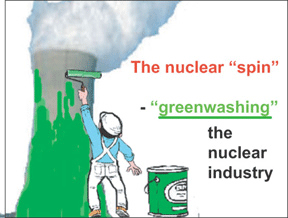
UK Labour touts ‘green industrial revolution’, BUT INCLUDES NUCLEAR POWER AS “GREEN”!
|
Labour pledges ‘green industrial revolution’ with nuclear power and a digging over of allotment laws The environment gets top billing in Labour’s manifesto. The first chapter of their 150 pages of policy pledges is devoted to what Labour are calling a “Green Industrial Revolution”. While they’ve conspicuously dropped a conference pledge of a net zero carbon target by 2030, which most serious analysts warned was impossible to achieve anyway, like the Liberal Democrats and Green Parties they’re planning to borrow big to invest in a low carbon economy. There’s a £250bn “Green Transformation Fund” to massively increase low carbon energy generation, warmer, lower carbon homes and promises to decarbonise heating in buildings — much needed if the UK is going to meet its existing climate change pledges. In a notable departure from Liberal Democrat and Green manifestos, they promise to support nuclear power as a way of ensuring stable electricity supply on a future national grid….. https://www.itv.com/news/2019-11-21/labour-pledges-green-industrial-revolution-with-nuclear-power-and-a-digging-over-of-allotment-laws/ |
|
|
For UK elections, top issue is climate change
Climate crisis topping UK election agenda is ‘unprecedented’ change Environmentalists say such political focus on green issues ‘unthinkable’ just five years ago, Guardian, Fiona Harvey Environment correspondent, Fri 22 Nov 2019 The climate emergency has risen to the top of the UK’s election agenda in a way that would have been “unthinkable” even five years ago, leading environmentalists have said, predicting that it augurs a permanent change in British politics.On Wednesday, Labour took the unprecedented move of putting green issues as the top section of its manifesto, the first time one of the UK’s two major parties has done so. Jeremy Corbyn led the appeal to voters with policies including an £11bn windfall tax on oil and gas companies, a million new jobs in a “green industrial revolution” and commitments on moving to a net-zero carbon economy.“Such focus on climate and the environment would have been almost unthinkable five years ago,” said Shaun Spiers, executive director of the Green Alliance. “Tackling climate change runs through this manifesto in a way that is unprecedented from either of the main parties ahead of a UK general election.”
“It would not have been possible five years ago,” said Tom Burke, chairman of environmental thinktank E3G and former adviser to several governments, who said the move marked a permanent change in British politics, as younger voters in particular were “energised” over the environment. Public anxiety had been fuelled by people seeing extreme weather around the world, and the rise of climate activism in movements such as Extinction Rebellion and the school climate strikes reflected that. “The politicians are following the public on this, not the other way round.”
…….. The Liberal Democrats, while focusing on Brexit, have also made the climate emergency a key priority, promising to generate 80% of the UK’s electricity from renewable sources by 2030, to bring forward to 2045 the deadline for net-zero carbon, and to expand electric vehicles and ban fracking. The Green party wants to spend £100bn a year for the next decade on the climate crisis, replacing high-carbon infrastructure and creating jobs…. https://www.theguardian.com/environment/2019/nov/21/climate-crisis-topping-uk-election-agenda-is-unprecedented-change
EDF’s misleading and deficient safety report on Hunterston nuclear station
|
1km emergency zone around cracked reactors will do, says nuclear firm, The Ferret, 22 Nov 19, The power company, EDF Energy, has come under fire for advising that the emergency zone to protect people around its cracked nuclear reactors at Hunterston could be shrunk to a kilometre.The current zone – within which evacuation, sheltering and anti-radiation pills are planned in the event of an accident – is a radius of 2.4 kilometres from the nuclear power station on the Ayrshire coast.
……. Campaigners have criticised EDF’s move, warning that an accident could send a plume of radioactive contamination over Glasgow and Edinburgh. They have called for the emergency zone to be expanded, not contracted. EDF stressed that its advice was that one kilometre was the “minimum” recommended distance. North Ayrshire Council is consulting with local residents before it decides what distance to implement. The Ferret revealed in October that the graphite cores of two ageing nuclear reactors at Hunterston B have begun to crumble as cracks spread and widen. According to the UK government’s Office for Nuclear Regulation (ONR), at least 58 fragments and pieces of debris have broken off the graphite bricks that make up the reactor cores. The older reactor, three, has an estimated 377 core cracks and has been shut down since 9 March 2018. ONR is assessing the safety case to decide whether it can be allowed to restart in 2020. Reactor four, which has an estimated 209 cracks, was shut down for over ten months before ONR allowed it to restart in August – but only for four months. EDF is currently planning to shut it down again on 10 December……… EDF accepts, however, that food restrictions may be required over a much wider area. “It is recommended that advice be issued within 24 hours to restrict consumption of leafy green vegetables, milk and water from open sources/rain water in all sectors of the detailed emergency planning zone and downwind of the site to a distance of 43km,” it says. …….Campaigners have previously warned that a serious accident at Hunterston could spread a cloud of radioactive contamination over Glasgow, Edinburgh and the central belt, if the wind was blowing in that direction. It could be like the Chernobyl accident in Ukraine in 1986, they claimed. Radiation consultant, Dr Ian Fairlie, described EDF’s report as “deficient” and “misleading”. The suggested emergency zone was “much too small”, he argued, and there was a “lack of openness and clarity” that would leave local people uncertain what to do in the event of a major accident. He added: “The issue of the pre-distribution of prophylactic potassium iodate tablets is not mentioned. This already occurs in most European countries, and should occur here as well in order to avoid the health consequences of breathing in radioactive iodine which is a gas.” Rita Holmes, who chairs Hunterston’s local stakeholder group, pointed out that at the moment only 13 households close to the plant were given iodine tablets in advance. “It would seem a simple precaution and unwise not to pre-distribute within a wider area,” she told The Ferret. “Despite EDF’s assessment, I hope that our local authority, Ayrshire civil contingencies team and ONR will decide to extend the detailed emergency planning zone and pre-distribute stable iodine to people within a wider area. I certainly don’t expect, given the ageing reactor cores, that the zone would be shrunk.” The 50-strong group of nuclear-free local authorities argued it would be “incongruous” if the emergency zone was reduced, given the deterioration of the Hunterston reactors. “Clear question marks remain over their future operation,” said the group’s policy advisor, Peter Roche. In our view the precautionary principle would suggest a much larger emergency planning zone is drawn to provide greater reassurance to the local population.” Friends of the Earth Scotland pointed out that seven years after the explosions at the Fukushima nuclear reactors in Japan in 2011, some areas more than 20 kilometres away were still prohibited zones. “The current Hunterston zone is already very modest in comparison to the very large area which would be affected in the event of a serious accident at the plant,” said the environmental group’s director, Dr Richard Dixon. “With increasing worries about the safety of the reactors at Hunterston now is definitely not the time to reduce the level of protection on offer to the local community,” he argued. “EDF are the last people who should propose what size the exclusion zone should be around their own nuclear sites because it is in their financial and PR interests to make the zone as small as possible.”……..https://theferret.scot/emergency-zone-hunterston-nuclear-reactrors/ |
|
Swedish accusations against Assange – always a political motive on behalf of USA
We need to ask ourselves why the focus is not on the crimes perpetrated by those involved in war crimes. Why is an Australian citizen being subjected to US espionage laws even though he was never on US soil? More importantly, why should an Australian citizen have allegiance to the US?
 The Swedish case against Assange was always political, https://www.theage.com.au/national/the-swedish-case-against-assange-was-always-political-20191120-p53cgs.html,By Greg Barns and Alysia Brooks, November 20, 2019 It is almost a decade since Julian Assange woke to discover, on the front page of a Swedish newspaper, that Swedish authorities had decided to pursue him on allegations of sexual misconduct. Immediately, Julian presented himself to the police station to make a statement and clear his name. After speaking with prosecutors, he was told he could leave the country; so he did.
Currently, Assange is held on remand in Belmarsh prison, in conditions that are exacerbating his already fragile health, and impeding his ability to prepare his defence. He is facing unprecedented charges under the US Espionage Act, for allegedly carrying out actions that journalists and publishers engage in as a part of their work. He is facing 175 years – an effective death sentence – for allegedly engaging in journalism.
And let’s not forget the material that was exposed by WikiLeaks. The releases included evidence of war crimes, including torture and unlawful killings, perpetrated during the Iraq and Afghanistan wars, and the Guantanamo files, which demonstrated that the majority of men, and children, were being held and tortured at the prison, even though they were innocent of any crime.
We need to ask ourselves why the focus is not on the crimes perpetrated by those involved in war crimes. Why is an Australian citizen being subjected to US espionage laws even though he was never on US soil? More importantly, why should an Australian citizen have allegiance to the US?
Greg Barns is a barrister and adviser to the Australian Assange Campaign. Dr Alysia Brooks is a human rights and due process advocate.
UK’s Liberal Democrat leader criticised for her willingness to use nuclear weapons
Sickening’: Jo Swinson condemned for unhesitatingly saying she would use nuclear weapons, CND attacks ‘disgraceful response’, saying: ‘Not even a moment’s hesitation about the prospect of killing millions of people’ Independent, Rob MerrickDeputy Political Editor @Rob_Merrick, 20 Nov 19
Jo Swinson has been criticised for trying to pass a “virility test” after saying she would be willing to press the nuclear button if she becomes prime minister.
The Liberal Democrat leader was asked if she would “ever be prepared to use a nuclear weapon”, answering with a single word: “Yes.”
The Campaign for Nuclear Disarmament attacked the “disgraceful response”, saying: “Not even a moment’s hesitation about the prospect of killing millions of people. We need better than this.”
And Nicola Sturgeon, the Scottish National Party leader, said: “It’s sickening to hear this question asked and answered as if it’s some kind of virility test and without any context.
“Using nuclear weapons would mean killing millions of people. Those consequences should be made clear.”
But a Lib Dem spokesman defended Ms Swinson’s answer, saying: “We support multilateral disarmament, but if you have a nuclear deterrent and tell everyone you won’t use it, it ceases to be a deterrent.”
The controversy comes after Labour got into difficulty over its stance on the UK’s Trident nuclear submarines. It is party policy to retain them – but Jeremy Corbyn has previously said he would not use them.
Emily Thornberry, the shadow foreign secretary, said Labour would “work collectively” on how to respond to a nuclear threat.
The Lib Dem general election manifesto is expected to back maintaining “a minimum nuclear deterrent”, while pursuing international talks to achieve multilateral disarmament.
When in office, in the Cameron-Clegg coalition, the party pledged to put forward alternatives to scale down the Trident fleet, but the idea came to nothing.
Defence experts have suggested that the number of Vanguard submarines could be reduced, ending so-called ‘continuous at sea deterrence’, without putting the UK at risk.
However, little has been heard about the idea from the Lib Dems since Nick Harvey was sacked from his defence post in the coalition in 2012.
On the campaign trail, Mr Corbyn has also declined to rule out scrapping Trident as part of any post-election arrangement with the SNP.
The Labour leader said that, as prime minister, he would seek to revive non-proliferation talks with other nations, with the UK’s nuclear weapons on the table.
Asked whether he would agree to scrap Trident if the SNP insisted on that as the price of backing a Labour government in a hung parliament, Mr Corbyn said: “I think the SNP would actually agree with me, and indeed in the past they certainly have, that the priority has to be giving realism to the nuclear non-proliferation treaty.”
Ms Thornberry, asked if Mr Corbyn would press the button, replied: “I suspect that the way that Jeremy makes decisions is that he takes advice and that we work collectively.”
Social media is an increasingly important battle ground in elections – and home to many questionable claims pumped out by all sides. If social media sites won’t investigate the truth of divisive advertising, we will. Please send any political Facebook advertising you receive to digitaldemocracy@independent.co.uk, and we will catalogue and investigate it. Read more here.https://www.independent.co.uk/news/uk/politics/jo-swinson-nuclear-weapon-button-war-lib-dems-election-debate-a9210456.html

If Julian Assange is extradited to the United States, journalism will be incarcerated, too
JOHN PILGER: Assange’s case will define the future of free journalism, https://independentaustralia.net/life/life-display/john-pilger-assanges-case-will-define-the-future-of-free-journalism,13324 By John Pilger | 18 November 2019 John Pilger describes the disturbing scene inside a London courtroom last week when the WikiLeaks publisher, Julian Assange, appeared at the start of a landmark extradition case that will define the future of free journalism.
THE WORST MOMENT was one of a number of “worst” moments. I have sat in many courtrooms and seen judges abuse their positions. This judge, Vanessa Baraitser – actually she isn’t a judge at all; she’s a magistrate – shocked all of us who were there.
Her face was a progression of sneers and imperious indifference; she addressed Julian Assange with an arrogance that reminded me of a magistrate presiding over apartheid South Africa’s Race Classification Board. When Julian struggled to speak, he couldn’t get words out, even stumbling over his name and date of birth.
When he spoke truth and when his barrister spoke, Baraister contrived boredom; when the prosecuting barrister spoke, she was attentive. She had nothing to do; it was demonstrably preordained. In the table in front of us were a handful of American officials, whose directions to the prosecutor were carried by his — back and forth this young woman went, delivering instructions.
Having ignored Julian’s barrister’s factual description of how the CIA had run a Spanish security firm that spied on him in the Ecuadorean embassy, she didn’t yawn, but her disinterest was as expressive. She then denied Julian’s lawyers any more time to prepare their case — even though their client was prevented in prison from receiving legal documents and other tools with which to defend himself.
Her knee in the groin was to announce that the next court hearing would be at remote Woolwich, which adjoins Belmarsh Prison and has few seats for the public. This will ensure isolation and be as close to a secret trial as it’s possible to get. Did this happen in the home of the Magna Carta? Yes, but who knew?
Who will then dare to expose anything of importance, let alone the high crimes of the West? Who will dare publish ‘Collateral Murder’? Who will dare tell the public that democracy, such as it is, has been subverted by a corporate authoritarianism from which fascism draws its strength?
Once there were spaces, gaps, boltholes, in mainstream journalism in which mavericks, who are the best journalists, could work. These are long closed now. The hope is the samizdat on the internet, where fine disobedient journalism is still practised.
The greater hope is that a judge or even judges in Britain’s court of appeal, the High Court, will rediscover justice and set him free. In the meantime, it’s our responsibility to fight in ways we know but which now require more than a modicum of Julian Assange’s courage.
Hinkley Point C nuclear, a super-expensive project for a dubious short term gain
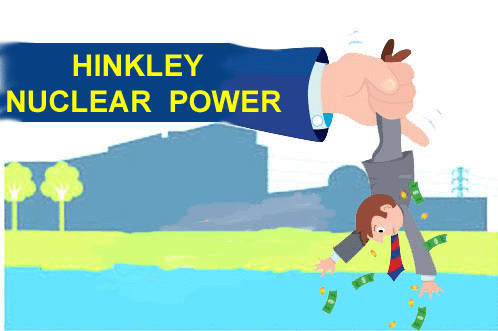 This is the West Country 17th Nov 2019, Stop Hinkley spokesman Roy Pumfrey questions whether the economic boost from Hinkley C is worth the cost I get tired of reading how easily impressed councillors are when they visit the giant incomplete building site that is HPC.
“biggest economic boost” is necessarily a good thing when it is also hugely
problematic and costly for anyone not directly involved? In our case,
economic growth also means a host of problems. There are more traffic jams
all around gridlocked Bridgwater. I’d like to travel from Bridgwater to
Taunton using the Taunton Road, but that simply adds 30 minutes to the
journey time.
schedule.
\ them to the reality of the massive hazard an untried new nuclear power
station running adjacent to her constituency represents.
1 This Month




PLEASE OPPOSE HR 8255 AND S.3639 – bills would accelerate satellite deployment, with no environmental review or safeguards – https://ncstd5li.quorum.us/campaign/169331/
To see nuclear-related stories in greater depth and intensity – go to https://nuclearinformation.wordpress.com
-
Archives
- September 2026 (339)
- August 2026 (330)
- July 2026 (355)
- June 2026 (287)
- May 2026 (306)
- April 2026 (356)
- March 2026 (251)
- February 2026 (267)
- January 2026 (308)
- December 2025 (358)
- November 2025 (359)
- October 2025 (375)
-
Categories
- 1
- 1 NUCLEAR ISSUES
- business and costs
- climate change
- culture and arts
- ENERGY
- environment
- health
- history
- indigenous issues
- Legal
- marketing of nuclear
- media
- opposition to nuclear
- PERSONAL STORIES
- politics
- politics international
- Religion and ethics
- safety
- secrets,lies and civil liberties
- spinbuster
- technology
- Uranium
- wastes
- weapons and war
- Women
- 2 WORLD
- ACTION
- AFRICA
- Atrocities
- AUSTRALIA
- Christina's notes
- Christina's themes
- culture and arts
- Events
- Fuk 2022
- Fuk 2023
- Fukushima 2017
- Fukushima 2018
- fukushima 2019
- Fukushima 2020
- Fukushima 2021
- general
- global warming
- Humour (God we need it)
- Nuclear
- RARE EARTHS
- Reference
- resources – print
- Resources -audiovicual
- Weekly Newsletter
- World
- World Nuclear
- YouTube
-
RSS
Entries RSS
Comments RSS

