Danger as oil companies plan drilling in nuclear waste ocean dump
The Kara Sea is so remote that the Soviet Union used it as a dumping ground for radioactive material for more than 25 years. The two oil companies have avoided calls for the nuclear waste, estimated to consist of over 17,000 barrels of radioactive waste, worn-out reactors, and even an old nuclear submarine, to be cleared up before any exploration takes place.
The most dangerous item down on the sea floor in that area is the K-27 nuclear submarine, which was dumped their by the Soviet navy in 1981. The NRPA said that any significant corrosion could damage the ships reactor and cause an environmental disaster.
 Exxon, Rosneft eye oil in nuclear wasteland http://www.csmonitor.com/Environment/Energy-Voices/2012/0927/Exxon-Rosneft-eye-oil-in-nuclear-wasteland
Exxon Mobil and Rosneft are planning to drill for oil in the Kara Sea, which the Soviet Union used as a dumping ground for radioactive material for more than 25 years, according to OilPrice.com. By James Burgess, September 27, 2012 It has been well documented that oil majors from around the world are looking at oil exploration in the Arctic, where they believe that some of the largest untapped fields in the world still lie.
Environmentalists have been fighting efforts to start exploring for oil, fearing that any serious oil spill could mean the destruction of one of the last pristine wildernesses on the planet. Continue reading
Russia’s Missile Force, Air Force, Navy can’t agree on a unified nuclear command plan
Russian military dumps Unified Nuclear Command plan: Report
http://zeenews.india.com/news/world/russian-military-dumps-unified-nuclear-command-plan-report_801650.html , September 25, 2012, Moscow: Russian Defence Ministry has abandoned plans to set up a unified command structure for
the country’s nuclear triad, according to Izvestia newspaper.
As a result, each major branch of the armed forces — the Strategic Missile Forces (SMF), the Air Force and the Navy — will retain control over its own triad component, the daily reported, citing an unidentified source in the ministry.
In the absence of any official statement from the ministry, the paper suggested that the decision might result from an unresolved internal struggle for leadership within the new structure.
The creation of a unified strategic nuclear command has been one option under consideration by the Russian military since late 1990s. The idea’s proponents, including former SMF commander Col. Gen. Viktor Yesin, argue it would streamline both the development and the deployment of Russia’s nuclear triad.
The plan envisioned the direct subordination of the command to the General Staff of the Russian Armed Forces.
According to the latest official figures, Russia has 494 deployed launchers for land, sea and air-based missiles armed with 1,492 warheads.
Russia’s nuclear waste storage ship

 Nuclear waste storage ship Lepse leaves Murmansk for decomissioning, Kola Peninsula, Russia http://www.youtube.com/watch?v=guPem_guPUk
Nuclear waste storage ship Lepse leaves Murmansk for decomissioning, Kola Peninsula, Russia Sep 14, 2012 by bellonafoundation
The Lepse, which in its heyday had been used as a support vessel for Russia’s nuclear icebreaker fleet, has been bobbing at dockside at the Atomflot port four kilometers north of Murmansk’s more than a quarter of a million-strong population since 1988. In the holds of the Lepse are filled with casks and caissons holding 639 spent nuclear fuel assemblies –equaling hundreds of tons of radioactive materials — a significant portion of which have been damaged, including assemblies that were damaged during offloading from the nuclear icebreaker Lenin. On September 14, 2012, Lepse was towed to Nerpa shipyard on the Kola Peninsula for decommissioning. Bellona has been instrumental in Lepse project. Bellona’s President Frederic Hauge is in Murmansk to see Lepse leaving the Kola Bay.
Multiple dangers in Russia’s new nuclear powered ice-breakers
multiple concerns including the “generation of radioactive waste, generation of spent nuclear fuel, which is reprocessed in Russia and as a result more radioactive waste is generated. [There is] a possibility of serious accidents like there was with the first icebreaker “Lenin.” There were two major accidents on-board in the 1960s and 1970s. Lenin’s spent nuclear fuel and reactors were cut out and dumped in the Kara sea.”
Breaking the Ice: Russian nuclear-powered ice-breakers, Scientific American By Eve Conant | September 8, 2012 Russia’s rapidly expanding nuclear industry has set it sights on the freezing waters of Arctic basin with an ambitious goal to build the world’s largest “universal” nuclear icebreaker.
Russia’s dream to dominate the Arctic will soon get a boost with a nuclear-powered icebreaker designed to navigate both shallow rivers and the freezing depths of the Northern Sea. Last month Rosatomflot , Russia’s atomic fleet, inked a deal to begin construction of a massive new vessel 170 meters long and 34 meters wide. That is 14 meters longer and four meters wider than any of Russia’s other nuclear vessels. Continue reading
MOX nuclear reprocessing: a Russian project leader’s safety fears
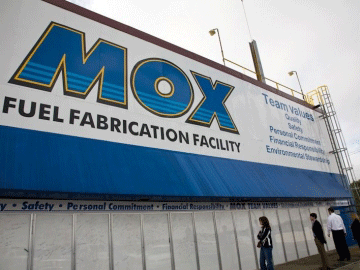 He [ Yevgeny (name changed)] then explains that colleagues and superiors of many years have been leaving the BN-800 project in recent weeks. Their vacated positions, he says, are being given to new employees just starting their careers.
“People who have no experience with the difficulties sodium coolant can cause now head our departments,”… “And you know what? I’m going to leave, too. Or, no, I’m going to run.”
From Plutonium to Power, Spiegal Online 09/07/2012 Russia To Produce Electricity with Former Nukes By Kerstin Brandt “…….. plutonium is not uranium. It’s more toxic and more radioactive, and it’s not easy to dilute.
Yevgeny doesn’t speak English, so he doesn’t understand the disarmament slogan “Global Zero.” Until recently, he was convinced that Russia, alone among world’s countries, had mastered fast reactor technology. He himself worked at Beloyarsk’s fast reactor for many years, after all. But since the plant’s managers assigned him to the construction of the successor model BN-800, Yevgeny has grown doubtful. Continue reading
IN its quest for Arctic oil, Russia admits its undersea nuclear dump
17,000 containers of radioactive waste, 19 ships containing radioactive waste, 14 nuclear reactors, including five that still contain spent nuclear fuel; 735 other pieces of radiactively contaminated heavy machinery, and the K-27 nuclear submarine with its two reactors loaded with nuclear fuel.
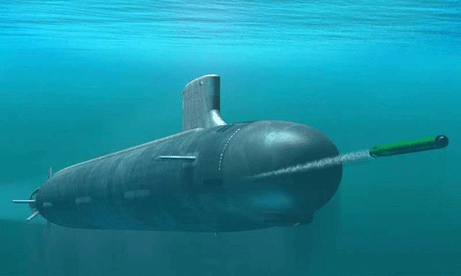 one of the most critical pieces of information missing from the report released to the Norwegian Radiation Protection Authority was the presence of the K-27 nuclear submarine, which was scuttled in 50 kilometers of water with its two reactors filled with spent nuclear fuel in in Stepovogo Bay in the Kara Sea in 1981.
Information that the reactors abord the K-27 could reachieve criticality and explode was released at the Bellona-Rosatom seminar in February.
 Russia Dumped 17 Nuclear Reactors and Tons of Waste in the Arctic by Charles Digges / Bellona.org, Earth First! Newswire, 30 Aug 12, Enormous quantities of decommissioned Russian nuclear reactors and radioactive waste were dumped into the Kara Sea in the Arctic Ocean north of Siberia over a course of decades, according to documents given to Norwegian officials by Russian authorities and published in Norwegian media.
Bellona had received in 2011 a draft of a similar report prepared for Russia’s Gossoviet, the State Council, for presentation at a meeting presided over by then-president Dmitry Medvedev on Russian environmental security.
The Russian state nuclear corporation Rosatom confirmed the figures in February of this year during a seminar it jointly held with Bellona in Moscow. Bellona is alarmed by the extent of the dumped Soviet waste, which is far greater than was previously known – not only to Bellona, but also to the Russian authorities themselves. Continue reading
Russia planning UNMANNED long-range nuclear strategic bombers.
 Russia’s Unmanned Strategic Nuclear Bomber Is A Really Terrible Idea http://www.gizmodo.com.au/2012/09/russias-unmanned-strategic-nuclear-bomber-is-a-really-terrible-idea/
The PAK-DA would be a standard nuclear bomber, with a on-board human crew controlling it. The next step, however, opens a potentially lethal and morally questionable Pandora’s Box. Lt General Anatoly Zhikharev — the commander for that branch of the Russian Air Force — says that they are thinking about a sixth generation to enter service “around 2040-2050″: unmanned long-range nuclear strategic bombers.
Somehow, the idea of having those birds in the sky makes me extremely nervous. You know, long range planes capable of flying for hours with a few nuclear bombs in their belly, with their wireless communication links ready to be intercepted and deciphered by hackers. Sure, the latter would be hard, but when it comes to computer security, there’s nothing impossible.
But regardless of potential accidents or security issues, I just can’t see the point of these or any other strategic bombers right now. Just like Deputy Prime Minister Dmitry Rogozin was saying before being slapped by Putin, “these aircraft will not get anywhere. Not ours, not theirs [the Americans]. With modern air defence systems, these targets will be destroyed on the way.”
He’s right. While a country like Iran can’t defend itself against stealth bombers, you can be sure that both the Russians and the Americans would be able to intercept any air attack. Which is precisely why the USAF is trying to develop ultra-sonic scramjets that could be silently launched as an alternative to easily-detectable Intercontinental Ballistic Missiles launches.
And if none of the two superpowers — well, there’s China there, quickly ramping up but still behind US and Russian military technology — are going to attack each other, what’s the point of keeping up with this stupid soft armament race, anyway? [RIA Novosti via DEW Line ]
Russia committed to nuclear disarmament, but USA’s missile shield is the obstacle
Putin says Russian nuclear cuts to hinge on U.S. missile shield By Nastassia Astrasheuskaya http://in.reuters.com/article/2012/08/24/russia-usa-nuclear-idINDEE87N0EX20120824 MOSCOW Aug 24, 2012 (Reuters) – Moscow is open to the idea of new nuclear arms cuts on a reciprocal basis and if Washington addresses its concerns about a U.S.-led missile defence system in Europe, President Vladimir Putin said on Friday. Continue reading
Russia to get stronger nuclear navy, Putin says By Gleb Bryanski SEVERODVINSK, Russia | Mon Jul 30, 2012 (Reuters) – President Vladimir Putin oversaw the start of construction of one of Russia’s newest generation submarines on Monday and vowed to boost nuclear naval forces to safeguard the country’s position as a leading sea power.
Warning that its navy would protect top energy producer Russia’s interests in the oil-rich Arctic, Putin led the ceremony to begin building the submarine Prince Vladimir, named after the ruler who founded a precursor state to modern Russia.
The vessel is the fourth Borei class submarine, designed to carry one of the country’s newest and most powerful intercontinental nuclear missiles, the Bulava, or Mace…… Putin is working to make the submarines and the missiles they will carry a cornerstone of the Russian navy, which will receive nearly a quarter of the 20 trillionroubles ($621.31 billion) to be spent by the end of the decade…… http://www.reuters.com/article/2012/07/30/us-russia-putin-navy-idUSBRE86T1D320120730
Russia resisting Israel’s push for military action against Iran
 Russia’s FM warns against issuing ultimatums to Iran over its nuclear program WP, 22 June, MOSCOW — Russia’s foreign minister said Friday that Iran shouldn’t face threats over its nuclear program and that a quick settlement of the standoff over it isn’t realistic. Sergey Lavrov said the latest round of talks in Moscow this week between six world powers and Iran has been “quite useful,” even though there was no breakthrough. He said talks must continue without “any artificial deadlines or ultimatums.”..
. Russia’s President Vladimir Putin is expected to face a strong Israeli demand to take a tougher line on Iran when he visits the Jewish state next week. Lavrov’s statement signaled, however, that Moscow will likely respond to Israeli calls for stronger action with its usual advice to be patient and continue talks..
.. The negotiators agreed to hold a low-level meeting on July 3 of technical experts in Istanbul, Turkey, before deciding whether there is enough common ground to hold another round of full-fledged political talks. A pause in negotiations may offer a new opportunity for Israel to argue that military force is the only way to stop Tehran from developing atomic weapons.
http://www.washingtonpost.com/world/europe/russias-fm-warns-against-issuing-ultimatums-to-iran-over-its-nuclear-program/2012/06/22/gJQArTgUvV_story.html
Russia can’t afford new nuclear plants, and can’t afford to shut down old ones
The decommissioning of nuclear plants after exhausting their resources will put an enormous strain on Russian state budget. Largely for this reason, Rosatom is making every effort to prolong their operational life, knowing quite well that there will be economic shockwaves in the industry should nuclear units be closed.
Russia’s Dangerous Nuclear Legacy – Analysis Eurasia Review, By: Richard Rousseau June 18, 2012“…….The safety of nuclear reactors is primarily provided through the increased number of sophisticated security systems and physical barriers that limit or contain potential radiation leaks. These systems consist of a combination of natural and artificial barriers that work in tandem and complement each other in assuring the required
long-term isolation of the waste by preventing or limiting the movement of radioactive substances from the infrastructure of the repository to the biosphere.
However, in essence this has made nuclear plants increasingly more complex systems, which in turn drives up their construction and operation costs, while it is still impossible to achieve a 100 percent safety level. Continue reading
Youthful protestors lead anti nuclear push in Russia
On Murmansk Oblast’s Kola peninsula, however, nuclear backers face one of the strongest environmental organizations in Russia. For more than 10 years, Vitaly Servetnik and other activists at Priroda i molodezh (Nature and Youth) have battled attempts to build new reactors and extend the life of existing ones at the Kola nuclear plant, carrying out more than 100 protest campaigns
Servetnik accuses the authorities of using the Interior Ministry’s anti-terror police, known as Center E, to spy on his small group based in Murmansk.
ecologists persuaded authorities in Volgodonsk, southern Russia, to hold round table talks on the planned power increase of one reactor at the Rostov nuclear plant. In the Kaliningrad exclave, opposition is mounting to the planned 2016 launch of a new reactor at the Baltic plant.
 Nuclear-Strength Kola TOL Special Report: In Russia’s northwest, a scrappy bunch of young environmentalists faces off against a powerful nuclear lobby. By Alexander Tretyakov reporter for SOTV, a publicly funded Internet television channel in Moscow. 24 May 2012 This is the fourth in a series of articles on the state of the environment in Russia.
MOSCOW | Murmansk Oblast in northern Russia has one of the highest
concentrations of nuclear energy on earth. Nuclear submarines and
icebreakers of the Russian Northern Fleet sail the White and Barents
seas, and the Kola nuclear power plant is still going strong nearly 40
years after its first reactor hummed into life.
Russia’s nuclear industry is due for a massive expansion under a
government plan to increase nuclear’s share in national power
production. Russia has shown no sign of wavering on nuclear power in
the wake of last year’s Fukushima disaster, ….. Continue reading
Vladimir Putin again takes hold of the nuclear warfare suitcase
Putin takes back Russia’s nuclear button, Channel New Asia, 07 May 2012 MOSCOW: Russia’s newly sworn-in President Vladimir Putin Monday was handed the black suitcase Monday that controls the country’s vast nuclear arsenal moments after taking his oath to a third term. Continue reading
USA and Russia – just the bare 2,800 non-strategic nuclear warheads !
The report concludes that non-strategic nuclear weapons are neither the reason nor the solution for Europe’s security issues today but that lack of political leadership has allowed bureaucrats to give these weapons a legitimacy they don’t possess and shouldn’t have.
 2,800 Nuclear Warheads in Russian and U.S. Arsenal, According to New
Report http://blogs.ottawacitizen.com/2012/05/01/2800-nuclear-warheads-in-russian-and-u-s-arsenal-according-to-new-report/ May 1, 2012 From the Federation of American Scientists: A new FAS Special Report – Non-Strategic Nuclear Weapons – concludes that Russia and the United States combined possess an estimated 2,800 nuclear warheads for their non-strategic nuclear forces. Several thousand other non-strategic warheads have been retired and are awaiting dismantlement. Continue reading
Russia’s top nuclear reactor designer arrested for fraud

 Russian Nuclear Reactors’ Designer Held on Suspicion of Fraud. 17/04/2012 MOSCOW, April 17 (RIA Novosti) –The head of the Russian nuclear reactor design bureau Gidropress, a subsidiary of the State Atomic Energy Corporation Rosatom, Viktor Mokhov has been detained on suspicion of an 18-million-ruble ($600,000) fraud scheme. Continue reading
1 This Month
29 Jan. Thursday 7-8 p.m. Webinar – World’s Largest Nuclear Station in Port Hope, ON?
To see nuclear-related stories in greater depth and intensity – go to https://nuclearinformation.wordpress.com/



31st January – Challenging the War Machine – a DECLASSIFIED UK SUMMIT


Website of the Week
Now until to February 10, 2026 Radioactive waste storage in France: the debate is finally open! How to participate?
-
Archives
- January 2026 (283)
- December 2025 (358)
- November 2025 (359)
- October 2025 (376)
- September 2025 (258)
- August 2025 (319)
- July 2025 (230)
- June 2025 (348)
- May 2025 (261)
- April 2025 (305)
- March 2025 (319)
- February 2025 (234)
-
Categories
- 1
- 1 NUCLEAR ISSUES
- business and costs
- climate change
- culture and arts
- ENERGY
- environment
- health
- history
- indigenous issues
- Legal
- marketing of nuclear
- media
- opposition to nuclear
- PERSONAL STORIES
- politics
- politics international
- Religion and ethics
- safety
- secrets,lies and civil liberties
- spinbuster
- technology
- Uranium
- wastes
- weapons and war
- Women
- 2 WORLD
- ACTION
- AFRICA
- Atrocities
- AUSTRALIA
- Christina's notes
- Christina's themes
- culture and arts
- Events
- Fuk 2022
- Fuk 2023
- Fukushima 2017
- Fukushima 2018
- fukushima 2019
- Fukushima 2020
- Fukushima 2021
- general
- global warming
- Humour (God we need it)
- Nuclear
- RARE EARTHS
- Reference
- resources – print
- Resources -audiovicual
- Weekly Newsletter
- World
- World Nuclear
- YouTube
-
RSS
Entries RSS
Comments RSS
 nuclear-news