As we might have expected, the de facto abandon of the Intermediate-Range Nuclear Forces Treaty (INF Treaty) – concluded between Washington and Moscow at the end of the Cold War – has now rebooted the competition. Except that this time, it’s even more complicated, since the United States violated the Treaty first, while they were already violating the Non-Proliferation Treaty (NPT). Meanwhile, Russia has discreetly forged ahead with its technological progress while pretending to allow the problem to drag on.
New research on impacts of climate change in the Mediterranean
 First study on climate change impact in Mediterranean https://www.eurekalert.org/pub_releases/2018-10/cuoh-fso102618.php, The first-ever study synthesizing risks posed by climate and environmental changes in the Mediterranean, CITY UNIVERSITY OF HONG KONG As the Mediterranean Basin is experiencing the impact of climate change more than ever, an international network of scientists has worked together to synthesize the effects of climate change and environmental problems, as well as the incurred risks, in the region, to facilitate decision-making in addressing the issues.This first-ever synthesis of multiple environmental changes and risks affecting the livelihoods of people in the entire region has just been published in the latest issue of Nature Climate Change. The rates of climate change observed in the Mediterranean Basin exceed the global trends for most variables. The impact has further exacerbated the existing environmental problems caused by land use changes such as urbanization and agricultural intensification, increasing pollution and declining biodiversity. Led by Professor Dr Wolfgang Cramer from the Mediterranean Institute for Biodiversity and Ecology, an international team of scientists has just published a review article in Nature Climate Change to address the current and future risks related to these changes, titled “Climate change and interconnected risks to sustainable development in the Mediterranean”. Professor Michael Tsimplis from the School of Law at City University of Hong Kong who is part of the international team and has multidisciplinary background with research in oceanography and climate change said, “this paper suggests that the risks posed by climate change in the Mediterranean Sea were underestimated because each was only examined independently. But in reality, they are interconnected and interact with social and economic problems exacerbating their impacts. So they all have to be addressed at the same time and within the same financial constraints.” The paper reviews the various environmental changes and the risks posed by these changes in the five major interconnected domains, namely water resources, ecosystems, food safety and security, health, and human security. For an instance, average temperatures in this region have already risen by 1.4°C since the pre-industrial era, 0.4°C more than the global average. Even if future global warming is limited to 2°C, as prescribed by the Paris Agreement, summer rainfall is at risk to be reduced by 10 to 30% in some regions, thereby enhancing existing water shortages and decreasing agricultural productivity, particularly in southern countries. Due to climate change alone, the irrigation demands in the region are projected to increase between 4 and 18% by the end of the century. Population growth may escalate these numbers furthers to 22-74%. Tourism development, new industries and urban sprawl may increase water pollution, too. The acidification of sea water, increasing heatwaves in combination with drought and land-use change also affect the natural ecosystems, posing risks in biodiversity and fisheries. Food production from agriculture and fisheries across the Mediterranean region is also changing due to the social, economic and environmental changes. Combined with the ongoing switch to more animal-based food production, southern countries are at risk to increase their dependence on trade. Public health is impacted by multiple trends of change, through heat waves, pollution (higher risk of cardiovascular or respiratory diseases), and the increased spread of disease vectors (West Nile virus, Dengue, Chikungunya). In politically unstable countries, environmental change is an increasingly relevant factor for socio-economic risks, due to famines, migration and conflict. Human security will also be threatened due to extreme weather, such as a rise in sea level posing a higher risk of storm surges for people living in coastal areas in the region. To facilitate decision-making in the face of these risks, the authors call for a pan-Mediterranean integrated risk assessment. Therefore, the Mediterranean Experts on Climate and Environmental Change (MedECC) network has been established, currently involving 400 scientific experts, supported by government agencies and other partners, to produce a full synthesis of risks and present it to decision makers for debate and approval. |
|
UK Law changed so nuclear waste dumps can be forced on local communities
 Law changed so nuclear waste dumps can be forced on local communities https://www.theguardian.com/environment/2015/apr/05/law-changed-so-nuclear-waste-dumps-can-be-forced-on-local-communities?fbclid=IwAR19RWY6_PDJsDLIDLGhunei Legislation rushed through in the final hours of parliament allows local planning laws to be bypassed, seriously alarming anti-nuclear campaigners, Juliette Jowit, Mon 6 Apr 2015, Last modified on Thu 15 Feb 2018 Objectors worry that ministers are desperate to find a solution to the current radioactive waste problem to win Nuclear waste dumps can be imposed on local communities without their support under a new law rushed through in the final hours of parliament.Under the latest rules, the long search for a place to store Britain’s stockpileof 50 years’ worth of the most radioactive waste from power stations, weapons and medical use can be ended by bypassing local planning. Since last week, the sites are now officially considered “nationally significant infrastructure projects” and so will be chosen by the secretary of state for energy. He or she would get advice from the planning inspectorate, but would not be bound by the recommendation. Local councils and communities can object to details of the development but cannot stop it altogether. The move went barely noticed as it was passed late on the day before parliament was prorogued for the general election, but has alarmed local objectors and anti-nuclear campaigners. Friends of the Earth’s planning advisor, Naomi Luhde-Thompson, said: “Communities will be rightly concerned about any attempts to foist a radioactive waste dump on them. We urgently need a long-term management plan for the radioactive waste we’ve already created, but decisions mustn’t be taken away from local people who have to live with the impacts.” Objectors worry that ministers are desperate to find a solution to the current radioactive waste problem to win public support to build a new generation of nuclear power stations. Zac Goldsmith, one of the few government MPs who broke ranks to vote against the move, criticised the lack of public debate about such a “big” change. “Effectively it strips local authorities of the ability to stop waste being dumped in their communities,” he said. “If there had been a debate, there could have been a different outcome: most of the MPs who voted probably didn’t know what they were voting for.” Labour abstained in the vote, indicating that a future government will not want to reverse the change of rules. However, the shadow energy minister, Julie Elliott, has warned that the project is expected to take 27 years to build even after a preferred site was identified and would cost £4bn-5.6bn a year to build, plus the cost of running it for 40 years. Since the Royal Commission on Environmental Pollution found in 1976 that it was “morally wrong” to keep generating nuclear waste without a demonstrably safe way of storing the waste, there have been at least four attempts to find the right site, all of them shelved after strong protest. There are now 4.5m cubic metres of accumulated radioactive waste kept in secure containers at sites across Britain, though only 1,100m3 of this is the most controversial high-level waste, and 290,000m3 is intermediate-level waste. It costs £3bn a year to manage the nuclear waste mountain, of which £2bn comes from taxpayers. The most recent proposal for a more permanent solution was to ask local authorities to volunteer to examine whether they could host the development. Initially, a coalition of Cumbria county council and Copeland and Allerdale borough councils put their names forward, but the policy stalled in 2013 when the county council pulled out. Last year, the Department for Energy and Climate Change (DECC) published a white paper which said ministers would prefer to work with public support, but reserved the right to take more aggressive action on planning if “at some point in the future such an approach does not look likely to work”. The day before parliament rose, MPs voted in an unusual paper ballot to implement a two-page statutory instrument which adds nuclear waste storage to the list of nationally significant infrastructure projects in England, via the 2008 Planning Act. Officials have said approval depends on a “test of public support” and any site would undergo extensive geological safety tests. Copeland borough council, one of the two areas most affected by any such development at Sellafield, said it was pleased with the government’s change to planning rules. Radiation-Free Lakeland – set up to block the Sellafield proposal because they claim there is no evidence deep storage is safe or that the geology of Cumbria is suitable – claimed, however, “the test of public support is a fig leaf: the government hast’t said what the public support will be”. The only existing high-level radioactive underground waste storage, in New Mexico, USA, has been closed since last year following two accidents. Germany has put similar plans for burying high-level waste on hold and four other countries, including France and Japan, are examining the idea. |
|
Russia preparing to discuss Intermediate-Range Nuclear Forces (INF) Treaty with USA
Lavrov Says Moscow Preparing Answers To U.S. Nuclear-Treaty Concerns, Radio Free Europe, 28 Oct 18 Russian Foreign Minister Sergei Lavrov has said Moscow was drafting responses to a list of questions recently presented by the United States concerning a key Cold War-era arms control treaty.Lavrov made the comments on October 28, days after President Donald Trump announced that the United States would withdraw from the Intermediate-Range Nuclear Forces (INF) Treaty, repeating longstanding U.S. accusations that Moscow had violated the agreement.
The 1987 accord prohibits the United States and Russia from possessing, producing, or deploying ground-launched cruise and ballistic missiles with a range of between 500 and 5,000 kilometers.
“Just a week ago, a couple of days before they announced their intention to withdraw from the Intermediate-Range Nuclear Forces Treaty, the Americans via their embassy in Moscow sent the Russian Foreign Ministry an extensive list of questions which are a concern to them,” Lavrov said in an interview aired on Russian television.
“It is better to come to terms with Russia on an equal basis and it is not necessary to be friends,” the Russian minister also said. “We are not forcing a friendship.”………
START Under Threat?
In the wake of U.S. threats to withdraw from the INF Treaty, Lavrov said that the “fate of the New START Treaty is unclear.”
The New START Treaty limits strategic nuclear weapons. It was signed in 2010 and is due to expire in 2021, although the two sides could agree to extend it for another five years.
Russian President Vladimir Putin has warned that Washington’s withdrawal from the INF Treaty could lead to a new “arms race.”
Meanwhile, European members of NATO have urged Washington to try to bring Russia back into compliance with the nuclear arms control agreement rather than quitting it, diplomats say.
Speaking on October 28, U.S. Defense Secretary Jim Mattis said the United States was in consultation with its European allies on the INF Treaty.
When asked whether he could rule out placing intermediate-range missiles on the ground if Washington left the INF Treaty, Mattis told reporters travelling with him to Prague, “I never rule things out like that, I also don’t rule it in.” ………https://www.rferl.org/a/lavrov-says-moscow-preparing-answers-to-u-s-inf-concerns/29568360.html
Putin warns European nations on hosting US nuclear weapons – risk to them of counter-strike
 Putin says Russia will target nations who host US nuclear weapons https://www.independent.co.uk/news/world/europe/russia-putin-missiles-us-arms-treaty-inf-john-bolton-moscow-a8600146.html
‘European countries… must understand that they are putting their own territory at risk of a possible counterstrike,’ says Russian president, Oliver Carroll, Moscow
Climate change. Prolonged dry weather leads EDF to curb Fessenheim 2 nuclear reactor output

 EDF curbs Fessenheim 2 nuclear reactor output due to dry weather https://www.reuters.com/article/france-drought-nuclearpower/edf-curbs-fessenheim-2-nuclear-reactor-output-due-to-dry-weather-idUSL8N1X63FD
PARIS, Oct 26 (Reuters) – French utility EDF reduced output at its 900 megawatts (MW) Fessenheim 2 nuclear reactor on Friday as prolonged dry weather across west and central Europe has led to low water levels at the Rhine river which it uses to cool the reactor.
French grid operator RTE said EDF cut output at Fessenheim 2 by 130 MW due to environmental issues. EDF use water from the Rhine river as coolant for the plant, France’s oldest, which has two 900 MW reactors.
EDF could not be reached for comment on the situation.
Toshiba to dissolve its British nuclear unit NuGeneration?
Toshiba considers liquidation of British nuclear unit NuGeneration https://mainichi.jp/english/articles/20181026/p2g/00m/0bu/070000c
October 26, 2018 (Mainichi Japan) TOKYO (Kyodo) — Toshiba Corp. is considering dissolving its British nuclear subsidiary NuGeneration Ltd. as negotiations for its sell-off have stalled, sources close to the matter said Friday.
The Japanese conglomerate is in the process of withdrawing from its overseas nuclear businesses after the bankruptcy of its U.S. subsidiary Westinghouse Electric Co. in 2017.
Korea Electric Power Corp. has been selected as the preferred bidder for the British nuclear subsidiary, but no agreement was reached before its preferred bidder status expired, the sources said.
Toshiba is also at odds over the terms of the unit’s sale with a Canadian asset management company which has shown interest in buying NuGeneration, they said.
NuGeneration plans to build a nuclear power plant with three reactors in Moorside, northwestern England. It was initially scheduled to use reactors manufactured by Westinghouse before the U.S. company went bankrupt.
French government to decide whether or not to build new EPR nuclear reactors
France to decide over building new EPR nuclear reactors between 2021 and 2025: AFP https://www.reuters.com/article/us-france-energy/france-to-decide-over-building-new-epr-nuclear-reactors-between-2021-and-2025-afp-idUSKCN1N00RO
PARIS (Reuters) 26 Oct 18– The French government will decide on whether or not to build a new generation of EPR reactors between 2021 and 2025, Agence France Presse (AFP) reported on Friday, citing a working document.
France’s nuclear industry could be asked to draw an “industrial plan” by mid-2021 that would guarantee future EPR reactors are able to produce energy at a reasonable price, estimated between 60 and 70 euros per megawatt, AFP reported.
The French government will present its 2018-28 energy strategy next month instead of at the end of this month, a government source told Reuters earlier this week.
The long-awaited plan (PPE) will outline how and by when France will reduce the share of nuclear energy in electricity generation, currently at about 75 percent, and is a crucial factor in the investment planning of state-owned utility EDF, which operates France’s 58 nuclear reactors.
Asked about the AFP story in an interview with France 2 television on Friday, Environment and Energy Minister Francois de Rugy declined to confirm the information.
De Rugy added to France 2: “I confirm that a working document is made to work on it and weigh different scenarios.”
Reporting by Mathieu Rosemain and Caroline Pailliez; Editing by Sudip Kar-Gupta
USA issues stark warning against UK partnering with China on nuclear power stations


 US warns Britain against Chinese alliances on nuclear plants, Security official claims evidence of civilian nuclear technology being put to military use, Ft.com, David Sheppard in London , 25 Oct 18
The US has issued a stark warning to the UK about partnering with China’s largest state-backed nuclear company on a host of new power plants, saying it has evidence that it is engaged in taking civilian nuclear technology and transferring it to military uses. Christopher Ashley Ford, the US assistant secretary for international security and non-proliferation, said that China General Nuclear (CGN), which is a partner on the £18bn Hinkley Point C nuclear project, among others, was at the forefront of Chinese efforts to militarise civilian nuclear technology.
“It’s quite clear now that essentially the entirety of the Chinese nuclear industry is lashed up with military-civil fusion,” Mr Ford said in a briefing with the Financial Times. “There is a growing pattern of information of which we have become aware over time related to technological theft issues.” Mr Ford said the US had shared evidence, both “open source” and from intelligence gathering, with the UK, showing CGN was involved in the transfer of technology that could be used for a range of military applications. That could include powering China’s new breed of nuclear powered submarines, aircraft carriers and “floating nuclear reactors for the ongoing militarisation of the South China Sea”, Mr Ford
“If CGN is engaged in helping the Chinese navy . . . with missiles that could presumably be pointed at western capitals, including London . . . It’s worth thinking about whether that’s a particularly good idea,” Mr Ford said. The bluntly delivered warning comes as UK prime minister Theresa May has tried to increase scrutiny of Chinese investment in key UK infrastructure compared to her predecessor David Cameron, including over involvement in nuclear power plants.
But the US intervention, given their status as the UK’s key military ally, is likely to increase pressure on Downing Street. The Trump administration is locked in a trade war with China, with tensions ramping up over tariffs and the balance of payments between the two countries. But the US this month also updated its own policies on civilian nuclear co-operation with China to say that there would be a “presumption of denial” for any US company seeking to transfer technology to CGN or its subsidiaries. …..
A contract between China and Westinghouse Electric Company, the US nuclear engineering group sold by Toshiba to Canadian asset manager Brookfield last year, is not, however, broadly affected by the US policy shift, although future deals could be. The second Westinghouse plant in China started up on Wednesday, 11 years after the deal to build four AP1000 reactors was first signed. …..
Last month, CGN told the Financial Times that political sensitivities could prompt it to give up the chance to operate a new atomic power plant at Bradwell in Essex, as the group also outlined ambitious plans for an industrial partnership with Britain. …..
CGN has invested more than £2bn in its British nuclear projects in the past two years, and has committed to spend £9.5bn in this area in total. https://www.ft.com/content/84ab26f6-d7a5-11e8-a854-33d6f82e62f
Britain’s Ministry of Defence foresees nuclear attacks on Earth, launched from space
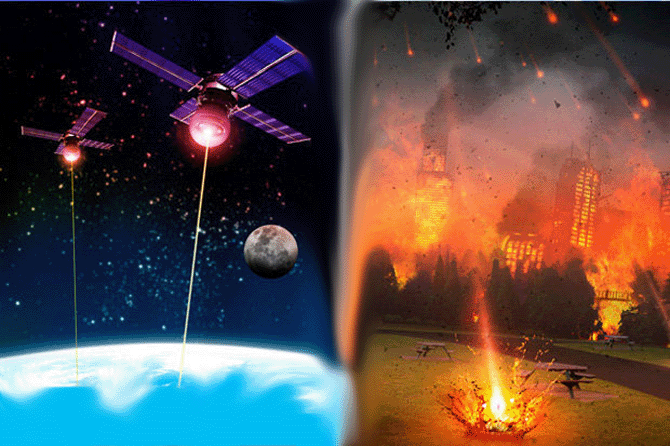 Space stations could launch NUCLEAR attacks on Earth in 30 years – shock MoD report
SPACE stations could launch nuclear attacks on Earth in 30 years, the Ministry of Defence has warned in a shock report on the growing threat of a nuclear space race. The threat of a nuclear space race comes as countries look to expand their arsenal of weapons outside the earths atmosphere.
A report called the ‘Future Starts Today’ outlines the “critical point” the world has reached in relation to warfare.
Defence Secretary Gavin Williamson acknowledged the “dangerous” state of the world.
He said: “This report makes clear that we are living in a world becoming rapidly more dangerous, with intensifying challenges from state aggressors who flout the rules, terrorists who want to harm our way of life and the technological race with our adversaries…………
As the advancement of technology increases the prospect of military space bases has come to fruition with nuclear warheads circling earth.
These weapons would have “global reach” and be unseen by those on Earth.
The destructive power of a nuclear electromagnetic pulse weapon – detonated in the air rather than on the ground – will be developed to knock out whole cities and even countries.
Electromagnetic pulses have the ability to shut down anything running on electrical power therefore, lights, communications, heating systems would all stop working in an instant.https://www.express.co.uk/news/world/1034575/space-stations-nuclear-attack-earth-ministry-of-defence-report
Future of Bradwell nuclear project in doubt – Chinese company might withdraw
BANNG 22nd Oct 2018 , BANNG has long maintained that there is no need for a new nuclear powerstation at Bradwell. The costs, in terms of the long-lasting, physical
damage to the tranquil and vulnerable Blackwater estuary, of the finances,
of the potential for terrorist attacks and of the uncertainties around
investment by a potentially hostile state, are too high.
Nuclear power is an old-fashioned technology and given the continuing success and decreases
in the costs of renewables and storage, there will be no need for it by the
time Bradwell B could be in operation.
in the costs of renewables and storage, there will be no need for it by the
time Bradwell B could be in operation.
In its partnership with EDF, CGN, a Chinese state-owned nuclear company, is the majority two-thirds stakeholder
in the Bradwell B project. However, it seems now that CGN is wavering. In
the Financial Times of 18 September it was reported that CGN ‘has
admitted that political sensitivities could prompt it to give up the chance
to operate a new atomic power plant in the UK’.
in the Bradwell B project. However, it seems now that CGN is wavering. In
the Financial Times of 18 September it was reported that CGN ‘has
admitted that political sensitivities could prompt it to give up the chance
to operate a new atomic power plant in the UK’.
The Chinese withdrawal, should it come, would appear to reflect widespread concerns about the
security issues surrounding Chinese investment into a highly sensitive part
of the UK’s national infrastructure. In the Financial Times, Zheng
Dongshan, Chief Executive of CGN’s UK subsidiary, is reported as
acknowledging that it would take time for CGN ‘to show the public, the
government they can trust us’. Andy Blowers, Chair of BANNG, said: ‘The
project may be doomed anyway as the Bradwell B site is totally unsuitable
and is opposed by communities all around the Blackwater estuary.’
https://www.banng.info/news/is-bradwell-b-going-down-the-drain/
Gorbachev, experts baffled by U.S. withdrawal from nuclear weapons deal
Euro News, By Alexander Smith with NBC News World News• 22/10/2018
A piece of reckless brinkmanship that could spark an arms race between NATO and Russia in Europe, or a hardball negotiating strategy that might push Moscow into keeping its longstanding promises on nuclear weapons?President Donald Trump was widely criticized this weekend when he announced his intention to scrap a landmark nuclear weapons agreement signed by President Ronald Reagan and Soviet leader Mikhail Gorbachev in 1987. The deal was designed to keep ground-based nuclear missiles out of Europe.Trump said that Russia has for years been violating the Intermediate-range Nuclear Forces Treaty, or INF.He’s not the first president to make this allegation. President Barack Obama said much the same.Many experts agree that Moscow continues to break the rules and flout the pact, but despite that some say ripping up the agreement is a bad idea.
These skeptics range from Sen. Rand Paul, R-Ky., to Gorbachev himself, with the Nobel laureate telling Russia’s Interfax news agency Sunday that Trump’s decision was “very strange” and not the work of “a great mind.”The White House’s decision to pull out, so this argument goes, will only allow Moscow to continue its current actions without having to maintain the pretense of compliance. Meanwhile, Russia, which also accuses the U.S. of violating the agreement, can point the finger at the U.S. as the one responsible for the INF’s failure.The 1987 agreement bans ground-based nuclear and conventional missiles that can strike between 300 miles to 3,400 miles.”One concern is that in the medium-term there may be the temptation to return intermediate-range missiles, potentially including nuclear weapons, to Europe,” said Karl Dewey, an analyst at Jane’s by IHS Markit, an open-source defense intelligence provider based in London…….. https://www.euronews.com/2018/10/22/will-trump-s-withdrawal-nuclear-treaty-spark-arms-race-or-n922731
5 things to know about threatened US-Russia nuclear weapons deal
 https://www.aljazeera.com/news/2018/10/5-threatened-russia-nuclear-weapons-deal-181021140208661.html Trump wants to withdraw from the INF treaty that was signed over three decades ago by the US and Soviet leaders. US President Donald Trump has said Washington will withdraw from a 31-year-old nuclear weaponsagreement with Moscow, accusing Russia of violating the treaty and demanding the inclusion of China. Here are five things to know about the Intermediate-Range Nuclear Forces Treaty (also known as the INF treaty: 1. How did the agreement come about? The INF treaty was signed in December 1987 by the then-US President Ronald Reagan and Soviet leader Mikhail Gorbachev. It resolved a crisis that had begun in the 1980s with the deployment of Soviet SS-20 nuclear-tipped, intermediate-range ballistic missiles targeting Western capitals. By signing the agreement, Washington and Moscow swore off from possessing, producing or test-flying a ground-launched cruise missile with a range between 500 and 5,500km. 2. Why is the US withdrawing from the treaty?US officials believe Moscow is developing and has deployed a ground-launched system in breach of the INF treaty that could allow it to launch a nuclear strike on Europe at short notice. Russia has consistently denied any such violation. Trump said on Saturday that it was only fair for US to develop the weapons since Russia and China (not a signatory of the treaty) were already doing it. 3. How does Russia feel about the INF deal?Moscow has long been accusing the US of violating the nuclear agreement, pointing to a NATO missile shield in Romania that could launch nuclear missiles at any time. In 2007, Russia even threatened to withdraw from the INF treaty. On Sunday, an unnamed Russian foreign ministry official told state news agencies that Washington has been “deliberately and step-by-step destroying the basis for the agreement” for many years. 4. What can the US withdrawal from the nuclear treaty lead to?The move will end the prospect of the renewal of the New Start agreement between Moscow and Washington which is set to expire in 2021, as the INF treaty is its backbone. Signed in 2010, New Start requires both nations to cut their deployed strategic nuclear warheads to no more than 1,550. Russian Senator Alexei Pushkov wrote on Twitter that the move was “the second powerful blow against the whole system of strategic stability in the world” after Washington’s 2001 withdrawal from the Anti-Ballistic Missile treaty. Gorbachev, the co-signatory of the INF treaty, said on Sunday it would be a mistake for Washington to quit the deal, and that it would undermine work he and US counterparts did to end the arms race. 5. Can the nuclear deal be saved? John Bolton, Trump’s national security adviser, is scheduled to meet Russian leaders, including Foreign Minister Sergey Lavrov and Security Council Secretary Nikolai Patrushev, this week in Moscow. The trip is likely to show whether there is a chance for the deal to be saved. Trump’s announcement on Saturday suggested that he hoped for the re-negotiation of the terms. Last week, The Guardian reported Bolton, a long-standing opponent of arms control treaties, was pushing for the US withdrawal over alleged Russian violations. US Defence Secretary James Mattis has previously suggested that a Trump administration proposal to add a sea-launched cruise missile to Washington’s nuclear arsenal could provide the US with leverage to try to persuade Russia to come back in line on the arms treaty.
|
|
UK govt incentives for nuclear, coal gas – work against renewable energy development
 Dave Toke’s Blog 20th Oct 2018 UK Renewable trade associations are fighting for the survival of the renewable industry against an onslaught led by the Treasury. If the Treasury gets its way almost all future development for renewable energy in the UK will be stopped.
Continued incentives and tax breaks for nuclear power, shale gas and conventional power stations will, however, remain in place.
The Treasury is pushing for:
a) An end to the policy of issuing CfDs as part of the scheduled review of electricity market reform which takes place next year.
b) The ending of all incentives to solar pv, including for solar power exported to the electricity distribution system.
c) The ending of the carbon price floor which makes fossil fuel more expensive and non-fossil sources relatively cheaper.
http://realfeed-intariffs.blogspot.com/2018/10/renewables-lobbies-fight-to-stave-off.html
http://realfeed-intariffs.blogspot.com/2018/10/renewables-lobbies-fight-to-stave-off.html
 |
ReplyForward
|
Nuclear Security UK – bolstering defences against a terror attack.
 Telegraph 20th Oct 2018 Counter-terrorism officers are to be equipped with a new fleet of high-tech
nuclear and radiological detection vehicles to trace weapons-grade materials in the UK. The Home Office is planning to buy up to 10 mobile gamma and neutron radiation detection systems to bolster its defences against them being used in a terror attack.
Ports and airports across the country already have screening systems in place to spot anyone smuggling nuclear or radiological materials into the UK as part of the Border Force’s Cyclamen monitoring system. Similar equipment was used at the Olympic Park during the 2012 Summer Olympics in London.
https://www.telegraph.co.uk/news/2018/10/20/nuclear-counter-terror-detection-systems-bolstered-high-tech/
US nuclear missiles in Italy, as well as their bombs?
VOLTAIRE NETWORK | ROME (ITALY) | 19 OCTOBER 2018 he B61-12, the new US nuclear bomb which replaces the B-61 deployed in Italy and other European countries, will begin production in less than a year. The announcement was made officially by the National Nuclear Security Administration (NNSA). It reveals that the revision of the final project has now been completed with success, and the qualification stage will begin this month at the Pantex Plant in Texas. Production will be authorised to begin in September 2019.
In March 2020, the first unit of production will begin fabricating a series of 500 bombs. As from that time, in other words in about a year and a half, the United States will begin the anti-Russian deployment in Italy, Germany, Belgium, Holland and probably certain other European countries, of the first nuclear bomb in their arsenal with a precision guidance system. The B61-12 is designed with penetrating capacity, built to explode underground in order to destroy bunkers housing command centres.
Since Italy and the other countries, in violation of the Non-Proliferation Treaty, are offering the USA the bases, the pilots and the aircraft for the deployment of the B61-12, Europe will soon be exposed to a greater risk as the front line of the developing nuclear confrontation with Russia.
An even more dangerous situation appears at the same moment – the return of the Euromissiles, meaning the nuclear missiles which are similar to those deployed in Europe in the 1980’s by the USA, with the official aim of defending against Soviet missiles. This category of ground-based nuclear missiles of intermediate range (between 500 and 5,500 km) were eliminated with the INF Treaty of 1987. But in 2014, the Obama administration accused Russia of having experimented with a cruise missile (# 9M729) whose category was forbidden by the Treaty. Moscow denied that the missile violated the INF Treaty and, in turn, accused Washington of having installed in Poland and Romania launch ramps for interceptor missiles (elements of the « shield »), which could be used to launch cruise missiles bearing nuclear warheads.
The accusation aimed by Washington at Moscow, which is not supported by any evidence, enabled the USA to launch a plan aimed at once again deploying in Europe ground-based intermediate-range nuclear missiles. The Obama administration had already announced in 2015 that « faced with the violation of the INF Treaty by Russia, the United States are considering the deployment of ground-based missiles in Europe ». This plan was confirmed by the Trump administration – in fiscal year 2018, Congress authorised the financing of a « programme of research and development for a cruise missile which could be launched from a mobile road base ».
The plan is supported by the European allies of NATO. The recent North-Atlantic Council, at the level of Europe’s Defence Ministers, which was attended for Italy by Elisabetta Trenta (M5S), declared that the « INF Treaty is in danger because of the actions of Russia », which it accused of deploying « a disturbing missile system which constitutes a serious risk for our security ». Hence the necessity that « NATO must maintain nuclear forces which are stable, trust-worthy and efficient » (which explains why the members of the Alliance rejected en bloc the United Nations Treaty for the prohibition of nuclear weapons).
So the grounds are being laid for a European deployment, on the borders of Russian territory, of ground-based intermediate-range US nuclear missiles. It’s as if Russia were deploying in Mexico nuclear missiles pointed at the United States. Manlio Dinucci
Translation
Pete Kimberley
Source
Il Manifesto (Italy)
1 This Month
23-25 October – on Zoom – World BEYOND War’s annual global conferenc


Shut down the radiation-damaged Heysham nuclear reactors now
To see nuclear-related stories in greater depth and intensity – go to https://nuclearinformation.wordpress.com

Say No to NASA’s Reckless Nuclear Reactor on the Moon
Say No to NASA’s Reckless Nuclear Reactor on the Moon

-
Archives
- October 2026 (199)
- September 2026 (339)
- August 2026 (330)
- July 2026 (355)
- June 2026 (287)
- May 2026 (306)
- April 2026 (356)
- March 2026 (251)
- February 2026 (267)
- January 2026 (308)
- December 2025 (358)
- November 2025 (359)
-
Categories
- 1
- 1 NUCLEAR ISSUES
- business and costs
- climate change
- culture and arts
- ENERGY
- environment
- health
- history
- indigenous issues
- Legal
- marketing of nuclear
- media
- opposition to nuclear
- PERSONAL STORIES
- politics
- politics international
- Religion and ethics
- safety
- secrets,lies and civil liberties
- spinbuster
- technology
- Uranium
- wastes
- weapons and war
- Women
- 2 WORLD
- ACTION
- AFRICA
- Atrocities
- AUSTRALIA
- Christina's notes
- Christina's themes
- culture and arts
- Events
- Fuk 2022
- Fuk 2023
- Fukushima 2017
- Fukushima 2018
- fukushima 2019
- Fukushima 2020
- Fukushima 2021
- general
- global warming
- Humour (God we need it)
- Nuclear
- RARE EARTHS
- Reference
- resources – print
- Resources -audiovicual
- Weekly Newsletter
- World
- World Nuclear
- YouTube
-
RSS
Entries RSS
Comments RSS

