Le Monde 18th Oct 2018 The Nuclear Safety Authority (ASN) fears that the site of the EPR nuclear
reactor in Flamanville (Channel) has other problems “very difficult” , in
addition to that of welds, said Thursday, October 18 the head of the EPR
pole of the ASN of Normandy. “I do not hide from you that ( … ) we can
imagine that there may indeed be other difficulties elsewhere.
We are looking at whether the welds will remain, or not, the only very difficult
topic ” of this project, said Eric Zelnio at a meeting of the Local
Information Committee (CLI) on the Flamanville nuclear site. This is the
reason why the ASN “is about to formulate to EDF a request to extend to
other equipment on the reactor” the requested quality review of the weld
problem.
October 20, 2018
Posted by Christina Macpherson |
France, safety |
Leave a comment
Wales Online 19th Oct 2018 David Lowry: The article by Westminster Energy Minister Claire Perry
to mark Green GB week is hypocritical, especially as in the same week
fracking was allowed to restart in Lancashire. She talks about windfarms
and solar farms in Anglesey, but makes no mention of the massively
expensive (£20 billion-plus) new nuclear plant on Ynys Mon at Wylfa
Newydd, which the Westminster government’s new financing plans mean
electricity bill-payers in Wales will have to subsidise in advance.
Also, in south Wales, people living near the coastline from Newport to Swansea
have had their health put in danger by the dumping of radioactively
contaminated mud from just off the Hinkley Point nuclear plant in Somerset.
The mud has been dredged to make channels for barges bringing equipment and
building materials to build the new £25bn reactor at Hinkley C. I find it
extraordinary that such a dangerous policy has been permitted by the Welsh
Labour Government, to assist the economically illiterate nuclear policies
of the Conservative Westminster government, whose policies are almost
entirely economically hostile to Wales. As a Welsh person from Neath
watching from afar, these absurd energy decisions are incomprehensible.
https://www.walesonline.co.uk/news/local-news/western-mail-letters-friday-october-15300307
October 20, 2018
Posted by Christina Macpherson |
politics, UK |
Leave a comment
|
How To Get Nuclear-Weapons Treaties Back on Track, Defense one BY DARYL G. KIMBALL, EXECUTIVE DIRECTOR, ARMS CONTROL ASSOCIATION, 16 Oct 18, Back in March, President Trump told reporters at the White House in March that he wanted to meet with Putin in large part “to discuss the arms race, which is getting out of control” and has characterized the costly nuclear weapons upgrade programs being pursued by each side as “a very, very bad policy.”Three months have elapsed since the July summit between Trump and Putin in Helsinki – after which the U.S. president said, “Perhaps the most important issue we discussed at our meeting…was the reduction of nuclear weapons throughout the world.”
But since the summit, there has been no apparent progress. The long-running dispute over Russia’s violation of the 1987 Intermediate-Range Nuclear Forces Treaty remains. The two sides have not begun to discuss the future of the successful 2010 New START agreement, which limits each side to 1,550 deployed strategic warheads. That treaty will expire on Feb. 5, 2021, unless Trump and Putin agree to extend it.
Without these treaties in place, the door will be opened to an unconstrained nuclear arms race. The already abysmal U.S.-Russian relationship will become even more complicated and dangerous.
Next week, National Security Advisor John Bolton will travel to Moscow to meet with his counterpart in the Kremlin, Nikolai Patrushev. It is past time for both sides to get serious about resolving the INF compliance crisis, to agree to discuss the extension of New START, and to resume regular talks on “strategic stability.”
INF Woes: U.S. and Russian officials both say they support the 1987 INF Treaty, which led to the elimination all U.S. and Soviet ground-launched ballistic and cruise missiles with ranges between 500 and 5,500 kilometers. But the treaty is now at risk because Russia has tested and deployed a prohibited ground-launched cruise missile: the 9M729. Moscow, for its part, alleges, far less credibly, that Washington is deploying missile defense systems in Europe that could be used to launch offensive missiles.
Contrary to what some observers may want to believe, the arms control community has been working hard to raise the alarm belland put advance serious options to put out the INF fire. Since Russia’s INF violation became known in early 2014, the Arms Control Association has steadfastly reported on and published expert analyses on the problem in our monthly journal Arms Control Today. We have convened U.S. and European and Russian experts from inside and outside government on the INFissue, and met with U.S. lawmakers and staff to exchange views on the problem. We have confronted senior Russian officials in private consultations Washington and in Moscow and, along with a number of experts and former U.S. officials, we have put forward options for resolving the dispute. ………
The Future of New START: New START remains one of the few bright spots in an otherwise broken U.S.-Russian relationship. Ratified in 2011, the Treaty limits the number of deployed strategic warheads to a maximum of 1,550 on each side, a target each met earlier this year, and which is far below the tens of thousands we pointed at each other during the Cold War.
The Treaty imposes important bounds on strategic nuclear competition as long as it is in force. As allowed in Article XIV of the treaty, it can be extended by up to five years by agreement by the two Presidents, without requiring further action by the Congress or the Duma.
Before and after the Helsinki summit, Russian officials have reiterated their interest in talks designed to extend the treaty. But after his first post-Helsinki meeting with Patrushev, in Geneva on Aug. 23, Bolton said the administration remains in the “early stages” of an interagency review about whether to extend, replace, or jettison New START or to pursue a different type of approach.
Unfortunately, some elements in the Trump administration want to hold New START hostage until Russia acknowledges its INFviolation—an extremely unlikely possibility. Sacrificing New START, given the transparency it provides, would only create a bigger nuclear headache and do nothing to bring Russia back into compliance with INF.
Key Senate Democrats have called for an extension of New START so long as Russia remains in compliance with it, and several leading Senate Republicans have also voiced their support for New START. U.S. military leaders continue to see value in New START; for example, Gen. John Hyten, commander of U.S. Strategic Command, told Congress last March that “bilateral, verifiable arms control agreements are essential to our ability to provide an effective deterrent.”
If New START is not extended, there will be no legally binding limits on the world’s two largest strategic arsenals for the first time since 1972. In its absence, each side could quickly increase the number of warheads deployed on their strategic delivery systems. Unconstrained U.S.-Russian nuclear competition—in both numbers and technology—could spark an arms race as dangerous as that of the 1950s and 1960s. That would add scores of billions in additional costs to an already unrealistic U.S.nuclear upgrade plan.
An extension of New START, on the other hand, would buy time for the two sides to discuss agreements on new strategic systems, including the ones under development by Russia, and provide a solid baseline for talks on further reductions of each side’s strategic and tactical nuclear stockpiles……..https://www.defenseone.com/ideas/2018/10/how-get-nuclear-weapons-treaties-back-track/152095/
|
|
October 18, 2018
Posted by Christina Macpherson |
politics international, Russia, USA, weapons and war |
Leave a comment
|
Britain’s next new nuclear plant to be built from 2021, says EDF boss, Telegraph UK, 17 Oct 18, The construction of EDF Energy’s follow up project to the Hinkley Point C new nuclear plant could begin within the next three years, according to the group’s boss.
The UK arm of the French state-owned nuclear giant is yet to agree a fresh financing framework for the Sizewell C nuclear in Suffolk after repeated criticism of the Hinkley Point C deal.
But Simone Rossi, the company’s new chief executive, said the group expects to be able start construction at the end of 2021 to take advantage of its experience building the Hinkley project in Somerset.
The UK’s new nuclear drive has been dogged by criticism due to high costs, while renewable energy costs have fallen faster than expected. The National Infrastructure Commission (NIC) warned the government earlier this year to slow plans for a new nuclear investment boom in favour of cheaper renewable power.
The Government had originally planned support the construction of as many as six new plants to help cut carbon emissions from the energy sector – but developers have struggled to finance the plans.
The Government is expected to abandon the contract offered to EDF Energy for Hinkley, which put bill payers on the hook to guarantee the developer a price of £92.50 for every megawatt-hour of energy produced.
Under the new proposals, known as a regulated asset base (RAB) model, EDF Energy could be in line for similar terms as those offered to companies building major multi-billion pound water infrastructure developments.
The Telegraph revealed earlier this year that Dalmore Capital, one of the backers of the Thames Tideway Tunnel, is in talks to help finance the £16bn Sizewell nuclear plant……….https://www.telegraph.co.uk/business/2018/10/16/britains-next-new-nuclear-plant-built-2021-says-edf-boss/
|
|
October 18, 2018
Posted by Christina Macpherson |
politics, UK |
Leave a comment
Russia Lost Two Nuclear Weapons. Why? They are Trapped 5,000 Feet Below the Waves on a Dead Submarine.
Komsomolets sank in 5,250 feet of water, complete with its nuclear reactor and two nuclear-armed Shkval torpedoes. Between 1989 and 1998 seven expeditions were carried out to secure the reactor against radioactive release and seal the torpedo tubes, by Kyle Mizokam, National Interest, 16 Oct 18, Komsomolets sank in 5,250 feet of water, complete with its nuclear reactor and two nuclear-armed Shkval torpedoes. Between 1989 and 1998 seven expeditions were carried out to secure the reactor against radioactive release and seal the torpedo tubes. Russian sources allege that during these visits, evidence of “unauthorized visits to the sunken submarine by foreign agents” were discovered.
In the mid-1980s, the Soviet Union constructed a super submarine unlike any other. Fast and capable of astounding depths for a combat submersible, the submarine Komsomoletswas introduced in 1984, heralded as a new direction for the Soviet Navy.
October 18, 2018
Posted by Christina Macpherson |
Russia, weapons and war |
Leave a comment
|
 Cost of building nuclear power plant in Uzbekistan to be about $11B, Azer News,
The estimated cost of construction of nuclear power plant of Russian design in Uzbekistan will be about $ 11 billion, the launch of the first power unit has been planned for 2028, the Aide to the President of the Russian Federation Yury Ushakov said, Interfax reported.
“It is estimated that the cost of the project will be somewhere around $11 billion,” Ushakov told reporters in Moscow Oct. 16.
Ushakov said that it is believed that the first power unit will presumably be launched in 2028.
Ushakov also said that during the state visit to Uzbekistan on October 18-19, President Vladimir Putin will take part in the ceremony of launching a project to build a nuclear power plant of Russian design in Uzbekistan………
Russia’s share in the total foreign trade of Uzbekistan exceeds 18 percent – this is second place after China,” Ushakov said. “According to the results of the current year, there are all opportunities to reach the trade turnover of $5 billion.”
At the same time, speaking about the international topics planned for discussion at the summit in Uzbekistan, Ushakov singled out Afghanistan, “as well as building up cooperation between Russia and Uzbekistan in the framework of the SCO (Shanghai Cooperation Organization).” https://www.azernews.az/region/139290.html
|
|
October 18, 2018
Posted by Christina Macpherson |
politics international, Russia |
Leave a comment
 Spain to block Berkeley uranium mine project – sources, CNBC , Belén Carreño, 16 Oct 2018 The Spanish government has decided not to deliver the permits necessary to open the European Union’s only open-cast uranium mine near Salamanca, dealing a serious blow to Australian mining company Berkeley Energia’s plans.
The project was granted preliminary approval in early 2013 but has since faced local opposition………
A neighbouring mine run by public company ENUSA was previously in operation near the site in Retortillo in Salamanca province, but closed in 2000 after it failed to turn a profit.
The price of uranium fell heavily following Japan’s Fukushima nuclear disaster of 2011 and for years struggled to recover…
October 18, 2018
Posted by Christina Macpherson |
AUSTRALIA, business and costs, Spain |
Leave a comment
 Russian firm offers expertise in nuclear research to Philippines
October 16, 2018
Posted by Christina Macpherson |
marketing, Russia |
Leave a comment
 Times 13th Oct 2018 The Green Party has emerged as Germany’s second largest party for the first time, in a poll released days before a crucial state election in Bavaria. The party hopes to become the dominant force of the centre left, dislodging
the ailing Social Democrats (SPD), who have fallen back to fourth place.
In tomorrow’s election in Bavaria, once a solid bastion of conservatism, the Green Party is forecast to win up to a fifth of the vote and break the stranglehold of the Christian Social Union (CSU), which has held an almost uninterrupted absolute majority in the state since the Fifties.
The resurgent Greens fought an upbeat and social media-savvy campaign fronted by Katharina Schulze, a telegenic 33-year-old nicknamed the Mother of Dragons after a stunt in which she dressed up as a character fro m the
television series Game of Thrones.
Nationwide opinion polls suggest that the traditional centre ground of German politics is disintegrating. Angela
Merkel’s Christian Democrats and their CSU allies have sunk to a historic low of 26 per cent. The SPD, their junior coalition partner, has collapsed to 15 per cent.
The Greens are vying for second place with the far-right Alternative for Germany (AfD) as voters become increasingly disenchanted with the grand coalition that has ruled the country for the past five years.
https://www.thetimes.co.uk/article/3a6971bc-ce1b-11e8-998e-a6e3c63abd14
October 15, 2018
Posted by Christina Macpherson |
Germany, politics |
Leave a comment
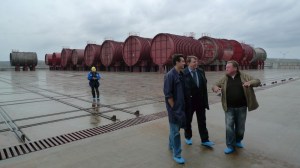 Last three reactor compartments soon off the water https://thebarentsobserver.com/en/ecology/2018/10/last-three-reactor-compartments-soon-water#.W8P-hlNi_4E.facebook25-years with safe decommissioning of Cold War submarines in the Russian north will come to an end next year. By Thomas Nilsen, October 14, 2018
120 nuclear-powered submarines sailing in-and-out from the Kola Peninsula during the Cold War have been properly decommissioned since the early 1990s. While most of the metal could be recycled, the still-highly radioactive reactor compartments had to be secured for long-term storage.
Intermediate, that meant storing the compartments floating at piers until they could be taken onshore at the central storage complex in Saida Bay, north of Murmansk on the coast of the Barents Sea.
In 2017, the Barents Observer reported that 15 compartments were still kept afloat on the water.
Today, only three reactor compartments remain and they will be taken onshore in 2019, Izvestia reports with reference to the northwestern branch of RosRao, Russia’s state owned company for handling radioactive.
The three compartments are today stored at piers in Saida Bay, while 117 compartments are stored on the huge concrete pad.
RosRao’s Chief Engineer says the very last reactor compartment t be taken onshore is the one from the “Kursk” submarine that sant in the Barents Sea in August 2000 during a naval exercise. The submarine was lifted from the seabed two years after and the remaining parts of the hull were scrapped.
In Saida Bay, the reactor compartments will have to be stored for onshore for many decades before the radioactivity have come down to levels acceptable for cutting the reactors’ metal up and pack it for final geological disposal.
October 15, 2018
Posted by Christina Macpherson |
Russia, wastes |
Leave a comment
 Anglesey council fact-finding trip to Japan ahead of nuclear plans for island called into question, North Wales Chronicle By Gareth Wyn Williams , 4th October, Local democracy reporter A TRIP to Japan by a delegation from Anglesey council ahead of a planned nuclear plant on the island has been called into question by opposition councillors.
On Saturday, economic development portfolio holder Carwyn Jones and head of regulation and economic development Dylan Williams will form part of a Welsh delegation heading to Japan.
The council says the five-day visit will serve as a key opportunity to improve knowledge, understanding and strengthen working relationships with Horizon Nuclear Power, the developer and operator of Anglesey’s proposed Wylfa Newydd development, and its owners Hitachi.
But, at a time when the authority is facing cuts of £9.34m over the next three years, the leader of the opposition has called into question the wisdom of spending taxpayers’ money on such a venture.
According to the authority, who have not revealed the cost of the trip, it will mostly come out of the Economic Development service budget, while flights were booked at the cheapest available rates (economy class), with Horizon covering the accommodation costs.
Cllr Bryan Owen, who leads the Anibynnwyr Mon opposition group, said: “I question the wisom of organising a trip like this when all ratepayers are seeing is schools being closed and services being cut due to austerity.
“It’s also been kept quite secretive. We as members were only made aware of this yesterday………
The delegation, which includes Welsh Government representatives, was invited by Horizon Nuclear Power and Hitachi.
The itinerary will include tours of key nuclear manufacturing facilities, as well as a visit to an Advanced Boiling Water Reactor site to see the same kind of technology that will be constructed at Wylfa Newydd……..
http://www.northwaleschronicle.co.uk/news/16981988.anglesey-council-fact-finding-trip-to-japan-ahead-of-nuclear-plans-for-island-called-into-question/
October 15, 2018
Posted by Christina Macpherson |
politics, UK |
Leave a comment

 Council of Europe requests Turkey to consult neighbours for Akkuyu nuclear plant https://ahvalnews.com/council-europe/council-europe-requests-turkey-consult-neighbours-akkuyu-nuclear-plant
The Parliamentary Assembly of the Council of Europe (PACE) expressed on Thursday deep concern at the construction of the Akkuyu nuclear power plant in an earthquake-prone region of Turkey only 85 kilometres from the border with Cyprus.
In a resolution it adopted, the assembly said that Turkey’s first nuclear plant being constructed as a joint Turkish-Russian project is in very close proximity to the other neighbouring countries.
The assembly asked Turkey to join the UN Convention on Environmental Impact Assessment in a Transboundary Context, also known as the Espoo Convention, and to take into account all concerns expressed, including those expressed by Turkish citizens.
The Espoo Convention , adopted in 1991, sets out the obligations of parties to assess the environmental impact of certain activities at an early stage of planning. It also lays down the general obligation of states to notify and consult each other on all major projects under consideration that are likely to have a significant adverse environmental impact across boundaries
The assembly also requested from the Turkish government to consult with neighbouring countries on the construction of the nuclear plant according to the International Convention on Nuclear Safety.
The construction of the Akkuyu nuclear plant located in the southern province of Mersin was kicked off by President Recep Tayyip Erdoğan and his Russian counterpart Vladimir Putin on Apr. 3.
The nuclear plant “raises concerns for a possible impact in terms of safety because such a power plant in this area affects our country much more than the largest part of the Turkish territory,” said the Cypriot government’s spokesman Prodromos Prodromou, following the groundbreaking ceremony in Mersin.
“Turkey did not take into account the grave reservations expressed by various quarters, nor did it heed the European Parliament’s call to terminate the construction plans since this is a seismologically vulnerable area,” he said.
Environmentalists in Turkey are also concerned about the potentially destructive ecological consequences of the Akkuyu nuclear power plant and several organisations form Mersin filed a lawsuit to stop its construction
October 13, 2018
Posted by Christina Macpherson |
EUROPE, politics international, safety, Turkey |
Leave a comment
WORLD WAR 3: Russian minister warns nuclear treaties under threat as relations plunge
SKY-HIGH tensions between the US and Russia are putting critical treaties designed to prevent a nuclear arms race in jeopardy as relations sink to an all-time low, a senior Russian official has warned.
By SIMON OSBORNE, Express UK, Oct 11, 2018 Moscow’s Deputy Foreign Minister Sergei Ryabkov described Western governments as “adversaries, not friends” and said a “complete malfunction of the American system” meant longstanding weapons agreements could be binned, leaving nuclear powers without constraint in the event of a future conflict.
He said: “We could lose several elements on arms control infrastructure. The building is shaky.”
Mr Rybakov warned another round of sanctions intruded by Donald Trump in the summer were “dangerous” and getting in the way of negotiations over renewing the New Strategic Arms Reduction Treaty “New START” which saw both sides agree to reduce their deployed nuclear arms by half but is set to expire in 2021.
He said: “If there is no progress then risk of a real backfire grows.
Mr Ryabkov was speaking as negotiators from the two countries met in Geneva to discuss a Cold War era treaty that was supposed to keep expansion of long-range nuclear-capable missiles in check.
Moscow and Washington have repeatedly accused each other of breaching the Intermediate-Range Nuclear Forces (INF) Treaty, a 1987 pact which bans firing land-based missiles with a range of up to 5,500km.
The US ambassador to NATO warned Moscow against developing a new cruise missile that could be armed with nuclear warheads, arguing that it was in breach of the INF and could be used against members of the Western military alliance.
Kay Bailey Hutchison said: “Counter measures by the United States would be to take out the missiles that are in development by Russia in violation of the treaty. They are on notice.”
The US government took a more aggressive line against Russia this year, when Mr Trump unveiled a new nuclear strategy that revolved around countering Russia and called for the development of small tactical nuclear weapons that were cheaper to maintain and could be used in more realistic scenarios.
Washington has also accelerated long-running US military plans to develop new intercontinental ballistic missiles (ICBMs) and nuclear-capable cruise missiles and has just confirmed hypersonic weapons testing is well underway……..https://www.express.co.uk/news/world/1030089/world-war-3-russian-minister-sergei-ryabkov-nuclear-treaties-moscow-washington-cold-war
October 13, 2018
Posted by Christina Macpherson |
politics international, Russia, USA, weapons and war |
Leave a comment
Penarth Daily News 11th Oct 2018 , The Welsh Labour Gover nment last night marshalled every vote it could
muster to see-off the combined forces of Plaid Cymru and the Conservative
Party in order to allow the dumping of 320,000 tons of ‘nuclear mud’
off Penarth to continue uninterrupted .
Outside the Welsh Assembly last night – immediately before the debate and vote on the issue in the
Assembly chamber – a mass protest rally took place attended by over 300
demonstrators who were addressed by the leader of Plaid Cymru Adam Price.
The Vale of Glamorgan Council and Barry Town Council votes to oppose the
dumping but a call for a debate on the issue in Penarth Town Council –
which had been initiated by the Deputy Mayor of Penarth Cllr Angela Thomas
– was quashed by the Labour Party.
PDN sources say the Labour leadership didn’t want to rock the sensitive Labour boat so near to a party
leadership election – due in December. Speaking against the
Plaid/Conservative motion was the Welsh Labour Government’s Energy
Minister Lesley Griffiths – a former personal secretary .
It was she whohad issued the licence to allow the mud dumping in the first place. She
said it was “deeply disappointing there are some who are deliberately
seeking to mislead the public for their own political gains and
misrepresenting the facts”. Griffiths warned the skippers of the fishing
boats circling in the waters outside the Assembly not to attempt any
blockade of the mud-dumping operation because it would be “a risk to
public safety”.
https://penarthnews.wordpress.com/2018/10/11/the-labour-party-is-dumping-on-wales-say-hinkley-mud-protesters/
October 13, 2018
Posted by Christina Macpherson |
politics, UK |
Leave a comment
 Le Monde 11th Oct 2018 Flamanville** [Machine Translation] New delay in sight for Flamanville EPR. According to
the Nuclear Safety Authority, “important technical work” remains to be done
to correct the anomalies identified on certain welds. The “battle of the
welds” probably did not finish to delay the construction of the EPR of
Flamanville (Channel). In a note sent to EDF and made public on 3 October, the president of the Nuclear Safety Authority (ASN) has severely reframed the public electrician, worrying about a “monitoring failure” on the Normandy nuclear site .
“It’s the whole chain of surveillance that has
malfunctioned,” says ASN. Pierre-Franck Chevet also indicated that
“important technical work remains to be done” to correct anomalies
identified on certain welds. To understand the vivacity of the reaction of
the nuclear policeman, we must return to the origin of the case. In
February, EDF discovered problems on 38 secondary circuit welds. This water
circuit serves to evacuate the steam towards the turbine. It consists of
four loops, associated with four steam generators. At first, the group
explains that these pipes comply with the regulations but that they should
have corresponded to the “high quality” standard, which is more demanding.
Specifically, EDF had defined this new standard for the construction of the
EPR and was unable to enforce it by its own subcontractors. And things got
complicated a few weeks later. The extensive examination of the welds
reveals that a large part of them do not comply with the standard required
by EDF, or even the regulations required for pressurized nuclear equipment.
Result: the group has to take back fifty-three welds, knowing that a single
weld represents at least eight additional weeks of work.
https://www.lemonde.fr/energies/article/2018/10/11/nouveau-retard-en-vue-pour-l-epr-de-flamanville_5367969_1653054.html
October 13, 2018
Posted by Christina Macpherson |
business and costs, France |
Leave a comment