Boris Johnson’s overhaul of govt departments. Will it really be good for the environment?
Times 16th Dec 2019, Boris Johnson wants an overhaul of Whitehall that would merge departments and make it easier to fire civil servants and bring in experts from outside. Climate change would again become a separate department, allowing Mr Johnson to claim that he has a commitment to the environment.
https://www.thetimes.co.uk/article/prime-ministers-cummings-plan-for-civil-service-zv85vxd8z
Legal action regarding defective welds in EPR nuclear reactor
Crilan 16th Dec 2019, On July 20, 2018 and following the “Sortir du nuclear” network and Greenpeace France, CRILAN filed a complaint with the Cherbourg Public Prosecutor concerning defective welds, particularly those relating to
crossings of the containment. This December 16, 2019, following ASN
inspections and in connection with the complaint by Réseau “Sortir du
nuclear” and Greenpeace France, CRILAN files a complaint with the Public
Prosecutor of Paris for serious breaches relating to the qualification of
some equipment installed on the EPR.
These are materials participating in
the safety demonstration: mechanical (pumps, valves) or electrical (relays,
circuit breakers, etc.). This qualification is based in particular on
studies and tests. It must be the subject of documentation and traceability
of reservations and “open” points, which has not always been the case.
As EDF is subject to regulations on basic nuclear installations, violations
committed may be penalized.
Call to postpone a decision on Suffolk’s new nuclear power station bid

 East Anglian Daily Times 16th Dec 2019, An MP has called on the Secretary of State for Energy to postpone a decision on Suffolk’s new nuclear power station bid – accusing developers of failing to address community concerns.
Central Suffolk and North Ipswich MP Dan Poulter told Andrea Leadsom that EDF Energy’s latest consultation on Sizewell C still failed to provide enough information for consultees to make an informed response. EDF is expected to make its ‘Development Consent Order’ to the Planning Inspectorate early next year – after finishing its stage four consultation in September.
But Dr Poulter, said the company’s stage four consultation still left too many unanswered questions. EDF said its consultation had engaged with thousands of people across East Suffolk, providing updates on its plans as they evolved. It said it held regular meetings with parish councils and had provided funding to offer themindependent and free guidance during consultation.
But it faced regular criticism over the level of detail supplied in each stage of consultation. Dr Poulter said EDF’s lack of detail was a “common theme”. “There was some hope among interested parties in East Suffolk that EDF would use the stage four consultation to address the numerous calls for better information, but a review of the responses indicates EDF has missed this opportunity,” Dr Poulter wrote.
He said the collective response from the Suffolk Coast and Heaths AONB was “particularly damning”. The response said the consultation failed to pay proper regard to the purposes of the AONB – “despite comments made in previous consultations”. Dr Poulter said the information called for should be provided in EDF’s DCO but he had “serious reservations” of its ability to do so, given its failings so far.
Even if EDF was able to provide the information, Dr Poulter said the amount of data consultees would need to go through would be “substantial” – meaning their ability to make proper responses would be “severely limited”. Explaining his letter, Dr Poulter said: “EDF are behaving in a disdainful and unacceptable way towards many of the communities in East Suffolk. They should engage
properly and consult with local communities so the very real concerns of
residents about what the construction of Sizewell C means for them can be
properly considered and addressed.”
Sceptisim over Boris Johnson’s promises environment and climate
The Conversation 13th Dec 2019, Rebecca Willis: Climate change had a higher profile in the UK election campaign than ever before, with parties competing hard over their offer to concerned voters.
But this was a debate that the Conservatives – who won a landslide majority – largely stood back from. Their manifesto was light on detail compared to the other parties, and Boris Johnson chose not to take part in the first ever UK televised leaders’ debate on climate.
Conservative candidates were conspicuous by their absence in local climate
hustings, too. Neither was climate mentioned in their legislative plan for
the first hundred days. The Conservative government did legislate for a net
zero carbon emissions target back in June, following the advice of the
Committee on Climate Change. And there was an explicit manifesto pledge to
deliver on this target, with no signs of backtracking.
In his speech to the party faithful on the morning of his election, Johnson declared his ambition to “make this country the cleanest, greenest on Earth, with the most far-reaching environmental programme”, adding: And you the people of this country voted to be carbon-neutral in this election – you voted to be carbon-neutral by 2050. And we’ll do it.
But targets don’t reduce carbon. Policies do. And despite its much-admired Climate Change Act, the UK’s policy record lately has not been good. The Committee on Climate Change have repeatedly warned that the UK is off track to meet future commitments, a verdict shared by the independent Climate Action Tracker project, which assesses each country’s performance against the Paris Agreement. It rated the UK as “insufficient”, with policies compatible
with a 3°C world – not the 1.5°C level that we desperately need.
If the new government is serious about its commitment, it will have to signal this soon, and with confidence. Steps that it could and should take straight
away include: instigating a swift review of governance for net-zero, giving
responsibility and resources to other government departments, and,
crucially, to local areas, to deliver on carbon strategy; prioritising
climate and environmental protection in negotiations for a trading
relationship with the European Union; moving quickly to consult on a
phase-out date for petrol and diesel vehicles, as promised in its
manifesto; removing the de facto ban on onshore wind energy, which the
Committee on Climate Change advised needs to increase in capacity by 1GW a
year; confirming its opposition to fracking, and making its moratorium
permanent; pledging to formally consider the results of the national
citizens’ assembly on climate change, Climate Assembly UK, due to report
in 2020.
UK election. Green Party grew by 60%
 Business Green 13th Dec 2019, The Green Party saw its total number of votes grow by over 60 per cent in yesterday’s election, delivering the biggest percentage gains of any party following a campaign that saw environmental issues take centre stage.
Caroline Lucas retained her seat in Brighton Pavilion, increasing her share
of the vote by almost five per cent to 57 per cent.
https://www.businessgreen.com/bg/news/3084650/green-party-celebrates-60-per-cent-vote-surge
United States and Russia are on the verge of a new arms race
By most accounts, the United States and Russia are on the verge of a new arms race, if not already in one.
But last month, something unusual happened: U.S. inspectors traveled to Russia to examine a new missile that Moscow says is super-fast. The demonstration was “aimed at facilitating efforts to ensure the viability and efficiency of New START,” the Russian Defense Ministry said.
Dmitry Stefanovich, a researcher with the Russian International Affairs Council, said the inspection of the weapon — called Avangard by Russian military designers — was a demonstration that Moscow was eager to extend New START.
“It is more like an offer: See, we will [give] you transparency on some new weapons and probably some more in the future, but we have to extend the treaty for it to work,” he told RFE/RL. “And we expect the same from you, when your modernization of strategic weapons reaches fruition.”
Large Arsenals
Signed in 2010 by Presidents Barack Obama and Dmitry Medvedev, New START limited the U.S. and Russian nuclear arsenals by capping the numbers of delivery systems — long-range bombers, silo-based land missiles, and submarine-launched missiles — and deployed warheads.
As of September 1, Russia had 513 deployed strategic launchers with 1,426 warheads, according to State Department figures. The United States deploys 668 strategic launchers with 1,376 warheads, according to the data……
The treaty expires in February 2021, although provisions allow for it to be prolonged by five years if both sides agree. ….. https://www.rferl.org/a/new-hope-for-new-start-can-russia-and-the-u-s-agree-to-keep-a-lid-on-their-nuclear-arsenals-/30326546.html
Docking problems for Russia’s nuclear ships
After the floating dock SD-50 sank at Roslyakovo yard north of Murmansk last fall “Sevmorput” now had to sail all around Scandinavia to St. Petersburg to find a dock large enough. Barents Observer, By Thomas Nilsen, December 15, 2019
“Sevmorput” left her homeport in Murmansk on December 5th and arrived in St. Petersburg on the 12th after sailing a distance of nearly 3,000 nautical miles, information from MarineTraffic tells.
The 260 meters long container ship is currently moored at the Admiralteyskiye yard in the Neva River, but will later be taken to the nearby dry dock at Kanonerskiy yard, SeaNews agency reports.
It was late October last year the floating dock sank at shipyard No. 82 in Roslyakovo between Murmansk and Severomorsk in the Kola Bay. The dock was then holding “Admiral Kuznetsov”, Russia’s only aircraft carrier.
The sunken dock was the only one on the Kola Peninsula large enough to accommodate “Sevmorput” and navy ships like the nuclear-powered battle cruiser “Pyotr Velikiy” and ballistic missile submarines of the Delta-IV-, Oscar, II- and Borei-classes.
An older land-dock at naval yard No. 35, Sevmorput, in Murmansk will be expanded to facilitate larger military vessels, like the submarines. The dock is said to be ready by 2021. Meanwhile, navy ships will have to sail to Severodvinsk for simple docking operations……..https://thebarentsobserver.com/en/industry-and-energy/2019/12/nuclear-powered-container-ship-sailed-3000-nm-change-propellers-lack
Release of radioactive dust at Dounreay contravened regulations
|
RADIOACTIVE DUST ACCIDENTALLY RELEASED AT NUCLEAR SITE CONTRAVENED MULTIPLE REGULATIONS, INVESTIGATION FINDS, Newsweek
BY ARISTOS GEORGIOU ON 12/13/19 Environmental authorities in Scotland have said that an accidental release of radioactive dust from a nuclear site “contravened multiple” regulatory conditions, according to reports.
The contaminated dust vented out of a uranium recovery plant at Dounreay—a nuclear research center which is in the process of being decommissioned—earlier this year after a valve failed during a system test in February, the BBC reported. This caused a “disturbance” of contaminated dust in the ventilation system and a subsequent discharge into the facility itself and the atmosphere…… https://www.newsweek.com/radioactive-dust-nuclear-site-multiple-regulatory-conditions-investigation-1477168 |
|
EU heads of state and government agreed that nuclear energy will be recognized as a way to fight climate change
 EU leaders include nuclear energy in green transition, By SAMUEL PETREQUIN, Associated Press Dec. 13, 2019 BRUSSELS (AP) — European Union leaders agreed Friday that nuclear energy will be part of the bloc’s solution to making its economy carbon neutral by 2050, allowing them to win the support of two coal-dependent countries.
EU heads of state and government agreed that nuclear energy will be recognized as a way to fight climate change as part of a deal that endorsed the climate target. While Poland did not immediately agree to the plan, the concessions on nuclear energy were enough for the Czech Republic and Hungary to give their approval…….. (subscribers only) https://www.sfchronicle.com/news/world/article/EU-leaders-include-nuclear-energy-in-green-14904378.php
France’s EDF company is trying to ‘restore trust’ in the nuclear industry

Sound the alarm on deadly US-Russia nuclear threat
 Sound the alarm on deadly US-Russia nuclear threat, by Jill Dougherty December 12, 2019 CNN, As I looked around the large square conference table, I watched the faces settle into worried frowns. Russians and Americans, several of whom once had responsibility for their nations’ nuclear weapons, all members of the Dartmouth Conference, the oldest continual bi-lateral dialogue between Americans and Russians, founded almost 60 years ago during one of the darkest periods of the Cold War.
UK Conservatives get big donations from fossil fuel and weapons companiess
Unearthed 11th Dec 2019, The Conservative election campaign has received hundreds of thousands of pounds from wealthy investors in the global fossil fuels industry, according to a new analysis by Unearthed. Some of the companies and projects benefiting from donors’ investments are opening up new fossil fuel reserves – even as the world battles climate change and the UK
prepares to host a crunch summit next year.
One of the Tory’s major donors also runs a hedge fund that holds significant investments in a major weapons manufacturer and a mining giant. Meanwhile the Liberal Democrats have taken a significant donation from a subsidiary of a hedge fund that has a major stake in the energy firm being blamed for California’s deadly wildfires and another stake in a French oil services firm.
The analysis looked at donations to political parties over £50,000 during the first three weeks of the election campaign and the financial holdings of
investment companies, as collected and presented by Bloomberg.
https://unearthed.greenpeace.org/2019/12/11/donations-election-campaign-investments-fossil-fuels/
Floating small nuclear reactors bring serious risks
nuclear experts have highlighted crucial negatives that cast doubt on the floating nuclear utopia.Jan Haverkamp, Greenpeace Netherlands senior expert nuclear energy and energy policy, sees the three main disadvantages of Akademin Lomonosov to be the big human factors risk, its problematic construction, and the pollution of the Arctic region with nuclear waste.
this project is reintroducing a major pollution risk in an area which functions as a climate regulator for the globe – “the Arctic pristine area, which is a very important natural area for the entire balance on the planet,”
Is floating nuclear power a good idea? Power Technology By Yoana Cholteeva, 9 Dec 19, Floating nuclear power promises to provide a steady source of energy at hard-to-reach locations, but at the same time the dangers inherent in nuclear power make some question whether it’s safe enough for areas where help is hard to find. Is floating nuclear power really a good idea? Yoana Cholteeva investigates.
Russian nuclear company Rosatom announced the arrival of the world’s first floating nuclear power plant, Akademik Lomonosov, in September 2019 when the technology was transported to the port of its permanent location in Russia’s Far East. The 144m-long and 30m-wide vessel has now docked at the port in Pevek, off the coast of Chukotka, where it will stay before its commissioning next year.
Akademik Lomonosov will use small modular reactor technology and is equipped with two KLT-40C reactor systems with 35MW capacity each. It has been designed to access hard-to-reach areas where it can operate for three to five years without the need for refuelling. It also has an overall life cycle of 40 years, which may be extended to 50 years Continue reading
Britain, France, and Germany press Iran over its ballistic missile program
|
Europeans Ramp up Pressure on Iran, Britain, France, and Germany say Iran’s ballistic missile program is inconsistent with the nuclear deal and improves its capacity to deliver nuclear payload. Tehran counters that Europeans have failed to meet obligations under the pact. FP.com,
BY COLUM LYNCH
DECEMBER 6, 2019, Three key European powers this week inched closer to the Trump administration’s maximum pressure campaign against Iran, saying that Tehran’s ballistic missile program is inconsistent with its obligations under the Iran nuclear accord. Iran’s ballistic program—which was largely prohibited by the United Nations Security Council before the adoption of the Iran nuclear pact in 2015—has been a source of contention between Washington and Tehran. Under the terms of the agreement, Iran reserved the right to develop ballistic missiles for conventional warheads. But it pledged not to develop missiles capable of delivering a nuclear bomb. Under President Donald Trump, the United States—which pulled out of the nuclear deal in May 2018—maintains that Iran has been violating the spirit of the agreement by developing banned missile capabilities under the cover its conventional weapons program. The administration recently got a boost from Britain, France, and Germany, which signed a joint letter last month declaring that “Iran’s developments of nuclear-capable ballistic missiles and related technologies is inconsistent” with its obligations under a U.N. resolution that endorsed the nuclear accord. Foreign Policy is publishing the letter, which was made public by the United Nations earlier this week, as part of our Document of the Week series. The letter constituted the latest sign that key European powers—which remain committed to the nuclear pact—are seeking to shore up their relations with Washington and to chastise Tehran for what they view as its gradual retreat from its obligations under the nuclear pact. But Iran’s foreign minister, Mohammad Javad Zarif, accused them of seeking to “cover up their miserable incompetence” in living up to their own obligations under the nuclear pact. If the United Kingdom, France, and Germany “want a modicum of global credibility, they can begin by exerting sovereignty rather than bowing to US bullying,” he said. The European powers assert that an Iranian launch of a Shahab-3 medium-range missile—which appeared footage posted on social media in April—included a booster that the Missile Technology Control Regime concluded is capable of delivering a nuclear weapon. The 35-member association of the world’s main missile producers urges restrictions on the export of nuclear missile technology……… https://foreignpolicy.com/2019/12/06/europe-iran-ramp-up-pressure-ballistic-missiles/ |
|
France’s nuclear industry in dire straits
 The French nuclear revolution is rusting away, December 6, 2019, THE AUSTRALIAN, Henry Ergas “……..France’s nuclear power industry faces a future that is more uncertain than ever. The problems gripping the industry were highlighted late last month in an official report prepared by the former president and chief executive of PSA Peugeot Citroen, Jean Martin Folz.
While the report’s focus is on the difficulties that have plagued the construction of a new reactor at Flamanville in northwestern France, its implications reach much further.
With nuclear power plants accounting for more than 70 per cent of its overall electricity generation, no country is as dependent on nuclear energy as is France.
The decision to rely so massively on nuclear energy was taken in 1974, after the oil shock of the previous year had underlined France’s vulnerability to Middle Eastern oil. Prime minister Pierre Messmer launched a crash program that led to the construction of 56 reactors in just 15 years.
…….. however, most of France’s generators are approaching the final decade of their useful life. Planning for their replacement has been a stop-start affair, with the Greens’ increasingly strident opposition to nuclear power deterring successive governments from taking action.
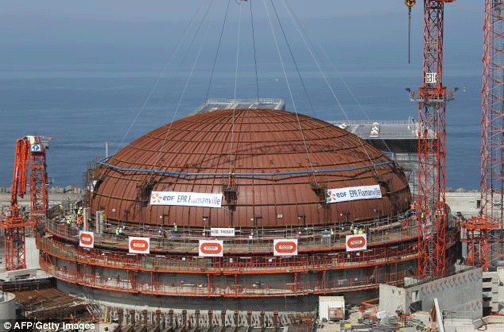 As a result, only the Flamanville plant received the go-ahead, with construction beginning in 2007 for an expected entry into service in 2012. Virtually from the outset, the project was beset by woes. At this stage, the total costs of construction are four times greater than initially estimated, while the plant will not enter service before the end of 2022.
The problems stem partly from the sheer complexity of the new reactor, which is the first of its kind to be built in France.
Additionally, the catastrophe at Fukushima in 2011 led to regulatory changes that necessitated costly redesigns. And the project has suffered more than its fair share of mismanagement, aggravated by a byzantine allocation of responsibilities between EDF, the main French electricity utility, which oversaw the project, and many layers of subcontractors.
However, as the Folz report shows, the primary cause of the difficulties lies in the erosion of the industry’s skill base during the long hiatus from the end of the crash program in 1990 to the initiation of Flamanville………
There is, at this point, no prospect of France scaling up its nuclear program  ………The cost blowout at Olkiluoto drove Areva, the “national champion” of France’s nuclear industry, into bankruptcy.
Even with an injection of $7.3bn in public funds EDF, which acquired Areva, lacks the balance sheet strength to underwrite new projects, while the French government’s borrowing ability is hampered by its already too high levels of debt.
To make matters worse, the regulated prices at which EDF has to sell the power it generates mean that it cannot charge its European clients the full value of the baseload it supplies.
 As for global investors, who might provide the debt financing EDF would require, they are wary of projects that are risky in themselves ….
Given those constraints, the government has announced a modest plan to eventually build six additional reactors. So far, however, there are no actionable decisions beyond the completion of Flamanville. And work on the next generation of reactors….. has been quietly downgraded, making it likely that there will no fourth generation reactor of French design.
The consequences for France itself are far-reaching. Beginning in the late 1950s, French firms succeeded in one high-technology market after the other by developing or acquiring a rather basic design (including the Westinghouse Pressurised Water Reactor, the Mirage jet fighter and the TGV high-speed train) that they upgraded while producing it on a large scale.
That era is over, and there is every sign France is struggling with almost all the major projects it has in train.
The Folz report should therefore come as an ominous warning for Australia’s submarine project, as it identifies French industry’s serious managerial and technological weaknesses in a range of areas, such as precision welding, that are crucial to that project’s success……. https://www.theaustralian.com.au/commentary/the-french-nuclear-revolution-is-rusting-away/news-story/afe4546ed799939cf117d71f05035c5e
1 This Month
23-25 October – on Zoom – World BEYOND War’s annual global conferenc


Shut down the radiation-damaged Heysham nuclear reactors now
To see nuclear-related stories in greater depth and intensity – go to https://nuclearinformation.wordpress.com

Say No to NASA’s Reckless Nuclear Reactor on the Moon
Say No to NASA’s Reckless Nuclear Reactor on the Moon
-
Archives
- October 2026 (170)
- September 2026 (339)
- August 2026 (330)
- July 2026 (355)
- June 2026 (287)
- May 2026 (306)
- April 2026 (356)
- March 2026 (251)
- February 2026 (267)
- January 2026 (308)
- December 2025 (358)
- November 2025 (359)
-
Categories
- 1
- 1 NUCLEAR ISSUES
- business and costs
- climate change
- culture and arts
- ENERGY
- environment
- health
- history
- indigenous issues
- Legal
- marketing of nuclear
- media
- opposition to nuclear
- PERSONAL STORIES
- politics
- politics international
- Religion and ethics
- safety
- secrets,lies and civil liberties
- spinbuster
- technology
- Uranium
- wastes
- weapons and war
- Women
- 2 WORLD
- ACTION
- AFRICA
- Atrocities
- AUSTRALIA
- Christina's notes
- Christina's themes
- culture and arts
- Events
- Fuk 2022
- Fuk 2023
- Fukushima 2017
- Fukushima 2018
- fukushima 2019
- Fukushima 2020
- Fukushima 2021
- general
- global warming
- Humour (God we need it)
- Nuclear
- RARE EARTHS
- Reference
- resources – print
- Resources -audiovicual
- Weekly Newsletter
- World
- World Nuclear
- YouTube
-
RSS
Entries RSS
Comments RSS

