Fukushima Prefecture has over 9 million bags of nuclear waste
|
Over 9 million bags of nuclear cleanup waste piled up across Fukushima Pref. https://mainichi.jp/english/articles/20151210/p2a/00m/0na/020000c?fbclid=IwAR0UFZrUByjuHKdFb8dE7o4p_WjADFuYZBGw-5NUrbUklXe_8buwbOifmaA The number of bags of waste from decontamination efforts around the stricken Fukushima No. 1 nuclear plant reached a little under 9.16 million as of the end of September according to Fukushima Prefecture and the Environment Ministry. The 1-cubic-meter bags are found at some 114,700 interim storage or decontamination sites across the prefecture. In the town of Tomioka — covered by a nuclear disaster evacuation order — mounds of bags have grown so tall that they obscure the power shovels used to move and stack the waste, the black balls covering every sliver of landscape. The bags of waste are typically stacked four layer high, with a fifth layer of uncontaminated soil laid on top to block radiation. Waterproof sheets are also used to stop rainwater from getting into the bags and becoming contaminated. Negotiations with the towns of Okuma and Futaba — both under evacuation orders — to establish mid-term waste storage facilities there have been hard-going, and the start of construction is nowhere in sight.December 10, 2015 (Mainichi Japan) |
USA’s Patriot Act destroys civil liberties
 Who Will Protect Us From an Unpatriotic Patriot Act?
 https://www.counterpunch.org/2019/12/11/who-will-protect-us-from-an-unpatriotic-patriot-act/ by JOHN W. WHITEHEAD
While Congress subjects the nation to its impeachment-flavored brand of bread-and-circus politics, our civil liberties continue to die a slow, painful death by a thousand cuts.
Case in point: while Americans have been fixated on the carefully orchestrated impeachment drama that continues to monopolize headlines, Congress passed and President Trump signed into law legislation extending three key provisions of the USA Patriot Act, which had been set to expire on December 15, 2019.
As Congressman Thomas Massie (R-Ky.) predicted:
Today, while everyone is distracted by the impeachment drama, Congress will vote to extend warrantless data collection provisions of the #PatriotAct, by hiding this language on page 25 of the Continuing Resolution (CR) that temporarily funds the government. To sneak this through, Congress will first vote to suspend the rule which otherwise gives us (and the people) 72 hours to consider a bill. The scam here is that Democrats are alleging abuse of Presidential power, while simultaneously reauthorizing warrantless power to spy on citizens that no President should have… in a bill that continues to fund EVERYTHING the President does… and waiving their own rules to do it. I predict Democrats will vote on a party line to suspend the 72 hour rule. But after the rule is suspended, I suspect many Republicans will join most Democrats to pass the CR with the Patriot Act extension embedded in it.
UK Conservatives get big donations from fossil fuel and weapons companiess

 Unearthed 11th Dec 2019, The Conservative election campaign has received hundreds of thousands of pounds from wealthy investors in the global fossil fuels industry, according to a new analysis by Unearthed. Some of the companies and projects benefiting from donors’ investments are opening up new fossil fuel reserves – even as the world battles climate change and the UK
prepares to host a crunch summit next year.
One of the Tory’s major donors also runs a hedge fund that holds significant investments in a major weapons manufacturer and a mining giant. Meanwhile the Liberal Democrats have taken a significant donation from a subsidiary of a hedge fund that has a major stake in the energy firm being blamed for California’s deadly wildfires and another stake in a French oil services firm.
The analysis looked at donations to political parties over £50,000 during the first three weeks of the election campaign and the financial holdings of
investment companies, as collected and presented by Bloomberg.
https://unearthed.greenpeace.org/2019/12/11/donations-election-campaign-investments-fossil-fuels/
Letter of Thanks to Operators of Cracked Nuclear Reactors in Scotland —

Below is a letter just sent from a supporter of Radiation Free Lakeland to EDF the operators of Hunterston B. Many thanks to David Autumns for his scrutiny on this – the nuclear industry, the most dangerous industry humans have ever engaged in, needs holding to account more than ever. Dear EDF Thank you for […]
via Letter of Thanks to Operators of Cracked Nuclear Reactors in Scotland —
December 11 Energy News — geoharvey

COP25: ¶ “Major emitters accused of blocking progress at UN talks” • Delegates from developing countries have reacted angrily to what they see as attempts to block progress at the COP25 meeting in Madrid. One negotiator told the BBC that the talks had failed to find agreement on a range of issues because of the […]
Los Alamos National Laboratory lost 250 barrels of nuke waste
The contractor that’s been in charge of Los Alamos National Laboratory’s operations for the past year lost track of 250 barrels of waste, while the company heading the legacy cleanup mislabeled and improperly stored waste containers and took months to remedy some infractions, according to the state’s yearly report on hazardous waste permit violations.
Triad National Security LLC, a consortium of nonprofits that runs the lab’s daily operations, had 19 violations of its permit from the New Mexico Environment Department. Newport News Nuclear BWXT Los Alamos, also known as N3B, which is managing a 10-year cleanup of waste generated at the lab, was cited 29 times.
Triad’s most notable violation was shipping 250 barrels of mostly mixed waste to the Waste Isolation Pilot Plant in Carlsbad without tracking them. Mixed waste contains low-level radioactive waste and other hazardous materials. Inspectors found records still listed the waste at the national lab. …..
A disastrous “kitty litter” incident happened under Los Alamos National Security, in which a waste barrel was packaged in error with a volatile blend of organic cat litter and nitrate salts, causing the container to burst and leak radiation at the Southern New Mexico storage site. WIPP closed for almost three years, and the cleanup cost about $2 billion.
The National Nuclear Security Administration, a division of the U.S. Department of Energy that oversees the lab, declined to renew LANS’ contract in 2015. Triad took over operations in November 2018. Among Triad’s duties is to dispose of waste at the lab generated from 1999 to the present.
N3B won a $1.4 billion contract in December 2017 to clean up waste produced at the lab before 1999.
The company was cited for a slew of mislabeled waste containers during the year. Inspectors also found some waste barrels, which are stored under tent-like domes, coated with snow or rainwater.
N3B also failed to remedy within 24 hours the flaws that inspectors found in equipment or structures that could present an environmental or human-health hazard, the report said. Inspectors discovered N3B took as long as 18 months to fix cracks in concrete and asphalt surfaces…….. https://www.santafenewmexican.com/news/local_news/state-report-lanl-lost-track-of-barrels-of-nuke-waste/article_e9de8348-17cc-11ea-bae3-c71a1aadd222.html
Devastating array of craters on the ocean floor, from nuclear tests
Enormous Craters Blasted in Seafloor by Nuclear Bombs Mapped for the First Time, Live Science, By Mindy Weisberger – Senior Writer 11 Dec FRANCISCO — Today, all seems quiet in the remote Bikini Atoll, a chain of coral reef islands in the central Pacific. But more than 70 years ago, this region’s seafloor was rocked by powerful atomic bombs detonated by the U.S. Army.
For the first time, scientists have released remarkably detailed maps of this pockmarked seabed, revealing two truly massive craters. This new map shows that the seabed is still scarred by the 22 bombs detonated at Bikini Atoll between 1946 and 1958.
The map was presented yesterday (Dec. 9) at the annual meeting of the American Geophysical Union.
During the 1946 nuclear weapons test known as “Operation Crossroads,” the U.S. wanted to test the impact of nuclear bombs on warships. To that end, the Army assembled more than 240 ships — some of which were German and Japanese — that held different amounts of fuel and munitions, then deployed two nuclear weapons to destroy them, researcher Arthur Trembanis, an associate professor with the College of Earth, Ocean, and Environment at the University of Delaware, said in the presentation.
At the time of the tests, Trembanis said, comedian Bob Hope joked grimly:
“As soon as the war ended, we found the one spot on Earth that had been untouched by war and blew it to hell.”……….
But as powerful as the early atomic tests were, they were dwarfed by the later blasts caused by hydrogen and fusion bomb tests in the 1950s. The researchers investigated a crater that was 184 feet (56 m) deep and had an unusual oblong shape; they determined that it was a composite crater from multiple blasts: “Castle Bravo,” a 15-megaton bomb that was the largest ever detonated by the U.S., and “Castle Romeo,” the first deployed thermonuclear bomb.
These tests left behind a uniquely devastating array of shipwrecks and craters, and the first detailed map of their aftermath will help scientists to tell this untold story and connect to “a moment at the dawn of the nuclear age,” Trembanis said. “Our new findings provide insights into previously unknown conditions at Bikini and allow us to reflect on the lasting consequences from these and other tests.” https://www.livescience.com/mapping-reveals-bikini-atoll-nuclear-craters.html
Dangers of nuclear crises in the Arctic: countries prepare for emergencies.
Arctic Council creates new expert group on nuclear emergencies https://thebarentsobserver.com/en/arctic/2019/12/arctic-council-creates-new-expert-group-nuclear-emergencies
The Arctic countries take major steps to prepare strategies and share information to improve preparedness in case of radiological and nuclear incidents. By Thomas Nilsen, December 11, 2019
Two fatal accidents during the summer of 2019 was a wake-up call for radiation emergency authorities monitoring northern waters.
On July 1st, the nuclear-powered special purpose submarine Losharik catches fire when on mission outside the Kola Peninsula. Six weeks later, a nuclear-powered cruise missile explodes while being recovered from the seabed outside Nenoksa naval weapons testing site in the White Sea.
While Russia has been very reluctant to share information about what happened at the two accidents, the country is a team-player when the Arctic Council now has agreed to establish a dedicated expert group on radiation and nuclear incidents.
The formal decision was taken at the meeting of the Arctic Council’s Working Group on Emergency Prevention, Preparedness and Response (EPPR) in Reykyavik on December 4th.
All eight Arctic states will appoint experts and observer states are encouraged to participate. To strengthen the group’s role, the International Atomic Energy Agency (IAEA) is invited to join the meetings.
Inside the Arctic Circle, the number of nuclear-powered vessels has increased sharply over the last decade.
Tensions between Russia and NATO have led to more sailings with reactor-powered submarines, especially in the Norwegian, Barents- and White Seas, but also under the ice in the high Arctic. Northern Norway saw a record number of 12 visiting NATO nuclear-powered submarines in 2018. And while the Arctic Council members met in Reykjavik last week, Russia’s Northern Fleet still had a number of attack submarines sailing the Norwegian Sea. So did at least one American nuclear-powered submarine as reported by the Barents Observer.
Secondly, increased shipping and industrial activities along Russia’s Northern Sea Route are supported by more and larger nuclear-powered icebreakers.
Unfortunate, the history of operating reactors and deploying nuclear weapons to the Arctic has a bad record with radioactivity released to the environment and exposure to people; nuclear weapons testing at Novaya Zemlya, the crash of a U.S. bomber with plutonium warheads at Thule airbase on Greenland, sinking submarines like the Komsomolets, Kursk and K-259. Several other submarines have suffered serious reactor accidents and in the Kara Sea, thousands of containers wit radioactive waste is dumped together with 16 reactors.
The Arctic Council, though, can not engage in anything related to military activities.
The list of potential incidents with possible releases of radioactivity exposing people living or working in the Arctic is long. How to share knowledge and information about each countries’ preparedness capacities will certainly be on the agenda when the new expert group’s first formal meeting, likely to take place next spring on the Faroe Islands.
Chair of the expert group in the starting period, Øyvind Aas-Hansen with the Norwegian Radiation and Nuclear Safety Authority, tells the Barents Observer that one interesting topic that might be brought to table is defining the risk potential for emergencies due to nuclear and radiological material and activities that pose a threat in the Arctic.
«We aim at protecting Arctic inhabitants and their livelihoods and the Arctic environment,» Øyvind Aas-Hansen explains.
He said it is needed to «identify minimal preparedness and response arrangements and capabilities applicable to the Arctic region.»
Aas-Hansen said it could be special needs for coordinating emergency prevention and response that are «specific to the Arctic region.»
Both the United States and Russia have serious experiences from dealing with nuclear accidents in cold climate, like the US clean-up work after the Thule accident in 1968 and Soviet clean-up work after the leakages from Building No. 5 in Andreeva Bay in the early 1980s.
More reactors at sea
The Barents Observer has recently published an overview (pdf) listing the increasing number of reactors in the Russian Arctic. The paper is part of Barents Observer’s analytical popular science studies on developments in the Euro-Arctic Region.
According to the list there are 39 nuclear-powered vessels or installations in the Russian Arctic today with a total of 62 reactors. This includes 31 submarines, one surface warship, five icebreakers, two onshore and one floating nuclear power plants.
Looking 15 years ahead, the number of ships, including submarines, and installations powered by reactors is estimated to increase to 74 with a total of 94 reactors, maybe as many as 114. Additional to new icebreakers and submarines already under construction, Russia is brushing dust of older Soviet ideas of utilizing nuclear-power for different kind of Arctic shelf industrial developments, like oil- and gas exploration, mining and research. “By 2035, the Russian Arctic will be the most nuclearized waters on the planet,” the paper reads.
Also, existing icebreakers and submarines get life-time prolongation. The average age of the Northern Fleet’s nuclear-powered submarines has never been older than today. Several of the submarines built in the 1980s will continue to sail the Barents Sea and under the Arctic ice-cap until the late 2020s.
In August, Russia’s first floating nuclear power plant, “Akademik Lomonosov”, will be towed from Murmansk to Pevek, a port-town on the northeast coast of Siberia.
Other plans to use nuclear reactors in the Russian Arctic in the years to come include many first-of-a-kind technologies like sea-floor power reactors for gas exploration, civilian submarines for seismic surveys and cargo transportation, small-power reactors on ice-strengthen platforms.
In the military sphere, the Arctic could be used as testing sites for both Russia’s new nuclear-powered cruise-missile and nuclear-powered underwater weapons drone. Both weapons were displayed by President Vladimir Putin when he bragged about new nuclear weapons systems in his annual speech to the Federation Council last year.
An Arctic Council summary report, presented to the Ministerial Meeting in Rovaniemi in May as a deliverable by the Emergency Prevention, Preparedness and Response (EPPR) Working Group highlight the risks: “The presence of radiological and nuclear material in the Arctic poses a risk for serious incidents or accidents that may affect Arctic inhabitants and their communities, the Arctic environment, and Arctic industries, including traditional livelihoods such as fisheries and local food sources.”
For Norway, Russia and Iceland, a nuclear accident in the Barents Sea could be disastrous for sales of seafood. The three countries export of cod and other spices is worth billions of Euros annually.
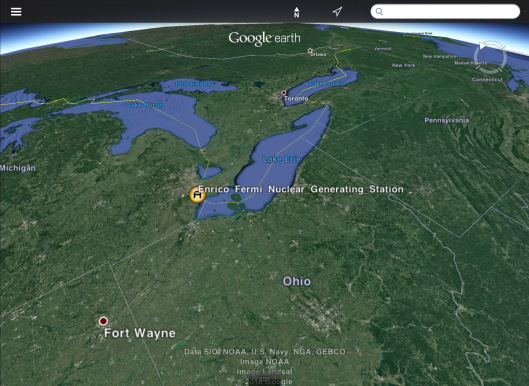
U.S. Congress members call on Trudeau to stop nuclear waste dumping near Great Lakes
|
Upton, Dingell, Kildee and Mitchell Appeal to Trudeau: No Nuclear Waste In the Great Lakes Basin, https://whtc.com/news/articles/2019/dec/10/upton-dingell-kildee-and-mitchell-appel-to-trudeau-no-nuclear-waste-in-the-great-lakes-basin/965368/ When U.S. Representatives Fred Upton and Debbie Dingell joined with a handful of other House members last Friday, Dec. 6, 2019, to decry plans by Canadian officials to put a nuclear waste storage site in the Great Lakes basin, they were hoping to shame Canadian Prime Minister Justin Trudeau into some kind of protective action.
Tuesday, December 10, 2019 But something else happened, Upton explained.
“We’ve got other members now, on a bipartisan basis, coming to us saying, ‘Hey, we want to sign that same letter,'” he said. “So we’re going to be doing another letter, a little bit later this week, that’ll have broader appeal. Because we were sort of under the gun when we learned the news late Friday afternoon.” Upton and Dingell joined two other Michigan representatives, Paul Mitchell and Dan Kildee in signing a letter appealing to Trudeau to oppose any nuclear waste storage plans near the Great Lakes. The complete text of last week’s letter: Dear Prime Minister Trudeau: We write to you out of deep concern regarding reports that Canada is moving closer to selecting a permanent national repository for harmful nuclear waste along the shores of the Great Lakes. Allowing a permanent nuclear waste storage facility anywhere near the Great Lakes basin, for any amount of time, is a risk we cannot afford to take. The recent reporting also has us greatly concerned that the highest levels of radioactive waste would ultimately be stored at the proposed site. We know that there are other Members of Congress representing districts in the Great Lakes basin who are most concerned by this development and will certainly be joining with us in the days ahead. This is a grave concern. These waters have long united us—they should not divide us. In November, the Energy and Commerce Committee favorably advanced H.R. 2699, the Nuclear Waste Policy Amendments Act of 2019, to the House for final consideration and it included an important bipartisan amendment that expresses the Sense of Congress that the governments of the United States and Canada should not allow permanent or long-term storage of spent nuclear fuel or other radioactive waste near the Great Lakes. This amendment was unanimously supported and adopted. We stand in strong opposition to any decision by the Canadian government to select or consider a permanent national repository for nuclear waste storage anywhere near the Great Lakes. This is a treasured natural resource each of our countries share and we urge you to stand with us to protect these waters for future generations. Thank you for your consideration of this important request and we look forward to a timely response. |
2 nuclear reactors in Fukui Prefecture to be shut down
Kansai Electric Power Co. will spend ¥118.7 billion to dismantle the Nos. 1 and 2 units at the Oi nuclear power plant, with work expected to wrap up in the fiscal year ending March 2049.
The units, which each have an output capacity of more than 1 million kilowatts, are the most powerful reactors to be approved for decommissioning by the Nuclear Regulation Authority since a magnitude 9.0 earthquake and subsequent tsunami caused a meltdown at the Fukushima No. 1 plant in March 2011.
Following the disaster, the government placed a 40-year limit on the lifespan of reactors in the country, with a possible 20-year extension if strict safety standards are met.
As both units came online in 1979 and were approaching the 40-year limit, Kansai Electric had a choice of applying for the extension or scrapping them.
In December 2017, the utility announced it would scrap the aging reactors, citing the high cost of implementing additional safety measures. Kansai Electric submitted the decommissioning plan to the authority in November 2018.
The plant’s Nos. 3 and 4 units came online in 1991 and 1993, respectively, and are currently active.
Around 23,000 tons of low-level radioactive waste will be remain following the dismantling process, according to the plan, along with another 13,200 tons of nonradioactive waste.
The plan does not state where the waste will be stored.
DoD To Report on Nuclear Programs of US, Russia, China
|
DoD To Report on Nuclear Programs of US, Russia, China
https://fas.org/blogs/secrecy/2019/12/us-foreign-nuclear/ Dec.10, 2019 in Dept of Defense by Steven Aftergood
In a challenge to Pentagon secrecy, Congress has told the Secretary of Defense and the Director of National Intelligence to prepare an unclassified report on the nuclear weapons programs of the United States, Russia and China. The requirement was included in the new House-Senate conference version of the FY2020 defense authorization act (sect. 1676). The mandated report must include an assessment of “the current and planned nuclear systems” of the three nations, including “research and development timelines, deployment timelines, and force size.” The Pentagon has been reluctant to issue its own unclassified estimates of foreign nuclear programs. Earlier this year DoD even refused to declassify the current size of the US nuclear stockpile, though it had previously done so every year since 2010. The newly required report must be produced in unclassified form, Congress directed, though it may include a classified annex. “Across the Department of Defense, basic information is becoming harder to find,” wrote Jason Paladino of the Project on Government Oversight in “The Pentagon’s War on Transparency,” December 5, 2019 |
|
Flammable hazard stalls LANL’s plutonium operations, waste shipments
Flammable hazard stalls LANL’s plutonium operations, waste shipments, Sante Fe New Mexican , By Scott Wyland , swyland@sfnewmexican.com
-
- Dec 9, 2019 Concerns that a calcium residue might be flammable prompted officials at Los Alamos National Laboratory to curtail plutonium operations and suspend waste shipments in early November, according to a federal report.
The lab suspended most waste generation and certification at its plutonium facility and halted all waste shipments after officials questioned the accuracy of documentation, particularly on how much calcium-and-salt residue remained in transuranic waste after processing, the Defense Nuclear Facilities Safety Board, an independent oversight panel, said in a Nov. 15 report that was publicly released Friday.
Calcium is used to help reduce oxidation in plutonium. Traces of the substance typically linger after processing, and if they are too high, they can ignite when exposed to open air, the report says…… https://www.santafenewmexican.com/news/local_news/flammable-hazard-stalls-lanl-s-plutonium-operations-waste-shipments/article_dad5a96c-186c-11ea-ac96-a345865823f1.html
1 This Month
23-25 October – on Zoom – World BEYOND War’s annual global conferenc

To see nuclear-related stories in greater depth and intensity – go to https://nuclearinformation.wordpress.com

Say No to NASA’s Reckless Nuclear Reactor on the Moon
Say No to NASA’s Reckless Nuclear Reactor on the Moon
-
Archives
- October 2026 (160)
- September 2026 (339)
- August 2026 (330)
- July 2026 (355)
- June 2026 (287)
- May 2026 (306)
- April 2026 (356)
- March 2026 (251)
- February 2026 (267)
- January 2026 (308)
- December 2025 (358)
- November 2025 (359)
-
Categories
- 1
- 1 NUCLEAR ISSUES
- business and costs
- climate change
- culture and arts
- ENERGY
- environment
- health
- history
- indigenous issues
- Legal
- marketing of nuclear
- media
- opposition to nuclear
- PERSONAL STORIES
- politics
- politics international
- Religion and ethics
- safety
- secrets,lies and civil liberties
- spinbuster
- technology
- Uranium
- wastes
- weapons and war
- Women
- 2 WORLD
- ACTION
- AFRICA
- Atrocities
- AUSTRALIA
- Christina's notes
- Christina's themes
- culture and arts
- Events
- Fuk 2022
- Fuk 2023
- Fukushima 2017
- Fukushima 2018
- fukushima 2019
- Fukushima 2020
- Fukushima 2021
- general
- global warming
- Humour (God we need it)
- Nuclear
- RARE EARTHS
- Reference
- resources – print
- Resources -audiovicual
- Weekly Newsletter
- World
- World Nuclear
- YouTube
-
RSS
Entries RSS
Comments RSS

