Nuclear power headed to be excluded from EU green finance scheme
‘Do no harm’: Nuclear squeezed out of EU green finance scheme, 
 By Frédéric Simon | EURACTIV.com Dec 6, 2019 European Greens claimed victory on Thursday (5 December) after EU negotiators reached agreement on a green finance taxonomy aimed at channelling billions of private investor’s money into clean technologies. Coal, and – in principle – nuclear power, are out.
The deal, reached by national envoys and EU Parliament negotiators yesterday evening, marks a stunning defeat for France, which lobbied hard to win recognition for nuclear energy as a low-carbon source of energy…….
Do no harm” test
But the European Parliament “resisted attempts from national governments to politicise the environmental criteria” underpinning the EU’s new sustainable finance classification scheme, the Greens said in a statement.
A strengthened “do no harm” principle means nuclear power will – in all likelihood – be excluded from the EU’s green finance taxonomy when experts sit down to agree detailed implementing rules next year, they said.
The ‘no-harm’ test “will help avoid nuclear energy from being considered an environmentally sustainable investment,” the Greens said in a statement to the press.
The taxonomy will provide investors, pension funds and private equity firms with “a common definition of what is green and what is not” in order to channel more capital into sustainable businesses and prevent “green-washing,” the European Commission said last year when it tabled the proposed new regulation.
The deal creates three categories for sustainable investments: “green”, “enabling” and “transition”. It also obliges companies with more than 500 employees to disclose how much of their activities are compliant with the three new categories, the FT reported.
“Today’s compromise will shift financial flows away from dirty, carbon intensive investments and into sustainable economic activities,” said Bas Eickhout, a Dutch Green MEP who was the European Parliament’s lead negotiator on the draft EU regulation.
“Any investment in coal cannot be considered sustainable,” he said in a statement……..
EU experts will now have to sit down and lay out thresholds to determine which economic activities can qualify as green. These will include CO2 emission limits for power production, which EU experts have tentatively set at 100g of CO2 per KWh – a threshold that would, in principle, exclude natural gas.
Here again, the Greens claimed they won guarantees ensuring those implementing rules “will be prepared by a balanced platform of experts” – not national envoys.
During the negotiations, France pushed for technical thresholds to be decided by a group of experts appointed by EU national governments. But the Greens resisted those attempts, saying that would have exposed the group to political pressures.
“The key part of the agreement is the strong independent governance structure,” Jess said.
“The text establishes an independent Platform on Sustainable Finance who will be responsible for developing and maintaining the full taxonomy going forward,” he explained. The expert group will also be responsible for monitoring capital flows and advising governments in their economic transition.
Significant obstacles to Rolls Royce’s fantasy of “clean” nuclear-supplied jet fuel
 Rolls-Royce Touts Nuclear Reactors as Key to Clean Jet Fuel, Bloomberg,
By Christopher Jasper,December 6, 2019,
Rolls-Royce Touts Nuclear Reactors as Key to Clean Jet Fuel, Bloomberg,
By Christopher Jasper,December 6, 2019,
- Synthetics, biofuels to be mainstay of aviation, CEO says
- Small reactors to be used to generate required electricityRolls-Royce Holdings Plc is pitching nuclear reactors as the most effective way of powering the production of carbon-neutral synthetic aviation fuel without draining global electricity grids.
Drawing on technology developed for nuclear-powered submarines, the small modular reactors or SMRs could be located at individual plants to generate the large amounts of electricity needed to secure the hydrogen used in the process, according to Chief Executive Officer Warren East…….
The proposals face significant obstacles, including widespread public concern about radiation leaks and the safe disposal of nuclear waste, as well as question marks over U.K. plans to revive the sector after Hitachi Ltd. and Toshiba Corp. withdrew from major projects.Rolls aims to minimize regulatory barriers by building an initial network of 16 SMRs on the sites of former U.K. nuclear power stations still approved for atomic use.
The plants, costing 1.8 billion pounds ($2.4 billion) apiece, would feed the national grid and come online from the 2030s, with all complete by 2050. https://www.bloomberg.com/news/articles/2019-12-06/rolls-royce-pitches-nuclear-reactors-as-key-to-clean-jet-fuel
Putin offers US to extend key nuclear pact
 Putin offers US to extend key nuclear pact https://www.heraldsun.com.au/news/breaking-news/putin-offers-us-to-extend-key-nuclear-pact/news-story/e88b576c31aaa9f2e81843b5f306dfc7. Associated Press, December 6, 2019 Russian President Vladimir Putin claims Moscow is prepared to immediately extend a pivotal nuclear arms reduction pact with the United States.
Speaking at Thursday’s meeting with military officials, Putin said that Russia has repeatedly offered the US to extend the New START treaty that expires in 2021 but as yet he hasn’t heard back.
“Russia is ready to extend the New START treaty immediately, before the year’s end and without any preconditions,” Putin said.
The pact, which was signed in 2010 by former President Barack Obama and then Russian President Dmitry Medvedev, limits each country to no more than 1,550 deployed nuclear warheads and 700 deployed missiles and bombers.
Putin and other Russian officials have repeatedly voiced concern about Washington’s reluctance to discuss the treaty’s extension.
New ship to handle all nuclear waste from Rosatom’s Arctic operations.
Barents Observer 5th Dec 2019, New ship to handle all nuclear waste from Rosatom’s Arctic operations.
The new special purpose vessel will serve the new icebreakers and the
floating nuclear power plants and possible other reactor installations.
Another shutdown at French nuclear power station Golfech
France Bleu 2nd Dec 2019. A nuclear reactor again shut down at the Golfech power station after a leak. The production unit number 2 of the Tarn-et-Garonne power plant was stopped this Monday, December 2 in the morning, after the discovery of a steam leak in a non-nuclear part. This reactor had just been restarted just four days ago.
Need for scrutiny of troubled Hunterston nuclear reactor before restarting it
 Largs & Millport Weekly News 3rd Dec 2019, A WATCHDOG’S vital scrutiny meeting scheduled to take placed before troubled reactors are switched back on at Hunterston Power Station has been cancelled – because of the general election. The Hunterston Site Stakeholders Group had been due to meet on December 5 where they would have quizzed EDF on the decision to reactivate two reactors blighted by safety concerns. It was revealed this week that reactor four is due to go back online fully from February 15 and reactor three on January 15.
Councillor Ian Murdoch believes that it is imperative that a scrutiny
meeting takes place before the reactors are switched back on after cracks
were found in their graphite cores. The acceptable threshold of cracks has
been extended from 350 to 700 by regulators ONR, who recently gave
permission for Hunterston reactor 4 to be brought back online for a four
month spell.
Technical fault shuts down Belgian nuclear reactor
Belgian nuclear reactor shuts down after technical fault https://www.brusselstimes.com/belgium/81820/nuclear-reactor-at-belgian-power-station-goes-into-automatic-shutdown-after-technical-fault-safely-electricty-doel/ Evie McCullough
The Brussels Times, 04 December 2019 A reactor at the Tihange nuclear power station in the town of Huy went into shut down on Wednesday morning after a technical problem automatically triggered the process, the plant’s operator Engie Electrabel confirms.
Tihange 1 went into shut down because of a problem with a pump in the “non-nuclear” part of the reactor, the operator explained in a Tweet.
The shutdown was carried out safely and procedures were followed throughout, with investigations into the fault still taking place at around 12:50 PM.The reactor is currently scheduled to stay in shut down mode until Thursday evening, although this could change depending on the results of the analysis of the fault that triggered the shutdown, Le Soir explains.
Tihange, which represents about 15% of total electricity production capacity in Belgium, is one of two nuclear energy production sites in the country- the other is located in Doel.
UK election. Nuclear power is a hot topic in Wales
 General election 2019: Nuclear power in Wales – what will parties do? BBC News, 2 December 2019 Pick up any of the main parties’ election manifestos and it is hard to escape pledges on the environment and climate change.The Conservatives, Labour, Liberal Democrats and Plaid Cymru all make promises ranging from a “green industrial revolution” to “decarbonisation”. General election 2019: Nuclear power in Wales – what will parties do? BBC News, 2 December 2019 Pick up any of the main parties’ election manifestos and it is hard to escape pledges on the environment and climate change.The Conservatives, Labour, Liberal Democrats and Plaid Cymru all make promises ranging from a “green industrial revolution” to “decarbonisation”.
One question you have been asking is: What about nuclear power in Wales?….. Energy Island On Anglesey, nuclear has always been a hot potato of a topic – especially at election timeA lingering hope remains that a new plant will be built – and with it, more jobs – always a vote winner.
But there is also a vocal anti-nuclear lobby – they would rather see cash invested in wind, wave and solar technology, which is also a significant employer in a constituency that dubs itself ‘energy island‘…… The UK government’s research and innovation arm is pumping £18m into a consortium led by Rolls-Royce to develop low-cost, factory assembled small nuclear plants. Those involved hope they can use these sites to deliver “nuclear power at the price of wind”…… Where do the parties stand on nuclear? The Conservatives have been emphatically in favour of nuclear power – their manifesto states: “We will support gas for hydrogen production and nuclear energy, including fusion, as important parts of the energy system, alongside increasing our commitment to renewables.” Asked specifically about Wales – and Wylfa, the party said: “The Welsh Conservatives support Wyfla B and we believe that nuclear power will continue to play a vital role in meeting the energy needs of Wales and the UK in the coming decades. “We do not believe that Wales will need more nuclear power stations in addition to Wyfla.” Labour’s manifesto is equally clear in Wales – it is also backing nuclear power – insisting new nuclear is “needed for energy security”. On Wylfa Newydd – the party said: “The Tories have let down the people of Ynys Môn by failing to deliver the Wylfa project. Labour will work with people on the island to maximise its potential for new nuclear energy, alongside investment in renewables.” Plaid Cymru also addresses the issue – which is politically tricky for a party with an eye on recapturing Anglesey from Labour. Its manifesto states it will “oppose the development of new sites for nuclear power stations”. On Wylfa, the party said: “The question is hypothetical as the plans are currently suspended and no-one is proposing to underwrite the project. “Plaid Cymru opposes new nuclear projects and our priority is on the green jobs revolution – investing in renewables, creating tens of thousands of green collar jobs (including on Anglesey) and tackling the climate emergency.” The Liberal Democrats say they want to “decarbonise the power sector completely”. The party’s UK manifesto does not deal with the issue of nuclear energy directly – rather focusing on “supporting renewables”. But the Welsh party said there was currently “no economic or environmental case” to build any new nuclear plants in the UK. They went even further on Wylfa and new Welsh plants: “We therefore would not support a new nuclear site on Wylfa Newydd or new nuclear stations elsewhere in Wales.” However, because of the electoral pact with Plaid Cymru – the Welsh Liberal Democrats and the Green Party are not fielding candidates in Ynys Môn. The Green Party said nuclear energy was “a distraction from developing renewable energy”. It says it would “prohibit the construction of nuclear power stations” in its manifesto, ‘If Not Now, When’. UKIP’s manifesto states: “UK needs a mix of energy sources comprising nuclear, conventional and renewable”, while nuclear power does not feature in the Brexit Party’s election contract. https://www.bbc.com/news/election-2019-50559046 [ This site invites questions] |
|
Germany must now face up to its nuclear waste problem

Germany is closing all its nuclear power plants. Now it must find a place  to bury the deadly waste for 1 million years
By Sheena McKenzie, [excellent diagrams]. CNN https://edition.cnn.com/2019/11/30/europe/germany-nuclear-waste-grm-intl/index.html When it comes to the big questions plaguing the world’s scientists, they don’t get much larger than this.
 Ben clock towers — of deadly radioactive waste for the next million years?
Searching for a nuclear graveyard
Between a rock and a hard place
People power
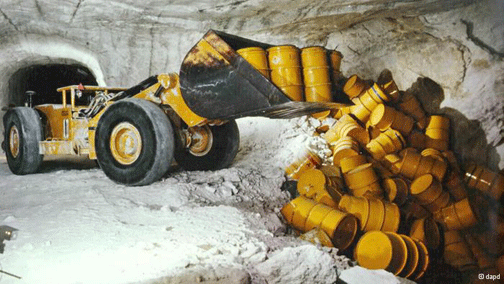 Former salt mines at Asse and Morsleben, eastern Germany, that were used for low- and medium-level nuclear waste in the 1960s and 1970s, must now be closed in multibillion-dollar operations after failing to meet today’s safety standards.
Cyber attack targets UK’s nuclear industry
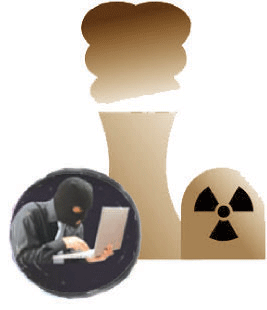 Telegraph UK, Wil Crisp, 30 NOVEMBER 2019 GCHQ cyber experts have been called in after a digital attack on a major player in Britain’s nuclear power industry triggered a security crisis.
The National Cyber Security Centre (NCSC), an arm of GCHQ, has been secretly providing assistance to a nuclear power company in the UK that has struggled to recover after being hit by a cyber attack, The Telegraph can reveal.
A Nuclear Decommissioning Authority (NDA) report, obtained using freedom of information legislation, said officials are “aware that an important business in the Nuclear Power Generating Sector has been negatively impacted by a cyber attack and has had to rely on expertise from the NCSC to help them with recovery”.
The document,... (subscribers only) https://www.telegraph.co.uk/business/2019/11/30/cyber-attack-targets-uks-nuclear-industry/
Russia’s nuclear company Rosatom in financial trouble trying to fund nuclear project in Turkey

 Turkey’s first nuclear plant delayed by funding problems – energy expert https://ahvalnews.com/turkey-energy/turkeys-first-nuclear-plant-delayed-funding-problems-energy-expert, Nov 30 2019 Turkey’s first nuclear plant delayed by funding problems – energy expert https://ahvalnews.com/turkey-energy/turkeys-first-nuclear-plant-delayed-funding-problems-energy-expert, Nov 30 2019
Completion of Turkey’s first nuclear power station is likely to be delayed as the Russian company building it is struggling to secure funding, former diplomat and Bosphorus Energy Club head Mehmet Öğütçü told Turkish daily Sözcü. A small part of the plant in Akkuyu, southern Turkey, may be opened for political reasons in 2023, the centenary of the founding of the Turkish Republic, Öğütçü said. But Russian state-owned Rosatom is having difficulties financing the project, which is expected to cost between $20 billion and $25 billion, he said, adding that Western companies were avoiding Akkuyu over concerns about nuclear armament. A Turkish consortium pulled out of the project last year, citing a failure to reach commercial terms with Rosatom, which owns a 51 percent stake in the project. A report by the main opposition Republican People’s Party this month criticised the terms of the government’s deal with Rosatom, which has been guaranteed a price of 12.35 U.S. cents per kilowatt hour in a 15-year power purchase agreement. |
|
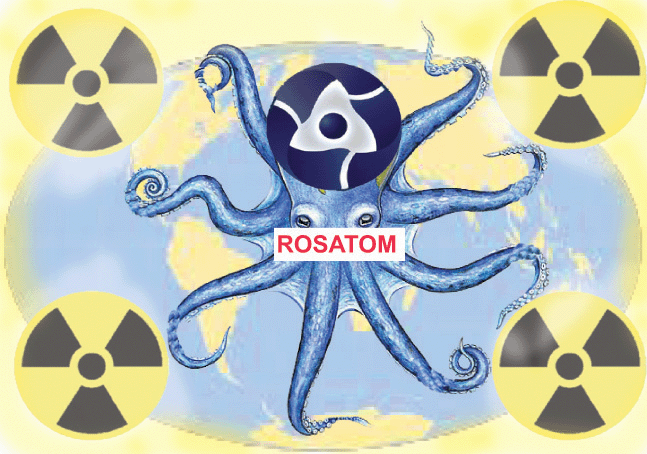
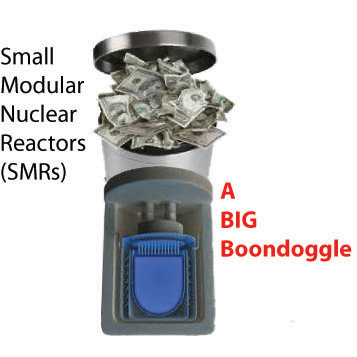
Russia’s Rosatom planning to market Small Modular Nuclear Reactors to Europe
|
Russian company’s plan for nuclear power expansion revealedVLADIMIR PUTIN has made nuclear energy one of Russia’s key priorities, and now the Russian nuclear power company Rosatom has revealed to Express.co.uk their plans to ramp up expansion into Europe with small modular reactors. Express UK By CHARLIE BRADLEY, Fri, Nov 29, 2019
Rosatom is completely under state control, and while its emphasis with some projects has been geared towards powering hard to reach Russian territories, it has also undertaken numerous international projects. This includes the development of nuclear power plants in China, Turkey and Iran, highlighting the growing presence of Russian energy throughout the world. And now, with some projects already under way in countries like Hungary and Finland, its Vice President of Marketing and Business Development Overseas, Anton Moskvin, has told Express.co.uk that Europe is a future target for the company.He said: “I must say Europe is very interesting for us with prospective small modular reactors market development, we know that several countries are interested. The UK has great interest in the small modular reactors.” …… However, some in the EU have expressed concern over any plans for the Russian nuclear giant, fearing that the country could use its business to wield political influence.
In 2014, President Putin agreed a deal worth £8.5billion with Hungary President Viktor Orban, a deal which has seen the two leaders meet regularly since. Hungary is both a NATO and EU member, and the latter has sought legislation to ensure countries embarking on nuclear deals with Moscow do not become dependent on the Kremlin. RFI (Radio France International) reported last month that Jan Haverkamp, vice-chairman of Nuclear Transparency Watch, has serious reservations about the projects. He said: “Our assessment is that the Kremlin tries to use nuclear power now to regain some of that lost influence. “We see Rosatom being very eager to buy up nuclear companies in Europe, where they try to get a participation in order to get a solid nuclear foothold inside the EU.” Mr Moskvin said he could not comment on political issues……… https://www.express.co.uk/news/world/1211103/putin-news-russia-europe-nuclear-power-eu-rosatom-spt |
|
Nuclear-capable air-launched ballistic missile tested over the Barents Sea
|
The Kinzhal missile was launched from a MiG-31K taking off from Olenegorsk airbase on the Kola Peninsula. Barents Observer By Thomas Nilsen, December 01, 2019
The missile changes the military power-balance in the north due to its range, speed and ability to overcome any known missile defence systems. Kh-47M2 Kinzhal (NATO name SA-N-9 Gauntlet) is one of the six new strategic nuclear weapons presented by Vladimir Putin in his presidential address to the Federal Assembly on March 1, 2018. Now, the missile is tested and like several of the other new strategic weapons under development by Russia, the test took place in the northwestern part of the country……. https://thebarentsobserver.com/en/security/2019/12/nuclear-capable-air-launched-ballistic-missile-tested-over-barents-sea |
|
Suffolk Coastal Labour opposes the development of new nuclear capacity at Sizewell
Suffolk Coastal Labour 27th Nov 2019, Suffolk Coastal Labour does not support the concept of ‘The Energy Coast’. The branding itself puts at risk the visitor and tourist economy of East Suffolk which depends on The Suffolk Coast and Heaths Area of Outstanding Natural Beauty.
It conflicts with established identities such as ‘The Sunshine Coast’ and ‘The Heritage Coast’. The huge industrial projects proposed threaten the local economy and environment without bringing any benefits. Traffic congestion on the A12 and ruralroads will discourage visitors and compromise the quality of life of localresidents.
In Suffolk Coastal, Labour opposes the development of new
nuclear capacity at Sizewell. The Sizewell C development cannot be
undertaken without unacceptable impacts on the Suffolk Coast and Heaths
Area of Outstanding Natural Beauty. It will compromise the future of RSPB
Minsmere, and, especially during the construction period, other Sites of
Special Scientific Interest and the highly sensitive local environment. It
will threaten jobs and prosperity in the visitor and tourist economy, the
agricultural sector and food and drink industries. It offers very few new
permanent jobs for local people. Current proposals to mitigate the worst
effects of the construction project are grossly underfunded and will not
relieve the impact of huge numbers of vehicle movements for goods and
people on the A12 and surrounding rural roads. There are no proposals to
invest adequately in rail alternatives.
UK’s Labour and Greens parties have highly prioritised climate change action
David Lowry’s Blog 29th Nov 2019, A letter writer in today’s Times newspaper complained that politicians have not prioritized climate change in their manifestos.Your correspondent Lesley Boase asks “why isn’t urgent action climate
change at the top of [political parties’] manifestos”? The day before
the letter appeared, the Labour Party launched its 48-page manifesto for
the environment ‘A Plan for the Environment. At its launch in
Southampton, Mr Corbyn stressed” The reality is this election is our last
chance to tackle the climate and environment emergency,” in setting out
“Labour’s plan for real change to protect our planet and restore our
natural world.” He added: “We have no time to waste…we have a choice.
We can shut our eyes, cross our fingers and entrust our fate to a system
that has already driven our planet to the brink of catastrophe. Or we can
do everything possible to tackle the biggest threat we face.
http://drdavidlowry.blogspot.com/2019/11/political-parties-prioritise-climate.html
1 This Month
23-25 October – on Zoom – World BEYOND War’s annual global conferenc


Shut down the radiation-damaged Heysham nuclear reactors now
To see nuclear-related stories in greater depth and intensity – go to https://nuclearinformation.wordpress.com

Say No to NASA’s Reckless Nuclear Reactor on the Moon
Say No to NASA’s Reckless Nuclear Reactor on the Moon
-
Archives
- October 2026 (170)
- September 2026 (339)
- August 2026 (330)
- July 2026 (355)
- June 2026 (287)
- May 2026 (306)
- April 2026 (356)
- March 2026 (251)
- February 2026 (267)
- January 2026 (308)
- December 2025 (358)
- November 2025 (359)
-
Categories
- 1
- 1 NUCLEAR ISSUES
- business and costs
- climate change
- culture and arts
- ENERGY
- environment
- health
- history
- indigenous issues
- Legal
- marketing of nuclear
- media
- opposition to nuclear
- PERSONAL STORIES
- politics
- politics international
- Religion and ethics
- safety
- secrets,lies and civil liberties
- spinbuster
- technology
- Uranium
- wastes
- weapons and war
- Women
- 2 WORLD
- ACTION
- AFRICA
- Atrocities
- AUSTRALIA
- Christina's notes
- Christina's themes
- culture and arts
- Events
- Fuk 2022
- Fuk 2023
- Fukushima 2017
- Fukushima 2018
- fukushima 2019
- Fukushima 2020
- Fukushima 2021
- general
- global warming
- Humour (God we need it)
- Nuclear
- RARE EARTHS
- Reference
- resources – print
- Resources -audiovicual
- Weekly Newsletter
- World
- World Nuclear
- YouTube
-
RSS
Entries RSS
Comments RSS

