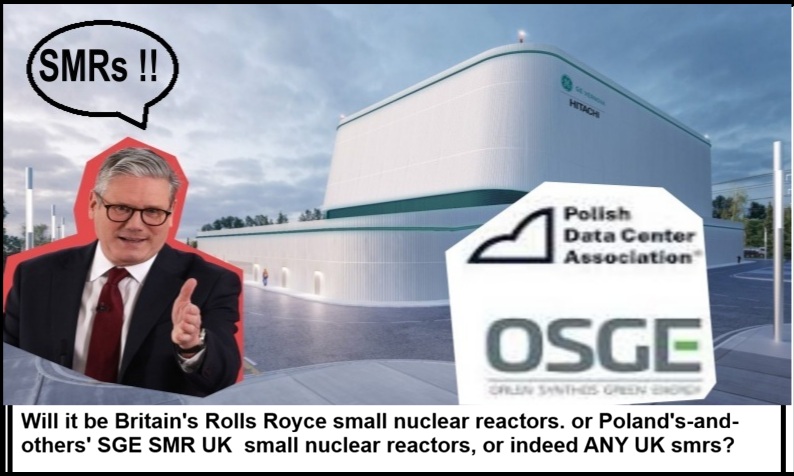
As UK’s Prime Minister fades away, will his beloved Small Nuclear Reactor dream fade too?
5 July 2026, https://theaimn.net/as-uks-prime-minister-fades-away-will-his-beloved-small-nuclear-reactor-dream-fade-too/
As soon as mid-July, Sir Keir Starmer is expected to finally quit his job as British Prime Minister. He’s not very popular, either within his own party, or with the general public. Labour’s previous popular leader, Jeremy Corbyn, opposed nuclear power. Soon after coming to power, Starmer called for tech companies to work alongside the government’s Great British Energy – Nuclear, to build SMRs to power energy-intensive AI data centres across Britain. Starmer might be hoping to be, later on, renowned for his legacy in revolutionising British energy systems, and producing a glorious renaissance for the global nuclear industry.
But possibly not.
“I say: build, baby, build,” – Starmer’s theme on Small Nuclear Reactors looks now, on the face of it, to be a resounding winner for Britain on the global nuclear scene. Why? Because… haven’t you heard? It is all over the British press that the UK is to get a fleet of SMRs with a multi-billion dollar “privately financed” scheme (helped just a bit by the government), to start generating in 2034.
SGE is a European Small Modular Reactor (SMR) development and investment platform. Founded by Polish billionaire Michał Sołowow, SGE has plans for SMR developments across Europe. On July 1st SGE announced in glowing terms, its UK plans for “delivering efficient, safe, affordable, and clean nuclear energy power at fleet scale.” It has established a consortium, SGE SMR UK Limited, as its dedicated UK-based project vehicle.
SGE hopes to use the GE Vernova Hitachi BWRX-300 design, to build under the government’s advanced nuclear framework (which was initiated by Starmer in February after the government promised to rip up “archaic rules” and slash regulations to “get Britain building”). SGE boasts that this SMR design is a “proven technology,” but it’s really a smaller, and as yet untested, version of the large boiling water nuclear reactor.
Where’s the money coming from?
The plan is to put in £35bn of private capital to build 14 small modular nuclear reactors on three sites across the UK. The consortium SGE SMR UK consists of SGE (formerly Synthos Green Energy), GE Vernova, Hitachi Nuclear, Samsung C&T, Laing O’Rourke, Aecon Group, Google Cloud, Fermi Development, and Etara. The biggest investor presumably is the Polish company.
Under the National Wealth Fund, Great British Energy – Nuclear (GBE-N) set up its Small Modular Reactor (SMR) Technical Partner contract (TP Contract) as a way for the government to help fund SMR development. It initially forecast that it may need £20bn to cover the cost of the (TP) Contract. “GBE-N has ultimately decided to award only one TP Contract and the contract award notice value reflects this.”
SGE plans to deploy under a Contract for Difference framework with National Wealth Fund engagement. I know that the contract for difference scheme means a fixed price for electricity bills once the project begins generating electricity. If the market price is below the fixed price, the government tops up the payment to the company. I don’t know what the National Wealth Fund engagement means, and I suspect that I’m not the only one puzzled about this.
In May 2026 Great British Energy – Nuclear (GBE-N) announced that Rolls-Royce SMR has been awarded Stage 1 of its Small Modular Reactor (SMR) Technical Partner contract (TP Contract). Stage 1 has a “forecast” price of £359M. A furtherr £8.17bn is estimated for the second delivery phase. Rolls Royce expects the SMRs to start operating in the mid 2030s.
So how much of the tax-payers’ £20bn is Rolls Royce going to get? And is SGE SMR UK going to get some too, and if so, how much? Or is the Polish entrepreneur’s SGE SMR UK truly really going to go it alone – with private financing?
Mysterious unanswered questions
Through the Freedom of Information Act, The New Civil Engineer requested some detail on the breakdown of the TP Contract award ‘s available £20bn. Great British Energy – Nuclear ‘s reply was – “GBE-N does not hold the information you have requested.”
Given the nuclear industry’s notorious history of delays and cost overruns, it’s pretty important to know how much each of these competing SMR projects is likely to cost, how long each would really take to come into operation, and how much the tax-payer will have to cough up.
What a complicated mess!
In 2023 the UK joined enthusiastically with world leaders in The Declaration to Triple Nuclear Energy by 2050. The Starmer Labour government took this up with zeal, and the message has been reinforced by academia and the media. Several UK universities have jumped on the nuclear bandwagon. Just this week, the Manchester University announced:
The University of Manchester and United Kingdom National Nuclear Laboratory (UKNNL) have signed a Memorandum of Understanding (MoU) formalising a wide-ranging partnership to advance nuclear science, grow the UK’s nuclear workforce, and strengthen the country’s position as a global leader in nuclear technology.
The UK media, except for The Guardian and New Civil Engineer, is ecstatically regurgitating nuclear lobby handouts. On July 2nd we have excited and positive articles on the SGE SMR UK project – from The Times, Telegraph, PR Newswire, Energy Live, Business Green, as well as from leading international news media. This privately-funded SMR project is a global first.
The New Civil Engineer is peskily pursuing its search for information on the UK government’s planned funding of small nuclear reactors, while the rest of them continue applauding this small nuclear fantasy.
I’m not here to push the points that SMRs are not cheap, not proven, not safe, not clean, not environmentally beneficial, not free of toxic wastes, and not actually in existence. Plenty of economists and scientists have made those assessments. Is the SGE UK thing going to really happen? Or is the Rolls Royce SMR thing going to beat it? When and where are these reactors going to operate? I’m just wondering about – for how long the UK pro SMR charade is going to play. Now that the leading actor Keir Starmer is about to bow out, will the whole performance have a very short season indeed?
Starmer Lied: Britain Is Cutting £11 Billion from Frontline Defence
The new Defence Investment Plan delivers almost nothing for our armed forces in the near term
Ian Proud, The Peacemonger, Jul 02, 2026
The United Kingdom is in effect going to spend up to £11 billion less per year on the day-to-day running of its armed forces under Keir Starmer’s Defence Investment Plan — and that’s before we even take inflation into account.
Despite the apparent uplift in spending toward 2.7% of GDP by 2029, the UK will get no meaningful increase in front-line conventional capability or personnel.
Our armed forces are at their smallest size in two hundred years, and that situation is not going to change under this plan.
Spending on long-term nuclear capabilities — programmes that will not deliver anything usable until the 2030s and 2040s — is absorbing the great majority of the headline increase.
This comes at a time when the government claims Russia could be ready to use military force against NATO by the end of this decade.
At the heart of the problem is a foreign policy that wants to confront multiple adversaries while maintaining armed forces that simply do not have the mass or readiness to do so credibly.
Important to point out that I am the son of a former British soldier and I am incredibly proud of the armed forces and anyone who serves this country. I also served alongside the British Army in Helmand province in 2010 and worked with some truly remarkable people. I am not criticising the men and women who put on the uniform. I am criticising how badly led we are as a country.
Keir Starmer announced the UK’s long-awaited Defence Investment Plan yesterday, 30 June. To describe it as a damp squib would be generous. It is a document that confirms the continued stagnation of the UK armed forces and the deep sclerosis at the heart of defence procurement.
Do not believe the headlines and the spin.
This plan will not transform our hollowed-out forces.
The British Army is already at its smallest size since 1823. That will not change.
There are no new soldiers being recruited in any significant numbers. Money available for the day-to-day operation of the armed forces is not going up — in real terms it is under severe pressure.
Having crunched the numbers, it’s clear to me that yearly spending on the actual running of the armed forces has effectively declined by up to £11 billion per year under this plan, set against the government’s claim of a £15 billion per year increase by 2027…………………………………………………………………………………………………………………………………………………………………………………………..
The outgoing UK Prime Minister has declared a big increase in defence spending, yet we are getting no new troops and very little new conventional capability in the near term.
Why?
Because the great majority of the additional money is being directed into nuclear programmes and a procurement system that has repeatedly failed to deliver on time or on budget.
………………………………………………….. As I write, I understand that all of the Astute-class submarines are operationally unavailable.
……………………the largest cost increases and overruns have been in the nuclear and naval programmes.
………….As the National Audit Office reported in 2023, the combined costs of nuclear and naval programmes rose by £54.6 billion between 2022 and 2023, with the nuclear element increasing by £38.2 billion.
The three biggest programmes are the SSN-AUKUS attack submarines, the Dreadnought ballistic missile submarines, and the new Astraea nuclear warhead.
The first UK-built AUKUS submarines are not expected until the late 2030s.
We already have ballistic missile submarines maintaining Continuous At-Sea Deterrence.
We already have attack submarines, even if they cost too much, took too long to build, and don’t work.
We already have nuclear warheads. Do we really need a slightly flashier design folks? Serious question.
The plan is being presented as a response to current and near-term threats, while a war continues in Ukraine and with political leaders abandoning diplomacy.
……………………I have a clear alternative. We should cancel or significantly scale back the highest-risk and longest-lead nuclear programmes — particularly the new Astraea warhead and major elements of the SSN-AUKUS programme.
The savings should be redirected into fixing and sustaining the equipment we already possess, improving the availability of existing platforms, and beginning the serious work of rebuilding conventional force numbers and readiness for the core task of defending the United Kingdom and its immediate interests………………………….. https://thepeacemonger.substack.com/p/starmer-lied-britain-is-cutting-11?utm_source=post-email-title&publication_id=3221990&post_id=204491995&utm_campaign=email-post-title&isFreemail=true&r=1ise1&triedRedirect=true&utm_medium=email
Poland revokes the Order of the White Eagle it had awarded to Volodymyr Zelensky

Voltaire Network | 26 June 2026
Polish President Karol Nawrocki, former president of the Institute of National Remembrance, revoked the Order of the White Eagle — Poland’s highest honor — awarded to Ukraine’s expired president Volodymyr Zelensky, on June 19, 2026.
This decision follows the designation of a Ukrainian military unit as “Heroes of the UPA”, in reference to the Ukrainian Insurgent Army (UPA), the military wing of the “Banderists” or “integral nationalists” of World War II. Any reference to the UPA conjures painful memories in Poland as its supporters murdered about 100,000 Poles in a campaign of ethnic cleansing in Volhynia in 1943-1945.
A majority of Poles (51%) reacted negatively to President Zelensky’s announcement………………………… https://www.voltairenet.org/article224771.html
MSP says ‘no’ to nuclear power plant as UK Government eyes Fife
Dunfermline Press 1st July 2026
Fife has been revealed as a potential site for a nuclear power plant in a new UK Government report – but a local MSP says it “wouldn’t go down well” with communities.
The document, titled ‘Potential future nuclear power plant siting in Scotland ‘, published on Tuesday, June 30, was penned by both the Department for Energy Security and Net Zero and Great British Energy – Nuclear.
The report sets out to offer “technical advice” on potential future sites.
In a section called ‘Land Areas of Interest ‘, Fife was identified as part of areas across eastern Scotland which could be eyed up for new development by the UK Government.
The report read: “The northern shore of the Firth of Forth benefits from a strong industrial heritage, existing brownfield land, good transport connections and historic use of river water for power station cooling.
“The presence of previous energy generation sites and proximity to major industrial hubs supports technical suitability.”
However, it did note that flood risks were a notable constraint, with some areas identified as high likelihood for coastal flooding and limited existing defences.
It continued: “The proximity of major COMAH sites and oil and gas infrastructure, including the Forties Pipeline System, introduces additional safety and planning complexity.”
MSP for Cowdenbeath, David Barratt said: “The document implies quite heavily, I would say, about nuclear power at Longannet. It’s talking about a site on the north side of the Forth, in close proximity to areas of flood risk and oil and gas.
“The SNP’s position aligns, from my perspective, closely with what communities think. I don’t think if you went to any community and asked them whether they like a nuclear power station next door, I struggle to imagine any in Fife, or along the Forth shore, would say yes please.
“I don’t think that would go down well at all with communities (near Longannet) who have put up with enough environmental consequences of that site. Scotland is blessed with an abundance of renewable sources, and we don’t require nuclear.”…………….. https://www.dunfermlinepress.com/news/26243980.mps-says-no-nuclear-power-plant-fife-uk-government-eyes-fife/
Westminster’s nuclear obsession will cost us dearly – Scotland
The irony of Scotland’s sky-high bills is that we sit on one of the goldmines of clean, renewable energy potential in Europe.
Scotland does not need dangerous, extortionate nuclear white elephants built in our communities against our will.
the SNP, 12 July 26, https://www.snp.org/westminsters-nuclear-obsession-will-cost-us-dearly/
The case for transferring full control of energy policy to the Scottish Parliament has never been more urgent.
As we head toward what is shaping up to be a winter of deep financial hardship for households across the country, it is clearer than ever that the only way to secure affordable, stable energy bills for the people and businesses of Scotland is to take control of our own immense resources from Westminster.
Before taking office, Labour campaigned heavily on a promise to lower energy bills for families across Scotland by £300. The reality since July 2024 has been a story of utter failure to deliver.
When Labour entered government in July 2024, the Energy Price Cap stood at £1,568 per year. To fulfil their signature pledge, that cap should heading towards £1,268.
Instead, fresh analysis from Cornwall Insight shows that the price cap is set to soar to £1,849 by this October.
That leaves Scottish households facing a staggering bill that is £581 higher than what was promised.
It is a profound injustice that in energy-rich Scotland, citizens are paying some of the highest energy bills in Europe while the country is haemorrhaging up to 1,000 energy sector jobs every single month.
The irony of Scotland’s sky-high bills is that we sit on one of the goldmines of clean, renewable energy potential in Europe.
Scotland regularly produces more clean electricity than it actually consumes, achieving an historic milestone where renewable generation already reached the equivalent of 113% of our gross electricity consumption in 2024.
Our natural landscape and seas make Scotland a significant green powerhouse:
- Wind Power: Scotland is often described as the “windbreak of Europe”, holding over 11GW of installed wind capacity – which makes up roughly 39% of the entire UK capacity.
- Hydro Power: Scotland commands 85% of the UK’s total hydroelectric resource.
- Increased Generation: The Scottish Government has expanded its offshore wind targets to a massive 40 GW by 2040.
Instead of letting Westminster mismanage this wealth, these resources should be utilised directly to lower local energy tariffs in Scotland and build a thriving green economy, much like Norway has done with its own native energy supplies.
Rather than supporting Scotland’s booming renewables sector or honoring promises to fund vital carbon-capture carbon capture infrastructure, Westminster remains locked into an obsession with nuclear energy.
Reports indicate that Labour’s GB Energy has secretly identified multiple sites for nuclear plants across Scotland, completely ignoring the Scottish Government that was democratically elected last month.
The push for nuclear power ignores the hard economic and environmental facts:
1 It is the most expensive power generation: Nuclear energy is financially draining. Industry experts and watchdogs routinely highlight it as one of the most expensive forms of electricity generation on Earth, with ballooning strike prices that lock consumers into high bills for generations.
2 t takes decades to come online: Major projects are notoriously crippled by logistical failure. For example, the flagship Hinkley Point C nuclear plant in Somerset was originally expected to cost £18 billion and open by 2025; it has now spiralled to an estimated cost of up to £46–£48 billion and is delayed until at least 2030 or 2031. Future projects like Sizewell C are projected to face similarly restrictive timeframes and even higher starting expenses.
3 A deadly legacy of radioactive waste: Nuclear reactors leave behind hazardous, highly radioactive waste that must be managed and monitored for centuries. The most toxic components of this spent fuel remain lethal to human life and the environment for up to 100,000 years, passing a dangerous and expensive ecological debt onto dozens of future generations.
Scotland does not need dangerous, extortionate nuclear white elephants built in our communities against our will. The Scottish Parliament has already passed an SNP motion demanding that power over our energy resources be fully devolved to Holyrood.
If the Westminster government is truly committed to the principles of devolution, they must listen to the Scottish people, remove the punitive taxes currently stifling our domestic energy markets, and transfer energy powers to the hands of the people who live here.
With the fresh start of independence, we can finally link Scotland’s immense natural wealth directly to lower, affordable bills for everyone.
Billionaire to invest £35bn in small modular nuclear reactors rollout across UK
Consortium led by Michał Sołowow planning enough SMRs to power equivalent of 8m homes for more than 60 years.
Jillian Ambrose, 2 July 26
A consortium led by the billionaire industrialist Michał Sołowow has announced plans to build 14 small modular nuclear reactors on three sites across the UK, including the location of a former nuclear plant in Gloucestershire..
The Polish entrepreneur and rally driver plans to use £35bn of private capital to roll out enough small modular reactors (SMRs) to power the equivalent of 8m UK homes for more than 60 years, or even power datacentre investments alongside Google.
Sołowow’s nuclear development company, SGE, plans to make the “significant investment” of between £2.2bn to £2.5bn in each 300 megawatt reactor alongside a string of industrial partners including the US manufacturer GE Vernova and Japanese industrial conglomerate Hitachi, which are responsible for the design.
The consortium, known as SGE SMR, hopes to secure three sites for the boiling water reactors (BWRs) by this time next year as well as a government support contract which would guarantee a “competitive” price for its electricity once it starts generating in 2034.
It has not disclosed which sites it hopes to use for the GE Vernova Hitachi BWRX-300 design, or which energy company would be the operator. However, the Guardian understands the consortium has submitted an application to use the Oldbury site in south Gloucestershire which was earmarked earlier this year for the development of SMRs under the government’s advanced nuclear framework.
Sołowow said the government’s framework, which aims to fasttrack the rollout of nuclear technologies, had created “a clear path to market” in the “home to one of the world’s most experienced nuclear workforces”.
Because of this, I am confident we will set a new standard for nuclear development by combining our disruptive business model with the BWRX-300’s 10th-generation proven technology. We will rely strongly on the UK supply chain; it is a critical element for our project. Our project will create a distinct competitive advantage for the UK economy,” he said.
The Labour government unveiled plans for a historic expansion in nuclear power across England and Wales within months of coming to power, with Keir Starmer calling for tech companies to work alongside the government to build SMRs to power energy-intensive AI datacentres across Britain.
SGE’s plans will put it in competition with Rolls-Royce to be the first to roll out SMEs in the UK, after the British engineering company won a government competition earlier this year to allow it to start generating power by 2032 at the earliest.
SGE’s joint venture agreement, signed this week in London, includes Google Cloud, which Sołowow hopes will also partner on investing up to £4.5bn in datacentres to make use of the nuclear output. The Guardian understands this is viewed as an accompanying proposal which is not part of its current application.
Instead, the consortium hopes to secure a similar deal to the contract offered to the Hinkley Point C nuclear project. It has opted for the contracts for difference scheme, which pays a fixed rate from energy bills once the project begins generating electricity, rather than the controversial model used to fund the Sizewell C project. Under that scheme the developer is paid during the construction phase, meaning billpayers risk bigger costs if there are delays.
Tom Greatrex, chief executive of the nuclear industry association, said SGE’s SMR plans showed the government’s nuclear framework “has really revived and spurred interest in privately led nuclear projects”.
No nuclear energy in Scotland – Greens

Labour’s nuclear obsession would be waste of time and money.
1 June 26, https://greens.scot/news/no-nuclear-energy-in-scotland
Labour’s plans to build nuclear power plants all over Scotland would be a costly error, says Scottish Green MSP Kristopher Leask.
This week saw the publication of a report by Great British Energy Nuclear, ordered by Ed Miliband, which identified multiple sites in Scotland which could be used if the Scottish Government’s opposition to nuclear was to change.
The report was publicly welcomed by Anas Sarwar, Michael Shanks and other Scottish Labour bosses.
Kristopher said:
“Labour’s obsession with forcing a new generation of nuclear power on Scotland rides roughshod over devolution and ignores the will of the Scottish Parliament.
“Opening new plants across Scotland would be a huge waste of time and money. It would swallow billions of pounds and take decades to deliver, while doing nothing to tackle energy bills or the climate crisis.
“Focusing on nuclear energy would be a huge missed opportunity. It would mean turning our backs on Scotland’s world-leading renewable resources.
“Instead of pouring money into expensive nuclear projects, the UK Government should be backing renewable energy that can create jobs, cut bills and strengthen energy security at a fraction of the cost.
“Our priority should be creating clean, green, secure jobs that support nuclear workers into new industries while revitalising communities across Scotland.”
Four US presidents steered European NATO into decline in furtherance of US proxy war against Russia.

Besides Starmer in the UK, French President Emmanuel Macron and German Chancellor in Friedrich Merz may be following Starmer out the door by the end of the year.
Walt Zlotow West Suburban Peace Coalition Glen Ellyn IL , 25 June 26
The resignation of UK Prime Minister Keir Starmer Monday comes as no surprise. Serving just 23 months, Starmer failed to revive the British economy. Possibly his biggest failing was going all in supporting the US proxy war against Russia using Ukraine as a Trojan horse to weaken, isolate Russia from the European political economy.
Starmer is the seventh UK Prime Minister to leave office since the US, under President George W. Bush, pitched NATO membership to Ukraine at the April 2008 Bucharest NATO Summit. His six predecessors all followed the US plan to totally isolate Russia from Europe by putting NATO and its nukes on Ukraine’s border with Russia.
Bush’s successor Obama greenlighted a coup against the Russian leaning Ukraine President Yanukovych in 2014 to keep Ukraine NATO membership alive. That sparked a civil war with Russian leaning Ukrainians in Donbas which claimed over 10,000 Ukrainian lives there, all with US support and approval. Obama was also fine with Europe’s deceiving Russia that Minsk I and II would give Donbas Ukrainians peaceful autonomy when it was a stall for time to build up the Ukraine military to finish off the Donbas separatists. It was dastardly diplomatic duplicity.
Obama’s successor Trump was worse, funning hundreds of millions in weapons to Ukraine’s military to complete the ultra-right Ukraine victory against the separatists.
Trump’s successor Biden was the worst. Essentially, he made Ukraine a de facto NATO member while totally dismissing Russia’s valid security concerns. With tens of thousands of US funded and supported Ukrainian troops massed on the Donbas border, Biden gave Russia’s Putin the back of his hand knowing Putin would invade. Biden believed this would be Russia’s Afghanistan 2.0 sealing Russia’s demise as a European power and US rival.
Instead, it’s turned Ukraine into a failed state utterly dependent on US and European treasure in weapons and staples to simply survive against the overwhelming Russian military. But it has also greatly weakened Europe economically and politically. Besides Starmer in the UK, French President Emmanuel Macron and German Chancellor in Friedrich Merz may be following Starmer out the door by the end of the year.
Macron’s disapproval rating has soared to between 73 and 79 %. Merz’s is worse at 80 at 84 %. Both are largely due to their flinging badly needed domestic treasure at the lost Ukraine cause. All three fools running the biggest European economies keep flayling around like Chicken Little chirping ‘The Russians are coming, the Russians are coming.’ Very few of their fleeing voters are buying that nonsense. Nationalist opponents in France and Germany may soon achieve power opposing continued military aid to Ukraine, demanding the commons be served instead.
Meanwhile, Trump in term two has had enough of his infamous four predecessors’ Russian fearmongering, including his in term one. He’s sick of supporting European defense that has no real enemies except themselves. He’s largely cut off the weapons spigot to Ukraine, leaving the big three and their 27 lessor NATO members to squander themselves into economic decline.
At least Trump has seller’s remorse regarding his support of US provocations which led to the inevitable Russian invasion just 13 months after he left office.
The other three, George W., Obama and Biden will live out their lives as Russophobes, with nary a thought or concern of the enormous carnage they unleashed which continues unabated.
When the right denies the true danger of heatwaves, ask yourself this: whose children’s lives is it willing to risk?

The Guardian, George Monbiot, 1 July 26
The class politics of extreme heat are very real and very dangerous – but that doesn’t stop the billionaire press from peddling its agenda
Every time you think the idiocy has hit rock bottom, it discovers a new level. It turns out there’s an even deeper hole you can dig for yourself than climate-science denial: heat-stress denial. Across the billionaire press last week, columnists and leader writers minimised the health impacts of the heatwave, particularly in schools. Expect more of this next week, when temperatures are forecast to soar again.
An editorial in the Telegraph (which represents the newspaper’s view) titled “Hot weather alarmism treats the public like children” maintained that “unlike in the seventies, when people were largely trusted to look after themselves, officialdom now feels the need to lecture the public about the risks of hot weather at every opportunity”. Extreme heat warnings are issued and weather maps are “painted in an alarming red”. Outrageous! Instead of issuing warnings, the government should just trust people to “take the appropriate precautions”. We should all “learn to live” with it. Quite right too: whatever happened to the bulldog spirit of ignorance and needless death? Cricket, warm beer, excess mortality: these are the markers of national character.
Also in the Telegraph, under the headline “Heatwave hysterics wouldn’t have lasted a day in 1976”, the columnist Ysenda Maxtone Graham insisted that during the heatwave that year – which she remembers as “two months of blissful messing about” – “common sense was applied by most without the need for nannying intervention”. Now, however, “health messages range from the patronising – tube announcements imploring travellers to carry a bottle of water – to the preposterous, as if a healthy adult is liable to drop dead from a little bit of sun exposure”. Never mind the unhealthy adults. Or disabled people, or elderly people, or children, all of whom are likely to be more vulnerable. She claimed that in 1976, “schools didn’t close because of the heat”, and that children and teachers heroically “sweltered in 30-degree classrooms”.
Maxtone Graham’s column was remarkably similar to Jane Moore’s in the Sun, titled: “Why on earth do schools need to CLOSE in hot weather? Forget today’s nannying, alarmist state – let’s go back to ’76.” Moore remembers 1976 as “the best summer of my life”. Apparently there was a “gung-ho spirit” that “should be used as a standard benchmark for common sense”………………………
There is a powerful body of evidence showing that warnings and advice save lives. The Red Cross discovered in 2023 that there’s a strikingly poor understanding of the health risks of heatwaves in the UK, where they used to be rare. A survey reported in the journal Energy Research & Social Science last year found that 49% of participants had “little to no knowledge on how to cope with extreme heat”. Nevertheless, government warnings, doubtless to the delight of the Telegraph, remain vague, hard to interpret and unsupported by effective action. Let the bodies pile high.
……………..There’s nothing new about feather-bedded columnists in nice homes in leafy streets or air-conditioned offices instructing other people to tough it out. But the class disparity in heat shielding is especially acute in Britain, where homes and public buildings are woefully unsuited to extremes.
The paper I mentioned above also found that 82% of households reported difficulty in keeping at least one room cool during the summer. The rate of overheating for the poorest half “was twice that of householders in the top half of higher-income earners”. Many other studies have produced similar findings. Steady temperatures are the preserve of the rich.
Extreme heat hits children – who have higher metabolisms and lower sweating rates – harder than most adults. Their thermal comfort levels are, on average, 1.9-2.8C lower. There are many reports of children vomiting and losing consciousness in class during heatwaves. Temperatures above 25C limit their cognitive performance. The government’s Climate Change Committee finds that “taking an exam on a 32C day leads to around a 10% lower likelihood of passing compared to a 22C day”. Yet another advantage for private schools, which can generally afford better buildings and air-conditioned exam rooms.
But, as the government confirms to me, it sets no maximum temperature limit for schools. Otherwise it might have to do something. Instead, it advises schools to open and close doors and windows and minimise heat from equipment: advice that leaves teachers with sealed windows and impossible heat loads in despair. https://www.theguardian.com/commentisfree/2026/jul/01/right-danger-heatwaves-children-class-politics-extreme-heat-billionaire-press
SNP blocks new nuclear power
SNP blocks new nuclear power despite ‘high-potential’ sites. A
Westminster-backed study identified places capable of hosting future
reactors, but the Scottish government’s longstanding opposition remains
unchanged. The SNP has shut down any hope for new nuclear power in Scotland
after a Westminster-backed report that highlighted the “high potential”
for projects. “The Scottish government is focused on supporting the
development of Scotland’s renewable energy potential, which provides
jobs, are safer and doesn’t leave a legacy of nuclear waste.
Times 30th June 2026, https://www.thetimes.com/uk/scotland/article/snp-blocks-new-nuclear-power-high-potential-sites-vfrcjx5ns
Russia Closes Border Crossings With Several NATO States After Finland Lifts Nuclear Ban
by Tyler Durden, Thursday, Jul 02, 2026, https://www.zerohedge.com/geopolitical/russia-closes-border-crossings-several-nato-states-after-finland-lifts-ban-nuclear
Finland’s parliament has finally followed through with a previously threatened move to reverse its decades-long ban on nuclear weapons. The June 17 vote to lift the ban in effect legally authorizes the Nordic country to receive, transport, and facilitate the movement of nuclear weapons on its territory as part of allied operations, with the representatives’ final tally at 125 to 61.
Finland officially became the 31st member of NATO in April 2023 – having abandoned its historic neutrality in the wake of the Russian invasion of Ukraine, in what was among the fastest accession processes in the Western military alliance’s history. Now it is already willing to host allied nukes on its territory, making it a target of Russian retaliation.
Moscow has long warned against such an ultra-provocative move. The Kremlin said Monday that this requires a response – given also the fact that Russia and Finland share an over 800-mile long border, which is made up largely of Arctic frontier.
“The results of the vote represent both bright and unflattering victory of the blind Russophobia of the past few years over what we have always viewed as pragmatic sanity in Finland,” said Russian Foreign Ministry spokeswoman Maria Zakharova.
“And let nobody doubt that [response] measures will be taken timely and effectively. In this light, the Finnish people need to think whether this decision made by their elites will actually enhance security in Finland itself,” she added.
As a start, Russia has moved to shutter more rail crossings to NATO states, including Finland – which is to further severely impact trade:
Russia has closed seven railway border checkpoints with Finland, Estonia and Latvia, according to a government decree published Tuesday.
The suspension, which takes effect July 1, halts the movement of individuals, vehicles and cargo through the designated rail crossings. Five of the shuttered checkpoints are located on the Finnish border, while Estonia and Latvia each have one crossing affected.
Officials have not disclosed the reasons for the closures or when the checkpoints might reopen.
In Estonia, the Ivangorod freight and passenger crossing will remain open, and in Latvia, the Sebezh crossing will also stay open. However, the closures leave Finland with no open railway crossings with Russia, which normally exports fertilizer to Finland by rail.
Finland shut its eastern vehicle and pedestrian border crossings with Russia indefinitely in December 2023 following an influx of asylum seekers.
Since the Ukraine war began, and in context of ratcheting tensions with NATO over its military support to Kiev, Moscow has steadily militarized its border with Finland.
The most significant source of NATO’s nuclear-sharing program is the United States. But lately France has expressed a desire to station some of its atomic arsenal in partner countries, and this could include in Finland, Sweden, Denmark and others.
Polish tycoon backs Britain’s £35bn mini nuclear reactors plan.

Michal Solowow’s Synthos Green Energy is seeking approval for 14 small modular
reactors at three sites including Oldbury in Gloucestershire.
SGE would not
disclose the location of the sites, two of which are privately owned, but
one of those that it has submitted an application to use is understood to
be the state-owned Oldbury nuclear site in Gloucestershire. Oldbury is one
of eight sites that has been designated for new nuclear power stations in
the UK.
The SMRs will deploy designs developed by GE Vernova Hitachi, a
joint venture between GE Vernova, the American energy equipment
manufacturer, and Hitachi, the Japanese conglomerate. It was one of four
technology providers that had been in the running to build the UK’s first
SMRs under a selection process led by Great British Nuclear, an
arm’s-length, state-backed body set up by the previous government, now
renamed Great British Energy — Nuclear.
It is hoped that the first unit
will start generating power by 2034, about the same time as the first
Rolls-Royce SMR, and will be funded by SGE through a mixture of debt and
equity. It is understood to be in discussions with the taxpayer-backed
National Wealth Fund over an investment and is aiming to apply for support
under the contracts-for-difference framework, which guarantees developers a
minimum that they will be paid for the power they generate. If future
wholesale prices are lower than this guaranteed price, developers will
receive a top-up payment, but if they are higher, they will repay the
excess as a saving to consumers.
Times 2nd July 2026, https://www.thetimes.com/business/companies-markets/article/polish-tycoon-britains-35bn-mini-nuclear-reactor-dsj5kc7s9
Revealed: Illegal West Bank settlements advertised at Israeli event in London

Despite denials from organisers, evidence gathered inside the event shows occupied Palestinian land was being marketed
DANIA AKKAD, 15 June 2026, https://www.declassifieduk.org/revealed-illegal-west-bank-settlements-advertised-at-israeli-event-in-london/
Properties from seven illegal settlements were advertised at the Great Israeli Real Estate Event on Sunday in London, days after more than 100 MPs and groups urged the UK government to ban it.
Organisers had told journalists last week that all exhibitors at the event “without exception” would only provide information about properties for sale within the Green Line – the internationally recognised border between Israel and Palestine.
But brochures circulated at the event which Jewish Anti-Zionist Action (JAZA) shared with Declassified and others posted online show companies touting properties for sale in the West Bank and East Jerusalem.
In one pamphlet, Harry Zahev Developers advertises apartments and private homes in Kfar Eldad and Teneh Omarim, illegal settlements in the occupied West Bank near Palestinian towns and communities.
“Bringing gardens and spaces where nature is your closest neighbour,” the pamphlet reads.
In another brochure, the Jerusalem Real Estate company offers the city’s “most sought-after Anglo neighborhoods” including French Hill and Ramat Eshkol, two settlement neighbourhoods in occupied east Jerusalem.
Neither company responded immediately to requests for comment on Monday. Declassified attempted to reach the event organisers, but could not find any contact details.
Other illegal Israel settlements featured in the promotional materials which JAZA collected include the West Bank settlements of Ma’ale Adumim and Givat Ze’ev, and Givat Hamatos, a settlement currently under construction in East Jerusalem.
“Through these pamphlets and information we collected on the inside, we can prove that this event was selling properties in the occupied West Bank,” said Guy Zilberman, a JAZA activist who gained entry to the exhibition.
‘Crazy times’
Zilberman described his experience at the real estate show. “After passing through security, I was given a free tote bag and a booklet advertising the different real estate companies present at the fair that day,” he said.
At the stall for one developer, he said he was told the company had “properties they were selling in ‘Judea and Samaria’ that he thought would be perfect for me”.
The company representative “had all the booklets and papers for it but couldn’t get them out because the police had said in order for the event to go ahead they couldn’t advertise properties illegal under international law,” Zilberman said.
The man then told him these were “crazy times we live in” and asked for Zilberman’s contact details so he could follow up after the event.
He visited another stall and said he was given a leaflet advertising properties in Ma’ale Adumim, which is an illegal West Bank settlement.
After about an hour inside, Zilberman disrupted the event, calling for “sanctions now” and saying “don’t steal” in Hebrew.
“After disrupting the event, I was pulled out by my neck by security,” Zilberman said.
He noted that the Board of Deputies had said that the event was “an excuse to harass and intimidate members of the Jewish community”.
“I would invite the Board of Deputies to look at the documents here that clearly depict in writing that these properties in illegally occupied territories…have been advertised at this event,” he said.
The Board of Deputies did not immediately respond to a request for comment on Monday.
What’s in Keir Starmer’s defence investment plan? Key points.

The ten-year military blueprint outlines billions in spending on special forces and hypersonic weaponry but leaves some major equipment programmes uncosted
More than £63 billion will be spent on the nuclear deterrent over four
years, including new warheads for the future Dreadnought-class submarines,
as well as 12 new F-35A aircraft that will be able to carry tactical
nuclear weapons, American B61-12 gravity bombs. The nuclear investment will
also include £26 billion over the next decade in Project Royal Oak, the
largest naval base upgrade for over 45 years. This will see
multi-billion-pound upgrades at Faslane, Portsmouth and Devonport.
Times 30th June 2026 https://www.thetimes.com/uk/defence/article/defence-investment-plan-keir-starmer-key-points-cgxtn69qf
UK: Inside Labour Together’s secret war against Jeremy Corbyn
Documents disclosed to Corbyn expose covert efforts by Starmer’s former chief of staff to combat the British left
DECLASSIFIED UK, PAUL HOLDEN, Jessica Murray and JOHN McEVOY, 24 June 2026
- Labour Together monitored views on antisemitism in Labour while stoking that crisis
- Media outlet The Canary was targeted amid concerns it was trusted among Labour members
- John McDonnell says new information about Labour Together “makes a call for a public inquiry overwhelming”
Newly released documents reveal the inner workings of Labour Together and its role in covertly undermining Jeremy Corbyn’s leadership of the Labour party.
The documents were disclosed to Corbyn in response to a subject access request. They contain emails from Labour Together’s two key figures Morgan McSweeney and Josh Simons.
McSweeney went on to be Keir Starmer’s chief of staff while Simons became a cabinet minister until he resigned following revelations that he had hired a reputation management firm to “proactively undermine” journalistic investigations into Labour Together, McSweeney and Sir Keir Starmer.
Simons subsequently vacated his Makerfield constituency seat for Andy Burnham.
Internal documents detail how Labour Together under McSweeney’s watch (2017-20) conducted polling of the Labour membership to monitor its views on the incidence of antisemitism in the party.
This polling allowed McSweeney and his allies to track responses to the antisemitism narrative that they were simultaneously helping to sustain by placing arguably alarmist stories in the media.
The documents further detail how The Canary media outlet was highly trusted among Labour members and identified as a political challenge because it defended Corbyn amid antisemitism accusations.
The Canary was subsequently targeted by the McSweeney-linked Stop Funding Fake News campaign with an advertiser boycott, which helped to diminish its revenue.
Weaponising antisemitism
McSweeney quietly inflamed the “antisemitism crisis” that would dog Corbyn’s leadership from at least 2018.
He did so by seeding and placing stories into the press that helped to build the narrative that Corbyn’s Labour had become riddled with antisemitism and that this flowed inexorably from a resurgent left-wing anti-imperialism.
At the same time, the new documents show, Labour Together was paying YouGov to repeatedly poll Labour members on whether they agreed with the framing of the party as a hotbed of antisemitism.
The goal was apparently to gain a detailed guide to the opinions of the party’s membership as McSweeney sought to detach it from Corbyn’s leadership.
Although the precise cost is unknown, polling of this kind was likely to be expensive.
It was also at this time that Labour Together unlawfully failed to declare most of its donations, amounting to over £700,000, with key funders of the organisation including hedge fund manager Martin Taylor and pro-Israel lobbyist Trevor Chinn.
‘Deliberately exaggerated’…………………………………………………..
‘Dreadful performance’…………………………………………………..
The Canary……………………………….
Stop Funding Fake News
When read against other emails and Labour Together’s polling, the briefing note points to concerns about how The Canary was undermining the antisemitism narrative that McSweeney and his allies were covertly helping to inflame in this period.
In March 2019, McSweeney and his ally Imran Ahmed would launch the Stop Funding Fake News (SFFN) campaign, which sought to demonetise The Canary by pressuring companies to withdraw advertising from its website.
While being led by factional Labour insiders, the SFFN campaign presented itself as a project run by committed grassroots activists who were concerned with the proliferation of “fake news”.
Interestingly, the internal briefing note, which appears to have been a precursor to the SFFN campaign, made no mention of the accuracy of The Canary’s reporting.
The emphasis was on its political influence, strongly suggesting the subsequent campaign was initiated in response to The Canary’s challenge to the political ambitions of Labour Together, onto which claims of “disinformation” were grafted.
Indeed, McSweeney reportedly told Labour Together colleagues: “Destroy the Canary or the Canary destroys us”.
That campaign, alongside changes to social media algorithms, played a powerful role in circumscribing the impact and reach of The Canary by late 2019.
By then, Labour Together’s plan to install Sir Keir Starmer as the leader of the Labour Party was well-advanced.
McSweeney and Labour Together’s fixation on polling would carry over the organisation while led by Josh Simons (2022 – 2024).
These intense polling efforts apparently also helped the organisation to create caricatures of target voters for the Labour party which were at once crude, bizarre, and insulting.
A version of the “Workington Man” curated by Labour Together was 62 years old, white, “absolutely despised Jeremy Corbyn”, “hates Europe and European culture”, drives an “Audi A4”, and “thinks South Asians who live nearby are terrible drivers”…………………………………………..
Labour Together is now called ThinkLabour. Think Labour, Josh Simons, Imran Ahmed and Morgan McSweeney were asked to comment.
Paul Holden is a journalist for Shadow World Investigations and author of the book The Fraud: Keir Starmer, Morgan McSweeney and the Crisis of British Democracy. Between 2020 and 2021, Holden worked directly with the Zondo Commission to assist its investigations into complex money laundering schemes used to hide and dissipate state capture loot in South Africa. https://www.declassifieduk.org/inside-labour-togethers-secret-battle-against-jeremy-corbyn/
1 This Month

26 September – International Day for the Total Elimination of Nuclear Weapons


PLEASE OPPOSE HR 8255 AND S.3639 – bills would accelerate satellite deployment, with no environmental review or safeguards – https://ncstd5li.quorum.us/campaign/169331/
To see nuclear-related stories in greater depth and intensity – go to https://nuclearinformation.wordpress.com
-
Archives
- September 2026 (206)
- August 2026 (330)
- July 2026 (355)
- June 2026 (287)
- May 2026 (306)
- April 2026 (356)
- March 2026 (251)
- February 2026 (267)
- January 2026 (308)
- December 2025 (358)
- November 2025 (359)
- October 2025 (375)
-
Categories
- 1
- 1 NUCLEAR ISSUES
- business and costs
- climate change
- culture and arts
- ENERGY
- environment
- health
- history
- indigenous issues
- Legal
- marketing of nuclear
- media
- opposition to nuclear
- PERSONAL STORIES
- politics
- politics international
- Religion and ethics
- safety
- secrets,lies and civil liberties
- spinbuster
- technology
- Uranium
- wastes
- weapons and war
- Women
- 2 WORLD
- ACTION
- AFRICA
- Atrocities
- AUSTRALIA
- Christina's notes
- Christina's themes
- culture and arts
- Events
- Fuk 2022
- Fuk 2023
- Fukushima 2017
- Fukushima 2018
- fukushima 2019
- Fukushima 2020
- Fukushima 2021
- general
- global warming
- Humour (God we need it)
- Nuclear
- RARE EARTHS
- Reference
- resources – print
- Resources -audiovicual
- Weekly Newsletter
- World
- World Nuclear
- YouTube
-
RSS
Entries RSS
Comments RSS
 nuclear-news