End of the line for Japan’s dangerous, super expensive fast breeder nuclear reactor
Japanese parliamentarian and a critic of nuclear power Taro Kono said: ”We spend billions of yen every year just to maintain Monju. It’s crazy. We spend so much money just to keep things not running.”…
critics and nuclear watchdog groups call Monju Japan’s most dangerous reactor, because it uses plutonium fuel and cools its reactor with sodium, which can explode if it comes into contact with water.
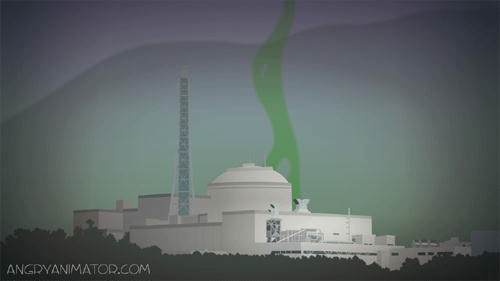
Fast-breeder reactor faces closure, The Age, February 2, 2012 TSURUGA: Japan’s long and expensive pursuit of a super-efficient nuclear reactor is on the brink of failure amid new government concerns about its runaway costs.
The four-decade project to develop a so-called fast-breeder reactor has consumed more than $13 billion in funding, so far producing onlyaccidents, controversies and a single hour of electricity. Continue reading
Radioactivity poses risk in Japan’s tsunami debris
 citizens say they are worried about radioactivity or even say that we should refuse to import this debris. “They worry about their children, they are afraid that radiation levels are too high.”
Radiation experts agree that children are at greatest risk from cancers and genetic defects because they are still growing, are more prone to thyroid cancers, and because they will have more time to develop health defects…..
Radiation fears slow tsunami clear-up, News 24, 1 Feb 12, Tokyo – Giant piles of debris from Japan’s earthquake and tsunami scar the country’s once picturesque northeast coast – and the clear-up is hamstrung by fears the rubbish may be contaminated by radiation. Continue reading
Japan’s government put use by date on nuclear reactors
Japan Cabinet OKs bill to cap nuke reactor life, Macon.com By MARI YAMAGUCHI – Associated PressTOKYO, 1 Feb -12 –– Japan’s Cabinet approved bills Tuesday aimed at bolstering nuclear safety regulations following last year’s Fukushima disaster, including one that would put a 40-year cap on the operational life of nuclear reactors.
The approval came as International Atomic Energy Agency experts generally endorsed “stress test” results at two idled reactors in western Japan, bolstering the Tokyo government’s efforts to restart the facility, though the IAEA team said some safety measures needed clarification.
Japan currently has no legal limit on the operational lifespan of its 54 reactors, many of which will reach the 40-year mark in coming years. One reactor at the Fukushima Dai-ichi plant had been in use 40 years when the tsunami struck last March.
The legislation, which still needs parliamentary approval to take effect, does allow for an extension of up to 20 years.
Critics have blasted that exception as a loophole,…… Critics, ….. say the tests are meaningless because they have no clear criteria, and view the IAEA as biased toward the nuclear industry.
BRICs – Brazil, Russia, China, India, all nuclear prospects looking dodgy
China is looking much less committed to nuclear power than it was a year ago.
The reality is that China needs nuclear power much less than the nuclear industry needs China.
 Prospects for Nuclear Power in 2012 Source: Platts – a leading global provider of energy, metals and petrochemicals information. London, 30 January 2012 “….BRICs [Brazil, Russia, India and China] + South Korea China has dominated new nuclear plant orders in the past few years, accounting for 25 out of the 38 reactors on which construction started worldwide between 2008-2010. Six of these units were for Gen III+ designs, four AP1000s and two EPRs. Almost all the others used a design imported from France in the 1980s, which in turn had been licensed from Westinghouse in the early 1970s. This design, the CPR1000, is showing its age and there was an expectation, even before Fukushima, that the AP1000 would replace it. This would have been a huge boost to the AP1000, giving it the volume of orders that might have allowed costs to come down and for teething problems to be solved. The EPR, by contrast, appears to have no prospect of further orders in China.
However, there were signs that the strain of the rapid pace of construction was beginning to show. In 2011, no new starts were made, compared with ten in 2010. Fukusima explains this to a degree, but some might have been expected in the first three months of 2011 before disaster struck. The reason behind the slowdown is the high cost of the AP1000. The large Chinese utilities appear to be looking at other options.
There is now talk of pursuing indigenous advanced designs developed from the CPR1000 as well as Small Modular Reactors. China has always been adept at convincing nuclear suppliers that there was a great future for their particular technology in China.
It is unclear whether talk of SMRs and new advanced designs will go any further. Continue reading
Plebicites – the beginning of the end for nuclear power
To date only three [ plebicites on nuclear power] have been held, [in Japan] in the villages of Maki and Kariwa in Niigata Prefecture, and in Miyama, Mie Prefecture. In all three polls, voters said no to nuclear power.

 NUCLEAR POWER PLEBISCITES Plebicites first step in pulling nuclear plug Japan Times, By ERIC JOHNSTON, 31 Jan 12. Last June more than 90 percent of Italian voters said no to nuclear power in a referendum, while Germany and Switzerland voted to phase out atomic energy in the coming years.
In France, which faces a presidential election this spring, the Socialists and Greens pledged to close 24 reactors by 2025 as public opinion in what was once Europe’s strongest supporter of nuclear plants begins to falter.
In Japan, efforts to collect signatures in support of a national vote on the future of nuclear power began just after the Fukushima disaster struck. But there are also separate attempts to introduce specific plebiscites in Tokyo and in the city of Osaka. Continue reading
Freezing weather causes 8 tons of water leakage at Fukushima nuclear plant
Freezing Fukushima Nuclear Plant Leaks Water TOKYO, Japan, January 30, 2012 (ENS) – The temperature fell to minus 8.7 degrees Celsius on Sunday morning near Japan’s crippled nuclear power plant, causing water pipes and valve seals to rupture, leaking tons of water.
Workers at the Fukushima Daiichi nuclear plant discovered Sunday that the damaged pipes spilled nearly eight tons of water from 14 locations. Two additional water leaks were discovered today, according to plant operator Tokyo Electric Power Company……
http://www.ens-newswire.com/ens/jan2012/2012-01-30-01.html
“Decommissioning” Fukushima nukes to take a very long time
Freezing Fukushima Nuclear Plant Leaks Water TOKYO, Japan, January 30, 2012 (ENS)“…..Decommissioning is expected to take 40 years and require the use of robots and new technologies to remove the melted nuclear fuel, the Japanese government said in December. Continue reading
Climate change policy manipulated by the nuclear lobby
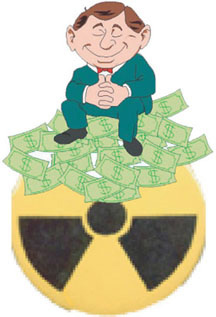 The threat of climate change gained traction in the global imagination after the end of the Cold War. And as warming worries grew, nuclear power became an anti-emissions trump card in the eyes of many, fueling a reactor building spree.
“Government policy came to incorporate promotion of nuclear power. It was taboo for us to even make an issue of it.”
 Nuclear power boosters used climate change to ride to energy supremacy, Mainichi DailyNews, 30 Jan 12 In 1997, in the midst of the international negotiations that would eventually result in the Kyoto Protocol, the Japanese delegation was pondering whether it could realistically accept the protocol’s main point: a commitment to a 6 percent decrease in greenhouse gas emissions from 1990 levels. They were also grappling with what such a commitment would mean for Japan’s energy supplies.
Strangely enough, though the Japanese delegation was grappling with issues of carbon emissions and energy needs, there was not a single representative of the then Environment Agency on hand. Osamu Watanabe, vice minister at the former Ministry of International Trade and Industry at the time of the talks and now president of Japan Petroleum Exploration Co., sums up Japan’s thinking like this:
“Taking nuclear power into account was a prerequisite for accepting the 6 percent reduction. Speaking for the industry ministry, we thought that the more nuclear power we had, the more we could reduce greenhouse gas emissions.”
Meanwhile, at the Environment Agency — which became the Environment Ministry in 2001 — there were many staff who took a more cautious attitude to the promotion of nuclear power. Their skepticism did not, however, often find effective expression.
“The industry ministry put up a lot of resistance to the Environment Agency getting involved in energy policy,” a senior agency official from the time says. “We just couldn’t get a word in.” Continue reading
Records not kept by 5 Japanese nuclear disaster committees
 Five Japan committees keep no disaster records Terra Daily Tokyo (AFP) Jan 27, 2012 Five government teams dealing with Japan’s tsunami and nuclear catastrophes kept no detailed records, an official said Friday, adding to a growing picture of chaos in Tokyo’s disaster response…
Now the government has admitted having no minutes from a further four emergency committees, Continue reading
Problems in assessing radiation in Fukushima school lunches
Radiation testing on school lunches differs, The Yomiuri Shimbun, 30 Jan 12, FUKUSHIMA-–Municipalities are carrying out tests for radioactive substances on ingredients used in school lunches, but parents are worried whether their children are adequately protected as the testsare conducted in various ways. Continue reading
Growth of anti-nuclear movement in Asia
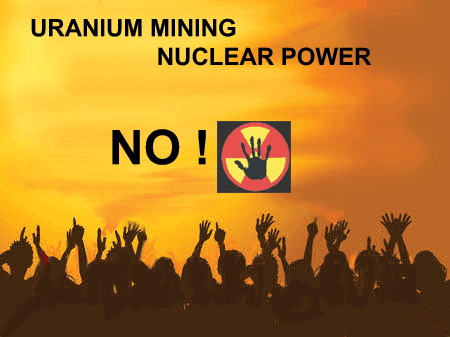 Anti-nuclear movement growing in Asia Though nuclear power still has a strong foothold in Asia, anti-nuclear sentiment and protest are growing from Mongolia to South Korea to Taiwan and even – in modest ways – in China. Christian Science Monitor, By Winifred Bird, January 27, 2012 YOKOHAMA, JAPAN
Heonseok Lee has a simple way of describing how public sentiment  toward nuclear power has changed in South Korea since the disaster at Japan’s Fukushima Daiichi nuclear power plant last March 11. “Before 3/11, I’d post an article criticizing the nuclear power industry, and right away there’d be hundreds of really nasty comments. After 3/11, there’ll still be a few dozen. But not hundreds,” says Lee, a full-time anti-nuclear activist in one of the world’s most pro-nuclear countries.
Though nuclear power still has a strong foothold throughout the region, and public opinion is  mixed, activists across Asia have anecdotes like this to show that anti-nuclear sentiment and protest are slowly growing from Mongolia, to South Korea to Taiwan and even – in modest ways – to China.
This month, activists from Japan and South Korea announced plans for a new East Asian civil society network to promote renewable energy and oppose nuclear power. Continue reading
Japan’s nuclear plant stress tests – “flimsy” and unreliable
“I don’t view their evaluation as something that is trustworthy or carries any weight,” “The last time the IAEA inspectors came to Japan, they simply inspected sites and documents and left saying everything was fine. They submitted a flimsy report, and I fear the same will be the case this time.”
 Experts cast doubt on Japan nuclear plant tests, Justin McCurry in Tokyo, guardian.co.uk, 27 January 2012 Japanese government ordered tests on all reactors after Fukushima meltdown, but advisers say they do not prove a plant is safe Advisers to Japan‘s nuclear safety agency have said power plant stress tests do not prove that a nuclear plant is safe, as the country faces the prospect of a summer without a single nuclear reactor in operation. Continue reading
China remains inscrutable on nuclear safety
China denies nuclear accident Telegraph, 27 Jan 12, China has moved swiftly to deny it has become the latest nation to experience a nuclear accident, after claims that it was forced to shut down its newest nuclear reactor last year. By David Eimer in Beijing 27 Jan 2012 A report from Japan’s Atomic Energy Agency said the China Experimental Fast Reactor (CEFR) stopped generating electricity in October following an accident. With Japan already reeling from the meltdown at the Fukushima nuclear plant in March last year, the incident sparked alarm there and in South Korea over the prospect of radiation leaking from the CEFR.
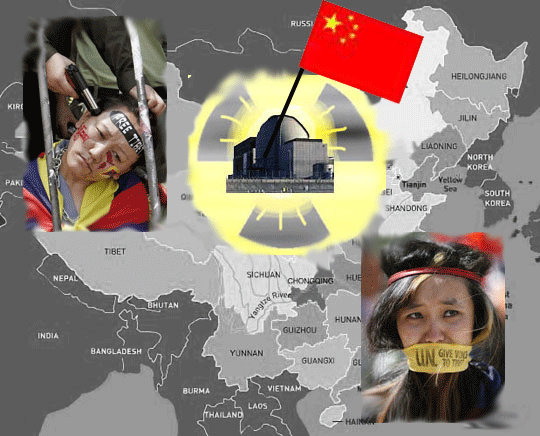
Those fears were intensified by Beijing’s failure to report the accident or release details of what happened, according to a Tokyo newspaper which cited the Japanese Atomic Energy Agency’s investigation. Continue reading
In Japan’s towns, nuclear money silences criticism
“After having received money related to the nuclear power plant like a form of drugs, this region’s capability to nurture its economy independently and actively has declined
 Japanese town’s dependence on nuclear plant hushes criticism, By Yoko Kubota, OHI, Japan Jan 26, 2012 (Reuters) – Japan’s nuclear disaster has eroded trust in utilities and shown residents of the rural, mountainous region of Fukui the risk of radiation, but a dependence on atomic plants for jobs and funds means speaking out against them is taboo. Continue reading
$13 billion taxpayer bailout for Japan’s TEPCO nuclear company
 Japan’s stricken nuclear operator set for $13 billion bailout By Kentaro Hamada and Linda Sieg TOKYO Jan 26, 2012 (Reuters) – Japan is set to launch a $13 billion bail-out of the owner of its stricken Fukushima nuclear power plant after the utility dropped resistance to a public fund injection, sources said on Thursday, as the country debates the future of nuclear power.
The injection of 1 trillion yen ($12.8 billion) in public funds into Tokyo Electric Power Co (9501.T) would effectively nationalize the firm, supplier of power to almost 45 million people, in one of the world’s biggest bailouts outside the banking sector………. It is now resigned to the state rescue, but sources familiar with the matter said it was still dragging its feet over the form of bail-out, with the government proposing that the state-backed Nuclear Damage Liability Facilitation Fund take a two-thirds share, which would let Tokyo make the key decisions. Continue reading
1 This Month
23-25 October – on Zoom – World BEYOND War’s annual global conferenc


Shut down the radiation-damaged Heysham nuclear reactors now
To see nuclear-related stories in greater depth and intensity – go to https://nuclearinformation.wordpress.com

Say No to NASA’s Reckless Nuclear Reactor on the Moon
Say No to NASA’s Reckless Nuclear Reactor on the Moon

-
Archives
- October 2026 (219)
- September 2026 (339)
- August 2026 (330)
- July 2026 (355)
- June 2026 (287)
- May 2026 (306)
- April 2026 (356)
- March 2026 (251)
- February 2026 (267)
- January 2026 (308)
- December 2025 (358)
- November 2025 (359)
-
Categories
- 1
- 1 NUCLEAR ISSUES
- business and costs
- climate change
- culture and arts
- ENERGY
- environment
- health
- history
- indigenous issues
- Legal
- marketing of nuclear
- media
- opposition to nuclear
- PERSONAL STORIES
- politics
- politics international
- Religion and ethics
- safety
- secrets,lies and civil liberties
- spinbuster
- technology
- Uranium
- wastes
- weapons and war
- Women
- 2 WORLD
- ACTION
- AFRICA
- Atrocities
- AUSTRALIA
- Christina's notes
- Christina's themes
- culture and arts
- Events
- Fuk 2022
- Fuk 2023
- Fukushima 2017
- Fukushima 2018
- fukushima 2019
- Fukushima 2020
- Fukushima 2021
- general
- global warming
- Humour (God we need it)
- Nuclear
- RARE EARTHS
- Reference
- resources – print
- Resources -audiovicual
- Weekly Newsletter
- World
- World Nuclear
- YouTube
-
RSS
Entries RSS
Comments RSS

