Church leaders head anti nuclear protest in Kudankulam
Kudankulam: Anti-nuclear forum stages protest Tirunelveli: IBN Tamil, Nadu, Live 27 Jan 12, An anti-nuclear forum spearheading the stir against Kudankulam Nuclear Power Plant on Thursday staged a demonstration in a coastal village near the site in protest against moves to get it commissioned.
Organisers of the People’s Movement Against Nuclear Energy said PMANE activists staged the demonstration at Chettikulam after coming in a procession from Perumanalpuram.
Both villages are about five km from the KNPP site.PMANE convenor SP Udayakumar and heads of various churches led the protestors.
The commissioning of the plant was earlier slated in December 2011, but has been delayed after protests by locals, who have been agitating since September last, demanding scrapping of the Indo-Russian project, citing safety concerns following the Fukushima disaster.
The previous three rounds of talks between the Central experts committee and Tamil Nadu Government panel set up to break the impasse over the project, held on November 7, 18 and
December 15 last year failed to make any headway towards commissioning of the first unit as locals were not satisfied with the replies given by the expert group to their queries.
The fourth round meeting between the committee and panel is planned to be held on January
31.http://ibnlive.in.com/news/kudankulam-antinuclear-forum-stages-protest/224546-62-128.html
Lynas rare earths company still in trouble over radioactive wastes in Malaysi
Locals say market won’t buy Lynas’ recycled waste, Malaysia, By Shannon Teoh, January 26, 2012 KUALA LUMPUR, Jan 26 — Lynas Corp’s plans to recycle waste from its controversial RM2.5 billion rare earth plant in Kuantan into a commercial product will not be accepted by the market, local residents opposed to the refinery said today.
The Stop Lynas Coalition (SLC) and Save Malaysia Stop Lynas (SMSL) groups said in a joint submission to the government that the synthetic gypsum the Australian miner hopes to produces from its waste is the subject of an international safety campaign due to radiation fears. The use of phospho-gypsum plaster-board and plaster cement in buildings as a substitute for natural gypsum may constitute an additional source of radiation exposure to both workers and members of the public,” the document quoted from Internet-based environmental organisation Zero Waste America. Continue reading
No records kept of Japan’s nuclear disaster crisis response!
 “Perhaps there were some goings on that the participants did not feel comfortable being made public,”
 Japan Task Force Kept No Records Of Nuclear Crisis Response, Planet Ark, 25-Jan-12, JAPAN by Yoko Kubota and Shinichi Saoshiro Japan’s energy minister admitted on Tuesday that no records were kept of top level discussions in the critical early days on how to respond to the world’s worst nuclear disaster in 25 years. Continue reading
Japanese govt’s secrecy on nuclear disaster report
 Japan kept silent on worst nuclear crisis, Herald Sun, Tokyo From: AP January 26, 2012 THE Japanese government’s worst-case scenario at the height of the nuclear crisis last year warned that tens of millions of people, including Tokyo residents, might need to leave their homes, according to a report.
But fearing widespread panic, officials kept the report secret. The recent emergence of the 15-page internal document may add to complaints in Japan that the government withheld too much information about the world’s worst nuclear accident since Chernobyl. It also casts doubt about whether the government was sufficiently prepared to cope with what could have been an evacuation of unprecedented scale.
The report was submitted to then-Prime Minister Naoto Kan and his top advisers on March 25, two weeks after the earthquake and tsunami devastated the Fukushima Dai-ichi nuclear power plant, causing three reactors to melt down and generating hydrogen explosions that blew away protective structures…..
After Mr Kan received the report, he and other Japanese officials publicly insisted that there was no need to prepare for wider-scale evacuations.
The government continues to refuse to make the document public. The AP obtained it overnight through a government source, who insisted on anonymity because the document was still categorised as internal……. http://www.heraldsun.com.au/news/breaking-news/japan-kept-silent-on-worst-nuclear-crisis/story-e6frf7jx-1226253974563
Pakistan causing an impasse at UN nuclear disarmament talks
The UN chief lamented that the practice of deciding by consensus “is currently used as a de facto veto power to stall every attempt to break the impasse.”
 Pakistan’s stonewalling could sink UN nuclear disarmament talks: Ban Ki-moon National Post, Agence France-Presse Jan 24, 2012 GENEVA — UN Secretary General Ban Ki-moon warned Tuesday that the UN Conference on Disarmament could fail because of a three-year stalemate over Pakistan’s reluctance to discuss nuclear power. Continue reading
Renewable energy development for Karnataka, India

 Renewable energy potential 28GW+ in Karnataka, Construction Week online India, Jan 24, 2012 Karnataka’s renewable energy potential is more than 28 GW, says Pune based World Institute of Sustainable Energy (WISE). Karnataka is one of the pioneers where states in India are concerned to draft an RE Policy for the state for the period of 2009-14.
The policy envisions a generation of 6600 MW of renewable electricity by 2014 and about Rs.23,890 crore of investments during the said period. Studies by the World Institute of Sustainable Energy (WISE), Pune, suggest that Karnataka has much more RE potential
than envisaged, which is more than 24 GW, out of which currently, only 3.45 GW has been tapped so far (as on Nov 2011). This includes 1929 MW of wind, 86 MW of biomass, 782 MW of bagasse cogen, 646 MW of small hydro, and 9 MW of solar. Wind offers the maximum potential with an untapped potential of 11 GW. Obviously the huge untapped potential also creates a huge investment opportunity…..
http://www.constructionweekonline.in/article-7672-renewable_energy_potential_28gw_in_karnataka/
A cheaper alternative to rare earths, for electric cars
Toyota Finds Way To Avoid Using Rare Earth: Report, Planet Ark, 24-Jan-12, JAPAN by Chang-Ran Kim and Risa Maeda Toyota Motor Corp has developed a way to make hybrid and electric vehicles without the use of expensive rare earth metals, in which China has a near-monopoly, Japan’s Kyodo News reported.
Toyota, the world’s top producer of fuel-saving hybrid cars such as the Prius, could bring the technology to market in two years if the price of rare earths does not come down, Kyodo said, citing a source familiar with the matter.
A Toyota spokeswoman said the company continues to research ways to reduce rare earth usage and has no time frame yet for commercialization.
Rare earth metals like neodymium and dysprosium are used in the powerful magnets in motors that power hybrid and electric cars, and demand is expected to surge as more of the environmentally friendly cars hit the market.
China produces more than 95 percent of the world’s rare earth metals. Its efforts to limit exports, citing resource depletion and environmental degradation, have alarmed its customers and trading partners and have sent prices soaring.
Japan accounts for a third of global rare earth demand and is aiming to cut consumption, providing subsidies for recycling and investing in new ways to limit their use. http://www.planetark.org/enviro-news/item/64496
Radioactive water leak reported from Fukushima’s No 2 nuclear reactor
Fresh Radioactive Water Leakage Reported at Fukushima Nuke Plant, MOSCOW, January 22 (RIA Novosti) About two liters of radioactive water leaked from the turbine building of the second reactor at the crippled Fukushima Daiichi nuclear plant, Kyodo news agency reported on Sunday.
TEPCO, which operates the nuclear plant, issued a statement on Saturday saying the leak was from a pipe there that transfers highly radioactive water in the basement of the No. 2 reactor’s turbine building to the plant’s waste disposal facility……http://en.ria.ru/world/20120122/170887389.html
TEPCO nuclear company to be nationalised, saved from bankruptcy
TEPCO ‘to be nationalised’ for 10 years, SKY News, January 21, 2012 The operator of Japan’s crippled nuclear power plant will be effectively nationalised for at least 10 years under a plan to provide it with money to fund compensation payouts, a report said Saturday.
The funding from a public body is expected to inject Y1 trillion yen ($A12.48 billion) into Tokyo Electric Power Co. (TEPCO), effectively putting it under state control, Kyodo reported quoting sources close to the matter.
The scheme is expected to be included in a comprehensive business plan to be finalised in March by TEPCO and the fund, named the Nuclear Damage Liability Facilitation Fund, the report said.
Under the plan TEPCO will remain as a listed company, it added.
The funding body will receive money from special government bonds and contributions from other utilities which have nuclear power plants in Japan.
The business plan is aimed at preventing TEPCO from becoming insolvent due to the heavy costs stemming from the world’s worst nuclear accident since the 1986 Chernobyl disaster…..
A government panel has estimated claims from victims affected by the Fukushima crisis could reach 4.5 trillion yen by 2013…..
(TEPCO) will aim to get into the black in the year to March 2014 by raising household electricity charges and reactivate its idle nuclear reactors from early 2013, the news agency added. It is hoped that TEPCO would be able to exit effective state control
as early as in March 2022.
Commenting on the report, TEPCO spokeswoman Megumi Iwashita said: “Nothing has been decided up to date.” http://www.skynews.com.au/businessnews/article.aspx?id=709835&vId=
Continuing radiation fallout danger from Fukushima nuclear disaster
 Radiation used to be a word that evoked serious concern in a lot of people. However, the nuclear industry and its supporters have done a masterful job in allaying public fears about it. They do this in significant part by relying on outdated and highly questionable data collected on Japanese atom bomb survivors, while at the same time ignoring and dismissing inconvenient but much more relevant evidence that shows the actual harmful effects of radiation exposure from nuclear accidents.
neglecting to monitor the fallout will not make it go away. In fact, another enormous problem with radioactive contamination is that it bioaccumulates in the environment, which means it concentrates as it moves up the food chain. (Think of mercury in fish.) Because many radionuclides are so long-lived, this can be a problem for a very long time.

 Fukushima Update: Why We Should (Still) Be Worried Business Insider, Russ Baker, WhoWhatWhy | Jan. 20, 2012, After the catastrophic trifecta of the triple meltdowns at the Fukushima Daiichi nuclear complex in Japan last March—what the Japanese are referring to as their 3/11—you would think the Japanese government would be doing everything in its power to contain the disaster. You would be wrong—dead wrong.
Instead of collecting, isolating, and guarding the millions of tons of radioactive rubble that resulted from the chain reaction of the 9.0 earthquake, the subsequent 45- to 50-foot wall of water that swamped the plant and disabled the cooling systems for the reactors, and the ensuing meltdowns, Japanese Environment Minister Goshi Hosono says that the entire country must share Fukushima’s plight by accepting debris from the disaster……
The enormous volume of waste is much more than the disaster areas can handle. So, in an apparent attempt to return this region to some semblance of normal life, the plan is to spread out the waste to as many communities across the country as will take it. Continue reading
Economic growth for India through renewable energy
Renewable energy holds key to growth, says Sheila, Times of India, TNN | Jan 21, 2012, NEW DELHI: Chief minister Sheila Dikshit on Friday unveiled the first Renewal Energy Assisted Pump (REAP) system at a function in Mayur Vihar. Developed by discom BSES Yamuna in collaboration with IIT Delhi, the REAP system is an easy-to-install submersible pump connected to a water tank, with a specially designed motor powered by a solar panel.
Officials said REAP would meet water storage and pumping needs in both rural and urban India by harnessing renewable energy sources. “It will help in combating global warming and other environmental issues. In addition to reducing dependence on fossil fuels, it will help BYPL manage the electricity demand better,” said an official.
The first REAP system was installed at a plot owned by the All India Panchayat Parishad (AIPS) in Mayur Vihar. Dikshit said the REAP technology would reduce consumption of power during morning peak hours, when most people switch on their pumps to get water as well as store it. “The technology will also prove useful in agriculture, hospitals, schools, hotels, restaurants, malls and group housing societies,” said a government official. The solar panel will be connected to a pump, which will draw ground water and store it in an overhead tank. The REAP has a capacity to draw 30,000l of water per hour. The CM said generation of power with coal and gas is not a viable solution as these resources are getting depleted. http://timesofindia.indiatimes.com/city/delhi/Renewable-energy-holds-key-to-growth-says-Sheila/articleshow/11573708.cms
Radioactive gravel in school building in Japan
Radioactive gravel finds way to school, Japan Times, 20 Jan 12, Hunt is on for other shipments from quarry in evacuation zone Kyodo FUKUSHIMA — Radiation-contaminated gravel shipped from a quarry in the evacuation zone around the Fukushima No. 1 nuclear plant found its way to an elementary school building as well as roads and pathways around
houses, sources said Wednesday. The gravel went into concrete that was used to make an elementary school in Nihonmatsu, Fukushima Prefecture, more resistant to earthquakes. The area where the gravel was used had a radiation reading of 0.1 to 0.2 microsieverts per hour.
“We are surprised at the news as we had never expected it. We’d like to make efforts to ensure children’s health by checking the radiation level on a regular basis,” the school’s principal said. Continue reading
Betrayal of Japanese people in government silence on radiation
With no information coming from Tokyo, mayor Tamotsu Baba decided to lead the people of his community further north away from the plant. He did not know it at the time, but that was the very direction the plumes of radiation were also blowing.
For the 20,000 people of Namie – they have lost their homes and many fear for the health of their children.
A system that was designed to protect and warn them has clearly failed.
Japan ‘betrayed citizens’ over radiation danger, ABC News AM By North Asia correspondent Mark Willacy January 20, 2012 Japan has been accused of betraying its own people by giving the American military information about the spread of radiation from Fukushima more than a week before it told the Japanese public.
The mayor of a Japanese community abandoned because of its proximity to the Fukushima nuclear plant has told AM the government’s actions are akin to murder.
An official from Japan’s science ministry, which was in charge of mapping the spread of radiation, has acknowledged to AM that perhaps the public should have been told about the dangers at the same time the US military was informed.
In the hours after the meltdowns at Fukushima, unseen plumes of radiation began to roll over the Japanese landscape. Just a few kilometres from the oozing remains of the nuclear plant the people of Namie village gathered to evacuate. Continue reading
Radioactive cesium in the ocean fish food chain
 Some cesium was found in 16 of these 22 species in November, the last
full month for which data was available.
Cesium was especially prevalent in certain of the species:
– 73 per cent of mackerel tested
– 91 per cent of the halibut
– 92 per cent of the sardines
– 93 per cent of the tuna and eel
– 94 per cent of the cod and anchovies
– 100 per cent of the carp, sea-weed, shark and monkfish
After Fukushima, fish tales, By Alex Roslin, The Montreal Gazette January 14, 2012 “…………evidence has emerged that the impacts of the disaster on the Pacific Ocean are worse than expected.
Since a tsunami and earthquake destroyed the Fukushima Daiichi Nuclear Power Plant last March, radioactive cesium has consistently been found in 60 to 80 per cent of Japanese fishing catches each month tested by Japan’s Fisheries Agency. Continue reading
Protestors denounce Japan’s nuclear watchdog agency
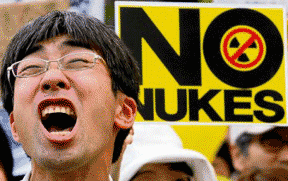 Japan Protesters Block Meeting on Restarting Nuclear Plants WSJ By MITSURU OBE, 18 Jan TOKYO—Protesters denouncing Japan’s nuclear watchdog agency as having a pro-nuclear bias, held up the initial approval of stress-test results for two idled reactors, as police were called in to break up the demonstration.
More than a dozen demonstrators, carrying anti-nuclear signs and shouting, “Shame on you,” disrupted what was to be a closed meeting of government agency representatives, nuclear experts and energy officials gathered to review test results. The Nuclear and Industrial Safety Agency was set to give its preliminary approval for the restart of the two plants ahead of the arrival next week of a mission from the International Atomic Energy Agency.
The protesters called the meeting a sham, and said the majority of the panel members are known to have pro-nuclear views and are merely giving a rubber stamp to reactors.
More than 100 uniformed and plainclothes police officers were called in to end the action. The panel members were escorted out of the meeting room and resumed the session in a different ministry building, where they approved bringing the two plants back online.
The vote represents the first step in a process for restarting plants, which also must get the approval of other nuclear agencies, the Japanese cabinet and local communities……
1 This Month
23-25 October – on Zoom – World BEYOND War’s annual global conferenc


Shut down the radiation-damaged Heysham nuclear reactors now
To see nuclear-related stories in greater depth and intensity – go to https://nuclearinformation.wordpress.com

Say No to NASA’s Reckless Nuclear Reactor on the Moon
Say No to NASA’s Reckless Nuclear Reactor on the Moon

-
Archives
- October 2026 (219)
- September 2026 (339)
- August 2026 (330)
- July 2026 (355)
- June 2026 (287)
- May 2026 (306)
- April 2026 (356)
- March 2026 (251)
- February 2026 (267)
- January 2026 (308)
- December 2025 (358)
- November 2025 (359)
-
Categories
- 1
- 1 NUCLEAR ISSUES
- business and costs
- climate change
- culture and arts
- ENERGY
- environment
- health
- history
- indigenous issues
- Legal
- marketing of nuclear
- media
- opposition to nuclear
- PERSONAL STORIES
- politics
- politics international
- Religion and ethics
- safety
- secrets,lies and civil liberties
- spinbuster
- technology
- Uranium
- wastes
- weapons and war
- Women
- 2 WORLD
- ACTION
- AFRICA
- Atrocities
- AUSTRALIA
- Christina's notes
- Christina's themes
- culture and arts
- Events
- Fuk 2022
- Fuk 2023
- Fukushima 2017
- Fukushima 2018
- fukushima 2019
- Fukushima 2020
- Fukushima 2021
- general
- global warming
- Humour (God we need it)
- Nuclear
- RARE EARTHS
- Reference
- resources – print
- Resources -audiovicual
- Weekly Newsletter
- World
- World Nuclear
- YouTube
-
RSS
Entries RSS
Comments RSS

