Russia keen to make big money selling nuclear to India

Russia is keen to cash in on its nuclear know-how and has ambitious plans to triple nuclear exports to $50 billion a year by 2030.
 Russia says near deal on two new Indian reactors Work on Russian-built reactors resumed after protests
* Russia hopes to sign deal for 2 more reactors soon
* India plans to build 30 reactors by 2032 By Alexei Anishchuk
VOLGINSKY, Russia, March 21 (Reuters) – Continue reading
200 arrested as India tries to crush anti nuclear movement
 Thousands of Anti-Nuclear Protesters Face Police in India, 200 Arrested Green signal for nuclear power ‘is a red signal for our lives’ Common Dreams , 21 March 12,
After thousands gathered in Idinthikarai, Tamil Nadu, India on Monday to protest the vastly contested Kudankulam Nuclear Power Plant there, police forces came out en masse to repress demonstrations. Over 200 protesters have been arrested including key anti-nuclear organizers.
Thousands of Koodankulam protesters have gathered in front of St Lourdes church (Photo: TEHELKA)Police initiated “operation Koodankulam” arresting protesters and blocking all entry points to the coastal villages surrounding the nuclear power plant….
Since the arrests, thousands have gathered on the grounds of St Lourdes Church in the area as several have begun a hunger strike. “We will continue our protest till we die,” said one protestor. http://www.commondreams.org/headline/2012/03/20-4
Is the world aware of India’s repression of its peaceful anti nuclear protestors?
 “There is no need for such massive deployment of police here. This is nothing short of state terrorism against a peaceful group of women, children and men fighting for the last seven months in a non-violent manner”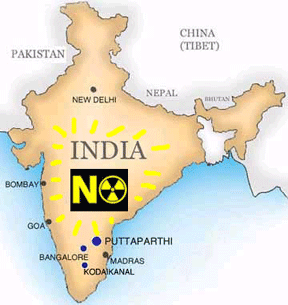
 Tension simmers in Koodankulam http://www.asianage.com/chennai/tension-simmers-koodankulam-750 The Asian Age, Mar 21, 2012 – Pradeep Damodaran & Arul Oli | DC | Idinthakarai Even as engineers and other workers drove in to resume work following the government’s green signal for the Koodankulam nuclear power project, the situation at Idinthakarai, which is less than 10 minutes drive from the nuke plant, is getting more tense by the minute as the ‘fast-to-death’ by the protesters’ leader S.P. Udayakumar and 14 others entered the second day on Tuesday. Continue reading
As Tamil Nadu govt turns against them, Koodankulam anti nuclear protestors plan fast till death
 PMANE leaders start fast Tamil Nadu IBN Live Mar 20, 2012 M Abdul Rabi TIRUNELVELI: Seeking release of the nine arrested anti-Koodankulam plant protesters and revocation of the Cabinet resolution favouring the Koodankulam Nuclear Power Plant (KKNPP), PMANE (People’s Movement Against Nuclear Energy) leaders S P Udayakumar and M Pushparayan began a fast-unto-death at Idinthakarai on Monday.
Speaking to Express, Udayakumar said: “It is very unfortunate that the
state government has changed its decision….. http://ibnlive.in.com/news/kpalnt-pmane-leaders-start-fast/240828-60-118.html
Civil liberties gone, as Tamil Nadu government moves to crush anti nuclear protest
Civil society members warn of “nuclear Nandigram” THE HINDU, CHENNAI, March 21, 2012 Civil society members, including former judges, writers, scientists, academicians, filmmakers and lawyers, have condemned the Tamil Nadu government’s decision “to give the green signal to commissioning of the Kudankulam Nuclear Power Project (KKNPP) and the massive deployment of police force to crush the peaceful agitation.” Continue reading
India: the crackdown on protestors, the pro nuclear media ‘spin’
And Koodankulam is Being Hunted Down ! http://www.dianuke.org/and-koodankulam-is-being-hunted-down/ 6000 armed policemen, led by Tamil Nadu’s Additional Director General of Police (ADGP), 3 DIGs (Deputy Inspector Generals) and 20 SPs (Superintendents of Police) who are present themselves and are presiding over this operation that can turn up into a state-sanctioned carnage of its own civilians.
As drumbeats approached Idinthakarai, Tamil Nadu Chamber of Commerce and Industry hails the decision to start the Koodankulam reactor as it is necessary for the State’s “progress”.
A 5-page press statement from the Chief Minister of Tamil Nadu ended the rituals of “engaging people”, “dialogue with the locals” and “allaying their fears” in the world’s largest democracy. Not surprisingly, the government crackdown on people’s movement waited for another mega-ritual to end: the elections in the neighbouring assembly constituency of Sankarankoil on March 18.
Since yesterday afternoon, the police squads have blocked every road leading to Koodankulam and Idinthikarai to prevent people from gathering there. Yet, more than 20,000 people have gathered at the gate of Koodankulam nuclear power project, with several hundreds getting detained on their way.
Learning from the democracies in the West, the corporate media here has also embedded itself to this ‘shock and awe’. Newspapers and TV channels are abuzz with the ‘green signal’ given to the nuclear project and the country’s progress. The titles say it all: …. http://www.dianuke.org/and-koodankulam-is-being-hunted-down/
Taipower poisons island with nuclear wastes, and islanders’ minds with money
“Taipower contaminates our island with nuclear waste and it also contaminates our minds with money,” “They are trying to make us think that we cannot live without nuclear waste.”…
a lot of Taos depend on Taipower for jobs and are afraid of losing their jobs if they tell people what they really think.

 Lanyu’s residents grudgingly accept nuclear storage Taipei Times, By Loa Iok-sin 19 March 12, The Tao Aborigines of Lanyu (蘭嶼) — also known as Orchid Island — are once again taking to the streets to voice their opposition to a nuclear storage facility on their island, calling for its immediate removal.
While it may appear that the removal of nuclear waste is the only thing the Taos want, the
real situation is much more complicated, as Taiwan Power Co (Taipower) is exerting considerable effort on the resource-scarce island to minimize opposition. Continue reading
Thousands of police surround India’s anti nuclear protestors
Indian Police Arrest 10 at Nuclear Power Plant Protest IDINTHAKARAI, Tamil Nadu, India, March 19, 2012 (ENS) – Thousands of police today surrounded thousands of anti-nuclear protestors demonstrating against the Kudankulam Nuclear Power Plant in Idinthakarai.
Ten people have been arrested, including three protest leaders, Continue reading
India bumps up its nuclear arsenal
 India to induct nuclear submarine early April Channel News Asia: 20 March 2012 NEW DELHI: In a major boost to its underwater strike capabilities, India will induct its Russian-built nuclear-powered submarine, Nerpa, in the first week of April. Nerpa, which will be rechristened INS Chakra, is scheduled to arrive at its home base of Visakhapatnam in the first week of April and is expected to be commissioned formally into the Indian Navy by Defence Minister A K Antony on April 5, Defence Ministry officials told Press Trust of India here Monday.
The submarine will be on a ten-year lease under a deal expected to be
worth over US$920 million, they said. …
 .. The Navy will have three submarines of this class by the end of this decade. India already
possesses or is in the process of developing a family of nuclear-capable missiles including the Agni series, Prithvi variants, naval missile Dhanush, and submarine-launched Sagarika….. http://www.channelnewsasia.com/stories/afp_asiapacific/view/1190063/1/.html
China’s secretive nuclear industry – more dangerous than Japan’s?
 China’s nuclear power plant review: ‘problems in 14 areas’ found Christina Science Monitor, Should we be concerned? 18 March 12, A nuclear official said in passing this weekend that problems in 14 areas need to be resolved. In the wake of Fukushima, a shade more transparency would be welcome. By Peter Ford, “…. a press conference held on Saturday on the sidelines of the annual National People’s Congress meeting, at which a top nuclear-industry insider spoke:
Referring to a safety review of China’s nuclear power plants conducted in the wake of the Fukushima nuclear power plant meltdown in Japan last year, he mentioned, in passing, that “problems in 14 areas have been found and need to be resolved.” Some of them will take up to three years to fix, he added.
 That was all that Wang Binghua, chairman of the State Nuclear Power Technology Corp., said on the subject, and none of the journalists present pressed him further, according to an official transcript of his remarks. So all we, and the Chinese public, know is that among China’s 14 working nuclear reactors there are 14 “problems.” What they might be, where, how serious they are, and what can be done to rectify them remains secret…..
Mr. Wang said he expected that the current freeze on the examination and approval of new nuclear plants – in effect since Fukushima – would end this year. He promised that “the Chinese government will not approve any new nuclear project that does not contain necessary emergency measures before the problems identified in the review have been solved.”
 But since nobody outside China’s nuclear industry knows what the problems are, nobody can know whether they have been solved or not. Suddenly, even Japan’s dangerously shadowy nuclear industry begins to look almost transparent…. http://www.csmonitor.com/World/Global-News/2012/0312/China-s-nuclear-power-plant-review-problems-in-14-areas-found
Critical nuclear data stolen, in Indian scientist’s lap-top
Laptop with India’s nuclear data still not found Pakistan Observer, March 18, 2012, Rabi-ul-Sani Islamabad—An Indian nuclear scientist’s laptop with classified nuclear data was stolen from a passenger rail car and is still missing raising serious alarm all over India.
Rare earths processing – a potent environmental polluter
China’s rare earths refineries…… have poisoned rivers with acid and piled up radioactive waste — an environmental cost that aroused little controversy in developed, consuming nations
Malaysian protesters blame an earlier rare earths plant, shut by Japan’s Mitsubishi Chemicals in 1992, for birth defects and a high number of leukemia cases……
Environmental campaigners point to studies done in both New Jersey and China showing that thorium radiation emitted during the refining process and by plant waste can cause cancer, leukemia, birth defects and chronic lung diseases.
Pollution the big barrier to freer trade in rare earths Al Arabiya News,, 19 March 2012 Environmental campaigners point to studies done in both New Jersey and China showing that thorium radiation emitted during the refining process and by plant waste can cause cancer, leukemia, birth defects and chronic lung diseases.
Tackling pollution, not freeing up trade, is regarded as the solution to a global shortage of rare earths, the metals that are the building blocks of the 21st century. Continue reading
Osaka’s mayor wants electricity utility to go nuclear free
Utility Faces Call to Halt Nuclear Power Use In Japan, WSJ, By TOKO SEKIGUCHI, 20 March 12, “…….Now, the brazen mayor of Japan’s western metropolis of Osaka is trying to get the country’s second largest utility to go nuclear-free—a challenge to the national government’s attempts to restart reactors that make up a third of Japan’s electricity-generation capacity amid public concerns over the safety of nuclear energy.
Osaka Mayor Toru Hashimoto is considering a proposal to use the city’s standing as Kansai Electric Co.’s largest customer and stockholder to call on the regional power provider to abandon its use of nuclear power at a shareholders’ meeting in June….. Continue reading
Wind energy in full sail in China
Winds of change blow through China as spending on renewable energy soars World’s biggest polluter spends £4bn a year on wind and solar power generation in single region as it aims to cut fossil fuel use Jonathan Watts in Jiuquan Guardian UK, 19 March 2012 “….. the landscape has started to undergo a transformation as Gansu has moved to the frontline of government efforts to reinvent China’s economy with a massive investment in renewable energy. Continue reading
Deomocracy teeters in India, as government cracks down on anti nuclear protest
India government responds bluntly to anti-nuclear push In response to villagers’ concerns about the Kudankulam nuclear plant project, Indian officials have deported a sympathizer and cracked down on charities they accuse of aiding anti-nuclear efforts. By Mark Magnier, Los Angeles Times March 18, 2012 Continue reading
1 This Month
23-25 October – on Zoom – World BEYOND War’s annual global conferenc


Shut down the radiation-damaged Heysham nuclear reactors now
To see nuclear-related stories in greater depth and intensity – go to https://nuclearinformation.wordpress.com

Say No to NASA’s Reckless Nuclear Reactor on the Moon
Say No to NASA’s Reckless Nuclear Reactor on the Moon

-
Archives
- October 2026 (199)
- September 2026 (339)
- August 2026 (330)
- July 2026 (355)
- June 2026 (287)
- May 2026 (306)
- April 2026 (356)
- March 2026 (251)
- February 2026 (267)
- January 2026 (308)
- December 2025 (358)
- November 2025 (359)
-
Categories
- 1
- 1 NUCLEAR ISSUES
- business and costs
- climate change
- culture and arts
- ENERGY
- environment
- health
- history
- indigenous issues
- Legal
- marketing of nuclear
- media
- opposition to nuclear
- PERSONAL STORIES
- politics
- politics international
- Religion and ethics
- safety
- secrets,lies and civil liberties
- spinbuster
- technology
- Uranium
- wastes
- weapons and war
- Women
- 2 WORLD
- ACTION
- AFRICA
- Atrocities
- AUSTRALIA
- Christina's notes
- Christina's themes
- culture and arts
- Events
- Fuk 2022
- Fuk 2023
- Fukushima 2017
- Fukushima 2018
- fukushima 2019
- Fukushima 2020
- Fukushima 2021
- general
- global warming
- Humour (God we need it)
- Nuclear
- RARE EARTHS
- Reference
- resources – print
- Resources -audiovicual
- Weekly Newsletter
- World
- World Nuclear
- YouTube
-
RSS
Entries RSS
Comments RSS

