Japanese farmers caring for their radioactive cows
“Rebel Farmers” Feed Cows Condemned To Death After Fukushima, by Kristina Chew, March 3, 2012 http://www.care2.com/causes/rebel-farmers-feed-cows-condemned-to-death-after-fukushima.html#ixzz1oHTSSaAM “….. 69-year-old Yukio Yamamoto is one of ten farmers from Namie, which is within the “no go zone,” who is defying government orders to euthanize his 36 black-haired wagyu cows. The cows — once prized for their high-quality beef; each was once worth $10,000 — ingested radioactive caesium and Yamamoto was supposed to kill them by lethal injection. In an interview with the Guardian, Yamamoto discussed getting a permit to enter the zone to feed his animalion. Says Yamamoto about the six-hour trip he now routinely makes:
“I left like everyone else after 11 March, “I couldn’t stop worrying about my cows, so I started coming back in every other day to feed them.”…
“Straight after the disaster, my cows had nothing to eat or drink … many of them starved to death right where they were tethered.I had to decide whether to leave the ones still alive or keep them healthy, even though we were separated.”
But Yamamoto, who is very likely the last of generations of his family to raise wagyu cows, has not received any feed from the Japanese government. Private donors, including farmers in Australia, have provided him with food for his cows.
“Eventually the feed will run out, and the government has said it will kill every last cow. But that is something I can’t allow to happen. “I could never kill these cows. They are like members of my family.”
Yamamoto is pinning his hopes on studies that can properly measure the level of contamination among his cows. As Ryoichi Harada, another “rebel farmer” helping Yamamoto feed his cows, says “We accept that the meat will never go on sale, but the cows could be put to some other commercial use.”
Radioactive cesium contamination in Japan
 Fukushima Nuclear Crisis Update for February 28th – March 1st, 2012, Greenpeace by Christine McCann – March 2, 2012 “……..Contamination (Includes Economic Impact and Human Exposure) A study by the Meteorological Research Institute estimates that 40,000 trillion (or 40 quadrillion) Becquerels of radioactive cesium were released as a result of the Fukushima Daiichi nuclear disaster last March. That amount is two times what scientists originally estimated.
Consumers are expressing concern about cesium contamination in rice, in light of a government decision to relax new rules about contamination levels of planting soil after local farmers exerted pressure on the government to do so. In December, the Ministry of Agriculture, Forestry, and Fisheries ruled that rice could not be planted in land where cesium exceeding 100 Bq/kg was discovered last year. However, it now says that rice may be planted in land where cesium measures between 100 Bq/kg and 500 Bq/kg, provided that the land is decontaminated and every bag of rice is tested. Many residents remain unconvinced that the rice will be safe for consumption. The chair of a national consumer advocacy association noted, “There have already been cases of rice with contamination over the government limit being shipped, even though it was promised that it wouldn’t happen. Won’t some sneak through this time as well?….” http://www.greenpeace.org/international/en/news/Blogs/nuclear-reaction/fukushima-nuclear-crisis-update-for-february-/blog/39340/
Current status of Fukushima’s nuclear reactors
Fukushima Nuclear Crisis Update for February 28th – March 1st, 2012, Greenpeace by Christine McCann – March 2, 2012“”…..Reactor Status The Fukushima Daiichi plant chief, Takeshi Takahashi, admitted this week that the plant is fragile, and its reactors remain highly vulnerable to ongoing earthquakes and the risk of a tsunami. “I have to admit that it’s still rather fragile. Even though the plant has achieved what we call cold-shutdown conditions, it still causes problems that must be improved,” Takahashi said.
TEPCO is continuing to struggle with how to handle large amounts of radioactive water, the byproduct of keeping nuclear fuel in the crippled Fukushima Daiichi reactors cool. The utility is pumping several hundred thousand gallons of water into the reactors each day; the water then becomes contaminated. Experts estimate that 10,000 tons of radioactive water leak from the reactors each month; in January and February alone, 28 new leaks were discovered. TEPCO says it will take at least six years to repair the leaks, and approximately 25 years to remove the fuel. Storage of the radioactive water is becoming an increasingly urgent issue. TEPCO currently has space to store 165,000 tons; 125,000 tons are already being stored. The utility has destroyed nearby forests to create room for more storage containers.
TEPCO announced that Quince II, a Japanese-made robot, has discovered radiation levels measuring 220 millisieverts per hour in reactor #2 at the Fukushima Daiichi plant. The robot, which was designed by researchers at the Chiba Institute of Technology, was created to explore the interior of the Fukushima Daiichi nuclear reactors, where radiation levels remain too high for humans to enter. http://www.greenpeace.org/international/en/news/Blogs/nuclear-reaction/fukushima-nuclear-crisis-update-for-february-/blog/39340/
India’s political problems intensify, with anti nuclear movement
Mood at nuclear-plant stir turns anti-DMK , http://timesofindia.indiatimes.com/city/chennai/Mood-at-nuclear-plant-stir-turns-anti-DMK/articleshow/12116624.cms TNN | Mar 3, 2012 KUDANKULAM: The anti-nuclear stir, spearheaded by the People’s Movement Against Nuclear Energy (PMANE) at Kudankulam, is turning out to be an anti-DMK and anti-Congress agitation too.
For two days, on Wednesday and Thursday, fishermen from many nearby hamlets went around removing DMK flags from the area, protesting against party president M Karunanidhi’s recent statement that the state government should have taken stern action against those staging a protest against the upcoming nuclear power plant. Karunanidhi on Wednesday accused the state government of extending “silent support” to anti-nuclear protesters.
DMK cadres in many coastal hamlets are incensed by his remarks. “We have decided to quit DMK and the same message has been relayed to coastal villages in Tirunelveli, Kanyakumari and Tuticorin. Party cadres from Idinthakarai, who are participating in the struggle, were asked to assemble at the protest site on Friday. But the decision of quitting the party is for individual cadre to take,” said T Raj Leon, a DMK sympathiser.
The mood has been anti-Congress ever since the agitation started 200 days ago. There are indications that the agitation may take a different turn in the coming days, especially after the Sankarankoil bypoll on March 18 as the state government is likely to show greater desire to resolve the issue. Close on the heels of a meeting between chief minister J Jayalalithaa and those leading the agitation, the government on Friday sent additional director general of police (law and order) S George to the region for an assessment of the situation. He toured the area to gather first-hand knowledge of the terrain. The entire police top brass in south Tamil Nadu accompanied him. A heavy police force was deployed near the plant.
Though there is no word yet on the future course of action, indications are that the state may heed to Centre’s request to clear the area near the plant for completion of works to ensure its early commissioning.
Global anti nuclear movement opposes nuclear in all countries, not just India
 The anti-nuclear movement today is a pointer to the huge crisis that India and the world is facing.
the same movement is also opposing American reactors coming up in Gujarat, French EPRs coming up in Jaitapur and indigenous reactors being constructed in places like Chutka and Fatehabad.
 How ‘Foreign’ Is The Anti-Nuclear Movement In India?, Counter Currents, By P K Sundaram http://www.countercurrents.org/sundaram290212.htm 29 February, 2012 Dianuke.org The Indian Prime-Minister has started an open tirade against the movement opposing the Koodankulam Nuclear Power Plant. In his recent interview, he alleged that it is “foreign-hand” and NGOs with American funding that are blocking India’s progress, not only in nuclear energy but also in GMOs.
It is one occasion where we can agree with our Prime Minister. It is important to understand today that the anti-nuclear movement in the country is a voice from beyond the existing system. Entirely foreign to the Manmohan Singh’s imagination of India.
The ‘illiterate’ fisherfolk in Koodankulam today earn at least thrice more than what they would earn in the employment guarantee scheme if they become part of the Manmohan-land governed by primitive market policies. Through opposing the reactor, a sustainably-living community is basically refusing to be part of the neo-liberal India. It is not only foreign to our PM’s imagination, it is essentially opposite to what his economics stands for.
The local administration in Jaitapur, in its attempt to ‘reach out’ and ‘educate’ people after their massive protests, went to the Madban village with vehicles loaded with armed men. Nobody from the village came out to welcome them except an old women who asked: if you have come to talk, whom are you afraid of? Why all this battalion? This moral landscape of dignity of the Jaitapur women definitely has no space in the India that Manmohan Singh, Ahluwalia, Chidambaram and other ex-employees of the World Bank and IMF want to impose on us.
The compensation amount for land in Haryana, for the nuclear power plants in Gorakhpur (Fatehabad district), has been raised dramatically over last 2 years. This month, it was raised to 34 hundred thousands rupees per acre of land. This is an unthinkable amount in India for farmers. One of the main reasons to plan a reactor in Haryana, criminally overlooking other requisites of setting-up reactors, was the assumption that farmers there are more likely to agree on better compensation. But the farmers of Gorakhpur and surrounding villages have refused to accept this amount, at the cost of their health, safety and livelihoods, particularly after Fukushima. This is beyond the neo-liberal mindset of our ruling class, where nothing is more than just a commodity. Continue reading
India deports German tourist solely because of his anti nuclear opinions
 German tourist’s deportation from Koodankulam: Dr. R S Mohan Lal’s Statement http://www.dianuke.org/german-tourists-deportation-from-koodankulam-dr-r-s-mohan-lals-statement/ Statement of Dr.R.S.Lal Mohan, Nagercoil regarding the News item about the German tourist Mr.Rainer.
Mr.Rainer is a tourist spending his own money. He was staying in a very low budget hotel spending Rs.200/- per day as tariff. He could not afford to pay costly accommodation. He is a very frugal man living a simple life. After working as a computer technologist he saved the money for being a tourist. He used to spend his retired life in India. Nepal, Thailand, Cambodia and Loas as life is cheap in these countries. Even he has lost weight because of Indian food which causes dysentery. He has only 2 or 3 pairs of dress. Computer is his only companion. He loves travel. He calls me sometimes to inform me about the dolphins. He is a Nature lover talks to me about nature and tree planting. He has a high degree of social consciousness and refined behavior
It is absolutely wrong to think he funded any NGOs and supported the Anti-Koodankulam agitation. He has no money to so. Any if the Govt. has proof that he supported the agitation by paying Rs.500 crores, he should have been detained in India instead of deporting him. Now he has no way to deny the charges.
It is wrong on the part of police to treat him shabbly. India is inviting tourists and many people come to Kanyakumari District as tourist. The treatment of Mr.Rainer will carry wrong impression on the tourist from Germany.
As for as I know that Mr.Rainer never gave any donation to any NGO. It is totally false that he funded the Koodankulam agitation. The Nuclear prolobby want to mislead the people that the foreigners life Rainer support the anti koodankulam agitation.
Thank You, (Dr.R.S.Lal Mohan) Conservation of Nature Trust, 43c, Water Tank Road, Nagercoil-1, 28.2.2012, Nagercoil
Rare earths company Lynas wants the profits, but nobody wants the radioactive wastes

 Malaysia – How to dispose of the waste? MY Sin Chew Daily,, 2012-03-01 By LIM SUE GOAN, Translated by SOONG PHUI JEE, Four government departments have earlier recommended that Lynas should ship back waste material produced by the refinery plant to Australia. They have a certain representativeness as four departments account for 16% of the total 25 departments.
It was reported that the Malaysian Cabinet has accepted the recommendation and required Lynas to ship back all waste material back to Western Australia. It is indeed a positive development, but is it feasible or just a wishful thinking?
Western Australian Minister for Mines and Petroleum Norman Moore told the Parliament in April last year that the Australian Government would not accept responsibility for any waste produced by Lynas. Even if the recommendation works, there is still a distance from the anti-Lynas group’s demand of revoking the temporary operating licence.
The Cabinet must have a clear decision on the issue, whether to revoke the licence or keep the refinery plant. If they decide to revoke the licence, they have to study how to deal with the aftermath problems, including explaining to the international community that Malaysia does not deliberately violate the agreement. The country might also have to compensate a huge sum of money, particularly when the rare-earth plant’s construction is almost complete.
If they decide to keep the plant, they should then ponder over how to ensure that the waste material will not threaten the people’s health. The chemical toxicity of thorium is estimated to be little and the risk is mostly from its radioactivity. The most stable isotope of thorium is 232Th, with a half-life of 14.05 billion years. Can Lynas’ permanent waste disposal facilities withstand the test of time and natural disasters?
In politics, the BN must also get prepared for attacks, particularly from political leaders of eastern Peninsula.
Since the anti-Lynas movement is in full swing in the civil society, BN leaders must think twice before making a speech. If they make a slip of the tongue, including calling it a local community issue and threatening to sell cendol at the rallies, it would only heighten the public’s ill-feeling. As Himpunan Hijau 2.0 chairman Wong Tuck said, the then process of approving the investment of Lynas lacked transparency and who actually allows the plant to be built in Kuantan? Why was the environment-threatening projects approved within a week?
……. we wonder how severe is the assessment procedure in Malaysia. It is understood that the Pahang Environment Department had given its approval only three weeks after Lynas submitted its environmental impact assessment report, while the radiation impact assessment procedure was completely opaque.
Should the rare-earth refinery plant be kept after the exposure of so many management weaknesses in the approval process? http://www.mysinchew.com/node/70809
India’s Good Vision denies allegations of funding from overseas for anti-nuclear activities
Fourth ‘anti-nuclear’ NGO says we got no foreign funds in last two years, The  Indian Express http://www.indianexpress.com/news/fourth-antinuclear-ngo-says-we-got-no…/918982/ Gopu Mohan , Shaju Philip : Kanyakumari, Fri Mar 02 2012 For the last two years, Good Vision — the fourth NGO facing government action for allegedly diverting foreign funds to fuel the protests against the Koodankulam nuclear power plant — has not received any funds from abroad.
From 2008-2010, Good Vision received foreign funds adding up to Rs 1.5 crore through CARE India, UNDP and Oxfam for implementing post-tsunami relief work. But, according to the organisation’s foreign contribution account at Syndicate Bank’s Karungal branch (in Kanyakumari district), the last monetary activity was two years ago.
While the three other NGOs — Rural Uplift Centre (RUC), Tuticorin Diocesan Association (TDA) and Tuticorin Multi-Purpose Social Service Society (TMSSS) — have denied any links to the protests, as reported by The Indian Express on Thursday, the director of Good Vision, Mano Thangaraj, is an active politician and is linked to the agitation. He is the convener of the political wing of the People’s Movement Against Nuclear Energy.
Like in the case of the other three NGOs, Good Vision received a note from the union home ministry seeking details about its foreign funds. Last month, Good Vision was informed that its account had been frozen for violation of the Foreign Contributions Regulations Act (FCRA), but no reason was specified.
Thangaraj alleged the move against Good Vision was motivated by his links with the agitation. “I have been opposing the plant since 1988. My work as an activist has no connection with the work done by Good Vision, which is a purely charitable outfit,’’ he said. “We have not undertaken any work in Koodankulam, Idinthakarai or anywhere in the neighbourhood,’’ he added. http://www.indianexpress.com/news/fourth-antinuclear-ngo-says-we-got-no…/918982/
Sharp denials by India’s non government organisations, as government accuses them
Govt intensifies drive against NGOs, to scrutinize workings of 77 more organizations Times of India, Pradeep Thakur, TNN | Mar 2, 2012, NEW DELHI: The government intensified its drive against NGOs it suspects of being hostile to national interests, with the home ministry zeroing in on 77 organizations whose activities will be scrutinized following a crackdown on four NGOs for allegedly fanning protests against the Kudankulam nuclear plant. …. The government’s tough steps against NGOs allegedly diverting foreign funds to sustain the agitation against the Kudankulam power project have drawn sharp criticism while the organizations deny any involvement in the agitation…..
The government has, however, refused to divulge names of the NGOs that it says are behind the protest at Tamil Nadu. The opposition has demanded a statement from the PM while civil society activists have decried the governments strong arm tactics.
PMANE has denied allegations that it is being funded by American NGOs to organise the protest.. http://timesofindia.indiatimes.com/india/Govt-intensifies-drive-against-NGOs-to-scrutinize-workings-of-77-more-organizations/articleshow/12105416.cms
India prepares to stop visas for anti nuclear foreigners – 77 non government organisations scrutinised
 77 foreign NGOS under watch, face visa woes, Sanjib Kr Baruah & Aloke Tikku, Hindustan Times http://www.hindustantimes.com/India-news/NewDelhi/77-foreign-NGOS-under-watch-face-visa-woes/Article1-819518.aspx New Delhi, March 02, 2012 The government has put 77 foreign NGOs on its global watchlist, making it difficult for their officials to get visas to India. The step comes within days of Prime Minister Manmohan Singh complaining that foreign NGOs were trying to influence Indian policies and projects.
The ministry put together the list based on information from intelligence agencies and the suspicious conduct of representatives of these NGOs in the past. Top government sources said the watchlist had been circulated to all Indian missions and posts with an advice to “monitor” visa requests from the NGOs – a euphemism for putting the applications through greater scrutiny that would lead to delays or rejection.
Officials refused to name the NGOs, insisting this would have serious diplomatic repercussions. But one of them confirmed that most were from the US and European Union. In 2010, US-based NGOs accounted for one-third of the foreign funds worth Rs 9,000 crore to Indian NGOs.
In an interview to Science magazine, the PM had blamed NGOs funded by US and Scandinavian countries for campaigning against the Kudankulam nuclear project and use of biotechnology.
North Korea agrees to stop nuclear missile tests, allow inspections
 N. Korea suspends nuclear testing, Inspections will also be allowed, News telegram, By Steven Lee Myers and Choe Sang-Hun THE NEW YORK TIMES WASHINGTON, 1 Mar 12, — North Korea announced Wednesday that it would suspend nuclear weapons tests and uranium enrichment and allow international inspectors to monitor activities at its main
nuclear complex, a step that raised the possibility of ending a diplomatic impasse that has allowed the country’s nuclear program to continue with no international oversight for years.
Although the Obama administration called the steps “important, if limited,” they nonetheless signaled that the country’s new leader, Kim Jong Un, is at least willing to engage with the United States, which pledged in exchange to ship tons of food aid to the isolated, impoverished nation. … http://www.telegram.com/article/20120301/NEWS/103019834/1116
China, South Korea, Japan, welcome North Korea’s nuclear freeze deal
 China backs US-N. Korea nuclear freeze deal, Google News, By Simon Martin (AFP) –1 March 12 SEOUL — China Thursday welcomed North Korea’s agreement to freeze nuclear activities in return for massive US food aid, a deal that raised cautious hopes of eased tensions under Pyongyang’s new young leader.
South Korea and Japan also hailed Pyongyang’s commitment to suspend its uranium enrichment programme along with nuclear and long-range missile tests, and to let UN nuclear inspectors monitor the deal. The announcement follows the death in December of longtime leader Kim Jong-Il and the transition to his untested son Jong-Un.
The deal could boost the son’s prestige in the run-up to a major celebration next month, marking 100 years since the birth of the Kim dynasty’s late founding leader Kim Il-Sung.
The breakthrough followed US-North Korean talks in Beijing last week,
the first under the new regime.
China, the North’s sole major ally and economic prop, welcomed the warmer relations between North Korea and its longtime foe the United States. “China is willing to work with relevant parties to continue to push forward the six-party talks process, and play a constructive role to realise long-term peace and stability on the Korean peninsula and
northeast Asia,” said foreign ministry spokesman Hong Lei.
The six-nation nuclear disarmament talks have been stalled for some three years. But the two Koreas, Japan, China, Russia and the United States have been talking for months about ways to revive them…..
http://www.google.com/hostednews/afp/article/ALeqM5jKKHWf-qQHojxMIQehsl0CPJaV6Q?docId=CNG.2c225bad7647d7052c9c04aa3cf15915.251
Humans can’t enter. Robot finds high radiation in Fukushima No.2 reactor
 Robot detects high radiation levels at Fukushima Daiichi plant, Mainichi Daily News, 29 Feb 12, TOKYO (Kyodo) –– A remotely operated robot has detected high radiation levels of up to 220 millisieverts per hour at the crippled Fukushima Daiichi nuclear power plant’s No. 2 reactor building, plant operator Tokyo Electric Power Co. said Tuesday.
The Japanese-made Quince 2 robot, which began checking radiation levels on Monday, was exposed to 153 millisieverts of radiation in just less than three hours of operation, according to the utility.

“It is difficult for a human being to go inside and do work,” a Tokyo Electric official said of conditions inside the reactor building, adding that the humidity inside is also high at around 70 percent…. http://mdn.mainichi.jp/mdnnews/news/20120229p2g00m0dm056000c.html
Hypocrisy: Indian government deports anti nuclear foreigner, fetes pro nuclear foreignors
India with it’s multi gigawatt solar availability could power the entire world with just solar
Solar is cheap today. It was 30 dollars per watt and today it has dropped down to 3 dollars per watt Nuclear is way way more expensive and will only leave our kids with a cancerous future and deadly waste forever
 from our correspondent in India, 29 Feb 12, The Government is cancelling the licences of three NGOs without giving their names because obviously these NGOs don’t exist. Let’s see what they will cook up and who they will pay to be stooges for the government. It is not an impossible task for this extremely anti-democratic government to organize goons who will agree to be phony NGOs in their attempt to derail the Koodankulam protests.
Sad this government had to stoop this low to make such a hue and cry about an innocent tourist and about non-existing foreign funding of the protests. We are however one hundred per cent sure the government is massively funded to promote foreign interests in our country. Continue reading
Cancer in India’s nuclear workers – the other side of nuclear power’s rosy picture
 After being in denial for years, last month the selfsame Department of Atomic Energy for the first time admitted that the deaths of its employees and their dependents at the Kalpakkam nuclear site were caused by multiple myeloma, a rare form of bone marrow cancer linked to nuclear radiation.
Not that the DAE willingly divulged the information – it came to light in response to a Right to Information (RTI) inquiry from October 2011, … one can only wonder what other reports the DAE is sitting on
The Darker Reality of India’s Nuclear Power Goals, By John Daly Oilprice.com 26 February 2012 India is betting heavily on nuclear power to meet its surging energy needs. While India currently has six nuclear power plants (NPPs) with 20 reactors generating 4,780 megawatts, seven other reactors are under construction and are expected to generate an additional 5,300 megawatts.
This current rate of nuclear power generation pales into insignificance with New Delhi’s future plans, Continue reading
1 This Month

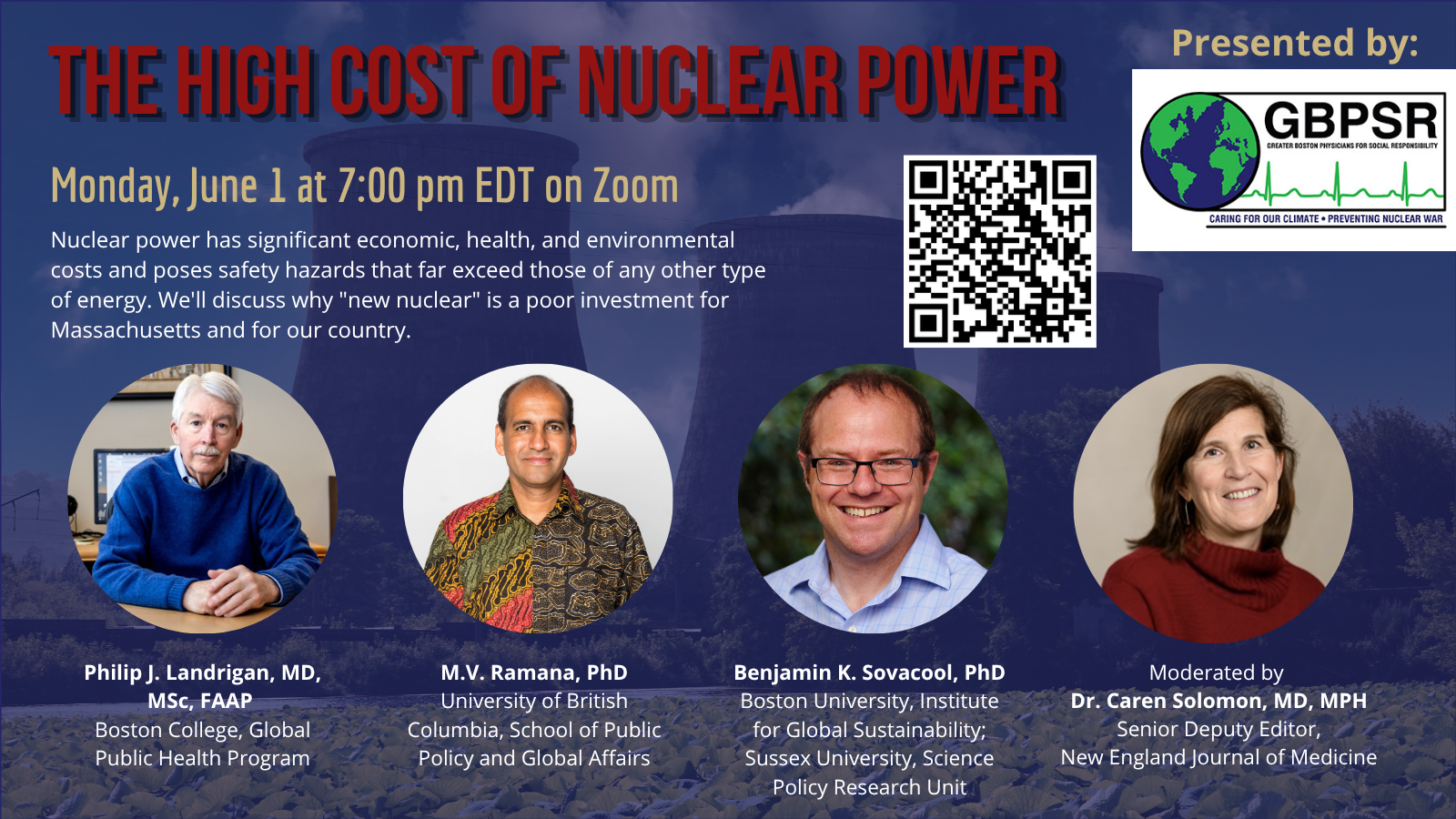
1 June Webinar – The High Cost of Nuclear Power – Register


of the week– Nuclear Reactor Information Task Force
To see nuclear-related stories in greater depth and intensity – go to https://nuclearinformation.wordpress.com
-
Archives
- May 2026 (255)
- April 2026 (356)
- March 2026 (251)
- February 2026 (268)
- January 2026 (308)
- December 2025 (358)
- November 2025 (359)
- October 2025 (376)
- September 2025 (257)
- August 2025 (319)
- July 2025 (230)
- June 2025 (348)
-
Categories
- 1
- 1 NUCLEAR ISSUES
- business and costs
- climate change
- culture and arts
- ENERGY
- environment
- health
- history
- indigenous issues
- Legal
- marketing of nuclear
- media
- opposition to nuclear
- PERSONAL STORIES
- politics
- politics international
- Religion and ethics
- safety
- secrets,lies and civil liberties
- spinbuster
- technology
- Uranium
- wastes
- weapons and war
- Women
- 2 WORLD
- ACTION
- AFRICA
- Atrocities
- AUSTRALIA
- Christina's notes
- Christina's themes
- culture and arts
- Events
- Fuk 2022
- Fuk 2023
- Fukushima 2017
- Fukushima 2018
- fukushima 2019
- Fukushima 2020
- Fukushima 2021
- general
- global warming
- Humour (God we need it)
- Nuclear
- RARE EARTHS
- Reference
- resources – print
- Resources -audiovicual
- Weekly Newsletter
- World
- World Nuclear
- YouTube
-
RSS
Entries RSS
Comments RSS
 nuclear-news