Deomocracy teeters in India, as government cracks down on anti nuclear protest
India government responds bluntly to anti-nuclear push In response to villagers’ concerns about the Kudankulam nuclear plant project, Indian officials have deported a sympathizer and cracked down on charities they accuse of aiding anti-nuclear efforts. By Mark Magnier, Los Angeles Times March 18, 2012 Continue reading
Most South Koreans against nuclear power – a growing election issue

 Nuclear issue creeps up agenda for April election The Korea Herald, 2012-03-18 In an increasingly volatile race for parliament, nuclear power is creeping up the political agenda as opposition lawmakers seek to exploit growing safety jitters to retake power in next month’s vote.
Concerns about the safety of the nuclear industry are rife after news broke last week that plant operators had attempted to cover up a power cut at a reactor in Busan for over a month. Continue reading
Fukushima cancer toll – years later, especially for nuclear clean-up workers
One group particularly at risk of health harm is the large and growing number of workers required to help control, shut down and clean up the damaged nuclear plants.
On average, the contracted day labourers receive two- to three-times the radiation dose of a regular worker but are not included in utility statistics. And there is no compulsory, centralised system for tracking cumulative radiation exposure or health outcomes of these workers.
Fukushima radiation toll will continue for generations Despite claims that Japan’s Fukushima meltdown caused no deaths, in fact the true health costs of Fukushima’s radiation leaks won’t be known for decades. Independent Australia 18 March 12, Professor Tilman Ruff reports. A year can be a long time in politics. But for the radioactive particles released from Fukushima’s damaged nuclear reactor, a year is just a moment in their life of hundreds or thousands of years.
So, what is the radiological situation at Fukushima one year after the disaster? the extensively damaged plants are still unstable and highly radioactive. This has restricted access and clean-up efforts, which will need to go on for many decades.
Though Japanese authorities declared they’d achieved a “cold shutdown” in December, an arbitrary definition was used: coolant water temperature was less than boiling, pressure inside the reactors was not raised, and the release of radioactive materials from the first layer of containment was below a specified level. But it didn’t mean the nuclear reaction inside the reactors had been stably shut down…. Continue reading
Japanese kids learn about radiation
“Still, there are many children who think nuclear energy is necessary but that’s probably because their parents or relatives have had nuclear-related jobs,”
Third of Fukushima kids got first radiation lessons from disaster: poll Japan Times, 19 March, Kyodo FUKUSHIMA — About a third of the 225 youngsters who were evacuated from around the Fukushima No. 1 nuclear plant last March but still reside in the prefecture say the disaster made them aware of radiation dangers for the first time, a new survey says. Continue reading
Radioactive isotopes in ocean plankton, from Fukushiam
follow-up studies will be necessary because the radioactive cesium is likely to have accumulated in fish that eat plankton, the team said
In the latest survey, the team also found cesium-134 — which has a two-year half-life — in plankton at the same levels as cesium-137, whose half-life is three decades.
Cesium found in plankton almost 375 miles from Fukushima nuclear plant, Boston Herald, By The Yomiuri Shimbun http://news.bostonherald.com/news/international/asia_pacific/view/20120318cesium found_in_plankton_almost_375_miles_from_fukushima_nuclear_plant/srvc=home&position=recent,March 18, 2012 – TOKYO — Radioactive cesium believed to have been released during the crisis at the Fukushima No. 1 nuclear power plant in Japan following last year’s major earthquake has been found in plankton about 600 kilometers (nearly 375 miles) east of the facility, according to a Japan-U.S. joint research team. Continue reading
3 categories of compensation payments for Japan’s nuclear evacuees
Japanese government panel urges compensation for nuclear evacuees (includes video) http://news.bostonherald.com/news/international/asia_pacific/view/20120318japanese_government_panel_urges_compensation_for_nuclear_evacuees/srvc=home&position=recent By The Yomiuri Shimbun , March 18, 2012 TOKYO – Residents who will be unable to return to areas around the crippled Fukushima No. 1 nuclear power plant for at least five years should be paid 6 million yen (US$71,813) each as compensation for their mental suffering, a Japanese government panel has decided. Continue reading
Legal challenge to India’s nuclear liability law
 “The Act channels all the liability to the nuclear operator [now the
  government itself], and the victims are not allowed to sue companies supplying reactors and other materials.”
the Act was passed because the U.S., France and Russia, with which India had signed nuclear deals, pressured the government to buy expensive reactors from their suppliers.
 Supreme Court to examine constitutional validity of nuclear civil
 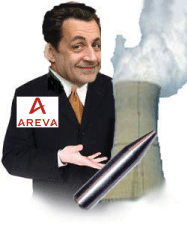 liability law THE HINDU, 17 March 12, J. VENKATESAN The Supreme Court will examine the constitutional validity of the Civil Liability for Nuclear Damage Act, 2010, which limits the liability of an operator in the event of a nuclear disaster to Rs. 1,500 crore. Continue reading
South Koreans becoming unsure of nuclear power safety
SK Sees Nuclear Plant Jitters Ahead Of Summit, WSJ, March 16, 2012, A little over a week before South Korea hosts the 50-nation Nuclear Security Summit, the government is trying to reassure the public over the safety of nuclear power following a blackout at a nuclear plant on the south coast and a public backlash about alleged cover-up attempts by officials. Continue reading
Warning to rare earths company about its radioactive wastes problem
“Where exactly is ‘abroad’? Identify and prove to us which country outside of Malaysia is willing to accept this massive [volume of] toxic waste.
 AELB says will close Lynas plant if waste agreement broken http://www.themalaysianinsider.com/malaysia/article/aelb-says-will-close-lynas-plant-if-waste-agreement-broken The Malaysian Insider, March 15, 2012 KUALA LUMPUR, The Atomic Energy Licensing Board (AELB) assured Malaysians today it will shutter Lynas Corporation’s rare earth plant in Kuantan if the Australian mining firm violates conditions on the disposal of radioactive material.
According to Star Online, the regulator reminded at its weekly media briefing today that that firm had already struck an agreement with local authorities here for it to return any radioactive waste to Australia if it fails to set up a permanent disposal facility here. Continue reading
Malaysians not impressed by Australian rare earths company Lynas
Four government ministries have been roped in to help Lynas find a suitable storage site in the country is not only amusing but downright deploring. The statement by the international trade and industry minister that the radio active wastes will be disposed of overseas, even though it may break international laws is really not very assuring.
Lynas cannot continue to hide behind the Malaysian government’s skirt in its operations
Lynas Corp’s absurd publicity stunts — The Malaysian Insider, Iskandar Dzulkarnain March 14, 2012 ”….what can the Penang CM do to alleviate the current controversy surrounding the Lynas rare earth plant? Would his personal opinion or intervention buy over the thousands of critics who are against the existence of the Rare Earth Plant in Pahang State?
Isn’t it more appropriate to meet with Anwar Ibrahim, the leader of Pakatan Rakyat who is against the controversial project based on allegations that the Australian miner has not given enough assurances on how it will handle the low-level radioactive waste that will be produced at the refinery? Continue reading
Japan’s former P.M. insisted on workers staying to prevent Fukushima total meltdown
“If the workers abandoned the plant, all the reactors and fuel rods in the fuel pools would have melted down, causing many times more fall-out than Chernobyl. “I called the TEPCO president and told him a withdrawal was unthinkable “

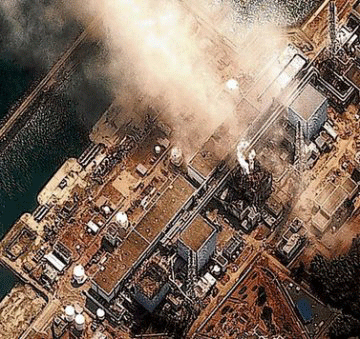 Ex-PM reveals meltdowns almost crippled Japan Mark Willacy, ABC South West Radio March 15, 2012 A year on from the meltdowns at the Fukushima nuclear plant, Japan’s prime minister at the time has told the ABC that the disaster came close to crippling the nation, with the evacuation of tens of millions from Tokyo a real possibility.
In an exclusive interview on ABC’s 7.30, Naoto Kan said the loss of the world’s biggest metropolis would have been like losing a war, leaving Japan without a political and economic capital. He has also confirmed that he confronted the operator TEPCO and rejected its request for its workers to abandon the crippled plant. Continue reading
Lynas rare earths processing – Malaysia’s political issue that will not go away
rare earth processing facility developed in 1985 by Mitsubishi Chemical at Bukit Merah n northern Perak state near the city of Ipoh that turned into an environmental disaster. The facility was closed in 1992 amid allegations that it was causing widespread groundwater and other environmental contamination and was responsible for deaths from leukemia as well as birth defects in children living nearby.
protesters say the company still doesn’t have a credible waste and water management plan and that radioactive materials could leach into both the groundwater, as they did at Bukit Merah, as well as into the South China Sea. ...
Malaysia and the Global Rare Earth Squabble, Asia Sentinel, 14 March 12, “…..Other nations have largely ceased production of the rare earth minerals because of the detrimental effect mining and processing them has had on the environment.
China has belatedly caught up with western sentiment after realizing that substandard mining practices have resulted in environmental catastrophes and has cut back on production, driving prices through the roof….. Continue reading
Luckily, Japan’s latest earthquake and tsunami were smaller
Magnitude 6.8 earthquake strikes Japanese coast, tsunami wave hits coast THE AUSTRALIAN, BY: BY SHINGO ITO IN TOKYO From: AFP March 14, 2012 A small tsunami wave has hit Japan’s northeastern coastline, officials say, after a strong earthquake rocked the region a year on from the country’s worst post-war natural disaster. Continue reading
Legal action against Taipower nuclear company for deceiving public
“Taiwan cannot afford a single nuclear disaster,”…Japan is about 10 times the size of Taiwan. If a radioactive leak occurs in Taiwan, people would have nowhere to escape,
Taipower misleading public: activists, Taipei Times, 14 March 12, ATOMIC ANGST:Environmentalists said Taipower wasted taxpayers’ money promoting nuclear power and falsely claimed Taiwan would face power shortages without it By Lee I-chia
Taiwan Power Co (Taipower) released misleading information to the media and public that power rationing would have to be implemented if nuclear power plants were shut down,
environmentalists said yesterday. Saying the misinformation was a bid by the company to ensure the continuation of its nuclear projects, environmental groups said they would file a lawsuit against the state-run company for “document forgery.” Continue reading
New computer spy malaware targets U.S. military computers
 New malware preys on Iran nuclear weapons tension, msnbc, 13 March 12, Researchers: China-based hackers goal is to corrupt US military computers Chinese cybercriminals have crafted a sophisticated, robust malware attack that exploits growing political tension and fear over Iran’s alleged covert nuclear weapons program to infect PCs.
The goal of the hackers is to corrupt the computers of U.S. military employees, according to researchers from the security firm Bitdefender , who detected the malware.
Calling it “the perfect firebomb,” the China-borne malware embeds itself in an email with an attached Microsoft Word document titled “Iran’s Oil and Nuclear Situation.doc.” The document, Bitdefender explained, contains an Adobe Shockwave Flash applet that attempts to get the recipients to load a fake YouTube video. While the rigged video (an .mp4 file) loads, the malware exploits an Adobe Flash flaw that sneaks an executable file into the initial Word document.
If it sounds complicated, that’s the point, Bitdefender’s Bogdan Botezatu said. “The operation is covert: the MP4 file triggering the exploit is streamed from the Web, which means the PC will be exploited by the time an anti-virus would generally scan a file,” he wrote. “Further, the malicious file delivered inside the doc file (us.exe) has multiple
layers of obfuscation to dodge detection.”
Once the malware is implanted on a victim’s computer, it communicates with a command-and-control server in China. Carefully crafted exploits aimed at military targets are nothing new; a November congressional report outlined state-sponsored cybercrime missions carried out by Chinese and Russian criminals against U.S. government agencies……
http://www.msnbc.msn.com/id/46722543/ns/technology_and_science-security/#.T2EiZ8WPX_M
1 This Month
23-25 October – on Zoom – World BEYOND War’s annual global conferenc


Shut down the radiation-damaged Heysham nuclear reactors now
To see nuclear-related stories in greater depth and intensity – go to https://nuclearinformation.wordpress.com

Say No to NASA’s Reckless Nuclear Reactor on the Moon
Say No to NASA’s Reckless Nuclear Reactor on the Moon

-
Archives
- October 2026 (209)
- September 2026 (339)
- August 2026 (330)
- July 2026 (355)
- June 2026 (287)
- May 2026 (306)
- April 2026 (356)
- March 2026 (251)
- February 2026 (267)
- January 2026 (308)
- December 2025 (358)
- November 2025 (359)
-
Categories
- 1
- 1 NUCLEAR ISSUES
- business and costs
- climate change
- culture and arts
- ENERGY
- environment
- health
- history
- indigenous issues
- Legal
- marketing of nuclear
- media
- opposition to nuclear
- PERSONAL STORIES
- politics
- politics international
- Religion and ethics
- safety
- secrets,lies and civil liberties
- spinbuster
- technology
- Uranium
- wastes
- weapons and war
- Women
- 2 WORLD
- ACTION
- AFRICA
- Atrocities
- AUSTRALIA
- Christina's notes
- Christina's themes
- culture and arts
- Events
- Fuk 2022
- Fuk 2023
- Fukushima 2017
- Fukushima 2018
- fukushima 2019
- Fukushima 2020
- Fukushima 2021
- general
- global warming
- Humour (God we need it)
- Nuclear
- RARE EARTHS
- Reference
- resources – print
- Resources -audiovicual
- Weekly Newsletter
- World
- World Nuclear
- YouTube
-
RSS
Entries RSS
Comments RSS

