India-USA nuclear deal very ‘up in the air’: no document signed
no specific document was signed
India is already generating more power from wind turbines alone than from nuclear power and has announced a solar target of 100 gigawatt by 2022. So it is perfectly coherent that the joint US-India declaration contains one paragraph on nuclear cooperation and eight on clean energy.

 Breakthrough in US-India civil nuclear deal ‘more symbolism than reality’, DW 29 Jan 15 The US and India announced a “breakthrough” in resolving a liability spat that has stalled the implementation of a civil nuclear deal. But Mycle Schneider tells DW this is more about geopolitics than industrial reality.
“…….Mycle Schneider, an independent international consultant on energy and nuclear policy, says in a DW interview that there is no real market for foreign nuclear companies in India, unless they bring their own funding, adding that the recent announcement is more about presenting both countries as equal partners than it is about the vision of a future blooming Indian nuclear export industry.
DW: What exactly does the new nuclear deal entail?
Mycle Schneider: Very little has so far been published about it. First of all, it is unclear whether there is even a “new nuclear deal.” Usually, when heads of state meet, the occasion is used to sign agreements. However, on this issue, the US-India joint statement only says President Obama and Prime Minister Modi welcomed the “understandings reached” on the issues of civil nuclear liability and “administrative arrangements for civil nuclear cooperation.”
Apparently, no specific document was signed. ………
Unlike all other aspirants for nuclear technology aid, India is not required anymore to put its entire fuel chain, facilities and materials, under comprehensive international control or so-called Full-Scope Safeguards. India has merely promised to separate its nuclear weapons related activities from the power sector……….
India law created liabilities for suppliers in the event of a nuclear accident. Are they not liable anymore?
The 2010 Civil Liability for Nuclear Damage Act has been voted by both houses of the Indian parliament. It remains in place as long as it has not been invalidated by a new vote. In that respect, absolutely nothing has changed from the situation prior to President Obama’s visit to India.
Considering the fact that the Act has not only been attacked by the nuclear industry side, but also from civil society representatives because it caps the liability of the nuclear operators to a ridiculously small sum of 240 million USD, reopening the parliamentary debate over this fragile compromise seems unlikely at this point. It also seems unlikely that the establishment of an insurance fund would fundamentally change the liability situation of nuclear suppliers.
What do India and the US expect to gain from this civil nuclear deal?
This is a typical example of announcement politics. Both governments are presenting the outcome of the US-India summit as a great success. But it is more an issue of symbolism and geopolitics than of industrial reality. The promise to continue to work together towards India’s “phased entry” into the Nuclear Suppliers Group as into three other international control regimes is more about presenting both countries as equal partners than it is about the vision of a future blooming Indian nuclear export industry.
Do you expect the Indian market to now become more appealing for US nuclear companies?
In reality, there is no real market for foreign nuclear companies in India, unless they bring their own funding. Under free market conditions it is not possible anymore to build a nuclear power plant anywhere in the world.
So if new reactors are built in India or elsewhere, the projects are highly subsidized, either by the government—the taxpayer—or the ratepayer. The Indian nuclear industry has painted a rosy picture of the nuclear future for decades and has delivered very little in comparison.
It is actually amazing to what extent overstretched projections of “hundreds of billions investment” are still being held up. Disconnected from reality, they are an effect of what Princeton University researcher M.V. Ramana has appropriately described as “The Power of Promise.”
India is already generating more power from wind turbines alone than from nuclear power and has announced a solar target of 100 gigawatt by 2022. So it is perfectly coherent that the joint US-India declaration contains one paragraph on nuclear cooperation and eight on clean energy.
Mycle Schneider is an independent international energy and nuclear policy consultant, based in Paris. He is the convening lead author of the annual World Nuclear Industry Status Report and a member of the Princeton University-based International Panel on Fissile Materials (IPFM). Schneider is a founding member and the spokesperson of the International Energy Advisory Council (IEAC).
The interview was conducted by Gabriel Domínguez. http://www.dw.de/breakthrough-in-us-india-civil-nuclear-deal-more-symbolism-than-reality/a-18221115
Construction of a radioactive waste storage complex in a 16-square-kilometer area straddling the towns Futaba and Okuma to start

The ministry says construction of 2 initial storage facilities, each 10,000 square kilometers, will start next Tuesday at industrial parks in the intermediate site.The waste is to be kept there until intermediate storage facilities are completed. It remains unclear when their construction will begin, due to lack of progress in purchasing land.Huge amounts of radioactive soil and other waste stemming from decontamination work have been kept in each municipality of the prefecture.
Municipalities are asking the government to provide a concrete schedule for transporting the waste.
31,000,000 Bq/m3 of Strontium-90 measured at the nearest boring well to Reactor 2

January 27, 2015
On 1/27/2015, Tepco announced they measured high density of Strontium-90 from groundwater in the seaside of Reactor 2.
It was 31,000,000 Bq/m3. The sampling point was the boring well, which is the closest to Reactor 2.
This is the highest density measured from this boring well, which is 10% more than the previous highest record.
The sampling date was last December. No Sr-90 data of January has been published.
http://www.tepco.co.jp/nu/fukushima-np/f1/smp/2015/images/2tb-east_15012701-j.pdf
Source: Fukushima Daiichi
31,000,000 Bq/m3 of Strontium-90 measured at the nearest boring well to Reactor 2
Global consequences from Fukushima-like nuclear disaster; Many nations at risk of ‘great exposure’
January 28th, 2015
Study: Global consequences from Fukushima-like nuclear disaster; Many nations at risk of ‘great exposure’ — Transport of hot particles to US was especially effective during worst releases after reactor explosions — Radioactivity confined ‘close to surface’ due to seasonal factors
T. Christoudias and Y. Proestos of The Cyprus Institute, J. Lelieveld of Max Planck Institute of Chemistry (Germany), Dec 12, 2014 (emphasis added):
- We estimate the contamination risks from the atmospheric dispersion of radionuclides released by severe nuclear power plant accidents… We present an overview of global risks… [These] risks exhibit seasonal variability, with the highest surface level concentrations of gaseous radionuclides in the Northern Hemisphere during winter [Fukushima crisis began with 10 days left in winter].
- The model setup was evaluated… using emission estimates from… Fukushima
- The risk posed from nuclear power plant accidents is not limited to the national or even regional level, but can assume global dimensions. Many nations may be subjected to great exposure after severe accidents.
- Our model shows increased surface-level concentrations throughout the Northern Hemisphere during the boreal winter months compared to the summer… Not only the expected risk magnitude is higher, but the geographical extent of the high concentrations of transported radionuclides is more pronounced towards the north… Horizontal advection [i.e. transfer] is more efficient in winter due to relatively stronger winds, and the concentrations are highest near the surface [and] surface level concentrations in the summer tend to be more localized in the emission region.
- Our results illustrate that accidents… could have significant trans-boundary consequences. The risk estimate [shows] increased surface level concentrations of gaseous radionuclides in the Northern Hemisphere during winter and a larger geographical extent towards the north and the east… This is related to the relatively shallow boundary layer in winter that confines the emitted radioactivity to the lowest part of the atmosphere close to the surface…It is the view of the authors that it is imperative to assess the risks from the atmospheric dispersion of radioactivity from potential NPP accidents [for] emergency response planning on national and international levels.
Source: http://www.mdpi.com/1996-1073/7/12/8338
JAMSTEC, Univ. of Tokyo, etc.: We show a numerical simulation for the long-range transport from the [Fukushima] plant to the US… Large-scale updraft [over] Japan from March 14 to 15 was found effective in lifting the particles [to the] jet stream that could carry the particles across the Pacific within 3 to 4 days [See study: On Mar. 15, Fukushima reactors emitted 100 quadrillion Bq of cesium into air — This one day was equal to total lifetime release from Chernobyl]… Some of the particles [had a] long-range atmospheric transport over — 10,000 km within 3 to 4 days… [R]adioactive materials were detected in that period over the east and west coasts of the U.S… In order for the particles to be transported with the jet stream, they must be lifted up from the surface boundary layer to the mid- or upper troposphere. Large-scale updraft was indeed observed… on March 14 through 15… [T]he westerlies in mid-March were thus particularly effective in the trans-Pacific transport of the radioactive materials…
Watch the numerical plume simulation here http://www.docin.com/p-773002550.html
CPI objects to Indian tax-payers taking on nuclear company risks
 CPI asks govt to explain why it rushed into nuke agreement http://zeenews.india.com/news/india/cpi-asks-govt-to-explain-why-it-rushed-into-nuke-agreement_1537199.html January 27, 2015 New Delhi: The CPI on Tuesday asked Prime Minister Narendra Modi to explain why the government “rushed” into an agreement with the US on the nuclear liability issue, saying a proposed insurance pool to cover American nuclear firms would violate Indian law on the issue.
In a letter to the Prime Minister, he said US suppliers “should obtain insurance from international insurance companies at commercial rates. Why are they unable to do so? Is this because they are unable to persuade their own companies that their reactors are as safe as they claim?”
 “Why should the Indian people have to provide insurance to American companies through an Indian public sector company,” he asked.
Expressing concern over reports that Modi government has agreed to US demands that its companies be protected from liability for accidents caused by design defects in reactors they supply, Raja said the intent of the Indian law was “clearly to place some liability on the supplier. This was meant to ensure that multinational suppliers would pay adequate attention to safety standards.”
Observing that design defects have contributed to nuclear accidents including those at Three Mile Island, Chernobyl, and Fukushima, he said US firm GE had “designed the Mark 1 reactors that were involved in the Fukushima accident.”
“Why is the Indian agreement rushing into a deal to purchase a reactor that is running into difficulties elsewhere,” Raja asked.”Your negotiations with President Obama have been opaque, and very few details are publicly available. … I hope that you will take urgent steps to address and answer them publicly,” he said. “Japanese (Fukushima) victims have been unable to hold (US firm) GE to account because of the Japanese liability law which indemnifies the supplier. It was to prevent such an eventuality that Clause 17(b) of the Indian law allows the operator a right of recourse against the supplier,” the CPI leader said.
It was only after the Bhopal gas disaster experience, the Supreme Court had formulated the ‘absolute liability’ principle under which all parties involved in running a hazardous enterprise would be liable for damage caused to the public, he said.
“I understand that there are only two reactor designs on offer by US companies – the AP1000 designed by Westinghouse and the ESBWR designed by GE.”
“Neither of these reactors is in commercial operation anywhere in the world. In fact, the ESBWR is so new that even its design was certified only recently by the US Nuclear Regulatory Council,” Raja said.
Observing that India would therefore be one of the first countries to have the ESBWR, he asked the Prime Minister: “Have you obtained any guarantees from President Obama, that the cost of such delays will be borne by GE and not the Indian Government?”
Raja also expressed concern over the cost of electricity from the proposed American reactors and said the two AP1000 units being constructed in Vogtle (US) were initially projected to cost USD seven billion each.
“If one uses the same cost per unit of installed capacity for the ESBWR, then this would suggest that it may cost as much as USD 10 billion,” he said, adding this would translate into a cost of electricity that exceeds Rs 15 per unit, “much higher than the tariff from competing sources.”
Subir Roy questions India’s supposed need for nuclear power
Only very broad features have been outlined and, hopefully, when the details become known the Indian government will not be found to have given away where it matters. If a negative picture does eventually emerge from the details, then the question will be — what for? ………
As for possessing a bomb, it does not enhance security. Pakistan followed quickly in India’s footsteps with its own nuclear tests in 1998 so that India’s superiority in conventional defence capability was replaced with parity in nuclear capability. http://www.business-standard.com/article/opinion/subir-roy-why-persist-with-nuclear-power-115012701341_1.html
USA persuades India to weaken its nuclear liability law – double standards here
Under pressure from GE and Westinghouse, the two American nuclear vendors hoping to sell billions of dollars worth of reactors to India, the Obama administration has demanded that Section 17(b) and Section 46 of the Indian liability law be deleted or amended.
Double standards? The irony is that American nuclear suppliers operate under a domestic liability regime that allows operators to sue them for recovery of damages in the event of an accident. That is how Metropolitan Edison, the operator of the Three Mile Island nuclear plant, sued Babcock Wilcox after the infamous 1979 accident.
Why India should say no to US demand to dilute its nuclear liability law The Modi government should resist pressure from Barack Obama, who landed in New Delhi on Sunday morning, to change key provisions to favour foreign supplier of reactors. Siddharth Varadarajan Scroll.in 26 Jan 15
With the issue of nuclear liability emerging as an obstacle in the relationship between India and the US, the Modi government is under pressure to dilute the law in favour of foreign reactor suppliers. Without this, we are told, it will not be possible to operationalise the US-India nuclear agreement and provide the country with the electricity its people need.
In the event of a major nuclear accident in India, one which damages lives and property, what does the law say about how liability is to be apportioned? Continue reading
Nuclear risks covered by India’s government under new deal with USA
Insurers to offer Rs 750 cr capacity for nuclear pool; rest from govt, Standard.com M Saraswathy | Mumbai January 26, 2015
Both operators and suppliers would be provided as cover against associated risks The proposed nuclear risk pool that will be set up in India will have five government-owned insurance companies (General Insurance Corporation of India (GIC), New India Assurance, Oriental India Insurance, National Insurance and United India Insurance) providing half the capacity for the Rs 1,500-crore pool. The rest will come from the central government.
Prime Minister Narendra Mdoi in his statement at the joint press interaction with President Barack Obama of America, said the civil nuclear agreement was the centrepiece of our (India-US) transformed relationship, demonstrating new trust…….. Continue reading
Weapons proliferation standards weakened in new USA-India nuclear trade deal
The Short Walk Home. How PM Modi, President Barack Obama Clinched Nuclear Deal NDTV All India | Reported by Nidhi Razdan (with inputs from agencies) | January 25, 2015 Within hours of US President Barack Obama’s arrival in Delhi, a landmark breakthrough on nuclear trade was clinched with Prime Minister Narendra Modi……….
India has offered to set up an insurance pool to indemnify companies that build reactors in the country
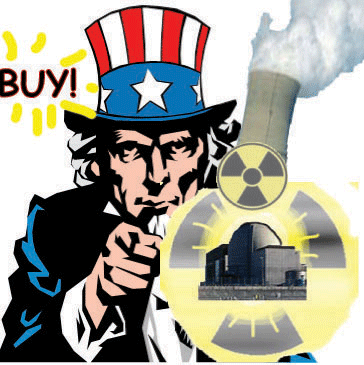 against liability in case of a nuclear accident.
Sources say America has forfeited its demand on insistence on “flagging” or tracking the nuclear material they supply to India, required under its rules to ensure it is not being used for military purposes. India said the demand was intrusive, especially because safeguards of the International Atomic Energy Agency, or IAEA, are in place.
Nuclear commerce worth billions of dollars was meant to be the centrepiece of a new strategic relationship between the United States and India, allowing New Delhi access to nuclear technology and fuel without giving up its weapons.
But a tough liability law which was cleared by the Indian parliament in 2010 and holds equipment suppliers liable for damages for an accident had meant that billions of dollars in trade were held up by concerns over exposure to risk. The US said this is a sharp deviation from international norms that put the onus on the operator to maintain safety. For India, the law grew out of the 1984 Bhopal gas disaster, the world’s deadliest industrial accident, at a factory owned by U.S. multinational Union Carbide Corp, which families are still pursuing for compensation.
The law had so far effectively shut out Western companies from a huge market, as energy-starved India seeks to ramp up nuclear power generation by 13 times, and also strained U.S-Indian relations. …http://www.ndtv.com/article/india/the-short-walk-home-how-pm-modi-president-barack-obama-clinched-nuclear-deal-653481
Details remain vague on nuclear deal between Obam and Narendra Modi
Thirty years after an infamous chemical leak killed thousands at Union Carbide’s factory in Bhopal, the threat of tough Indian compensation laws has frustrated US hopes of an export boom in the energy sector – despite an agreement by former US president George W Bush to share civil nuclear technology in 2005.
After pressure from US diplomats, the Indian government was thought to have agreed a state-backed insurance scheme that would cap the exposure of nuclear suppliers and open the door to billions of dollars of new contracts. India will also allow closer tracking of spent fuel to limit the risk of it falling into terrorist hands.
“Today we achieved a breakthrough understanding on two issues that were holding up our civil nuclear cooperation,” Obama said on Sunday………
Details of the deal remain vague, however, and officials stressed they were still working out the finer arrangements of the scheme, which is designed to avoid the need to change Indian law……….
The two governments also said they had struck deals to share defence technology and improve dialogue in future, with a security hotline between Obama and Modi……….
“Nuclear liability remains the cinder in the eye of the relationship right now,” Rick Rossow, of the Centre for Strategic and International Studies (CSIS), said in Washington last week. “Nuclear cooperation was the high-water mark for our bilateral history and the fact that India’s nuclear liability law precludes American involvement, it stings.”
US suggestions of full legal indemnity for suppliers were knocked by the Indian government, which is wary of trying to overturn a 2010 nuclear liability law in parliament……. http://www.theguardian.com/world/2015/jan/25/obama-modi-limit-us-liability-nuclear-disaster
Fukiashima radioactive water clean-up is 2 months behind schedule
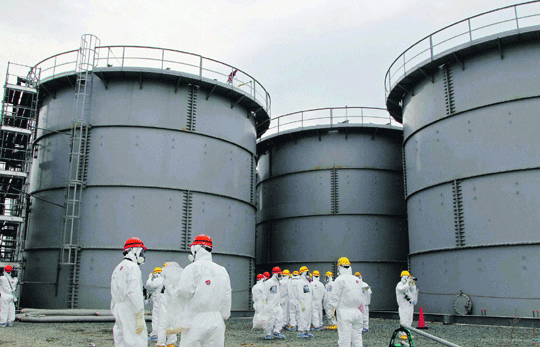 Fukushima Watch: Tepco Two Months Behind on Cleaning Tainted Water http://blogs.wsj.com/japanrealtime/2015/01/26/fukushima-watch-tepco-two-months-behind-on-cleaning-tainted-water/ By MARI IWATA Tokyo Electric Power Co. says it will need an additional two months to process all the highly contaminated water in storage at the Fukushima Daiichi nuclear plant.
The power company previously said it would clean all the water by the end of March. A Tepco spokesman said Friday that the process had been slowed down by the need for workers to frequently clean the filters of the water processing system. He also said the system needed more initial adjustments than first expected when it came into use.
Tepco plans to give a more detailed outline of the water processing schedule in March, the spokesman said.
A large amount of groundwater keeps flowing underneath the reactors, creating about 300 to 400 tons a day of highly contaminated water. The water has been stored in about 1,000 tanks set up at the site.Tepco has been processing the water to remove most of the radioactive materials to reduce the contamination to a low level. The system is unable to remove tritium, a less harmful material.
The company now says it won’t finish processing the stored water until May. After that it will have sufficient capacity to deal with the daily inflows of groundwater.
India’s solar plants above canals save water
INDIA BUILDS SOLAR PLANTS ATOP CANALS TO SAVE LAND, WATER. https://jpratt27.wordpress.com/2015/01/25/india-builds-solar-plants-atop-canals-to-save-land-water/As India moves to ramp up investment in solar power, it is exploring innovative places to install solar plants, including across the top of canals.
Last weekend, U.N. Secretary General Ban Ki-moon inaugurated a new “canal-top” solar energy plant in Vadodara district in India’s western state of Gujarat. “I saw more than glittering panels – I saw the future of India and the future of our world,” said Ban. “I saw India’s bright creativity, ingenuity and cutting-edge technology.”

Experts identify two major advantages in building solar plants atop canals: efficient and cheap land use, and reduced water evaporation from the channels underneath. business-standard.com
Prime Minister Narendra Modi supports climate action, ready for big expanse in renewable energy
We very much support India’s ambitious goal for solar energy and stand ready to speed this advancement with additional financing,” Obama said during the news conference at Hyderabad House.
Modi Shifts on Climate Change With India Renewables Goal, Bloomberg By Reed Landberg and Natalie Obiko Pearson Jan 26, 2015 Prime Minister Narendra Modi said India is ready to expand its use of renewable energy as a way to reduce greenhouse gas pollution, a signal that his government is moving toward joining an international deal on global warming.
After a meeting with U.S. President Barack Obama in New Delhi, the prime minister said that his nation along with all others has an obligation to act on reducing the fossil-fuel emissions blamed for damaging the climate.
The remarks represent a shift in India’s tone on global warming………….
Environmental groups led by the World Resources Institute in Washington said Modi appeared to be moving toward a nationwide goal on renewables, expanding its current program of reaching 100 gigawatts of solar energy by 2022.
“This announcement builds on the recent progress on climate made between the U.S. and China,” Continue reading
Fatal accidents cause TEPCO to suspend decommissioning at Fukushima No. 1 power plant
Tepco suspends Fukushima No. 1 cleanup to probe fatal accidents Japan Times STAFF WRITER JAN 23, 2015 Tokyo Electric Power Co. has said it will suspend decommissioning work at the wrecked Fukushima No. 1 power plant until it completes safety checks related to two fatal accidents at its facilities in the prefecture this week……http://www.japantimes.co.jp/news/2015/01/23/national/tepco-suspends-fukushima-no-1-cleanup-to-probe-fatal-accidents/#.VMWMHtKUcnm
Vietnam’s nuclear power programme slowing – could grind to a halt?
Vietnam’s Slowing Growth and Safety Concerns Delay Nuclear Plans WSJ, By VU TRONG KHANH, 23 Jan 15 Vietnam’s plan to introduce nuclear power to its energy mix faced a fresh setback on Thursday as safety concerns and legal issues pushed back the planned construction of the country’s first nuclear plant by about five years from the initial schedule………
Construction of the country’s first nuclear power plant isn’t likely to begin until 2019, said Hoang Anh Tuan, director general of Vietnam Atomic Energy Agency. The revised schedule comes after the government had already pushed its planned 2014 construction date to 2017……..
The need for the new plant had become less pressing recently, though, as Vietnam’s demand for electricity hasn’t risen as fast as previously forecast, Mr. Tuan said………
Phan Minh Tuan, director of Vietnam Electricity Group’s Nuclear Power & Renewable Energy Projects Pre-Investment Board, said safety concerns had also had an impact on the proposed construction start date……..
The country has chosen Russian utility and nuclear energy company Rosatom to build the first plant, the 2,000 megawatt Ninh Thuan 1. The Russian government has also pledged to lend Vietnam at least $8 billion for the project.
In 2011, Vietnam signed a contract with Japan Atomic Power for a feasibility study to build a second nuclear power plant nearby, the 2,000 MW Ninh Thuan 2, which is expected to use either Japanese or U.S. technology.
Mr. Tuan said Westinghouse is keen to supply its technology for the construction of the second plant, adding that the company earlier this month signed an agreement with Vietnam to train Vietnamese personnel to manage and operate nuclear power facilities in the country. http://blogs.wsj.com/frontiers/2015/01/23/vietnams-slowing-growth-and-safety-concerns-delay-nuclear-plans/
1 This Month


of the week– Nuclear Reactor Information Task Force

14 May – online event From Bombs to Data Centres: the Face of Nuclear Colonialism
To see nuclear-related stories in greater depth and intensity – go to https://nuclearinformation.wordpress.com
-
Archives
- May 2026 (180)
- April 2026 (356)
- March 2026 (251)
- February 2026 (268)
- January 2026 (308)
- December 2025 (358)
- November 2025 (359)
- October 2025 (376)
- September 2025 (257)
- August 2025 (319)
- July 2025 (230)
- June 2025 (348)
-
Categories
- 1
- 1 NUCLEAR ISSUES
- business and costs
- climate change
- culture and arts
- ENERGY
- environment
- health
- history
- indigenous issues
- Legal
- marketing of nuclear
- media
- opposition to nuclear
- PERSONAL STORIES
- politics
- politics international
- Religion and ethics
- safety
- secrets,lies and civil liberties
- spinbuster
- technology
- Uranium
- wastes
- weapons and war
- Women
- 2 WORLD
- ACTION
- AFRICA
- Atrocities
- AUSTRALIA
- Christina's notes
- Christina's themes
- culture and arts
- Events
- Fuk 2022
- Fuk 2023
- Fukushima 2017
- Fukushima 2018
- fukushima 2019
- Fukushima 2020
- Fukushima 2021
- general
- global warming
- Humour (God we need it)
- Nuclear
- RARE EARTHS
- Reference
- resources – print
- Resources -audiovicual
- Weekly Newsletter
- World
- World Nuclear
- YouTube
-
RSS
Entries RSS
Comments RSS
 nuclear-news