If USA nuclear reactors have accidents in India – Indian tax-payers pay: US corporations scot-free!

 Good News! US Corporations Won’t Have to Pay for Nuclear Disasters in India, FAIR,
But what is the news? Here’s how the paper’s Mandakini Gahlot summarizes the agreement:
Picking up from a stalled 2008 civil nuclear agreement between the two countries, the deal would allow US firms to invest in energy in India. It also resolves a dispute over US insistence on tracking fissile material it supplies to the country and over Indian liability provisions that have discouraged US firms from capitalizing on the agreement.”……
These corporations–who have the political backing of the US government–have succeeded in getting international conventions to agree that “no one other than operators can be held responsible” in the event of a nuclear catastrophe. The suppliers want assurances that these international conventions, and not Indian law, will be applied in the wake of such an event.
The “breakthrough” between Obama and Modi seems to be an agreement that the law will be “tweaked” to let US corporations off the hook in case of a devastating accident. For example, suppliers of nuclear equipment could be redefined as “contractors” and therefore not be liable under Indian law.
Of course, if USA Today explained that Obama had gotten the Indian prime minister to find a loophole that would allow US corporations to avoid having to compensate victims of nuclear disasters that they contributed to, that would be harder to present as a “good news!” story. http://fair.org/blog/2015/01/27/good-news-us-corporations-wont-have-to-pay-for-nuclear-disasters-in-india/
India tests nuclear-capable missile that could reach China , even Europe
India tests nuclear-capable missile from mobile launcher,DW, 30 Jan 15 India has carried out the first launch of its Agni-V long-range missile from a mobile mount. The weapon, which can carry nuclear warheads, is capable of reaching China and even Europe.
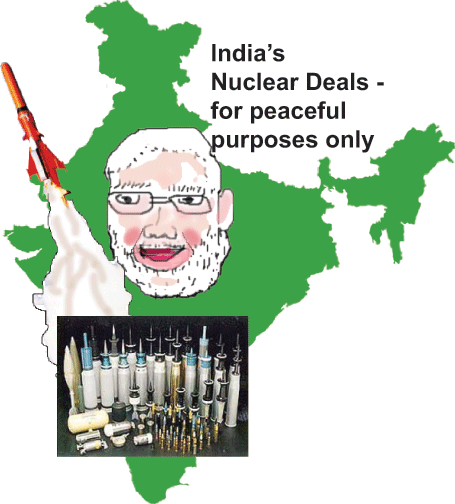
Saturday’s test-launch of the Agni-V ballistic missile was the first time that the weapon has been fired from a truck mount – called a “canister” – rather than a concrete launchpad, a spokesman for India’s Defense Research and Development Organization said.
The mobile launchpad will facilitate flexible deployment of the missile, which has a range of 5,000 kilometers (3,100 miles) – making it capable of reaching the Chinese mainland, or nearly all of western Europe.
“Successful test-firing of Agni-V from a canister makes the missile a prized asset for our forces,” Prime Minister Narendra Modi said on Twitter.
The 17-meter (18.6-yard) weapon, which weighs 50 tons, was launched from the test range on Wheeler Island off the eastern state of Orissa.
It is the third time that the Agni-V missile, named after the Sanskrit word for “fire,” has been tested, having received its initial launch in April 2012 (pictured above).
Deterring ‘evil eyes’
The test comes as India, the largest importer of arms in the world, is involved in a defense upgrade to the tune of $100 billion (88.6 billion euros).
Modi has said he wants to increase India’s military power to the extent that no other country “dare cast an evil eye” on it. His right-wing government has pushed on with long-delayed projects worth over $60 billion since taking power in elections in May. http://www.dw.de/india-tests-nuclear-capable-missile-from-mobile-launcher/a-18227324
Renewable energy a more practical option than nuclear, for Pakistan
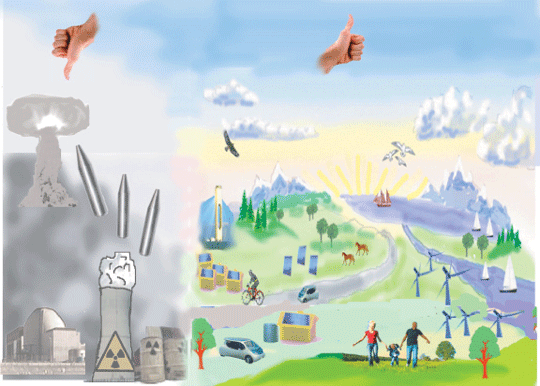
 Generating energy from alternative resources more feasible than nuclear plants: speakers, Pakistan Today, 1 Feb 2015 Physicists, architects, engineers, economists and civil society activists on Sunday emphasized the need to adopt alternative energy sources like solar and wind instead of nuclear power plants for generation of electricity in Pakistan as it is not cheaper as claimed by the Atomic Energy Commission of Pakistan.
Instead of providing nuclear reactors, China should be asked to provide money for power generation through solar and wind, said the experts while speaking at a workshop on ‘proposed karachi nuclear power plants: preparing for the environmental impact assessment and public hearing’ jointly organised by the Pakistan Institute of Labour Education and Research (PILER) and the Pakistan Fisherfolk Forum (PFF) at a local hotel.
“The citizens of Karachi should take part in a large number in the expected public hearing for the Environmental Impact Assessment (EIA) by the government after the orders by Sindh High Court,” said Dr AH Nayyar, Professor of Physics at Quaid-e-AzamUniversityIslamabad. It is for the first time that an EIA and public hearing is being held for a nuclear power plant.
They stressed the need to sensitise the local communities especially fishermen about dangers of radiations which may be great threat to their lives.
Dr Nayyar said the present government was setting up two nuclear power plants, K2 and K3, along Karachi coast without acquiring the mandatory EIA report. The SHC order has asked the government to arrange a public hearing for the EIA. But for that the EIA document should be made available for the general public much before the actual hearing so they can study and understand.
He pointed out that some concerned citizens had gone to the court against the nuclear power plants and during the hearing, the PAEC had confessed that earlier it had done the EIA process in a “wrong way,” without following the legal process. It had acquired the EIA from Sindh Environmental Protection Agency without holding public hearing……………….http://www.pakistantoday.com.pk/2015/02/01/city/karachi/generating-energy-from-alternative-resources-more-feasible-than-nuclear-plants-speakers/
Consumer groups in Malaysia condemn government that is “hell-bent’ on nuclear power
 Putrajaya ‘hell-bent’ on nuclear plant despite public concerns, says consumer group Malaysian Insider, 1 February 2015 Plans to build a nuclear plant in Malaysia are afoot, warned a consumer group, and said Putrajaya was misleading the public into thinking that it will consult the people on the use of nuclear energy when it had already decided to proceed with a bill to be table in Parliament this year.
Consumers Association of Penang (CAP) president SM Mohamed Idris said the government was “hell-bent” on introducing nuclear power in the country’s energy mix and highlighted statements made by energy officials over the past year and recently which indicated that Malaysia was intent on adopting nuclear energy.
As proof, he cited the setting up of the Malaysian Nuclear Power Corporation (MNPC) in January 2011, and the listing of nuclear energy as an entry point project in the Economic Transformation Programme in 2010.
“The government is hell-bent on introducing nuclear energy in the country’s energy mix.
“It is disingenuous of the government to continue misleading the public with its standard response line that a decision has yet to be made and the government is still exploring the option to go nuclear,” he said in a statement today.
Mohamed also said Putrajaya had announced its intention to table the Atomic Energy Regulatory Bill in August last year, and that the announcement was welcomed by MNPC chief executive officer, Dr Mohd Zamzam Jaafar, who said MNPC was hopeful that the bill would be approved by Parliament this year.
Malaysia, a nett oil exporter, has, in the past, floated the idea of adding nuclear power to its energy mix to meet long-term fuel needs, but such announcements were always greeted with public disapproval.
In 2010, the minister of energy, green technology and water then, Tan Sri Peter Chin, announced plans to build a nuclear plant that would start operations in 2021.
In July last year, Minister in the Prime Minister’s Department Datuk Mah Siew Keong, who oversees the MNPC, had also said that feasibility studies would be conducted on building nuclear plants as a sustainable energy option for Malaysia.
There is no indication yet of where the proposed nuclear plant would be built, but remote locations close to water sources are required in line with international rules. This would leave a limited number of states, such as Pahang, Johor and Terengganu, as possible locations……….
CAP also called upon the public to denounce the soon-to-be completed Malaysian Nuclear Power Infrastructure Development Plan as an “undemocratic and authoritarian” plan. – February 1, 2015. – See more at: http://www.themalaysianinsider.com/malaysia/article/putrajaya-hell-bent-on-nuclear-plant-says-consumer-group#sthash.2irEgUtq.dpuf
Civil Society in Pakistan challenges government, questioning nuclear power plans
Alternative energy: Civil activists prepare for public hearing on nuclear power plants, Express Tribune, By Our Correspondent February 1, 2015 KARACHI: Despite the Pakistan Atomic Energy Commission’s (PAEC) claims that nuclear power is the ‘most cost efficient’ energy source for the developing country, civil society activists want it to be replaced with alternative sources of energy because they say the Chernobyl, Three Mile Island, Fukushima and Bhopal disasters are not forgotten.
In view of the PAEC’s public hearing scheduled for March, on the proposed nuclear sites near Karachi, the civil society is bracing itself to meet it fully prepared and question the power project’s significance, benefits, hazards and possible alternatives.
“It is suspected that the K-2 and K-3 Chinese-manufactured nuclear power plants are being installed here on an experimental basis,” said physicist Abdul Hameed Nayyar, speaking to a workshop on Sunday, organised by the Pakistan Institute of Labour Education and Research (Piler). “No such power plant is operating anywhere in the world.”
He asserted that according to international standards, a 30-kilometer-radius around nuclear plants was vulnerable. The proposed nuclear sites were too close to Karachi and put the lives of millions of people at risk, he said.
Nayyar claimed that many regulations were being neglected in conducting the Environmental Impact Assessments (EIA). “PAEC wrongfully obtained certificates for the nuclear plants from the Sindh Environment Protection Agency (SEPA) without seeking public consent,” he said. “The SEPA was bound by law to incorporate and consider public comments into the procedure before issuing such a certificate to any industry.”
Another activist, Roland deSouza, added that in Pakistan, the institutions supposed to assess the environmental impact of growing industrialisation were very poor. “The SEPA is understaffed, incompetent and influenced by political and bureaucratic circles,” he said, adding that the prosperity of a country depended on the conservation of its environment.
He narrated stories of the DHA Cogen project and constructions near the Abdullah Shah Ghazi’s shrine, claiming that even in those cases, the proper course of action for assessment were not followed until the civil society took the matter to court.
On the PAEC’s claim that radiations caused by the nuclear plants would not be harmful, he said, that no independent verification could be made as yet. Concluding his presentation, he questioned why we didn’t import solar energy projects from China, since it was the largest producer of this less hazardous and modern source of energy.
The nine-hour-long programme at the Regent Plaza was divided into sessions to give attendees an understanding of nuclear power projects and the significance of the forthcoming formal public hearing.
The speakers focused on the issues of how the PAEC would transport radioactive material, what measures they would take in case of a mishap and how a reactor would be decommissioned after the completion of its life cycle……….http://tribune.com.pk/story/831269/alternative-energy-civil-activists-prepare-for-public-hearing-on-nuclear-power-plants/
Indian Citizens’ Statement against Capitulation to the US on Nuclear Liability
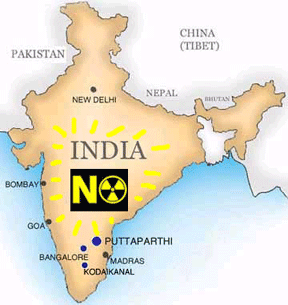 http://kashmirwatch.com/news.php/2015/01/30/indian-citizens-statement-against-capitulation-to-the-us-on-nuclear-liability.html Kumar Sundaram
We are deeply disturbed by media reports that the Indian government has capitulated to aggressive U.S. demands and agreed to a deal that indemnifies American nuclear vendors from the consequences of accidents caused by design defects in their reactors.
Preliminary reports suggest that the government has agreed to create an insurance pool, backed by public sector companies, so that any potential American liability can be redirected back to Indian taxpayers. This creates a “moral hazard”, where the Indian people could end up being responsible for mistakes made by a multinational corporation.
The 2010 Indian liability Act is already a weak law heavily biased towards the nuclear industry. It caps the total liability for an accident at a paltry Rs 1,500 crores and takes away the rights of victims to sue the supplier. The much-discussed supplier liability is very limited: the government alone, as the operator, has a right of recourse against the vendor.
So, we fail to understand the Modi government’s motivation for weakening this law even further. The U.S. has nothing attractive to offer in terms of nuclear commerce. The Indian government has agreed to purchase the AP1000 reactors from Westinghouse, and the Economic Simplified Boiling Water Reactor (ESBWR) from General Electric. Both these designs are untested. The ESBWR technology is so immature that the design received certification from the U.S. nuclear regulatory commission—the first step before a reactor can be constructed—only last September. Recent reports suggest that construction of AP1000 units has run into trouble in China.
Independent estimates suggest that the cost of electricity from these reactors may exceed Rs. 15 per unit. This is much higher than the tariff from competing sources of electricity.
Therefore, the reality behind the grandiose proclamations made by the Indian government is rather sobering. India has agreed to pay billions of dollars for immature American technology, and then ensured that American companies will not be held to account for any design defects.
We hope that progressive forces and concerned citizens throughout the country will unite to oppose this disturbing development.
Signatures: Continue reading
Danger for India in weakening Liability law, and no benefit to India in USA nuclear deal
The most baffling feature of the current agreement is that it holds no tangible benefits for India. The United States has offered to sell two reactor designs — both of which are expensive and untested.
Last week, the residents of Mithi Virdi wrote an open letter to Mr. Obama and Mr. Modi reminding them that the “gram panchayats of four most-affected villages … [have] passed a resolution declaring the entire … region as [a] nuclear free zone.” The leaders of the “world’s largest democracies” face a clear choice. They can channel billions of dollars into nuclear corporations by sacrificing safety and economic prudence. Or they can heed the democratic voices from Mithi Virdi and cancel these unnecessary deals.
 Nuclear deal no cause for celebration THE HINDU, SUVRAT RAJUM. V. RAMANA 31 Jan 15 Any understanding between Narendra Modi and Barack Obama on circumventing the Indian nuclear liability law to protect American reactor suppliers should be a matter of concern
At their recent meeting, Prime Minister Narendra Modi and President Barack Obama discussed methods of circumventing the Indian nuclear liability law to protect American reactor suppliers from the consequences of accidents caused by design defects. Although public details are scarce, if they have indeed reached an understanding on the issue, then this is not a cause for celebration; it should be a matter of deep concern.
The importance of supplier liability is illustrated by the Fukushima nuclear disaster in 2011. When the reactors were hit by the tsunami that year, the weakness of the General Electric (GE) Mark I design was cruelly exposed. The reactors’ inadequate containment was unable to prevent the spread of radioactivity when the cooling systems failed and pressure built up inside the reactors. Although this design defect was first noted about 40 years ago, just as the Fukushima reactors were commissioned, the industry resisted regulatory changes that could have ameliorated the disaster.
Framework of impunity
The Japan Center for Economic Research estimated that the cost of cleanup at Fukushima may reach $200 billion. A 2013 expert study “Accounting for long-term doses in worldwide health effects of the Fukushima Daiichi nuclear accident” published in the journal Energy and Environmental Science estimated that the disaster may lead to about a thousand excess deaths due to cancer. However, it is unlikely that GE will ever be held accountable for its poor design choice. Under Japanese law, the supplier is indemnified from liability for an accident. This is the framework of impunity under which nuclear suppliers like to operate.
Legal indemnity for suppliers creates a “moral hazard”— encouraging suppliers to take excessive risks since they don’t have to pay for the consequences. The case of GE not strengthening the Mark I containment is not an exception. Continue reading
Sums add up for solar power in India, but NOT for nuclear power
I’m afraid the sums simply don’t add up for nuclear power, purely from an economic point of view. The fully loaded cost (including decommissioning and waste management) of a unit of power would be probably 100 times that of a unit of conventional power today.
On the other hand, it appears as though the time has come for solar power. Plummeting costs of photovoltaic panels, improvements in storage and transmission, and other technological factors now mean that solar lifecycle cost is approaching conventional costs in the West. Given India’s inherent availability of sunlight, I am of the opinion that we would be better off spending the billions needed for nuclear power on a crash program of research into solar power, and maybe even on subsidizing it heavily to kick-start it.
Indo-US nuclear deal: Why is Modi pursuing what looks like a total loss in N-energy? First Post by Rajeev Srinivasan Jan 26, 2015 On 25 January, the airwaves were filled with self-congratulatory and self-satisfied messages about how “we” had “won” the “nuke deal”. Nobody was clear about what exactly we had won, and how, and why the Americans (superb negotiators) had apparently caved in to Indian demands. As I write this on Republic Day, there is still no concrete data. ……. Continue reading
Poor likelihood that nuclear power can ever be effective against climate change
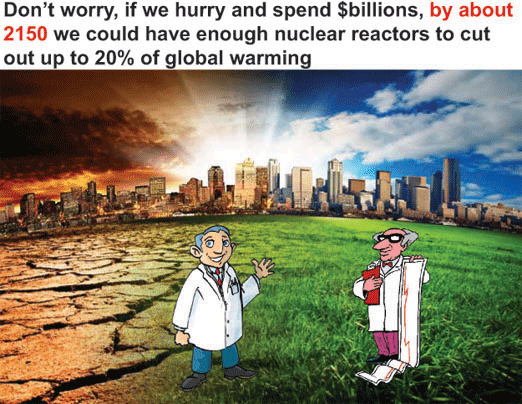 Nuclear power additions ‘need to quadruple’ to hit climate goals, IEA says, The Carbon Brief 31 Jan 2015, 14:50 Simon Evans “………Governments can choose whether to support new nuclear or not, the IEA says. They could finance guarantees, as well as reviewing electricity market arrangements. The UK has done both, through its electricity market reforms and fixed-price contracts for nuclear power.
The nuclear industry needs to show it can deliver projects on time and within budget so that these financing costs can be reduced, the IEA says. It says new nuclear plants should cost around £3.8 billion per gigawatt in Europe. The UK’s Hinkley C plant is expected to cost almost that, partly because of the costs of borrowing money to finance the scheme.
Existing nuclear plants will also need to stay open for longer as part of the 2050 roadmap, which depends on further research and investment. The IEA sees plants operating for up to 60 years or more. Nuclear operator EDF recently announced a ten-year life extension at one of its Dungeness B plants, and it hopes to agree similar extensions at its other UK plants.
Small modular nuclear reactors (SMRs) could play a “niche” role in future, the IEA says. It points out that just three prototype modular reactors are under construction, that none are yet operating and that the economics of SMRs “have yet to be proven”. Former environment secretary Owen Paterson gave SMRs a starring role in his vision for the UK’s energy future in a speech last year…….”
Engineers in the dark about the state of Fukushima nuclear molten cores
 TV: Only ‘some’ of Fukushima melted fuel is now solid — Nuclear Expert: Molten core ‘re-melts’, even with enough cooling water — Japan Engineer: “The Fukushima accident was the first of its kind” (VIDEO) http://enenews.com/tv-only-fukushimas-melted-fuel-solid-nuclear-expert-molten-core-will-melt-enough-cooling-water-japan-engineer-fukushima-accident-first-kind-video?utm_source=feedburner&utm_medium=email&utm_campaign=Feed%3A+ENENews+%28Energy+News%29
NHK, Jan 27, 2015 (emphasis added): Groundwater entering the facility becomes tainted when it mixes with melted fuel inside the reactor containers. Tepco engineers believe some of the fuel has cooled down and turned into solid debris. But they don’t know the exact situation, so they’re hoping to take a look inside… Scientists have figured out a way of using muons to help them see substances hidden from views — like magma… When particles hit a high-density object like magma, they lose energy or are absorbed… it’s like an x-ray. Researchers are hoping to use the technique to get a better idea of what’s inside the reactors… Engineers will… try and determine the state of the melted fuel… Engineers say knowing what’s inside will help them figure out a way to decommission the plant.
Asahi Shimbun, Jan 24, 2015: [TEPCO] will use cosmic rays… to identify sites with melted fuel… They will first study the No. 1 reactor… by the end of this fiscal year, estimating how much fuel remains in the reactor[and] intend to extract the melted fuel after surrounding it with water… the plant operator will need to repair damaged sections of the containers to prevent water leaks… However… nuclear fuel at the base of the container cannot be seen using the muon technique…
Dr. Ing. Mazzini, Ph.D. Nuclear & Industrial Safety (pdf): Severe Accident Phenomenology…Milestones of Nuclear Safety: 2011 Fukushima Accident (1st for an External Event)
- Ex-Vessel Accident Phenomena:
-> The molten debris falls into the reactor cavity. This produces boiling off of whatever water is there. If sufficient water is present, the core would be cooled and solidify, and would subsequently re-melt.
-> Steam explosions may also occur at this time as the molten fuel falls onto water in the reactor cavity. This can disperse fuel, create radioactive aerosols, and increase the rate of heat transfer to the containment atmosphere.
-> Molten corium attacks the concrete basement, which proceeds to penetrate, and creates a cauldron that releases aerosols and gases [and] containment pressure rises.
DPA, Jan 28 2015: More delays expected in Fukushima nuclear plant clean-up… More delays in treating contaminated water from Japan’s crippled Fukushima nuclear power plant are likely, a senior official of a company involved in the clean-up said Wednesday. “Some schedule(s) would be delayed because the contaminated facility did not operate as planned,” [said] Yoshiki Ogata, director of the global nuclear project department of Mitsubishi… “The situation in the building is not clear,” he told dpa on the sidelines of a nuclear energy conference. Mitsubishi, along with Toshiba and Hitachi, are the three companies helping… Ogata said that the Fukushima accident was the first of its kind so there were a lot of challenges… “So, first stop the underground water from entering and also leakage to the sea…”
India’s energy future is in renewables: nuclear costly and dirty
Nuclear Energy is past its expiry date, renewal energy is the future. ABP Live, Food and trade policy analyst Devinder Sharma Wed, Jan 28, 2015 “……..Prime Minister Narendra Modi is now laying stress on renewal and clean sources of energy, and has promised to generate 100,000 MW from solar power in next few years. This is heartening by all standards.
This brings me to the media excitement that I see all around from the so-called ‘breakthrough’ that has been achieved in Indo-US nuclear deal. With India accepting to shoulder the liability, with the assurance of putting together an insurance pool and thereby allowing the suppliers of nuclear equipment to go Scott free in case of a nuclear mishap, the question that nuclear energy is safe and clean is itself being defeated. Why should nuclear suppliers insist on not being held responsible in case of a nuclear accident if the technology is safe?
I don’t understand why and how nuclear energy is being called safe and clean……….
Let’s look at the cost involved. According to the Union of Concerned Scientists: “Between 2002 and 2008, cost estimates for new nuclear power plant construction rose from between $ 2 billion and $ 4 billion per unit to $9 billion per unit, while experience with new construction has seen costs continue to soar.” With the costs rising, the nuclear suppliers have been seeking government subsidies, including loan guarantees, tax credits. Interestingly, some estimates point to the huge burden on taxpayers, stating that the plants cost more to taxpayers than the market value of power generated. Nuclear energy today is the most expensive.
With such an expensive source of energy, I don’t think Indian industry can be viable and competitive unless of course massive subsidies are provided to keep the nuclear plants running. If India can provide for massive subsidy support, I wonder why the same investment can’t be made for harnessing solar and wind energy. Let us not forget that way back in 1985 Forbes magazine had categorically termed the US nuclear industry “the largest managerial disaster in business history.” And this also points to the managerial failure to find a safe burial for the nuclear waste generated……..
the huge potential that exists in non-conventional energy resources. In solar alone, India is presently producing only 0.5 per cent of the estimated potential of 750 GW. This estimate is based on the wastelands that can be used for solar power generation. But I see no reason why rooftop solar power generation cannot replace the household (as well as commercial establishments like hotels/hospitals/malls) use of electricity.
In case of wind, Energy Minister Piyush Goyal has already given a green signal for stepping up the existing capacity, by promising to put up 10,000 MW of wind power installations every year. Add to this the massive potential that exists in biogas and biomass, India can easily chart a new pathway in meeting its growing energy needs. Given that the crude oil prices have fallen drastically, and are expected to stay low, the challenge to build up the country’s energy needs from clean, safe and non-conventional resources is immense and untapped. http://www.abplive.in/author/devindersharma/2015/01/28/article487692.ece/Nuclear-Energy-is-past-its-expiry-date-renewal-energy-is-the-future.
Enthusiasm by investors for Indian renewable energy project
“We have received commitment for investments for nearly 1.3 lakh MW of renewable energy from both the domestic and international players,” Goyal today said, speaking here on sidelines of an event organised by VASVIK………..
http://economictimes.indiatimes.com/articleshow/46069893.cms?utm_source=contentofinterest&utm_medium=text&utm_campaign=cpps
USA nuclear reactor corporations know that exports to India are nowhere near really happening
 A year’s wait likely before commercial N-deals inked mydigitalFc.com By Subhash Narayan Jan 27 2015 The breakthrough in civil nuclear deal between India and US may be heads up for American equipment makers that plan to export eight unbuilt nuclear power reactors to India, but the companies will have to wait for up to a year before any commercial deal is inked with their Indian counterparts.
 department of atomic energy on the other would take a year to conclude before projects can commence on ground in Andhra Pradesh and Gujarat, a government official said……….
Toshiba’s Westinghouse Electric Company did not issue a statement but its chief executive officer Danny Roderick told Bloomberg that the company would look at commercial agreements with Indian only after studying the Indian government’s offer to create an insurance pool
“Let us understand that Indo-US civil nuclear deal is government-to-government agreement while the final deals have to reached between companies. There is sense that a lot still needs to be resolved,” said Debasish Mishra, partner at Deloitte Touche Tohmatsu……..
Under the umbrella agreement since the technology transfer will happen over a phased manner, nuclear reactor services companies are also likely to set up their shop in India through joint ventures with Indian entities.
The deal could also see increased exposure of Exim banks from US, Canada, Germany, France. Insurance companies from these countries are also likely to generate business.
Indo-US agreement provides for an insurance cover on liabilities to cover any disaster related liabilities.
Westinghouse has already been allotted a site in Modi’s home state of Gujarat to build a nuclear power station with total capacity of 2,500 MW and possibility of expansion in future. Similarly, two sites have also been identified for GE plants in Andhra Pradesh with an initial capacity of 3,200 MW………http://www.mydigitalfc.com/news/year%E2%80%99s-wait-likely-commercial-n-deals-inked-082
Many a slip twixt the much touted USA-India deal and commercial reality
Hurdles Remain in Nuclear Deal, Indian Express By B B Singh 30th January 2015 For almost two weeks prior to president Barack Obama’s visit to India, the negotiators from both the countries had been burning the midnight oil to operationalise Indo-US nuclear cooperation but hurdles seem to be emerging one after another. The first and the most talked about hurdle arose from Section 17 (b) of the Civil Liability for Nuclear Damage Act 2010, giving the right of recourse to the operator of the nuclear installation if nuclear incident resulted as a consequence of an act of the supplier or his employee which includes supply of equipment or material with patent or latent defects or sub-standard services.
This provision was introduced to ensure that the suppliers took utmost care since they would be liable even for “latent” defects that may exhibit their appearance in their equipment later on after extended exposure to nuclear related stresses. This problem seems to have been solved by India’s proposal for an insurance cover of `1500 crore out of which 50 per cent would be government contribution and the remaining from a pool of insurance companies which are public sector units.
Oddly, it would mean victims compensating victims.
The next conflict has arisen in respect of Section 46 of the Act which provides that its provisions shall be in addition to and not in derogation of any other law for the time being in force. It further provides that nothing contained in this Act shall exempt the operator from any proceeding which might, apart from this Act, be instituted against such operator or the suppliers directly or through the operator. The victims of nuclear incidents are thus entitled to file tort suits for unlimited damages and even criminal proceedings against the operator as well as suppliers. ………….
The story does not end here. There is still some more to come. Under the Hyde Act, the US president is further required to submit to an appropriate Congressional committee any significant changes in the nuclear activities of India including construction of nuclear facilities, production of nuclear weapons or changes in nature and amount of fissile material produced and the purpose and operational status of any unsafeguarded new nuclear facility.
Still further under the Hyde Act, the US president shall have to inform the Congress an estimate of the amount of uranium mined and milled in India and amount of such uranium that has likely been used or allocated for weapons; the rate of production of nuclear devices and the material used therein. Some procedure will have to be worked out in the administrative arrangements to achieve this objective and procure such information on India’s non-civilian nuclear activities for information to the US Congress. In view of these requirements, the Indian negotiators are likely to face still tougher uphill tasks ahead.http://www.newindianexpress.com/columns/Hurdles-Remain-in-Nuclear-Deal/2015/01/30/article2643619.ece
If it ever becomes a reality, USA-India nuclear deal a very bad one for Indian public
Financially, solar and wind energy are already becoming more attractive than nuclear. Electricity from these renewable sources cost Rs 8 and Rs 4.5 per unit respectively,according to a report by solar think-tank Bridge to India. Renewables are quicker to erect and are not as politically contentious as nuclear. In contrast, the Mithi Virdi project has run into serious opposition from local residents and farmers. If it is ever built, electricity from the Westinghouse reactors will cost Rs 12 per unit.
The ‘breakthrough’ in Indo-US nuclear deal will bleed Indians every which way, Scroll In, The taxpayer will be made to pay to cover US companies’ untested technologies and the expensive electricity they generate. Nityanand Jayaraman, 29 Jan 15
1 This Month


of the week– Nuclear Reactor Information Task Force

14 May – online event From Bombs to Data Centres: the Face of Nuclear Colonialism
To see nuclear-related stories in greater depth and intensity – go to https://nuclearinformation.wordpress.com
-
Archives
- May 2026 (180)
- April 2026 (356)
- March 2026 (251)
- February 2026 (268)
- January 2026 (308)
- December 2025 (358)
- November 2025 (359)
- October 2025 (376)
- September 2025 (257)
- August 2025 (319)
- July 2025 (230)
- June 2025 (348)
-
Categories
- 1
- 1 NUCLEAR ISSUES
- business and costs
- climate change
- culture and arts
- ENERGY
- environment
- health
- history
- indigenous issues
- Legal
- marketing of nuclear
- media
- opposition to nuclear
- PERSONAL STORIES
- politics
- politics international
- Religion and ethics
- safety
- secrets,lies and civil liberties
- spinbuster
- technology
- Uranium
- wastes
- weapons and war
- Women
- 2 WORLD
- ACTION
- AFRICA
- Atrocities
- AUSTRALIA
- Christina's notes
- Christina's themes
- culture and arts
- Events
- Fuk 2022
- Fuk 2023
- Fukushima 2017
- Fukushima 2018
- fukushima 2019
- Fukushima 2020
- Fukushima 2021
- general
- global warming
- Humour (God we need it)
- Nuclear
- RARE EARTHS
- Reference
- resources – print
- Resources -audiovicual
- Weekly Newsletter
- World
- World Nuclear
- YouTube
-
RSS
Entries RSS
Comments RSS
 nuclear-news