Japanese media reports IAEA urged to dump contaminated water into ocean but no such statement made in real

February 19
Japanese media is misleading the Japanese citizens to accept the discharge of contaminated water to the Pacific as a request of an international organization
On 2/17/2015, IAEA (International Atomic Energy Agency) completed third review of Japan’s plans to decommission Fukushima plant.
NHK and other major Japanese media covered the press conference by Juan Carlos Lentijo, leader of IAEA inspection team and reported that he strongly recommended to consider discharging contaminated water into the Pacific.
They read the increasing contaminated water storage is stopping the decommissioning plan, they are running out of the storage place.
However on the website of IAEA, they actually state only “The IAEA team considered the current practice of storing contaminated water a temporary measure and highlighted the need for a more sustainable solution. “, which does not mention “discharge”. In the statement they highly evaluated “the improvement and expansion of systems to clean contaminated water”, “the installation of new, improved tanks to store contaminated water” and “the operation of an underground water bypass system”, which have been implemented since 2013.
None of the Japanese media released the unedited press conference video without interpreted subtitle.
http://ai.2ch.sc/test/read.cgi/newsplus/1424236682/
Source: Fukushima Diary
Walking atop an underground battle

February 19, 2015
FUKUSHIMA — The mass of machinery that engineers hope can stem the relentless flow of water into the gutted Fukushima Daiichi nuclear power plant impresses by its sheer size as well as its ambitious aim.
Huge 55cm-diameter ducts snake out from the roof of the refrigeration plant that forms the heart of this beast, which Tokyo Electric Power Co. showed the media for the first time Wednesday. When it starts beating, a minus 30 C solution of calcium chloride will course through them at 2 meters per second.
This refrigerant will circulate through more than 1,500 buried pipes encircling four of the plant’s six reactor buildings. If all goes according to plan, a “frozen earth” wall will form, stopping the influx of groundwater that now leaks back out as streams of radioactive contamination.
The refrigeration plant houses 30 units, each with a capacity of about 70 tons of refrigeration, defined as the heat reduction needed to freeze a ton of 0 C water in 24 hours. To put this in perspective, a Tepco guide described it as the freezing capacity of two tuna-fishing ships.
While the system entails 3.5km of ductwork, it will operate by the same principle as a household fridge. After absorbing heat from the soil and re-emerging from the ground, the refrigerant, now warmed up to minus 20-something, will be cooled back down to the right temperature with CFCs. All 30 units will go on full blast until the soil congeals, after which about half will be turned off, Tepco said.
Only about 15% of the equipment is in place. Tepco plans to start freezing the ground on the inland side, which is about 90% finished, before closing the circle on the coastal side.
Tepco had initially aimed to complete the installation by the end of March. But a fatal accident brought everything to halt for roughly two weeks while the company performed safety checks. Work resumed Feb. 3 but is running two to four weeks behind schedule.
“We’re putting safety before our schedule,” Fukushima Daiichi manager Akira Ono said.
Roughly half of the workers at the plant call Fukushima Prefecture home. For them, staying safe is not only about protecting themselves, but also about sparing their disaster-ravaged communities any more pain.
Snow fell at the plant on the day of the media tour. Gloves were little help against the biting cold, and the goggles shielding our eyes from radiation kept fogging up. For the 6,000-plus workers a day who toil at the ruined plant, such grim conditions have become a fact of life.
Source: Nikkei Asian Review
http://asia.nikkei.com/Japan-Update/Walking-atop-an-underground-battle
Inspectors urge Japan to dump water from Fukushima plant into ocean
 February 17, 2015
Nearly four years after Japan’s massive March 2011 earthquake and tsunami, the country has made “significant progress” toward stabilizing and decommissioning the ravaged Fukushima Dai-ichi nuclear power plant, international nuclear inspectors said Tuesday.
However, the nearly 160 million gallons of contaminated water stored on-site pose massive logistical challenges, and examiners strongly urged Japan to consider controlled discharges of the liquid into the Pacific Ocean once it is treated.
The situation at the crippled plant remains “very complex” and “the benefits [of discharges] could be very, very huge” said Juan Carlos Lentijo, who led the team of 15 inspectors from the International Atomic Energy Agency on a nine-day mission that follows surveys in April and November 2013.
Japanese officials have been reluctant to take such a step at the plant 160 miles northeast of Tokyo, fearing it might further antagonize local fishermen and other residents affected by the initial accident and its aftermath.
In the past year, Japan has succeeded in removing spent and fresh fuel from one reactor, Unit 4, and reduced the inflow of groundwater into the facility. It has also taken steps to clarify which entities are responsible for particular jobs, the IAEA team noted.
But about 80,000 gallons of groundwater continue to enter the plant per day, and building and maintaining storage tanks is increasingly taxing for the 7,000 workers toiling at the site, Lentijo’s team noted. In January, a laborer in his 50s who was inspecting an empty, 33-foot-tall storage tank fell into the vessel and died.
In wake of that accident, Japan’s nuclear regulator called on plant operator Tokyo Electric Power Co. to move toward discharges of treated water.
About half of the water stored on-site has been treated to remove most radioactive contaminants, the IAEA team noted, though current technology does not allow for the easy removal of tritium, an isotope of hydrogen.
Unlike other contaminants, which are suspended or dissolved in water, tritium actually modifies the water molecules and therefore is difficult to separate out.
Still, tritium is considered one of the least hazardous radioactive materials produced by nuclear power plants, and Lentijo said “controlled discharges are a normal practice in the industry.”
“Most of the nuclear power plants are discharging treated water,” he said at a news conference in Tokyo. “This is accomplished with negligible impact on the environment and the safety of the people.”
Japan’s Ministry of Economy, Trade and Industry has solicited demonstration projects from several companies for technology that might effectively treat the tritiated water. Orange County-based Kurion said it was awarded a $10-million grant in November for a pilot programs of its technology in Japan to see if it would be effective at Fukushima.
Among its other recommendations, the IAEA team encouraged Japan to narrow down the number of options being considered for the overall decommissioning plan and to reinforce “safety leadership and safety culture” systems.
A final report from the IAEA team is expected in late March.
Source: Los Angeles Times
http://www.latimes.com/world/asia/la-fg-iaea-japan-water-fukushima-plant-20150217-story.html
Radiation spike at Daiichi Unit 1 discharge canal

- A significant spike in contaminated water levels at Fukushima Daiichi in the unit 1 discharge canal was reported today.
- The only new work began between the 14th and 18th is the concreting of the unit 4 seawater piping trench.
- Readings between Feb 14th and Feb 18th saw a considerable jump beyond normal fluctuations for these two locations.
Source: Tepco
http://www.tepco.co.jp/nu/fukushima-np/handouts/index-j.html
Northeast Japan coast hit with magnitude 6.9 earthquake
Quake near Magnitude 7 hits off northeast Japan — Country’s strongest since 2013 — Felt along entire Pacific coastline, distance of over 1,000 kilometers — Followed by multiple aftershocks, one centered at Japan Trench — Official: Event related to massive 3/11 quake (VIDEO) http://enenews.com/quake-magnitude-7-hits-northeast-japan-strongest-hit-country-2013-felt-along-entire-pacific-coastline-1000-km-followed-multiple-aftershocks-one-centered-japan-trench-official-event-related?utm_source=feedburner&utm_medium=email&utm_campaign=Feed%3A+ENENews+%28Energy+News%29
The Guardian, Feb 16, 2015: Japanese coastal towns evacuated as earthquake hits Pacific… Evacuations were ordered for towns closest to the coast in Iwate prefecture in Japan early on Tuesday morning after a strong earthquake with a preliminary magnitude of 6.9 was recorded… The Japan Meteorological Agency issued a tsunami warning and Japanese broadcaster NHK warned residents a one metre-high wave was expected to hit the coast of Iwate. The quake was measured at a depth of about six miles and shook much of north-east Japan even being felt in Tokyo, 430 miles away.
NBC News, Feb 16, 2015: Japan’s Meteorological Agency cast the quake as an aftershock of the 9.0 temblor that rocked Japan on March 11, 2011… “Because the 3/11 earthquake had such a strong impact, and because it’s an area where it was affected by the 3/11 Earthquake, we are describing this as an ‘aftershock,’” said agency seismologist, Yasuhiro Yoshida… USGS wasn’t characterizing Tuesday’s quake as an aftershock, considering it a separate event.
- M6.7 — 02-16 23:06:27 UTC
- M4.7 — 02-17 00:50:02 UTC
- M4.6 — 02-17 01:15:02 UTC
- M4.9 — 02-17 02:29:51 UTC
- M4.3 — 02-17 02:45:12 UTC (Japan Trench)
The quake was felt from Chiba to Hokkaido, a distance of over 1,000 kilometers.
This is the most powerful earthquake to hit Japan since a M7.1 on Oct. 25, 2013.
Japan’s government wrestles with the unsolved problem of nuclear wastes
 Government explores options on how to store nuclear waste in the long term, Japan Times, 18 Feb 15
KYODO The government said Tuesday it will consider pursuing a final storage site for nuclear waste that can be opened in the event that policies change or better techniques become available to deal with it.
Officials aim to include the plan in a revised basic policy on the final disposal of highly radioactive waste. The government is currently considering the vexed question of what to do with waste in the long-term, as some of it may need management for tens of thousands of years.
Prime Minister Shinzo Abe’s administration wants to fire up nuclear reactors again following the hiatus caused by the 2011 Fukushima meltdowns, but public opinion remains opposed.
Critics accuse the government of pushing a return to nuclear without answering the question of where the waste will go.
Also on Tuesday, the Science Council of Japan, a representative organization of various scientists, rapped the government’s stance as “irresponsible,” urging it and power companies to develop concrete measures for handling nuclear waste as a prerequisite for restarting reactors.
To fend off such criticism, the revised policy will also declare that the “current generation” is not only responsible for generating the waste it will also take action on the storage question. However, it falls short of mentioning a time frame for deciding on the final storage……..
As for how Japan would store its waste, a policy adopted in 2008 envisions reprocessing the waste, then vitrifying it and placing it deep underground…….
This implies a possible review of Japan’s long-standing but stalled policy of a nuclear fuel cycle that aims to reprocess all spent fuel and reuse the extracted plutonium and uranium as reactor fuel…….
The process of finding local governments willing to host a final repository started in 2002, but there was overwhelming opposition and little progress was made.
The government now plans to choose candidate sites based on their scientific value, rather than waiting for municipalities to step forward.
The Science Council of Japan also suggested that waste be temporarily kept in above-ground dry storage for 50 years in principle, during which the government should try to build a consensus on the issue. It also called for national discussions on how to curb, or setting limitations, on the amount of nuclear waste to be generated. http://www.japantimes.co.jp/news/2015/02/17/national/science-health/final-nuclear-waste-dump-may-be-reversible/#.VOP4A-aUcnk
Fukushima’s serious radioactive water problems, and fatal fall of worker into tank
………Following the incident, Japan’s Nuclear Regulatory Authority met to discuss options for disposing of the radioactive waste, which continues to pose health threats at the facility. The Wall Street Journal reports that the regulatory body’s chairman isn’t pleased with the way the Tokyo Electric Power Company (TEPCO) has handled the disaster, which continues to wreak havoc……..
But the power operator has yet to take action, which has resulted in massive contamination of local groundwater. Reports indicate that up to 400 tons of highly contaminated water is added to the site every day, an insurmountable level that will only make it that much worse to clean up in the future.
TEPCO’s water purification process can’t remove tritium; operator running out of room for storage tanksTEPCO is currently trying to remove radioactive material from the tainted water before dumping it into the ocean. But the system it currently has in place to do this is unable to remove radioactive tritium, which is why the power operator has begun moving the water into large storage tanks onsite.
There are currently about 1,000-and-counting storage tanks at the facility, but TEPCO is quickly running out of space to add more. Besides this, TEPCO is having to continue working towards removing spent fuel rods and replacing cooling equipment to prevent further problems at the plant, which show no signs of relent.
http://www.naturalnews.com/048634_Fukushima_radioactive_waste_worker_death.html##ixzz3S43ma2hG
Radioactive water problem at Fukushima continues to grow

Agency Report— Feb 17, 2015 A team of international experts on Tuesday expressed concern about increasing amounts of radiation-contaminated water at a crippled Japanese nuclear plant.
Juan Lentijo, head of the 15-member International Atomic Energy Agency team, said at the end of its 9-day mission.
Lentijo said over 350 tonnes of toxic water was generated daily in the process of cooling three reactors at the Fukushima plant that suffered meltdowns during the 2011 earthquake and tsunami.
“The situation remains very complex, with the increasing amount of contaminated water posing a short-term challenge at the plant.
“The need to remove highly radioactive spent fuel, including damaged fuel and fuel debris, from the reactors that suffered meltdowns poses a huge long-term challenge,’’ he said.
The team said other challenges include persistent underground water ingress to main buildings, the long-term management of radioactive waste and problems related to the removal of nuclear fuel. “Japan has made significant progress in its efforts to plan and implement the decommissioning of the plant run by Tokyo Electric Power Co.
“The team is expected to issue its final report by the end of March, although the path ahead is long, complex and challenging.
“Japan is progressing step-by-step and plans are taking shape, which is a welcome development,’’ Lentijo said. (dpa/NAN)
Now India too wants to sell nuclear reactors overseas!
 India to supply nuclear reactors to Sri Lanka By Dipanjan Roy Chaudhury, ET Bureau | 17 Feb, 2015 NEW DELHI: With an eye on checking China’s growing ambitions in South Asia, India has signed a landmark civil nuclear pact with Sri Lanka – the first such agreement to supply nuclear power reactors to a foreign nation – and decided to expand defence and security cooperation to address Colombo’s requirements.
Fukushima disater recovery funds to be used for Olympic events?
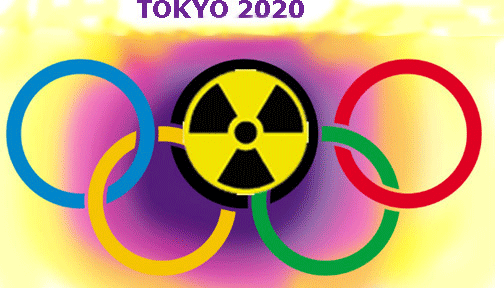 Tokyo Gov. Masuzoe wants to use disaster recovery funds for Olympic events in Tohoku Mainichi, 18 Feb 15 Tokyo Gov. Yoichi Masuzoe says he will ask the central government to use part of the Tohoku tsunami disaster reconstruction budget to cover the costs of staging some events for the 2020 Tokyo Olympics and Paralympics in areas that were severely affected by the 2011 disaster……..
There is a rough road ahead for Masuzoe’s plan, however, as some Tohoku residents say that spending the reconstruction budget on the Olympics will not win support from the local community……http://mainichi.jp/english/english/newsselect/news/20150213p2a00m0na016000c.html
Fukushima nuclear catastrophe changed the world
Magazine: ‘Fukushima catastrophe changed the world’; Worst nuclear accident in history, like two Chernobyls; ‘Poisoned entire landscapes for centuries’ — Study: Fukushima ‘overwhelms’ the peak radioactivity from nuclear bomb testing in ice core samples; ‘Affected the global environment’http://enenews.com/magazine-fukushima-catastrophe-changed-world-worst-nuclear-accident-history-like-having-chernobyls-poisoned-entire-landscapes-centuries-study-fukushima-overwhelms-peak-radioactivity-atmospheric-bom?utm_source=feedburner&utm_medium=email&utm_campaign=Feed%3A+ENENews+%28Energy+News%29
Spiegel Online International (Der Spiegel, German news magazine), Feb. 5, 2015 (emphasis added): [It’s] the worst accident in the history of civilian atomic power… The Fukushima catastrophe changed the world. Nuclear reactors melted down on live television and twice as much radioactive material was released as during the Chernobyl accident in 1986. The disaster… poisoned entire landscapes for centuries and killed hundreds of thousands of farm animals… Fukushima is more than just a place-name, it is an historical event…
Scientists from the Chinese Academy of Sciences, University of Venice, and Nanjing University, Feb 6, 2015: The β radioactivity of snow-pit samples collected in the spring of 2011 on four Tibetan Plateau glaciers demonstrate a remarkable peak in each snow pit profile, with peaks about ten to tens of times higher than background levels. The timing of these peaks suggests that the high radioactivity resulted from the Fukushima nuclear… The released radioactive nuclear substances not only polluted Japan… but also spread to other areas of the Northern Hemisphere via atmospheric circulation and ocean currents, affecting the hemispheric and even global environment. As an overdose of nuclear radiation may seriously threaten human health and wildlife survival, this nuclear accident has caught the attention of the world. The radioactive fallout [was] detected in the atmosphere, soil, surface water, and pastures in the low-altitude regions of North America… Much of the radioactive material was transported by the westerlies, resulting in the fallout over North America… [T]o reach the Tibetan Plateau, material transported by the westerlies has to first circle much of the globe… In May 2011, snow-pit samples were collected on the Gurenhekou Glacier… Dongkemadi Glacier… Muztag Glacier and Yuzhufeng Glacier… In 2005 and 2007, we drilled ice cores… Tanggula ice core [and] Yuzhufeng ice core… Clearly, the peak β radioactivities in the snow pits… are much higher than that in the corresponding local ice cores, and even overwhelm the peak β radioactivities caused by past atmospheric thermonuclear tests in the early 1960s… The peak β radioactivities… are 11.0 and 92.4 times larger than their local average background levels… attributed to the Fukushima radioactive fallout… The Fukushima nuclear accident… created a radioactive horizon that can be used as independent age markers in snow and ice cores in the Northern Hemisphere… providing a direct record of the impacts of human activities on the Earth’s environment…
See also: VIDEO: New data shows Fukushima radiation release exceeds Chernobyl
Nuclear projects between China and Pakistan – a weapons proliferation worry
China, Pakistan, and Nuclear Non-Proliferation Recent evidence regarding China’s involvement in Pakistan’s nuclear program should provoke international scrutiny. The Diplomat By Rohan Joshi February 16, 2015 China’s confirmation that it is involved in at least six nuclear power projects in Pakistan underscores long-standing concerns over both the manner in which both China and Pakistan have gone about engaging in nuclear commerce and the lack of transparency around China-Pakistan nuclear cooperation in general. The guidelines of the Nuclear Suppliers Group (NSG), a 48-nation body that regulates the export of civilian nuclear technology, prohibit the export of such technology to states, like Pakistan, that have not adopted full-scope International Atomic Energy Agency (IAEA) safeguards. Yet over the last decade, China has accelerated nuclear commerce with Pakistan while contending that its actions are in compliance with NSG guidelines, an argument that is not entirely convincing.
Today, China is not only a violator of global nuclear non-proliferation norms, but also presents the most convincing evidence of the non-proliferation regime’s ineffectiveness. The pattern of its behavior on the nuclear front as it relates to Pakistan goes well beyond the scope of what may be construed as the state’s legitimate ambition to be a leader in the supply of civilian nuclear technology…….http://thediplomat.com/2015/02/china-pakistan-and-nuclear-non-proliferation/
Many a slip before there’s any Takahama nuclear restart
Local approval is no given for Takahama nuclear restarts , Japan Times 17 Feb 15 FUKUI – Kansai Electric Power Co. wants to fire up its Takahama nuclear plant as soon as possible, but it has cleared only one hurdle in securing a green light from regulators. The next could be difficult: obtaining the consent of local officials.
Areas within 30 km of the plant must have evacuation plans for all residents. Although the plant is located in Fukui Prefecture, the evacuation zone sweeps into Kyoto and Shiga prefectures, and they fear for a repeat of a crisis like the Fukushima meltdowns.
The Nuclear Regulation Authority declared last week that the No. 3 and No. 4 reactors of the Takahama plant meet safety standards.
But Yutaka Nose, mayor of Takahama, called on the NRA to explain what that green light means. He suggested that it record a video for town residents to watch via a local cable television network.
Nose said he himself will only decide whether to approve the restarts after consulting residents.
Fukui Gov. Issei Nishikawa plans to decide in line with the recommendations of a panel of experts conducting an independent assessment at the prefectural government’s behest. He will also, he said, consider sentiment in the town and the prefectural assembly.
Along with the NRA’s safety certificate, Kansai Electric needs to win approval for the systems and facilities it would deploy in the event of an accident.
Nishikawa said he will take everything into account in deciding what to do.
It is unlikely that there will be much progress before April’s gubernatorial election.
If the Sendai nuclear plant in Kagoshima Prefecture is anything to go by, approval could be months away at least. Approval is still pending for a resumption of life at that plant’s No. 1 and No. 2 reactors, even though the NRA gave a thumbs-up in September……..
Taizo Mikazuki, governor of Shiga Prefecture, part of which also falls within the 30-km radius, maintains that he will not endorse the restart of the reactors unless the Takahama plant introduces an “effective” safety system.
Mikazuki was elected last July on a pledge of seeking to phase out nuclear power.
He has warned that in the event of an accident, the fallout won’t respect prefectural boundaries. He believes reactivating nuclear plants should be a matter for other prefectures, not just the one that hosts the plant……
Nishikawa recognizes that there is concern in the Kyoto and Shiga prefectural governments, and therefore he has called on the central government to explain why the reactors need to be restarted. http://www.japantimes.co.jp/news/2015/02/17/national/local-approval-given-takahama-nuclear-restarts/#.VOPwQOaUcnk
USA – India agreement raises danger of nuclear weapons proliferation and nuclear war
 Even more serious has been the deal’s impact on the nuclear arms race between India and Pakistan……..
By granting India access to uranium, the deal allows India to divert its indigenously-mined uranium to military applications without detracting fuel from the civilian program. To get uranium to India, the U.S. pressured members of  the Nuclear Suppliers Group to “[ease] long-standing restrictions on nuclear trade with India.” Since then, Australia has committed to providing India with uranium
The international community would do best if it encouraged and helped India and Pakistan to settle their differences and accede to the NPT – and if no nation provided either of them with new nuclear technology or fuel until they scale back their military nuclear programs………
The Darker Side of the U.S.-India Nuclear Deal The recent “breakthrough” is cause more for concern than it is for celebration. The Diplomat By Amitai Etzioni February 13, 2015 The American media is gushing about improvements to the United States-India relationship in the wake of President Barack Obama’s January visit to India. Among the achievements stemming from the visit is what the media had called a “breakthrough” that paved the way for implementing the two nations’ civilian nuclear cooperation deal. However, examining the reasons why this deal was first struck, its components, and its side effects suggests that it is a cause more for concern than for celebration. Continue reading
2,837 Iitate villagers petition Nuclear Damage Compensation Dispute Resolution Center (NDCDRC)
 Residents of Fukushima’s Iitate Village file petition for nuclear damage compensation to restore home village http://www.cnic.jp/english/newsletter/nit164/nit164articles/03_iitate.html Kaori Yoshioka, CNIC Nearly half of the entire population of Iitate Village, Fukushima Prefecture, filed a petition with the Nuclear Damage Compensation Dispute Resolution Center (NDCDRC) on November 14, 2014, demanding measures to restore the lives of the nuclear disaster victims. The petitioners are 2,837 villagers from 737 households and the petition is addressed to Tokyo Electric Power Company (TEPCO) President and CEO, Naomi Hirose.
Main points of the petition seeking NDCDRC arbitration for an out-of-court settlement
The petitioners call on TEPCO to
- admit legal responsibility for causing serious radioactive contamination in the village and inflicting massive damage on the villagers, and to sincerely apologize to the villagers for this,
- pay 3 million yen to each villager to compensate for mental anguish regarding their health and other psychological stress caused by radiation exposure that could have been prevented,
- raise the amount of compensation for the period of evacuation from 100,000 yen per person per month to 350,000 yen,
- pay 20 million yen to each of the petitioners as compensation for destroying their livelihoods and causing psychological distress,
- pay the maximum amount of compensation (that for the “difficult-to-return zone”) to the residents who need to secure their houses, but without categorizing the locations into “difficult-to-return zone,” “restricted habitation zone,” and “evacuation directive lift preparation zone,” and without forcing them to take complicated procedures for filing applications, and
- pay lawyers’ fees for this class action suit.
Purpose of the class action suit
This class action suit was launched by the Iitate residents for the purpose of extracting an apology from TEPCO for forcing all the villagers to evacuate after the utility’s accident at the Fukushima Daiichi Nuclear Power Station in 2011, to seek just compensation for the damage they have suffered in order to regain their pride as Iitate villagers and to restore their home village.
-
Archives
- October 2026 (129)
- September 2026 (339)
- August 2026 (330)
- July 2026 (355)
- June 2026 (287)
- May 2026 (306)
- April 2026 (356)
- March 2026 (251)
- February 2026 (267)
- January 2026 (308)
- December 2025 (358)
- November 2025 (359)
-
Categories
- 1
- 1 NUCLEAR ISSUES
- business and costs
- climate change
- culture and arts
- ENERGY
- environment
- health
- history
- indigenous issues
- Legal
- marketing of nuclear
- media
- opposition to nuclear
- PERSONAL STORIES
- politics
- politics international
- Religion and ethics
- safety
- secrets,lies and civil liberties
- spinbuster
- technology
- Uranium
- wastes
- weapons and war
- Women
- 2 WORLD
- ACTION
- AFRICA
- Atrocities
- AUSTRALIA
- Christina's notes
- Christina's themes
- culture and arts
- Events
- Fuk 2022
- Fuk 2023
- Fukushima 2017
- Fukushima 2018
- fukushima 2019
- Fukushima 2020
- Fukushima 2021
- general
- global warming
- Humour (God we need it)
- Nuclear
- RARE EARTHS
- Reference
- resources – print
- Resources -audiovicual
- Weekly Newsletter
- World
- World Nuclear
- YouTube
-
RSS
Entries RSS
Comments RSS

