Fukushima plant abnormalities – due to ionising radiation fallout?
Yahoo News: Mutated plants near Fukushima gain internet fame — Pics show centers fused together, petals growing out of sides, ring-shaped flower with 4 stems — US Gov’t Expert: Plant abnormalities can be induced after only 24 hours of exposure to radioactive fallout (PHOTOS) http://enenews.com/yahoo-news-mutated-plants-fukushima-gain-internet-fame-pics-show-centers-fused-together-petals-growing-sides-flowers-govt-expert-abnormalities-be-induced-after-only-24-hours-exposure-radioactive?utm_source=feedburner&utm_medium=email&utm_campaign=Feed%3A+ENENews+%28Energy+News%29
Yahoo News, Jul 13, 2015: Deformed daisies from Fukushima disaster site gain Internet fame… one Japanese amateur photographer has captured something a bit more unique than a beautiful bloom. Twitter user @san_kaido posted a photo of mutated yellow daisies last month, found in Nasushiobara City, around 70 miles from Fukushima… The photos show daisies with fused yellow centres and with the petals growing out the side of the flower…
Tweet from @san_kaido, translated by Fukushima Diary: “The right one grew up, split into 2 stems to have 2 flowers connected each other, having 4 stems of flower tied beltlike. The left one has 4 stems grew up to be tied to each other and it had the ring-shaped flower. The atmospheric dose is 0.5 μSv/h at 1 m”…
Taka Katsumi, former aide to Member of Japan’s Parliament, Jun 21, 2015: Deformed Margaret flowers found 130 km from Fukushima Daiichi plant at Nasu Shiobara on May 26, 2015.
Video from Nasushiobara City: Sep 2012, I measured radiation in front of SEKIYA elementary school of Nasushiobara… The monitor indicates… 6.94 on mud in the road side garter, 8.10 micro Sievert per hour on dusts of the school road.
More on Plant Fasciations (emphasis added)
> Univ. of Chicago w/ grant from Rockefeller Foundation (pdf), 1933: All vegetative parts are subject to injury by x-rays. Root tips may become bulbous and swollen, with tumor-like enlargements in which giant cells may occur. Stems become fasciated… flowers of plants rayed in seed or seedling stages may show fasciation…
> Japan’s National Institute of Agrobiological Sciences, 2009: The proportion of plants showing stem fasciation increased with gamma-irradiation… Each single mutant also showed stemfasciation at a low frequency without gamma-irradiation, while gamma-irradiation induced stem fasciation. Importantly, in wild-type plants, the frequency of stem fasciation was very low (<0.1%) [but] were induced by gamma-irradiation.
> Affidavit of James Gunckel, Brookhaven National Lab (pdf), 1984: I have carefully examined… plants, collected shortly after the [1979] accident at TMI and compared them with specimens collected more recently. The current abnormalities [5 years post-accident] are probably carried forward by induced chromosomal aberrations. There were a number of anomalies entirely comparable to those induced by ionizing radiation — stem fasciations [etc.]… Most of the stem abnormalities… are induced by relatively high doses of X or gamma rays extending over a period of usually 2-3 months. Notable exceptions, however, are similar responses to beta ray exposure from radioisotopes… for only 24 hours. In other words, it would have been possible for the types of plant abnormalities observed to have been induced by radioactive fallout on March 29, 1979… I am the world authority on modifications of plant growth and development induced by ionizing radiations…
Japan’s nuclear regulator says the country’s nuclear safety is inadequate
Japan’s nuclear safety ‘not enough’ IOL. za July 15 2015 By Reuters
Tokyo – Japan’s atomic regulator on Wednesday said falsified documents at Chugoku Electric Power related to radioactive waste showed the country’s nuclear industry still lags on safety more than four years after the Fukushima plant meltdown.
Chugoku Electric on 30 June said it had not conducted the mandatory inspection of equipment for handling low-level nuclear waste, yet had recorded that the checks were carried out.
“From a safety culture point of view, if that kind of thing happens, it’s not good enough,” Nuclear Regulation Authority (NRA) head Shunichi Tanaka said at a regular press conference on Wednesday, when asked about the incident by Reuters………
The NRA is continuing to review the number two reactor at Chugoku Electric’s sole Shimane nuclear plant for relicencing despite the falsification of documents, an NRA official said, when contacted by Reuters.
Chugoku Electric President Tomohide Karita expects the incident may make it harder to gain the consent of local residents to eventually restart the nuclear plant, a Chugoku spokesman told Reuters on Wednesday……..http://www.iol.co.za/business/news/japan-s-nuclear-safety-not-enough-1.1885678#.Vag2XqSqpHw
The Fukushima Radionuclides Polluting the Pacific, Causing Extinction Events
R&D on Treatment and Disposal of Radioactive Waste resulting from Accident at Fukushima Daiichi NPS
Here are isotopes of interest from the Fukushima Daiichi man made nuclear disaster.
This is what has polluted the Pacific, caused extinction events and will continue to, and the industry has nothing but profit for it all.
The following radionuclides are selected referring to the radionuclides for evaluation in the existing disposal system
γ-ray nuclide : 60Co, 94Nb, 137Cs, 152Eu, 154Eu
β-ray nuclide : 3H, 14C, 36Cl, 41Ca, 59Ni, 63Ni, 79Se, 90Sr, 99Tc, 129I, 241Pu
α-ray nuclide : 233, 234, 235, 236, 238U, 237Np, 238,239,240,242Pu, 241,242m,243Am, 244,245,246Cm
Sources:
http://irid.or.jp/_pdf/20150421_2.pdf
Special thanks to Richard Wood
TEPCO to Resume Fukushima Daiichi Reactor One Protective Cover Removal on July 28
TEPCO will start dismantling the cover on July 28.
TOKYO (Sputnik) — Japanese utility company TEPCO will resume work to remove a protective cover from the stricken Fukushima reactor building in late July, a public Japanese broadcaster said.
A dome was installed over Reactor No.1 in 2011 to stop radioactive particles from escaping into the atmosphere after the facility suffered a meltdown when a tsunami caused by a powerful earthquake crippled the Fukushima nuclear plant.
According to the NHK broadcasting organization, the operator will begin dismantling the cover on July 28 if weather permits.
TEPCO began preparatory work to dismantle the protective cover over the Reactor 1 building in May. The preparations began with anti-dispersal agents poured through holes in the cover’s roof to prevent radioactive dust from escaping into the surrounding environment during the dismantling process.
Dismantling has been delayed several times due to technical failures.
Source: Sputnik News
Japan to buy more Philippine farm products if Manila resumes imports from Fukushima
MANILA – Remember that story we ran about a group of Filipino banana growers who were complaining about their shrinking share of the Japanese market despite a free-trade agreement between the two countries?
Well, here’s an interesting twist to the contentious implementation of the Philippine-Japan Economic Partnership Agreement (PJEPA), which both countries are reviewing.
According to the Department of Agriculture (DA), Tokyo is willing to relax import restrictions on Philippine bananas and other farm products if we agree to import products from Japan’s Fukushima prefecture.
To recall, Fukushima is home to the nuclear power plant that sustained damage after a powerful earthquake in 2011, raising fears of harmful radiation. Thereafter, the Philippines ceased importing farm products from Fukushima.
Agriculture Undersecretary Segfredo Serrano said Japanese negotiators have asked for the resumption of Philippine imports of Fukushima-grown dairy, rice and fresh vegetables.
“They want us to lower our food safety requirements based on the fact that Canada and other countries have already accepted their farm products. But I don’t see any reason why,” Serrano said.
Besides Canada, Australia, New Zealand and the United Kingdom lifted import restrictions on Fukushima products as early as January last year.
Serrano said the DA will insist that product samples from Fukushima undergo tests at the Philippine Nuclear Research Institute (PNRI) to ensure they are radiation-free before the country resumes imports. Agricultural imports require the DA’s clearance.
“Even if Mars already accepted their produce, it still has to undergo study by our own experts. We have to be careful since it’s their own technical report, which may differ from our own study,” Serrano said.
“It’s not a matter of volume. Even if [the shipment] is just one gram, if it has a radioactive content, it will not pass the requirements under the Food Safety Act,” he said.
“It’s very political for them to show that they have already addressed the problem. It’s what they want to project. There’s pressure. But I don’t see any reason to give in to their demand,” Serrano added.
During the review of the PJEPA, the Philippines has been prodding Japan to bring down duties on farm products. The Philippine Banana Growers and Exporters Association (PBGEA) recently complained that its members have been losing market share, as Tokyo forges free-trade agreements with other banana-supplying countries, the latest of which was Indonesia.
In turn, Japan has asked the Philippines to reduce the number of tariff lines to a “manageable” level.
“Our main interest is our traditional exports like sugar, coconut oil, tropical fruits, fishery and processed food,” Serrano said.
“We want them [Japan] to bring down to zero all their agricultural tariffs to reciprocate our own reduction of tariff,” he said, adding that the Philippines had unilaterally reduced import duties.
“If they want to make true in their commitment to help Philippine agriculture and rural development, put their money where their mouth is,” Serrano said.
Source: Interaksyon
Radioactive water from Fukushima plant escapes – 1,100 becquerels of beta-ray emitting radioactive substances.
The operator of the crippled Fukushima Daiichi nuclear plant has found that radioactive water has overflowed from a drainage channel, spilling into the sea. This is due to heavy rain.
Workers at the complex discovered the leak at around 8:40 AM on Thursday.
The operator, Tokyo Electric Power Company, said rainwater samples taken from the channel about 2 hours later contained 830 becquerels per liter of radioactive cesium. That’s above the government standard for water allowed to be released into the sea.
The water also had 1,100 becquerels of beta-ray emitting radioactive substances.
An approaching typhoon has been bringing intermittent heavy rain around the plant. The utility suspects that the rain has washed away mud and soil that also contains radioactive materials.
It also presumes the amount of rainwater has exceeded the pump’s capacity.
The leak was continuing as of 5 PM. But the firm says it cannot stop the spill anytime soon and has been monitoring the density of the radioactive substances.
Radioactive rainwater spilled into the sea from the same channel in February. The company built a barrier at channel’s downstream to pump up water before it leaks into the sea.
Source : NHK
http://www3.nhk.or.jp/nhkworld/english/news/20150717_01.html
Japan adopts energy mix plan
An expert panel in Japan has approved a government plan that sets out how the country should meet its energy needs by the year 2030.
The panel endorsed the energy mix plan at a meeting on Thursday.
By fiscal 2030 Japan will take between 20 and 22 percent of its power from nuclear plants, down from more than 28 percent before the 2011 nuclear accident. Power from renewable sources will make up between 22 and 24 percent, up from just over 10 percent in fiscal 2013.
Some panel members opposed the plan. They said it contradicts a government policy to minimize dependence on nuclear power.
Experts are focusing on what kind of support the government will offer to the renewables industry and nuclear power operators.
Souce : NHK
http://www3.nhk.or.jp/nhkworld/english/news/20150716_46.html
Cover of Fukushima reactor 1 building to be removed
The operator of the crippled Fukushima Daiichi nuclear plant has decided to resume work to dismantle the cover of the No.1 reactor building later this month.
The work is part of efforts to decommission the facility, which suffered a meltdown after the March 2011 earthquake and tsunami disaster.
A hydrogen explosion damaged the No.1 reactor building. Tokyo Electric Power Company installed the cover to prevent radioactive material from dispersing.
The utility initially planned to start dismantling the cover last year to clear away radioactive rubble and remove spent nuclear fuel stored at a pool inside the building.
The plan was postponed several times after people expressed concern about the dispersal of radioactive substances.
Engineers also found a problem with a device that controls the air flow in the building when dismantling work was set to begin in May.
The engineers say they have addressed the problem. TEPCO decided to resume the dismantling work on July 28th as long as weather conditions permit.
As part of the plan, chemical agents will be sprayed to prevent radioactive dust from being released into the air.
Engineers plan to remove the six roof panels in about 4-months’ time.
Source : NHK
http://www3.nhk.or.jp/nhkworld/english/news/20150716_01.html
Despite pressing need, Japan continues to grope for nuclear waste site

Welcome to Japan, land of cherry blossoms, sushi and sake, and 17,000 metric tons of highly radioactive waste.
That’s what the country has in temporary storage from nuclear plants. Supporters of nuclear power say it’s cleaner than fossil fuels for generating electricity. Detractors say there’s nothing clean about what’s left behind, some of which remains a deadly environmental toxin for thousands of years.
Since nuclear power was first harnessed more than 70 years ago, the industry has been trying to solve the problem of safe disposal of the waste. Japan has been thrown into the center of the conundrum by the decision in recent months to retire five reactors after the Fukushima disaster started in 2011, while the restart process for one reactor was recently approved despite public opposition.
“It’s part of the price of nuclear energy,” Allison Macfarlane, a former chief of the U.S. Nuclear Regulatory Commission, said in Tokyo during an interview on waste. “Now, especially with the decommissioning of sites, there will be more pressure to do something with this material. Because you have to.”
For more than half a century, nuclear plants in more than 30 countries have been humming away — lighting up Tokyo’s Ginza, putting the twinkle into New York’s Broadway and keeping the elevators running up the Eiffel Tower. Plus powering appliances in countless households, factories and offices around the world.
In the process, the world’s 437 operating reactors now produce about 12,000 tons of high-level waste a year, or the equivalent of 100 double-decker buses, according to the World Nuclear Association.
Most countries now agree burying atomic waste deep underground is the best option. Other ideas like firing it into space or tossing it inside a volcano came and went.
The U.S., with the most reactors, spent an estimated $15 billion on a site for nuclear refuse in Yucca Mountain, Nevada. Local opposition derailed the plan, meaning about 49,000 tons of spent fuel sits in cooling pools at nuclear plants around the country.
Japan faces another challenge. The crisis at Fukushima No. 1 that started four years ago completely changed the equation.
It will take trillions of yen and technology not yet invented to clean up the shattered facility. How long that will take is disputed. Tokyo Electric Power Co. estimates 40 years. Greenpeace says it could take twice that time.
All 43 operational reactors in Japan have been offline since September 2013 for safety checks after the disaster started. The government has said nuclear power is essential to energy supply and reactors that meet safety standards will be allowed to restart.
The first in line belongs to Kyushu Electric Power Co., which last week said it has finished refueling one of its units in Kagoshima Prefecture. It plans to restart the reactor in August, which means generation of more nuclear waste.
It will be a “failure in our ethical responsibility to future generations” to restart reactors without a clear plan for waste storage, the Science Council of Japan said in April.
The Nuclear Waste Management Organization, known as NUMO, has been searching for a permanent storage site for years, initially inviting districts to apply as a host.
In 2007, it got one when the mayor of Toyo, Kochi Prefecture, submitted interest. Like the residents near Yucca Mountain, the town’s citizens didn’t like the idea and voted him out of office. His successor canceled the plan.
Now facing the accelerated shutdown of some reactors post-Fukushima, NUMO in May ditched the idea of waiting for a volunteer. Instead, scientists will nominate suitable areas.
“We’d like all citizens to be aware and feel ownership of this situation,” said Takao Kinoshita, a NUMO official. “We should feel grateful for the community that’s doing something for the benefit of the whole country and respect their bravery.”
NUMO’s plan for a final underground repository was drawn up in 2007 and would cost ¥3.5 trillion.
It would contain about 40,000 canisters, each weighing half a ton and holding waste at temperatures above 200 degrees. The contents would give off 1,500 sieverts of radiation an hour, a level that would instantly kill a human being.
The canisters need to cool in interim storage for as long as 50 years before heading 300 meters below ground. Their stainless steel inner layer is wrapped in bentonite clay to make sure water can’t leak inside.
“That’s the biggest risk we see, water leaking through,” said Kinoshita.
Finland and Sweden are the only two countries so far to have selected and reached a public agreement on a final site and storage technology for high-level nuclear waste. Finland’s is expected to open in 2020.
Taking apart a reactor, known as decommissioning, produces a few tons of highly radioactive material, usually the used fuel and coolant. The buildings and equipment account for thousands of tons of so-called low-level waste.
In Japan, the central government is responsible for dealing with the most radioactive waste. Each plant operator handles the rest.
“Even in the low-level category there is the relatively higher-level waste and the nation’s technical solutions are not ready,” Makoto Yagi, the president of Kansai Electric Power Co., said at a June briefing in Tokyo.
Shaun Bernie, senior nuclear specialist with Greenpeace Germany, said this shows Japan’s reactor program and high-level nuclear waste policy are “in a state of crisis.”
Without a clear disposal strategy, costs to take apart the reactors can end up being double original estimates, said Colin Austin, senior vice president at Energy Solutions, which has worked on every decommissioning project in the U.S.
Another wrinkle in Japan for finding a final disposal site is that the country sits on a mesh of colliding tectonic plates that make it one of the most earthquake-prone countries in the world.
Former NRC chief Macfarlane, who is also a seismologist, said that doesn’t make it impossible to bury the waste. A repository hundreds of meters underground is partly protected against quakes in the same way submarines are during high storms, she said.
Leaving nuclear waste on the surface indefinitely means it will get into the environment, so Japan has to solve this, she said.
“An adequate place underground is better than waiting for the best possible place.”
Source: Japan Times
Tokyo urges Manila to accept Fukushima farm produce
Tokyo is pressing Manila to relax its import restrictions on farm products from the Fukushima prefecture in exchange for more trade concessions under the Japan-Philippines Economic Partnership Agreement (JPEPA), the Department of Agriculture (DA) revealed on Wednesday.
Agriculture Undersecretary Segfredo Serrano said that Japanese negotiators want to resume exports of Fukushima-grown produce —including dairy, rice and fresh vegetables—to the Philippines after these were suspended amid concerns about radiation contamination following the nuclear crisis in March 2011.
“They want us to lower our food safety requirements based on the fact that Canada and other countries have already accepted their farm products. But I don’t see any reason why [we should],” Serrano told reporters.
The DA official said that if exports from Fukushima were to resume, all products coming from the prefecture should first undergo tests at the Philippine Nuclear Research Institute (PNRI) to ensure that they are radiation-free.
“Even if Mars already accepted their produce, it still has to undergo study by our own experts. We have to be careful since it’s their own technical report, which may differ from our own study,” Serrano said.
It can be recalled that by January 24, New Zealand, Australia and Canada had lifted import restrictions on products from Fukushima Prefecture based on measurements of radioactive material. Britain allows imports as long as a government-issued radioactive material inspection certificate is submitted.
However, agricultural products from Fukushima prefecture are still widely shunned in other overseas markets, putting more pressure on the Japanese government revive its export market.
“It’s not a matter of volume. Even if [the shipment] is just one gram, if it has radioactive content, it will not pass the requirements under the Food Safety Act,” Serrano added.
“It’s very political for them to show that they have already addressed the problem. It’s what they want to project. There’s pressure. But I don’t see any reason to give in to their demand,” Serrano stressed.
For its part, Manila wants Tokyo to lower import duties on all possible agricultural products—mainly agricultural and marine products for which the Philippines has competitive advantage—that are viable for export to Japan.
“Our main interest is in our traditional exports—like sugar, coconut oil, tropical fruits, fishery and processed food,” Serrano said.
“We want them [Japan] to bring down to zero all their agricultural tariffs to reciprocate our own reduction of tariffs,” Serrano said, stressing that the Philippines has been ahead in reducing its tariff wall compared to Japan.
The DA official, however, said that Japan has appealed to Philippine negotiators, led by the Department of Trade and Industry, to further cut the number of tariff lines to a more “manageable” level.
“If they want to be true to their commitment to help Philippine agriculture and rural development, [they should] put their money where their mouth is,” he said, stressing that the DA wants to keep the number of tariff lines close to their earlier proposal to give the Philippines more elbowroom in the negotiations.
The JPEPA is a bilateral agreement that is intended to liberalize trade, investments and labor relations between the two countries. The Philippine government is seeking for a review of the JPEPA due to Japan’s failure to fulfill its own commitments under the agreement.
Source: The Manila Times
http://www.manilatimes.net/tokyo-urges-manila-to-accept-fukushima-farm-produce/200631/
More residents joining lawsuits seeking damages from South Korean nuclear plants
 Hwang Bun-hui, a plaintiff in nationwide lawsuits against the government-owned operator of nuclear power plants in South Korea, stands in front of the Wolseong nuclear power plant in Gyeongju.
GYEONGJU, South Korea–For three decades after a nuclear power plant near her home became operational, Hwang Bun-hui believed that nuclear power was no different from other energy sources in terms of safety and health effects.
But after the Fukushima nuclear disaster unfurled in Japan in March 2011, she came to harbor a growing concern over the effects that nuclear power generation has on human health as she had long suffered from a feeling of listlessness.
After a medical checkup, Hwang, 67, a resident of Gyeongju, was diagnosed with thyroid cancer and had to have immediate surgery to remove the tumor. Several other people from her village, which is the closest human settlement to the Wolseong nuclear power plant, were also diagnosed with thyroid cancer.
Hwang is among an increasing number of South Koreans who live near the country’s four nuclear power plants and are joining civil suits against the operator of the plants, demanding compensation for cancer and other adverse health effects.
The citizen’s legal actions were prompted by a landmark ruling by a district court last October, which ordered Korea Electric Power Corp., the government-owned operator of the nuclear plants, to pay 15 million won (1.68 million yen, or $13,500) in damages to a thyroid cancer patient.
The number of plaintiffs seeking compensation from KEPCO for health damages incurred by radioactive emissions from the plants has now swelled to more than 2,500.
Hwang joined the lawsuit late last year, encouraged by the landmark ruling by the Busan District Court.
In demanding compensation from KEPCO, she argues that radioactive emissions from the Wolseong nuclear power plant in Gyeongju, with its five reactors, have caused her thyroid cancer.
Hwang’s residence is located just 915 meters from the nuclear plant. The country’s nuclear watchdog authorized the extension of the operational life of the plant’s No. 1 reactor beyond 30 years in February.
While seeking damages through a civil trial, Hwang has also joined a local residents’ protest to demand the immediate decommissioning of aging reactors at the plant.
After she read the headlines of the landmark ruling in favor of the resident of Busan, Hwang realized that, “I’m equally a victim of a nuclear power plant.”
The 48-year-old plaintiff lived at a site located 7.7 kilometers from the Kori nuclear power plant in Busan for about two decades, and had her thyroid cancer surgically removed three years ago.
Citing a judicial precedent set by the Supreme Court in a pollution case, the Busan District Court held KEPCO responsible to pay damages unless it could prove that a nuclear power plant is safe for local residents.
The ruling brought similar civil actions among residents who live near four nuclear power plants in South Korea.
Between December and April, 545 residents living near the nuclear plants, who have been diagnosed with thyroid cancer, joined lawsuits. Most of the plaintiffs live in areas within a 10-km radius from a nuclear power plant.
The total number of plaintiffs, including the family members of cancer patients, has already exceeded 2,500.
Lawyer Kim Yeong-hui, who has encouraged residents living near nuclear plants to join the litigation, said that epidemiological surveys in South Korea have shown that residents living 5 to 30 km from nuclear power plants have 1.8 times a higher incidence of thyroid cancer than people from other areas.
“The district court made the decision based on the survey results, and Japan should also conduct surveys covering residents living near all domestic reactors (to determine the health effect of nuclear energy),” the lawyer said.
At a gathering of anti-nuclear citizens in Osaka in January, Lee Jin-seop, the husband of the plaintiff who won the lawsuit at the Busan court, said that citizens from the two countries and elsewhere need to join hands in legal efforts against nuclear power.
“Even after the Fukushima disaster, South Korea has increased its number of nuclear reactors, while Japan is pushing for the restart of idled reactors,” said Lee, 51. “We need to expand the network of citizens seeking legal justice to protect our safety and health.”
Source: Asahi Shimbun
http://ajw.asahi.com/article/asia/korean_peninsula/AJ201507150007
Cesium-134/137 measured over 200 percent of safety level from Fukushima rice

“To not be distributed”: unfortunately nothing can stop unscrupulous merchants to distribute it under false labeling of the origin, or to “dilute” its radiation level by mixing it with another rice to lower its radiation level below the safety level, to be sold then on the national market or to be exported to other countries…
According to Ministry of Health, Labour and Welfare, excessive amount of Cs-134/137 was detected from two unpolished rice samples produced in Fukushima city.
The rice was experimentally produced but not distributed, the farmer states. The highest reading was 220 Bq/Kg in total of Cs-134/137. The safety limit is supposed to be 100 Bq/Kg.
The sample was brought to Fukushima Agricultural Technology Centre this July.
http://www.mhlw.go.jp/file/04-Houdouhappyou-11135000-Shokuhinanzenbu-Kanshianzenka/0000091483.pdf
http://jishin-yogen.com/blog-entry-7178.html
Source: Fukushima Diary
Cesium-134/137 measured over 200 percent of safety level from Fukushima rice
Nuclear fuel core melted through bottom of Fukushima reactor – documents show
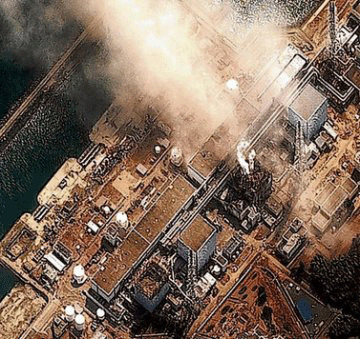 Document shows nuclear fuel burned through bottom of containment vessel under Fukushima reactor — Official: Leakage we observed indicates melt-through by ‘shell attack’ — “This is a very big problem… fuel debris in the PCV is doing something bad” (VIDEO) http://enenews.com/official-document-shows-molten-nuclear-fuel-burned-bottom-containment-vessel-fukushima-tepco-leaks-coming-reactor-indicate-melt-shell-attack-very-big-problem-fuel-debris-pcv-doing-bad-video?utm_source=feedburner&utm_medium=email&utm_campaign=Feed%3A+ENENews+%28Energy+News%29
[Good diagrams]
Shunichi Suzuki, Tokyo Electric Power Co., 2014 IRID Symposium (emphasis added):
• Part 30 – “This is the current situation… This is Unit No. 1, this shows the the lower part of the PCV [primary containment vessel]… Based on the results of research so far… the ‘sand cushion drain’… water is leaking here, which means that this section above there is damaged — so that is highly possible. Therefore, this is a very big problem, because if this is damaged, then one possibility is that shell attackhas happened [see drawing by General Electric at bottom right]. So the debris in the PCV is doing something bad to this, so we have to take that into consideration for investigation.”
• Part 31 – “Unit 2… the water level [in the suppression chamber] and the water level in the torus room is about the same . What that means is that at the bottom [of the S/C], there could be a hole. Not only there, but also there is a pump room and there are other pipings here, so that needs needs to be considered as well when they conduct the investigation.”
• Part 42 – “Unit 1… there is little fuel remaining in the core… Fuel debris exists even outside the pedestal. Therefore we give priority to outside pedestal investigation. I talked about suppressionchamber earlier, shell attack has happened perhaps— I said that — shell attack in Unit 1 is something like this. Debris may exist around here so… there is some fuel that has penetrated outside the pedestal… If debris is outside the pedestal we can’t reach it, therefore we have to consider opening a side area – it’s very unique… Regarding Unit 2 and 3… in Unit 3 we presume that more fuel than we expected has fallen down to the PCV… we cannot deny the possibility that fuel has gone outside the pedestal.”
• Part 55 – “This is a MAAP example [computer code used for estimating fuel debris position]. Improvement points… the height is increasing, we had a single transfer path [for the molten fuel], but it is going to be multiple paths. And also debris, a uniform debris deposit was the assumption, now however asymmetrical distribution has to be considered. And alsodebris below the PCV bottom [see TEPCO drawing at middle right], the behavior has to be considered.”
• Part 95 – “The level of damage is high so it may not be able to stop water… and it may not be possible to fully cover the fuel debris. In such a case innovative approaches could be considered.”
And: Image published by embassy in Japan shows Fukushima melted fuel deep underground
Residents unhappy with inadequate radiation decontamination in city of Date, Fukushima
伊達市- みんなの声 Voices of the Residents in Date, Fukushima, Evacuate Fukushima, Jul 13, 2015Nelson Surjo 子どもの未来を守る会inだて kodomonomiraiwomamorukai by Kurumi Sugita Nos Voisins Lointains 311
The City of Date has divided its territory into three zones to program decontamination work: Zone A where the measurement of ambient radioactivity exceeds 20 mSv/yr, the area adjacent to the B zone A and zone C where radioactivity does not exceed 5 mSv/yr.
In zone C, instead of decontaminating entire areas, the municipality only cleans hot spots that exceed 3μSv/h measured at 1cm off the ground. For example, if a measurement exceeds this limit on a rooftop, it won’t be decontaminated.
During the election campaign of January 2014, the incumbent Mayor Shôji NISHIDA promised to work on decontaminating the entire specified C areas. However, since his re-election, he did not fulfill his promise.
Frustrated by the lack of response from the mayor on their repeated requests for him to fulfill his promise, some residents of Date city gathered to found the “Association to Protect the Future of Children in the Date city” (Kodomo no Mirai wo kai mamoru in Date). They began installing flags and signs across town, calling for effective decontamination work. The association brings together their voices and publish on their website and Facebook page.
The following is a sample of these voices trying to pierce the ongoing deafening silence.
みんなの声 Voices of the Residents………. http://www.evacuate-fukushima.com/2015/07/voices-residents-date-fukushima/
12 miles from Fukushima’s shattered nuclear reactors, World’s Largest Offshore Wind Turbine gives hope
World’s Largest Offshore Wind Turbine Comes Online Near Fukushima Daiichi -bureau EnviroNews World News by Emerson Urry on June 28, 2015 – http://environews.tv/world-news/worlds-largest-offshore-wind-turbine-comes-online-near-fukushima-daiichi/ Fukushima Prefecture, Japan — A mere 12 miles from the full-blown triple nuclear reactor “melt-through” at Fukushima Daiichi on the eastern coast of Japan, sits a bafflingly huge, 620-foot-tall, 1,500-ton bladed beast — floating on a 5,000 ton platform in the water. The world’s largest floating wind turbine has three 270 foot long blades, can withstand 200 mile-per-hour winds, and will be able to generate “up to 7 megawatts of electricity,” making it the biggest offshore wind turbine on earth, according to Gizmodo, a popular science and technology blog.
Additionally, the downright lies and coverup perpetrated by both TEPCO and the Japanese Government surrounding the Fukushima crisis, have left a bad taste in the mouth of the population, leaving trust in the government at an all time low. Perhaps more government-backed, non-lethal energy innovations like the one just activated in Fukushima can start to rebuild the people’s trust in the government. Time will tell. – http://environews.tv/world-news/worlds-largest-offshore-wind-turbine-comes-online-near-fukushima-daiichi
1 This Month


of the week– Nuclear Reactor Information Task Force

14 May – online event From Bombs to Data Centres: the Face of Nuclear Colonialism
To see nuclear-related stories in greater depth and intensity – go to https://nuclearinformation.wordpress.com
-
Archives
- May 2026 (163)
- April 2026 (356)
- March 2026 (251)
- February 2026 (268)
- January 2026 (308)
- December 2025 (358)
- November 2025 (359)
- October 2025 (376)
- September 2025 (257)
- August 2025 (319)
- July 2025 (230)
- June 2025 (348)
-
Categories
- 1
- 1 NUCLEAR ISSUES
- business and costs
- climate change
- culture and arts
- ENERGY
- environment
- health
- history
- indigenous issues
- Legal
- marketing of nuclear
- media
- opposition to nuclear
- PERSONAL STORIES
- politics
- politics international
- Religion and ethics
- safety
- secrets,lies and civil liberties
- spinbuster
- technology
- Uranium
- wastes
- weapons and war
- Women
- 2 WORLD
- ACTION
- AFRICA
- Atrocities
- AUSTRALIA
- Christina's notes
- Christina's themes
- culture and arts
- Events
- Fuk 2022
- Fuk 2023
- Fukushima 2017
- Fukushima 2018
- fukushima 2019
- Fukushima 2020
- Fukushima 2021
- general
- global warming
- Humour (God we need it)
- Nuclear
- RARE EARTHS
- Reference
- resources – print
- Resources -audiovicual
- Weekly Newsletter
- World
- World Nuclear
- YouTube
-
RSS
Entries RSS
Comments RSS
 nuclear-news