Typhoon Soudelor hits Taiwan, then China’s coast – danger to nuclear stations
 Typhoon Soudelor toll rises to 17 in China: state media http://news.yahoo.com/typhoon-downgraded-china-killing-five-taiwan-030301544.htmlShanghai (AFP) – The number of people killed by Typhoon Soudelor in China rose to 17, state media reported on Monday, with five more missing.

Three people were killed by a mudslide and one was missing after being swept away by floods in Ningde, in the eastern province of Fujian, the Fujian Daily reported.
In neighbouring Zhejiang province 14 were killed and four were missing, the official news agency Xinhua said earlier, quoting local officials as saying that the dead and missing may have been washed away by floods or buried under ruined homes.
The total direct economic losses in the two provinces were estimated at around eight billion yuan ($1.31 billion), figures from state media showed.
Billed as the biggest typhoon of the year last week with winds of up to 230 kilometres (140 miles) an hour, Soudelor — named for a Micronesian chief — has since weakened.
It made landfall in Fujian on Saturday night after leaving six people dead in Taiwan — including two twin sisters and their mother, who had all been swept out to sea.
It also knocked out power to a record four million households on the island. [Taiwan’s nukes in danger from typhoon,too]

Some 379 people were injured by the storm in Taiwan, which saw rivers break their banks under torrential rain and towering waves pound the coastline.
The China Meteorological Administration lifted its typhoon warning Monday as the storm weakened and moved further inland.
Ageing plant and risks raise widespread concern about Japan’s nuclear restart
Local campaigners say the plant operators – Kyushu Electric – and local authorities have yet to explain how they would quickly evacuate tens of thousands of residents in the event of a Fukushima-style meltdown.
A survey by the Asahi Shimbun newspaper found that only two of 85 medical institutes and 15 of 159 nursing and other care facilities within a 30 km radius of the Sendai plant had proper evacuation plans.
About 220,000 people live within a 30km radius – the size of the Fukushima no-go zone – of the Sendai plant; a 50km radius would draw in Kagoshima city and raise the number of affected people to 900,000.
“The local authorities may have approved the restart, but they are completely out of touch with public opinion.”

 Japan split over restart of first nuclear reactor since Fukushima disaster, Guardian, Justin McCurry, 10 Aug 15 Rising costs from gas and oil are sited by supporters of a programme to bring reactors back on line, but ageing plant and risks raise widespread concern An otherwise unremarkable town in south-west Japan will be propelled this week to the forefront of the country’s biggest experiment with nuclear power since theFukushima disaster in March 2011.
After months of debate about safety, Japan will begin producing nuclear energy for the first time in almost two years close to the town of Satsumasendai as early as Tuesday.
Restarting one of the Sendai nuclear plant’s two 30-year-old reactors represents a victory for the prime minister, Shinzo Abe, who insists that without nuclear energy the Japanese economy will buckle beneath the weight of expensive oil and gas imports.
But his call for Japan to confront its Fukushima demons has been greeted with scepticism by most voters, whose opposition to nuclear restarts remains firm, even in the face of rising electricity bills. Continue reading
With 2020 Olympics in mind. Japan’s govt trying to coerce Fukushima evacuees back

Even with the massive cleanup, only about one-fifth of the 6,200 displaced residents of Iitate are willing to return, according to a recent head count by village officials.
4 Years After Fukushima Nuclear Calamity, Japanese Divided on Whether to Return By MARTIN FACKLER, NYT< AUG. 8, 2015 ITATE, Japan — For four years, an eerie quiet has pervaded the clusters of farmhouses and terraced rice paddies of this mountainous village, emptied of people after the disaster at the Fukushima Daiichi nuclear power plant, 25 miles away, spewed radiation over a wide swath of northeastern Japan……….
They accuse Tokyo of repeating a pattern from the early days of the disaster of putting residents at risk by trying to understate the danger from the accident. They say the central government is trying to achieve its own narrow political interests, such as restarting the nation’s powerful nuclear industry, or assuring the world that Tokyo is safe enough to host the Summer Olympics in 2020.
“If the national officials think it is so safe, then they should come and live here,” said Kenichi Hasegawa, a former dairy farmer in Iitate who has organized more than 3,000 fellow evacuees — almost half the village’s pre-disaster population — to oppose the return plan. “The government just wants to proclaim that the nuclear accident is over, and shift attention to the Olympics.” Continue reading
China’s massive solar farm going ahead fast in Gobi desert
 China builds huge solar power station which could power a million homes, http://www.independent.co.uk/environment/china-builds-huge-solar-power-station-which-could-power-a-million-homes-10446840.html
 The Independent, 08 August 2015 China is set to build a giant solar power station in the Gobi desert, which could generate enough energy to supply one million homes. The proposed power station will measure 10 square miles and generate 200 megawatts of solar energy.
Thousands hospitalised as Tokyo experiences record heat wave
Japan in Hot Water — Longest Heatwave on Record for Tokyo, Tens of Thousands Hospitalizedhttp://robertscribbler.com/2015/08/06/japan-in-hot-water-longest-heatwave-on-record-for-tokyo-tens-of-thousands-hospitalized/
This morning, at 10:53 AM local time in Tokyo, the temperature was a sweltering 95.2 F (35.1 C) and climbing…
For six days running thermometers in that city have been above 95 degrees F (35 C). That’sthe longest unbroken string of 95 degree + highs Japan’s capital has experienced since record-keeping began 140 years ago in 1875. In other words, parts of Japan are experiencing never-seen-before heat.
All told, recent days have seen fully 25 percent of Japan’s cities and towns hit temperatures above 95 F. It’s a heat that sinks bone deep. That gets into the blood. That makes it hard to keep going outdoors. A heat that causes injury and, sometimes, death. And over this summermore than 35,000 people have been hospitalized throughout Japan due to heat injury. Of those, more than 850 have remained hospitalized for three weeks or more. And from this grim tally 55 have now lost their lives.
Hot Ocean Waters Breed Heat Domes
The record hot air temperatures have come on due to a combination of factors. First, the ocean around Japan is abnormally warm. Recently, near-Japan sea surface temperatures have ranged from 2-5 degrees Celsius above established averages. That’s excessively hot water, especially when one considers that El Nino will typically draw the warm waters south and eastward. But this year is not at all typical with unusual-to-record heat now ranging much of the Pacific Ocean basin.
(Extreme sea surface temperatures and a heat dome high pressure system are setting the stage for record heatwaves and tragic heat injuries in Japan. Ocean temperatures in the region have ranged up to 5-6 C above average for this time of year. Image source: Earth Nullschool.)
Near Japan, the added ocean warmth lends both heat and humidity to the air about the archipelago land mass. A combination that can push wet bulb readings into ranges that are ever more difficult for human bodies to manage.
Concordant with the exceptionally hot waters surrounding Japan is a heavy heat dome high pressure system dominating the atmosphere above it. This heat dome, as with many weather systems under the regime of human-caused climate change, has been doggedly persistent. Setting up an excessively long-lasting period of record heat that has now continued off and on for weeks.
Multiple Heatwave Mass Casualty Events for Record Hot 2015
Japan joins India, Pakistan, and the Persian Gulf Region as locations experiencing heat capable of producing mass casualty events this year. In India, more than 3,000 lost their lives due to high heat and humidity during late May and early June. In Pakistan, more than 1,500 died due to the heat even as hospitals were overwhelmed by related injuries. And in Iran last week, wet bulb temperatures rocketed to a stunning 34.7 C.
Under human-forced climate change it’s a sad fact that heatwaves proliferate. We are now four times more likely to experience a heatwave on any part of the globe than we were back during the 1880s. Before our fossil fuel burning warmed the global climate by 1 degree Celsius. And as maximum temperatures and humidity push toward and past the wet bulb limit of 35 C, we are unfortunately likely to see more and more of these heatwave mass casualty events.
The atomic bombing of Nagasaki, and its aftermath – theme for this week
Entering the nuclear age, body by body — the Nagasaki experience, Asia Times, BY AT EDITOR on AUGUST 6, 2015 (From TomDispatch.com)
By Susan Southard [This essay has been adapted from chapters 1 and 2 of Susan Southard’s new 
book, Nagasaki: Life After Nuclear War, with the kind permission of Viking.] “…….The five-ton plutonium bomb plunged toward the city at 614 miles per hour. Forty-seven seconds later, a powerful implosion forced its plutonium core to compress from the size of a grapefruit to the size of a tennis ball, generating a nearly instantaneous chain reaction of nuclear fission. With colossal force and energy, the bomb detonated a third of a mile above the Urakami Valley and its 30,000 residents and workers, a mile and a half north of the intended target. At 11:02 a.m., a superbrilliant flash lit up the sky — visible from as far away as Omura Naval Hospital more than 10 miles over the mountains — followed by a thunderous explosion equal to the power of 21,000 tons of TNT. The entire city convulsed.
At its burst point, the center of the explosion reached temperatures higher than at the center of the sun, and the velocity of its shock wave exceeded the speed of sound. A tenth of a millisecond later, all of the materials that had made up the bomb converted into an ionized gas, and electromagnetic waves were released into the air. The thermal heat of the bomb ignited a fireball with an internal temperature of over 540,000 degrees Fahrenheit. Within one second, the blazing fireball expanded from 52 feet to its maximum size of 750 feet in diameter. Within three seconds, the ground below reached an estimated 5,400 to 7,200 degrees Fahrenheit. Directly beneath the bomb, infrared heat rays instantly carbonized human and animal flesh and vaporized internal organs.
As the atomic cloud billowed two miles overhead and eclipsed the sun, the bomb’s vertical blast pressure crushed much of the Urakami Valley. Horizontal blast winds tore through the region at two and a half times the speed of a category five hurricane, pulverizing buildings, trees, plants, animals, and thousands of men, women, and children. In every direction, people were blown out of their shelters, houses, factories, schools, and hospital beds; catapulted against walls; or flattened beneath collapsed buildings.
Those working in the fields, riding streetcars, and standing in line at city ration stations were blown off their feet or hit by plummeting debris and pressed to the scalding earth. An iron bridge moved 28 inches downstream. As their buildings began to implode, patients and staff jumped out of the windows of Nagasaki Medical College Hospital, and mobilized high school girls leaped from the third story of Shiroyama Elementary School, a half mile from the blast.
 The blazing heat melted iron and other metals, scorched bricks and concrete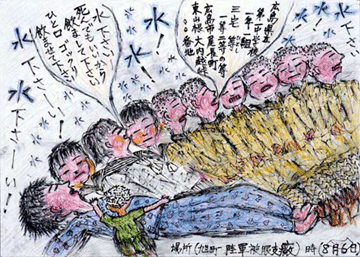
buildings, ignited clothing, disintegrated vegetation, and caused severe and fatal flash burns on people’s exposed faces and bodies. A mile from the detonation, the blast force caused nine-inch brick walls to crack, and glass fragments bulleted into people’s arms, legs, backs, and faces, often puncturing their muscles and organs. Two miles away, thousands of people suffering flesh burns from the extreme heat lay trapped beneath partially demolished buildings.
At distances up to five miles, wood and glass splinters pierced through people’s clothing and ripped into their flesh. Windows shattered as far as eleven miles away. Larger doses of radiation than any human had ever received penetrated deeply into the bodies of people and animals. The ascending fireball suctioned massive amounts of thick dust and debris into its churning stem. A deafening roar erupted as buildings throughout the city shuddered and crashed to the ground……http://www.tomdispatch.com/blog/176032/ http://atimes.com/2015/08/entering-the-nuclear-age-body-by-body-the-nagasaki-experience/
One living witness to the history of Hiroshima bombing survivors
Survivor Koko Kondo shares horror of Hiroshima’s ground zero by: YUKA HAYASHI The Wall Street Journal August 06, 2015 Every year, Koko Tanimoto Kondo tours her hometown carrying the tiny, tattered pink tunic she wore on the day, 70 years ago, she and her family survived the world’s first atomic bombing.On storytelling tours around the August 6 anniversary, Ms Kondo, who was eights months old when the bomb hit, tells students about the devastation that destroyed her home and haunted her for decades.She recalls when her American fiance abandoned her days before their wedding because his relatives thought radiation exposure had made her unable to bear children.
She shares the humiliation she felt as a teenager, standing naked on a stage while doctors and scientists scrutinised her for signs of radiation’s long-term effects on the body.
She offers tales of ordinary Americans who sent food and built homes for the victims, and continued for decades after the war to send cheques on birthdays to sons and daughters of Hiroshima connected through “moral adoption”.Ms Kondo’s father, Kiyoshi Tanimoto, was a US-educated minister at a church in Japan. When Hersey visited Hiroshima in the spring of 1946, Tanimoto shared with him a detailed account of the horror and chaos he witnessed. In the book, Tanimoto is described as passing by “rank on rank of the burned and bleeding”, scurrying to find water for dying victims, and removing a dead body from a rowboat to carry those who were still alive, after apologising to the dead man for doing so.
Ms Kondo and her mother were buried under the parsonage of her father’s church. Her mother managed to hoist her out of the rubble after chipping away at “a chink of light” that they could eventually fit through. When Tanimoto was reunited with his wife and baby, he was “so tired that nothing could surprise him”. Hersey wrote in his account, which first appeared in the New Yorkermagazine in August 1946, a year after Hiroshima and Nagasaki became the first and only cities in history to experience a nuclear bombing………..
Ms Kondo shows the visitors where her father’s church stood before it collapsed, burying her under the rubble. She takes them to the river her father crossed in a rowboat to carry victims, some grotesquely burned, to escape the devastation. They go to the Red Cross Hospital, where thousands went for refuge. Ms Kondo’s brief appearance in the book Hiroshima, by journalist John Hersey, set her on a path to become a messenger from ground zero. http://www.theaustralian.com.au/business/wall-street-journal/survivor-koko-kondo-shares-horror-of-hiroshimas-ground-zero/story-fnay3ubk-1227471529950?from=public_rss&utm_source=The%20Australian&utm_medium=email&utm_campaign=editorial
China sends back infant milk formula to Fukushima
The principle radioactive poison that is being tested for in Japanese foods is cesium-137. Unfortunately, there are also other deadly poisons that have been spewed in lesser amounts by Fukushima disaster. These include americium-241, plutonium-236, uranium-238, thorium-232 and the extremely dangerous isotope, strontium-90. All of these contaminants may also be found in food from Japan, including in baby formula.
Fukushima Baby Milk Formula Declared Unfit by China http://www.huntingtonnews.net/11938 August 5, 2015 – BY JOHN LAFORGE Chinese authorities seized more than 881 pounds of baby milk formula that had been imported from Japan because it had been produced in areas known to be heavily contaminated with radioactive material emitted by three damaged nuclear reactors at the Fukushima-Daiichi complex. Continue reading
Damaged fuel rod containers, suspicious death at Fukushima nuclear plant
 Vice: ‘Suspicious’ death at Fukushima plant — Officials: Damaged nuclear fuel containers found in Unit 3 pool after removal of massive piece of debris — “High radioactivity prevented workers from carrying out the removal smoothly” — Concern about “new fuel failure” (PHOTOS & VIDEO) http://enenews.com/vice-suspicious-death-fukushima-plant-officials-damaged-nuclear-fuel-rod-containers-found-unit-3-pool-after-debris-removed-concern-about-new-fuel-failure-high-radioactivity-prevented-workers?utm_source=feedburner&utm_medium=email&utm_campaign=Feed%3A+ENENews+%28Energy+News%29
NHK, Aug 4, 2015 (emphasis added): Fuel rod casings found damaged by debris… workers have found damaged fuel rod containers after removing a device that had fallen on them during the 2011 disaster. They’re now checking whether the damage will affect their plan to remove fuel from the pool. A 20-ton device for moving fuel rods in and out of the pool on the building’s top floor was removed on Sunday… High radioactivity prevented workers from carrying out the removal smoothly… Workers found that the metal casings of 4 assemblies had been distorted and have twisted handles. This is evident in images released by the operator… The utility is checking for other damage and studying how to remove the distorted casings from the pool.
TEPCO (pdf), Aug 4, 2015: Unit 3 Spent Fuel Pool… we found bent handles of 4 nuclear fuel assemblies located under the Fuel Handling Machine which was removed on August 2nd… there is no indication ofnew fuel failure by the removal… In the future, when discussing fuel removal, we will consider how to deal with the bent handles of nuclear fuel assemblies.
Vice News, Aug 4, 2015: A 30 year-old man died this weekend as he worked on decommissioning Japan’s Fukushima nuclear plant… It is not yet known whether the man’s death was due to radiation exposure, and an autopsy is pending… In a statement released Monday, [Tepco] said that the man had been taken to the emergency room after complaining that he wasn’t feeling well. “His death was confirmed early in the afternoon,” Tepco said. Isabelle Dublineau, the head of the experimental radiotoxicology laboratory for France’s Institute for Radiological Protection and Nuclear Safety (IRSN), said… it was “too early” to comment on the death… While the latest death has already been branded suspicious in the media, Tepco has so far denied that any of the deaths are related to radiation exposure… The worker who died over the weekend was working… on the construction of the “ice wall”…
Fukushima: ALL EVIDENCE POINTS TO MELT DOWNS IN BOTH NUCLEAR REACTORS 5 AND 6
Fukushima; Reactors And/Or SFP’s In #5 And #6 Melted Down – Total of 7 Melt Down’s, Melt Outs, Nuclear Explosions A Green Road Blogspot, 12 July 15,
- massive amounts of hydrogen/tritium gas released out of holes cut in the buildings
- high levels of cesium in the drains coming from 5 and 6
- radioactive water in the basements, hauled away by US military barge
- white smoke from both buildings
- melted fuel in pipe picture
- broken pipes in all buildings
- report of melted down fuel
- report of radioactive xenon gas releases months after disaster
Gov’t model shows Fukushima radioactive gas near Tokyo skyrocketed to 10,000,000,000 times normal levels soon after 3/11 – “Very high concentrations” recorded at all monitoring posts in northern hemisphere (VIDEO)
http://enenews.com/noaa-model-shows-fukushima-radioactive-gas-tokyo-skyrocketed-10-billion-times-normal-levels-after-311-very-high-concentrations-recorded-all-monitoring-posts-northern-hemisphere-video
Radioactivity in the drains, in the gas/air and in the water in the basements comes from melting down fuel rods, not normal operations from a shut down and cooled off reactor and spent fuel pools, wouldn’t you agree?
And where did all of that highly radioactive water from the basements of the #5 and #6 buildings go, by the way, in that US supplied barge? Where did the high level radiation in the water come from? Where did that melted fuel in the pipe go?
In all of the other buildings, the high level radiation in the basements comes from broken reactors with melted down fuel in them. Certainly radioactive water does not come from the tsunami, because the tsunami wave was clean, pure ocean water. And pray tell TEPCO, what was the radiation level in that water, from buildings 5 and 6, hmmmmmm?
MELTDOWN OF THE TRUTH AROUND BUILDINGS 5 AND 6
Problems ahead, if Japan restarts mothballed nuclear reactors
Japan Heads Toward Nuclear Unknown With Post-Fukushima Restarts, Bloomberg by Stephen Stapczynski Yuriy Humber August 6, 2015 Japan is about to do something that’s never been done before: Restart a fleet of mothballed nuclear reactors.
The first reactor to meet new safety standards could come online as early as next week. Japan is reviving its nuclear industry four years after all its plants were shut for safety checks following the earthquake and tsunami that wrecked the Fukushima Dai-Ichi station north of Tokyo, causing radiation leaks that forced the evacuation of 160,000 people.
Mothballed reactors have been turned back on in other parts of the world, though not on this scale — 25 of Japan’s 43 reactors have applied for restart permits. One lesson learned elsewhere is that the process rarely goes smoothly. Of 14 reactors that resumed operations after four years offline, all had emergency shutdowns and technical failures, according to data from the World Nuclear Association, an industry group.
In Sweden, E.ON Sverige AB closed the No. 1 unit at its Oskarshamn plant in 1992 and restarted it in 1996. It had six emergency shutdowns in the following year and a refueling that should have taken 38 days lasted more than four months after cracks were found in equipment……..The challenges facing the NRA are “absolutely unique worldwide,” said John Large, chief executive at Large & Associates, a London-based engineering consultant to the nuclear industry. “You have had the whole nation’s fleet of nuclear power plants closed down for four years.”
Long-Dormant
As problems can arise with long-dormant reactors, the NRA “should be testing all the equipment as well as the operator beforehand in preparation,” Macfarlane of the U.S. said by e-mail. …….http://www.bloomberg.com/news/articles/2015-08-05/japan-heads-toward-nuclear-unknown-with-post-fukushima-restarts
Every year, thousands of Hiroshima survivors treated for radiation-induced illnesses
Hiroshima nuclear bomb 70th anniversary: New research shows thousands of survivors treated every year August 6, 2015 Julie Power Reporter
“…….New Red Cross data released on Thursday shows that even 70 years after the atomic blasts, Japanese hospitals treat thousands of survivors each year, mostly for cancer which has caused two-thirds of deaths. In the past 12 months, the Red Cross hospitals treated nearly 11,000 survivors.
The full impact of the blast on the survivors and their children who are now reaching 50 years of age, is still not fully known, Dr Masao Tomonaga, the director of the Japanese Red Cross Nagasaki Atomic Bomb Hospital and a survivor told Fairfax Media this week.
As well as suffering higher rates of cancer, new research by the Red Cross hospitals showed survivors who had lived close to the epicentres were also 1.5 times more likely to suffer from heart attacks and angina.
“I couldn’t imagine (these results) before we started this research some 65 years ago (when the hospitals were built.) This means atomic bomb radiation is a life-long effect, with evidence of a life-long susceptibility to cancers, leukaemia and heart attacks,” Dr Tomonaga said.
Of the 16,000 nuclear weapons held today, 1800 are launch ready and any one would make Little Boy or Fat Man “look tiny” and wipe out a city like Sydney, said Robert Tickner, the CEO of the Australian Red Cross. No country or medical service could handle the immediate or long-term impacts, including the millions who would go hungry, Red Cross research has found.
Mr Tickner is calling on Australians and their leaders to support a ban on nuclear weapons for humanitarian reasons.
The author Junko Morimoto drawing as a young girl near what became the Hiroshima Peace Memorial.Photo: Junko Morimoto
“If the world has moved on biological and chemical weapons as illegal weapons of war, if we have moved on clusters, landmines and had conventions to tackle those to deal with them as a weapon of war, what madness is it that we have not taken a similar stand on nuclear weapons.They are the standout greatest threat to the planet,” he said.
Around 113 countries have now signed the Austrian Pledge to prohibit and eliminate nuclear weapons because of their unacceptable humanitarian consequences. The federal government hasn’t signed, but the ALP ‘s new party platform, amended at last month’s conference, agrees to “prohibiting and eliminating nuclear weapons is a humanitarian imperative.”…..http://www.smh.com.au/nsw/hiroshima-nuclear-bomb-70th-anniversary-new-research-shows-thousands-of-survivors-treated-every-year-20150804-girqz8.html#ixzz3i4jl5UGt
Scary part of Fukushima is the sheer epic scale of this mega nuclear disaster
Fukushima; Reactors And/Or SFP’s In #5 And #6 Melted Down – Total of 7 Melt Down’s, Melt Outs, Nuclear Explosions A Green Road Blogspot, 12 July 15, “………CONCLUSION
Building 1 – melted out
Building 2 – melted out
Building 4 – melted out from at least the equipment pool
Building 5 – melted down
Building 6 – melted down
TEPCO exploits homeless, mentally disabled men, in Fukushima nuclear clean-up
 TV: Mentally disabled are working at Fukushima Daiichi, says journalist — Many men forced to go to plant — Homeless treated like ‘disposable people’(VIDEO) http://enenews.com/tv-journalist-says-theres-mentally-disabled-workers-at-fukushima-many-men-forced-to-work-at-plant-homeless-treated-like-disposable-people-video
RT News, Nov. 20, 2013: Homeless men employed cleaning up the stricken Fukushima nuclear plant, including those brought in by Japan’s yakuza gangsters, were not aware of the health risks they were taking and say their bosses treated them like “disposable people.” […] While some workers voluntarily agreed to take jobs on the nuclear clean-up project, many others simply didn’t have a choice […] many of the workers were brought into the nuclear plant by Japan’s organized crime syndicates, the yakuza. […] Although a special task force to keep organized crime out of the nuclear clean-up project has been set up, investigators say they need first-hand reports from those forced to work by the yakuza […]
Anonymous former Fukushima worker: We were given no insurance for health risks, no radiation meters even. We were treated like nothing, like disposable people — promised things, and then kicked us out when we received a large radiation dose.
Tomohiko Suzuki, journalist who worked at Fukushima plant: The government called Tepco to take urgent action, Tepco relayed it to subcontractors — and they, eventually, as they had a shortage of available workers, called the Yakuza for help. […] They were given very general information about radiation and most were not even given radiation meters. They could have exposed themselves to large doses without even knowing it. Even the so-called Fukushima 50 […] at least three of them were enrolled by the yakuza.
Aleksey Yaroshevsky, RT: There are 25% more openings for jobs at Fukushima plant than applicants, according to government data. Gaps filled, says Suzuki, by the homeless, the desperately unemployed and even those with mental disabilities.
The effects of radiation have haunted the lives of atomic bomb survivors.
The A-bombs fell / Specter of radiation lingers on , Japan News, , August 04, 2015, August 04, 2015 The Yomiuri ShimbunThis is the second installment in a series. “……….When hibakusha (atomic bomb survivors) need treatment due to malignant tumors, leukemia, cardiac infarcts and other ailments, they may be officially recognized as having radiation sickness. This entitles them to a special monthly medical allowance of about ¥140,000, which is provided by the government apart from medical costs.
However, there are certain requirements for receiving the allowance, such as how far they were from Ground Zero when they were exposed. There were a total of 183,519 holders of special hibakusha health-care certificates for the bombings in Hiroshima and Nagasaki as of the end of March, but only 4.8 percent of them, or 8,749, were recognized as having radiation sickness………..
Poverty and discrimination
The effects of radiation have haunted the lives of atomic bomb survivors.

“Just as I expected.” So thought a 72-year-old woman in Kure, Hiroshima Prefecture, when she was diagnosed with malignant lymphoma at a hospital nine years ago.
Her older brother and sister, both hibakusha, died from cancer after the war. The woman was the youngest of seven siblings, a boy and six girls. She experienced the bombing when she was 2 years old, in Ushita-Honmachi, now Higashi Ward, in the city of Hiroshima, about 2.5 kilometers from the blast center.
Looking for her brother and sisters, she entered the central area of the city while being carried by her mother for several days.
Her mother died eight months later, probably as a result of that exposure, while her father also died from a disease. The woman was adopted by another family, but three years later, her brother, who was also exposed to the Hiroshima bombing and had reached the age of 17, took her back……..
The woman was recognized as having radiation sickness in 2009. However, a neighbor told her, “You’re lucky to be a recipient” of the special monthly medical allowance. These words were very painful and in May this year, she refused to accept the money.
She wants people to know about her suffering but does not want them to know that she is hibakusha. This spring, a shadow was also found in her pancreas.
“My family was devastated, and I suffered from poverty and discrimination. My life is bound to the atomic bomb. I want to be freed from this,” she said in a trembling voice http://the-japan-news.com/news/article/0002331263
-
Archives
- October 2026 (112)
- September 2026 (339)
- August 2026 (330)
- July 2026 (355)
- June 2026 (287)
- May 2026 (306)
- April 2026 (356)
- March 2026 (251)
- February 2026 (267)
- January 2026 (308)
- December 2025 (358)
- November 2025 (359)
-
Categories
- 1
- 1 NUCLEAR ISSUES
- business and costs
- climate change
- culture and arts
- ENERGY
- environment
- health
- history
- indigenous issues
- Legal
- marketing of nuclear
- media
- opposition to nuclear
- PERSONAL STORIES
- politics
- politics international
- Religion and ethics
- safety
- secrets,lies and civil liberties
- spinbuster
- technology
- Uranium
- wastes
- weapons and war
- Women
- 2 WORLD
- ACTION
- AFRICA
- Atrocities
- AUSTRALIA
- Christina's notes
- Christina's themes
- culture and arts
- Events
- Fuk 2022
- Fuk 2023
- Fukushima 2017
- Fukushima 2018
- fukushima 2019
- Fukushima 2020
- Fukushima 2021
- general
- global warming
- Humour (God we need it)
- Nuclear
- RARE EARTHS
- Reference
- resources – print
- Resources -audiovicual
- Weekly Newsletter
- World
- World Nuclear
- YouTube
-
RSS
Entries RSS
Comments RSS

