Amid protests, Kyushu Electric restarts Sendai nuclear plant in Kagoshima
 SATSUMA-SENDAI, Kagoshima Prefecture–Kyushu Electric Power Co. activated the No. 1 reactor of the Sendai nuclear power plant here on Aug. 11, the first to be restarted in Japan under new safety regulations instituted after the Fukushima nuclear disaster.
The reactor is the first of 43 across the nation to be brought back online, ending a period with no nuclear power, which lasted for a year and 11 months.
As anti-nuclear protesters rallied around the Sendai plant, located in Satsuma-Sendai city, work to restart the No. 1 reactor began in the central control room at 10:30 a.m. on Aug. 11.
Kyushu Electric workers pulled a lever to remove the control rods that had curbed nuclear fission in the reactor.
The 32 control rods began to withdraw, reactivating the reactor.
The reactor is expected to reach criticality, in which nuclear fission is self-sustaining, at around 11 p.m. on Aug. 11. Steam produced from the heat generated by the nuclear fission will drive a turbine to produce electricity.
The generation and transmission of electricity is expected to begin on Aug. 14. The output will be raised gradually, reaching full power generation in late August and shifting to a commercial operation in early September.
In a statement, Kyushu Electric Power President Michiaki Uriu said, “The activation of the nuclear reactor is one of the important steps in the process for restart. We will continue to deal sincerely with the government’s inspections and proceed with the subsequent process by putting a top priority on safety.”
In September 2014, the Sendai nuclear power plant passed the new safety regulations for the first time in the nation. In March this year, the Nuclear Regulation Authority started the inspection process that is required before a nuclear reactor can be reactivated. In July, nuclear fuel was brought into the reactor.
As operations of the reactor had been suspended for about four years, Kyushu Electric proceeded cautiously with the preparations.
All nuclear reactors in Japan were taken offline soon after the March 2011 Great East Japan Earthquake and tsunami triggered three meltdowns at the Fukushima No. 1 nuclear power plant. Though Kansai Electric Power Co. temporarily operated the No. 3 and No. 4 reactors of its Oi nuclear power plant in Fukui Prefecture to deal with an electricity shortage, it suspended operations again in September 2013.
The electric power industry is pushing for the restart of idled nuclear reactors. The Abe administration also regards nuclear power as vital to the nation’s power needs.
Kyushu Electric plans to restart the No. 2 reactor at its Sendai nuclear power plant in mid-October. Preparations for a restart are progressing at the No. 3 and the No. 4 reactors of Kansai Electric’s Takahama nuclear power plant in Fukui Prefecture and the No. 3 reactor of Shikoku Electric Power Co.’s Ikata nuclear power plant in Ehime Prefecture.
One stumbling block for the Takahama plant is a temporary injunction the Fukui District Court issued in April this year to prohibit the restart.
Meanwhile, anxieties remain among residents living near nuclear power plants over insufficient emergency measures in the event of a nuclear accident. For example, the formulation of evacuation plans has been delayed for some medical and welfare facilities that house many elderly people.
In the Kyushu region where the Sendai nuclear power plant is situated, volcanic activity poses a threat. Therefore, some opponents argue that it is necessary for nuclear power plants to take safety measures against major eruptions.
The spread of summer power-saving campaigns and solar power generation have reduced concerns over electricity shortages even when no nuclear reactors are operating. A stable electricity supply is continuing across the nation even amid a serious heat wave.
Opposition to the restart of nuclear plants remains strong among the public.
Source: Asahi Shimbun
http://ajw.asahi.com/article/behind_news/social_affairs/AJ201508110066
Explosion in Tianjin, China – in warehouse supplying nuclear fuel?
Top Asian News at 11:00 pm GMT
TIANJIN, China (AP) — Huge explosions at a warehouse for … ore which could supply its nuclear weapons program or fuel nuclear reactors, …–
The blasts ripped through a warehouse storing “dangerous goods” in Tianjin’s Binhai New Area around 11:30 p.m. local time, China’s official Xinhua News Agency said. http://www.wsj.com/articles/huge-blast-rocks-chinese-city-1439403843
Japan restarting nuclear reactor – but what about Japan’s intractable problem of wastes?
 Nuclear restart highlights government dilemma over lack of waste disposal sites, Japan Times BY KAYO MIMIZUKA KYODO AUG 11, 2015 With an unpopular return to nuclear power generation, Japan can no longer ignore the elephant in the room: where is the country’s highly radioactive nuclear waste going?
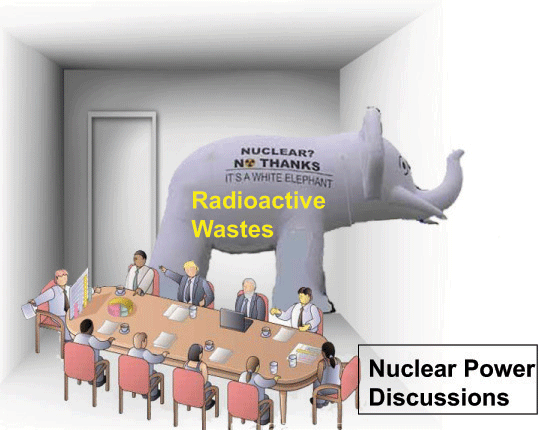
The reboot Tuesday of a reactor at Kyushu Electric Power Co.’s Sendai plant in Kagoshima Prefecture comes as the government struggles to find a final disposal site for high-level nuclear waste.
Currently, around 17,000 tons is sitting in temporary storage pools across the country, and the restart means the generation of even more.
Spent fuel pools at some nuclear plants will reach their capacity in as soon as three years.
A spokeswoman at Kyushu Electric said the Sendai plant’s storage pools “still have enough room,” suggesting the utility is not planning to immediately take further measures. But they are expected to become full in roughly 11 years, according to official data.
International concerns are also growing over the increase in Japan’s possession of plutonium due to its potential for falling into the wrong hands and being used to make nuclear weapons. As of the end of 2014, Japan had 47.8 tons of plutonium, up 0.7 tons from a year earlier.
Under Japan’s nuclear fuel recycle policy, plutonium extracted by reprocessing conventional uranium fuel is consumed by reactors in the form of plutonium-uranium mixed oxide fuel, known as MOX. But its feasibility remains uncertain, given public concerns after the Fukushima disaster.
Currently, the government plans to store nuclear waste at a final repository more than 300 meters underground. It would sit there for up to 100,000 years until radiation levels fall low enough and there is no harm to the environment……
In May, the Cabinet of Prime Minister Shinzo Abe introduced a scheme allowing the government to choose candidate sites based on scientific grounds, including resistance to earthquakes……
Hideyuki Ban, co-director of the Citizens’ Nuclear Information Center, said finding a location to build a disposal site in Japan is even more difficult than in other countries due to the public’s sensitivity to nuclear power given the Fukushima crisis.
“For now, there is no national consensus at all on what to do with nuclear power generation down the road,” Ban said. “As the majority of people oppose nuclear power, surely there will be a backlash” against the government’s plan.
Since May, the government has been briefing municipalities on how it selects candidate sites.
Such meetings have been held in all 47 prefectures except Fukushima, but officials from some communities refused to take part out of fear their attendance might be considered a sign of their intention to accept a disposal site.
Questions have also arisen over the transparency of the process……http://www.japantimes.co.jp/news/2015/08/11/national/nuclear-restart-highlights-government-dilemma-lack-waste-disposal-sites/#.VcrZ3LKqpHx
Politics, Safety, Money – all factors working against Japan’s supposed nuclear power revival
Japan’s return to nuclear meets with fear and loathing, CNBC, Nyshka Chandran | @NyshkaC 11 Aug 15, “………..Tuesday’s restart has far-reaching consequences for Japan’s politics and economy. Here are the key issues:
The move is highly controversial among citizens, with regular opinion polls revealing that a clear majority of the population want Japan to end nuclear power………”This is absolutely the worst possible timing given public opinion is significantly moving away from Abe: There is already backlash against his security bills and last week’s Hiroshima commemoration didn’t go well for him either,” James Brown, assistant professor at Temple University in Tokyo, told CNBC, referring to new legislation that would end Japan’s pacifist constitution.
“If we start to see some connection between nuclear issues and the collective self-defense concept behind the security bills, i.e. a connection between civilian and military nuclear usage, that’s particularly dangerous for Abe’s popularity.”
Despite public disapproval, the government will be able to implement its nuclear policies due to the lack of a strong political opposition, Brown explained.
Safety
Kyushu’s Sendai reactor was commissioned around 30 years ago, raising doubts whether the unit may be too old to withstand future disasters, such as the large earthquakes common across Japan.
“They are on the edge, seeing as most reactors above 40 years of age are considered to be aging,” Daniel Aldrich, professor of political science and co-director of the Center for Resilience Studies at Northeastern University in Boston, told CNBC.
The country has embraced stricter guidelines and new technology for the entire nuclear industry since the 2011 tragedy, but according to Aldrich, “the question is, for Japan to extend the life and licensing of these aging reactors, can they convince the population that these reactors are safe?”
The Sendai reactor is also located near an active volcano……..
Money…….“In the longer term, Japan’s population will be in decline, they will be more efficient in energy usage, and overall gas demand should slow. The government is also going big on renewable energy, which should also lower demand.”………”Marginal operating expenses are low but the longer-term costs are incredibly high. Regulatory standards have increased, so nuclear operators need to install more equipment, which means higher costs,” Brown added.http://www.cnbc.com/2015/08/10/japans-return-to-nuclear-meets-with-fear-and-loathing.html
A nuclear revival in Japan is by no means a sure thing
Japan restarts reactor – A nuclear revival? , DW, 11 Aug 15 “…….The government’s nuclear energy program, however, remains controversial in Japan……..PM Abe’s decision to ignore the prevailing public opinion can be explained by the huge amount of influence exercised by regional electricity lobbies on politicians, said Franz Waldenberger, Japan expert at the Tokyo-based German Institute for Japan Studies (DIJ).
“Major media outlets in the country have also been unable to escape this influence, making it extremely difficult for opponents to make themselves heard,” he told DW. Added to this is the lack of any real opposition for Abe either within or outside his Liberal Democratic Party, Waldenberger noted.
Clever tactics
Abe has also maneuvered skillfully in terms of his energy policy. At first, he promised to reduce Japan’s high-reliance on nuclear power as much as possible. This was followed by the PM’s announcement of making nuclear power part of the “main sources of electricity,” and ultimately by raising the intended share of nuclear power in the country’s energy mix from 20 to 22 percent……….
Sakurajima, one of Japan’s active volcanoes, is only 50 kilometers away. Several volcanologists have contradicted the inspectors who argue that the mountain poses no threat. TheAsahi newspaper criticized the ongoing “systemic vulnerability” of the nuclear reactors given that nothing had changed in terms of their classification into groups.
Other experts even think that restarting the reactors after such a long period of time is dangerous. According to the World Nuclear Association, the restart of 14 nuclear reactors around the world after four years of idleness led to emergency shutdowns and technical failures.
An unrealistic goal?
There is significant opposition in Japan to bringing the reactors back online
There are also big doubts about a renaissance of nuclear energy in the East Asian country. “There is just too much happening in terms of renewable energy sources which are becoming increasingly competitive in Japan,” said Waldenberger, adding that this is already being reflected in the country’s energy mix…….
Furthermore, operators will also have to deal with the consequences of the deregulation of the Japanese energy market, which will allow consumers to switch to “green energy” from 2016. And they will also have to face the fact that they are running out of storage space for used nuclear fuel elements. Japan doesn’t even have temporary storage facilities for this purpose. http://www.dw.com/en/japan-restarts-reactor-a-nuclear-revival/a-18640138
Most Japanese oppose nuclear power restart; support drops for PM Shinzo Abe
Japan PM Abe’s support slips, majority oppose nuclear restart http://www.dailymail.co.uk/wires/reuters/article-3191885/Japan-PM-Abes-support-slips-majority-oppose-nuclear-restart.html By REUTERS, 10 August 2015 TOKYO, Support for Japanese Prime Minister Shinzo Abe has slipped to just over 30 percent and a majority oppose the planned restart of a nuclear reactor that went offline after the 2011 Fukushima disaster, a poll by the Mainichi newspaper showed on Monday.
The three-point decline to 32 percent – the lowest since Abe returned to office in December 2012 – comes as voters fret over a shift in security policy that would end a ban on the military fighting overseas to defend a friendly country. That could let Japan’s troops fight abroad for the first time since World War Two.
Abe’s ratings began dropping sharply after scholars told a parliamentary panel in June the legislation would violate Japan’s post-war, pacifist constitution. Abe says the change will boost deterrence and make war less likely but critics fear Japan could get embroiled in a U.S.-led conflict.
Fifty-seven percent of respondents to the weekend survey opposed Kyushu Electric Power Co’s restart of a reactor at its Sendai plant in southwest Japan, set for Tuesday. Thirty percent supported the reboot, the first in nearly two years, which will reopen the nuclear sector.
Opposition to Abe was higher among women than men. Only 26 percent of female voters backed his government compared to 40 percent of men.
Japan’s fragmented opposition parties, however, are not benefiting from Abe’s woes. Support for the ruling Liberal Democratic Party (LDP) was flat at 28 percent but that of the main opposition Democratic Party was just 9 percent.
Nor has any LDP rival so far indicated a desire to challenge Abe in a party leadership election that must be held next month. (Reporting by Linda Sieg; Editing by Alan Raybould)
Japan’s govt pursuing nuclear power, while having no effective plan for wastes
It was bureaucrats who made the plan to demand each prefecture to build it. There has been no viable explanation why each prefecture has to be responsible for the solution.
This is a typical example of negative aspect of top-down style bureaucracy in Japan
 No Exit for Radioactive Wastes http://hitaku7664.blogspot.com.au/2015/08/no-exit-for-radioactive-wastes.html While Government of Japan promotes nuclear policy of resuming some nuclear power plants, the people in the area suffered from radioactive materials emitted by broken First Fukushima Nuclear Power Plant are still living with great amount of contaminated soil, grass or trees. Although the government decided that those contaminated wastes should be treated by each prefecture, programs to build processing facilities are deadlocked by firm opposition by the residents. The government is facing a necessity for changing their plan.
Ministry of Environment designated radioactive waste, caused by the accident in Fukushima, with 8,000 Becquerel per kilogram or more as necessary to be under control of public sector. Concerning firm opposition from Fukushima, if those waste would be concentrated to Fukushima, the ministry decided that the disseminated waste should be processed in each prefecture.
Among five prefectures around Fukushima in need of building processing facility, Miyagi and Tochigi have been seeing strong protest of the residents. In Tochigi, although the ministry determined the place for the facility in Shioya Town, the people there organized broad movement against the plan. They pointed out fundamental contradiction of Ministry of Environment that it was building environmentally harmful facility in the place close to a water source which the ministry had formerly registered as a pure water source to be protected.
Chiba has been regarded as the place where the facility would be build first. Tokyo Electric Power Company offered an unused land in Chiba city for the facility. But, residents started protesting activities, arguing that the reason of selecting the place was unclear or liquidation caused by great earthquake would be concerned. Two thousand metric tons of radioactive waste in Chiba has still no way to go.
Now, the question is whether the decision of Ministry of Environment to process radioactive waste in each prefecture was right or wrong. The lawmakers passed a law which determined that national government would deal with radioactive waste caused by Fukushima accident. But the law did not require each prefecture to build processing facility. It was bureaucrats who made the plan to demand each prefecture to build it. There has been no viable explanation why each prefecture has to be responsible for the solution.
This is a typical example of negative aspect of top-down style bureaucracy in Japan. The key is whether bureaucrats would admit their wrong decision and change the course to plan B.
Digital archives on Fukushima documents
NPO launches digital archives on Fukushima nuclear disaster, Japan Times, BY KEIJI HIRANO, 11 Aug 15 KYODO A Tokyo-based nonprofit organization has launched a digital archive of public documents on the 2011 nuclear catastrophe at the Fukushima No. 1 plant, so people can examine whether administrative bodies have pursued appropriate policies since the disaster started.
There are currently over 3,000 documents organized by Access-Info Clearinghouse Japan on file, totaling some 60,000 pages obtained from central government offices and local-level authorities through freedom-of-information requests or from the home pages of each administrative body.
“Some of the official documents may be stored as historical papers in the future, but others may be eventually lost after they’ve been screened,” said Yukiko Miki, who heads the NPO.
“It is necessary to create conditions to allow people to access these documents even 20 or 30 years later to ensure effective follow-up on radioactivity impact, which must have a late onset, and examine policies over the disaster as it will take a long time to put it under control,” she added.
The documents on the archives include summaries of teleconferences involving the government, Tokyo Electric Power Co. and the Fukushima No. 1 complex, which came from the Cabinet Office, as well as those on decontamination and radioactive waste owned by the Environment Ministry.
Papers filed with the Radiation Medical Science Center of Fukushima Medical University, including those on health monitoring, and summaries of joint press conferences of the government and Tepco are also available.
Users of the archives are able to find their target documents through keyword retrievals.
“Information disclosure allows us to examine policy decision processes, and the public examination will push administrative bodies to make better decisions,” Miki said. “This type of scrutiny will lead to better administrative work, particularly on behalf of those affected by the disaster.”
As only portions of some documents were disclosed, the NPO has posted them on the archives as they are…….
Touching on the lawsuit and the launch of the archives on the nuclear disaster, Miki said: “I believe we have to take concrete action to achieve our right to know rather than merely insisting on it.”
She said her organization will continue seeking the disclosure of official documents, such as records of the nuclear disaster dosimetry and policy records on evacuations of those living near the Fukushima complex, to improve and expand the archives in the span of 10 to 15 years.
The URL of the archives, which is available without charge and only in Japanese, iswww.archives311.org. http://www.japantimes.co.jp/news/2015/07/31/national/npo-launches-digital-archives-fukushima-nuclear-disaster/#.VcpzcXGqpHx
Solar power races ahead as China builds huge station in Gobi desert
China builds huge solar power station which could power a million homes, http://www.independent.co.uk/environment/china-builds-huge-solar-power-station-which-could-power-a-million-homes-10446840.html The Independent, ALEXANDRA SIMS, 08 August 2015 China is set to build a giant solar power station in the Gobi desert, which could generate enough energy to supply one million homes. The proposed power station will measure 10 square miles and generate 200 megawatts of solar energy.
The plans will fall in line with the Chinese government’s ambitious initiative to reduce the country’s fossil fuel energy by 20 per cent by 2030 in addition to cutting its green house gas emissions.
Construction began six years ago on the country’s first large –scale power station, according to National Geographic.Recent photos from NASA satelites show that the solar panels making up the plant cover an area roughly three times bigger than was seen three years ago.
China is quickly becoming a world leader in solar power.
According to the International Energy Agency, the country produces two-thirds of all solar panels and it gained more solar capacity than any other country in the world last year. China invested $83.3 billion dollars last year into renewable energy, more than any other country, according to a report from the UN Environment programme.
The United States, despite being the second highest investors in renewable energies, invested less than half this amount.
Jennifer Morgan, director of the climate program at the World Resources Institute told National Geographic: “China is largely motivated by its strong national interests to tackle persistent air pollution problems, limit climate impacts and expand its renewable energy job force.”
She added that China, presently the greatest emitter of greenhouse gases, will be able to meet its pledge if it continues with its new emphasis on renewables.Chinese Premier Li Keqiang said: “China’s carbon dioxide emission will peak by around 2030 and China will work hard to achieve the target at an even earlier date,” according to Reuters.
A global boom in solar power could be on the cards, according toBloomberg New Energy Finance, as panels get cheaper and batteries become more advanced.
By 2040, they predict, in moves led partly by China, solar power could account for one-third of new electricity.
Standards for nuclear related deaths in Fukushima
Fukushima Pref. eyes uniform standards for recognizing deaths as related to nuke accident http://www.fukushimaminponews.com/news.html?id=368 26 June 2014 The Fukushima prefectural government is considering correcting municipal imbalances in standards for recognizing local people’s deaths as being related indirectly to the 2011 accident at the Fukushima Daiichi Nuclear Power Station of Tokyo Electric Power Co. Specifically, the local government is seeking to have city, town and village offices share information on the causes of deaths believed associated with the nuclear disaster caused by the March 11, 2011 killer earthquake and tsunami.
At a prefectural assembly session on June 25, a senior prefectural government official in charge of compensation for damage from the disaster said it is becoming increasingly difficult to identify a relationship between deaths and the accident due to the long period of time that has lapsed, adding that the local government will call meetings with municipalities as needed to exchange information and share examples of accident-related deaths.
According to the prefectural government, 1,729 people had died as a result of lingering effects of the accident as of June 25, exceeding the 1,603 deaths caused directly by the disaster. The government intends to provide municipal authorities with information on accident-related deaths in an aggressive manner to help standardize norms for identifying such fatalities.
Note: Nuclear accident-related deaths result from deterioration in health conditions following protracted life in shelters as evacuees and they are recognized by a panel of experts such as medical doctors and lawyers set up by each municipality. A sum of 5 million yen is paid as consolation money to a family in the case of the death of a main income earner and half the sum for other dead family members.
(Translated by Kyodo News)
Lifting of Japanese food ban to require more time: minister
Taiwan is working toward lifting a ban on food imports from Japanese prefectures affected by the 2011 meltdown at the Fukushima Dai-ichi nuclear power plant, but the timeline will depend on further evaluations by health authorities, Minister of Foreign Affairs David Lin (林永樂) said yesterday.
“I believe we are moving in that direction,” Lin said in response to questions on whether Taiwan is working toward lifting the ban on Japanese products from areas affected by the nuclear disaster.
Since Taiwan tightened regulations on imported Japanese food on May 15, “to date there have been no safety concerns associated with food products imported from Japan,” Lin said.
Lin said the Ministry of Health and Welfare is conducting further assessments and the government is also looking at how other countries have been dealing with the situation.
“Basically, the vast majority of countries are moving toward lifting restrictions, but we still hope that the Ministry of Health and Welfare can give a clear explanation of [the results of] its assessments at an appropriate time,” Lin said.
Even if the ban is lifted, Lin added, the new regulations implemented in May are to continue.
The new measures require Japanese food product importers to present certificates that show the place of origin of their products and radiation inspection results for certain types of products, such as tea, baby food and aquaculture products.
The new regulations were imposed after it was found in March that products from five restricted areas in Japan had made their way into Taiwan through the use of false labels.
Taiwan currently bans food imports from the Japanese prefectures of Fukushima, Ibaraki, Tochigi, Gunma and Chiba, which were affected by a meltdown in March 2011 after Japan was struck by a disastrous earthquake and tsunami.
Source: Taipei Times
http://www.taipeitimes.com/News/taiwan/archives/2015/08/11/2003625096
Fukushima governor seeks safety first
The governor of Fukushima Prefecture says Japan’s nuclear energy policy should place utmost priority on ensuring people’s safety and giving them a sense of security.
Masao Uchibori issued a statement in response to the restart on Tuesday of a nuclear plant in southwestern Japan, the first time in nearly 2 years for a nuclear facility in the country to come online. He said the government’s policy should reflect the lessons learned from the accident at the Daiichi plant in Fukushima.
He said his prefecture will continue pressing the government and Tokyo Electric Power Company to scrap all nuclear plants in Fukushima. TEPCO is the Daiichi plant’s operator.
Uchibori said the prefecture will also do its utmost to realize its basic principle for reconstruction — fostering a society that does not depend on nuclear power.
Former residents of Namie Town, which was designated a no-entry zone after the nuclear accident, expressed mixed emotions at the news of the restart of the Sendai plant.
An 83-year-old man was against the move, saying the suffering endured by the evacuees in Fukushima can never be understood by others.
A 44-year-old woman said the restart probably can’t be avoided. Even so, it gives her complicated feelings. She said she believes the normal order of business is to restart nuclear reactors only after confirming that all safety measures are in place — such as securing a final disposal site for spent nuclear fuel and designating evacuation routes in case of emergencies.
The woman said she wants the government to think more about protecting lives than profits, by looking at issues from the people’s perspective.
Source: NHK
http://www3.nhk.or.jp/nhkworld/english/news/20150811_20.html
Sendai nuclear plant restarted
A nuclear reactor has been restarted in Japan for the first time in nearly 2 years.
The No.1 reactor at the Sendai nuclear plant in southwestern Japan is the first to go back online under new regulations introduced after the 2011 Fukushima nuclear accident.
On Tuesday morning, workers at the plant’s central control room operated a lever to pull out the reactor’s 32 control rods. Plant operator Kyushu Electric Power Company says there’s been no trouble so far.
If all goes well, the reactor is due to achieve a sustained nuclear chain reaction in about 12-and-a-half hours and begin generating power on Friday. After gradually raising output, Kyushu Electric plans to begin commercial operations in early September.
The utility says it will watch carefully for any abnormalities in equipment operation, as the reactor has been kept offline for more than 4 years.
The 2-reactor Sendai plant in Kagoshima Prefecture last year cleared the new, rigorous regulations introduced after the 2011 accident at the Fukushima Daiichi nuclear plant. It completed all necessary inspections on Monday.
The reactor is the first to go online since September 2013, when the Ohi nuclear plant in central Japan halted operations.
Source: NHK
http://www3.nhk.or.jp/nhkworld/english/news/20150811_17.html
Efforts to improve nuclear plant evacuation roads – Protesters rally at Sendai nuclear power plant
Some residents near the nuclear power plant in Satsumasendai City in Kagoshima Prefecture, southwestern Japan, are questioning the feasibility of evacuation plans drawn up by local communities.
9 towns and cities within 30 kilometers of the plant have already drawn up evacuation plans for their residents. But some of the roads designated as evacuation routes have problems.
In Takae Town, a prefectural highway turns into a single-lane road with narrow sections where there are no sidewalks. Other sections are close to the mouth of a river and the sea and could be flooded in the event of tsunami.
An NHK survey shows that 6 of the 9 municipalities have acknowledged problems including traffic jams that might occur during evacuations.
The prefectural government of Kagoshima has started repair work such as widening roads and reinforcing embankments at 11 sections of such routes. However, the work is expected to take 7 to 8 years to complete.
Some municipal offices are improving forestry roads that can be used for evacuation. Officials say if a disaster causes traffic congestion, authorities may redirect people and vehicles to use forestry roads for evacuation.
Yuichi Kojima, a senior Kagoshima prefectural official, says the prefecture is giving top priority to improving evacuation routes and will also work with local municipalities to secure smooth evacuations.
Source: NHK
http://www3.nhk.or.jp/nhkworld/english/news/20150810_21.html
Protesters rally at Sendai nuclear power plant
Protesters are rallying outside the Sendai nuclear power plant in Kagoshima Prefecture, southwestern Japan in a last-ditch effort to stop the restart of a nuclear reactor at the plant. The restart will be the first under new safety rules established after the 2011 Fukushima disaster.
About 200 activists from both in and out of the prefecture gathered in front of the plant early on Tuesday morning.
Using loudspeakers, they shouted “Don’t forget the nuclear accident at Fukushima Daiichi!” and “Do not restart the Sendai plant!”
Police officers and the plant’s guards are deployed around the protesters.
A 22-year-old student taking part in the rally said the plant’s restart is not an issue limited to Kagoshima, but also affects other areas.
He said he does not want the plant to be restarted under the current conditions. He said he is worried that the local emergency evacuation plan is inadequate, especially for old people.
Source: NHK
http://www3.nhk.or.jp/nhkworld/english/news/20150811_11.html
Reactor in Kagoshima poised for restart despite public opposition
SATSUMASENDAI, Kagoshima Pref. – Kyushu Electric Power Co. said Monday it will restart the No. 1 reactor at its Sendai nuclear plant on Tuesday, marking the country’s first long-term return to nuclear power since the Fukushima crisis.
The reactor, in Satsumasendai, Kagoshima Prefecture, will be the first to go live under new safety standards that were put in place in 2013. The standards were drawn up after the meltdowns at the Fukushima No. 1 power plant in March 2011.
The restart, strongly pushed by the pro-business administration of Prime Minister Shinzo Abe, will deal a tough blow to anti-nuclear activists and citizens who have been calling for abolition of all nuclear power plants.
Advocates of the restart include the prefectural government as well as residents of Satsumasendai who appreciate the impact of nuclear-power related subsidies on public works projects and the effect the plant has on local service industries.
Meanwhile, the Abe Cabinet risks losing popularity among voters. A poll by the Mainichi Shimbun on Saturday and Sunday found that 57 percent of people are opposed to reactivating the Sendai plant, while 30 percent support it. The survey polled 1,015 respondents nationwide.
Abe has maintained that utility companies, not the central government, should decide whether to restart reactors if the Nuclear Regulation Authority declares them safe under new inspection standards.
But at the same time his administration has been promoting the reactivation of suspended commercial reactors, citing the huge cost of importing fossil fuels for thermal power plants.
Tuesday’s restart would come despite local worries that Kyushu Electric Power and local politicians and businesses have been pushing for it without addressing what would happen in the event of an emergency.
A protest rally in front of the plant Monday drew former Prime Minister Naoto Kan, who was in office at the time of the events of March 11, 2011.
With the exception of Kansai Electric Power Co.’s Oi No. 3 and 4 reactors in Fukui Prefecture, which were restarted in summer 2012 under the old safety measures and ran until early autumn 2013, all of Japan’s 43 remaining operable nuclear reactors have been shut down since the Great East Japan Earthquake and tsunami, and subsequent meltdowns in Fukushima.
“Like Tepco and Fukushima at that time, Kyushu Electric will not take responsibility for evacuation in case of an emergency,” Kan told the rally. “Under current laws, neither Tepco nor Kyushu Electric have responsibility to ensure the safety of residents.”
Local governments hosting nuclear plants are required to draw up evacuation plans for those living within 30 km of the site.
But nuclear plants like Sendai are often located in isolated areas along a coast, where access roads are sometimes few and where many local residents are elderly and would require special care and assistance.
“The plans Kagoshima Prefecture has drawn up are unrealistic,” said Katsuhiro Inoue, a member of the Satsumasendai Municipal Assembly from the Japan Communist Party.
“They assume the main access road closest to the plant will be usable in the event of accident, and they don’t answer basic questions of how long it might take to move those who are elderly outside the 30-km radius of the plant, or what might happen to people who live more than 30 km away and try to evacuate,” Inoue said.
In May 2014, the prefecture calculated how long it would take to evacuate the nearly 215,000 people who live in Satsumasendai and nine other towns within 30 km of the plant.
In the best case scenario, officials estimated it would take almost 10 hours to evacuate 90 percent of the population.
In the worst case, the prefecture concluded, it could take almost 29 hours.
Source: Japan Times
-
Archives
- October 2026 (112)
- September 2026 (339)
- August 2026 (330)
- July 2026 (355)
- June 2026 (287)
- May 2026 (306)
- April 2026 (356)
- March 2026 (251)
- February 2026 (267)
- January 2026 (308)
- December 2025 (358)
- November 2025 (359)
-
Categories
- 1
- 1 NUCLEAR ISSUES
- business and costs
- climate change
- culture and arts
- ENERGY
- environment
- health
- history
- indigenous issues
- Legal
- marketing of nuclear
- media
- opposition to nuclear
- PERSONAL STORIES
- politics
- politics international
- Religion and ethics
- safety
- secrets,lies and civil liberties
- spinbuster
- technology
- Uranium
- wastes
- weapons and war
- Women
- 2 WORLD
- ACTION
- AFRICA
- Atrocities
- AUSTRALIA
- Christina's notes
- Christina's themes
- culture and arts
- Events
- Fuk 2022
- Fuk 2023
- Fukushima 2017
- Fukushima 2018
- fukushima 2019
- Fukushima 2020
- Fukushima 2021
- general
- global warming
- Humour (God we need it)
- Nuclear
- RARE EARTHS
- Reference
- resources – print
- Resources -audiovicual
- Weekly Newsletter
- World
- World Nuclear
- YouTube
-
RSS
Entries RSS
Comments RSS

