Pakistan edging towards deal on nuclear non proliferation
 Islamabad moves closer to total disclosure over nuclear weapons, The National ae, Tom Hussain, 25 Oct 15, It has been more than 17 years since Pakistan detonated five nuclear warheads, in a tit-for-tat exchange with India that announced weapons of mass destruction were now part of the South Asian strategic theatre.
Since then, very little has been made public about the underlying philosophy of Pakistan’s programme. In fact, the sole stated “known” is that Pakistan has refused to embrace the no-first-strike commitment made by India, on the ground that Pakistan’s strategic weapons exist to discourage India from using its conventional military superiority to overwhelm it. That position was taken in 2001.
Until recently, the only other information in the public realm was gleaned from Pakistan’s ballistic missile tests. For example, its tests two years ago of short-range missiles revealed they would be used, in theory, against an Indian force that had seized a strategically important parcel of Pakistani territory. However, it has never been specified which parcels of territory would qualify under that inferred criterion.
Pakistan’s so-called “red lines” – events that would trigger a nuclear weapons launch – are unstated and the subject of conjecture. Security analysts have learnt of no more than three such scenarios and they are statements of the obvious for those familiar with recent history……..
Against that backdrop, and that of annual upward revisions of estimates of the number of Pakistan’s nuclear warheads, there have been occasional outbursts of alarm in the US media, reflecting how little is actually known.
Subtly, that situation has begun to change. In June, a US-Pakistan working group issued a statement about their shared desire to ensure the security of Pakistan’s nuclear arsenal and steps Pakistan had taken to prevent even unintentional proliferation of its technology. Then, in August, the Carnegie Endowment for International Peace and the Stimson Centre proposed that Pakistan’s strategic programme should be accepted and brought into the global non-proliferation scheme, in exchange for its commitment to a ceiling on the number of warheads it would produce and the range of its ballistic missile delivery platforms. This month, Washington Post columnist David Ignatius disclosed that Carnegie’s proposals had, in fact, been adopted by the Obama administration and offered to Islamabad. The veracity of the disclosure was confirmed, by inference, in a statement issued after a meeting of Pakistan’s civilian and military leadership held the next day and, the following day, by the White House.
But a deal is not imminent……..
Last Wednesday, however, 24 hours before prime minister Nawaz Sharif’s meeting with Barack Obama, Pakistan’s press, quoting the same unnamed official sources, reported the government’s position was markedly different to the long-perceived policy of zero compromise. It would not accept limits on the number of tactical battlefield warheads, it was reported. No mention was made of other types of devices, the strong hint being that a compromise could be reached on those, eventually, if India were prepared to make a matching commitment.
That is, by far, the biggest shift in – and disclosure of – Pakistan’s nuclear doctrine since the 1998 tests……..
It would appear Pakistan has taken the first steps towards joining the global non-proliferation regime. Nobody is suggesting a breakthrough will happen soon, but in a world increasingly characterised by regional conflicts, Pakistan’s willingness to negotiate is an encouraging sign that responsible attitudes are being adopted.
Tom Hussain is Asia-Pacific editor of The World Weekly On Twitter: @tomthehack http://www.thenational.ae/opinion/comment/islamabad-moves-closer-to-total-disclosure-over-nuclear-weapons
Many radiation related cancers to come, as Japan confirms Fukushima worker’s radiation caused cancer
“Thyroid cancer is commonly developed as a result of acute exposure to radioactive iodine 131, a product of nuclear fission…”
The British journalist also highlighted that the scientists have failed to mention that other radioactive elements emitted in the accident pose even more of a threat to the population’s health (in particular, 17.5 percent Cesium-137 and 38.5 percent Cesium 134).
 Fukushima: Hundreds of Radiation-Related Cancer Cases on the Way in Japan, http://sputniknews.com/asia/20151023/1029014961/fukushima-radiation-cancer-threat-japan.html, 23 Oct 15 The Japanese government has recently admitted that a worker at the Fukushima nuclear plant contracted cancer as a consequence of radiation exposure of 2011, British journalist Oliver Tickell points out, warning that there are many more cases on the way.
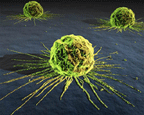 The Japanese government has officially confirmed that a worker at the Fukushima nuclear plant has contracted radiation-related cancer: the man has been diagnosed with acute myelogenous leukaemia.
“But that single ‘official’ cancer case is just the beginning. New scientific research indicates that hundreds more cancers have been and will be contracted in the local population. A 30-fold excess of thyroid cancer has been detected among over 400,000 young people below the age of 18 from the Fukushima area,” British journalist, author and health and environment issue campaigner Oliver Tickell wrote in his article for The Ecologist, citing a report entitled “Thyroid Cancer Detection by Ultrasound Among Residents Ages 18 Years and Younger in Fukushima, Japan: 2011 to 2014.”
The highest incidence rate ratio, using a latency period of 4 years, was observed in the central middle district of the prefecture compared with the Japanese annual incidence (incidence rate ratio = 50; 95% confidence interval [CI] = 25, 90),” the report read.
Tickell noted that during a first screening for thyroid cancer held four years after the Fukushima catastrophe among 298,577 youths, the disease was registered 50 times more frequently among those who lived in the most heavily irradiated zones than among other Japanese youth.
During a second screening carried out in April 2014 among 106,068 young people who lived in less contaminated areas of the Fukushima prefecture, the disease was 12 times more common than for the main population.
“Thyroid cancer is commonly developed as a result of acute exposure to radioactive iodine 131, a product of nuclear fission. Because iodine concentrates in the thyroid gland, thyroid damage including cancer is a characteristic marker of exposure to nuclear fallout,” Tickell elaborated, adding that iodine-131 constituted about 9.1 percent of the radioactive material released during the Fukushima disaster.
Quoting the report, Tickell called attention to the fact that “the incidence of thyroid cancer is high by comparison with the Chernobyl nuclear disaster in 1986,” beating the drums over the possibility of a growing cancer threat in the region in the next four-five years.
That is not all, the British journalist added, emphasizing that the real exposure doses for residents could have been higher than had been reported by the authorities and the World Health Organization.
“We could infer a possibility that exposure doses for residents were higher than the official report or the dose estimation by the World Health Organization, because the number of thyroid cancer cases grew faster than predicted in the World Health Organization’s health assessment report,” the authors of the report underscored, as quoted by Tickell.
The British journalist also highlighted that the scientists have failed to mention that other radioactive elements emitted in the accident pose even more of a threat to the population’s health (in particular, 17.5 percent Cesium-137 and 38.5 percent Cesium 134).
“These longer-lived beta-emitters (30 years and two years respectively) present a major long-term hazard as the element is closely related to potassium and readily absorbed into biomass and food crops,” Tickell stressed.
The author bemoaned the fact the Japanese people also face a danger posed by “long lived alpha emitters like plutonium 239 (which has a half-life of 24,100 years) which is hard to detect.”
“Even tiny nano-scale specks of inhaled plutonium entering the lungs and lymphatic system can cause cancer decades after the event by continuously ‘burning’ surrounding tissues and cells,” Oliver Tickell warned.
Pakistan refuses to limit tactical nuclear weapons
 Pakistan tells US it won’t accept limits on tactical nuclear arms October 23, 201 Mehreen Zahra-Malik Islamabad: Pakistani Prime Minister Nawaz Sharif, who met US President Barack Obama at the White House on Thursday, has rebuffed attempts to limit his country’s use of tactical nuclear weapons, Pakistani officials said.
Pakistan insists smaller weapons would deter a sudden attack by its neighbour India, which is also a nuclear power. But the US worries they may further destabilise an already volatile region because their smaller size makes them more tempting to use in a conventional war.
The Obama administration is preparing to sell eight F-16 fighter jets to Pakistan in an attempt to bolster the two countries’ relationship, despite Washington’s concerns about Pakistan’s growing nuclear arsenal.
The Federation of American Scientists, a leading US group that monitors the spread of nuclear weapons, published a report on Wednesday that shows that Pakistan has expanded its arsenal to between 110 and 130 warheads, up from 90 to 110 four years ago.
Officials in Washington have said they are exploring whether a deal might be possible to halt Pakistan’s deployment of tactical nuclear weapons that US experts fear are vulnerable to being launched without authorisation, or stolen, on the battlefield.
Pakistan says the US is demanding unreasonable limits on its use of nuclear weapons and not offering much in return apart from a hazy promise to consider Pakistan as a recognised recipient of nuclear technology………The Federation of American Scientists, a leading US group that monitors the spread of nuclear weapons, published a report on Wednesday that shows that Pakistan has expanded its arsenal to between 110 and 130 warheads, up from 90 to 110 four years ago.
Officials in Washington have said they are exploring whether a deal might be possible to halt Pakistan’s deployment of tactical nuclear weapons that US experts fear are vulnerable to being launched without authorisation, or stolen, on the battlefield.
Pakistan says the US is demanding unreasonable limits on its use of nuclear weapons and not offering much in return apart from a hazy promise to consider Pakistan as a recognised recipient of nuclear technology. http://www.smh.com.au/world/pakistan-to-tell-us-it-wont-accept-limits-on-tactical-nuclear-arms-20151022-gkgees.html#ixzz3phoMZJnK
Fukushima experiences 5.5 earthquake
5.5 earthquake shakes Japan’s Fukushima & Miyagi regions Rt.com : 21 Oct, 2015 A 5.5-magnitude earthquake has hit near the Fukushima prefecture in Japan, with residents of some 10 other prefectures feeling the tremor.
The quake occurred off the northeast coast of Japan. No tsunami warning has been issued.
The epicenter was near the Fukushima coastline, at a depth of 30 kilometers.
People in affected areas of Japan took to Twitter to say they felt the tremor……..https://www.rt.com/news/319243-japan-earthquake-fukushima-miyagi/
Public opinion in North Korea about nuclear weapons
 Ask a North Korean: what do you think about nuclear weapons? http://www.theguardian.com/world/2015/oct/23/ask-a-north-korean-nuclear-weapons
In an ongoing series, NK News poses a reader’s question to a North Korean defector. This week, pride in the government’s atomic exploration, Guardian, Je Son Lee for NK News, part of the North Korea network
Friday 23 October 2015 When I was still living in North Korea, the regime had a successful nuclear test. People were very proud of it, and afterwards we had a town hall meeting where my neighbours talked about how the US would no longer be able to boss us around.
Most North Koreans are very aware of the fact that other countries make fun of them, and look down on the DPRK, but many think it’s because the country is poor.
North Koreans are generally very curious about how they are perceived internationally, and reports are circulated among communities of discrimination and abuse suffered abroad – such as in China – which generate a feeling of self-consciousness.
Therefore, people in the DPRK have become very proud when they hear that the country has become a nuclear state. When they hear news like this, they think: “Our nation may still be poor. But we can [still] be one of the most powerful and influential nations in national defence.”
Justification
North Korea invests heavily in education, especially in teaching people about Japanese imperial rule and the era following independence.
The Japanese committed atrocities against unarmed, innocent Koreans, and Kim Jong-un’s government frequently highlights these acts of brutality when it justifie the possession of nuclear weapons.
Thanks to frequent reminders in school textbooks and history classes, North Koreans show more hostility toward Japanese than Americans.
Pictures and graffiti of Japanese and American soldiers committing acts of violence are painted on the buildings of kindergartens, schools and offices. If you had grown up being brainwashed and exposed to this from a young age, how would you feel? North Koreans begin to realise the importance of protecting their country.
This justifies the nuclear programme and weapons, but the government doesn’t teach its people about the negative sides and ordinary citizens have no way of finding out how dangerous they can be.
Of course, some North Koreans may hold different opinions on this issue. But from what I’ve seen, North Koreans are in favour of their government’s nuclear programme for one reason: they think it will protect them from powerful countries such as the US and Japan, and means they won’t have to go back to the time when Koreans had to suffer under the US military and Japanese imperialism.
Editing and translation by Elizabeth Jae. A version of this article first appeared on NK News, North Korea News
Apple developing huge solar investment in China
 Apple steps up solar power investment in China http://www.smh.com.au/business/energy/apple-steps-up-solar-power-investment-in-china-20151022-gkfttm.html October 22, 2015 Alex Nussbaum “The time for action is now:” Apple chief Tim Cook. The move will make Apple’s operations in China carbon-neutral, the company says.
Apple will build an additional 200 megawatts of solar power in China and push suppliers to make similar commitments, as the maker of the iPad and Apple Watch seeks to offset its global-warming emissions in the world’s most polluting country.
The solar investment comes atop two previously announced solar farms in southern China that have now been completed, producing a combined 40 megawatts of power, Apple said in a statement overnight. The company will also partner with suppliers, including iPhone maker Foxconn Technology Group, on an additional 2 gigawatts of solar, wind and hydropower projects.
“Climate change is one of the great challenges of our time, and the time for action is now,” Apple chief executive Tim Cook said. “We believe passionately in leaving the world better than we found it and hope that many other suppliers, partners and other companies join us in this important effort.”
The promises are part of Apple’s efforts to cut greenhouse-gas emissions and come ahead of a United Nations summit in Paris later this year where world leaders will try to reach a global deal on reining in climate-change pollution. China, the world’s biggest source of greenhouse gases, has promised to almost double the amount of energy it gets from renewable and nuclear power by 2030.
Apple said in April that it would partner with US-based SunPower Corp. to build the two generating stations in Sichuan province. The new solar farms produce more power than Apple’s operations consume in China, making the company “carbon neutral,” it claims. The 200 megawatts of new investments will involve construction in northern, eastern and southern China and “will begin to offset the energy used in Apple’s supply chain.”
Foxconn will construct 400 megawatts of solar by 2018 as part of the initiative with suppliers, starting in Henan province. Foxconn has committed to generate as much renewable energy as its Zhengzhou factory uses in final production of the iPhone, Apple said.
Bloomberg
Fukushima worker’s leukaemia confirmed as caused by radiation
 Fukushima worker diagnosed with leukaemia after shocking radiation leak at nuclear plant, news.com.au OCTOBER 20, 2015 A FORMER Fukushima nuclear plant worker has been diagnosed with radiation-linked cancer, making him the first such confirmation more than four years after the worst atomic accident in a generation.
An official with the health ministry said the ex-employee, who was in his thirties while working at the plant following the 2011 crisis, has developed leukaemia. He is now 41 years old, local media reported.
“The case has met the criteria” to link his illness to the accident, the official told a Tokyo press briefing on condition of anonymity, adding that other possible causes have been ruled out.
“This person went to see a doctor because was not feeling well. That was when he was diagnosed with leukaemia.” The ministry revealed few details about the man, but said he had worked at a destroyed building that housed one of the crippled reactors.
The man, who wore protective equipment during more than a year spent at Fukushima, will be awarded compensation to pay for his medical costs and lost income, the official said, without elaborating on the amount.
Three similar cases of cancer in plant workers are still awaiting confirmation of a link to the accident…….
The announcement Tuesday will likely further inflame widespread public opposition to nuclear power……..
The case was likely to deal another blow to Prime Minister Shinzo Abe’s unpopular attempt to switch on Japan’s stable of atomic reactors………http://www.news.com.au/world/asia/fukushima-worker-diagnosed-with-leukaemia-after-shocking-radiation-leak-at-nuclear-plant/story-fnh81fz8-1227576166328
Obama and Pakistan’s President Nawaz Sharif talking about nuclear weapons
Nuclear weapons, Taliban in focus as Obama meets Pakistan’s Sharif http://www.reuters.com/article/2015/10/22/us-usa-pakistan-idUSKCN0SG29020151022 WASHINGTON | BY DAVID BRUNNSTROM U.S. President Barack Obama met Pakistani Prime Minister Nawaz Sharif at the White House on Thursday and was expected to stress U.S. concerns over Pakistan’s expanding nuclear arsenal and to press Sharif to help bring the Taliban back to talks.
Washington has been trying to persuade Pakistan to make a declaration of “restraint” over its nuclear program but Pakistani officials said Sharif would tell Obama Islamabad will not accept limits on its use of small tactical nuclear weapons.
Analysts also question whether Sharif has sufficient influence with his own security establishment to get them to press the Taliban to return to talks on Afghanistan.
Afghan President Ashraf Ghani is pushing for a negotiated settlement to the 14-year insurgency, which has escalated since tens of thousands of U.S.-led NATO combat troops withdrew ahead of an end-2014 deadline. The two sides held inaugural talks in Pakistan in July but the process has since stalled.
While the Washington talks were expected to focus on nuclear weapons and Islamist militancy, the Obama administration is preparing to sell Pakistan eight F-16 fighter jets in an attempt to bolster the relationship, a U.S. source familiar with the matter said.
The sale, which Congress could block, would be a symbolic step given Pakistan’s already large fleet of fighters.
U.S. concerns have been growing about Pakistan’s nuclear arsenal, tensions between Islamabad and India, and the continued existence of militant sanctuaries in Pakistan used to target the U.S.-backed Afghan government and U.S. forces.
The insurgency in Afghanistan is hampering Obama’s efforts to withdraw U.S. troops, but Bruce Riedel of the Brookings Institution think tank said it was not clear Sharif had the clout with his own army to get military leaders to pressure the Taliban back into talks.
Pakistan insists smaller tactical nuclear weapons would deter a sudden attack by India, which is also a nuclear power, but Washington worries they may further destabilize an already volatile region because their smaller size makes them more tempting to use in a conventional war.
The Federation of American Scientists said this week that since 2011, Pakistan had deployed two new nuclear-capable short-range ballistic missiles and a new medium-range ballistic missile and was developing two extended-range nuclear-capable ballistic missiles and two nuclear-capable cruise missiles.
It estimated Pakistan’s stockpile had grown to 110 to 130 warheads from 90 to 110 in 2011 and could reach 220 to 250 by 2025, making it the world’s fifth-largest nuclear-weapons state.
Pakistani officials say Washington is demanding unreasonable limits on its nuclear weapons while not offering much in return apart from a hazy promise to consider Pakistan as a recognized recipient of nuclear technology.
(Reporting by David Brunnstrom; Additional reporting by Julia Edwards, Roberta Rampton, Idrees Ali and Andrea Shalal; Editing by James Dalgleish)
The public recognition of a radiation-cancer threat may lead to high compensation payments
Japan Acknowledges First Possible Radiation Casualty at Fukushima Nuclear Plant The public recognition of a radiation-cancer threat may lead to high compensation payments TOKYO, Oct 20 (Reuters) – Japan on Tuesday acknowledged the first possible casualty from radiation at the wrecked Fukushima nuclear power plant, a worker who was diagnosed with cancer after the crisis broke out in 2011.
The health ministry’s recognition of radiation as a possible cause may set back efforts to recover from the disaster, as the government and the nuclear industry have been at pains to say that the health effects from radiation have been minimal.
It may also add to compensation payments that had reached more than 7 trillion yen ($59 billion) by July this year…….
The male worker in his 30s, who was employed by a construction contractor, worked at Tokyo Electric Power Co’s Fukushima Daiichi plant and other nuclear facilities, a health ministry official said.
Of total radiation exposure of 19.8 millisieverts (mSv), the worker received a dose of 15.7 (mSv) between October 2012 and December 2013 working at Fukushima, said the official.
While the exposure amount was lower than the annual 50 mSv limit for nuclear industry workers, the government had decided it cannot be ruled out that the worker’s leukaemia was a result of radiation, the official said.
Tokyo Electric is also facing a string of legal cases seeking compensation over the disaster.
Inside the plant, Tepco has struggled to bring the situation under control. It is estimated removing the melted fuel from the wrecked reactors and cleaning up the site will cost tens of billions of dollars and take decades to complete. ($1 = 119.4200 yen) (Reporting by Kiyoshi Takenaka; Writing by Aaron Sheldrick; Editing by Nick Macfie) http://www.scientificamerican.com/article/japan-acknowledges-first-possible-radiation-casualty-at-fukushima-nuclear-plant/
Details emerge on UK’s nuclear deal with China
China to take one-third stake in £24bn Hinkley nuclear power station http://www.theguardian.com/environment/2015/oct/20/china-to-take-one-third-stake-in-24bn-hinkley-nuclear-power-station Details unveiled of deal signed between state-owned companies from China and France to build world’s most expensive plant on UK soil, Guardian, Damian Carrington, 20 Oct 15 China will take a one-third stake in a French-led project to build a new £24bn nuclear power station in the UK at Hinkley Point in Somerset, expected to be the most expensive ever built.
The deal was signed between state-owned companies from China and France just hours before the Chinese president, Xi Jinping , arrived in London for a state visit, and is due to be announced on Wednesday.
It will lead to a final investment decision – the point of no return – by the end of 2015, according to the Financial Times.
The companies – France’s EDF and China General Nuclear Power Corporation – will be the only investors, having failed to attract others. The new completion date for the two reactors at Hinkley Point is 2025, eight years later than first suggested. The deal is strongly backed by the chancellor, George Osborne. The government believes the new plant, which would deliver 7% of the UK’s electricity, represents good value for low-carbon electricity which, barring problems, is always on.
The plant has been promised £92 per megawatt hour (MWh) for 35 years, double today’s average wholesale electricity price, with any shortfall being paid by consumers via household energy bills. Hinkley Point will also be backed by up to £17bn of UK government loan guarantees.
The deal signed this week is also expected to mention Chinese involvement on additional nuclear plants at Sizewell in Suffolk and Bradwell in Essex. China hopes to build 110 nuclear power plants at home and wants to use its own designs at Bradwell as a showcase to help it sell its technology further afield.
But the nuclear push has many criticsover its cost, the time it takes to build and the possible threats to the UK’s national security of having China in control of a plant on UK soil. Osborne’s father-in-law, former energy minister Lord Howell, said the project was “one of the worst deals ever” for British consumers and industry.
Howell, and others, have warned the reactor design planned for Hinkley C has never been completed successfully, pointing to huge cost and time overruns at EDF’s projects at Flamanville in France and Olkiluoto in Finland .
EDF needs the Chinese investment as it is burdened with high levels of debt and is expected to sell €10bn of assets in the next five years, according to the Financial Times. Earlier in October, two of the world’s biggest ratings agencies warned the company it faced credit-rating downgrades if Hinkley Point goes ahead.
A Greenpeace poll this week showed 29% of the UK public supports the Hinkley project, with 34% against it.
A protest camp was set up outside the site this week and Alan Jeffery, a spokesman for the Stop Hinkley campaign said: “We remain mystified about why Osborne wants to throw good money after bad on this project. In the process, he has devastated the UK’s burgeoning renewable energy industry, threatening up to 20,000 jobs in the process. He is doing his best to kill off an innovative industry of the future in order to keep alive a technology of the past.”
However, the Institution of Mechanical Engineers have welcomed the Hinkley plan. “Nuclear is set to play a central and vital role in the UK’s energy future,” said the IME’s Jenifer Baxter. “Although the financial costs of nuclear power seem high, this power station will provide and modernise the diversification we so badly need in ensuring the UK’s lights stay on.”
Despite safety problems, South Korea obsessed with plan for massive nuclear station
South Korea’s Nuclear Obsession The fixation on nuclear power ignores Fukushima and the global trend towards renewables. The Diplomat By Daul Jang October 22, 2015 Five Greenpeace activists last week entered the security zone of the Kori Nuclear Power Plant. Arriving via a black inflatable boat, they climbed out and scampered up a rocky slope, unfurling a bright yellow banner in front of the plant’s fence. For 40 minutes they stood their ground as guards looked on, sirens blazed, and warnings from the Coast Guard were broadcast over the loud speaker.
In South Korea, the world’s fourth largest producer of nuclear power, the government is planning to expand the Kori site. With six reactors online, two waiting for operating license approval, and an additional two planned, it will bring the total number to ten reactors by 2022. Yet with 3.4 million people living within the 30 km zone, major companies such as Hyundai Motors located nearby, and popular Haeundae beach also in the vicinity, it reveals a government in denial of the threat to its people and nation.

But for the government and the industry, the argument is that Korea needs nuclear power. But the reality is that industrial economies, both established and rapidly developing nations, are investing in renewables because they are reliable, affordable, quick to install, safe, and are the best generating technology to reduce carbon emissions. In 2014, Germany, Japan, China, India, Spain, Mexico, Brazil and the Netherlands collectively generated more electricity from renewables (excluding large-scale hydro) than from nuclear power.
Even before the tragic Fukushima Daiichi nuclear accident in 2011, the global nuclear industry was in decline. ……..
The meltdown of three nuclear reactors at Fukushima dramatically exposed the reality that multiple reactors at a nuclear power plant site equal catastrophic failure. …….
The majority of South Korean people, like the people of Japan, have understood the lessons of Fukushima – that nuclear power is a technology with unacceptable risks. In contrast, both the Abe government in Japan and the administration of Park Geun-hye in South Korea are deliberately ignoring the lessons of Fukushima. It took the Fukushima Daiichi accident to change the mind of one national leader. South Korea should not have to wait for an accident at Kori to have a similar effect.
Daul Jang is the Project Leader for the Climate and Energy Campaign at Greenpeace East Asia in Seoul. http://thediplomat.com/2015/10/south-koreas-nuclear-obsession/
Chinese firm seeking to build nuclear in UK has history of errors in construction
Errors revealed at Chinese nuclear firm seeking to invest in UK plants, Guardian, Emma Graham-Harrison, 19 Oct 15 Huge quantity of protective steel was left out of initial construction of China General Nuclear Corp’s first reactor, built close to Hong Kong in 1987. One of the Chinese nuclear power firms pushing for a stake in the UK’s energy industry left out hundreds of critical steel rods when building its first reactor nearHong Kong in 1987 because workers misread the blueprint.
The missing parts were added in a higher layer of the foundation, with extra steel to reinforce them, after the extraordinary mistake was discovered. The plant has now been operating safely for more than two decades.
But the nature and scale of the error raises serious questions about the rigour of Chinese nuclear firms and the country’s oversight regime, experts say.
“[This a prospective] partner who, when they built the first nuclear power station in China, forgot to put in a large percentage of the protective steel,” said Professor Steve Tsang, senior fellow of the China Policy Institute at Nottingham University. “Potentially we are putting ourselves in a very difficult situation.”
China General Nuclear Corp built and runs Daya Bay nuclear plant in Shenzhen. It is one of two Chinese power firms expected to invest in the UK’s Hinkley Point power station and potentially build and operate a future nuclear plant, along with China National Nuclear Corporation and French firm EDF.
Chancellor George Osborne, on a trade mission to China last month, said the government would provide £2bn in initial financing for the much-delayed project, which EDF has struggled to fund. ndustry observers believe the Chinese cash for Hinkley is conditional on allowing Chinese firms to build their own plant at Bradwell in Essex. That project would function as a showcase for Chinese technology.
“I understand what the Chinese want, which is to have a demonstration plant, to show they can build inexpensively, quickly and reliably,” said Theresa Fallon, senior associate at the European Institute of Asian Studies.
“But it’s at a time when energy is relatively inexpensive, and this plant is a bit untried technology. I understand there are rules, but there were rules in Hong Kong too when you had the problems in Daya Bay. You are not building a gazebo, it’s really dangerous, serious stuff.”
News of the problems at one of China’s first commercial nuclear power plants only reached neighbouring Hong Kong weeks after the mistake was discovered on 14 September 1987……
A leading Chinese scientist told the Guardian this year that China’s nuclear power expansion plans are “insane” because the country’s safety controls are notrigorous enough.
“China currently does not have enough experience to make sound judgments on whether there could be accidents,” said 88-year-old He Zuoxiu, who worked on China’s nuclear weapons programme. “The number of reactors and the amount of time they have been operating safely both matter.”……http://www.theguardian.com/environment/2015/oct/19/steel-rods-missing-at-chinese-nuclear-firm-seeking-to-invest-in-uk-plants
South Korea claims that North Korea is preparing for nuclear test
Seoul says North Korea preparing for nuclear test http://www.thestar.com/news/world/2015/10/20/seoul-says-north-korea-preparing-for-nuclear-test.html The South Korean spy agency says its assessment is based on the monitoring of activities at North Korea’s main Nyongbyon nuclear complex. By: The Associated Press, Published on Tue Oct 20 2015
The office of lawmaker Lee Cheol Woo said the National Intelligence Service made the assessment after monitoring activities at North Korea’s main Nyongbyon nuclear complex.
Lee and another lawmaker, Shin Kyung-min, said the spy agency didn’t say how it obtained the information. Shin said it also didn’t elaborate on what test preparations meant. The spy agency’s public affairs office said it could not confirm the reported assessment.
Last month, North Korea said it had upgraded and restarted all of its atomic fuel plants, sparking speculation that it might carry out a fourth nuclear test explosion.
The speculation subsided after North Korea did not go ahead with a threat to conduct a banned long-range rocket launch to send what it called a satellite into orbit earlier this month. All of North Korea’s three previous nuclear tests in 2006, 2009 and 2013 came after it launched long-range rockets.
A fourth test could put North Korea a step closer to its goal of building a nuclear warhead small enough to mount on a long-range missile that could threaten the United States. North Korea says it has already manufactured such a warhead, but many foreign analysts are skeptical of its claim.
Fukushima insect study shows there is no safe low level of ionising radiation
 The researchers found that caterpillars that ate radioactive leaves pupated into mutated butterflies that did not live as long, compared with caterpillars that ate non-radioactive leaves. These mutations and increased mortality were seen even in butterflies that consumed only very small doses of radioactive cesium.
Deaths and mutations spike around Fukushima; no safety threshold for radioactive cesium exposure http://theunhivedmind.com/wordpress3/deaths-and-mutations-spike-around-fukushima-no-safety-threshold-for-radioactive-cesium-exposure/October 16, 2015 theunhivedmind Deaths and mutations spike around Fukushima; October 16, 2015 by: David Gutierrez, staff writer
http://www.naturalnews.com/051581_fukushima_radiation_nuclear_power.html
Plants in the area around Fukushima, Japan are widely contaminated with radioactive cesium, which is 
producing mutation and death in local butterflies, according to a study conducted by researchers from the University of the Ryukyus, Okinawa and published in the journal Scientific Reports.
The butterflies were found to experience severe negative effects at all detectable radiation levels, even very low ones.
“We conclude that the risk of ingesting a polluted diet is realistic, at least for this butterfly, and likely for certain other organisms living in the polluted area,” the researchers wrote.
Insects hard hit
The researchers note that although the 2011 meltdown of the Fukushima Daiichi Nuclear Power Plant released “a massive amount of radioactive materials … into the environment,” few studies have looked at the biological effects of this disaster. Researchers have, however, measured elevated radiation levels in the polluted area, and have chronicled the accumulation of radioactive material in both wild and domestic plant and animal life in the region.
Studies have also suggested that insects may be particularly hard-hit by the increased radiation. One study found an increase in morphological abnormalities (physical deformities) in gall-forming aphids. Another found that insect abundance has decreased in the affected region, particularly butterfly abundance. Continue reading
Concerns over Japan’s huge stockpile of weapons grade nuclear material
 China calls on Japan to address world concerns on excessive nuclear stocks http://news.xinhuanet.com/english/2015-10/15/c_134717556.htm BEIJING, Oct. 15 (Xinhua) — China on Thursday called for action from Japan to defuse concerns over its excess of nuclear materials as both Chinese and U.S. think tanks expressed worry in recent reports.
“The international community has always been concerned about Japan’s stockpile of enriched uranium and the risks relating to nuclear proliferation and safety,” Foreign Ministry spokesperson Hua Chunying said.
“The reports suggest there are ways to resolve the surplus nuclear material issue,” she said at a regular news briefing, calling on Japan to be responsible and act to address the international community’s concerns.
The stockpile puts Japan, its neighbors and the world at risk, a joint study by China Arms Control and Disarmament Association and the China Institute of Nuclear Information and Economics said on Friday.
“If, in future, a different country started to stockpile — could be enriched uranium, it could be plutonium — that country could cite Japan as a precedent,” said James Acton, author of a new report on Japan’s reprocessing policy at the Carnegie Endowment for International Peace think tank.
The Chinese study suggests Japan should make a rational plan for its nuclear consumption and address the imbalance, while ensuring the safety and security of these materials.
Citing the latest data from the Japanese government submitted to the International Atomic Energy Agency (IAEA), the Chinese study found Japan has 47.8 tonnes of highly sensitive separated plutonium, 10.8 tonnes of which are stored in Japan, enough to make 1,350 nuclear warheads.
-
Archives
- October 2026 (112)
- September 2026 (339)
- August 2026 (330)
- July 2026 (355)
- June 2026 (287)
- May 2026 (306)
- April 2026 (356)
- March 2026 (251)
- February 2026 (267)
- January 2026 (308)
- December 2025 (358)
- November 2025 (359)
-
Categories
- 1
- 1 NUCLEAR ISSUES
- business and costs
- climate change
- culture and arts
- ENERGY
- environment
- health
- history
- indigenous issues
- Legal
- marketing of nuclear
- media
- opposition to nuclear
- PERSONAL STORIES
- politics
- politics international
- Religion and ethics
- safety
- secrets,lies and civil liberties
- spinbuster
- technology
- Uranium
- wastes
- weapons and war
- Women
- 2 WORLD
- ACTION
- AFRICA
- Atrocities
- AUSTRALIA
- Christina's notes
- Christina's themes
- culture and arts
- Events
- Fuk 2022
- Fuk 2023
- Fukushima 2017
- Fukushima 2018
- fukushima 2019
- Fukushima 2020
- Fukushima 2021
- general
- global warming
- Humour (God we need it)
- Nuclear
- RARE EARTHS
- Reference
- resources – print
- Resources -audiovicual
- Weekly Newsletter
- World
- World Nuclear
- YouTube
-
RSS
Entries RSS
Comments RSS

