France invites China in, to save failed nuclear corporation AREVA
 France’s nuclear-reactor maker Areva open to Chinese funds, says French President Francois Hollande, South China Morning Post, Zhen Liuzhen.liu@scmp.com 3 Nov 15 It’s natural to involve China in Areva’s planned restructuring as the two nations cooperate to build nuclear plants, says French President French President Francois Hollande said on Tuesday that France welcomed Chinese investment in its state-owned nuclear-reactor maker Areva, as he wrapped up his two-day trip to China.
“We welcome foreign capital in the Areva restructuring. It would not affect our sovereignty,” Hollande said in Beijing.
On Monday, Areva and the China National Nuclear Corporation signed a memorandum of understanding for possible partnership on nuclear-waste recycling that could be worth €20 billion (HK$171 billion).
Hollande said that as China and France had become partners building nuclear plants together in Britain and China, it was natural to have the Chinese in the Areva recapitalisation. Last month, French utility company EDF came to an agreement with Chinese nuclear company CGN to jointly build the Hinkley Point nuclear plants in Britain.
Despite the continuous nuclear cooperation, Hollande said his two-day China trip focused more on climate change issues to ensure success in the upcoming UN round of climate talks to be held in Paris next month……..http://www.scmp.com/news/china/diplomacy-defence/article/1875477/frances-nuclear-reactor-maker-areva-open-chinese-funds
Call for Hong Gong to end nuclear energy imports when contract ends
Hong Kong should end nuclear energy imports after Daya Bay contract ends in 2034, Greenpeace says, South China Morning Post Group says ‘business as usual’ approach not enough and urges greater use of renewables, 04 November, 2015, Ernest Kao ernest.kao@scmp.com
By halting nuclear energy imports after the 20-year supply contract with the Daya Bay plant ends in 2034, along with reducing electricity use by one per cent each year and boosting renewable energy use to 10 per cent, Greenpeace calculated an emissions cut of 34 per cent could be achievable…..http://www.scmp.com/news/hong-kong/health-environment/article/1875380/hong-kong-should-end-nuclear-energy-imports-after
Extremely high radiation measured in Fukushima mushroom sample
 [Photo] 52,339 Bq/Kg of Cs-134/137 still measured from mushroom in Fukushima http://fukushima-diary.com/2015/10/photo-52339-bqkg-of-cs-134137-still-measured-from-mushroom-in-fukushima/ by Mochizuki , October 29, 2015 A Japanese citizen measured extremely high density of Cs-134/137 from mushroom in Fukushima.
On 10/22/2015, the person posted on Twitter that 52,339 Bq/Kg of Cs-134/137 was detected from a type of mushroom called “Ramaria botrytis” (Photos A). The sample was collected in a copse of Futaba county in Fukushima.
Cs-134/137 density was 2,378 Bq/Kg in the soil around the sample to show the mushroom concentrated Cs-134/137 over 22 times.
30,865 Bq/Kg of Cs-134/137 was also measured from a sample of “Cortinarius violaceus” (Photos B). The sampling location was the same.
Mystery of “Deadly” radiation levels detected outside Fukushima containment vessel
 Japan Times: “Deadly” radiation levels detected outside Fukushima containment vessel — “Details behind situation are unknown” — Officials unable to grasp location of melted nuclear fuel — “Impossible” to plan for decommissioninghttp://enenews.com/japan-times-deadly-94-sieverts-detected-fukushima-containment-vessel-details-behind-situation-unknown-officials-unable-grasp-location-melted-nuclear-fuel-impossible-plan-decommissioning?utm_source=feedburner&utm_medium=email&utm_campaign=Feed%3A+ENENews+%28Energy+News%29Jiji Press, Oct 29, 2015: 9.4 Sieverts Detected outside Fukushima Reactor Containment Vessel– [TEPCO] said Thursday that radiation levels of up to 9.4 sieverts per hour have been detected outside a reactor containment vessel… People exposed to the maximum radiation dose for some 45 minutes will die. TEPCO expects decontamination work to take at least one month. Checks conducted on Sept. 4-25 found the extremely high radiation levels at a cell which accommodates a pipe connected to the containment vessel of the No. 2 reactor…
Japan Times (via Jiji), Oct 30, 2015 (emphasis added): Deadly 9.4 sieverts detected outside Fukushima reactor 2 containment vessel; checks stop… Details behind the situation are unknown, according to the company. Tepco planned to start in August to check the inside of the containment vessel by using a remote-controlled robot but high radiation levels have stalled the examination. Extremely high radiation levels and theinability to grasp the details about melted nuclear fuel make it impossible for the utility to chart the course of its planned decommissioning of the reactors at the plant.
Fukushima: underground walls built to contain radioactive water
Walls to halt tainted groundwater from flowing into sea completed at Fukushima plant http://ajw.asahi.com/article/0311disaster/fukushima/AJ201510260048 October 26, 2015 THE ASAHI SHIMBUN Tokyo Electric Power Co. announced Oct. 26 that the construction of seaside walls to block radiation-contaminated groundwater from seeping into the sea has been completed at the crippled Fukushima No. 1 nuclear power plant.
The walls, comprising numerous cylindrical steel pipes, were installed at a 780 meter-long stretch along the plant’s coastal embankment near the damaged No. 1 to No. 4 reactor buildings.
TEPCO officials said the underground walls will reduce the daily flow of contaminated groundwater into the sea from the previous estimated 400 tons to 10 tons.
However, they said it will take a month or two to confirm the effectiveness of the barriers.
The seaside walls are one of the three pillars of TEPCO’s efforts to deal with tainted groundwater accumulating at the plant.
The other projects are a plan to treat groundwater pumped from subdrain wells around the reactor buildings and release it into the sea and a frozen soil wall being constructed to divert untainted groundwater away from the damaged reactor buildings and into the ocean.
Cone of silence about Fukushima, as Abe prepares for 2020 Tokyo Olympics
But, wait a moment, where’s the corium?
Corium is a lava-like radioactive hot molten mix of a nuclear reactor core formed during a meltdown. The corium is missing at Fukushima Daiichi Nuclear Power Plant No. 2. Nobody knows where it is. Nobody knows! Better yet, or rather worse yet, finding No.2’s melted core is an ongoing challenge of enormous, humongous proportions, kinda like hovering at the edge of a Black Hole. What’s next?
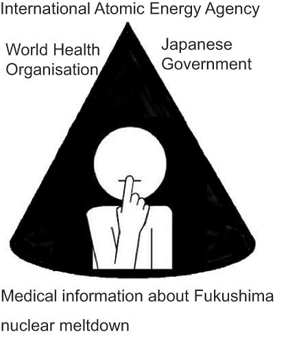 Fukushima – a Hushed Up Catastrophe, CounterPunch, by ROBERT HUNZIKER , OCTOBER 30, 2015 The Fukushima disaster is radiantly exposed in the Pacific Ocean, but as for people behind the disaster, it is treated like the Manhattan Project, circa 1942… Top Secret!
Still, “Its against international law to dump radioactivity into the sea, but that is precisely what is happening on a daily basis,” according to Dr. Keith Baverstock, former regional adviser for Radiation and Public Health, World Health Organization (“WHO”), speaker at the Citizen-Scientist International Symposium on Radiation Protection, October 23, 2015.
As intimated by Dr. Baverstock, inexplicably Fukushima is immune to international law, standards, and conventions, and nobody cares enough to do anything about it.
Surely, nobody intentionally caused the disaster behind the meltdown, similar to a chain reaction of falling dominoes: an earthquake, tsunami, massive flooding, black-outs, loss of power, hydrogen explosions, nuclear meltdown, and four years of highly radioactive water spewing into the Pacific Ocean, and who knows what else or where else?
But, “cause” is not the issue with Fukushima. The issue is whether nuclear power is a satisfactory source of energy, whether it is safe. In that regard, Angela Merkel (61), PhD physics, University of Leipzig and current chancellor of Germany is shutting down all nuclear reactors because of the Fukushima incident. Germany favors renewable sources of energy like solar and wind. Meanwhile, Japan’s PM Abe (61), a graduate in political science from Seikei University, is reopening nuclear power plants as quickly as possible, proving that politics overrides science. Continue reading
Outside Fukushima reactor containment vessel deadly 9.4 sieverts detected

 Deadly 9.4 sieverts detected outside Fukushima reactor 2 containment vessel; checks stop http://www.japantimes.co.jp/news/2015/10/30/national/deadly-9-4-sieverts-detected-outside-fukushima-reactor-2-containment-vessel-checks-stop/#.VjPyu9IrLGj Tokyo Electric Power Co. said Thursday that radiation levels of up to 9.4 sieverts per hour have been detected outside a reactor containment vessel at the meltdown-hit Fukushima No. 1 nuclear power plant.
People exposed to the maximum radiation dose for some 45 minutes will die. Tepco expects decontamination work to take at least one month.
Sept. 4-25 checks found the extremely high radiation levels at a cell that accommodates a pipe connected to the containment vessel of reactor 2 at the plant, which was devastated by the March 2011 earthquake and tsunami, Tepco said.
The highest contamination was detected on the floor. Details behind the situation are unknown, according to the company. Tepco planned to start in August to check the inside of the containment vessel by using a remote-controlled robot but high radiation levels have stalled the examination.
Extremely high radiation levels and the inability to grasp the details about melted nuclear fuel make it impossible for the utility to chart the course of its planned decommissioning of the reactors at the plant.
Is the world ignoring the climate catastrophe of Indonesia’s fires?
 Governments ignore issues when the media ignores them.
one reason is the complete failure of perspective in a de-skilled industry dominated by corporate press releases, photo ops and fashion shoots, where everyone seems to be waiting for everyone else to take a lead. The media makes a collective non-decision to treat this catastrophe as a non-issue, and we all carry on as if it’s not happening.
Indonesia is burning. So why is the world looking away?, Guardian George Monbiot, 30 Oct 15 A great tract of Earth is on fire and threatened species are being driven out of their habitats. This is a crime against humanity and nature “……A great tract of Earth is on fire. It looks as you might imagine hell to be. The air has turned ochre: visibility in some cities has been reduced to 30 metres. Children are being prepared for evacuation in warships; already some have choked to death. Species are going up in smoke at an untold rate. It is almost certainly the greatest environmental disaster of the 21st century – so far.

And the media? It’s talking about the dress the Duchess of Cambridge wore to the James Bond premiere, Donald Trump’s idiocy du jour and who got eliminated from the Halloween episode of Dancing with the Stars. The great debate of the week, dominating the news across much of the world? Sausages: are they really so bad for your health?
What I’m discussing is a barbecue on a different scale. Fire is raging across the 5,000km length of Indonesia. It is surely, on any objective assessment, more important than anything else taking place today. And it shouldn’t require a columnist, writing in the middle of a newspaper, to say so. It should be on everyone’s front page. It is hard to convey the scale of this inferno, but here’s a comparison that might help: it is currently producing more carbon dioxide than the US economy. And in three weeks the fires have released more CO2 than the annual emissions of Germany.
But that doesn’t really capture it. This catastrophe cannot be measured only in parts per million. The fires are destroying treasures as precious and irreplaceable as the archaeological remains being levelled by Isis. Orangutans, clouded leopards, sun bears, gibbons, the Sumatran rhinoceros and Sumatran tiger, these are among the threatened species being driven from much of their range by the flames. But there are thousands, perhaps millions, more.
One of the burning provinces is West Papua, a nation that has been illegally occupied by Indonesia since 1963. I spent six months there when I was 24,investigating some of the factors that have led to this disaster. At the time it was a wonderland, rich with endemic species in every swamp and valley. Who knows how many of those have vanished in the past few weeks? This week I have pored and wept over photos of places I loved that have now been reduced to ash.
Nor do the greenhouse gas emissions capture the impact on the people of these lands. After the last great conflagration, in 1997, there was a missing cohort in Indonesia of 15,000 children under the age of three, attributed to air pollution. This, it seems, is worse. The surgical masks being distributed across the nation will do almost nothing to protect those living in a sunless smog. Members of parliament in Kalimantan (Indonesian Borneo) have had to wear face masksduring debates. The chamber is so foggy that they must have difficulty recognising one another.
It’s not just the trees that are burning. It is the land itself. Much of the forest sits on great domes of peat. When the fires penetrate the earth, they smoulder for weeks, sometimes months, releasing clouds of methane, carbon monoxide, ozone and exotic gases such as ammonium cyanide. The plumes extend for hundreds of miles, causing diplomatic conflicts with neighbouring countries.
Why is this happening? Indonesia’s forests have been fragmented for decades by timber and farming companies. Canals have been cut through the peat to drain and dry it. Plantation companies move in to destroy what remains of the forest to plant monocultures of pulpwood, timber and palm oil. The easiest way to clear the land is to torch it. Every year, this causes disasters. But in an extreme El Niño year like this one, we have a perfect formula for environmental catastrophe……..
Governments ignore issues when the media ignores them. And the media ignores them because … well, there’s a question with a thousand answers, many of which involve power. But one reason is the complete failure of perspective in a de-skilled industry dominated by corporate press releases, photo ops and fashion shoots, where everyone seems to be waiting for everyone else to take a lead. The media makes a collective non-decision to treat this catastrophe as a non-issue, and we all carry on as if it’s not happening.
At the climate summit in Paris in December the media, trapped within the intergovernmental bubble of abstract diplomacy and manufactured drama, will cover the negotiations almost without reference to what is happening elsewhere. The talks will be removed to a realm with which we have no moral contact. And, when the circus moves on, the silence will resume. Is there any other industry that serves its customers so badly?
A fully linked version of this article can be found at monbiot.com http://www.theguardian.com/commentisfree/2015/oct/30/indonesia-fires-disaster-21st-century-world-media
Nobody knows what to do with Fukushima nuclear reactors’ corium – melted fuel
Fukushima – a Hushed Up Catastrophe, CounterPunch, by ROBERT HUNZIKER , OCTOBER 30, 2015 “……..As the situation now stands, what if the corium leaked or leaks into the ground beneath the reactor’s final cement & steel containment vessel, the last line of defense? Answer: Nobody knows because it has never happened before, but the smell test says it can’t be good; in fact, it’s gotta be awful, really awful and deadly out of control, impossible to stop.
Tragically, nobody knows what to do. They really don’t.
Still, here’s what sources claim probably happens when a nuclear meltdown hits pay dirt, immersing into Earth: Some isotopes uncontrollably spread erratically, for example, Cesiun-137, which is deadly toxic to all life forms, and only one of many dangerous isotopes, is water-soluble and makes its way into soils and waters and quickly becomes ubiquitous in the ecosystem; that’s what happens, “ubiquitous in the ecosystem.”
Thereafter, assuming a situation similar to Chernobyl (1986), an exclusion zone is established to keep everybody out due to excessive levels of radiation. But, questions like how big of an exclusion zone and how prolific the underground hot radioactive corium reacts nobody knows how to answer. When Ihor Gramotkin, director of the Chernobyl Power Plant was asked how soon the Chernobyl reactor site would be inhabitable again, he replied: “At least 20,000 years,” Eben Harrell, Apocalypse Today: Visiting Chernobyl, 25 Years Later, Time Magazine, April 26, 2011.
Nevertheless, the Abe government is already moving people back into some of the four-year-old exclusion zones of Fukushima………… http://www.counterpunch.org/2015/10/30/fukushima-a-hushed-up-catastrophe/
China far from being nuclear industry hope, could be its nightmare
Just how safe is China anyway? Now if China had a fantastic record of safety in its construction and other industries, maybe the odds should be made a bit longer….
Cheap? Some scepticism is in order How do we know what these reactors really cost? The fact is, we don’t. With China’s nuclear corporations under the control of various organs of state including the Communist Party and the Peoples Liberation Army, official statistics and accounts can simply not be relied upon…..
Nuclear construction in China must be cheaper than in the US and Europe due to lower labour costs. But if it really is that much cheaper it can only be at a huge safety penalty……
Tsunami risk – not if but when…….
The only good news in all this is that nuclear construction in China is not proceeding anything like as fast as Forbes magazine claims. Most of the more modern ‘Generation III’ reactors are well behind in their completion times, echoing the European experience with the failed EPR design.
Fukuzilla? China’s nuclear boom threatens global catastrophe http://www.theecologist.org/blogs_and_comments/commentators/2986056/fukuzilla_chinas_nuclear_boom_threatens_global_catastrophe.html Oliver Tickell 28th October 2015
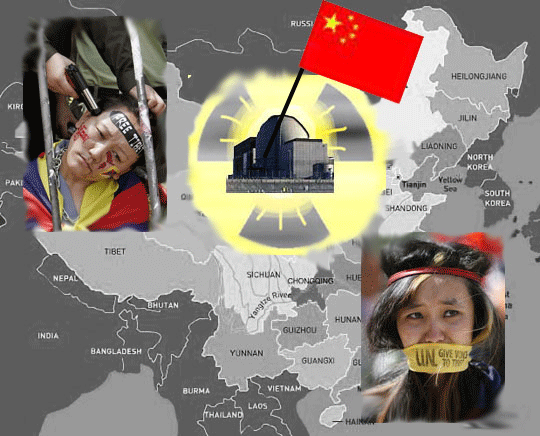
China’s plans for 400 nuclear reactors threaten global catastrophe, writes Oliver Tickell. In the normal way of things we could expect major accidents every few years, but with 300 reactors along China’s seismically active coast, a major tsunami would be a Fukushima on steroids – wiping out much of China and contaminating the whole planet. Continue reading
No foreseeable end to Fukushima’s daily dumping of radioactive waste to Pacific Ocean
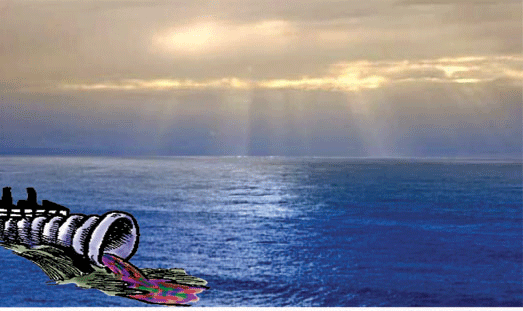 Former WHO Official: Fukushima plant is dumping nuclear waste into ocean on a daily basis; “There’s no foreseeable end to it… and nobody has any good ideas on how to stop it” — Japan gov’t worried that attempts to reduce leakage will cause even more radioactivity to flow into sea (VIDEO) http://enenews.com/former-official-fukushima-plant-dumping-radioactivity-ocean-daily-basis-foreseeable-good-ideas-stop-japan-govt-worried-attempts-stop-going-nuclear-waste-flow-sea-video?utm_source=feedburner&utm_medium=email&utm_campaign=Feed%3A+ENENews+%28Energy+News%29
Asahi Shimbun, Oct 26, 2015 (emphasis added): [TEPCO announced] the construction of seaside walls to block radiation-contaminated groundwater from seeping into the sea has been completed at the crippled Fukushima No. 1 nuclear power plant… TEPCO officials said the underground walls will reduce the daily flow of contaminated groundwater into the sea from the previous estimated 400 tons to 10 tons. However, they said it will take a month or two to confirm the effectiveness of the barriers.
Japan Times, Oct 26, 2015: Tepco hopes the wall will significantly reduce the amount ofcontaminated water that has continued to flow into the Pacific more than four yearsafter the 2011 meltdown crisis… 400 tons of groundwater was draining along the sides of the buildings and into the sea each day, after being contaminated with fallout from the 2011 meltdown crisis, according Tepco. The utility says an estimated 150 tons of underground water is still flowing into the basements of the damaged reactor buildings each day… Recent tests of water samples from the nearby sea have detected radioactive substances such as cesium-137 and strontium-90, but scientists have said the density is so low that it poses no immediate danger to human health. Yet, the ongoing flow of tainted water from the plant has raised anxiety and concerns among local fishermen and many consumers across the country. Tepco plans to keep monitoring the density of radioactive materials in the nearby sea over the next month. To isolate the four reactor buildings from the underground water, Tepco hopes to freeze the soil around them… The Nuclear Regulation Authority has yet to give permission for the operation, saying creation of frozen soil could drastically change the underground water level around the plant. If the water level outside falls lower than that inside, the contaminated water could leak out. Meanwhile, Tepco has not explained exactly how it will control the water levels, an NRA official said.
Dr. Keith Baverstock, former World Health Organization regional adviser for radiation and public health, published Oct 23, 2015 (at 37:00 in): “I’m really appalled at the way the international system has failed… Quite frankly, we don’t get anything through the media… There is no general understanding of the situation here in Europe, because the media are not putting this view forward. In fact, I think many people would be very surprised that it was still a matter for discussion. They would be even more surprised to learn that it’s still an ongoing accident, and that it hasn’t terminated yet. They’d be even more surprised that nobody has any good ideas on how to stop it. So this is a very big black point… for the nuclear industry — that they can cause a situation like this, where there’s no foreseeable end to it. It’s against international law to dump radioactivity into the sea, but that is precisely what is happening on a daily basis.”
Japan’s govt admits that 40% of Fukushima evacuation personnel exposed to radiation of 1 mSv
40% of Fukushima evacuation personnel exposed to radiation of 1 mSv http://www.japantoday.com/category/national/view/40-of-fukushima-evacuation-personnel-exposed-to-radiation-of-1-msv OCT. 27, 2015 TOKYO —
Nearly 40% of Self-Defense Forces troops, police officers and firefighters involved in evacuation operations right after the 2011 Fukushima nuclear crisis were exposed to radiation above the annual public limit of 1 millisievert, the government said Monday.
The Cabinet Office surveyed for the first time 2,967 personnel who assisted in evacuating residents living within a 20-kilometer radius of the Fukushima Daiichi nuclear complex as well as radiation cleanup and other activities from March 12 to 31, 2011.
The survey found that around 62% were exposed to radiation of less than 1 millisievert. But 38% were exposed to 1 millisievert or more, of whom 19% received 1 to 2 millisieverts and 5% received 5 to 10 millisieverts.
Daily radiation doses remained high until around March 15—the day the third reactor building suffered an explosion at the plant—and dropped below 0.1 millisievert from March 18.
The Cabinet Office revealed the data at a meeting to discuss ways to mitigate the radiation exposure of civilians helping others to evacuate in the event of a nuclear accident. The Japanese government is pushing for the reactivation of reactors that have cleared a set of new safety requirements imposed in the wake of the Fukushima crisis, triggered by a massive earthquake and tsunami on March 11, 2011, but public concern persists about whether smooth evacuations would be possible in the event of a nuclear accident.
The government plans to set a 1-millisievert-limit for civilians assisting in evacuations such as bus drivers. But some bus drivers are reluctant to accept the proposal.
The maximum radiation dose for ordinary members of the public is set at 1 millisievert per year. The limit for workers at nuclear facilities is 100 millisieverts over five years and 50 millisieverts per year in normal times, but it is raised in emergencies.
Vietnam: Nonproliferation and Nuclear Energy
Nonproliferation and Nuclear Energy: The Case of Vietnam Is Vietnam diverting its civilian know-how to create an indigenous nuclear weapons program? Not yet, says the CSS’ Oliver Thränert, but increased tensions or overt conflict with China could lead Hanoi to develop its own nuclear deterrent. By Oliver Thränert for Center for Security Studies (CSS) 26 October 2015
For many years, the international nuclear non-proliferation regime has been in deep crisis. This became apparent most recently when the ninth Review Conference of the Parties to the Treaty on the Non-Proliferation of Nuclear Weapons (NPT) in May 2015 ended without a common final document. At the same time, a number of threshold countries are planning to begin using nuclear energy for peaceful purposes. In a time of increasing international tensions, some of them might build on know-how acquired through their civilian programs to safeguard their national security needs through a nuclear weapons program in the near future. Vietnam is an interesting case in point. Irrespective of certain delays in the development of its peaceful nuclear program, the country has progressed quite far. At the same time, it is engaged in an increasingly precarious conflict with its main neighbor, nuclear-armed China. Currently, there are no signs of a Vietnamese nuclear weapons program. In the framework of the nuclear non-proliferation regime, the country is a model of transparency and cooperation. But it is uncertain whether this will always remain the case. On the contrary, Hanoi might change its policy if the conflict with China should come to a head while the NPT continues to be weakened…….
Vietnam’s strategic situation Vietnam’s strategic environment is rapidly changing. This is especially true for Vietnam’s relations with China. While the Communist parties of the two countries regard each other as brother parties and economic relations run deep, the two countries also have disputes over certain small islands in the South China Sea and over the mutual demarcation of exclusive economic zones in these waters. The extent of widespread anti-Chinese feeling among the general public became evident in May 2014, when a Chinese oil platform was discovered in an area claimed by Vietnam. Subsequently, there were not only skirmishes between Chinese and Vietnamese vessels, but also demonstrations in several Vietnamese cities that escalated into violence in which several people were killed.
With an increasingly aggressive China next door, Vietnam, like most of the riparian states, is seeking closer engagement with the US. Washington has become one of Vietnam’s main trading partners. Military relations, too, have been intensified. In July 2013, speaking in Washington, D.C., US President Barack Obama and Vietnamese President Truong Tan Sang announced a comprehensive bilateral partnership. One important step towards the closer development of ties was the passing in Congress of a 123 Agreement in September 2014, which paved the way for future cooperation in the peaceful use of the atom.
Despite the interest in improving cooperation with the US across the board, however, the leadership in Vietnam must be aware that issues such as the country’s single-party system, together with a human-rights situation that the US continues to regard as problematic, are certain to resurface time and again in relations with Washington. Against this background, US security guarantees such as Japan and South Korea have been given can hardly be expected by Vietnam. At the same time, there is the danger that an overly evident rapprochement with Washington might provoke reactions by China. Thus, Hanoi is forced to perform a difficult tightrope walk, balancing out its relations with China on the one hand against those with the US on the other………http://www.isn.ethz.ch/Digital-Library/Articles/Detail/?id=194337
Japan keen to sell nuclear reactors to Kazakhstan
 Japan to construct nuclear power plant in Kazakhstan, Tengri News, 27 Oct 15
For more information see:http://en.tengrinews.kz/politics_sub/Japan-to-construct-nuclear-power-plant-in-Kazakhstan-262718/
Use of the Tengrinews English materials must be accompanied by a hyperlink to en.Tengrinews.kz
October 23 Tengrinews.kz reported, citing the country’s Vice Minister of Energy Bakhytzhan Dzhaksaliyev, that Kazakhstan was to decide within the following 2-3 years on the location and strategic partner for its first nuclear power station.
January 23,2015 Tengrinews.kz reported that Kazakhstan had started talks with Toshiba, owner of Westinghouse, to construct its first nuclear power plant. The sides were to sign an agreement on supplying a $3.7 billion reactor capable of 1 gigawatt, according to Russia’s Kommersant daily.
Early 2014 the country’s President Nursultan Nazarbayev commissioned the Government to decide before the end of the Q1 2014 on the location, sources of investments and timing of constructing a nuclear power plant in Kazakhstan.
In his Address to the Nation at the start of 2014, President Nursultan Nazarbayev elaborated why Kazakhstan needs to construct a nuclear power plant.
He emphasized that the future lies with nuclear power……… “The actual need for a nuclear power plant will be felt around 2025 given the current power generation and consumption figures”, he elaborated.
For more information see:http://en.tengrinews.kz/politics_sub/Japan-to-construct-nuclear-power-plant-in-Kazakhstan-262718/
Japanese Prefecture Kyoto moves to replace nuclear with gas and renewables, in pact with Alaska
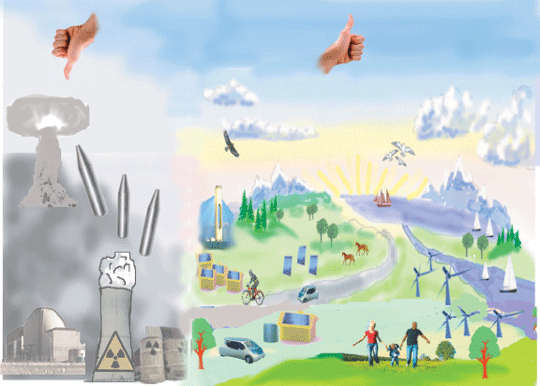
 Kyoto advances nuclear-free agenda with Alaska LNG pact, Japan Times, BY ERIC JOHNSTON KYOTO, 25 OCT 15, – The Kyoto Prefectural Government signed an agreement with Alaska last month to explore the possibility of importing liquid natural gas from the state to Maizuru, a port city on the Sea of Japan.
While daunting financial and bureaucratic challenges mean it will still be a while before Alaskan LNG flows to Kyoto, the agreement represents a step forward for Kyoto to achieve a larger goal: ending prefectural dependence on nuclear power by 2040.
The strategy, as outlined by Kyoto Gov. Keiji Yamada, calls for building up LNG facilities at Maizuru and installing new LNG pipelines in the Kansai region. The prefecture envisions Maizuru supplying not only Kyoto, but other prefectures in the region with gas to replace Fukui Prefecture’s nuclear power plants as a major source of electricity.
Kyoto is not alone in seeking to replace atomic power with a combination of LNG imports and renewable energy. As of the end of 2014, more than 600 local governments nationwide had declared their intent to be nuclear-free, although not all of have set specific dates like Kyoto, and many lack a strategic plan for achieving that goal.
Yamada listed several reasons why the prefecture needs to end its usage of nuclear power, which comes mostly from 11 Kansai Electric Power Co. reactors in neighboring Fukui……..
Kyoto and Hyogo, along with Osaka Gas, Kepco, and the Ministry of Economy, Trade and Industry, agreed in early September to formally research the cost of building an LNG pipeline from Maizuru to Sanda, Hyogo Prefecture, that could then supply other parts of Kansai and likely lead to other localities needing less nuclear power. http://www.japantimes.co.jp/news/2015/10/25/national/kyoto-advances-nuclear-free-agenda-alaska-lng-pact/#.Vi0_ztIrLGh
-
Archives
- October 2026 (112)
- September 2026 (339)
- August 2026 (330)
- July 2026 (355)
- June 2026 (287)
- May 2026 (306)
- April 2026 (356)
- March 2026 (251)
- February 2026 (267)
- January 2026 (308)
- December 2025 (358)
- November 2025 (359)
-
Categories
- 1
- 1 NUCLEAR ISSUES
- business and costs
- climate change
- culture and arts
- ENERGY
- environment
- health
- history
- indigenous issues
- Legal
- marketing of nuclear
- media
- opposition to nuclear
- PERSONAL STORIES
- politics
- politics international
- Religion and ethics
- safety
- secrets,lies and civil liberties
- spinbuster
- technology
- Uranium
- wastes
- weapons and war
- Women
- 2 WORLD
- ACTION
- AFRICA
- Atrocities
- AUSTRALIA
- Christina's notes
- Christina's themes
- culture and arts
- Events
- Fuk 2022
- Fuk 2023
- Fukushima 2017
- Fukushima 2018
- fukushima 2019
- Fukushima 2020
- Fukushima 2021
- general
- global warming
- Humour (God we need it)
- Nuclear
- RARE EARTHS
- Reference
- resources – print
- Resources -audiovicual
- Weekly Newsletter
- World
- World Nuclear
- YouTube
-
RSS
Entries RSS
Comments RSS

