Fukushima: pressure of groundwater causing underground wall around reactors to lean and crack
 TV: Underground wall around Fukushima reactors started “leaning” — Cracks developing due to rising water levels — Problems seen along almost entire length of sea wall — Trying to make repairs to keep groundwater from surging (VIDEO) http://enenews.com/nhk-underground-wall-around-fukushima-reactors-started-lean-rising-water-levels-causing-cracks-develop-problems-occuring-along-almost-entire-length-sea-wall-tepco-trying-make-repairs-keep-gro?utm_source=feedburner&utm_medium=email&utm_campaign=Feed%3A+ENENews+%28Energy+News%29
NHK World, Nov 25, 2015 (emphasis added): Groundwater wall at Fukushima plant leans slightly — The operator of the damaged Fukushima Daiichi nuclear plant has found that a wall it built 30 meters into the ground to block the flow of radioactive water is leaning slightly. {TEPCO] built the steel barrier along a coastal embankment to stop contaminated groundwater from seeping into the sea… TEPCO inspectors found that the wall is leaning up to some 20 centimeters toward the sea. They say this is due to the pressure of the groundwater flow. The officials also blamed rising groundwater levels for cracks found in the embankment’s pavement. The utility says workers are buttressing the wall with steel pillars…
NHK (Google translation), Nov 25, 2015: In TEPCO Fukushima Daiichi nuclear power plant, it can be seen that the equipment called “impervious wall”, which was completed last month in order to reduce the outflow of the contaminated groundwater, are slightly tilted to the sea side… [T]he pavement of the seawall also cracked… When depends on the Tokyo Electric Power Company, after the “impervious wall” has been completed, it is that it’s because thewater level of the land side of the groundwater is rising.
Fukushima Minyu Shimbun (Google translation), Nov 26, 2015: … sea side wall is inclined about 20 centimeters at the maximum to the sea side, cracks of up to about 1 centimeter has occurred in the pavement of the seawall. That inclination and cracks have occurred in almost the entire sea side wall… TEPCO, rain water enters the cracks of the pavement, so that the groundwater does not surge, is promoting the repair to block the cracks spraying resin.
Nuclear giants AREVA and Hitachi to help dismantle Japan’s nuclear recators
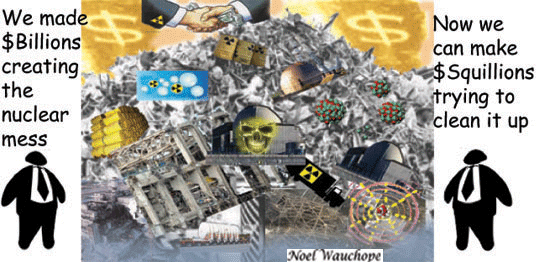
Areva was involved in the Fukushima clean-up, but that reactor is not covered by the new agreement, the French group said in a statement. It has been working with Hitachi to improve Japanese reactors’ safety for the past two years.
Areva’s role will now be to participate in preliminary studies for dismantling boiling-water reactors.
Prime Minister Shinzo Abe’s government has been pushing for a return to nuclear power to generate electricity after Japan’s several dozen reactors went offline in the wake of the 2011 disaster.
The resource-poor nation’s energy bill has soared since it was forced to turn to fossil-fuel imports to plug the gap.
But the Japanese public remains wary of atomic power, and Abe’s push has prompted rare protests and damaged his popularity.
Declaration of the World Nuclear Victims Forum in Hiroshima
The world nuclear victims forum was held at Hiroshima.
“A charter of world Nuclear Victim’s rights” was adopted. https://www.facebook.com/permalink.php?story_fbid=10154396267119937&id=685379936
世界核被害者フォーラム
Declaration of the World Nuclear Victims Forum in Hiroshima
(Draft Elements of a Charter of World Nuclear Victims’ Rights)
November 23, 2015
1. We, participants in the World Nuclear Victims Forum, gathered in Hiroshima from November 21 to 23 in 2015, 70 years after the atomic bombings by the US government.
2. We define the rights of nuclear victims in the narrow sense of not distinguishing between victims of military and industrial nuclear use, including victims of the atomic bombings in Hiroshima and Nagasaki and of nuclear testing, as well as victims of exposure to radiation and radioactive contamination created by the entire process including uranium mining and milling, and nuclear development, use and waste. In the broad sense, we confirm that until we end the nuclear age, any person anywhere could at any time become a victim=a Hibakusha, and that nuclear weapons, nuclear power and humanity cannot coexist.
3. We recall that the radiation, heat and blast of the atomic bombings of Hiroshima and Nagasaki sacrificed not only Japanese but also Koreans, Chinese, Taiwanese and people from other countries there as a result of Japan’s colonization and invasion, and Allied prisoners of war. Continue reading
Indonesia’s fires – enormous output of greenhouse emissions
 Indonesia: fires threaten to send even modest climate ambitions up in smoke The Conversation, Sonny Mumbunan Economist and research scientist at the Research Centre for Climate Change, University of Indonesia , 26 Nov 15 At the Paris climate negotiations, Indonesia will bring to the table a target of an unconditional 29% emissions reduction by 2030, increasing to 41% on condition of international assistance.
Indonesia’s emission reduction plan (or Intended Nationally Determined Contribution) is therefore slightly higher than its 2009 commitment to reduce emissions by 26% by 2020.
There are three problems with Indonesia’s INDC. The target is not ambitious; the plan is incoherent; and with the recent massive forest fires in Indonesia that have yet to be accounted for in the INDC it does not accurately reflect emissions for Indonesia.
Such a problematic INDC would affect the global efforts to adequately tackle climate change, since Indonesia is one of the biggest carbon emitters in the world. The forest fires have pushed the country into the top ranks of global greenhouse gas emitters……https://theconversation.com/indonesia-fires-threaten-to-send-even-modest-climate-ambitions-up-in-smoke-49155
Russia keen to market nuclear power to impoverished Cambodia
Russia to help Cambodia build capacity for nuclear power, REUTERS, YEKATERINBURG,  RUSSIA/PHNOM PENH 26 Nov
 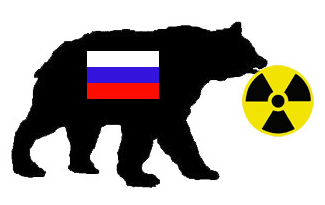 Russia will help Cambodia work towards building a nuclear power plant under an agreement the two countries signed this week, said Sergei Kirienko, the head of state nuclear firm Rosatom.
Cambodia depends heavily on imported fuel and power. Electricity in the country is among the most expensive in Southeast Asia and a common source of complaint from investors.
“The Cambodian government is mulling, in future, a nuclear power station construction,” Kirienko told reporters on Wednesday when asked about the agreement.
Cambodian energy officials declined to comment on the deal on Thursday.
The agreement was signed during a visit by Russian Prime Minister Dmitry Medvedev to Cambodia this week. His visit was the first to Cambodia by a senior Russian politician since 1986.
Under the terms of the agreement, Russia will provide expertise, research and training to Cambodia…… http://www.reuters.com/article/2015/11/26/us-cambodia-russia-nuclear-idUSKBN0TF0W220151126#siJ8T6T4vdeKAEm8.97
Talks between officials of North Korea and South Korea
North Korea, South Korea Hold Rare Talks Following Clashes, IBT, By Aditya Kondalamahanty on November 26 2015 North Korean and South Korean officials met in a demilitarized village on the border Thursday, to hold talks aimed at initiating sustainable communication between the two countries, according to reports. The rare meeting is the first intergovernmental interaction since August when the two sides met to defuse a crisis that had pushed them to the brink of an armed conflict.
Held in the border village of Panmunjom, about 34 miles north of Seoul, the meeting saw the two sides ironing out a framework to resume high-level talks, although they did not arrive at a precise timeline. Both countries signed a joint agreement agreeing on details such as who would represent their respective governments and the issues that would be on the agenda…….
Yoo Ho-yeol, a professor of North Korean studies at Korea University, said, according to Yonhap News Agency: “The North will likely call on Seoul to lift its sanctions against the North and to reopen the Kumgang tour program. The South is expected to raise the issue of family reunions.”
In October, the two Koreas conducted reunion of families, separated by the 1950-53 Korean War, as part of a deal signed in August. South Korea seeks to regularize the reunions while the cash-strapped North Korea has demanded that Seoul allow South Korean tour groups to its scenic Mount Kumgang resort.
Earlier in November, South Korean President Park Geun-hye said she was open to a summit with North Korean leader Kim Jong Un if the latter agreed to give up nuclear weapons and focus sincerely on inter-Korean ties. http://www.ibtimes.com/north-korea-south-korea-hold-rare-talks-following-clashes-2201165
Did China dump nuclear trash in Northern Sudan?

 Sudan: Govt Urged to Investigate ‘Nuclear Waste Dumping’ http://allafrica.com/stories/201511170207.html Khartoum / Merowe — The Sudanese Parliament and the Communist Party of Sudan (CpoS) have called on the government to “immediately investigate the burial of nuclear waste” from China in the Northern State. The director of the governmental Dams Implementation Unit has strongly denied the “presence of containers with chemicals or harmful substances to Sudan from any other country”.
The former director of the Sudan Atomic Energy Commission in Sudan, Mohamed Siddig, said at a conference in Khartoum last Tuesday that 60 containers with nuclear waste were brought from China to Sudan during the construction of the Merowe Dam in the Northern State.
Siddig told the audience that 40 containers were buried in the desert not far from the Merowe Dam construction site. Another 20 containers were disposed of in the desert. He did not mention the date the waste was dumped, however China worked on the dam between 2004 and 2009. On Sunday, the spokesman for the caucus of the independent MPs, Mubarak El Nur, called for an immediate investigation into the alleged crime. The perpetrators should be brought to justice, he stressed.
The chairman of the Northern State’s parliamentary Services Committee, Ali Hassan Bateik, said that the northern MPs will also demand an investigation into the rapid rise of cancer and kidney failure in the region
Medics The medical contingent of the Communist Party demanded that the government disclose the exact sites of the 60 Chinese containers.
In a statement on Sunday, the doctors emphasise the need for holding those involved in the operation accountable: “Charge them with murder, and sentence them to maximum penalties”.
The medics also blame the government for keeping silent on the growing number of people in the area who suffer from kidney failure or cancer.
Rumours The director of the governmental Dams Implementation Unit, Jaafar Mohamed Hammad, however, strongly denied the “presence of containers with chemicals or harmful substances to Sudan from any other country”.
He told the Sudan News Agency (Suna) in Khartoum last week that he will take legal action “against those who spread the rumours” about the dumping of Chinese nuclear waste in the Northern State.
In Japan, the “Nuclear Village” is in charge again
In Japan the propaganda warfare took a more sinister turn blaming the victims for their predicament. Japanese newspaper Asahi Shimbun that is closely connected to Japan’s ruling elite has run a series of articles on “radiophobia”, attributing health complaints of the affected to psychological and emotional stress.
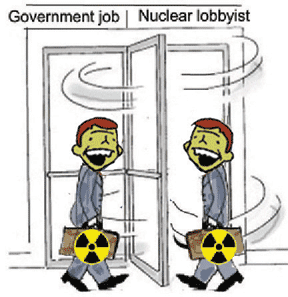 The long standing and corrupt practice of “amakudari” -“descent from heaven” which led to the capture of regulators by the regulated in form of career revolving doors has made any meaningful reform a pipe dream.
The Fukushima disease: Creation of virtual world based on radioactive reality,Rt.com 24 Nov 15 Derek Monroe “…………”We are in a difficult position that we made ourselves reliable on nuclear energy first and then were hurt by it,” said a local Minamisoma city employee who asked to remain anonymous as he was not authorized to talk to the media. “Many people here had good jobs and good lives and when the nuclear accident happened this came to a complete halt,” he said. The city’s website now is very optimistic in its proclamation of moving forward without nuclear power, despite the central government’s move to the contrary. The government in Tokyo has decided what is best for the citizens of Minamisoma and all of Japan.

Furthermore, nuclear power is back in charge as if it never left. Nationalist Prime Minister Abe Shinzo’s administration is another one anointed by “kempatsu mura” – “the nuclear village”, power and money complex that has been a steady fixture in the history of modern Japan. In 2012, Tokyo’s Waseda University researcher Tetsuo Arima disclosed declassified CIA documents dating to the 1950s. It was revealed that the long time kingmaker of Japanese politics, Matsutaro Shoriki and head of the country’s most powerful Yomiuri Shimbun media empire, worked hand in hand with the CIA to popularize nuclear energy as way for the future. Despite its peaceful angle and spin thrown onto the Japanese public that was still traumatized within a generation of the Hiroshima and Nagasaki bombings, Shoriki insisted the way to a successful future would have to include Japan’s nuclear armament………..
The long standing and corrupt practice of “amakudari” –“descent from heaven” which led to the capture of regulators by the regulated in form of career revolving doors has made any meaningful reform a pipe dream. This ultimately allowed the Tokyo Power Company (TEPCO), Japan’s largest utility, to defeat any efforts to improve plant safety as it would cost it too much money to comply with increased regulatory requirements. ………..
In Britain the government together with the industry decided on a strategy to spin the information released to the public as to avert a backlash against nuclear energy experienced in Germany as result of the disaster in Japan.
In Japan the propaganda warfare took a more sinister turn blaming the victims for their predicament. Japanese newspaper Asahi Shimbun that is closely connected to Japan’s ruling elite has run a series of articles on “radiophobia”, attributing health complaints of the affected to psychological and emotional stress. Ironically the same took place during a period of “radiophobia” scare doled out by medical professionals and nuclear experts in the Soviet Union after the Chernobyl disaster. Their fears and concerns were met with explanation that the victims were subjected and suffered from fear of radiation rather than the radiation itself. University of California anthropologist Adriana Petryna’s ethnographic study of the Chernobyl medical assessment and compensation system shown it was biased against the victims and politically manipulated. The same now applies to the case of Fukushima disaster victims as the more sophisticated forms of manipulation employing intrinsically Japanese traits of shame and group think are now used to shift the effects of the disaster onto victims’ own sense of responsibility. This allows the system to move on and not take responsibility for what transpired while using the cultural trait of the population’s acquiescence as a catalyst for its de facto forced amnesia.
Looking at the Japanese media and governmental space that work hand in hand to obfuscate its responsibility to inform, the truth of the matter is : the technology to decommission melted reactors doesn’t exist and the most optimistic scenario of final solution to the crisis is pure fiction.
As the country’s political establishment is readying itself to host the 2020 Olympics in Tokyo for which there is no public money or popular support whatsoever, the nuclear sword of Damocles will be hanging over it. The negligence and incompetence bordering on willful disregard for lives of its citizens makes the Japanese government a perfect candidate for prosecution under the crimes against humanity statues. Its handling of the Fukushima crisis puts into doubt Japanese credentials as a real democracy that is able and willing to address its citizens’ needs instead of using them as fodder for obscene corporate profits and foreign policy gamesmanship.
As a result Fukushima is worse than Chernobyl in many respects, making the difference between both political systems only a semantic one at best.
Japan Red Cross declined to be interviewed for the story.
Japanese Government did not respond to questions about its propaganda funding.
Chicago Tribune did not respond to request for interview.
Greg Burns did not respond to request for interview.
TEPCO did not respond to request for interview.
Japan Times did not respond to request for interview. https://www.rt.com/op-edge/323105-japan-fukushima-nuclear-disaster/
China’s authoritarian nuclear push meets community opposition
China’s authoritarian government, adept at corralling public opinion to get its way, can ram through its plans over the objections of people like Ms. Liu. But opponents say its closed, secretive political system is ill equipped to manage a rapid expansion of nuclear power, pointing to its struggle to prevent industrial disasters such as the chemical explosions in Tianjin in August that killed 173 people.
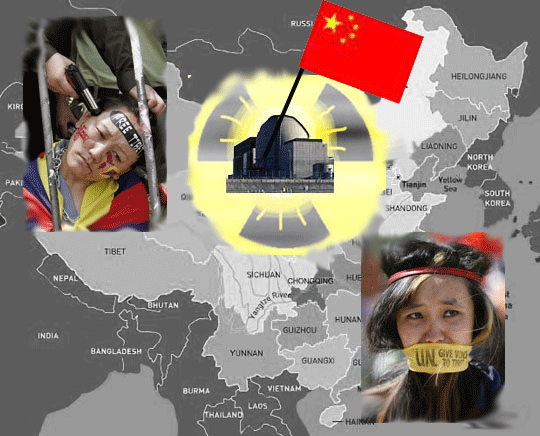
“The Chinese are beginning to wrestle with the same issues that Western countries were dealing with, concerning fear of the technology, transparency in decision making and trust of the authorities,”
Opponents of nuclear power in China maintain that the country can achieve its clean energy goals without a nuclear building spree, by investing heavily in improving solar and wind power and by upgrading the power grid so it can send electricity more efficiently across vast distances.
They point to the deadly explosions in Tianjin, where hazardous chemicals appear to have been stored improperly at a facility close to residential areas, as an example of how of lax regulation, graft and official obfuscation can undo the Chinese government’s promises to put safety first.
China’s Nuclear Vision Collides With Villagers’ Fears, NYT By CHRIS BUCKLEYNOV. 21, 2015“………..Hubin is one of dozens of sites across the country where officials have plans ready, awaiting further approval, to build atomic reactors over the next decade — an ambitious program to expand the use of nuclear energy that Beijing considers essential to weaning the Chinese economy from its reliance on coal-fired plants, which churn out air pollution and carbon dioxide.
Ask villagers here what they think of the proposed plant, though, and talk quickly turns to the Communist government’s dismal record of industrial accidents, as well as the 2011 nuclear disaster in Fukushima, Japan. Residents in Hubin will be resettled to new homes a few miles away, but many said that they would still feel threatened living so close to a nuclear station.
“It’s just not safe,” said Liu Shimin, a farmer in her 20s, nursing a baby outside her home near the banks of the Yahe River. “We’ll always be wondering, ‘What if there’s a big accident, like that one in Japan?’ ”
Such fears are on the rise in China as the nation embarks on a new phase of nuclear power construction that could make it the world’s biggest producer of nuclear energy by 2030. Continue reading
Japan to step up radiation protection, as worker’s leukaemia attributed to radiation
 Leukemia case recognized Last month, the Health, Labor and Welfare Ministry acknowledged a man in his 40s who developed leukemia after working at the Fukushima plant as a sufferer of work-related illness. He was the first decommissioning worker to be recognized as such.
Appropriate radiation control vital for Fukushima decommissioning http://the-japan-news.com/news/article/0002580144, November 22, 2015 The Yomiuri Shimbun It will take about 40 years to decommission reactors at Tokyo Electric Power Co.’s Fukushima No. 1 nuclear power plant. To secure the personnel necessary for that task, it is important to thoroughly safeguard the health of such personnel.
TEPCO has started stepping up its safety measures. The utility has established a consultative body in cooperation with subcontracting firms that dispatch personnel to the plant, thereby increasing the frequency of visits and inspections at their work sites. Measures also include expanding worker safety education. These steps are in keeping with a set of safety guidelines laid down by the government in late August.
An average of about 7,000 personnel work at the Fukushima facility every day, and not a small number of accidents tied to construction and other work have occurred. We hope TEPCO will comprehensively improve the work environment of these personnel.
It is particularly important to reduce the workers’ radioactive exposure. Continue reading
Indonesia will block its waters to nuclear waste ship travelling to Australia
 Indon to ‘block Aust-bound nuclear waste’ http://www.couriermail.com.au/news/breaking-news/indon-to-block-aust-bound-nuclear-waste/story-fnihsg6t-1227617732008 November 21, 2015 AAP
“WE will block the ship because nuclear waste is very dangerous,” sea security coordinating agenda head Vice Admiral Desi Albert Mamahit told The Jakarta Post newspaper.
“Our ships are on standby, although the ship is still far from Indonesia. We have information about the ship.”On October 16, the Australian Nuclear Science and Technology Organisation (ANSTO) confirmed a project to repatriate radioactive waste from France, where it was sent for reprocessing in the 1990s and early 2000s, and which will now be retained at ANSTO’s Lucas Heights, Sydney, facility.”Consistent with security requirements and practice established during nine previous export operations, ANSTO will not confirm the destination port, land route, or timing,” it said on its website.The Indonesians are concerned about a ship called the MV Trader, which was close to the African coast and expected to pass through the Malacca Strait, according to reports.
Japan ramps up its evacuation rules for nuclear ship accidents
 Evacuation rules revised for nuclear vessel accidents http://www.
japantimes.co.jp/news/2015/11/20/national/science-health/evacuation-rules-revised-for-nuclear-vessel-accidents/#.Vk-NWdIrLGh KYODO The government on Friday lowered the threshold for evacuating residents during accidents on nuclear vessels, bringing it in line with accidents at atomic power plants.
Under the new rules, residents will begin evacuating when radiation exceeds 5 microsieverts per hour in areas near nuclear-powered aircraft carriers or submarines — significantly lower than the previous 100 microsieverts per hour.The government also revised its emergency manual to reflect the change, and local authorities will now order or advise residents to leave based on the new rules.
Cities hosting U.S. Marine Corps bases with nuclear vessels are Yokosuka, Kanagawa Prefecture, Sasebo, Nagasaki Prefecture, and Uruma, Okinawa Prefecture.
The Cabinet Office had been working to revise the standards after disaster management minister Taro Kono instructed it to do so last month.
The government is also eyeing further amendments since discrepancies between nuclear vessel accidents and nuclear plant accidents still exist.
For example, people within a 30-km radius of a nuclear plant are urged to stay indoors during an accident, while only those within a 3-km radius of a nuclear vessel accident are urged to do so.
The rules for power plant accidents were revised in the wake of the 2011 Fukushima disaster.
Japan: 6.5 earthquake, small tsunami, not far from Sendani nuclear reactors
Japan hit by 6.5 magnitude earthquake, Brock Press, November 17, 2015 Chace King On Nov. 14, a magnitude 6.5 earthquake struck Japan, hitting the coastal island of Kyushu and triggering a small tsunami, according to the U.S Geological Survey.
Initially, the earthquake was thought to be close to a 7.0, but was downgraded later Saturday.
According to the Japanese Meteorological Agency (JMA), the 30 cm tsunami registered off the island of Nakanoshima, part of the Kagoshima region. The earthquake struck 159 km south of the town Makurazaki at a depth of about 10 kilometers, prompting fear that the quake would affect a pair of reactors in Sendani owned by the Kyushu Electric Power Co.

“There was no abnormality at the No. 1 and No. 2 reactors following the quake,” stated spokesman for Kyushu Electric Naoyuki Igawa in an interview with the Japan Times……. Far from uncommon, Japan is hit by roughly 1,500 earthquakes annually. The most deadly in recent history being when in 2011, Japan was hit by an earthquake in eastern Japan, leaving more than 18,000 dead or missing and sending three nuclear reactors into meltdown. http://www.brockpress.com/2015/11/briefs-japan-hit-by-6-5-magnitude-earthquake/
China to finance and build two nuclear stations in Argentina
 China to build two nuclear plants in Argentina in $15bn deal, Ft.com, Jamil Anderlini in Beijing and John-Paul Rathbone, Latin America Editor , 17 Nov 15
China will finance and build two nuclear power plants in Argentina in a deal worth up to $15bn underlining Beijing’s continued presence in Latin America despite its slowing economy.
The deal comes amid a push to export China’s homegrown atomic technology, often by offering cheap technology and generous financing. It follows China’s move last month to take a one-third stake in a French-led project to build the first in a new generation of UK nuclear plants.
Buenos Aires has been one of Beijing’s larger clients, with $19bn of lending for Chinese-led infrastructure projects since 2007, according to the Inter-American Dialogue’s China database.
Although China has started to scale back its exposure to more risky Latin American borrowers, such as Venezuela, it provided an $11bn currency swap arrangement last year to bolster Argentina’s sagging reserves.
Both reactors will be built by state-owned China National Nuclear Corp in co-operation with Argentina’s state-owned Nucleoeléctrica. When finished, they will roughly double the country’s nuclear power capacity provided by its existing three nuclear plants.
Chinese banks and companies will provide loans and investment to cover 85 per cent of the projects’ costs, with the loans to be paid back over 18 years with an annual interest rate below 6.5 per cent, according to Argentine media.
CNNC’s domestic state-owned rival, China General Nuclear Power Group (CGN), will apply to UK regulators next year for approval of its similar nuclear power technology as it seeks to build more plants in Britain.
CGN has already agreed to take a one-third stake in the French group EDF’s £18bn Hinkley Point power station, and wants to build a series of new reactors in the UK.
Analysts say success in exporting its nuclear technology to Britain will help China sell more nuclear plants around the world because of the perceived rigour of the UK’s regulatory regime.
“We have our first foot in the UK,” Zheng Dongshan, senior vice-president at CGN, told the Financial Times during a visit to the UK last month. “This could have a good effect to kick the door of other countries.”
Chinese economic planners have identified more than 60 countries between China and Europe as potential customers. They hope to provide 30 of the 200 nuclear plants they estimate will be under construction in those countries by 2030……
In recent years Beijing has stepped in to provide financing and investment to several countries locked, like Argentina, out of international credit markets or shunned by global investors because of war, sanctions or corruption.
Latin America has been an area of particular interest to China because of the ruling Communist party’s desire to expand Chinese influence into America’s traditional “backyard”.
UN Secretary-General Ban Ki-moon to visit North Korea – hope of diplomatic progress?
Hopes rise of nuclear breakthrough as UN chief visits North Korea, The Scotsman, 17 Nov 15 UN Secretary-General Ban Ki-moon is expected to visit Pyongyang this week for a possible meeting with leader Kim Jong Un.
The trip would come six months after Pyongyang at the last minute cancelled an invitation for Mr Ban to visit an inter-Korean factory park in the North Korean city of Kaesong. Mr Ban has said North Korea gave no reason for the cancellation. He had not planned to visit Pyongyang at that time.
South Korean news agency Yonhap cited an unidentified source in the UN when it reported Mr Ban’s Pyongyang trip. It gave no details on the purpose of the trip or the day it would take place.
If the trip does take place, Mr Ban would be the first UN head to visit North Korea since Boutros Boutros-Ghali in 1993. Yonhap, quoting a UN source, said Mr Ban is expected to meet Mr Kim because it is unlikely for the secretary-general to visit a UN member state without meeting the country’s leader.
-
Archives
- October 2026 (104)
- September 2026 (339)
- August 2026 (330)
- July 2026 (355)
- June 2026 (287)
- May 2026 (306)
- April 2026 (356)
- March 2026 (251)
- February 2026 (267)
- January 2026 (308)
- December 2025 (358)
- November 2025 (359)
-
Categories
- 1
- 1 NUCLEAR ISSUES
- business and costs
- climate change
- culture and arts
- ENERGY
- environment
- health
- history
- indigenous issues
- Legal
- marketing of nuclear
- media
- opposition to nuclear
- PERSONAL STORIES
- politics
- politics international
- Religion and ethics
- safety
- secrets,lies and civil liberties
- spinbuster
- technology
- Uranium
- wastes
- weapons and war
- Women
- 2 WORLD
- ACTION
- AFRICA
- Atrocities
- AUSTRALIA
- Christina's notes
- Christina's themes
- culture and arts
- Events
- Fuk 2022
- Fuk 2023
- Fukushima 2017
- Fukushima 2018
- fukushima 2019
- Fukushima 2020
- Fukushima 2021
- general
- global warming
- Humour (God we need it)
- Nuclear
- RARE EARTHS
- Reference
- resources – print
- Resources -audiovicual
- Weekly Newsletter
- World
- World Nuclear
- YouTube
-
RSS
Entries RSS
Comments RSS

