Continuing struggle to rid Okinawa of USA military bases
Struggle against U.S. bases continues in Okinawa http://happening-here.blogspot.com.au/ The elected governor of the Japanese-controlled island of Okinawa has said no, again, to further construction of a new U.S. base. Okinawans have been trying to reclaim their territory for decades. The island is part of the Ryukyu archipelago which the U.S. conquered at the end of World War II. Japan recovered sovereignty, but although since 1945 Japan has been ostensibly a nuke-free zone, the U.S. has been allowed to bring nuclear armed vessels to Okinawa if not the Japanese mainland.
The 1.3 million Okinawans have repeatedly elected officials who promise to oust the U.S. military. These local officials have then been overruled from Tokoyo repeatedly.
The U.S. Marines are not considered good neighbors on the island: they are seen as the source of drunken louts and rapists who usually enjoy impunity from the local justice system.
Okinawans are Japan’s largest minority group.
I have written previously about Okinawa’s special place and its irritants to the U.S. empire here and here.
Anxious about 2020 Olympics, Tepco to hasten ice wall project at Fukushima nuclear station
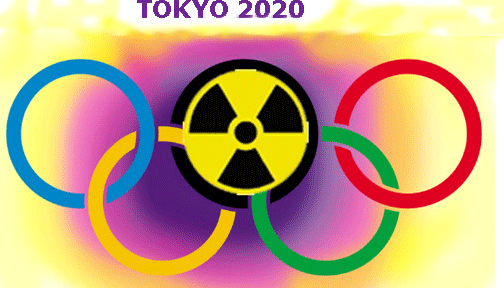 Tepco Expects to Begin Freezing Fukushima Ice Wall by Year End http://www.bloomberg.com/news/articles/2015-10-10/tepco-expects-to-begin-freezing-fukushima-ice-wall-by-year-end Stephen Stapczynski October 10, 2015
-
Aim to resolve contaminated water issue by 2020 Olympics
-
About 300 tons of water a day flow into radioactive reactor
-
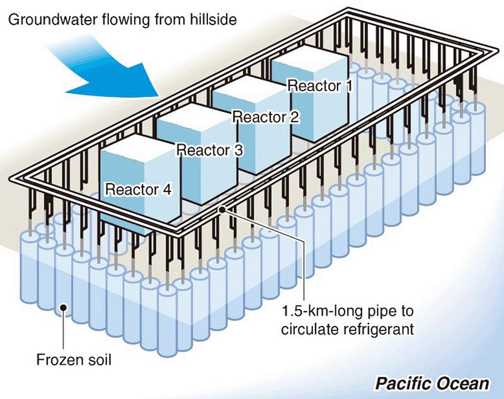
Tokyo Electric Power Co. expects to begin freezing a soil barrier by the end of the year to stop a torrent of water entering the wrecked Fukushima nuclear facility, moving a step closer to fulfilling a promise the Japanese government made to the international community more than two years ago.
“In the last half-year we have made significant progress in water treatment,” Akira Ono, chief of the Fukushima Dai-Ichi plant, said Friday during a tour of the facility north of Tokyo. The frozen wall, along with other measures, “should be able to resolve the contaminated water issues before the Olympic games.”
Solving the water management problems would be a major milestone, but Tokyo Electric is still faced with a number of challenges at the site. The company must still remove highly radioactive debris from inside three wrecked reactors, a task for which no applicable technology exists. The entire facility must eventually be dismantled.
- Currently, about 300 metric tons of water flow into the reactor building daily from the nearby hills. Tepco, as the nation’s biggest utility is called, has struggled to decommission the reactors while also grappling with the buildup of contaminated water.
Even four years after the meltdown and despite promises from policymakers, water management remains one of Tepco’s biggest challenges in coping with the fallout of Japan’s worst nuclear disaster.
The purpose of the ice wall — a barrier of soil 30 meters (98 feet) deep and 1,500 meters long which is frozen to -30 Celsius (-22 Fahrenheit) — is to prevent groundwater from flooding reactor basements and becoming contaminated.
-
Public Trust Needed
“As the radiation levels decrease via natural decay, water management becomes the main issue,” Dale Klein, an independent adviser for Tepco and a former chairman of the U.S. Nuclear Regulatory Commission, said by e-mail. “It is a very important issue for the public, and good water management is needed for Tepco to restore the public’s trust.”
- Tepco is currently testing the freezing system, aiming to have the fence fully operational by the end of December, company spokesman Yuichi Okamura said.
At the moment, the deluge of groundwater entering the reactor buildings is purified, lowering its radioactive content. The water is then stored in one of numerous barrels at the site, each of which can hold 1,000 tons of water.
To make room for the 1,000 or so barrels required to hold the water, Tepco flattened a 500 square meter (5,382 square foot) bird sanctuary on the outskirts of the facility. The company doesn’t have government approval to release the water into the ocean, and there’s no clear plan for its disposal, Tepco’s Okamura said.
- Prime Minister Shinzo Abe promised in 2013 that the government would take the lead in resolving the water management issues at the Fukushima site ahead of the 2020 Tokyo Olympics. Two years later, hundreds of tons of water continue to pour into the reactor building, while tainted water at other parts of the site overflows into the ocean.
Water Overflow
Since January, slightly tainted water has spilled from a drainage system into the ocean on nine occasions, according to company spokeswoman Yukako Handa.
The company aims to end these leaks by reconfiguring a drainage system and building a wall running 30 meters into the seabed. The drainage work will be completed next year, and the sea wall will be completed this month.
The proposed ice wall has never been done on such a scale, and there could be operational issues due to the complicated nature of the project, according to Lake Barrett, former head of the U.S. Department of Energy’s Office of Civilian Nuclear Waste Management.
“Some of these areas may have different freezing and sealing capabilities,” he said by e-mail. “These types of problems were encountered when Tepco tried and failed to seal the seawater trenches by freezing.”
China keen to market nuclear technology overseas
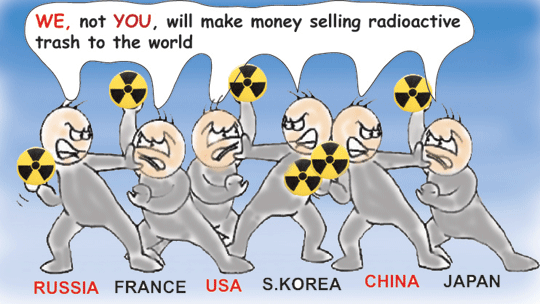
 Eyeing future exports China aims to become world’s top nuclear power producer by 2030 TETSUYA ABE, Nikkei staff writer BEIJING, 10 October 15 — Chinese President Xi Jinping’s government is poised to greatly expand the country’s nuclear power generation, with plans to build six to eight new reactors a year over the next five years.
Under its 13th five-year national development plan, which starts in 2016, China will invest 500 billion yuan ($78.7 billion) to introduce domestically developed reactors. The new five-year plan is to be formally adopted at next spring’s annual session of the National People’s Congress, China’s parliament……….
According to the China Nuclear Energy Association, there are 25 nuclear reactors operating in the country and a further 26 under construction. Under its current five-year plan, China has frozen new nuclear projects, in principle, in the wake of the 2011 nuclear disaster at Japan’s Fukushima Daiichi nuclear power plant.
In addition to unfreezing new projects, China will lift a ban on nuclear projects in inland areas and promote the introduction of domestically developed reactors under its next five-year plan. China hopes to make nuclear reactors a major infrastructure export in the future, along with high-speed trains. http://asia.nikkei.com/Politics-Economy/Policy-Politics/China-aims-to-become-world-s-top-nuclear-power-producer-by-2030
USA worries about Pakistan’s nuclear agendas
India, Pakistan’s Nuclear Agendas Concern U.S., Value Walk, Brinda Banerjee October 10, 2015 A high-ranking official from within the Obama administration has recently likened India and Pakistan to North Korea and Iran in a conversation regarding the countries’ nuclear capabilities. The comment was made in a discussion about countries that are actively pursuing nuclear development and growth even as the international community remains apprehensive about weapons proliferation and the potential fallout of the same.
Addressing a seminar at Oslo, Norway, U.S. official Frank Rose recently said, “India and Pakistan are adding to their arsenals; North Korea’s nuclear and missile programs remain a concern to all; and Iran, despite the landmark nuclear deal, continues its ballistic missile programs”. Mr. Rose currently serves as the Assistant Secretary of State at the Bureau of Arms Control, Verification and Compliance of the United States Department of State.
At present, India possesses between 80 and 100 nuclear warheads while Pakistan’s stockpile is estimated at between 100 and 120 nuclear warheads. Assessments based on Pakistan’s nuclear development goals reveal that the country is poised to own the third-largest supply of nuclear weapons within the next ten years.
At present, Russia and the United States have the biggest nuclear weapons supplies in the world, with both Moscow and Washington totaling in at approximately 1,600 each. China, France and the United Kingdom follow suit with 250, 300 and 225 nuclear warheads respectively.
Security experts interpret Pakistan’s ever-expanding nuclear arsenal as a cause for concern given the country’s history of proliferation. Talk of Pakistan and the nuclear issue is incomplete without mention of Pakistani scientist Abdul Qadeer Khan who was found guilty of selling nuclear weapons technology and information on the black-market to bidders in Iran, Libya and North Korea. The country’s record with nuclear technology, its experiences with internal security challenges and extremism and the historic rivalry with India have all caused the international community to worry about regional security and international fallout should nuclear growth in the region be allowed to continue unchecked.
Comprehensive Nuclear-Test-Ban Treaty And Proliferation Concerns
While the Comprehensive Nuclear-Test-Ban Treaty (CTBT) is the overarching international regulation by way of which the global community aims to prevent nuclear proliferation, the agreement has not been fully effected. This is, due in part to the reluctance of some states to fully agree to the covenant.
The United States and Iran are amongst the countries that have signed the CTBT but are yet to ratify it. Other states that have signed the treaty but not ratified it include China, Egypt and Israel. India, North Korea and Pakistan are the three countries that have not signed the agreement. Signing began in the year 1996; since then, only three countries have been conclusively known to have carried out nuclear testing: India, North Korea and Pakistan. India and Pakistan both conducted two rounds of nuclear tests in 1998 while North Korea organized its tests in 2006, 2009 and 2013……….
U.S. Considers Nuclear Accord With Pakistan, India Objects
The United States is reportedly exploring options for a nuclear arrangement with Pakistan. The deal, if it were to be realized, would witness a definite capping of Pakistan’s nuclear stockpile in return for a greater supply of nuclear material. The deal will allow the U.S. access to Pakistan’s nuclear production facilities and raw materials. For Pakistan, the tradeoff will include the U.S.’ assistance in purchasing nuclear materials and necessary capabilities from the Nuclear Suppliers Group, which at present does not transact with countries that have not signed the Non Proliferation Treaty.
While Pakistan has demanded a “non-discriminatory approach on nuclear issues” in its pursuit of a nuclear agreement like the one India enjoys with the United States, Islamabad has not been as successful in realizing its ambitions.
However, The Washington Post has reported that Pakistan’s wishes may soon be realized and while the White House is yet to lend credence to these allusions, Pakistani Prime Minister Nawaz Sharif’s upcoming trip to the United States may indeed spell a new era for Pak-U.S. strategic ties. http://www.valuewalk.com/2015/10/india-pakistans-nuclear-agendas-concern-u-s/
Nuclear power building – UK’s worry of China’s poor health and safety record

 nuclearnews No 2 nuclear power Oct 15 ..…….. it is China’s poor health and safety record which is most worrying. With the power of the Chinese Government and the UK Government’s enthusiasm for Chinese money the concern is that the UK’s nuclear regulators will be sidestepped.
China’s health and safety standards have been thrust into the spotlight this year by a series of chemical explosions. An explosion at a chemical plant in the eastern Chinese province of Shandong shortly before midnight on 31st August 2015 was the second to occur at a chemical plant in Shandong province in a matter of days.
Although no casualties were reported, the blast happened about a fortnight after explosions in the port city of Tianjin, northern China, which killed over 145 people. In the wake of the Tianjin blast, the Communist Party has sacked the head of China’s safety regulator, who was previously the vice mayor of the city. Shortly after, 12 government officials and company executives were detained. (6)
 According to Ben Chu, author of ‘Chinese Whispers: Why Everything You’ve Heard About China is Wrong, the disaster in Tianjin was the latest consequence of a system that places personal profit before public safety. He says in China today behind every industrial accident lies a reeking morass of corruption.
Chinese state media reported that the son of a former local police chief was secretly a joint owner of the Tianjin warehouse that went up in a devastating fireball last week, killing 145 people, injuring 674 and damaging some 17,000 homes. He used his official connections to obtain licences for the warehouse, even though it flagrantly breached regulations prohibiting the storage of hazardous chemicals (sodium cyanide in this case) near residential areas. (7)
Surge in thyroid cancers in Fukushima

 UPI: ‘Skyrocketing’ cancer cases in Fukushima — AP: ‘Alarming’ cancer rates after nuclear disaster — Times: Child cancers up 5,000% — Radiation doses may be “considerably higher” than estimated — Expert: Cancer outbreak shows officials must now prepare for onset of leukemia, other diseases (VIDEO) http://enenews.com/times-child-cancers-5000-after-fukushima-disaster?utm_source=feedburner&utm_medium=email&utm_campaign=Feed%3A+ENENews+%28Energy+News%29
The Times, Oct 8 2015 (emphasis added): Child cancers up fiftyfold after Fukushima disaster— Cases of thyroid cancer among children living close to the Fukushima nuclear power plant have increased fiftyfold since the meltdown in 2011, according to Japanese scientists… in one of the most pessimistic assessments of the health implications of the world’s second-worst nuclear disaster. He urged the Japanese authorities to stop quibbling over the interpretation of cancer statistics, and to muster medical resources. “We need to prepare for leukaemia, breast cancer and (remainder of article only available to subscribers)… Photo Caption: 104 cases of thyroid cancer have been identified, a far higher rate than the national average
AP, Oct 9, 2015: Study shows alarming thyroid cancer rates in children living near Fukushima… “This is more than expected and emerging faster than expected,” lead author Toshihide Tsuda said…
UPI, Oct 8, 2015: Fukushima radiation has been linked to a surge in thyroid cancer among children near the disaster area… A team of Japanese researchers led by Toshihide Tsuda, a professor of environmental epidemiology at Okayama University, said cases of thyroid cancer in Fukushima Prefecture have skyrocketed since March 2011… and the culprit was increased radiation exposure since the Fukushima nuclear disaster…
T. Tsuda, A. Tokinobu, E. Suzuki, E. Yamamoto (Okayama Univ.), Oct 5, 2015:
- Thyroid Cancer Detection by Ultrasound Among Residents Ages 18 Years and Younger in Fukushima… 2011 to 2014
- The highest incidence rate ratio… was observed in the central middle district of the prefecture… incidence rate ratio = 50…
- … estimated doses ranged from 119 to 432 mSv among mothers and from 330 to 1,190 mSv in their infants for those living 45 to 220 km south or southwest, including Iwaki City in the Fukushima Prefecture, Ibaragi Prefecture, and Chiba Prefecture.
- … we could infer that the incidence of thyroid cancer in Fukushima rose more rapidly than expected… as estimated by the World Health Organization.
- The radiation burden to the thyroid in Fukushima Prefecture might have been considerably higher than estimated…
- The minimum empirical induction time for thyroid cancer is 2.5 years for adults and 1 year for children, according to the [CDC]. Therefore, we considered it possible to detect thyroid cancer… even within the 2011 fiscal year.
- In Chernobyl, excesses of thyroid cancer became more remarkable 4 or 5 years after… the observed excess alerts us to prepare for more potential cases.
Japan Moving People Back to Fukushima Restricted Zones
Radiation Impact Studies: Chernobyl and Fukushima, Dissident Voice, by Robert Hunziker / September 23rd, 2015 “…….Japan’s Abe government has started moving people back into former restricted zones surrounding the Fukushima Daiichi Nuclear Power Station even though it is an on-going major nuclear meltdown that is totally out of control.
Accordingly, Greenpeace Japan conducted a radiation survey and sampling program in Iitate, a village in Fukushima Prefecture. Even after decontamination, radiation dose rates measured ten times (10xs) the maximum allowed to the general public.
According to Greenpeace Japan:
The Japanese government plans to lift restrictions in all of Area 2 [2], including Iitate, where people could receive radiation doses of up to 20mSV each year and in subsequent years. International radiation protection standards recommend public exposure should be 1mSv/year or less in non-post accident situations. The radiation limit that excluded people from living in the 30km zone around the Chernobyl nuclear plant exclusion zone was set at 5mSV/year, five years after the nuclear accident. Over 100,000 people were evacuated from within the zone and will never return.2
http://dissidentvoice.org/2015/09/radiation-impact-studies-chernobyl-and-fukushima/
Contradictions in Japanese govt’s nuclear planning
 Government Fails to Address Contradictions Over Japan’s Nuclear Future, nippon.com Kikkawa Takeo [2015.10.08] The August 2015 restart of the Sendai Nuclear Power Plant in Kyūshū ended a two-year shutdown of all nuclear reactors in Japan. As commentators debate whether this will prompt other plants around the country to come back online, the current administration appears unwilling to take responsibility for dealing with contradictions between the need to shut down aging facilities and the nation’s continued reliance on nuclear power……
Many Japanese news organizations predicted at the beginning of 2015 that nuclear energy would make a full-fledged comeback during the year, with operations resuming at Sendai and other nuclear plants one after another. The projections appear to have been slightly too hasty, however, as restarting reactors has proved to be more difficult than anticipated…….
The 2012 revisions to the Act on the Regulation of Nuclear Source Material, Nuclear Fuel Material, and Reactors require all nuclear power plants to be taken out of service after 40 years, with a one-time-only, 20-year extension being granted in exceptional cases when certain conditions are met. The maximum number of years that a plant can remain in operation is thus 60 years. Of the 48 reactors in Japan as of January 2015, only 18 will be under 40 years old at the end of December 2030. If the revisions are strictly enforced, 30 reactors will need to be decommissioned by then. Two reactors are currently under construction—Unit 3 of Chūgoku Electric Power’s Shimane Nuclear Power Plant and Electric Power Development’s Ōma Nuclear Power Plant—but even if they come online, that would still mean just 20 reactors as of the end of 2030. Assuming that these 20 units operate at 70% capacity (which was roughly the average prior to the Fukushima accident), they would only be able to generate 15% of the nearly 1 trillion kWh projected to be required in 2030.
If the 40-year rule is applied strictly, nuclear power will meet just 15% of the nation’s energy needs in 2030. The additional 5%–7% needed to meet METI’s 20%–22% outlook is thus premised on either building new reactors or extending the life of existing ones beyond 40 years. Since the administration has announced that it has no plans now to build additional reactors, one can then conclude that it intends to cover the 5%–7% shortfall by extending the life of existing plants…….
The resumption of operations at Kyūshū Electric’s Sendai plant thus will not trigger a spate of restarts at other plants, and 2015 is hardly likely to mark the full-fledged return of nuclear power in Japan.
(Originally written in Japanese and published on September 22, 2015 http://www.nippon.com/en/currents/d00196/
A nuclear power plant project in India is stalled
Nalco’s foray into nuclear energy hits legal roadblock Proposed Rs 12,000-cr nuclear energy plant in a JV with Nuclear Power Corporation in limbo Business Standard, India, Dilip Satapathy | Bhubaneswar October 9, 2015 National Aluminium Company (Nalco)’s plan to foray intonuclear energy generation has hit a legal roadblock.
Though the aluminium major proposed to set up a Rs 12,000 crore nuclear energy plant in joint venture withNuclear Power Corporation of India Ltd (NPCIL), it is unable to go ahead with the project with the present act restricting the sector to only a couple of its own fully owned subsidiaries under the Atomic Energy Department…….
Though NPCIL is keen to involve other public sector firms like Nalco, IOCL and NTPC, with whom it has signed MoUs, for setting up of nuclear power plants in a bid to expand its nuclear power footprint in the country, the present act does not allow this.
The Atomic Energy Act, framed in 1962, also prohibits private control of nuclear power generation though it allows them minority investment……….Apart from the fuel supply issue and protests over establishment of nuclear power plants, changes in the act to allow JVs formed by NPCIL with other PSUs to make them workable is another hurdle, the India government has to take care if the country wants to achieve 20 GWe nuclear energy capacity by 2020, sources said.
Besides nuclear energy, the aluminium major has identified renewable energy as its next focused area.
“We have set up wind mills in Andhra Pradesh (50.4 Mw) and Jaisalmer (47.6 Mw) in Rajasthan. We plan to set up solar plants in Rajasthan and Maharashtra (50 Mw each) and Madhya Pradesh (20 Mw). We are also in the processing of installing a 14 Mw wind power mill at Damanjodi,” Chand said. http://www.business-standard.com/article/companies/nalcos-foray-into-nuclear-energy-hits-legal-roadblock-115100900777_1.html
Fukushima children and adolescents have unusually high rates of thyroid cancer
 Thyroid Cancer Detection by Ultrasound Among Residents Ages 18 Years and Younger in Fukushima, Japan: 2011 to 2014. http://journals.lww.com/epidem/Abstract/publishahead/Thyroid_Cancer_Detection_by_Ultrasound_Among.99115.aspx by Tsuda, Toshihide; Tokinobu, Akiko; Yamamoto,
Eiji; Suzuki, Etsuji Epidemiology: Post Author Corrections: October 5, 2015 Open Access Published Ahead-of-Print
Methods: After the release, Fukushima Prefecture performed ultrasound thyroid screening on all residents ages <=18 years. The first round of screening included 298,577 examinees, and a second round began in April 2014. We analyzed the prefecture results from the first and second round up to December 31, 2014, in comparison with the Japanese annual incidence and the incidence within a reference area in Fukushima Prefecture.
Results: The highest incidence rate ratio, using a latency period of 4 years, was observed in the central middle district of the prefecture compared with the Japanese annual incidence (incidence rate ratio = 50; 95% confidence interval [CI] = 25, 90). The prevalence of thyroid cancer was 605 per million examinees (95% CI = 302, 1,082) and the prevalence odds ratio compared with the reference district in Fukushima Prefecture was 2.6 (95% CI = 0.99, 7.0). In the second screening round, even under the assumption that the rest of examinees were disease free, an incidence rate ratio of 12 has already been observed (95% CI = 5.1, 23).
Conclusions: An excess of thyroid cancer has been detected by ultrasound among children and adolescents in Fukushima Prefecture within 4 years of the release, and is unlikely to be explained by a screening surge.
This is an open-access article distributed under the terms of the Creative Commons Attribution-Non Commercial-No Derivatives License 4.0 (CCBY-NC-ND), where it is permissible to download and share the work provided it is properly cited. The work cannot be changed in any way or used commercially.
Fiftyfold increase in child thyroid cancers in Fukushima residents
Child cancers up fiftyfold after Fukushima disaster The Times, Richard Lloyd Parry Tokyo, October 8 2015 Cases of thyroid cancer among children living close to the Fukushima nuclear power plant have increased fiftyfold since the meltdown in 2011, according to Japanese scientists.
Residents of Fukushima prefecture in northeast Japan should be monitored in the same way as survivors of the atomic bombings of Hiroshima and Nagasaki, say the researchers, who offer one of the most pessimistic assessments so far of the health implications of the world’s second worst nuclear disaster……..http://www.thetimes.co.uk/tto/news/world/asia/article4579144.ece
Increasing public opposition to South Korean govt’s nuclear power policy
 The Repercussions of South Korea’s Pro-Nuclear Energy Policy A long-term policy is running into increasing domestic opposition, The Diplomat, By Se Young Jang, 8 Oct 15 Se Young Jang is an associate at the Belfer Center for Science and International Studies, Harvard Kennedy School, and a non-resident Kelly fellow at Pacific Forum CSIS.
In a local referendum held in October 2014, an overwhelming majority of the residents in Samcheok, a small coastal city in Gangwon province, rejected the South Korean government’s plan to build a nuclear power plant in the city. Since Japan’s 2011 nuclear disaster in Fukushima and South Korea’s 2013 scandals over fake safety certificates for nuclear equipment, South Koreans have begun to take nuclear safety issues more seriously, which in turn has prompted a growing anti-nuclear power sentiment. A series of scandals and accidents in South Korea’s nuclear power plants have focused public attention on the effects of radioactive materials on the health of the residents who live near the country’s four nuclear power plants. Last year, a South Korean courtruled that the Korea Hydro & Nuclear Power Co., a state-run nuclear power plant operator, was responsible for the thyroid cancer suffered by a plaintiff, who has lived 7.7 km away from the Kori nuclear power plant over the past 20 years. Since then, more than 500 thyroid cancer patients living close to the nuclear power plants in South Korea have been preparing a joint legal action against the company.
Notwithstanding the anti-nuclear sentiment, nuclear energy as a share of total electricity generated increased to about 30 percent in 2014, and the South Korean government is currently constructing four new nuclear reactors with eight more being planned. Standing firm on its nuclear power plant projects, the South Korean government regarded the Samcheok referendum as not legally binding, and this position remains unchanged. Under the Second Basic National Energy Plan for 2015-2035, South Korea appear to have few options but to stick to its original plan of building more nuclear power plants, as the 2015-2035 energy plan was based on the assumption that it could not avoid raising its dependence on nuclear power.
Critics say that the government overestimated future electricity demand and underpriced electricity. According to the Sixth Basic Supply-Demand Plan for Electricity (2013-2027), South Korea will use more electricity per capita than the United States in 2024. The high population density in South Korea could translate into lower demand for electricity per capita. Moreover, estimates of electricity demand are based on cheap prices for electricity; the government calculated that the rate of increase in electricity prices in the coming years would be one third of the inflation rate. Some newspapers in South Korea report concerns about rising electricity bills as a result of a decreasing reliance on nuclear power. Still, it is interesting to note that 65.6 percent of respondents in a 2013 poll were willing to pay a higher electricity bill if it meant fewer nuclear power plants……….
Today, South Korea no longer seeks its own nuclear weapons, but Park Geun-hye still sees boosting nuclear energy industry as a great opportunity for the South Korean economy. Now a nuclear exporter, South Korea has concluded agreements with Jordan and the United Arab Emirates to construct one research reactor and four commercial reactors. …….
Korea’s success in the nuclear export market and geopolitical necessities notwithstanding, the current domestic situation is hardly favorable to the South Korean government. The 2013 scandal over hundreds of faulty components used in reactors is still unfolding. A parliamentary audit last year revealed that the temporary suspension of the operations of nuclear power plants after the scandal caused the loss of 10 trillion won (about $9.5 billion), and that some officials fired from the KEPCO E&C (Korea Electric Power Corporation Engineering and Construction) over the scandals were rehired. Worse, the result of the referendum in Samcheok is probably only the beginning of a series of hurdles which the South Korean government will have to overcome. More than half of the respondents in a recent poll conducted in Yeongdeok, in North Gyeongsang Province, which was also designated as a nuclear power plant site by the government in 2012 along with Samcheok, opposed the central government’s construction plan.
The consent of local residents will be even more important in the near future as South Korea faces a crisis over the storage of nuclear spent fuel. South Korea has nearly 9,000 tons of spent fuel stacked in temporary storage pools with about 750 tons added to the pools every year. They could reach maximum capacity by 2021. The government has been deliberating over several ways of storing spent fuel, including pyroprocessing and a medium-term solution using dry casks; but no matter what method South Korea chooses, the government will need to be able to persuade people living next to the facility, no easy task as Samcheok has demonstrated……….http://thediplomat.com/2015/10/the-repercussions-of-south-koreas-pro-nuclear-energy-policy/
Pediatric Thyroid Cancer after the Fukushima Accident
Press Conference: Toshihide Tsuda, Professor of Okayama Univeristy, October 08, 2015, “Pediatric Thyroid Cancer after the Fukushima Accident”
Toshihide Tsuda
Professor, Graduate School of
Environmental and Life Science, Okayama University
Language: The speech and Q & A will be in Japanese with English interpretation
Almost five years after the triple meltdown at the Fukushima Daiichi nuclear power plant, attention is turning to the possible long-term health effects radiation exposure has had on local people, particularly children.
A large-scale thyroid ultrasound screening examination is underway in Fukushima Prefecture, covering about 370,000 children who were 18 or younger at the time of the accident.
Despite evidence of much higher rates of juvenile thyroid cancer in the prefecture compared with the pre-accident incidence rate, local medical authorities and the central government claim that the Fukushima disaster is not the cause.
They point to the evacuation of tens of thousands of people in the immediate aftermath, and the ban on the sale of locally produced milk and other produce. The authorities, backed by prominent international experts, claim the increased rate of thyroid cancer is due to the highly sensitive ultrasound equipment being used to test Fukushima children.
But in a significant challenge to that thesis, Toshihide Tsuda, professor of environmental epidemiology at Okayama University, believes the excess occurrence of juvenile thyroid cancer is not due merely to the screening effect, but is the consequence of exposure to radiation. http://www.fccj.or.jp/events-calendar/press-events/icalrepeat.detail/2015/10/08/3459/30/press-conference-toshihide-tsuda-professor-of-okayama-univeristy.html
Turkey warns Russia it may not get its nuclear technology from Russia
Turkey’s Erdogan warns Russia on nuclear project, natural gas: papers http://news.yahoo.com/turkeys-erdogan-warns-russia-nuclear-project-natural-gas-090830083.html ISTANBUL (Reuters), 8 Oct 15 – Turkish President Tayyip Erdogan told Russia there were other places Turkey could get natural gas and other countries that could build its first nuclear plant, in the wake of Russian incursions into Turkish air space during its air campaign in Syria.
Russian aircraft twice entered Turkish air space at the weekend. Turkish F-16 jets have also been harassed by Syrian-based missile systems and unidentified planes since then.
“We can’t accept the current situation. Russia’s explanations on the air space violations are not convincing,” the Turkish daily Sabah and others quoted Erdogan as telling reporters as he flew to Japan for an official visit. He said he was resentful over what had happened but did not currently plan to speak to Russian President Vladimir Putin.
“These are matters for Russia to think about. If the Russians don’t build the Akkuyu (nuclear plant in southern Turkey) another will come and build it,” he said.
Turkey in 2013 commissioned Russia’s state-owned Rosatom to build four 1,200-megawatt reactors, but a start date for what is Turkey’s first nuclear power plant project has not yet been set.
“We are Russia’s number one natural gas consumer. Losing Turkey would be a serious loss for Russia. If necessary, Turkey can get its natural gas from many different places,” he said.
Around 28-30 billion cubic meters (bcm) of Turkey’s 50 bcm annual natural gas needs are met by Russia.
(Additional reporting by Orhan Coskun; Writing by Daren Butler; Editing by Hugh Lawson)
Serious questions about China’s involvement in Britain’s new nuclear power projects
 Serious issues for George Osborne on China’s role in the UK’s nuclear future The Conversation, Jeffrey Henderson Professor of International Development, University of Bristol October 5, 2015 George Osborne will address the Conservative party conference on Monday fresh from a sales trip to Beijing. His efforts to drive more trade between the two nations saw Chinese state-owned companies invited to participate in the development of nuclear generating plants in Britain. They will have the chance to work with French state-owned company, EDF at Hinkley Point, Somerset and will be the sole operators at Bradwell, Essex. The move has already attracted doubts but there are other vital issues that have yet to be aired. These can be crystallised into five clear questions that Osborne and his government must answer.
Safety concerns
Two Chinese companies are involved with Hinkley Point: China National Nuclear Corporation (CNNC) and China General Nuclear Power Corporation (CGN). The latter was responsible, under its previous guise (China Guangdong Nuclear Power) for building and running China’s first nuclear station, Daya Bay, near Hong Kong. It was initially improperly built – with reinforcement rods missing from the concrete base under the reactor – and there have since been reports of minor leakages of radioactive materials (though this is difficult to check, given China’s lack of transparency).
The deeply corrupt environment in which many Chinese companies operate compounds the possibility of these companies being lax on safety measures and it’s simply not good enough to say that Britain has one of the tightest nuclear safety regimes in the world. Confronted with the power of the Chinese government and the British government’s enthusiasm for unceasing flows of Chinese investment, the risk must be that the regulatory agency will be sidestepped or unable to cope………
Who builds what and with which workers?
The public needs to know whether Chinese construction companies will be involved in building Hinkley Point and other power stations and, if so, whether they will seek to use workers from China. ……..
One of the companies involved at Hinkley Point – China National Nuclear – produces China’s nuclear weapons. This means that as well as the Communist Party, CNNC is almost certainly controlled by the People’s Liberation Army (as all Chinese military-related companies are). Given geopolitical uncertainty (with rising tensions between China, Japan and the US over China’s territorial claims in the East and South China Seas), allowing such a company anywhere near Britain – not to mention in an industry as strategic as power generation – verges on the insane. Has MI5 been consulted on this, and if it has, what was its advice?
At its heart, the question of Chinese state (and thus Communist Party) involvement in Britain’s power generation, is a matter of national security. In its desire to help financial services (the only economic sector it privileges) penetrate the Chinese market, the government’s nuclear quid pro quo means it is set to embark on a potentially very dangerous path. Had this deal been negotiated by Jeremy Corbyn as prime minister, the media would have been wondering if he were in the pay of the Chinese government. But George Osborne? Surely not.
Osborne may address some of these concerns in Monday’s speech, but it seems unlikely. In any case, before any binding commitments are made, it’s vital that the government’s proposal be opened up to public debate and subject to parliamentary scrutiny. https://theconversation.com/serious-issues-for-george-osborne-on-chinas-role-in-the-uks-nuclear-future-48541
1 This Month

of the week– Nuclear Reactor Information Task Force

14 May – online event From Bombs to Data Centres: the Face of Nuclear Colonialism
To see nuclear-related stories in greater depth and intensity – go to https://nuclearinformation.wordpress.com
-
Archives
- May 2026 (126)
- April 2026 (356)
- March 2026 (251)
- February 2026 (268)
- January 2026 (308)
- December 2025 (358)
- November 2025 (359)
- October 2025 (376)
- September 2025 (257)
- August 2025 (319)
- July 2025 (230)
- June 2025 (348)
-
Categories
- 1
- 1 NUCLEAR ISSUES
- business and costs
- climate change
- culture and arts
- ENERGY
- environment
- health
- history
- indigenous issues
- Legal
- marketing of nuclear
- media
- opposition to nuclear
- PERSONAL STORIES
- politics
- politics international
- Religion and ethics
- safety
- secrets,lies and civil liberties
- spinbuster
- technology
- Uranium
- wastes
- weapons and war
- Women
- 2 WORLD
- ACTION
- AFRICA
- Atrocities
- AUSTRALIA
- Christina's notes
- Christina's themes
- culture and arts
- Events
- Fuk 2022
- Fuk 2023
- Fukushima 2017
- Fukushima 2018
- fukushima 2019
- Fukushima 2020
- Fukushima 2021
- general
- global warming
- Humour (God we need it)
- Nuclear
- RARE EARTHS
- Reference
- resources – print
- Resources -audiovicual
- Weekly Newsletter
- World
- World Nuclear
- YouTube
-
RSS
Entries RSS
Comments RSS
 nuclear-news