Japan-India nuclear deal sounds good, but not likely in practice
Much-feted Indo-Japan nuclear deal isn’t all that it’s made out to be and will mean little when implemented, First Post by Jaideep Prabhu Dec 13, 2015 News of an agreement on civil nuclear cooperation between India and Japan has been met with much fanfare in the Indian media. The announcement came on the second morning of Japanese prime minister Shinzo Abe’s three-day trip to India to attend the ninth annual India-Japan Summit. Despite the celebratory tone in India, the fine print and context of what was agreed upon between the two nations is less than satisfactory and will mean little in practice.
The nuclear deal has been a sensitive subject between Delhi and Tokyo for the past five years. ………
Japan holds an important position in international nuclear commerce. Over the years, the island nation has developed expertise in manufacturing several critical reactor components of high quality and become a key node in the supply chains of at least three of the major nuclear vendors, namely the French firm Areva and the American firms General Electric and Westinghouse. Among the major players, only Russia’s Rosatom and China’s two major state-run nuclear vendors – China General Nuclear Power Group (CGN) and China National Nuclear Corporation (CNNC) – are independent of Japanese components. As per Japan’s strict export controls stipulating end-user certification and other conditions, US and French nuclear firms would first need the permission of their Japanese suppliers before doing business with India. Tokyo’s consonance on nuclear cooperation with India thus achieved a greater import, not to mention the symbolic value India put on such an agreement as an indicator of its nuclear normalisation.
The declaration at the India-Japan Summit falls considerably short of a nuclear deal. The two sides merely signed a memorandum of understanding that has punted the legal and technical differences further down the road. In essence, this means that Japan has only agreed to the principle that it can conclude a civil nuclear cooperation agreement with India, that it will make an exception to its rule of not conducting nuclear commerce with a state that is not a signatory of the NPT. This is progress, no doubt, but what price Japan will extract for its concession in terms of technical requirements or how long the nuclear deal will take to operationalise is anyone’s guess……
Why Japan’s government and media keep the silence on Fukushima radiation effects

 The Taboo Of Radiation Exposure In Japan: The Social Effects Of Fukushima, Activist Post, By Erin O’Flaherty, 11 Dec 15 “…..why is society reacting in such a way? [keeping quiet about radiation effects] In order to attempt to answer this question, let us break society into two groups: the government/nuclear power companies, and the ordinary Japanese people.
The level of intensity with which the former group have tried to diminish the seriousness of the incident and divert blame from themselves – by appealing to public well-being (avoiding panic), ‘radiophobia’, and the supposed harmlessness of radiation – leads to the obvious conclusion that they are acting to protect their own interests. Companies such as TEPCO (Tokyo Electric Power Company) wish to continue running so they can continue making money. It appears the government also wants to continue the use of nuclear power. This may be to do with nuclear power’s close relationship to war and military power, due to its association with nuclear weapons. It is no secret that the current government are in favour of restoring Japan’s military status, as evidenced by the recent changes to Article 9, which essentially render it meaningless.[24]
The down-playing of the catastrophe of Fukushima is crucial not only for economic reasons (the issue of the continuing operation of the remaining 54 nuclear power plants); it is also vital for the implementation of the state’s military plans for the future.[25]
In order to keep these plans, it is necessary to make everything feel normal, meaning there will be no questioning of nuclear power or of the government’s policies towards it. Information about radiation exposure would breed more empathy with the victims of Fukushima among the public, thus bringing the issue to a more personal level. This empathy could potentially cause a much larger number of people to become angry at the government and wish for the nuclear power companies to be held responsible. It is to avoid this situation that radiation exposure is intentionally not discussed in mainstream Japanese media……..
In order to break past the social stigmas and question the government and nuclear power companies’ actions, people need to start speaking out. But this is an extremely risky and frightening thing to do, especially in light of the treatment journalists may face if they discuss radiation exposure. At the end of the day, people need to make a living, put food on the table and protect their families. Thus, it is much easier to keep your head down and look the other way.
As we have seen, the social effects of the Fukushima nuclear incident are many, including displacement, poverty, depression, anxiety and social discrimination. These effects are all compounded by the media treatment of the incident: lack of information breeds fear and encourages discrimination, victims’ fears are dismissed as irrational, and the actions of the government and nuclear power companies are not questioned because it is made to appear as if everything is fine. The reason for such a reaction can be understood as the government and nuclear power companies protecting their own interests, both economically and militarily. Traditional conceptions of impurity combined with a general by-stander effect within Japanese society, also encourage discrimination and allow the status-quo to be maintained. In this way, we can see that the social effects on Fukushima victims are complex and interwoven, and that their lives have been changed, perhaps irreversibly; “Their lives will be divided into two parts: before and after Fukushima.”[27] References: …… http://www.activistpost.com/2015/12/the-taboo-of-radiation-exposure-in-japan-the-social-effects-of-fukushima.html
Enormous increase in radiation levels in Fukushima underground ducts
 Report: “Red Alert! Sharp increase in radiation… at Fukushima” — Levels spike 400,000% under plant — Almost 1,000,000,000 becquerels per cubic meter — TV: Officials investigating cause http://enenews.com/report-red-alert-sharp-increase-radiation-fukushima-levels-spike-400000-plant-tv-officials-investigating?utm_source=feedburner&utm_medium=email&utm_campaign=Feed%3A+ENENews+%28Energy+News%29NHK World, Dec 9, 2015: Radiation spikes in Fukushima underground ducts — The operator of the Fukushima Daiichi nuclear power plant says levels of radioactivity in underground tunnels have sharply risen. Tokyo Electric Power Company has detected 482,000 becquerels per liter of radioactive cesium in water samples taken from the tunnels on December 3rd. That’s 4000 times higher than data taken in December last year. The samples also contained 500,000 becquerels of a beta-ray-emitting substance, up 4,100 times from the same period… They plan to investigate what caused the spike in radiation.
Rossiya Segodnya (Russian gov’t news agency) – Sputnik: Red Alert! Radiation Spike Registered Under Fukushima Nuclear Plant — A sharp increase in radiation levels was detected in one of the underground tunnels at the crippled Fukushima Daiichi nuclear power plant, according to media reports. According to a press release issued by TEPCO, Fukushima plant’s operator, the water samples retrieved from the tunnels on December 3rd contained 482,000 becquerels per liter of radioactive cesium and about 500,000 of beta-ray-emitting substance becquerels per liter of a beta-ray-emitting substance, which is about 4,000-4,100 times higher compared to the samples taken a year ago, Japanese NHK TV channel reports.
Tokyo Electric Power Company (translated by Google), Dec 9, 2015: About the situation at the Fukushima Daiichi nuclear power plant, we will inform you as follows… As part of the accumulated water survey in the trench duct that is connected to each building, it is a confirmation of the radioactivity concentration of appropriate standing water, but the waste treatment building between the contact duct taken on December 3 analytical results of stagnant water is, ensure that it is following values.
<December 3 [2015]>
- Cesium-134: 9.2 × 10^4 Bq/L [92,000 Bq/L]
- Cesium-137: 3.9 × 10^5 Bq/L [390,000 Bq/L]
- All beta: 5.0 × 10^5 Bq/L [500,000 Bq/L]
- Tritium: 6.7 × 10^3 Bq/L [6,700 Bq/L]
Reference (December 11… 2014):
- Cesium-134: 2.7 × 10^1 Bq/L [27 Bq/L]
- Cesium-137: 9.4 × 10^1 Bq/L [94 Bq/L]
- All beta: 1.2 × 10^2 Bq/L [120 Bq/L]
- Tritium: 3.1 × 10^2 Bq/L [310 Bq/L]
According to TEPCO’s data, total cesium increased 3,984 times (~400,000%) and all beta-emitting radionuclides including strontium-90 increased 4,167 times (~420,000%).
The total concentration of radionuclides in the Dec. 3, 2015 sample is 988,700 Bq/L or 988,700,000 Bq/m^3.
Unpalatable news for nuclear industry: reprocessing may be found to be ‘wasteful spending’
Japan may review spending on plutonium fuel cycle http://www.japantoday.com/category/national/view/japan-may-review-spending-on-plutonium-fuel-cycle By Aaron Sheldrick and Linda Sieg DEC. 11, 2015 TOKYO —
Japan may review spending on reprocessing plutonium for use in nuclear reactors, a minister appointed to identify wasteful spending told Reuters, following years of government outlays on the controversial program that has yielded no results.
The minister’s comments come after the operator of Japan’s fast breeder reactor, designed to use plutonium extracted from spent reactor fuel, was declared unfit following decades of accidents, missteps and falsification of documents.
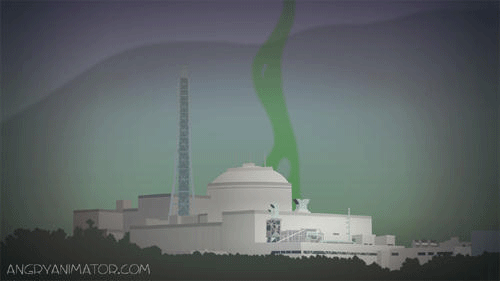 Costs for the Monju breeder reactor have ballooned to about 1 trillion yen ($8 billion) while Japan’s public debt is the highest among industrialized nations. Taro Kono, a ruling Liberal Democratic Party member who is a critic of the Monju facility and the nuclear industry in general, was appointed to examine government spending in a recent cabinet reshuffle by Prime Minister Shinzo Abe.
While Kono emphasized he cannot overturn government policy, he can review public projects and said Abe had told the cabinet that wasteful spending had to be taken “out of the budget.”
He has been reviewing part of the government budget request of 102 trillion yen for the fiscal year starting March, including a little-used ship carrying nuclear fuel and subsidies to towns that host nuclear power plants. “In my portfolio, I can ask them if the money is spent wisely and that’s what I have been doing and the nuclear fuel cycle is no exception,” the U.S.-educated Kono said.
He said next year’s review could be widened to include all government spending on nuclear projects, something that might resonate with voters after the Fukushima disaster in 2011 turned the public against atomic power. “If they are not doing a good job, the review next year will be all nuclear, maybe,” Kono said.
His comments could have implications for another costly nuclear project that is mostly in private hands but has strong government support and receives some public funds. The Rokkasho plutonium reprocessing facility in northern Japan is meant to provide fuel for Monju and some of Japan’s nuclear reactors, but completion was delayed for a 23rd time last month.
The plant has been beset with problems since the first concrete was laid in 1993 and costs have ballooned to 2.2 trillion yen ($18 billion) from 760 billion yen.
 Meanwhile, Japan’s plutonium stockpile has expanded to nearly 50 tons, with stocks held in Britain and France as well as in Japan. Recently, a group of 31 scientists wrote to Abe urging him to abandon reprocessing.
With all but two of Japan’s reactors shut down in the wake of the Fukushima disaster and no immediate use for the plutonium, there is little meaning to the costly exercise of extracting more from spent fuel, critics say.
“The PM’s directive is very clear. If we point out any items that are not spent well it has to be out of the budget,” Kono said. “That’s why a few ministers are not speaking to me right now,” he added, with a laugh.
Cover-up of radiation effects makes Fukushima victims’ lives even worse
 There is absolutely no negative discussion of radiation exposure in the mainstream media, to the point where journalists risk being fired if they discuss radiation exposure in their articles, and even liberal newspapers refuse to print articles discussing this topic.
The Taboo Of Radiation Exposure In Japan: The Social Effects Of Fukushima, Activist Post, By Erin O’Flaherty, 11 Dec 15 It is understood that radiation is physically harmful to those who are exposed to it. However, it is also harmful on a social level. Those who become exposed to radiation form a new class within society, one that is discriminated against and even feared by many ordinary people. This has certainly been the case with the Fukushima nuclear incident. This discrimination is worsened by the government and mainstream media’s treatment of the incident. This essay will discuss the social effects of the Fukushima incident by comparing it with the victims of Hiroshima and Nagasaki. It will also explain how the media play into this discrimination and attempt to understand why Japanese society is reacting in such a way. Continue reading
Japan’s NRA may change nuclear waste burial rules, increase depth
NRA panel wants deeper disposal for nuclear waste http://www3.nhk.or.jp/nhkworld/english/news/20151211_01.html A team of experts at Japan’s nuclear regulator has proposed that nuclear waste with relatively high levels of radiation be buried deeper underground than current law requires.

The team at the Nuclear Regulation Authority, or NRA, presented a draft of regulations for such waste on Thursday. The waste comes from the decommissioning of reactors. The draft calls for such waste to be buried at least 70 meters underground. This is to prevent people from approaching the waste.
Current law requires that waste with low or relatively high levels of radiation be buried at least 50 meters underground. The draft requires utilities to maintain buried waste for 300 to 400 years.
The draft also would have the central government prepare a system to prevent the buried waste from being dug up after the maintenance period ends. The NRA team plans to gather opinions from the Federation of Electric Power Companies of Japan and compile basic ideas by the end of next March.
Nuclear capable ballistic missile test fired by Pakistan
Pakistan test-fires nuclear capable ballistic missile, The Guardian, By AFP on December 11, 2015 Pakistan test-fired a nuclear-capable ballistic missile on Friday, the military said, two days after the government confirmed it would resume high-level peace talks with arch-rival India.
- The test is the latest in a series carried out by India and Pakistan since both demonstrated nuclear weapons capability in 1998.
The military said it had fired a Shaheen III surface-to-surface ballistic missile which can carry nuclear and conventional warheads within a range of 2,750 kilometres (1,700 miles)…….
Relations between Pakistan and India — which have fought three wars since independence from Britain in 1947 — have always been fraught but soured further last August amid a rise in clashes along their borders and a row over a Pakistani diplomat meeting Kashmiri separatists.
On Wednesday India’s Foreign Minister held talks with her Pakistani counterpart Sartaj Aziz in Islamabad on the sidelines of a regional summit on Afghanistan, where they jointly announced they would resume high-level peace talks. http://www.ngrguardiannews.com/2015/12/pakistan-test-fires-nuclear-capable-ballistic-missile/
Monju fast breeder reactor – a failure that’s damaging France’s and Japan’s nuclear industry
| French and Japanese nuclear fuel cycle may be affected by failures at Monju Enformable ,08 Dec 2015 Residents of Fukui Prefecture in Japan have announced that they will file a lawsuit with the Nuclear Regulation Authority (NRA) to permanently shutdown the Monju fast breeder reactor.
A breeder reactor generates more fuel than it consumes. The Monju reactor was not only supposed to process the nuclear waste generated at the operating nuclear reactors, but was also supposed to provide fuel for future reactors. The facility has never lived up to its lofty expectations. Japan has spent nearly 10 trillion Yen on the facility, and in return the Monju reactor has been kept offline for most of the past 19 years due to a massive leak, repeated failures, safety problems and organizational issues. The resident lawsuit claims that the Japan Atomic Energy Agency (JAEA), operator of the Monju facility, is not qualified to handle operating the facility…… The lawsuit by the citizens could also impact France’s Advanced Sodium Technological Reactor for Industrial Demonstration (ASTRID) fast-breeder reactor project. Japan and France have agreed to work together to research, develop, and promote fast breeder reactors. France was supposed to use the Monju reactor to test fuel for the ASTRID project, which uses the same concepts – but since the facility is banned from operations and testing with no established date for coming back online and the volatility around whether or not the facility should operate at all and who should operate it continues unabated – France may be forced to scrap its plans to incorporate the Monju facility. Monju Fast Breeder Reactor Timeline…. http://enformable.com/2015/12/french-and-japanese-nuclear-fuel-cycle-may-be-affected-by-failures-at-monju/?utm_source=feedburner&utm_medium=email&utm_campaign=Feed%3A+Enformable+%28Enformable%29 |
Jaitapur activists write to Japan’s PM to cease promoting the nuclear industry
 Jaitapur nuclear power project: Protesters write to Japan PM, warn of stepping up pressure . http://indianexpress.com/article/cities/mumbai/jaitapur-nuclear-power-project-protesters-write-to-japan-pm-warn-of-stepping-up-pressure 10 Dec 15
Recently, a top officer of the Fukushima plant Akira Ono as well as Naohiro Masuda, president of Tepco’s Fukushima Daiichi Decommissioning Company, have both admitted that there is no existing technology to remove the melted cores; that such technology may not be available for hundreds of years, and it may be impossible to decommission the stricken reactors. Thus the radioactive contamination may continue indefinitely for hundreds of years. Further, there is increasing evidence that rates of incidence of thyroid cancers among children near Fukushima have increased sharply,” the letter claimed.
The letter added that councils of all the 27 villages surrounding the proposed Jaitapur project have passed unanimous resolutions to oppose it.
“We, therefore, once again reiterate strongly our request that in the light of its own experience with radioactive contamination, Japan should shun any agreement for the promotion of the use of nuclear power. If our request goes unheeded, then be cautioned that we will be forced to step up national and international pressure against this policy of your government and build public opinion in both our countries, as well as all over the world against the double
standards it represents,” the letter warned.
Say in light of its own experience, Japan should not put profits of its nuclear industry before the environment. Written by Mihika Basu | Mumbai | Published:December 11, 2015 CLAIMING that in the wake of opposition to nuclear power in Japan, the nuclear industry there was protecting its profits by getting into a civil nuclear agreement with India, the Maharashtra-based outfit ‘Jaitapur Anuveej Prakalpvirodhi Abhiyan’ (JAPVA) or ‘campaign against Jaitapur nuclear power project’ has written letters to the Prime Minister of Japan and the National Diet of Japan and stated that “it is highly unethical and immoral on your part to put profits of nuclear industry before lives of millions of Indian citizens and environment”. Continue reading
India’s PM Modi visiting Russia re nuclear purchase deal
 Nuclear expansion on agenda of PM visit to Russia, Zee News, , December 9, 2015 – New Delhi: The upcoming visit of Prime Minister Narendra Modi to Russia is expected to see the two countries deciding on expansion of nuclear programme, government told theLok Sabha on Wednesday. Minister of State for PMO Jitendra Singh said the earlier visits of the Prime Minister to various countries were also marked by signing of agreements to procure uranium and give boost the nuclear programme…….
He said during Modi’s visit the US, a deal was finalised for the construction of nuclear reactors in Gujarat and during the visit to France, a deal was finalised with AREVA, world’s leading nuclear power company.
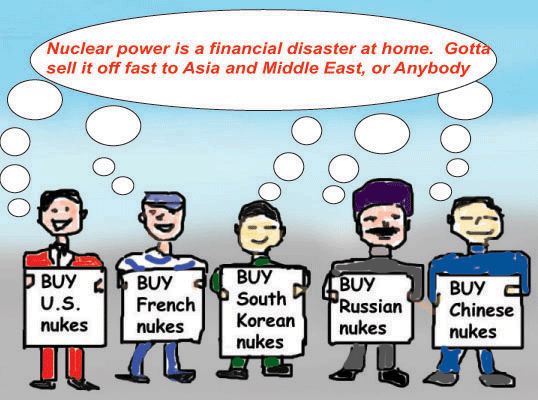
“For the visit of the Prime Minister to Russia, a programme has been finalised for expansion of nuclear programme,” he said about the trip expected later this month……http://zeenews.india.com/news/india/nuclear-expansion-on-agenda-of-pm-visit-to-russia_1832478.html
Kim Jong-un’s claim that North Korea has a hydrogen bomb
North Korea has a hydrogen bomb, says  , Guardian, 11 Dec 15
International experts sceptical as leader describes the DPRK as ‘a powerful nuclear state ready to defend its dignity’ Kim Jong-un has suggested that North Korea has the capacity to launch a hydrogen bomb, a step up from the less powerful atomic bomb, although international experts are sceptical of the claim.
The North Korean leader made the comments on a tour of the Phyongchon Revolutionary Site, which commemorates the achievements of his father Kim Jong-il and his grandfather, Kim Il-sung, on Thursday, the official KCNA news agency reported.
The work of Kim Il-sung “turned the DPRK into a powerful nuclear weapons state ready to detonate a self-reliant A-bomb and H-bomb to reliably defend its sovereignty and the dignity of the nation,” Kim Jong-un was quoted as saying.
A hydrogen bomb, also known as a thermonuclear bomb, uses more advanced technology to produce a significantly more powerful blast than an atomic bomb.
North Korea conducted underground tests to set off nuclear devices in 2006, 2009 and 2013, for which it has been subject to UN Security Council sanctions banning trade and financing activities that aid its weapons programme.
An official at South Korea’s intelligence agency told Yonhap news agency there was no evidence that the North had hydrogen bomb capacity, and said he believed Kim was speaking rhetorically…….http://www.theguardian.com/world/2015/dec/10/north-korea-hydrogen-bomb-kim-jong-un-nuclear
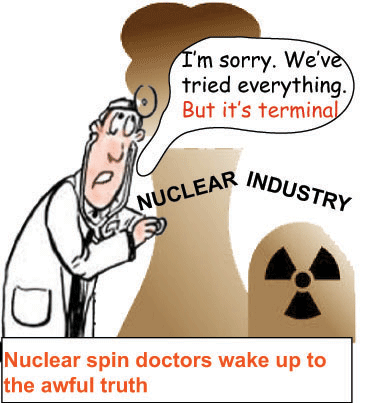
Japan should move nuclear power into terminal phase
 The electric utilities would doubtless resist any plan to scrap the remaining reactors and reduce the nation’s dependence on nuclear power to zero, but they could probably be induced to go along if the authorities simultaneously drew up measures to cushion the financial blow. The government will also need to compensate localities for the loss of jobs and subsidies associated with the nuclear power plants by funding programs to foster the growth of other industries. Now is the time to plan for a shift from long-term nursing to end-of-life care for Japan’s unsustainable nuclear power industry.
- |The resumption of commercial operations at a nuclear power plant in Kagoshima Prefecture last September might seem to bode well for the comeback of nuclear energy in Japan after the nationwide shutdown precipitated by the 2011 Fukushima meltdown. But the author argues that the government’s policy of “long-term nursing care” for an unsustainable industry is merely delaying the inevitable while exposing the nation to unacceptable risks.

Dim Prospects and a Growing Burden
The obstacles to the industry’s revival will scarcely disappear after 2015. Fukushima Prefecture is lobbying to have all its remaining nuclear plants scrapped, and local opposition to resumption of operations predominates in Niigata Prefecture, Shizuoka Prefecture, and the village of Tōkai in Ibaraki Prefecture. Between them, these four locales account for 15 (about a third) of the nation’s nuclear reactors. Four other units (one at Japan Atomic Power’s Tsuruga plant, two at Hokuriku Electric’s Shika plant, and one at Tōhoku Electric’s Higashidōri facility) are facing likely decommissioning owing to earthquake hazards. Kansai Electric is appealing a May 2014 court order against restart of two reactors at its Ōi facility, and more unfavorable rulings are possible in the months ahead.
The electric utilities themselves are expected to scrap a number of older units in consideration of cost factors. Reactors are licensed to operate for no more than 40 years, and the upgrades required to win an extension under the new regulations would be prohibitively expensive in many cases. Five older reactors were officially retired for this reason last April (Kansai Electric’s Mihama-1 and Mihama-2, Japan Atomic Power’s Tsuruga-1, Chūgoku Electric’s Shimane-1, and Kyūshū Electric’s Genkai-1).
Even those facilities that make it back online face a tough road ahead. The Fukushima disaster has drastically altered the Japanese public’s perception of nuclear energy’s risks. Henceforth, every accident, issue, or natural disaster has the potential to cause an extended or permanent shutdown at any given plant. And the construction of new reactors is virtually out of the question.
The goal of returning to pre-Fukushima levels of nuclear power generation is quite simply out of reach. Japan currently has 43 operable nuclear reactors (excluding the five already decommissioned). Realistically, no more than half of these can be expected back online before 2020, and they will be under intense scrutiny as each new problem—both in Japan and overseas—calls their safety and viability into question once again.
Nuclear power imposes heavy cost burdens that can only grow in the years ahead. Thus far the government has borne the brunt of the costs and risks, nurturing the industry with subsidies to the host communities and prefectures, funding for research and development, and guaranteed assistance with compensation and cleanup costs in the event of an accident, while allowing the electric utilities to pass the costs of the nuclear fuel cycle to their customers. In today’s climate, this amounts to long-term nursing care for a terminally ill industry. An end to these lavish supports is the electric power industry’s worst nightmare……….
As noted above, the electric utilities cannot hope to restart more than about 20 of its reactors by 2020 under the best of conditions. It will not be difficult to shut down those 20 reactors by 2030.
The electric utilities would doubtless resist any plan to scrap the remaining reactors and reduce the nation’s dependence on nuclear power to zero, but they could probably be induced to go along if the authorities simultaneously drew up measures to cushion the financial blow. The government will also need to compensate localities for the loss of jobs and subsidies associated with the nuclear power plants by funding programs to foster the growth of other industries. Now is the time to plan for a shift from long-term nursing to end-of-life care for Japan’s unsustainable nuclear power industry. http://www.nippon.com/en/currents/d00200/
Japan’s new nuclear regulatory regime is inadequate
 Time to Stop Nursing the Nuclear Power Industry, nippon.com Yoshioka Hitoshi, 7 Dec 15 “……. Failings of the New Safety Standards
Despite the reforms instituted in the wake of the 2011 meltdown, the fundamental safety issues surrounding nuclear power in Japan remain unresolved.
The final report of the government’s Investigation Committee on the Accident at the Fukushima Nuclear Power Stations, along with a slew of outside reports, points to the culture of complacency that undermined Japan’s pre-2011 nuclear safety regime and left the country—with its high population density and high risk of natural disasters—vulnerable to a catastrophic accident. It was clear that the government needed to institute a far stronger regulatory regime if it wanted to resurrect Japan’s nuclear power program. In September 2012, it launched the Nuclear Regulation Authority, and in July 2013, the NRA adopted new safety standards for reactors in use at nuclear power stations.
Unfortunately, the new regulatory regime is also inadequate to ensure the safety of Japan’s nuclear power facilities.
The first problem is that the new safety standards on which the screening and inspection of facilities are to be based are simply too lax. While it is true that the new rules are based on international standards, the international standards themselves are predicated on the status quo. They have been set so as to be attainable by most of the reactors already in operation.
In essence, the NRA made sure that all Japan’s existing reactors would be able to meet the new standards with the help of affordable piecemeal modifications—back-fitting, in other words. In practice, they need only to add a new layer of emergency management and some back-up equipment to meet the new standards for emergency preparedness. The estimates for earthquake intensity and tsunami height in each locale have been revised upward, but not to the point where they would necessitate fundamental design changes.
The second basic problem is that the new standards do not cover all the levels of “defense in depth” advocated by the International Atomic Energy Agency in its seven-stage International Nuclear Events Scale. They extend only as far as Level 4 (“control of severe conditions including prevention of accident progression and mitigation of the consequences of a severe accident”), stopping short of Level 5 requirements for responding to accidents that threaten the surrounding area through significant release of radioactive materials.
Under the Act on Special Measures Concerning Nuclear Emergency Preparedness, the prefectural and municipal governments within a 30-kilometer radius of a nuclear power facility are given full responsibility for emergency preparedness and evacuation planning geared to nuclear accidents with wider consequences, whose impact extends beyond the confines of the plant compound. Under the law, the plans must incorporate all items on a mandated checklist, but they are not subject to any outside review. The NRA does not view local preparedness or evacuation plans for a nuclear disaster as part of its regulatory regime.http://www.nippon.com/en/currents/d00200/
Fukushima nuclear disaster – still not understood, still not under control
Time to Stop Nursing the Nuclear Power Industry, nippon.com Yoshioka Hitoshi “….Fukushima’s Ongoing Disaster The risks attached to nuclear power are of a completely different magnitude from those associated with other civilian technologies. A nuclear accident can cause catastrophic damage extending over a vast area and persisting for many years. As of September 2015, the number of people displaced by the Fukushima accident stood at 107,700. Damages from the accident have already reached ¥11 trillion, and the final tally will doubtless soar to several times that amount. Moreover, the safety problems at the Fukushima Daiichi Nuclear Power Plant have yet to be resolved.
The three basic conditions for controlling a nuclear accident are stopping the chain reaction, cooling the fuel, and containing the radioactive material. By these criteria, the Fukushima accident has yet to be brought under control after more than four years. The water-injection system used to cool the molten fuel has been plagued by reliability issues. As for containment, the radioactive materials spewed over a vast area during the accident can never be recovered, nor can the radioactive wastewater that has been discharged into the ocean. Furthermore, workers have been unable to pinpoint the location of the highly radioactive fuel that leaked out of the reactors during the meltdown.
In many respects, the progress and causes of the accident remain unclear to this day. Without knowing these things, how can we institute effective safety measures to ensure that such accidents will not occur in the future?http://www.nippon.com/en/currents/d00200/
China’s nuclear programme is fraught with problems

 Mixed Fortunes for Nuclear Power NYT, DEC. 7, 2015 In July 2013, hundreds of people took to the streets in the southern Chinese city of Jiangmen to protest the proposed construction of a uranium processing plant in the region.
The $6 billion plant would have supplied fuel for the country’s rapidly expanding nuclear power industry. But the plan was dropped in the face of public opposition, the first case of its kind in China, said Keith Florig, a risk-management researcher at the University of Florida’s Warrington College of Business.
The protest, and its fallout, are important events in a country that has 22 nuclear power reactors under construction and more planned, as well as a growing international business selling nuclear energy technology to countries including Argentina, Britain and Pakistan. Mr. Florig said that this “rate of development hasn’t happened since the late 1960s and early 1970s in the U.S. and Soviet Union.”
At the same time, Mr. Florig characterized China as being underprepared for dealing with the public opinion issues that have plagued nuclear energy in developed countries.
He said that about 15 years ago he had interviewed Chinese energy officials to find out what they knew about nuclear energy development in the West. He found that they were uniformly focused on the technical challenges of controlling nuclear fission and using the heat it produced to boil water, create steam and power electric turbines. No one seemed to be aware of the social, political and economic challenges….
-
Archives
- October 2026 (104)
- September 2026 (339)
- August 2026 (330)
- July 2026 (355)
- June 2026 (287)
- May 2026 (306)
- April 2026 (356)
- March 2026 (251)
- February 2026 (267)
- January 2026 (308)
- December 2025 (358)
- November 2025 (359)
-
Categories
- 1
- 1 NUCLEAR ISSUES
- business and costs
- climate change
- culture and arts
- ENERGY
- environment
- health
- history
- indigenous issues
- Legal
- marketing of nuclear
- media
- opposition to nuclear
- PERSONAL STORIES
- politics
- politics international
- Religion and ethics
- safety
- secrets,lies and civil liberties
- spinbuster
- technology
- Uranium
- wastes
- weapons and war
- Women
- 2 WORLD
- ACTION
- AFRICA
- Atrocities
- AUSTRALIA
- Christina's notes
- Christina's themes
- culture and arts
- Events
- Fuk 2022
- Fuk 2023
- Fukushima 2017
- Fukushima 2018
- fukushima 2019
- Fukushima 2020
- Fukushima 2021
- general
- global warming
- Humour (God we need it)
- Nuclear
- RARE EARTHS
- Reference
- resources – print
- Resources -audiovicual
- Weekly Newsletter
- World
- World Nuclear
- YouTube
-
RSS
Entries RSS
Comments RSS

