Who will pay for decommissioning the Fukushima reactors?
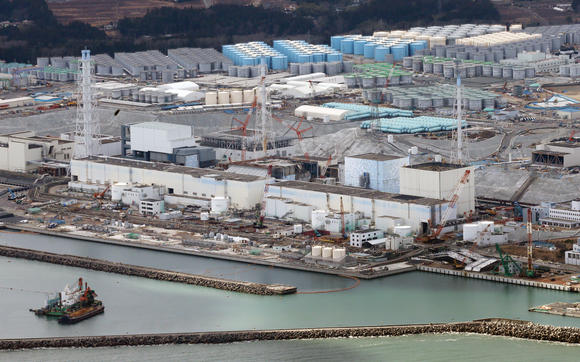
TOKYO — Energy policy was not high on the agenda in Sunday’s upper house election in Japan, in which the ruling Liberal Democratic Party consolidated its power. But Prime Minister Shinzo Abe, the Japanese people and the country’s power companies are facing a difficult question over the fate of the future of nuclear power in Japan: who will foot the costly bill for decommissioning the crippled Fukushima Daiichi nuclear power plant?
Every visit to the site, which was devastated by a magnitude-9.0 earthquake and subsequent tsunami five years ago, shows things are moving forward. A full-face mask is no longer needed in 90% of the compound. An underground ice wall is being constructed to reduce the amount of groundwater entering the basements of the reactor buildings. But what really caught my eye this time was the cream puffs.
Workers engaged in the cleanup effort can now buy the sweets at a convenience store that opened at the site in March. “Every day, we sell at least 50,” a clerk said. This represents a significant improvement in working conditions. In addition, last year, a large lounge and a cafeteria opened, providing the 6,000-plus workers with hot meals for the first time.
“Decommissioning is a project that will last 30 or 40 years, and we will have to pass the work on to future generations,” said Akira Ono, who stepped down as the plant’s manager at the end of June. “We must turn this place from a disaster site to a decommissioning site,” he added.
But the road ahead is fraught with obstacles. “We haven’t even started climbing the mountain, and we don’t even know how high it is,” said Naohiro Masuda, head of the decommissioning project and a managing executive officer of Tokyo Electric Power Co. Holdings, better known as Tepco, the plant’s operator. The most difficult task is going to be the removal of nuclear debris believed to be sitting inside the containment vessels after it melted through the reactor cores. No one precisely knows the current state of the debris.
No matter how long it takes, though, we must climb this mountain. Completing the project will require determination, technology and money. The actual cost will become more clear next year, when the company determines how it is going to remove the debris. Tepco hopes to start removal in 2021.
“The overall decommissioning is estimated to cost over 10 trillion yen ($98 billion),” a government official said. But nobody mentions who will pay the bill and how.
Currently, compensation and decontamination are being covered by the state, on Tepco’s behalf, without charging interest. Tepco and other power companies will eventually have to reimburse the government for compensation payouts through a pool of contributions. The government will recoup decontamination costs by selling the Tepco shares it owns.
Under this program, introduced immediately after the nuclear accident so that Tepco could meet all of its compensation obligations without going bankrupt, 11 power companies that operate nuclear reactors, including Tepco, together made a general contribution of 163 billion yen in the fiscal year to March. Tepco added another 70 billion yen as a special contribution. Although general contributions are meant to create a contingency fund for any future severe accidents at the country’s electric companies, they are in reality being used to cover Fukushima-related compensation claims.
Power companies must make general contributions for decades, and the cost is passed on to consumers through higher electricity bills. But with the liberalization of Japan’s retail electricity market in April, this mechanism will become increasingly difficult to maintain. Previously, dominant power suppliers, such as Tepco, could recoup the cost by assessing a fee on users within their territories. But that may no longer be possible as government-approved rates will be abolished in a few years, making way for new suppliers to step in with cheaper rates.
http://asia.nikkei.com/Business/Trends/Who-will-pay-for-decommissioning-the-Fukushima-reactors
Japan could change pacifist constitution after Shinzo Abe victory
Prime minister wins upper house elections, giving his coalition enough seats to push ahead with controversial changes
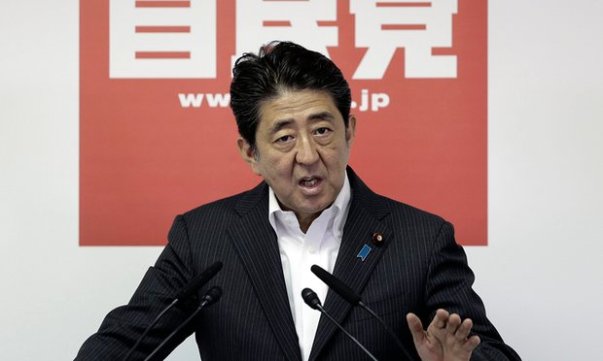
Shinzo Abe has called for a debate on rewriting Japan’s constitution, including an article renouncing war
Japan’s prime minister, Shinzo Abe, has called for a debate on rewriting the country’s pacifist constitution after his Liberal Democratic party [LDP] and its allies secured a supermajority in upper house elections on Sunday.
The LDP, its junior coalition partner Kōmeitō, and several like-minded smaller parties and independent MPs now control two-thirds of the 242 seats in the upper house. The ruling coalition already has a similar majority in the more powerful lower house.
Conservative MPs have enough seats to push ahead with constitutional changes, including scrapping the war-renouncing article 9 – a prospect that has caused alarm in China and among many Japanese who value their country’s postwar pacifism. Any amendments passed in parliament would then require approval by a simple majority in a nationwide referendum.
Abe had studiously ignored the constitution issue during the upper house campaign, insisting that the election was an opportunity to reaffirm public support for his troubled economic policy, as he sought to capitalise on the lack of a credible alternative offered by the opposition.
The LDP won 56 of the 121 seats – half the upper house total – being contested, while Kōmeitō secured 14 seats. Abe had set a goal of winning a combined 61 seats.
But speaking soon after his landslide victory, Abe said his party had always been committed to rewriting the postwar constitution. The Asahi Shimbun newspaper quoted him as saying that he hoped deliberations by expert panels and a deeper public debate would lead to a consensus on which parts of the constitution needed changing.
The most controversial move would be a revision of article 9 to allow Japan’s self-defence forces to act more like a conventional army. The clause forbids Japan from using force to settle international disputes and restricts its land, air and naval forces to a strictly defensive role.
Rewriting the constitution, imposed by the US occupation authorities after the second world war, has been the ideological driving force behind Abe and other conservatives who believe it unfairly restricts Japan’s ability to respond to new threats such as international terrorism, an increasingly assertive China and a nuclear-armed North Korea.
However, Abe risks losing the political capital he has built over the past three and a half years if he is seen to be neglecting the economy in favour of constitutional reform.
“The key question will be whether he can carry out structural reforms,” said Nobuhiko Kuramochi, chief strategist at Mizuho Securities. “If Abe fails to do so, despite the political freedom he has gained, that will be negative for foreign investors’ appetite for Japanese stocks.”
Xinhua, China’s official news agency, described Sunday’s election result as a threat to regional stability, as it had given MPs who support constitutional reform an unprecedented advantage.
“With Japan’s pacifist constitution at serious stake and Abe’s power expanding, it is alarming both for Japan’s Asian neighbours, as well as for Japan itself, as Japan’s militarisation will serve to benefit neither side,” Xinhua said in a commentary.
Some analysts played down the prospects for change, noting that the loose collection of pro-reform parties and independents had yet to reach a consensus on which parts of the constitution should be altered.
“It’s the first time to have two-thirds in both houses of parliament, but you can’t find any issue on which the two-thirds can agree,” said Gerry Curtis, professor emeritus at Columbia University.
But Curtis added: “With these numbers … he [Abe] is going to want to see what he can achieve. That means less attention to the economy and a lot of spinning over the constitution.”
The LDP’s dovish coalition partner, Kōmeitō, is cautious about any change that would expand the role of the military, while the public remains deeply divided. An exit poll conducted by the Asahi on Sunday showed that 49% of voters supported constitutional revision, with 44% opposed.
Many voters unaware what 2/3 majority means for Constitution revision
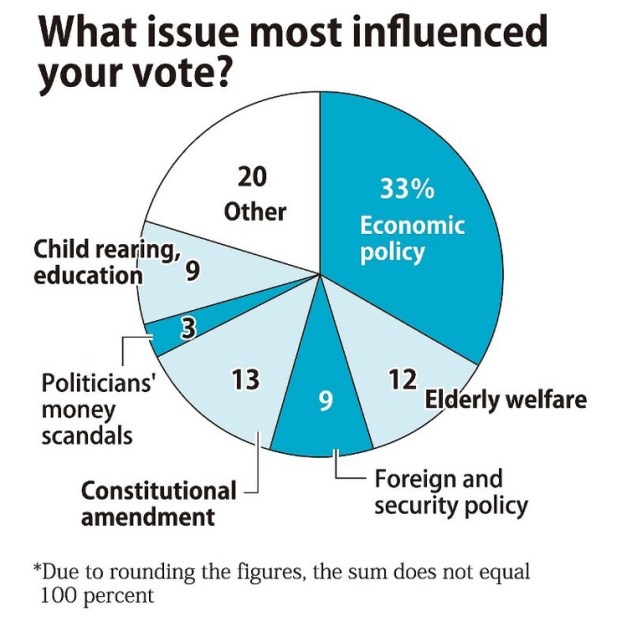
Nuclear energy and safety were not among the major concerns of the Japanese voters, for whom the main issue remained economic policy. To the exception of Fukushima Prefecture (Fukushima Daiichi Nuclear plant) and of Kagoshima Prefecture (Sendai Nuclear plant) were voters elected anti-nuke candidates.
With the ruling Liberal Democratic Party (LDP) having focused its campaign for the July 10 House of Councillors election on economic issues, many voters say they weren’t aware what securing a two-thirds majority in the upper house meant for parties in favor of revising the pacifist Constitution — that is, they can initiate constitutional amendment in the chamber, a Mainichi Shimbun poll shows.
“It ended without us (and the voters) being on the same page,” said Katsuya Okada, head of the main opposition Democratic Party (DP), as he spoke to the media amidst a barrage of camera flashes at his party’s headquarters in Tokyo’s Nagatacho district on the night of July 10. The DP had tried to rally voters around the idea of stopping the ruling coalition and some opposition parties from gaining enough seats to amend the Constitution, while the LDP buried this issue by talking only about the economy. In the end, the LDP came out the clear victor.
Did voters even know about the “two-thirds majority” and its importance for constitutional amendment? On July 10, the Mainichi Shimbun interviewed 150 eligible voters around the country, and 83 of them, or almost 60 percent, said they “didn’t know” what the two-thirds majority meant in terms of constitutional revisions. When asked what issue influenced them the most in their vote, most answered things that were closely related to their lives, like economic or social welfare policies. Only about 10 percent said constitutional amendment was the most influential issue for them.
When asked, “Do you know what the number ‘two-thirds’ means?” a 29-year-old man working in building management who responded to the Mainichi Shimbun poll in front of JR Akabane Station in Kita Ward, Tokyo, responded, “Does that number have something to do with employment?” When the man was told that this was “the number of Diet seats needed for initiating constitutional amendment,” he was surprised and said, “Does that mean Article 9 is going to be messed around with? People don’t know this, do they?”
Based on a prediction that voter turnout would be about 50 percent, the poll was conducted on 75 people who voted and 75 people who didn’t. Among those who voted, 29 people did not know the significance of “two-thirds,” and among those who didn’t vote 54 did not know. Most people who didn’t know and were told the meaning of the number appeared uninterested.
Even among those who knew the significance of securing two-thirds of the vote, many people were more influenced by other issues. A 57-year-old self-employed man in Kagoshima Prefecture said, “As someone operating a tiny business outside of Tokyo, economic policies are most important to me.”
On the night of July 10, Prime Minister Shinzo Abe did not talk about the changes to the Constitution the LDP is looking to bring about. There is no denying that because of the LDP avoiding the topic of the supreme law, debate over constitutional amendment never heated up in the election.
A 21-year-old company employee in Toyama Prefecture explained why she didn’t vote. “I didn’t know what the main issues of the election were. I thought that it would be better not to vote than to just vote without a good reason.”
Due to low voter turnout, those aiming for constitutional amendment have reached their desired two-thirds majority, and a movement to change the country is set to truly begin.
* Interviewees’ opinions on constitutional reform
– It is necessary to consider amendment to make the Constitution match with today’s world, but don’t change the fundamentals of basic human rights and pacifism. (50-year-old female, company employee, Akita Prefecture)
– If necessary it’s OK to change the Constitution, but currently we have not yet had a national debate about this, so it’s too early. (37-year-old male, company employee, Tokyo)
– I don’t want us to do something and then regret it, like the United Kingdom after its referendum result to leave the European Union. I want the issue to be thought over carefully. (47-year-old female, company employee, Tokyo)
– We’ve been peaceful up until now, so we don’t need to change it. (20-year-old male, company employee, Kanagawa Prefecture)
– As long as we have the Self-Defense Forces and they are active, we have to change the Constitution (to clearly allow for those forces). (51-year-old male, company employee, Shiga Prefecture)
– A proposal for constitutional amendment will be a good opportunity for people to think about the Constitution. (65-year-old male, unemployed, Nara Prefecture)
– It’s not that I’m for or against amendment, the problem is that the current administration is too forceful in moving policies forward, when there should be in-depth debate. We shouldn’t rush to amend the Constitution. (34-year-old male, self-employed, Shimane Prefecture)
– We need to create a sovereign Constitution. We shouldn’t depend on another country for our defense. (65-year-old male, taxi driver, Yamaguchi Prefecture)
– I oppose amendment. The current way where we just pay money and are protected by the United States is better. I don’t want us to participate in wars. (56-year-old male, company employee, Fukuoka Prefecture)
* Why eligible voters chose not to vote
– I can’t trust politicians. (18-year-old female, vocational school student, Tokyo)
– I have my hands full with my everyday life. Increasing my income comes before everything else. (40-year-old male, company employee, Kyoto Prefecture)
– There are no candidates or parties I support. I don’t like the ruling parties’ forceful methods, but when it comes to the opposition parties, though they talk about joining forces against the ruling parties, they advocate different policies from each other. (29-year-old male, company employee, Hyogo Prefecture)
– I feel powerless against the hard-line stance of the Abe administration. (66-year-old female, unemployed, Hiroshima Prefecture)
– I didn’t know what the main election issue was. Maybe it’s because my electoral district was merged, but I never once saw the candidates. (43-year-old female, housewife, Kochi Prefecture)
– I don’t feel like a House of Councillors election affects my life. (56-year-old male, civil servant, Ehime Prefecture)
http://mainichi.jp/english/articles/20160711/p2a/00m/0na/026000c
Japan nuclear restart in doubt after skeptic wins governor’s race
TOKYO — The election of a governor who favors shutting down the Sendai nuclear power plant in southwestern Japan raises uncertainty for the nation’s only running reactors.
“A nuclear plant whose safety hasn’t been confirmed shouldn’t be operating,” Satoshi Mitazono, a former TV journalist who ran in Kagoshima Prefecture, told reporters Sunday.
Mitazono said he wanted another study to determine whether the facility lies near active faults and said there are “problems” with the current plans for evacuating residents in an emergency.
His victory in Sunday’s gubernatorial race is not expected to lead to the plant immediately shutting down, since governors lack the legal authority to make this happen.
But the plant’s two reactors are due for regularly scheduled inspections in October and December. Local utility Kyushu Electric Power would have little chance of restarting them after the safety checks if the governor objects. Mitazono’s problems with the evacuation plans may introduce time-consuming revisions.
“If the new governor insists on postponing the restarts, that would rule out operating the Sendai reactors,” said a senior official at the Ministry of Economy, Trade and Industry, which is responsible for Japanese energy policy.
The No. 3 reactor at Shikoku Electric Power‘s Ikata nuclear plant may resume operations as early as this month. Even so, nationwide nuclear energy output would remain far short of the government’s fiscal 2030 target of 20-22% of power generation.
How rights and liberties may be downsized under the LDP
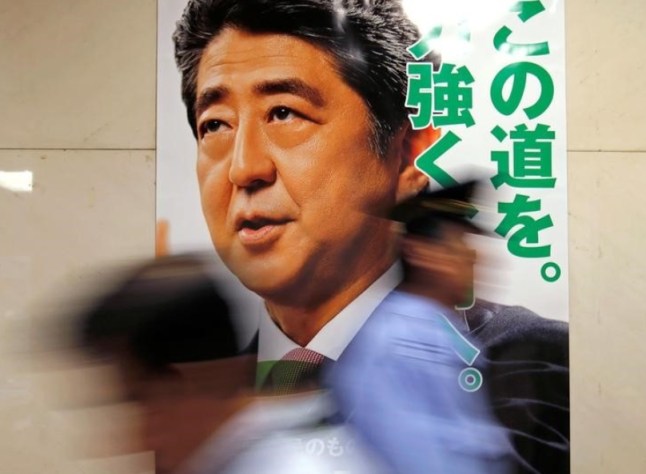
A revisionist path: Men walk past a poster for the July 10 Upper House election with the image of Prime Minister Shinzo Abe, leader of Japan’s ruling Liberal Democratic Party, at the LDP headquarters in Tokyo. The slogan on the poster reads: ‘Forward with strength this path.’
During a recent TV program, the vice president of the Liberal Democratic Party, Masahiko Komura, insisted “there is zero possibility” that Prime Minister Shinzo Abe would revise war-renouncing Article 9 of the Constitution even if the ruling coalition wins a two-thirds majority in the upcoming Upper House elections. But why believe him? Abe has made clear his intentions of promoting constitutional revision. Until he publicly pledges not to do so, voters are right to be wary.
Komura wants to bamboozle voters because he understands that public support for revising the Constitution is weak. An NHK poll in June indicated only 26 percent of Japanese citizens support his plans and only 11 percent think it is a priority. This lack of enthusiasm is also evident in a Kyodo poll in June indicating that 46.6 percent of all Upper House candidates oppose revising the Constitution, while only 34.6 percent support doing so. Broken down by party, 72.1 percent of the LDP favors revision while no candidate from coalition partner Komeito does, and only 28 percent of Osaka Ishin no Kai (One Osaka) candidates support revision. Virtually all the candidates of the Democratic Party and all of those fielded by the Japanese Communist Party and Social Democratic Party oppose revision.
Significantly, despite Abe’s enthusiasm, only 11.7 percent of all candidates think constitutional revision is a priority, according to the Kyodo poll.
DP leader Katsuya Okada has pointed out that Abe doesn’t seem to understand the role of the Constitution, which is to restrain state powers and protect the people’s civil liberties.
Where would Okada ever get that idea? Perhaps he glanced through the LDP’s 2012 draft constitution or the Q&A pamphlet the party distributed to explain its plans.
Indeed, the LDP seeks to fundamentally shift the relationship between the people and the state, imposing duties on citizens while lifting curbs on state powers. The LDP pamphlet asserts that there are “big” and “small” rights after a state of emergency is declared. The prime minister can declare a state of emergency in the event of a natural disaster, an armed attack by external forces or social disorder due to domestic turmoil, and the Cabinet could then suspend these small rights if they are deemed a threat to the undefined “public interest and public order.” So-called big rights are specified as those related to lives, bodies and property. Exactly what the mingy freedoms are is left to our imagination, but the implication is that they are a trivial but necessary sacrifice that must be made in service of the indispensable.
The LDP has cited the recent Kumamoto earthquake as an example of why it would be useful to have such a provision to facilitate relief and recovery efforts, but it is not clear that any problems in such operations had anything to do with the government’s inability to temporarily suspend civil liberties and human rights, or to concentrate power in the Cabinet. A state of emergency provision means that the government would have authority to suspend constitutional rights and bypass the Diet.
Good idea? Well it is troubling that the LDP believes that certain rights not only trump others, but can suspend them. The LDP is arguing that it may be necessary to sometimes put the Constitution on hold and, other times, to enforce it.
How would restrictions on human rights help in an emergency and what civil liberties might get in the way? This raises more questions: What are the criteria for deciding, and who gets to decide, that social turmoil has reached the tipping point for suspension of civil liberties and constitutional freedoms?
In the May 26 edition of the Mainichi Shimbun, the LDP says, “Some are of the opinion that fundamental human rights should not be restricted even in times of emergency. But we believe that it is possible that in order to protect big human rights, such as people’s lives, bodies and properties, we could be forced to place restrictions on smaller human rights.”
The notion that “small” human rights exist in the Constitution and can be violated with impunity is a novel concept. Constitutional scholars do not differentiate between rights by privileging some over others and distinguishing the vital from the inconsequential. Such a regressive view is antithetical to constitutionalism because it means that the government decides on an ad hoc basis what counts and what doesn’t, whereas a constitution is supposed to establish the legal foundations and rules through thick and thin.
Freedom of expression is likely one of the smaller rights that would be jettisoned in a state of emergency. This is the basis of press freedom in the Japanese Constitution. It is hard to imagine how a functioning democracy can exist without freedom of expression or how that small right would be detrimental in an emergency. How would its sacrifice protect property rights and lives? How would freedom of expression threaten such rights?
The LDP’s concern about pesky civil liberties like freedom of thought and conscience or freedom of expression enshrined in the Constitution reflects discomfort with the Western values and notion of “natural rights” that the U.S. wrote into the text in 1947. The LDP is eager to claw back rights for the state that the current Constitution bestows on citizens. The foreign DNA of the current Constitution rankles conservatives, but even former prime minister — and longtime pro-revision politician — Yasuhiro Nakasone now believes that, during the decades since it was written, the spirit and text have been assimilated by society. He sees no pressing need for revision.
Essentially, the only thing that the proposed state-of-emergency proviso allows the state to do that it can’t do now is suspend constitutional rights and effect what amounts to a coup d’etat. It is about boosting powers of the state in the name of protecting big human rights and suppressing dissent or criticism of the state. Rather than Western “natural rights,” the LDP is pushing “natural duties” that are allegedly in line with Japanese traditions and values. It means writing the U.N. Declaration on Human Rights out of the Constitution by renouncing the preamble of Japan’s current Constitution, which states:
“Government is a sacred trust of the people, the authority for which is derived from the people, the powers of which are exercised by the representatives of the people, and the benefits of which are enjoyed by the people. This is a universal principle of mankind upon which this Constitution is founded.” Further on, it reads, “laws of political morality are universal; and that obedience to such laws is incumbent upon all nations who would sustain their own sovereignty and justify their sovereign relationship with other nations.”
Preserving these commitments and derailing the LDP’s revision juggernaut seem reason enough to vote, but my guess is that low turnout persists because citizens find politics in Japan so uninspiring and dispiriting. With a supermajority in both houses, Abe will seek to revise the Constitution without being able to claim a mandate to do so.
Nuclear-free society advocate set to win Kagoshima governor race
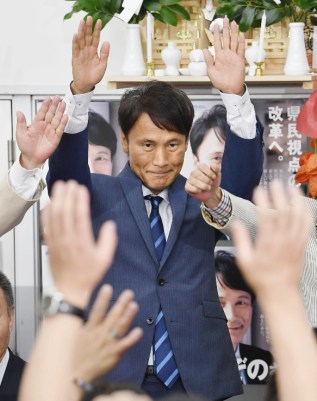
KAGOSHIMA – Anti-nuclear advocate Satoshi Mitazono was heading for victory in the Kagoshima gubernatorial race Sunday, beating incumbent Yuichiro Ito, who agreed to the resumption of reactors at a power plant in the prefecture, a projection showed.
The 58-year-old Mitazono is a former TV Asahi Corp. commentator. He ran as an independent backed by the main opposition Democratic Party and the Social Democratic Party as well as some conservatives who typically support the ruling Liberal Democratic Party but were opposed to the incumbent.
Ito, 68, with the support of the LDP and its junior coalition partner Komeito, was seeking his fourth four-year term.
One of the contentious issues in the race was the fate of Kyushu Electric Power Co.’s Sendai nuclear power plant in the prefecture.
The Sendai plant’s No. 1 and No. 2 units are the only reactors operating in the country after the government imposed tougher safety rules following the 2011 earthquake and tsunami that triggered meltdowns at the Fukushima No. 1 nuclear power plant.
Mitazono demanded that plant operations be temporarily suspended for safety checks in the wake of a series of strong earthquakes that hit central Kyushu in April, while Ito argued that the plant’s safety had been secured.
“We will not activate any reactors the safety of which is not guaranteed,” he told reporters on Sunday.
Nuclear power opponent wins governor’s race in South West Japan

 Japan nuclear restart in doubt after skeptic wins governor’s race http://asia.nikkei.com/Politics-Economy/Policy-Politics/Japan-nuclear-restart-in-doubt-after-skeptic-wins-governor-s-race, 11 July 16 TOKYO — The election of a governor who favors shutting down the Sendai nuclear power plant in southwestern Japan raises uncertainty for the nation’s only running reactors.
“A nuclear plant whose safety hasn’t been confirmed shouldn’t be operating,” Satoshi Mitazono, a former TV journalist who ran in Kagoshima Prefecture, told reporters Sunday.
His victory in Sunday’s gubernatorial race is not expected to lead to the plant immediately shutting down, since governors lack the legal authority to make this happen.
But the plant’s two reactors are due for regularly scheduled inspections in October and December. Local utility Kyushu Electric Power would have little chance of restarting them after the safety checks if the governor objects. Mitazono’s problems with the evacuation plans may introduce time-consuming revisions.
“If the new governor insists on postponing the restarts, that would rule out operating the Sendai reactors,” said a senior official at the Ministry of Economy, Trade and Industry, which is responsible for Japanese energy policy.
The No. 3 reactor at Shikoku Electric Power‘s Ikata nuclear plant may resume operations as early as this month. Even so, nationwide nuclear energy output would remain far short of the government’s fiscal 2030 target of 20-22% of power generation.
Japan joins the crowd marketing nuclear reactors to Britain
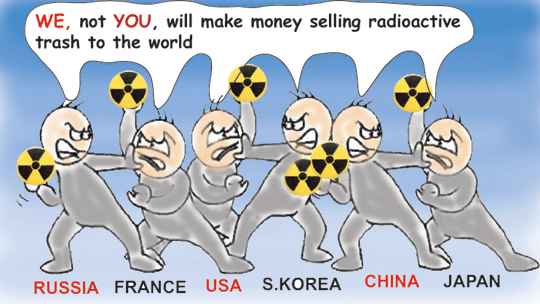
Japan Atomic Power to join Hitachi’s nuclear plant business in Britain http://www.japantimes.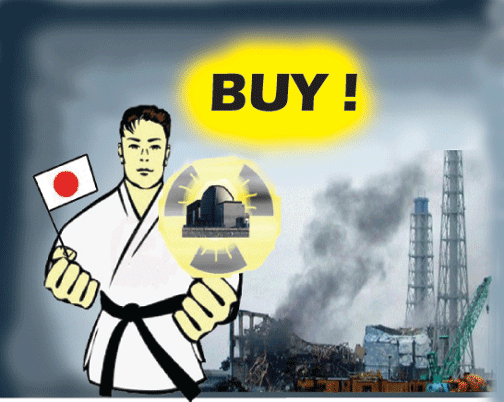 co.jp/news/2016/07/07/business/corporate-business/japan-atomic-power-join-hitachis-nuclear-plant-business-britain/#.V39eRdJ97GhJapan Atomic Power Co. will join Hitachi Ltd.’s nuclear power plant business in Britain, informed sources said Thursday.
The two companies will soon sign a cooperation agreement to make Japan Atomic Power the first Japanese power supplier to take part in an overseas nuclear power plant business in full scale.
Japan Atomic Power will become part of a project to build nuclear reactors in Britain, which is undertaken by Horizon Nuclear Power Ltd., a Hitachi unit in Britain, possibly engaging in licensing procedures for reactor construction.
Japan Atomic Power hopes that overseas operations will become a new source of revenue at a time when its nuclear reactors in Japan have been suspended following the 2011 core meltdowns at Tokyo Electric Power Company Holdings Inc.’s Fukushima No. 1 nuclear plant.
Hitachi, which has no experience as a nuclear plant operator, asked for Japan Atomic Power’s cooperation over the British project.
Fukushima Myth: Pacific Genocide
The latest video from Goddard
I have always been opposed to the minimalist lies of the pro-nuke spinners aiming to trivialize the Fukushima ongoing catastrophe but I have always been opposed also to the exaggerated claims of the sensationalists feeding their fear hungry gullible fans with much nonsense.
Like the sharp edge of a razor is that path, so the wise say—hard to tread and difficult to cross.
I always also said that the sensationalists with their exaggerated claims provide the fodder to be later used against us anti-nukers to suppress our rightful concerns in the eyes of the general public.
I have always been opposed to the sensationalization of Fukushima, the “Pacific is dying from Fukushima”, high-pitched drama on internet played by some websites, bloggers, Youtubers, the same ones that Goddard is now quoting in this video: Enenews, Natural News, Info Wars, Kevin Blanch and others.
There are many things causing the North American Pacific coastline ecocide at the same time, it is a convergence of many factors. These pre-date Fukushima.
That said I do believe that there should be wide scale fish testing, not just due to Fukushima but to the long term radioactive contamination of the Pacific. But having that happen, having it done properly and without it being hijacked by vested interests is extremely difficult. Why there should be wide scale fish testing is to determine the range of contamination among fish and where the high readings pop up to try to better understand where and what species are showing up with high readings and also what are the real averages being seen. Again, a big undertaking that can easily be hijacked making it meaningless.
The main danger is for the people living in eastern Japan, which has been contaminated at various degrees depending on the locations. The contaminated food, which when constantly consumed, even at a low level of contamination, will certainly have mid-term and long-term harmful consequences on the health of the people.
Another danger is the danger of radiation contaminated food products exported from Japan oversea to other countries with more lax radiation control and regulations, where people will buy them and consume them unknowingly of their contamination. As an example, in 2013 some tuna fish imported from the Philippines which was radiation contaminated was found sold in a supermarket in Switzerland. Of course that Philippines tuna had been contaminated by radioactive nanoparticles coming from Fukushima Daiichi in nearby Japan, and not from Diablo Canyon in far-away California.
To expose the false exaggerated claims, the sensationalism and the sensationalists, still does not change nor remove the fact that Fukushima contamination is spreading slowly but surely into our environment, and therefore there should be more measures and controls made to protect the people from possibly present radioactive contamination. As our governments are more busy protecting the financial interests than the people health, concerned citizens should organize themselves in local radwatch groups, to learn and to practice radiation measuring, in their surrounding environment and in their food, so as to protect themselves.
To resume: the Pacific ocean is not dying from Fukushima, but Fukushima radioactive contamination is slowly but surely, continously spreading into our environment, to slowly bioaccumulate and to affect the food chain.
That said, the biggest risks are still for the Fukushima people who are being left on location to live everyday with omnipresent radiation and contamination.
As I See It: Has nothing been learned from TEPCO’s ‘meltdown’ cover-up?

The March 14, 2011 press conference at the Tokyo Electric Power Co. (TEPCO) head office in Tokyo in which then TEPCO vice president Sakae Muto (second from right) was reportedly told by then company president Masataka Shimizu not to use the expression “core meltdown.”
A third-party panel set up by Tokyo Electric Power Co. (TEPCO) to investigate the company’s cover-up of the core meltdowns that occurred at its Fukushima No. 1 Nuclear Power Plant following the March 11, 2011 Great East Japan Earthquake and tsunami revealed in a report last month that then TEPCO president Masataka Shimizu had ordered the company not to use the term “meltdown” to describe what had occurred. The report also stated that the organizational cover-up took place against a backdrop of “what is presumed to be a request that came from the prime minister’s office.”
Then Chief Cabinet Secretary Yukio Edano has objected to the report, saying that the very people who were involved, himself included, were not consulted by the panel before it drew its conclusion. Edano also said that he sent a letter of protest to TEPCO seeking an apology and a retraction of the report.
There are many missing pieces to the investigative report, but without a doubt, TEPCO acted irresponsibly toward local residents. A meltdown refers to a severe incident in which nuclear fuel melts and leeches out. If the facts had been revealed to the public, they could have fled further and avoided going outdoors. TEPCO bears a heavy responsibility for exposing local residents to risks more dangerous than they would have been otherwise.
On March 14, 2011, three days after the nuclear crisis broke out, then TEPCO vice president Sakae Muto was in the midst of a press conference when a company PR official passed him a handwritten note indicating that a core meltdown had taken place, and whispered into his ear that “the prime minister’s office has instructed that this expression not be used.” The third-party investigative panel concluded that this message was from then TEPCO president Shimizu. In accordance with the instructions, Muto and TEPCO used the term “core damage,” a word with a less serious connotation than core meltdown, making the incident seem less severe than it actually was.
The residents of the Fukushima Prefecture town of Namie — the northerly neighbor of the town of Futaba, one of the two towns that the stricken nuclear plant straddles — were forced to evacuate without crucial information. According to the Namie Municipal Government, some 8,000 of the town’s 21,000 or so residents evacuated on March 12, 2011, to the town’s Tsushima district, further northwest of the nuclear plant. At the time, however, the wind had been blowing in that direction, putting the residents directly in the path of radioactive materials being emitted in massive amounts from the crippled nuclear plant.
Local resident Hidezo Sato, 71, evacuated from the town center and stayed at a community center in Tsushima until March 15. “There were other evacuees who said we should be fleeing farther away, but I didn’t think the situation was that grave,” he recalls. “If we’d known there’d been a core meltdown, it would’ve determined how we evacuated.” The community center where he was taking refuge was overflowing with people. Not knowing that he was downwind from the troubled nuclear plant, Sato sat by a fire outdoors. He also saw children going into grassy areas, where radioactive materials are known to collect.
“I would’ve avoided going outdoors had I known there’d been a meltdown,” says Yoko Hashimoto, 64, who also evacuated to the Tsushima district. “Five years have passed since the disaster broke out, and I’m worried that I’ll start seeing the health effects of radiation exposure. Why wasn’t the meltdown announced right away?” It is only natural for residents whose safety was all but ignored by TEPCO to feel anger toward the utility. The power company had always emphasized the happy coexistence of its nuclear plants and local communities. Yet when a serious incident took place, the local residents were neglected. This more than explains why the residents are distrustful and angry.
It wasn’t until at least two months later that TEPCO admitted that core meltdowns had occurred. And even then, it was only because the then Nuclear and Industrial Safety Agency, which has since been disbanded, demanded an overall report on the disaster. Moreover, it wasn’t until February of this year that TEPCO announced that it had discovered an internal company manual stipulating that damage to 5 percent or more of nuclear fuel be defined as a nuclear meltdown. Until then, the utility had cited the fact that it didn’t have any standards by which to define nuclear meltdowns as its excuse for delaying the announcement that such a phenomenon had occurred. But indeed, according to the manual, then vice president Muto could have said at the press conference on March 14, 2011, that a nuclear meltdown had taken place.
Hirotada Hirose, professor emeritus at Tokyo Woman’s Christian University and an expert in disaster risk studies, says that while local residents may have been thrown into confusion if information about the core meltdown had been made public, the merits of them evacuating farther away and reducing their exposure to radiation would have outweighed the possible risks of panic. “The physical and psychological damage that residents have suffered because information was not provided to them are far greater.” He adds, “Regardless of whether or not TEPCO actually received instructions from the prime minister’s office (not to use the expression ‘core meltdown’), it should have decided on its own to release accurate information. TEPCO lacks awareness and responsibility as the operator of nuclear plants that are at risk of creating serious crises.”
There is still much more room for improvement in TEPCO’s attitude toward its responsibilities. After the report on the meltdown cover-up was released, TEPCO President Naomi Hirose was asked at a press conference how the utility expected to work with the prime minister’s office if another serious incident were to occur. He refused to respond in clear-cut terms, instead stating, “That’s a difficult question to answer in general terms.”
On the one hand, the third-party investigative panel should be praised for digging up the fact that then TEPCO president Shimizu instructed the cover-up. On the other hand, however, the probe into the utility’s relationship with the prime minister’s office is insufficient. Residents harbor distrust toward not just TEPCO, but the government as well. Local residents will remain unconvinced unless further investigation into the extent and the manner in which the government interfered with the nuclear crisis is conducted.
Core meltdowns are not a problem specific to TEPCO. Whenever there’s a problem surrounding a nuclear plant, it often turns out that similar things are taking place at other plants run by other utilities. Can we say that TEPCO’s latest case is an isolated event? There’s a fear that when a nuclear accident takes place, we won’t be able to trust the power companies involved to provide us with appropriate information that respects and reflects the needs of affected residents. If utilities are going to restart halted nuclear reactors and extend the number of years its aging reactors are allowed to operate, they must take away important lessons from the Fukushima crisis and be prepared to disseminate information to the public from their standpoint. (By Mirai Nagira, Science and Environment News Department)
http://mainichi.jp/english/articles/20160706/p2a/00m/0na/008000c
Former Japanese Leader Starts Fund for US Vets Who Helped Fukushima

Former Japanese Prime Minister Junichiro Koizumi has started a fund for U.S. veterans who say they were sickened by radioactive fallout from the 2011 disaster at the Fukushima Dai-ichi nuclear power plant.
YOKOTA AIR BASE, Japan — A former Japanese prime minister is calling on his countrymen to donate to a fund for U.S. veterans who say they were sickened by radioactive fallout from the 2011 disaster at the Fukushima Dai-ichi nuclear power plant.
“They went so far to do their utmost to help Japan,” Junichiro Koizumi told a news conference Tuesday in Tokyo alongside fellow former Prime Minister Morihiro Hosokawa, according to Asahi Shimbun. “It is not the kind of issue we can dismiss with just sympathy.”
Hundreds of veterans, claiming a host of medical conditions they say are related to radiation exposure after participating in Operation Tomodachi relief efforts, have filed suit against the nuclear plant’s operator, the Tokyo Electric Power Co. A massive earthquake caused a tsunami that swamped a large stretch of northeastern Japan and inundated the power plant. Experts are still dealing with continuing leaks from the reactors.
The suit asserts that TEPCO lied, coaxing the Navy closer to the plant even though it knew the situation was dire. General Electric, EBASCO, Toshiba Corp. and Hitachi were later added as defendants for allegations of faulty parts for the reactors.
Illnesses listed in the lawsuit, which is making its way through the courts, include genetic immune system diseases, headaches, difficulty concentrating, thyroid problems, bloody noses, rectal and gynecological bleeding, weakness in sides of the body accompanied by the shrinking of muscle mass, memory loss, leukemia, testicular cancer, problems with vision, high-pitch ringing in the ears and anxiety.
People can donate to the fund, called the Operation Tomodachi Victims Foundation, at Japanese credit union Jonan Shinyo Kinko, Eigyobu honten branch, account No. 844688.
Donations, accepted through March 31, 2017, will be transferred to a U.S. bank and used, under the management of a judge, to support the veterans, according to a news release from the credit union.
The power of a vote can affect Japan’s nuclear energy policy
With brutal heat forecast for this summer, the government is not calling for power-saving efforts this year. This is a break from tradition that started in summer 2011 after the disastrous accident at the Fukushima No. 1 nuclear power plant, operated by Tokyo Electric Power Co., in March that year.
Only two nuclear reactors are currently running in Japan, both at the Sendai nuclear plant operated by Kyushu Electric Co. But the government determined that the nation’s power supply will not fall short this summer, largely because energy-saving practices have become well-established in private homes and businesses over the last five years, including the widespread use of energy-efficient LED lighting.
Japan appears to have become less dependent on nuclear power generation since the Fukushima disaster. Nowadays, the subject is debated less frequently, and anti-nuclear demonstrators have shrunk in number.
In the campaign for the July 10 Upper House election, too, the nation’s nuclear policy is hardly a hot topic of debate for the ruling and opposition parties.
But we need to re-examine whether the government is moving toward maintaining or abolishing its current nuclear policy.
Looking 20 to 30 years ahead, The Asahi Shimbun has consistently advocated a “zero nuclear power generation society” in its editorials. Our basic thinking is to approve the restart of offline reactors for the time being when urgent power needs exist. But at the same time, high-risk and antiquated reactors should be decommissioned, starting with the oldest and the most dangerous.
Abe administration’s piecemeal restart of reactors
Since the current Abe administration was inaugurated in December 2012, its track record has made the direction of its nuclear policy quite clear.
The administration initially stressed a “decrease in reliance on nuclear power generation.” But within less than six months, it put the Nuclear Regulation Authority (NRA) in the forefront to justify a switch to the policy of “restarting nuclear reactors once their safety has been confirmed.”
In the Basic Energy Plan of 2014, nuclear power is positioned as “an important base load power source.” One year later, the administration announced its decision to formulate a policy that would make nuclear energy account for 20 to 22 percent of the nation’s power supply in fiscal 2030. This target cannot be attained unless more than 30 nuclear reactors, out of the 54 that existed before the Fukushima disaster, are brought into operation.
In fact, starting with the Sendai reactors last summer, the government has been proceeding, bit by bit, with the restart of idle reactors. So far, four units have gone back on line. This month, the No. 3 reactor at the Ikata nuclear plant operated by Shikoku Electric Power Co. is scheduled to resume operations. Twenty reactors are currently under inspection.
Furthermore, the NRA has approved the extension of operations of the 40-plus-year-old No. 1 and No. 2 reactors at the Takahama nuclear plant, operated by Kansai Electric Power Co. Put plainly, even the “40-year rule,” set for averting disasters by decommissioning old reactors, is about to lose teeth.
Abe stresses nuclear power as “a low-cost and stable energy source.” But as deregulation in the power industry eliminates regional monopolies while electricity charges become less subject to rigid rate structures, nuclear power generation could actually become a burden to operators for the huge costs needed to maintain safety and dismantle old reactors.
For this reason, the government is coming up with what may be called new initiatives to protect the nuclear power industry.
The Ministry of Economy, Trade and Industry is working on a policy under which the government will buy electricity generated at nuclear power stations at a set price to encourage sustained investment in nuclear power generation.
Another plan under consideration is to decrease the financial responsibility of nuclear power plant operators for accident compensation and increase the government’s responsibility instead. This goes in the opposite direction from industry deregulation.
Parties need to clarify positions on nuclear power
Many Upper House election candidates running on the ruling coalition ticket are keeping their opinions on nuclear power generation to themselves, leaving all policy decisions to the government. But some of the same candidates are also starting to call for the construction of new, safer reactors to counter the argument of people opposed to extended operations of old reactors.
Should the ruling coalition win the Upper House election, there is no doubt that it will add momentum to the Abe administration’s move to return to nuclear power generation.
The opposition camp, with some minor exceptions, is united in opposing nuclear power generation. The Democratic Party and three other parties share the policy of “realizing a society that does not depend on nuclear power generation.”
However, the parties differ in the method and speed with which they propose to reduce the nation’s dependence on nuclear energy. While the parties are sharply focused on issues related to Abenomics, the national security legislation and constitutional revision, nuclear power generation tends to remain less discussed.
Will Japan keep relying on nuclear power? Or does it aim to eventually end this reliance by switching aggressively to sustainable energy development?
Because the answer spells a fundamental difference in the future of the nation’s energy policy, every party owes it to the voting public to explain its position clearly and engage in serious debate.
In disaster-affected areas of Fukushima Prefecture, the government’s evacuation orders are being lifted one by one, but there is a long way to go before the affected citizens can rebuild their lives. For them, the March 2011 disaster is still a dire reality they must face very day.
Looking at the future
For voters not directly affected by the nuclear disaster, five years may be enough time for their interest to wane.
But electricity is indispensable to everyone’s daily life and work. An immediate and crucial political issue is how to secure the necessary infrastructure, and at what cost.
Since April, it has become possible for private households to choose their electricity supplier, giving people a greater chance to exercise their free will. Still, every ballot cast carries weight. The outcome of the Upper House election can either accelerate or put the brakes on the Abe administration’s nuclear energy policy.
We need to look at 10 years and 20 years down the road, not just today and tomorrow, when we think about the nation’s energy policy, especially regarding nuclear power.
TEPCO to reuse tanks holding radioactively contaminated water at Fukushima plant

Tokyo Electric Power Co. (TEPCO) will reuse highly contaminated tanks at the crippled Fukushima No. 1 Nuclear Power Plant to store radioactively contaminated water after treatment, company sources said.
The company will return contaminated water to flange-type tanks that had held such water after removing radioactive materials from the water using the Advanced Liquid Processing System (ALPS). This is because TEPCO has failed to prevent contaminated water from being generated on the premises of the plant or to secure enough storage tanks to hold treated water.
TEPCO had submitted the reuse plan to the Nuclear Regulation Authority, which approved it on July 6 or earlier. TEPCO is set to begin reusing contaminated tanks as early as this month.
Flange-type tanks are assembled by tightening multiple steel plates with bolts. Since such tanks have higher risks of leaking contaminated water, TEPCO is gradually replacing them with tanks assembled by welding steel plates together.
TEPCO is trying to freeze underground soil to surround reactor buildings at the Fukushima power plant to prevent underground water from flowing beneath them and becoming contaminated with radioactive materials.
However, as the efforts have proven ineffective, the utility has decided to reuse flange-type tanks, which it had initially planned to dismantle.
Massive amounts of water are flowing onto the premises of reactor buildings at the atomic power station, generating some 400 tons of radioactively contaminated water a day. TEPCO uses ALPS to purify contaminated water, but the system cannot remove radioactive tritium.
The power company has stored the treated water mainly in welded-type tanks. There are already 1,000 water tanks on the premises of the power station.
http://mainichi.jp/english/articles/20160707/p2a/00m/0na/003000c
Showdown in apathetic Fukushima finds justice minister scrambling for survival

Justice Minister Mitsuhide Iwaki of the Liberal Democratic Party (left) campaigns in Iwaki, Fukushima Prefecture, on June 3. Right: Democratic Party candidate Teruhiko Mashiko speaks in Fukushima on June 6.
FUKUSHIMA – Justice Minister Mitsuhide Iwaki is feeling threatened.
With his electoral district in Fukushima Prefecture reduced to one seat from two for Sunday’s Upper House election, he needs to beat Democratic Party rival Teruhiko Mashiko, something he failed to pull off the last time around.
If the Cabinet minister loses, it will end his career and deal a humiliating blow to the administration of Prime Minister Shinzo Abe. And with Mashiko enjoying joint backing from opposition parties including the DP, the Fukushima race represents a showdown between the Liberal Democratic Party-Komeito ruling bloc and the opposition.
Addressing supporters last Sunday, Mashiko couldn’t have described the dynamics more succinctly.
“My opponent is no longer the justice minister. It’s Prime Minister Abe,” he said. “He’s really desperate. He’s been doing everything he can to unseat me. What an honor.”
Abe, for his part, has bent over backward to help Iwaki, joining him on the campaign trail right after the Diet closed for the summer on June 1 and sending a string of big-name politicians to Fukushima to campaign for him.
Failed strategy
Abe is said to have appointed the third-term Upper House lawmaker as justice minister in October to ensure re-election. He apparently felt he couldn’t afford to lose LDP influence in the sensitive constituency that was heavily damaged by three reactor meltdowns in March 2011.
But past election results show that Iwaki is facing an uphill battle on Sunday — the first since Fukushima became a single-seat constituency in 2013.
Not once in the past three Upper House elections has Iwaki defeated his main challenger, always finishing second. The last time he and Mashiko competed was in 2010, when Fukushima was a two-seat constituency. Mashiko won by 3,000 votes.
To make things worse, Iwaki’s appointment as justice minister appears to have backfired.
Earlier this year in the Diet, he was repeatedly driven into a corner as opposition lawmakers blitzed him with highly technical legal questions. His struggle to respond was televised nationwide. He majored in law at Sophia University.
“We all share the understanding that Iwaki, as a member of the current administration, cannot lose. If he does, the damage to the Abe administration will be immense,” his secretary, Izuru Onodera, said.
Lingering nuclear woes
While the election is being played as a vote on Abenomics, the two candidates in Fukushima are localizing the agenda.
In recent campaign trips in the prefecture, most of their speeches have focused on how they would steer Fukushima’s recovery. Five years into the worst nuclear disaster since Chernobyl, about 100,000 residents still remain displaced within and outside the prefecture.
While Iwaki trumpets the LDP’s decisiveness and legislative advantage, Mashiko is vowing to decommission all 10 reactors in the prefecture.
Standing before a crowd of supporters in Koriyama on Monday, Iwaki stressed that the LDP is the party that can steer Fukushima toward recovery and accused the DP of engaging in an “irresponsible tie-up” with the radical Japanese Communist Party.
“We cannot entrust the future of Fukushima to a mishmash opposition coalition fraught with ideological differences,” Iwaki said. “As a Cabinet member, I have the responsibility to facilitate government efforts to reconstruct Fukushima.”
Mashiko, meanwhile, reaffirmed his pledge to decommission the 10 reactors and denounced Iwaki’s ambiguous stance on the matter. Although the LDP’s Fukushima chapter has vowed to dismantle the reactors, Iwaki is apparently refusing to back that pledge publicly to avoid contradicting Abe’s pro-nuclear central government.
During campaigning activities Monday, Iwaki told The Japan Times that he will “respect” the Fukushima chapter’s stance on the reactors, before speeding off in a van.
Voter apathy
Neither candidate appears to have made much of an impression with voters.
Fukushima resident Yuriko, 54, who only wished to be identified by her first name, said she will vote but might cast a blank ballot in protest.
“I feel it will make no difference no matter who wins,” the company employee said when approached on a street in Koriyama. She said she doesn’t even know who is running.
A 25-year-old man who also requested anonymity said he only cares about one topic — employment. Even the issue of Fukushima’s recovery hardly struck a nerve.
“Everyone was affected by the disaster to a different degree and I wasn’t much of a victim. As a Fukushima resident, I’m mildly curious about how the reconstruction effort proceeds, but that topic doesn’t motivate me into any sort of action,” he said.
Expectations are even dimmer among those whose lives were upended by the calamity.
On a recent visit to a remote temporary housing unit in Nihonmatsu, evacuees from the town of Namie near the crippled Fukushima No. 1 power plant were downright apathetic about the election.
They are too preoccupied with their uncertain future, not to mention the daily inconveniences of the evacuation, to even think about the poll, they said. Not a single supermarket or hospital exists near the housing unit, forcing them to drive long distances to complete even the smallest part of their daily routine.
Nobuhiro Fujita, 68, a former farmer and carpenter, said he wasn’t interested in Sunday’s election.
“All I can think about is my own life. I don’t know what is going to happen to my house in Namie. I don’t have time to wonder about the election,” he said.
Although he wants to go home, Fujita, who suffers from numbness in his leg, said he is stuck in limbo.
“I do want to return to Namie, but even if I do, my rice field has been left unattended for too long and is now ruined. With my bad leg, I can’t do any carpentry work, either.”
A 48-year-old company employee and father who asked to be identified only by his surname of Yoshida, also took a dim view of the historic race.
“After being left like this for five years and counting, I can’t really trust the candidates to put their words into action, no matter what they say they will do for us,” he said.
“I’m resigned.”
Don’t Say Meltdown: Japan’s Coverup and US’ ‘Radioactive Russian Roulette’

Japan finds itself in the midst of a fresh scandal, as the president of the Tokyo Electric Power Company (TEPCO) has publicly admitted that the company staged a cover-up during the disastrous Fukushima nuclear meltdown in March of 2011.
Radio Sputnik’s Loud & Clear spoke with Kevin Kamps, from Beyond Nuclear, about the coverup and its possible implications for the US.
Kamps documented how TEPCO knew about the meltdown from the beginning, and understated the true extent of the damage. “They clearly did conceal the three meltdowns for two months,” he said. “They [TEPCO] knew really within the first day or two that they had a meltdown, and they simply covered it up for as long as they could.”
Kamps pointed out a recent report in which the company attempted to dodge responsibility for their duplicity. “What’s interesting now is this panel report is trying to shift the blame from Tokyo Electric to the serving government at the time, which was the Democratic Party of Japan. They’re trying to blame Prime Minister [Naoto] Kan and his chief spokesman Yukio Edano, both of whom have really come out swinging against this report, saying it’s preposterous [and that] they made no order to TEPCO to not use the word ‘meltdown,’ but that’s what TEPCO’s trying to say, that’s it’s the government’s fault.”
Kamps explained that, at first, TEPCO spokespeople described the meltdown as “‘core damage,’ in that the solid nuclear fuel, the fuel rods in the core of these three reactors, had suffered damage, had released some of their radioactive activity out into the environment.”
“But a meltdown indicates that you’ve lost complete control of the integrity of the nuclear fuel cores, they have literally melted down because of the hellish thermal heat levels and have formed a molten mass that can then burn its way through the reactor pressure vessel and even the containment structures, into the earth. And they knew, by their own regulations and their own instruction manuals, that 5% or more core damage equals a meltdown, and they knew that, in unit 1, they had 55% core damage, they knew in unit 3 they had 25% damage, they knew this within a couple days.”
Loud & Clear host Brian Becker asked Kamps if TEPCO is aware of what happened to the cores. Kamps replied, “They still don’t know where the cores are. Tokyo Electric optimistically assumes that they are still located within containment structures, which are obviously damaged or even destroyed, because of the levels of radioactivity that have escaped and is still escaping. They don’t know for sure.”
Kamps noted the drastic impact that nuclear reactor meltdowns have on the environment in contaminating soil and groundwater, and that similar incidents are possible in the US because the same technology is still being used. “We have 22 reactors in the United States that are of the same design of Fukushima-Daiichi,” he said. “We have another eight that are closely related, so that’s 30 of these radioactive Russian-roulette games going on in the United States.”
http://sputniknews.com/asia/20160706/1042496696/japanese-company-covers-up-meltodown.html
1 This Month





PLEASE OPPOSE HR 8255 AND S.3639 – bills would accelerate satellite deployment, with no environmental review or safeguards – https://ncstd5li.quorum.us/campaign/169331/
To see nuclear-related stories in greater depth and intensity – go to https://nuclearinformation.wordpress.com
-
Archives
- October 2026 (40)
- September 2026 (339)
- August 2026 (330)
- July 2026 (355)
- June 2026 (287)
- May 2026 (306)
- April 2026 (356)
- March 2026 (251)
- February 2026 (267)
- January 2026 (308)
- December 2025 (358)
- November 2025 (359)
-
Categories
- 1
- 1 NUCLEAR ISSUES
- business and costs
- climate change
- culture and arts
- ENERGY
- environment
- health
- history
- indigenous issues
- Legal
- marketing of nuclear
- media
- opposition to nuclear
- PERSONAL STORIES
- politics
- politics international
- Religion and ethics
- safety
- secrets,lies and civil liberties
- spinbuster
- technology
- Uranium
- wastes
- weapons and war
- Women
- 2 WORLD
- ACTION
- AFRICA
- Atrocities
- AUSTRALIA
- Christina's notes
- Christina's themes
- culture and arts
- Events
- Fuk 2022
- Fuk 2023
- Fukushima 2017
- Fukushima 2018
- fukushima 2019
- Fukushima 2020
- Fukushima 2021
- general
- global warming
- Humour (God we need it)
- Nuclear
- RARE EARTHS
- Reference
- resources – print
- Resources -audiovicual
- Weekly Newsletter
- World
- World Nuclear
- YouTube
-
RSS
Entries RSS
Comments RSS

