Russia paying for setting up nuclear power plant in Vietnam
 Work on Russian-assisted nuclear power plant in Vietnam to begin in 2023 https://rbth.com/news/2016/07/15/work-on-russian-assisted-nuclear-power-plant-in-vietnam-to-begin-in-2023_611821 TASS
“The schedule is still set for 2028,” Tuan said. Construction will begin in 2022 or 2023, he added.
Such a timeframe is indicated in the revised master plan of Vietnam’s energy sector development, the official said.
Russia’s Rosatom is acting as a partner in the Ninh Thuan 1 nuclear power plant in Vietnam.
Study shows bulk of fuel still in crippled Fukushima No. 2 reactor

TOKYO, July 14, Kyodo
A study on the disaster-hit Fukushima Daiichi nuclear power plant has found that most of the melted fuel in the No. 2 reactor is still present in the reactor core area, sources close to the matter said recently.
According to the study that used a cosmic ray imaging system, around 200 tons of fuel and other melted substances is estimated to have accumulated at the bottom of the pressure vessel, the first time the current location of the fuel has been specified.
The finding is important for devising ways to remove the so-called fuel debris, the most challenging task in decommissioning the Nos. 1 to 3 reactors that suffered meltdowns in the nuclear crisis that began in March 2011.
https://english.kyodonews.jp/news/2016/07/421290.html
Deposition of radiocesium on the river flood plains around Fukushima

The environment in the area around Fukushima Daiichi Nuclear Power Plant has been contaminated by widely deposited significant amount of radioactive materials, which were released to the atmosphere caused by the Fukushima Daiichi Nuclear Power Plant accident due to the Great East Japan Earthquake, which occurred on March 11, 2011. The radiocesium released in the accident mainly affects radiation dose in the environment. Decontamination work in the contaminated area except a mountain forests has been conducted to decrease the radiation dose. However, there are concerns that the redistribution of this radiation due to water discharge will occur due to the resulting transport of radiocesium. In particular, the deposition of soil particles containing radiocesium on the flood plains in the downstream areas of Fukushima’s rivers can potentially increase the local radiation dose. Therefore, it is important to understand the influence of the deposition behavior of radiocesium on the radiation dose.
Investigations of rivers have been performed to enhance the understanding of the mechanisms by which radiocesium is deposited on these flood plains. It was found that the spatial distribution of the radiocesium concentration on the flood plain along the river is heterogeneous with a dependence on the depositional condition and that the number of points with high air dose rates is limited. In detail, the radiocesium concentration and air dose rates in flood channels are higher than those at the edges of the river channels. Based on these heterogeneity and hydrological events, the deposition and transport mechanisms of the radiocesium due to water discharge at rivers were also interpreted, and a conceptual model was constructed.
http://www.sciencedirect.com/science/article/pii/S0265931X16301187

Ultraconservative lobby Nippon Kaigi backs constitution revision

TOKYO — An influential political lobby in Japan will do its utmost to capitalize on Prime Minister Shinzo Abe’s election victory and push for the constitution to be revised to allow a more active military, the group’s chairman said Wednesday.
Abe’s gains in the upper house in last weekend’s election mean his party can cobble together the crucial two-thirds majority in both houses to propose a revision and put it to a referendum, if it gets support from lawmakers in other parties open to the changes.
Tadae Takubo, chairman of Nippon Kaigi, or Japan Conference, said the war-renouncing constitution that makes Japan’s defense “defective” needs to be corrected.
It’s time to grow out of Japan’s “silly” postwar goal of becoming an economic power with lightweight military, and seek to restore Japan with more self-respect, traditional family values and principles under the emperor as head of nation, said Takubo, international politics professor at Kyorin University.
“This is a golden opportunity that has never happened before. If I were in the prime minister’s position, I will go all out to accomplish a revision during the current term,” Takubo said. His organization will provide full support to push forward the drive, he said.
For Abe and his ultra-conservative supporters, like Nippon Kaigi, the 1947 constitution is the legacy of Japan’s defeat in World War II and an imposition of the victor’s world order and values. The charter renounces the use of force in international conflicts and limits Japan’s military to self-defense only, although Japan has a well-equipped modern army, navy and air force that work closely with the United States, its top ally.
Abe’s ruling party proposed revisions to the constitution in 2012 that intended to restore traditions similar to prewar-era family values centered on the emperor, and to put national interest before individuals’ basic human rights in some cases. It was never formally submitted to parliament.
Abe did not make the constitution a focus of the election, but said on Monday he takes Sunday’s victory as a public endorsement for a revision, pledging to launch a parliamentary committee to discuss which articles to change and how.
Founded in 1997, Nippon Kaigi has strived to revise the constitution to restore traditional gender roles, increase imperial worshipping and put public interest before individuals. The group is believed to be behind Abe’s comeback in 2012 and has become increasingly influential.
Their grass-roots movement backed by Shinto shrines and other new religious groups has a growing membership that reportedly includes many of Abe’s Cabinet ministers and hundreds of national and local lawmakers.
The organization holds lectures and other events to spread its views and defends Japan’s wartime atrocities while accusing China and South Korea of lying or exaggerating their suffering. It also believes the U.S. postwar occupation brainwashed Japanese with guilt and that education since the war was self-degrading.
‘Stone coffin’ eyed for decommissioning Fukushima plant: report
The government-funded Nuclear Damage Compensation and Decommissioning Facilitation Corp. (NDF) eyes an option of covering the disaster stricken Fukushima No. 1 Nuclear Power Plant with concrete in the future as in the Chernobyl disaster, it has been learned.
In its first planning report drawn up on July 13, the NDF leaves room for adopting the “sarcophagus (stone coffin) method,” in which nuclear fuel debris that melted in the Fukushima crisis will be confined inside reactor buildings using concrete and other materials.
The NDF points out in the report that it will be difficult to manage such a sarcophagus safely over a long period of time, and emphasizes that it is planning to remove fuel debris from the Fukushima nuclear plant for now. However, the report also says, “It is appropriate to flexibly review the plan in accordance with the conditions inside (nuclear reactors and other parts) that will be revealed later.”
The report also states, “It is necessary to fully consider the uncertainties over passing down responsibilities for a long period of time and concerns over easy postponement from one generation to another.”
The sarcophagus method was adopted at the Chernobyl nuclear complex in the former Soviet Union in the wake of the core meltdowns there in 1986.
http://mainichi.jp/english/articles/20160714/p2a/00m/0na/009000c
Makers of Fukushima reactor not liable: court
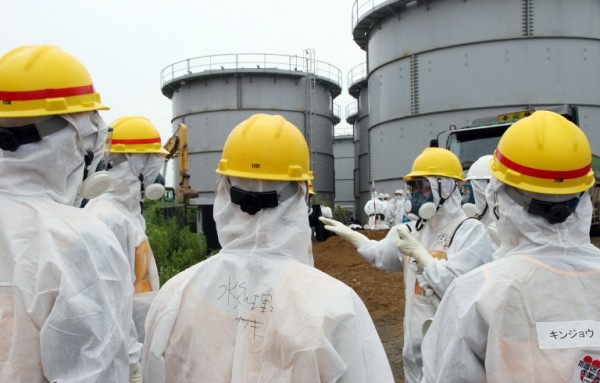
TOKYO – A Japanese court on Wednesday turned down a class-action lawsuit seeking damages from nuclear plant makers Toshiba, Hitachi and GE over the Fukushima meltdown disaster, the plaintiffs, one of the companies and a report said.
About 3,800 claimants in the suit, hailing from Japan and 32 other countries including the United States, Germany and South Korea, had sought largely symbolic compensation from the nuclear power plant manufacturers.
Under Japanese liability law, nuclear plant providers are usually exempt from damage claims in the event of an accident, leaving operators to face legal action.
The plaintiffs’ lawyers, however, had argued that that violated constitutional protections on the pursuit of happy, wholesome and cultured livelihoods.
But the Tokyo District Court ruled that the law “is not unconstitutional”, according to lawyers for the plaintiffs.
“We knew it was difficult to win under the current legal system in Japan, but it’s clearly wrong that nuclear (plant) manufacturers don’t have to bear any responsibility for an accident,” Masao Imaizumi, 73, one of the plaintiffs, told AFP.
“If they are spared responsibility, it could lead to disregard for product quality,” he said, adding that the plaintiffs will appeal.
Toshiba welcomed the decision.
“The company recognises the verdict as an appropriate ruling handed out by the court,” it said in a statement.
Hitachi and GE’s Japan office could not be reached for comment.
Japan’s Jiji Press also reported that the suit was rejected.
The suit — which sought just 100 yen (96 US cents) per claimant — was the first to be brought against nuclear power-plant suppliers over the accident, Akihiro Shima, lead lawyer for the plaintiffs, said previously.
The suit was first filed in January 2014 with just over 1,000 claimants, but more joined and the number nearly quadrupled.
The plaintiffs had alleged that the companies failed to make necessary safety updates to the Fukushima reactors, swamped on 11 March 2011 by a magnitude 9.0 earthquake-sparked tsunami that lead to the worst nuclear accident since Chernobyl in 1986.
Embattled plant operator Tokyo Electric Power is already facing massive lawsuits and compensation costs.
https://www.enca.com/world/makers-of-fukushima-reactor-not-liable-court
Reactor decommissioning plan cites ‘sarcophagus’
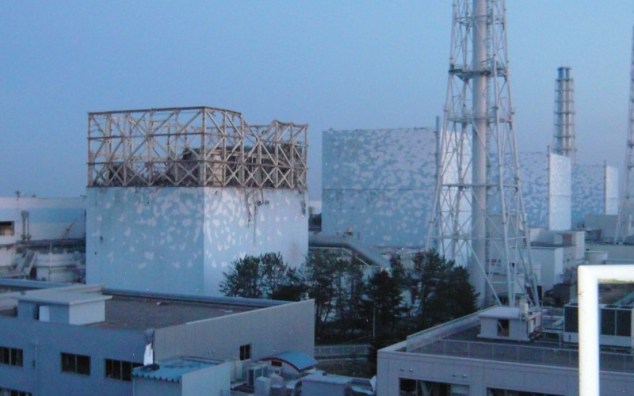
Reactor decommissioning plan cites ‘sarcophagus’
The government body charged with decommissioning the reactors at the Fukushima Daiichi nuclear plant says it remains committed to removing the fuel but sealing off the buildings that house them could be an option.
The Nuclear Damage Compensation and Decommissioning Facilitation Corporation issued its latest report Wednesday on its plan.
It says 2 methods will be used to remove molten fuel depending on the condition of the reactors.
One entails filling the containment vessels with water to shield workers from radiation. The second does not use water.
The new plan also introduces the option of creating a “sarcophagus” to seal off the buildings with the nuclear fuel inside.
This method was used at the Chernobyl nuclear plant in Ukraine.
The plan favors removing the nuclear fuel because of the long-term safety issues involved with a sarcophagus. It urges a flexible review of all available options.
It also notes the importance of addressing long-term public concerns about the plan.
The government and the plant operator, Tokyo Electric Power Company, plan to decide by the middle of next year how to remove the fuel from the reactors. They hope to begin work at one of them by 2021.
http://www3.nhk.or.jp/nhkworld/en/news/20160713_25/
Fukushima mayors react to decommission plan
Reacting to the new plan, the heads of municipalities around the Fukushima Daiichi nuclear plant have urged the government to stick to its promise regarding nuclear waste disposal.
The mayor of the city of Minamisoma, Katsunobu Sakurai, said the government and TEPCO must be made to abide by their initial pledge to remove the fuel from Fukushima Prefecture. Until this is done, he said, the evacuees won’t feel that it’s safe to return home.
He warned against using the word “sarcophagus” lightly. He said its mention only points out the inadequacy of decommissioning technology.
The mayor of the town of Namie, Tamotsu Baba, said a sarcophagus should not be considered because engineers are hard at work figuring out ways to remove the fuel.
He said all they can do is to have faith that the initial pledge will be kept, even if it takes 30 or 40 years to remove the fuel.
The mayor of the town of Okuma, Toshitsuna Watanabe, also urged the government and the utility to stick to their disposal promise.
Again, a Japanese court blocks restart of 2 nuclear reactors

 Japan court again blocks restart of 2 nuclear reactors, Nikkei Asian Review, 13 July 16 OSAKA — Handed another defeat by a Japanese court on Tuesday, Kansai Electric Power likely will not be able to run any of its nuclear power plants for at least six months, a major setback for a utility facing intense competition from industry newcomers.
The Otsu District Court in Shiga Prefecture rejected the company’s objection to an injunction issued in March that suspended operation of the Nos. 3 and 4 reactors at the Takahama nuclear plant in neighboring Fukui Prefecture. The presiding judge was the same as when the injunction was issued.
The Osaka-based company had been banking on the restart of nuclear power stations for an earnings recovery. Its medium-term business plan released in April set a pretax profit target of 300 billion yen ($2.87 billion) on the assumption that most of its nuclear reactors will be back online by fiscal 2025.
Assuming that its earnings would improve by about 10 billion yen a month if the two Takahama reactors went back onstream, Kansai Electric had intended to lower its power rates to compete on a better footing with newcomers expected to enter the market following deregulation in April. But it was forced to scrap its plan to cut rates after the court ordered the two reactors — reactivated in January and February — shut down in March.
Since April, Kansai Electric has lost more than 200,000 customers to Osaka Gasand other power providers. ……..http://asia.nikkei.com/Business/Companies/Japan-court-again-blocks-restart-of-2-nuclear-reactors
New governor’s Sendai plant shutdown pledge alarms utility
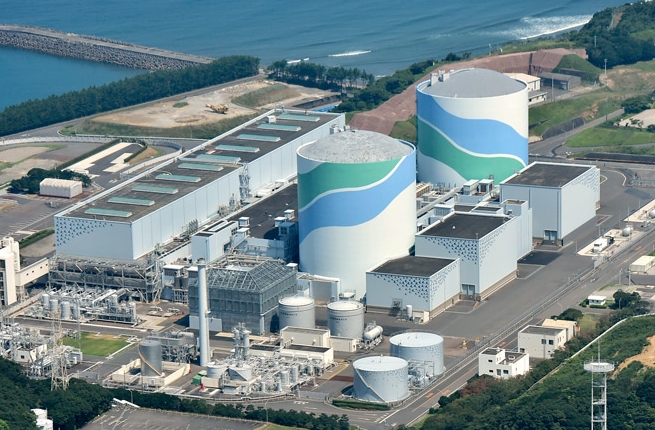
Kyushu Electric Power Co.’s Sendai nuclear power plant in Satsuma-Sendai in Kagoshima Prefecture
Concern is growing among Kyushu Electric Power Co. and the central government over the new Kagoshima governor’s pledge to request a reassessment of the Sendai nuclear plant’s safety in light of the recent Kumamoto quakes.
Satoshi Mitazono, a former political reporter with TV Asahi Corp., was elected on his campaign pledge to build a “society without nuclear energy” in the July 10 gubernatorial race, defeating incumbent Yuichiro Ito.
Mitazono, 58, wants to suspend operations at the plant for a review of its emergency evacuation plan and to re-examine its safety features.
A top Kyushu Electric executive expressed bewilderment over Mitazono’s proposal.
“A governor has no legal authority to order a halt,” the official said. “On what legal basis can the plant be shut down?”
But Mitazono’s calls reflect local residents’ mounting concerns over the Sendai plant in Satsuma-Sendai, Kagoshima Prefecture, after a series of strong tremors rocked neighboring Kumamoto Prefecture starting in mid-April.
The company allows prefectural officials to inspect the nuclear plant site, and request for it to take corrective measures based on their findings under an agreement with the prefectural and Satsuma-Sendai city governments over safety issues.
Kyushu Electric, based in Fukuoka, would likely be forced to respond in one way or another when the governor asks for the suspension of the plant, regardless of legal authority.
With two reactors in operation, Sendai is the only nuclear power station back online in the nation after it cleared the new safely regulations implemented after the 2011 Fukushima nuclear disaster.
After Mitazono emerged as the winner on July 10, Kyushu Electric’s closing stock price dropped more than 7 percent, compared to July 8, reflecting the company’s potentially gloomy prospects.
The two reactors at the Sendai plant are scheduled to be shut down in October or later for a regular check.
An official with the Ministry of Economy, Trade and Industry, which oversees the nuclear industry, said it would take a prolonged period before the plant could be restarted if a review of the evacuation plan or other demands were made.
A senior Kyushu Electric official concurred that it would not be easy to go back online on a regular time schedule if such demands were made.
“It would be difficult to reactivate the reactors amid the opposition of the local government hosting the plant,” the official said.
Evacuation order lifted in Minami-Soma after 5 years, affecting 10,000 people
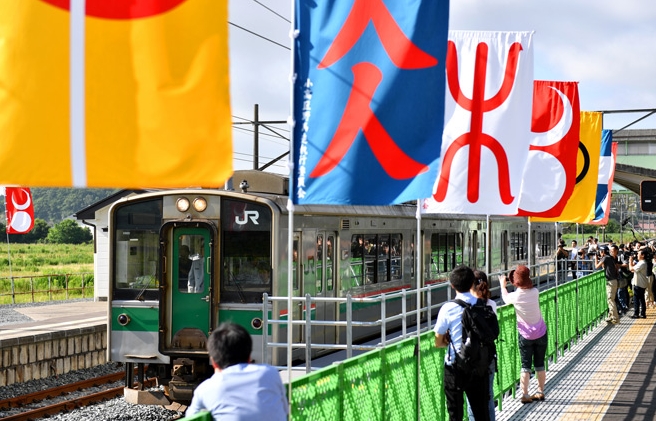
For the first time in five years, a train begins service on the 9.4-kilometer stretch between Odaka and Haranomachi stations in Minami-Soma, Fukushima Prefecture, on East Japan Railway Co.’s Joban Line at 7:33 a.m. on July 12.
Evacuation order lifted in Minami-Soma after 5 years
MINAMI-SOMA, Fukushima Prefecture–In good news for residents, an evacuation order for the southern part of the city here was lifted on July 12 for the first time since the massive earthquake and tsunami crippled the Fukushima No. 1 nuclear power plant five years ago.
However, due to lingering fears of radiation contamination, less than 20 percent of the populace are set to return to their homes.
The central government allowed residents back into the southern region of the city after midnight on July 11. It marks the sixth time that evacuation orders have been lifted for locales in Fukushima Prefecture, following such municipalities as Naraha and Katsurao.
The latest lifting in Minami-Soma affects a total of 10,807 residents in 3,487 households in all parts of the Odaka district and parts of the Haramachi district, making it the largest number of people to be let back into their homes since evacuation zones were established following the 2011 nuclear disaster.
Two residents living in a household in an area designated a “difficult-to-return” zone in the southern part of the city are still not allowed back home.
However, only about 2,000 residents signed up to stay overnight at their homes in the area ahead of the lifting of the evacuation order.
That is likely because many still fear the effects of radiation from the destroyed power plant, which straddles the towns of Futaba and Okuma to the south of Minami-Soma. In addition, five years was more than enough time for residents who evacuated elsewhere to settle down.
With at least some of the residents returning home, East Japan Railway Co. resumed service on the 9.4-kilometer stretch between Odaka and Haranomachi stations on the Joban Line for the first time in more than five years on the morning of July 12. The first train of the morning entered Odaka Station carrying 170 or so people on two cars as traditional flags used in the Soma Nomaoi (Soma wild horse chase) festival on the platform greeted passengers.
The central government is pushing to lift evacuation orders on all areas of the prefecture excluding difficult-to-return zones by March 2017.
http://www.asahi.com/ajw/articles/AJ201607120054.html
Japan lifts evacuation orders in Fukushima affecting 10,000 people
FUKUSHIMA, Japan (Kyodo) — The government on Tuesday further scaled down areas in Fukushima Prefecture subject to evacuation orders since the March 2011 nuclear disaster at the Fukushima Daiichi complex, enabling the return of more than 10,000 residents to the city of Minamisoma.
Following the move, the city will become mostly habitable except for one area containing one house. But many residents seem uneager to return, having begun new lives elsewhere.
The government is in the process of gradually lifting evacuation orders issued to areas within a 20-kilometer radius of the plant of Tokyo Electric Power Company Holdings Inc. and in certain areas beyond the zone amid ongoing radiation cleanup efforts.
Eight municipalities in Fukushima Prefecture have areas defined as evacuation zones, which are divided into three categories based on their radiation levels. The most seriously contaminated area is called a zone “where it is expected that the residents have difficulties in returning for a long time.”
In Minamisoma, the government lifted evacuation orders for areas except for the difficult-to-return zone. As of July 1, the areas had a registered population of 10,807, or 3,487 households.
To encourage evacuees to return, the central government and the city reopened hospital facilities, built makeshift commercial facilities and prepared other infrastructure.
Radiation cleanup activities have finished in residential areas, but will continue for roads and farmland until next March.
The government hopes to lift the remaining evacuation orders affecting areas other than the difficult-to-return zones by next March, officials said.
http://mainichi.jp/english/articles/20160712/p2g/00m/0dm/031000c
Court rules a third time against Takahama reactors
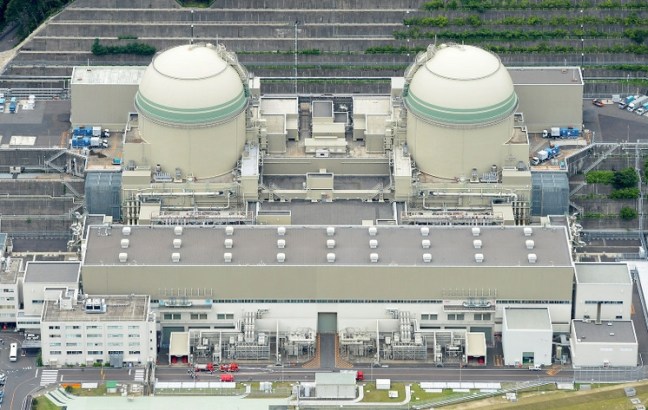
The No. 3 and No. 4 reactors at the Takahama Nuclear Power Plant, from left to right, are pictured in this photo taken from a Mainichi helicopter in Takahama, Fukui Prefecture, on June 15, 2016.
OTSU, SHIGA PREF. – The Otsu District Court ruled against Kansai Electric Power Co. for the third time in five months Tuesday, in a decision that will keep its Takahama No. 3 and 4 reactors in Fukui Prefecture shut down indefinitely.
Both sides are now gearing up for an appeal by Kepco to the Osaka High Court, where a decision could come next year, while the plaintiffs are expected to file further suits.
The utility had filed an objection to the Otsu court’s March decision, which granted a temporary injunction on the reactors, forcing Kepco to shut them down about two months after they had been restarted.
The court reaffirmed its decision in June and again made the same ruling on Tuesday after Kepco fought the June decision.
“The utility was not arguing that both reactors were safe based on expert evidence and reasonable safety standards, but that they were safe due to detailed assertions directly related to their safety and prima facie evidence,” said presiding Judge Yoshihiko Yamamoto, the same judge who has twice ruled against Kepco. “However, the new safety standards haven’t drawn the limits of what dangers should be accepted by society.”
Representatives for the plaintiffs welcomed the ruling.
“Once again, the Otsu court has ruled against the safety of restarting the reactors, especially with Lake Biwa nearby, even though Kepco has said it’ll likely appeal to the (Osaka) High Court,” said Yoshinori Tsuji, one of the chief plaintiffs.
The case boiled down to the basic question of what determines adequate safety for a nuclear power plant. It has raised questions about the way the Nuclear Regulation Authority is handling safety inspections for restarts.
http://www.japantimes.co.jp/news/2016/07/12/national/court-rules-third-time-takahama-reators/
Report: Japan court upholds injunction to halt nuclear reactors
A Japanese court on Tuesday upheld an order for the shutdown of two reactors at Kansai Electric Power Co’s Takahama nuclear plant in western Japan, a Japanese news agency reported, in a widely expected ruling that prevents the utility from restarting them.
Japan’s second-biggest utility had appealed Otsu District Court’s March 9 ruling ordering it to shut the Takahama No. 3 and No. 4 units with immediate effect, which marked the first injunction to shut a nuclear plant in operation. The court last month also denied the utility’s request for a stay of execution of the injunction.
Kansai Electric is expected to appeal the latest decision to the Osaka High Court.
http://www.asahi.com/ajw/articles/AJ201607120042.html
Court again nixes appeal to restart 2 Takahama nuclear reactors
OTSU, Japan (Kyodo) — A Japanese court again disallowed the operation of two nuclear reactors Tuesday, rejecting their operator’s request to suspend an injunction the same court had issued over the once-reactivated units at the Takahama power plant in Fukui Prefecture, western Japan.
The Otsu District Court’s decision, following the injunction issued in March over the Nos. 3 and 4 units at the Kansai Electric Power Co. plant, would continue to legally prevent the Osaka-based utility from restarting operation of the reactors on the Sea of Japan coast about 380 kilometers west of Tokyo.
Kansai Electric plans to appeal the decision to the Osaka High Court, company officials said.
In June, the district court also rejected the plant operator’s appeal to temporarily void the effects of the injunction, with public concerns lingering over the restart of nuclear power plants in Japan in the wake of the 2011 Fukushima Daiichi disaster.
Tuesday’s decision was issued under the same presiding judge, Yoshihiko Yamamoto, who made the judgments in March and June.
The March injunction was the first of its kind affecting operating reactors. One of the reactors was taken offline one day after the order. The other reactor was already offline.
The Takahama plant has cleared the post-Fukushima safety regulations, allowing Kansai Electric to reactivate the Nos. 3 and 4 reactors. But their operation was beset with problems.
Kansai Electric has announced it will remove fuels from the two nuclear power reactors in August, even though Prime Minister Shinzo Abe’s government has expressed a desire to ramp up nuclear power generation at home.
http://mainichi.jp/english/articles/20160712/p2g/00m/0dm/067000c
Fukushima’s Ice-Wall – A Fridge Too Far
The Tōhoku earthquake and tsunami on March 11, 2011 caused significant damage to the TEPCO Fukushima Daiichi nuclear power generation site. The damage inflicted to the plant’s cooling system, caused a ‘Loss of Coolant Accident’ resulting in nuclear meltdowns and releases of radioactive materials from several of its reactors. It was the largest nuclear disaster since the Chernobyl disaster of 1986 and only the second disaster (along with Chernobyl) to measure Level 7 on the International Nuclear Event Scale.
The reactor buildings were severely damaged to their foundations, and having been built on ‘made ground’ above a highly active and porous aquifer up to 50 metres deep, ground water began to penetrate the damaged reactor building’s basement at a significant rate. Initially this proved an aid to the immediate situation, with the cooling system out of action an emergency system was set up utilising site waters to cool the damaged reactors, with 400 tons of water being continuously poured into the damaged reactor buildings every day to cool them. On the downside, this cooling water became contaminated by the exposed molten fuel. Added to that, approximately 400 tons per day of groundwater flowing into the basements of the damaged buildings also became contaminated due to cracks in the reactor containment vessels. Approximately 800 tons of contaminated water was required to be pumped up every day from the damaged buildings and treated to minimise its harmful contaminant content. Even after treatment, these stored waters contained significant amounts of caesium-134, caesium-137, strontium-90 and tritium. The water that was not reused for cooling was stored in holding tanks. Needles to say the contaminated water is accumulating as such a rate that some discharges to the sea will become inevitable.
The technical problems posed for the authorities are immense. High level contamination around the damages reactors, massive structural damage, derelict buildings and radioactive debris spread over an extensive area. And an apparently unstoppable flow of ground water flooding buildings wherein the corium stumps of 3 melted-down reactors still lay. And as if to make matters worse, the water levels in the basement behaved tidally, indicating that the contaminated waters had a seriously large conduit or ‘preferential pathway’ to the open sea. With all of these issues, even with the Chernobyl experience, the Fukushima clean-up project is a massive, unique and highly challenging situation, that may take as long as 50 years or more to fully address.
In years following the disaster the Japanese authorities, struggling to meet the daunting challenges, came under increasing internal and external pressure to seek external assistance in the clean-up and remediation of the Fukushima plant. In response, in mid-2013, Japan’s International Research Institute for Nuclear Decommissioning Authority (IRID) made a worldwide call for technologies to address their radio-chemical contaminated water, and other technologies to assist to remediate the site. In a global ‘brainstorm’ they drew in a significant amount of good ideas and prospective valuable new technologies.
There are several key stages to ‘brainstorming‘. Setting the context and defining the problems faced at Fukushima are largely self evident. The plant needs to be made safe and decommissioned, and the wider environment beyond the plant needs to be remediated and restored, at least as far as is possible. In generating ideas, there needs to be a flow of ideas that are uncompromised by ‘mindset’. To this end those involved in the process are generally selected from both within and without the problem owning group and from as wide a range of expertise as possible. So as not to prohibit radical ideas or ideas that would be outside the technical culture of the problem owning group, it is quite normal to reserve any critical review at this stage, until everything is on the table. Thereafter, the filtering of ideas commences. The most promising are shortlisted and then follows a more detail examination of the pros and cons of each, where their merits and de-merits weighed. On selection of the best idea, any specific problems are addressed and if acceptable, the front runner goes forward to be implemented as an operational project.
Consider the operation requirements of decommissioning the Fukushima reactor buildings. There needs to a be robust containment wall put in place, to (a) control the immediate ingress and discharge of water (b) prevent spread of contamination during decommissioning and (c) a coffer must be installed to contain for what will remain a site of significant radiation risk for hundreds of years to come. The ‘brainstorming process seems to have fallen short at Fukushima. The concept of the ice-wall was mooted long before IRID’s call for technology, and advanced as the optimum solution before any wide-ranging brainstorming took place. Moreover, it would appear that the overseeing authorities had become ‘mindset’ on this solution, announcing the decision to construct the Ice-wall in September 2013 despite IRID still seeking and collecting worldwide technology submissions. Installation of facilities to create the ice-wall commenced in June 2014 and was completed on February 9, 2016 at an estimated to cost some ¥34.5 billion ($339 million). Activation was on March 31 this year, with commencement of the freezing of the seaward side wall. Freezing of the land-side wall commenced on June 6 and has as yet to achieve and control over the water ingress to the ice-walled coffer. Yet despite this commitment to the ‘ice-wall’ as a solution to the problem, serious questions arise as to whether this technology is capable of meeting the short term needs, let alone the medium or long-term containment needs.
Ice-wall technology has been used in Japan on hundreds of occasions in civil engineering projects to stem flooding and avoid collapse issues in tunnelling. The purported principal benefit of using a frozen barrier compared with a physical barrier is that it avoids the challenges of building a wall around such underground obstacles as pipes, which it can freeze plug, and if complete, create a seamless barrier. Once in place, frozen walls take a long time to melt and therefore if the site were hit by another earthquake or tsunami the wall might stay intact for a couple of months, allowing time for its refrigeration plant to be repaired and power restored.
As for the cons, relative to what is required at Fukushima, ice-wall technology has only ever been used on a short term basis, and never for a semi-permanent installation. None have run for the decades that Fukushima’s wall would need to be in place. The Fukushima wall at 1,500 metres in length, 30 metres in depth and at circa 70,000 cubic metres in volume would be nearly double the size of the largest prior ice-wall ever constructed. Curiously it was designed only as a partial barrier in that it doesn’t reach to 50 meters to the impermeable rock strata below the aquifer and thus it has no containment floor beneath the site. Such a wall has never been constructed on such a highly active aquifer and it is quite a different matter to freezer moving water. As an added complication, due to the proximity of the sea to the site and the existence of preferential pathways to the sea, the groundwater would have a high mineral content and be highly saline, containing salts of sodium, potassium and critically calcium. Owing to this mixed salinity, freezing to below 0oC would not be nearly enough to freeze the soil-water column solid and stop the water flow. The ground soil-water column would have to be taken to below -21oC and possibly to -41oC. TEPCO are utilising a CaCl2/card-ice eutectic coolant, which has a minimum freezing temperature of -41oC ‘at the pump’ and closer to -25oC in the cooling pipes. It would be hard pressed to get the ground temperature to -21oC due to heat ingress, and even at its coldest it won’t freeze a calcium rich saline system solid. As for the heat ingress into the system, we mustn’t forget that we are trying to enclose 3 very warm meltdown corium stumps, effectively comprising a ‘hot-spring’ at the centre of the ice-wall structure. Over and above that heat, the Fukushima site is located next to the Pacific and has seasonally warm southerly currents bathing the site’s shore front during the summer months bringing yet more heat into the system. Even with a heat exchanger rated at 12.6 Mega Watt, (that’s about enough energy to run a small town), it’s a big ask, and I fear that given the geotechnical circumstances the desired ice-wall project outcomes are beyond the capacity of this technology.
A complication of ice-wall technology is that it causes ground heave. The ice causes the ground to swell, creating a sheer between the unfrozen ground and the ice swollen frozen ground. So, further damage to the foundations of the stricken buildings and localised subsidence is likely. A greater problem might ensue when the wall is thawed. The chewing of the ground by the ground heave process would likely destroy subsoil texture and leave the ground more permeable to water than before.
Given the pros and cons of an ice-wall I ask the question; why didn’t TEPCO opt for a jet grouted cement/mortar double wall that could have totally enclosed the site, as this was the method of choice for controlling groundwater migration at Chernobyl? It would be possible to jet grout below the buildings and flexible ‘soft wall’ mortars could be used rather than Ordinary Portland Cement (OPC) to guard against fracture by future earthquakes.
At present TEPCO contend that the ice wall project is going to plan. However, Japan’s Nuclear regulatory authority (NRA) aren’t yet convinced, pointing out that the ice wall has yet to impact the collection of water in waterfront wells. Test wells within and without the ice wall indicated water levels tracking each other over time, showing the internal and external groundwater systems still interconnected. Moreover, the much vaunted advantage of the ice wall in being able to seal around a plug pipes appears not to be the case a Fukushima, where underground pipes and conduits remain warm and are probably acting as the preferential pathways for water ingress and egress. NRA committee member Toyoshi Fuketa recently stated, “This is not a wall in a true sense. Perhaps it’s more akin to a bamboo screen, with groundwater trickling through the gaps”. It would now seem that in response to criticism and to control the water flow TEPCO are now resorting to a hybrid approach by trying to cement closed the holes in the wall. The problem with cement is, it doesn’t set well below 0oC, but other related sealant options are available.
Thus far, it would appear that after 5 years with the bill racing toward $500 million, all TEPCO’s Ice-wall project has achieved is a very expensive steaming ‘slushy’ and no control over water ingress into the site. Indeed there is little control on water egress from the site other than by continual pumping from the reactor building basement to tanks to maintain the basement water levels below groundwater, and in doing so hope migration of contamination into the sea is prevented. Maybe it’s time to ‘call it a day’, purge the mindset and re-brainstorm the problem.
https://www.linkedin.com/pulse/fukushimas-ice-wall-fridge-too-far-peter-j-hurley
Asahi exit poll: 49% support constitutional amendment
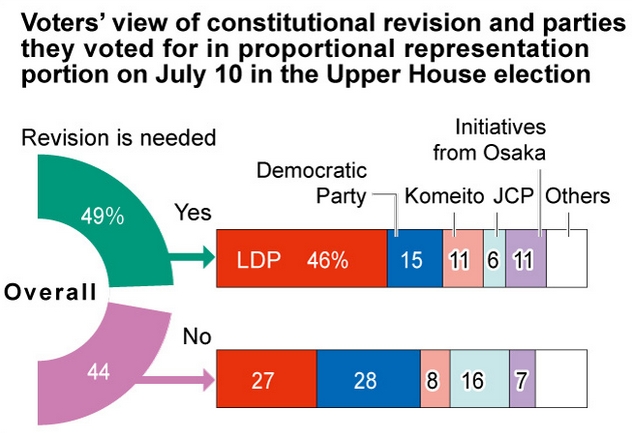
Forty-nine percent of voters in the July 10 Upper House election said the Constitution should be amended, according to an Asahi Shimbun exit poll.
The survey also showed that 44 percent were opposed to constitutional amendment, a goal of Prime Minister Shinzo Abe.
However, the poll found that revising the Constitution was not the central issue for voters when deciding which party to support in the Upper House election.
It showed that 70 percent of voters in favor of constitutional amendment said they cast their ballots for the four pro-revision parties–Abe’s Liberal Democratic Party, junior coalition partner, Komeito, Initiatives from Osaka and the Party for Japanese Kokoro–in the proportional representation portion.
However, 40 percent of those who said they oppose revision also voted for the four parties.
By age group, 55 percent of voters in their 30s supported revision, while 42 percent said it is not necessary.
Voters in their 70s were divided over the issue, with 40 percent backing revision and 43 percent opposed.
Of voters who cast ballots for the LDP, 32 percent did not support revision, while the comparable figure for Komeito, Initiatives from Osaka and the Party for Japanese Kokoro, totaled 36 percent, 35 percent and 31 percent, respectively.
Apparent discrepancies in voters’ stance on constitutional amendment and the parties they actually voted for means revision was not the deciding factor in making up their minds.
According to the poll, only 14 percent named revision as the most important issue in deciding their vote.
The issue cited by most of the voters, at 30 percent, was the economy and employment, followed by social security, at 22 percent.
Of voters who backed the LDP in the proportional representation portion, 5 percent said amending the Constitution was the most important issue. The rate for those who replied similarly was 4 percent for Komeito, 10 percent for Initiatives from Osaka and 15 percent for the Party for Japanese Kokoro.
Twenty-three percent of voters who voted for the main opposition Democratic Party and 34 percent who voted for the opposition Japanese Communist Party said that constitutional amendment was the most important issue.
The exit polls were conducted at 3,660 polling stations around Japan, and 182,646 valid responses were received.
Half of new teen voters choose ruling parties, exit polls reveal
A reminder: only 24% of the Japanese population voted in these elections.
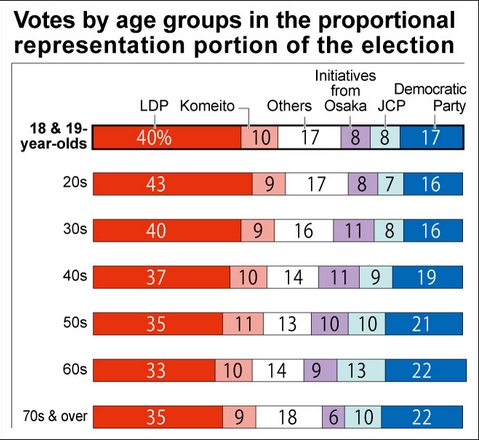
Half of teenage voters cast their ballots for the ruling parties, the Liberal Democratic Party and Komeito, in the proportional representation portion of the July 10 Upper House election, according to exit polls conducted by The Asahi Shimbun.
The nation’s 18- and 19-year-olds, who were enfranchised for the first time in Japan’s history, responded that they placed more importance on issues that are relevant to them now and in the near future: the economy, employment and the consumption tax.
The LDP and Komeito jointly accounted for half the proportional representation votes from the teenage and 20s age groups. In other age groups, the parties fell just short of gaining half the voting share.
By age group, younger people voted proportionately more for the ruling parties, and older people tended to lean more toward the opposing parties. The 20s age group delivered the largest proportion of votes for the ruling parties, at 52 percent all together, followed by the underage group, at 50 percent.
Of the teenagers, 40 percent voted for the LDP, 10 percent for Komeito, 17 percent for the main opposition Democratic Party, 8 percent for Initiatives from Osaka, and 8 percent for the Japanese Communist Party (JCP).
Forty-five percent of males and 35 percent of females aged 18 to 19 voted for the LDP.
In terms of issues, 28 percent of young people chose the economy and employment as their top concern, the most common choice, followed by social security at 15 percent, the Constitution at 14 percent, child support at 13 percent, the consumption tax at 11 percent, and foreign affairs and national security at 8 percent.
In comparison to the other age groups, the teenagers accounted for the highest percentage of respondents choosing the consumption tax as their top concern.
The exit polls were conducted at 3,660 polling stations around Japan, and 182,646 valid responses were received.
Japan Elections: Antinuclear Candidate’s Win Poses Risk to Plant Restarts
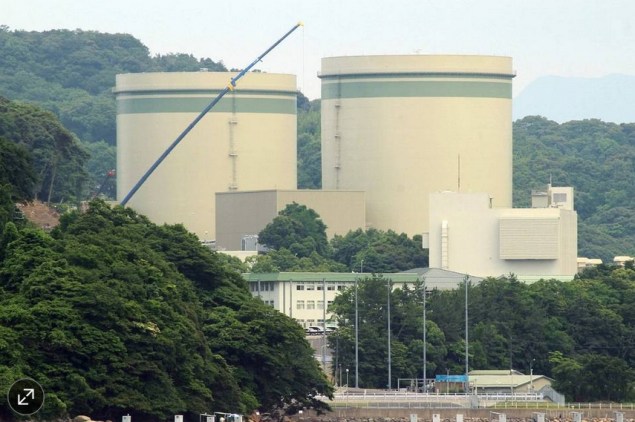
Kansai Electric’s No. 1 and No. 2 reactors at the Takahama nuclear plant on June 20. In March, a district court in Fukui prefecture issued an injunction halting the two reactors just months after they had been restarted.
Ex-journalist Satoshi Mitazono defeats incumbent Yuichiro Ito
TOKYO—The election Sunday of an antinuclear governor in the only Japanese prefecture with an operating nuclear power plant poses another risk to the government’s efforts to restart idled nuclear plants.
Former journalist Satoshi Mitazono defeated incumbent Kagoshima Gov. Yuichiro Ito largely by pledging to suspend operations at Kyushu Electric Power Co. ’s Sendai nuclear plant, which is located in the southern prefecture.
Mr. Mitazono’s victory underscores the strength of antinuclear sentiment in the country, even as Japanese companies such as Toshiba Corp. and Hitachi Ltd. win orders to build plants abroad in countries searching for a reliable, emissions-free source of power.
Kyushu Electric shares tumbled 7.5% to a three-year low Monday.
The Japanese public remains skeptical about the safety of nuclear power after the 2011 triple meltdowns at the Fukushima Daiichi nuclear plant, with many parents still screening food for radiation. Communities hosting the plants are resisting plans to restart reactors.
The Japanese government aims to revive at least 32 of the 54 reactors it shut down following the Fukushima disaster, and plans for nuclear power to account for about a fifth of the nation’s total electricity generation by 2030. It also hopes to double the contribution from renewable energy to meet a goal of cutting the nation’s greenhouse gas emissions by about a quarter from 2013 levels.
Nuclear power is also seen by many analysts and policy makers as key to Japan’s energy security. The country is forced to import nearly all of its fossil fuel.
“Relying on oil and gas is not sustainable, with huge costs to people’s health and the economy, and serious consequences for the environment,” said Hooman Peimani, research fellow at the Tokyo-based Asia Pacific Energy Research Centre.
Yet the government’s goals for nuclear look increasingly ambitious as local communities fight back. In March, a district court in Fukui prefecture issued an injunction halting two reactors at Kansai Electric Power Co. ’s Takahama nuclear plant just months after they had been restarted. The court said Kansai Electric had failed to show the public that the reactors were safe, despite having met stricter safety standards established after the Fukushima accident.
The only other nuclear plant now scheduled to be restarted is Shikoku Electric Power Co. ’s plant in Ikata, in southern Ehime prefecture. The restart is slated for August.
“The people are worried,” Mr. Mitazono said in a TV interview shortly after the election Sunday night. “We will not operate nuclear reactors when their safety cannot be guaranteed.”
The fight against nuclear at home has Japanese plant operators seeking business overseas—particularly in China and India. Hitachi last week said it would work with plant operator Japan Atomic Power to build and run nuclear plants in the U.K.
Toshiba, through U.S. unit Westinghouse Electric, hopes to secure contracts to build 45 nuclear reactors by 2030. Westinghouse is already building four reactors each in the U.S. and China. Toshiba said last week that it is eyeing 12 more deals in India, three in the U.K., and a total of five in the U.S. and Turkey.
Having nuclear plants idled is costly for Japan’s utilities, which are competing in a newly deregulated retail market. Restarting the Sendai plant has enabled Kyushu Electric to cut its imports and consumption of fossil fuels, which helped it log a profit in the year ended in March.
Mizuho Securities Co. analyst Norimasa Shinya said in a note to clients Monday that if the Sendai plant were to remain shut after planned maintenance checks later this year, Kyushu Electric’s recurring profit would fall by nearly a third, or about 18 billion yen ($176 million), in the current business year.
Kyushu Electric declined to comment on the impact of a possible shutdown at Sendai. “We have not been told to halt operations, nor do we know when, if, or how such a request would be made,” a spokesman said. “Voters voted on a wide array of issues, and not just on nuclear.”
1 This Month





PLEASE OPPOSE HR 8255 AND S.3639 – bills would accelerate satellite deployment, with no environmental review or safeguards – https://ncstd5li.quorum.us/campaign/169331/
To see nuclear-related stories in greater depth and intensity – go to https://nuclearinformation.wordpress.com
-
Archives
- October 2026 (40)
- September 2026 (339)
- August 2026 (330)
- July 2026 (355)
- June 2026 (287)
- May 2026 (306)
- April 2026 (356)
- March 2026 (251)
- February 2026 (267)
- January 2026 (308)
- December 2025 (358)
- November 2025 (359)
-
Categories
- 1
- 1 NUCLEAR ISSUES
- business and costs
- climate change
- culture and arts
- ENERGY
- environment
- health
- history
- indigenous issues
- Legal
- marketing of nuclear
- media
- opposition to nuclear
- PERSONAL STORIES
- politics
- politics international
- Religion and ethics
- safety
- secrets,lies and civil liberties
- spinbuster
- technology
- Uranium
- wastes
- weapons and war
- Women
- 2 WORLD
- ACTION
- AFRICA
- Atrocities
- AUSTRALIA
- Christina's notes
- Christina's themes
- culture and arts
- Events
- Fuk 2022
- Fuk 2023
- Fukushima 2017
- Fukushima 2018
- fukushima 2019
- Fukushima 2020
- Fukushima 2021
- general
- global warming
- Humour (God we need it)
- Nuclear
- RARE EARTHS
- Reference
- resources – print
- Resources -audiovicual
- Weekly Newsletter
- World
- World Nuclear
- YouTube
-
RSS
Entries RSS
Comments RSS

