Japan allows world’s biggest nuclear plant to restart
DW, 27 Dec 23
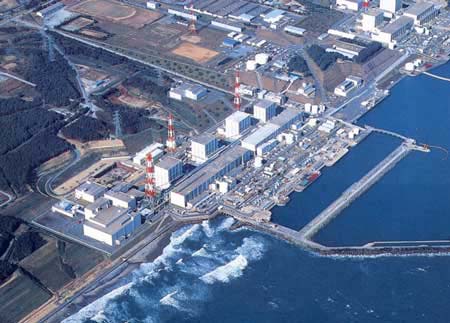
The safety ban on TEPCO’s Kashiwazaki-Kariwa plant has been lifted, allowing it to become operational once again. However, the facility still needs permission from local government bodies
Japan’s nuclear regulator announced Wednesday that it has lifted its safety ban on Tokyo Electric Power’s (TEPCO) Kashiwazaki-Kariwa plant, the largest in the world in terms of capacity.
TEPCO has been looking to restart the plant due to high operating costs. It must now seek permission from local bodies in the Niigata prefecture, Kashiwazaki city, and Kariwa village.
Why was the ban imposed?
The Kashiwazaki-Kariwa plant has a capacity of 8,212 megawatts (MW) and was TEPCO’s only operable atomic power station. It has been offline since 2012, after the Fukushima disaster in March 2011 led to the shutdown of all nuclear power plants in Japan……………………
Previously in 2021, the NRA had barred the plant from operating due to safety breaches and insufficient antiterrorism measures. This included a failure to protect nuclear materials and an incident that involved an unauthorized staff member accessing sensitive areas of the plant.
It had then issued an order that prevented TEPCO from transporting new uranium fuel to the plant or loading fuel rods into its reactors……………………….
After the decision, TEPCO said it would continue to work towards gaining the trust of the local community and society at large. On Tuesday, a Tokyo court ruled that TEPCO, the only operator of the tsunami-wrecked Fukushima nuclear power plant, had to pay damages to dozens of evacuees.
Japan has been trying to reactivate all domestic nuclear power plants that comply with the safety network, to reduce its reliance on fossil fuels which need to be imported. But in some cases, there is opposition from locals or other regulatory bodies. https://www.dw.com/en/japan-allows-worlds-biggest-nuclear-plant-to-restart/a-67829687
Tokyo court holds only the utility responsible to compensate Fukushima evacuees, and reduces damages
A Tokyo court has ruled that only the operator of the tsunami-wrecked
Fukushima nuclear power plant had to pay damages to dozens of evacuees,
relieving the government of responsibility. Plaintiffs criticized the
ruling as belittling their suffering and the severity of the disaster. The
Tokyo High Court also slashed the amount to half of a lower court’s
decision, ordering the Tokyo Electric Power Company Holdings, known as
TEPCO, to pay a total of 23.5 million yen ($165,000) to 44 of the 47
plaintiffs.
AP News 27th Dec 2023
The Spread of Radiation Internal Contamination thru Fresh Produce in Japan.
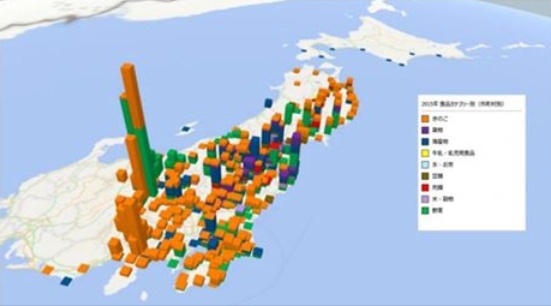
[Photo] Green: vegetables, Brown: mushrooms, Navy blue: seafood.
FROM THE ARCHIVES – June 15, 2016
Here is the map of Japan, which indicates the spread of radiation contamination studied with fresh produce.
Everyone should be careful and aware that radiation contaminated food is being distributed anywhere in Japan, not only in Fukushima Prefecture.
To know the exact measure, becquerels level in each food to be consumed is becoming vital so as to not be harmed internally, knowing that radiation exposure internally is much more harmful than external exposure : at least 100 times more harmful.
Professional insight is there important. In Japan today professional insight is only presently given by White Food company, whose main concern is now to sell food that is not radioactive contaminated. (If only once proven wrong White Food would lose its credibility, which is the foundation of their company.)
Why is this happening ◾️? Because radioactive contamination in distributed foods is harder to be known, to be detected than the geographical distribution of hotspots in Japan which can be easily detected and are now well listed.
As an example, although it is not well known, the best shiitake mushrooms are mostly produced in Fukushima prefecture, and from there distributed all over Japan, some even exported abroad.
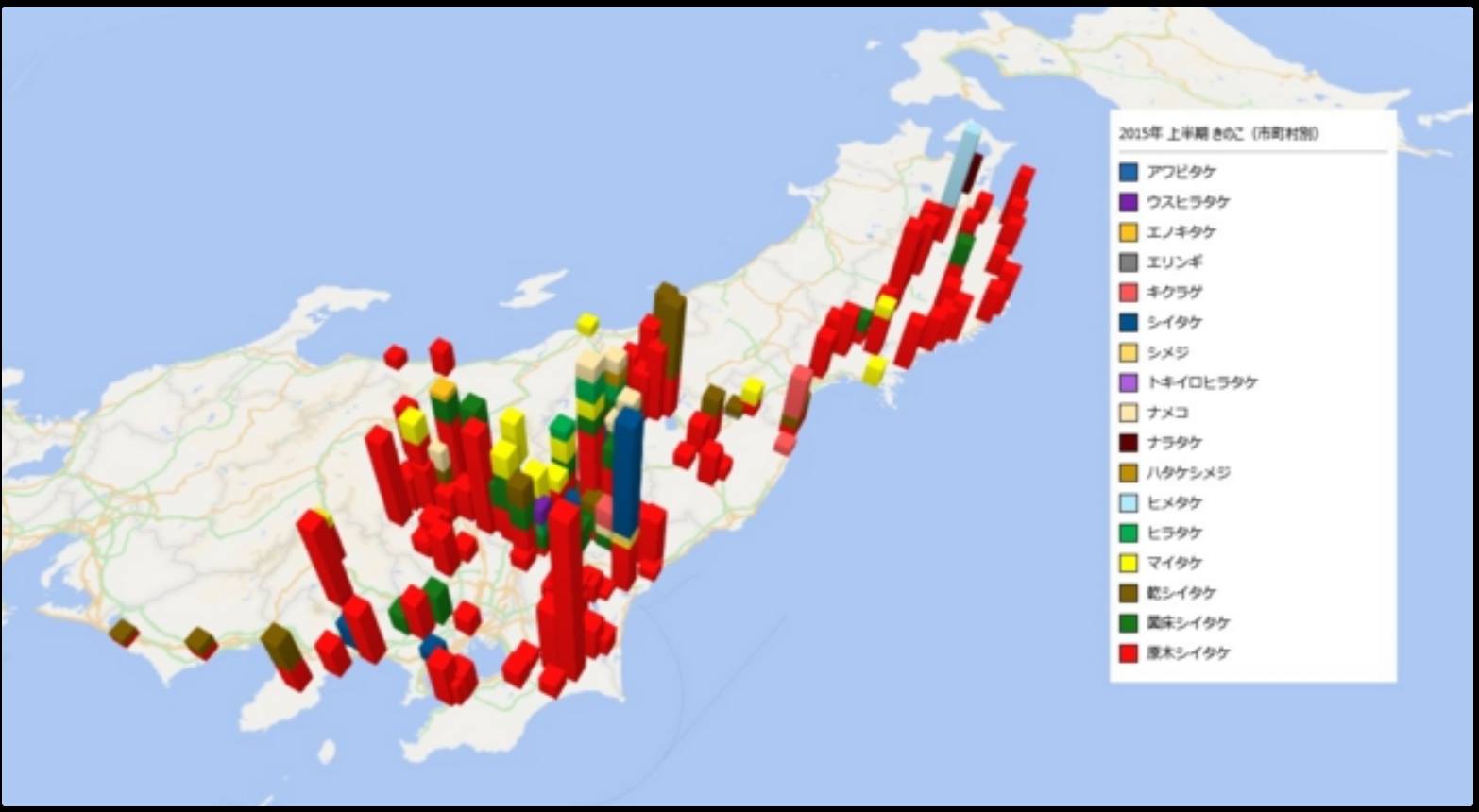
Map of mushrooms only. Type details.
Recently, information about contaminated foods is become more available, than just after the accident. Nevertheless radioactive contamination is ongoing and well present in food everywhere as it shows on the map above.
Data Sources:
Radioactivity inspection map per category & destination list links
Seafood: http://news.whitefood.co.jp/tag/map_fish/
Meat: http://news.whitefood.co.jp/tag/map_meat/
Mushroom: http://news.whitefood.co.jp/tag/map_mush/
Beans: http://news.whitefood.co.jp/tag/map_bean/
Fruit: http://news.whitefood.co.jp/tag/map_fruit/
Vegetables: http://news.whitefood.co.jp/tag/map_vegi/
Rice, grain: http://news.whitefood.co.jp/tag/map_rice/
Water, tea: http://news.whitefood.co.jp/tag/map_drink/
Radioactivity inspection map of food (2015) information source
Ministry of Health, Labour and Welfare
2014 monthly test results
http://www.mhlw.go.jp/stf/kinkyu/0000045281.html
http://www.mhlw.go.jp/stf/kinkyu/0000084439.html
Article Sources:
http://saigaijyouhou.com/blog-entry-10727.html
http://sharetube.jp/article/2958/
https://news.whitefood.co.jp/news/foodmap/
Special credits to Kitagawa Takashi for the informations
Translated by D’un Renard from Japanese.
China’s CGN Halts Funding for UK’s Hinkley Nuclear Plant

- EDF may have to fund completion of £32.7 billion plant alone
- Britain took over CGN’s stake in a similar project last year
By Francois De Beaupuy, December 14, 2023
China General Nuclear Power Corp. has halted funding for the UK’s Hinkley Point C nuclear station in a fresh sign of tension between London and Beijing.
CGN skipped several installments in recent months, according to people familiar with the matter. That means Electricite de France SA, which was building the £32.7 billion ($41 billion) plant with CGN, may have to pay for its completion alone, they said, asking not to be named,
because the information isn’t public.
The withdrawal of funding comes
after the UK took over CGN’s stake in a similar nuclear project in
Sizewell last year following concerns over national security. Back then,
the government didn’t rule out that it might intervene in other cases of
Chinese involvement in UK energy supply, arguing that it would need to
consider risks to security and energy independence.
CGN’s plan to build a
Chinese-designed atomic plant in Southeast England is also up in the air.
It’s unclear whether the funding halt is temporary or definite, some of
the people said, adding that the project will continue in any case. A
spokesperson for EDF declined to comment when reached by Bloomberg, and CGN
didn’t respond to a request for comment.
Bloomberg 14th Dec 2023
Fukushima nuclear plant worker exposed to radiation
TOKYO. 12 Dec 23 https://japantoday.com/category/national/fukushima-nuclear-plant-worker-exposed-to-radiation
A plant worker at the crippled Fukushima Daiichi nuclear complex may have ingested radioactive materials after his face was exposed to the substances, the plant operator said Monday.
The operator Tokyo Electric Power Company Holdings Inc said the man in his 20s was wearing a protective full-face mask and suit while working in a room near the plant’s No. 2 reactor building, decontaminating fences and other equipment ahead of the removal of 615 spent nuclear fuel rods from the building.
But radioactive material was found on his face during a routine radiation test as he was leaving the site and he was decontaminated immediately.
The incident follows one in October when two men were exposed to radioactive liquid while cleaning a water filtration facility at the same plant.
Chinese Nuclear Weapons and Canada: An Uncivil-Military Connection

The United States should take action to ensure that domestic and foreign actors are not boosting the nuclear programs of adversaries.
by Henry Sokolski, https://nationalinterest.org/feature/chinese-nuclear-weapons-and-canada-uncivil-military-connection-207727 6 Dec 23
For decades, the Defense Department made little or no connection between China’s civilian nuclear power program and its military nuclear weapons buildup. No longer.
For the last three years, the Pentagon has explicitly linked Beijing’s “peaceful” fast reactor power program to China’s ramped-up weapons plutonium efforts and the projection China will acquire more than 1,000 nuclear warheads by 2030. In its latest annual China military power report, the Defense Department went further and revealed that China is using its civilian nuclear reactors to produce tritium to fuel its thermonuclear weapons.
China is doing this by placing lithium rods in power reactors and bombarding the rods with neutrons. This produces tritium, which subsequently is separated, much like how America makes its weapons tritium. It’s unclear if China uses all its power reactors—American, Canadian, Russian, French, or Chinese-designed—for this purpose.
The Pentagon report, however, notes that China uses a tritiated heavy water extraction process to cull tritium produced when hydrogen atoms absorb neutrons and become tritium atoms. The only reactors in China that use heavy water are located in Haiyan and operated by China National Nuclear Power Corporation (CNNC)—Beijing’s premier nuclear weapons contractor.
Canada supplied these reactors through Atomic Energy of Canada Limited (AECL), a Canadian government-owned firm. In addition, AECL agreed to work with CNNC on advanced heavy water reactors and related technologies. In 2011, AECL sold its heavy water reactor business to SNC-Lavalin Inc. (recently renamed AtkinsRealis). AtkinsRealis continues to collaborate with CNNC on its heavy water reactors.
However, Canada’s nuclear transfers to China aren’t limited to reactors. In late October, the Canadian firm Cameco, one of the world’s largest uranium suppliers, announced it had contracted to sell more than 97,500 metric tons of uranium to CNNC. Cameco says it will send the CNNC more than 12,700 metric tons annually for the next four years. 12,700 metric tons is roughly 200 to 300 metric tons more than China’s entire civilian sector consumes annually. The 200-to-300-ton surplus alone could fuel as many as 100 bombs each year.
This should raise eyebrows. With poor domestic uranium resources, China insists it’s only building up its uranium reserves for future nuclear power use. Perhaps, but there is no agreed way to verify this. The same is true with tritium. Currently, there are no effective controls on either nuclear substance to assure their peaceful end-use. Both, however, are critical to making nuclear weapons, and CNNC, China’s top weapons vendor, controls these materials.
What should be done?
First, our government needs to name and shame firms exporting critical nuclear materials and technologies to America’s nuclear-armed rivals. This would require spotlighting Canada’s Cameco and AkinsRealis. It also would require listing France’s nuclear firm, EDF, which this spring announced it would work with CNNC in developing advanced spent fuel recycling, a process critical to producing weapons plutonium. Yet, another entity that deserves dishonorable mention is Rosatom, Russia’s prime nuclear weapons developer, in addition to firms in business with the company. The House has already spotlighted Rosatom as a bad actor, asking the White House to sanction it for assisting China’s fast reactor program.
To expose these entities further, the Departments of Defense and the Intelligence Community should produce an unclassified annual report clarifying which domestic and foreign firms might be transferring nuclear materials and technologies to hostile states’ nuclear weapons entities.
Second, the U.S. government should prohibit government purchases and subsidies to these firms. Congress and the White House may be reticent to sanction firms for trading with hostile states’ nuclear weapons entities. But our government should, at least, not buy goods from such firms or subsidize them.
Finally, the United States and other like-minded nations should call on the International Atomic Energy Agency to track and safeguard tritium and unenriched uranium to prevent their diversion to make bombs. Fortunately, there is little commercial demand for tritium. Most of what is produced is then extracted from reactors for occupational safety reasons and is accounted for.
Similarly, most uranium ore is used to fuel legitimate civilian reactors. Yet, it too is critical to make nuclear weapons, and it is not currently tracked or safeguarded. Given that the government already tracks and sanctions certain oil and gas transfers—a daunting task—it’s difficult to understand why we don’t do the same for uranium and tritium. In the lead-up to the next Nuclear Nonproliferation Treaty Review Conference in 2026, the United States should close this gap.
Henry Sokolski is the executive director of the Nonproliferation Policy Education Center in Arlington, Virginia, and the author of Underestimated: Our Not So Peaceful Nuclear Future (2019). He served as deputy for nonproliferation policy in the office of the U.S. Secretary of Defense during the George H.W. Bush administration.
Would A Nuclear Weapon Make South Korea Safer?
By Emma Sandifer, 4 Dec 23, https://armscontrolcenter.org/would-a-nuclear-weapon-make-south-korea-safer/—
The question of whether a nuclear deterrent might be necessary for South Korea has experienced a resurgence over the past few years, becoming a “mainstream feature of South Korea’s national security discourse”. With recent escalation in the pace of North Korea’s nuclear provocation, China’s aggressive buildup of its nuclear arsenal, and waning confidence in the U.S. commitment to extended deterrence, the public perception in South Korea has reflected a sense of increased vulnerability. Consequently, public polling in January of this year found that 71 percent of South Koreans support the return of nuclear weapons to their country — even if it means engaging in indigenous development. In 2023, South Korean President Yoon Suk-yeol spoke openly, for the first time, of the perceived need to either redeploy American non-strategic nuclear weapons on the Korean Peninsula or build their own. The reality is that it is not in South Korea’s national interest to have a nuclear weapon — politically, militarily or economically.
Despite this, the debate on the Peninsula is real and the country’s legitimate security concerns should be considered. With the North making regular threats, the trepidations of South Koreans are understandable and the need to take measures to reduce the threat from the North clear, but it remains questionable if nuclear weapons would serve such a purpose. More likely, a South Korean nuclear weapon would serve to fuel a destabilizing arms race in Asia and could actually undermine South Korea’s negotiating position vis-a-vis North Korea.
Politically, a nuclear weapon would not make South Korea safer. As an active member of multiple non-proliferation agreements including the Nuclear Non-Proliferation Treaty (NPT) and the 1992 Joint Declaration on the Denuclearization of the Korean Peninsula, South Korea uses these agreements to condemn North Korea’s proliferation and mobilize international support against the nuclear activities of its adversary. South Korea’s own proliferation would jeopardize its ability to do so as well as damage its standing in the international community and its relationship with its primary security ally, the United States.
Militarily, a nuclear weapon would not make South Korea safer. The ROK already has the conventional capabilities needed to strike any target in North Korea through the use of short-range ballistic missiles and precision strike weapons, has recently committed $81 billion toward strengthening its pre-existing defense capabilities, and has established a strategic command to oversee its “three-axis” defense system. Nuclear weapons would add little while increasing paranoia north of the DMZ.
To reinforce reliability of the U.S. commitment to extended deterrence, Presidents Joe Biden and Yoon announced the Washington Declaration in early 2023, as well as the creation of the bilateral Nuclear Consultative Group. In early November, the two countries updated their Tailored Deterrence Strategy agreement for the first time in a decade to reflect their “ironclad” commitment to collective security underscored by the symbolic deployment of major U.S. military assets to the country, such as a nuclear ballistic missile submarine and a nuclear capable B-52 bomber. South Korea is not only conventionally capable of deterring a nuclear attack by North Korea, but it is also protected by a renewed commitment to extended deterrence by the United States, making the development of a nuclear weapon redundant and escalatory.
Economically, a nuclear weapon would not make South Korea safer. A withdrawal from the NPT would bring an array of potential sanctions with the ability to cause real economic damage. Even if the impact of these sanctions is mitigated by allies to protect regional security interests, the impact of potential Chinese sanctions would be severe. Moreover, this withdrawal would impact international cooperation with Seoul’s nuclear energy program, an economic and energy priority.
Thus, although a nuclear weapon might make South Koreans feel safer, at least temporarily, it would not make the country any more secure. Conversely, creation of a nuclear weapon will undermine South Korean efforts to protect itself against a North Korean threat. Instead, the legitimate security concerns voiced by South Koreans could be addressed by strengthening conventional capabilities as well as engaging with international arms control efforts and dialogue across the DMZ. Such measures would do more to promote confidence among Korean citizens than engaging in a destabilizing arms race.
Closer to nuclear plant than ever, latest Korean quake renews calls to retire aging reactors

A 4.0 magnitude earthquake struck Gyeongju at dawn on Thursday only 10 km from a nuclear plant.
A shallow, magnitude 4.0 earthquake hit the city of Gyeongju in North Gyeongsang Province at 4:55 am on Thursday. It was the second biggest quake Korea has seen this year, following a 4.5 magnitude quake that occurred 52 km off the coast of Donghae, Gangwon Province, on May 15. The Gyeongju quake is the biggest to strike on land in Korea this year.
As the quake occurred not too far from the city’s Wolsong nuclear power plant, critics of nuclear power are becoming more vocal about safety concerns. Many are calling for the immediate decommissioning of aging nuclear power plants at a time when operators are trying to extend their lifespans.
Gyeongju saw a much larger quake of 5.8 magnitude in September 2016, the largest to be recorded in the area, but the recent quake’s epicenter was a mere 10.1 km away from the Wolsong nuclear plant, while the 2016 quake’s epicenter was 27 km away from the plant.
…………………………….. A study published by the Ministry of the Interior and Safety on faults in the southeastern region (North and South Gyeongsang provinces, Busan, Ulsan) revealed 14 active faults that have the potential to produce an earthquake of 6.5 magnitude or larger. The study was published in early 2023. Based on earthquake magnitude and proximity, five of these 14 faults were judged to have the potential to affect the structural integrity of the Wolsong plant. These faults are referred to as “faults for consideration in seismic design.”
Among the 16 nuclear plants operating in regions along the southeastern coast, only Shinkori nuclear power plants unit Nos. 3-6, which were built relatively recently, were designed to withstand an earthquake of 6.5 magnitude or larger (0.3 g).
Joint Action of Gyeongju Citizens Opposing Nuclear Power, a local anti-nuclear power activist group, released a statement that opposes attempts to extend the lifespan of the already aging Wolsong power plant……….
“The Wolsong nuclear power plant’s construction was based on faulty inspections of the geological integrity of the ground and surrounding region. Its earthquake-resistance designs are subpar, and today’s earthquake only magnifies our concerns about the plant’s safety,” the statement said
.“The South Korean government must begin the processing of shutting down Wolsong power plant units 2,3 and 4, as they are exposed to the risks of active faults,” the statement continued……………. https://english.hani.co.kr/arti/english_edition/e_national/1118764.html
Possibly irradiated items stolen at site 3 km from Fukushima plant
THE ASAHI SHIMBUN, November 26, 2023
OKUMA, Fukushima Prefecture–Potentially highly radiated items have been stolen from a temporary storage site for contaminated waste here and were likely put up for sale, The Asahi Shinbun has learned.
Although the site is strictly controlled, managers on the front line said there is a limit in what they can do to monitor the waste. So it is unknown if or how many possibly dangerous goods have been sold to unsuspecting buyers.
The site, located about 3 kilometers from the crippled Fukushima No. 1 nuclear power plant, features a home improvement center that was abandoned after the triple meltdown in March 2011. The building and merchandise inside were left untouched.
The site and the surrounding area are now used for temporary storage.
Nishimatsu Construction Co., a second-tier general contractor, has been commissioned to demolish the commercial facility.
The special measures law concerning the handling of radioactive materials states that contaminated waste should be taken to temporary storage sites to measure their radiation levels before deciding where they should be disposed of………………………………………
The ministry has yet to announce the theft.
RISK OF RESALE
Each entrance to the temporary storage site has a gate to keep out unregistered workers and vehicles.
But an on-site manager said it was practically impossible to check all the comings and goings of people and vehicles.
“A total of 1,000 workers were involved in the demolition project, with 30 to 40 of them coming in and going out of the site on a steady basis,” the manager said. “Frankly speaking, if they put merchandise into their pockets and took them outside, I wouldn’t know.”…………………………………….
A worker said several 4-ton trucks have entered the demolition site on a few occasions after employees of Nishimatsu Construction, which oversees the site, finished their shifts and left their posts.
“The truck beds were covered with tarps, so I don’t know what was inside,” the worker said.
He added that a rumor was going around that merchandise taken from the demolition site was being sold on flea market app Mercari…………………………..
Recently, four former workers were arrested on suspicion of stealing iron scraps from a demolition site of a library and folklore museum, which lie within the “difficult-to-return zone” in Okuma.
It is impossible to recover the iron scraps because they were already sold and distributed in the market, according to the Environment Ministry.
(This story was written by Yukiko Sakamoto, Nobuyuki Takiguchi and Takaoki Yamamoto.) https://www.asahi.com/ajw/articles/15045134
A Photographer Goes Inside the Ruins of the Fukushima Nuclear Power Plant
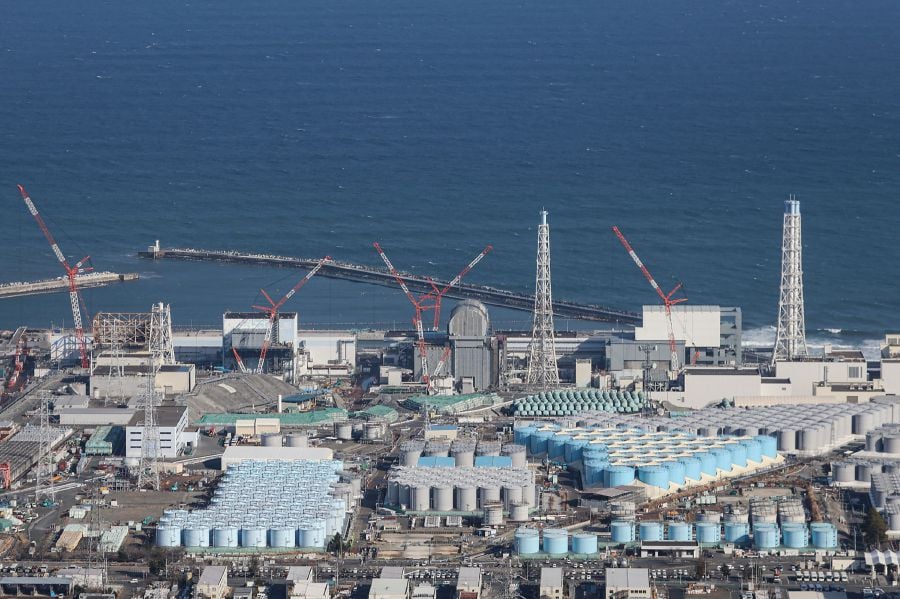
The first tests, during which remotely operated underwater robots were launched into the containment structure, were unsuccessful……… The extremely high levels of radiation (650 Sv/h) would destroy the vehicles’ electronic circuits in minutes. A person would die in seconds in such conditions..
Peta Pixel NOV 26, 2023, ARKADIUSZ PODNIESIŃSKI
This article has copious photographs. They are not very interesting, as the photographer was banned from photographing the seriously dangerous parts of place
For more than a dozen years, I have been documenting the aftermath of the disasters at the Chornobyl and Fukushima nuclear power plants, the progress of the cleanup, and the decontamination and revitalization of the contaminated areas. During this time, I made many visits to the Chornobyl plant. Finally, it was time to visit the Fukushima plant………………
Given my critical attitude towards nuclear power, as demonstrated by my published album about the tragic consequences of the two disasters as well as my photographs and films that have been shown around the world, obtaining permission was not easy or straightforward. However, after several months of trying and dozens of emails and phone calls, I finally managed to get approval.
Interestingly, I was told no photographer before me had ever had such an extensive itinerary for a visit. Despite this, I hope that my two-day visit will not be the last. The decommissioning of the power plant is a process that will take several decades, so I hope there will be more than one opportunity to return.
……………………………..nowhere else in the world have I seen so many workers guarding the exits of underground garages, building sites and intersections, or thousands of flashing bollards shaped like frogs, mice, and other animals.
..For security reasons, taking pictures of many places is prohibited……………………………………..
Similarities or Differences
Only when I’m standing in front of the damaged units do I grasp the scale of the tragedy and destruction. The first unit has no roof, as it was destroyed by a hydrogen explosion. Only the jagged remnants of the steel skeleton now protrude from it. There is less external damage to the second unit, but inside the meltdown of the reactor core produced a similar effect. When I look at the exposed roof of the first reactor building, comparisons to Chornobyl automatically come to mind.
Units 3 and 4 have already been covered with new structures that are intended to strengthen their substructures and enable the removal of the spent fuel inside. Probably to avoid comparisons with Chornobyl, these are not called sarcophagi, but they serve an identical purpose – they reinforce the damaged buildings, prevent radioactive substances from escaping, and serve or will be used to extract the fuel inside. At Chornobyl, one reactor was damaged, while at Fukushima it was as many as three.
On the one hand, in Chornobyl, the areas around the nuclear power plant are still closed 37 years later. The damaged reactor has already been covered by a second sarcophagus and the removal of the fuel inside of it is still a subject of debate. On the other hand, in Japan, after 12 years most of the areas around the plant have already been cleaned and returned to their residents.
The process of removing the fuel from the damaged reactors is expected to begin in 2024. This very complex and dangerous task will be divided into two separate phases. The first involves removing the melted fuel from the damaged reactors, while the second consists of removing the spent fuel stored in the spent fuel pools. Fuel remains in the first two units as debris is still being cleaned up and other obstacles blocking access to the interior are being removed. The next two units are in much better condition: the spent fuel has already been removed from the pools, and only one of them has had a nuclear core meltdown.
After a while, we drive up to the reactor buildings themselves. Standing next to the vertical walls of the structure, I realize their magnitude. For obvious reasons, I can’t go inside any of them. It’s a red zone, where the damage is greatest, and the radiation levels are deadly high.
Inside of Primary Containment Vessel
I also visit Units 5 and 6, which sustained less damage. They were shut down when the earthquake and tsunami hit, although there was still nuclear fuel in the reactors and spent fuel pools the entire time. Due to the power outages and the cessation of the cooling processes, they did not operate properly and had to be monitored constantly. After the damage was repaired and cooling restored, the remaining fuel in the reactors was moved to a spent fuel pool several floors above. Besides having the chance to take photos, visiting these units is an excellent opportunity for me to better understand how the disaster unfolded and the work to clean up the resulting damage, particularly the melted fuel from inside the reactors.
In Unit 5, I enter the safety enclosure known as the PCV (Primary Containment Vessel) that houses the reactor. This is already a yellow – more radioactive – zone, so once again I must change my clothes. The safety enclosure is shaped like a huge steel pear, more than 30 meters high. Inside it is the reactor, which is surrounded by hundreds of pipes, valves, and pumps. I squeeze between them and come to a small opening in the wall. This leads to a tiny room where the control rod drive hydraulic system is located.
The room is cramped and not even a meter high – definitely not a place for people who have claustrophobia. The reactor is just a few meters above me. It is identical to the ones whose cores melted down due to the power outages and lack of cooling. Under the extreme heat, their uranium fuel rods melted like candle wax and dripped to the bottom of the reactor casing. The hot mass then burned through the steel walls and seeped into the bottom of the containment enclosure, exactly where I stand now.
Because of these similarities, Unit 5 is currently being used to test various methods of removing fuel from damaged reactors. The first tests, during which remotely operated underwater robots were launched into the containment structure, were unsuccessful. More often than not, they got stuck while maneuvering underwater amid piles of debris, cables, and rusted structures. The extremely high levels of radiation (650 Sv/h) would destroy the vehicles’ electronic circuits in minutes. A person would die in seconds in such conditions………………………………
According to a report by the Japanese Atomic Energy Commission – not disclosed to the public for fear of causing panic – in the event that the situation went completely out of control and the direction of the wind changed, there would have been so much contamination that it would have necessitated the evacuation of the 50 million people living within a 250 km radius of the plant, an area that includes Tokyo. Thus, the fact that the worst-case scenario was avoided is not only due to the superhuman efforts of hundreds of power plant workers, firefighters, and other emergency responders, but also to chance or, if you prefer, luck.
Although the danger was averted, fuel remains in the spent fuel pools in Units 1 and 2 (the most damaged ones) as well as in Units 5 and 6. I was allowed to enter the last of these. It stores over 1,600 fuel assemblies………………………………………………………………………………………………………………………………………………………………………………………..more https://petapixel.com/2023/11/26/a-photographer-goes-inside-the-ruins-of-the-fukushima-nuclear-power-plant/
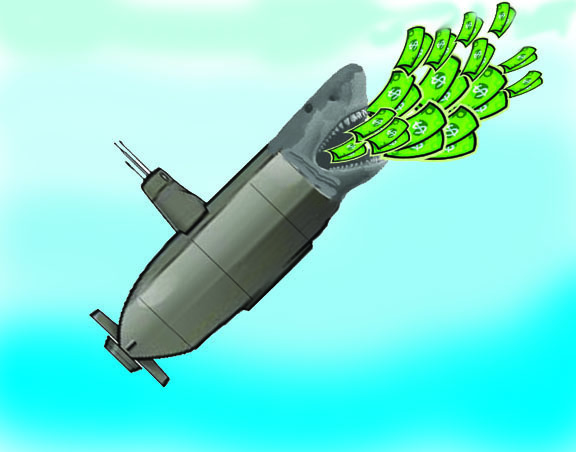
South Korea does not need nuclear subs
The Hill BY DOV S. ZAKHEIM, OPINION CONTRIBUTOR – 11/24/23
South Korea is again debating whether to develop and build a nuclear-powered submarine.
During a National Assembly confirmation hearing that took place last week, Admiral Kim Myung-Soo, the nominee for chairman of South Korea’s Joint Chiefs of Staff, responded positively to a question about the utility of nuclear-powered submarines, stating that “those capabilities are needed.” He noted, however, that the current U.S.-Korean nuclear agreement restricts the use of nuclear materials for military purposes.
Nevertheless, there appears to be a growing sentiment on the part of both of South Korea’s leading parties and the general public in favor of Seoul acquiring nuclear-powered boats. The government should resist the temptation to do so.
In theory, South Korea could avoid America’s restrictions by turning to France to help it develop or acquire a nuclear-powered submarine. France could help South Korea develop its own nuclear-powered sub, much as Paris has assisted Brazil with its own nuclear-powered submarine program.
However, there are many reasons why Seoul should not imitate the Brazilians and forge ahead with its own program. To begin with, it was only in April of this year that President Biden and South Korean president Yoon Suk Yeol reached an agreement that not only calls for greater consultation on nuclear matters between the two countries, in the form of a newly created nuclear consultative group, but also provides for an enhanced American nuclear presence around the peninsula to deter North Korean aggression…………………………………………………..
In any event, it is not clear how Seoul could afford to undertake a nuclear-submarine program unless it were to dramatically increase its defense spending beyond current levels…………………………………
…………………… Lastly, there are good operational reasons why South Korea should continue to acquire conventionally powered submarines rather than nuclear powered boats. The waters around the Korean peninsula are relatively shallow, which favors the employment of quiet conventional subs. South Korea now operates seven Son–Won II–class diesel-electric submarines, powered by a hybrid diesel‐electric/fuel cell with air-independent propulsion technology. These subs are extremely quiet; they can travel up to 20 knots when submerged and remain under water for seven weeks. They are perfectly suited for operations around the Korean Peninsula.
The South is currently planning both to upgrade the Son-Won II for about $100 million per boat and is proceeding with a new Son-Won III class at about $900 million per submarine. In other words, the country could acquire three state-of-the-art conventional submarines for less than the cost of one nuclear-powered sub.
The costs, the technologies, and operational realities all weigh against South Korea acquiring nuclear-powered submarines. If that were not enough, America’s recent commitment to bolster the nuclear umbrella that it has long provided to South Korea and that is so critical to its deterrent should settle the argument once and for all.
Dov S. Zakheim is a senior adviser at the Center for Strategic and International Studies and vice chairman of the board for the Foreign Policy Research Institute. He was undersecretary of Defense (comptroller) and chief financial officer for the Department of Defense from 2001 to 2004 and a deputy undersecretary of Defense from 1985 to 1987. https://thehill.com/opinion/international/4324038-south-korea-does-not-need-nuclear-subs/
In softening on China, the West may be trying to avoid a nuclear arms race
SCMP, Bob Savic 26 Nov 23
Why the West is suddenly softening on China: power grows out of nuclear warheads
- Weeks before Xi Jinping met various leaders in San Francisco, the US released an estimate of China’s nuclear stockpile
- Now, the EU and UK seem to be holding out an olive branch to China, especially with the surprise appointment of David Cameron as foreign secretary
In a much-publicised report issued on October 19, the US Department of Defence estimated China’s stock of operational nuclear warheads to be at 500, and exceeding 1,000 by 2030. This contrasts with its 2020 report that estimated a stockpile “in the low-200s”, which would grow to about 400 by the end of the decade.
Beijing has consistently dismissed these reports, asserting they are used to serve Washington’s strategic interest of portraying China as a threat to global security.
Irrespective of whether the reports are accurate or fictional, the West has probably decided to err on the side of caution and accept the findings. There has been a discernible shift as Western governments actively seek areas of mutual cooperation with Beijing.
Ultimately, this turn of events probably reflects Western concern over a nuclear arms race fuelled by dangerously destabilising great-power rivalry between China and the United States, at a time when the West is grappling with so-called fatigue in its conflict with Russia over Ukraine.
Further, there is the Israel-Hamas conflict in Gaza. The major Western powers’ failure to back a non-binding UN resolution calling for a truce, which was supported by China and the vast majority of non-Western states, has opened a yawning rift between the West and the Global South.
In any case, one cannot rule out both factors in the West’s approach to China. The most high-profile rapprochement with China was clearly reached when Chinese President Xi Jinping met US President Joe Biden on the sidelines of the Apec summit in San Francisco.
After a year of hyper-tense relations between Beijing and Washington – over then US House speaker Nancy Pelosi’s visit to Taiwan and the Chinese “spy balloon” over mainland America – the Biden administration’s four-hour talks with Xi and senior Chinese officials signified a new strategy of constructive engagement.
As widely reported, the meeting concluded with an agreement to resume military-to-military communications, deemed vital in the context of increasingly knife-edge naval and air activities, by both sides, in the Taiwan Strait and South China Sea.
Also on the sidelines of the Asia-Pacific Economic Cooperation summit in San Francisco, Xi held talks with Japan’s Prime Minister Fumio Kishida for the first time in a year…………………………………………………………………….
Other leaders, further afield, may also be seeking to offer Beijing an olive branch. In early November, European Commission President Ursula von der Leyen said a summit with the Chinese government would take place in China in December, the first in-person European Union-China summit in four years………………
Lastly, and in an even greater surprise, was the appointment of Britain’s former prime minister David Cameron as the new foreign secretary on November 13. There has been much speculation about why the current British prime minister, Rishi Sunak, would bring Cameron back into the cabinet after he spent several years outside politics.
Among those reasons is likely to be that Cameron made high-level international contact when in office, not the least of which was crafting the “golden era” of relations with China, even having a pint of beer with Xi at a British pub…………………………………..
the new Pentagon report on China’s substantial upscaling of its nuclear stockpile, no matter whether it is accurate or not, may have been all that was necessary to prompt Western decision-makers to act swiftly, and in concert, thus averting any escalation of geopolitical tensions that might imperil the West’s still dominant global position. https://www.scmp.com/comment/opinion/article/3242540/why-west-suddenly-softening-china-power-grows-out-nuclear-warheads
Japanese and Chinese top envoys eye more talks on Fukushima row
Jsapan Times, BY JESSE JOHNSON, STAFF WRITER 26 Nov 23
Foreign Minister Yoko Kamikawa met her Chinese counterpart, Wang Yi, on Saturday, with the top Japanese diplomat “strongly urging” Beijing to immediately remove its complete ban on seafood imports from Japan over Tokyo’s release of treated wastewater from the Fukushima No. 1 nuclear plant.
The Fukushima issue has bedeviled Sino-Japanese relations already facing tensions over issues such as China’s growing military assertiveness in the region. Despite this, both sides agreed to find a way to resolve the wastewater matter “through discussion and dialogue in a constructive manner,” Japan’s Foreign Ministry said.
Wang repeated China’s opposition to the discharge of “nuclear-contaminated water,” a move that he labeled as “irresponsible,” according to the Chinese Foreign Ministry.
The two top diplomats also agreed to hold bilateral security talks “at an early date,”…………………………………………………………………………………………….
On Thursday, Wang met with Natsuo Yamaguchi, head of Komeito, the Liberal Democratic Party’s coalition partner in the ruling bloc, for talks in Beijing. China called for independent monitoring of the ongoing Fukushima discharge, according to Yamaguchi.
China’s seafood ban has hit Japanese exporters hard, with Chinese customs authorities reporting last week that imports of fish and shellfish from Japan in October dropped 99% from a year earlier to $332,000. https://www.japantimes.co.jp/news/2023/11/25/japan/politics/japan-china-yoko-kamikawa-wang-yi/
Malaysian Govt urged to halt Australian company Lynas’ thorium extraction plan

https://www.thestar.com.my/news/nation/2023/11/24/govt-urged-to-halt-lynas-thorium-extraction-plan
SEVERAL DAP lawmakers have urged the government to review Lynas Malaysia’s license and stop the plan for thorium extraction from the waste produced at the factory of the rare earth producer.Chow Yu Hui (PH-Raub) said that he remains unconvinced that Lynas Malaysia was capable of extracting thorium.
“Let us not forget that the amount of waste from the Lynas plant was as large as five hills behind its factory. Will the new thorium extraction technology and Lynas be able to manage the radioactive waste which is expected to reach 1.2 million metric tonnes?” he asked reporters at the parliament media centre yesterday.
Oct 24, Science, Technology and Innovation Minister Chang Lih Kang announced that Lynas Malaysia would be allowed to import lanthanide concentrates until its licence expires in March 2026.
He also said that the Atomic Energy Licensing Board (AELB) decided to amend Lynas Malaysia’s license conditions after the company made a proposal to the licensing board about its thorium extraction technology.
With this, Chang said radioactive waste will not be produced after extraction and cracking and leaching activities are carried out on the lanthanide concentrate.
Khoo Poay Tiong (PH-Kota Melaka) said the Science, Technology and Innovation Ministry had announced on May 10 regarding the renewal of Lynas Malaysia’s license until Dec 31.
However, Khoo said that within a period of five months, the government, via AELB, had reviewed Lynas’ licence conditions.
“This matter has raised many concerns regarding the radioactive pollution and safety of locals,” said Khoo, who also wanted to know the parties that came up with the idea of thorium extraction.“We also want clarification from the government on what the possible market for thorium is,” he said.
Tan Hong Pin (PH-Bakri) also pointed out that thorium extraction technology was still in its initial phases, even at the international level.
“To what extent can thorium be extracted, used and commercially extracted? What are the effective measures that can be taken by the government to address the issue and ensure that Lynas will adhere to all the international standards in managing radioactive waste?” asked Tan.
On Nov 16, Chang promised that AELB will closely monitor the thorium extraction process from Lynas Malaysia’s waste material.
Japan’s Fukushima plant completes third water release

Canberra Times By Mari Yamaguchi, November 20 2023 – Australian Associated Press
The release of a third batch of treated radioactive wastewater from Japan’s damaged Fukushima nuclear plant into the Pacific Ocean ended safely as planned, its operator says, as the country’s seafood producers continue to suffer from a Chinese import ban imposed after the discharges began.
Large amounts of radioactive wastewater have accumulated at the nuclear plant since it was damaged by a massive earthquake and tsunami in 2011.
It began discharging treated and diluted wastewater into the ocean on August 24 and finished releasing the third 7800-ton batch on Monday.
The process is expected to take decades.
The discharges have been strongly opposed by fishing groups and neighbouring countries including China, which banned all imports of Japanese seafood, badly hurting Japanese producers and exporters of scallops and other seafood……………………………………………………
Japan’s government has set up a relief fund to help find new markets for Japanese seafood, and the central and local governments have led campaigns to encourage Japanese consumers to eat more fish and support Fukushima seafood producers.
TEPCO is also providing compensation to the fisheries industry for “reputational damage” to its products caused by the wastewater release and said it has mailed application forms to 580 possible compensation seekers…………………………..
TEPCO and the government say the process is safe, but some scientists say the continuing release of water containing radionuclides from damaged reactors is unprecedented and should be monitored closely.
Monday’s completion of the release of the third batch of wastewater brings the total to 23,400 tons.
TEPCO plans a fourth release by the end of March 2024.
That would only empty about 10 of the approximately 1000 storage tanks at the Fukushima plant because of its continued production of wastewater, although officials say the pace of the discharges will pick up later.

The tanks currently hold more than 1.3 million tons of wastewater, most of which needs to be retreated to meet safety standards before release.
TEPCO and the government say discharging the water into the sea is unavoidable because the tanks need to be removed from the grounds of the plant so that it can be decommissioned. https://www.canberratimes.com.au/story/8430646/japans-fukushima-plant-completes-third-water-release/
1 This Month


10 March A LIVE WEBINAR THE REAL EFFECTS OF NUCLEAR POWER
What the Industry Isn’t Telling Us
1:00 PM Mountain, 2 pm Central, 3 pm Eastern. Live on the Keepers of the Water Facebook page


18 March Webinar @ 1 PM EST: An Assessment of SMR Projects: The Case of Canada
register for the zoom:
https://us02web.zoom.us/webinar/register/WN_o8BIIOUvQ2ONJR1nta65DQ#/registration


of the week – STOP SMALL MODULAR REACTORS IN CANADA
To see nuclear-related stories in greater depth and intensity – go to https://nuclearinformation.wordpress.com
-
Archives
- March 2026 (64)
- February 2026 (268)
- January 2026 (308)
- December 2025 (358)
- November 2025 (359)
- October 2025 (376)
- September 2025 (258)
- August 2025 (319)
- July 2025 (230)
- June 2025 (348)
- May 2025 (261)
- April 2025 (305)
-
Categories
- 1
- 1 NUCLEAR ISSUES
- business and costs
- climate change
- culture and arts
- ENERGY
- environment
- health
- history
- indigenous issues
- Legal
- marketing of nuclear
- media
- opposition to nuclear
- PERSONAL STORIES
- politics
- politics international
- Religion and ethics
- safety
- secrets,lies and civil liberties
- spinbuster
- technology
- Uranium
- wastes
- weapons and war
- Women
- 2 WORLD
- ACTION
- AFRICA
- Atrocities
- AUSTRALIA
- Christina's notes
- Christina's themes
- culture and arts
- Events
- Fuk 2022
- Fuk 2023
- Fukushima 2017
- Fukushima 2018
- fukushima 2019
- Fukushima 2020
- Fukushima 2021
- general
- global warming
- Humour (God we need it)
- Nuclear
- RARE EARTHS
- Reference
- resources – print
- Resources -audiovicual
- Weekly Newsletter
- World
- World Nuclear
- YouTube
-
RSS
Entries RSS
Comments RSS
 nuclear-news