Corrosion found in treated radioactive water tanks at Fukushima plant
Apr. 21 , https://japantoday.com/category/national/corrosion-found-in-treated-radioactive-water-tanks-at-fukushima-plantTOKYO
Corrosion has been found on the inside of tanks used to store treated radioactive water at the crippled Fukushima Daiichi nuclear power plant, its operator has revealed.
Tokyo Electric Power Company Holdings Inc said there are no problems with the strength of the tanks, but added that some of the more than 1,000 containers at the plant were installed over 10 years ago and have aged over time.
A TEPCO official said the operator will continue to inspect the tanks.
The firm began releasing the treated water containing tritium from the plant into the Pacific Ocean in August 2023 despite backlash from local fisheries and China.
In March, corrosion and peeling paint were spotted in three empty tanks that have been in use since 2016 at the plant, which suffered meltdowns following the devastating earthquake and ensuing tsunami in March 2011.
As it is impossible to check the inside of tanks currently containing treated water, other than with the use of underwater robots, TEPCO conducts annual exterior inspections to detect any abnormalities.
Tanks that have been used for more than 10 years also have the thickness of their steel plates measured using ultrasonic waves to assess their strength, TEPCO said.
The Japanese government and TEPCO have said that the treated water released from the Fukushima plant is diluted to reduce the levels of tritium to less than one-40th of the country’s national safety standards.
Japan starts 5th ocean discharge of Fukushima nuclear-tainted wastewater despite opposition

(Xinhua) Web editor: Zhang Kaiwei, Liang Jun, April 19, 2024
TOKYO, April 19 (Xinhua) — Japan on Friday started the fifth-round of release of nuclear-contaminated wastewater from the crippled Fukushima Daiichi Nuclear Power Plant into the Pacific Ocean.
Despite opposition among local fishermen, residents as well as backlash from the international community, Tokyo Electric Power Company (TEPCO), the plant’s operator, started discharging the radioactive wastewater in the morning, the first round in fiscal 2024.
Similar to the previous four rounds, about 7,800 tons of the wastewater, which still contains tritium, a radioactive substance, will be discharged until May 7.
TEPCO analyzed the water stored in the tank scheduled for release, and found that the concentrations of all radioactive substances other than tritium were below the national release standards, while the concentration of tritium that cannot be removed will be diluted with seawater, Japanese newspaper Asahi Shimbun reported.
TEPCO will measure the concentration of radioactive substances such as tritium in the surrounding waters every day during the period to investigate the effects of the release, it added.
The Fukushima nuclear-contaminated water release began in August 2023, and a total of about 31,200 tons of the water was released in four rounds in fiscal 2023, which ended in March.
In fiscal 2024, TEPCO plans to discharge a total of 54,600 tons of contaminated water in seven rounds, which contains approximately 14 trillion becquerels of tritium.
Nuke authorities approve loading fuel at Niigata nuclear plant
THE ASAHI SHIMBUN, April 15, 2024 https://www.asahi.com/ajw/articles/15229991
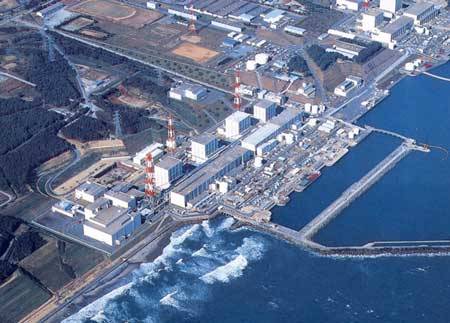
KASHIWAZAKI, Niigata Prefecture–The Nuclear Regulation Authority gave the go-ahead on April 15 to loading nuclear fuel into a reactor at the long-idled Kashiwazaki-Kariwa nuclear power plant here.
The approval is an important step toward restarting the plant, which has remained offline for more than a decade.
Plant operator Tokyo Electric Power Co. will start loading 872 fuel assemblies into the plant’s No. 7 reactor at around 4 p.m. The loading process is expected to take a couple of weeks to complete.
The reactor will then undergo a series of safety inspections before regulatory approval for a restart is granted.
In 2017, the reactor passed new safety regulatory standards mandated following the 2011 nuclear disaster at TEPCO’s Fukushima No. 1 nuclear power plant.
However, regulators suspended the restart process in 2021 due to deficiencies in the plant’s anti-terrorism measures. The NRA eventually approved the plant’s upgraded security measures in December last year.
Despite progress toward restarting the reactor, the governor of Niigata Prefecture has not yet granted his consent. Local communities remain divided, with ongoing debate and concerns regarding the plant.
‘Pakistan advanced nuclear weapons programme despite economic challenges’
Pakistan is reported to have 170 nuclear warheads as of January 2023
By: Pramod Thomas, 17 Apr 24, https://www.easterneye.biz/pakistan-nuclear-programme-india-us/
DESPITE economic challenges, Pakistan continued upgrading its nuclear capabilities, driven by its ongoing tensions with India, top US intelligence official told Congress.
The remarks by Lt Gen Jeffrey Kruse, director of the Defence Intelligence Agency came during a Congressional hearing on China on Monday (15).
Kruse told lawmakers that Pakistan has sought international support, including from the UN security council, to resolve its dispute with India about Kashmir.
Separately, Islamabad and New Delhi have maintained an uneasy ceasefire along the shared Line of Control since February 2021, he said.
“Pakistan has sustained its nuclear modernisation efforts despite its economic turmoil. Terrorist violence against Pakistani security forces and civilians also rose last year,” he said.
According to the Stockholm International Peace Research Institute, Pakistan is reported to have 170 nuclear warheads as of January 2023.
Cash-strapped Pakistan is banking on close allies like China and Saudi Arabia for loans to tide over its economic woes. Moreover, Pakistan’s finance minister Muhammad Aurangzeb is now in Washington to discuss a new loan package with the International Monetary Fund.
Pakistan’s contentious relationship with India continues to drive its defence policy, Kruse told US lawmakers.
However, cross-border violence between the countries has decreased since their February 2021 recommitment to a ceasefire, he said.
“Islamabad is modernising its nuclear arsenal and improving the security of its nuclear materials and nuclear C2 (command and control). In October, Pakistan successfully tested its Ababeel medium-range ballistic missile,” he said.
In 2023, militants killed around 400 security forces, a nine-year high, and Pakistani security forces have conducted almost daily counterterrorism operations during the past year.
Islamabad and New Delhi have a long history of strained relations, primarily due to the Kashmir issue as well as the cross-border terrorism emanating from Pakistan.
In 2019, Pakistan downgraded its diplomatic ties with New Delhi after the Indian government abrogated Article 370 of the constitution, revoking the special status of Jammu and Kashmir and bifurcating the state into two union territories.
India has been maintaining that it desires normal neighbourly relations with Pakistan while insisting that the onus is on Islamabad to create an environment that is free of terror and hostility for such an engagement.
New Delhi has also asserted that the constitutional measures taken by the Indian government to ensure socio-economic development and good governance in the Union Territory of Jammu and Kashmir are matters internal to India.
The short march to China’s hydrogen bomb
Bulletin, April 11, 2024. (very lengthy historic and technical detail. Good graphics)
On December 28, 1966, China successfully conducted its first hydrogen bomb test—only two years and two months after the successful explosion of its first atomic bomb. In so doing, China became the fastest among the five initial nuclear-weapon states (the United States, Russia, China, the United Kingdom, and France, collectively known as P5) to pass from its first atomic bomb explosion to a first hydrogen bomb detonation.
There is still very limited knowledge in Western literature about how China built its first H-bomb. Based on newly available information—including Chinese blogs, memoirs, and other publicly available publications—this account reconstructs the history of how China made a breakthrough in understanding hydrogen bomb principles and built its first H-bomb—without foreign help.
Beyond the previously untold story of China’s early exploration of the hydrogen bomb theory, the article also explores in detail the so-called “100 days in Shanghai”—a milestone of China’s hydrogen bomb development—and describes the efforts that led to a series of three nuclear tests that happened in 1966 and 1967 and that are often called “the trilogy” of the H-bomb development in China.
Early explorations
Moscow’s broken promise
China officially started its nuclear weapon program on January 15, 1955.[1] About two years later, China and the Soviet Union signed the New Defense Technical Accord in Moscow. Under that agreement, Moscow would provide Beijing with a prototype of an atomic bomb model and relevant technical materials. In June 1959, however, as many major relevant facilities in the Chinese nuclear weapon program were at the peak of construction, Soviet-Sino relations deteriorated,[2] and Moscow sent a letter to Beijing formally announcing it would not provide the promised model and data. From the second half of 1959 onward, the Second Ministry of Machine Building Industry—China’s government ministry overseeing the nuclear industry—followed central government policy and relied on the country’s own capabilities to complete the task of developing the atomic bomb.[3]
In early 1960, the weaponeers of the Beijing institute of nuclear weapon research—called the Ninth Institute and placed under the leadership of the Second Ministry[4]—started to explore atomic bomb science and technology. As those weaponeers started working hard on the atomic bomb program, then-Minister of the Second Ministry Liu Jie began considering ways to conduct the nation’s hydrogen bomb development. ……………………………………………………………………………………………………………………………………………………………………………………………………………………………
On January 7, 1965, Liu Jie delivered a speech at the meeting of the Second Ministry, conveying Mao’s new instructions to the audience: “If we have hydrogen bombs and missiles, wars may not be fought, and peace will be more secure. We make the atomic bombs but will not be too many. It will be used to scare [enemies] and embolden [ourselves].” Mao also said that “it still needs three years to have the hydrogen bomb, which is too slow.” [23]
……………………………………… On February 3, 1965, the Second Ministry set the goal of testing the first hydrogen bomb device in 1968.[25]………………………………………………
…………………From February 1965 onward, the weaponeers tried different routes and proposed different ideas, but none was successful. ………………………………………………………………………
Gathering in Shanghai
In late September 1965, Yu Min and over 50 researchers gathered in Shanghai for what may have been the most intense period in the development of the hydrogen bomb………………….
……………………………….For nearly 100 days—and nights—all the physicists, mathematicians, and research assistants gathered in Shanghai would arrange shifts and take turns in the computer room around the clock to solve problems.[43]
…………………………………………………………………………….The group in Shanghai also continued the optimization design work of the boosted three-phase hydrogen aerial bomb.
Finally, in early January 1966, the researchers returned to Beijing with the new hydrogen bomb principle they had sought so hard for nearly 100 days and nights in Shanghai.
Testing the Bomb
………………………………………………..A new two-year plan included preparations for three nuclear tests that aimed for a breakthrough in confirming the H-bomb principle.
………………………….Low-yield hydrogen bomb (device 629).………………………………………………………………………………………………On December 28, 1966, the hydrogen bomb device 629-1 successfully exploded.[70]
………………..Third test: Full-yield hydrogen bomb (device 639)
…………………………………………………………………………………………..On June 17, 1967, China successfully conducted its first hydrogen bomb (device 639) air-burst test, which was coded operation 21-73……………………………..
more https://thebulletin.org/2024/04/the-short-march-to-chinas-hydrogen-bomb/?utm_source=Newsletter&utm_medium=Email&utm_campaign=MondayNewsletter04152024&utm_content=NuclearRisk_ChinaHydrogenBomb_04112024
First Images Inside Fukushima’s Nuclear Reactor Show “Icicle-Like”Structures
First Images Inside Fukushima’s Nuclear Reactor Show “Icicle-Like”
Structures. Many robots have ventured into the ruins of Fukushima, but few
have returned.
A snake-like robot and mini drones have ventured deep inside
the irradiated reactor of the Fukushima Daiichi Nuclear Power Station in
Japan.
As shown in their new images, the clean-up operations still have
some way to go 13 years after the catastrophic nuclear meltdown. In their
latest step to clean up the area, TEPCO sent robotic probes in the bowels
of this reactor to examine the core and its melted nuclear fuel. Their aim
is to learn about the condition of the spent fuel to facilitate its removal
so the plant can be decommissioned. It marks the first time they’ve managed
to return with images from inside the “pedestal” of reactor Unit 1.
IFL Science 9th April 2024
There Is No Grudge That Cannot Be Resolved, China’s Xi Jinping Tells Former Taiwan President Ma Ying-jeou in Momentous Beijing Meeting
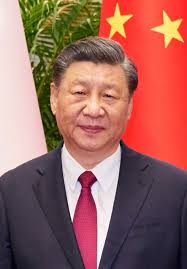
“[There is] [n]o problem that cannot be talked through. And there are no forces that can separate us,” Xi Jinping said.
By Diego Ramos ScheerPost, https://scheerpost.com/2024/04/10/there-is-no-grudge-that-cannot-be-resolved-chinas-xi-jinping-tells-former-taiwan-president-ma-ying-jeou-in-momentous-beijing-meeting/
In a historic meeting marking mainland China’s first reception of a former or serving Taiwanese president, President Xi Jinping and former Taiwanese president Ma Ying-jeou engaged in a dialogue of peace and unity in Beijing on April 10.
Amidst heightened tensions between China and Taiwan, mentions of war are commonplace but according to Ma, “If there’s war, it would be unbearable to the Chinese nation, and the two sides of the [Taiwan] strait have the wisdom to handle their disputes peacefully.”
This echoes Xi’s assertion that the two governments can converse and resolve issues: “Compatriots on the two sides are both Chinese. There is no grudge that cannot be resolved. No problem that cannot be talked through. And there are no forces that can separate us.”
Xi, alluding to reunification, also made reference to “foreign interference,” which, according to him, could not get in the way of a “family reunion.”
The meeting comes a month before William Lai Ching-te, current Taiwanese vice president and president-elect, is set to step into office. Despite being part of the independence-favoring Democratic Progressive Party, the South China Morning Post (SCMP) reports that Beijing does not see significance in the party’s electoral victory.
Zhu Songling, a Taiwan affairs specialist at Beijing Union University, told SCMP that the talks came at a favorable time, citing president-elect Lai’s approaching inauguration. Songling also said Ma’s reception in Beijing signaled the Chinese government’s willingness and resolve to peacefully settle the cross-strait issues.
“Since Ma is not in office, many of his ideas may not be implemented in concrete terms, but in general this [meeting] is still of great significance,” Zhu said, mentioning Ma’s continued influence in the Beijing-friendly Kuomintang (KMT) party.
Towards the end of Ma’s “journey of peace,” another KMT leader, former mayor of Taipei Hau Lung-bin, also plans to visit mainland China, with the possibility of meeting with Xi as well.
Hau is set to visit Zhengzhou and take part in the annual cultural spectacle that pays tribute to the Yellow Emperor. The tribute honors Chinese ancestry and heritage and Hau said his visit “emphasise[s] the fact that the people from both sides of the Taiwan Strait share the same root, the same origin, and the same historical and cultural backgrounds, which should go beyond political differences.”
“It would be unreasonable for the cross-strait relations to end up in a military crisis or dangerous war caused by political manipulation,” Hau also mentioned.
US, Philippines, Japan, and Australia Conduct First Joint Military Exercise in South China Sea
China launched patrols in the South China Sea in response
by Dave DeCamp April 7, 2024
https://news.antiwar.com/2024/04/07/us-philippines-japan-and-australia-conduct-first-joint-military-exercise-in-south-china-sea/
The US, Japan, the Philippines, and Australia conducted joint military exercises in the South China Sea on Sunday in a provocative show of force aimed at China.
According to Japan’s Kyodo News, the drills marked the first “full-scale exercise” between the four nations. The US has been looking to increase military cooperation between its treaty allies in the region as part of its military build-up to prepare for a future war with China.
The four countries released a joint statement that made clear the drills were meant to push back on China’s claims to the South China Sea. “We stand with all nations in safeguarding the international order based on the rule of law that is the foundation for a peaceful and stable Indo-Pacific region,” the statement said.
According to The South China Morning Post, the drills included two Philippine vessels, one American ship, one Australian ship, and a Japanese ship and focused on anti-submarine warfare training, tactical exercises, and photo exercises.
China launched patrols in the South China Sea on the same day in what appeared to be a response to the drill. “The Southern Theatre Command of the People’s Liberation Army will conduct a joint air and sea combat patrol in the South China Sea on April 7,” the Chinese military’s Southern Theater Command said.
The joint drills come as tensions are soaring between China and the Philippines over disputed rocks and reefs in the South China Sea. Chinese and Philippine vessels frequently have tense encounters in the waters, which often end in collision. In the most recent incident, a Chinese vessel fired a water cannon at a Philippine supply boat, injuring several crew members.
The incidents in the South China Sea could potentially spark a major war as the US has repeatedly affirmed that the US-Philippine Mutual Defense Treaty applies to attacks on Philippine vessels in the disputed waters.
President Biden is hosting Philippine President Ferdinand Marcos Jr. and Japanese Prime Minister Fumio Kishida in Washington this Thursday for the first-ever trilateral summit between the three nations. They’re expected to announce the launch of regular joint patrols in the South China Sea.
TEPCO plans new installations at Fukushima nuclear plant, to deal with radioactive leakage
In the wake of recent contaminated water leakage at Japan’s Fukushima
Daiichi Nuclear Power Plant, the plant’s operator Tokyo Electric Power
Company (TEPCO) has announced its plan for new installations as a
preventive measure, local media reported.
TEPCO is expected to install new
piping and ventilation ports designed to guide any spewing liquid to fall
within the building, thereby containing the spread of contamination,
national news agency Kyodo reported, citing the company’s announcement on
Friday. The construction is slated to commence on Monday and is expected to
be completed by the end of the month, according to the operator.
CGTN 6th April 2024
China’s quiet energy revolution: the switch from nuclear to renewable energy
By Derek Woolner and David Glynne Jones, Apr 6, 2024 https://johnmenadue.com/chinas-quiet-energy-revolution-the-switch-from-nuclear-to-renewable-energy/
There is now a policy dispute about the roles of nuclear and renewable energy in future Australian low emission energy systems. The experience of China over more than a decade provides compelling evidence on how this debate will be resolved. In December 2011 China’s National Energy Administration announced that China would make nuclear energy the foundation of its electricity generation system in the next “10 to 20 years”. Just over a decade later China has wound back those ambitious targets and reoriented its low emission energy strategy around the rapid deployment of renewable solar and wind energy at unprecedented rates.
Australia has seen a campaign against the use of renewable energy technologies and for the benefits of nuclear energy in developing Australia’s future low emission energy systems. The Federal Opposition has now adopted this position as their policy. The recent experience of China provides a compelling commentary on this decision.
In December 2011 China’s National Energy Administration (NEA) announced that China would make nuclear energy the foundation of its electricity generation system in the next “10 to 20 years”, adding as much as 300 gigawatts (GWe) of nuclear capacity over that period.
This was followed by a period of delay as China undertook a comprehensive review of nuclear safety in the aftermath of the Fukushima nuclear disaster.
Subsequently, moderated nuclear energy targets were established, aiming for a nuclear energy contribution of 15% of China’s total electricity generation by 2035, 20-25% by 2050 and 45% in the second half of the century.
However by 2023 it was becoming clear that China’s nuclear construction program was well behind schedule. The target for 2020 had not been achieved, and targets for subsequent 5-year plans were unlikely to be achieved.
In September 2023 the China Nuclear Energy Association (CNEA) reported that China was now aiming to achieve a nuclear energy contribution of 10% by 2035, increasing to around 18% by 2060.
The CNEA also indicated that ‘greenlighting’ of new construction would now be at the rate of 6-8 large nuclear power reactors per year – not the 10 per year previously targeted for 2020-2035 and beyond. This will result in new nuclear generation increasing by 60-80 terawatt-hours (TWh) annually.
Meanwhile the deployment of renewable energy (primarily solar and wind energy) was dramatically accelerated in 2023, with the installation of 217GWe of new solar capacity and 70GWe of new wind capacity.
This represents an increase of around 400TWh in annual low emission generation – the quantitative equivalent of 40 large nuclear power reactors, or four times the average annual output of the Three Gorges Dam hydroelectric system (the world’s largest power station).
In 2023 energy analysts started reporting that China was now expected to achieve or exceed its 2030 target of 1200GWe for the total installed capacity of solar and wind energy by 2025, and was now planning to triple the 2030 objective, to reach 3900GWe.
Previously China expected that its energy emissions would peak in 2030, but revised forecasts are now indicating that this could happen as early as 2024, 5-6 years ahead of target.
By the end of 2023 it was clear that nuclear energy was no longer going to be the foundation of China’s future electricity generation system, and that this task had shifted to renewable energy.
So what has happened? There’s no single answer, but two key factors appear to be at play.
The first is the emergence of renewable energy technologies at competitive scale and cost since 2011.
Between 2011 and 2022, the cost of solar PV modules declined by 85%, wind energy costs by 60-70%, and battery costs by 90%.
China now dominates the global production of solar PV panels, wind turbines and batteries, with costs expected to continue to decline significantly for the foreseeable future while performance improves.
The consequence is that renewable energy generation can now be deployed economically at rates five to eight times faster than nuclear energy, which is constrained by logistical and regulatory capability, safety, site availability and other factors.
The second is the slow delivery of new nuclear generation which contributed to continued ‘greenlighting’ of new coal-fired generation to underwrite energy security, as it became clear that deployment rates for new low emission electricity generation were insufficient to blunt demand from provincial governments for new coal-fired generators, even though many existing plants are operating at uneconomically low capacity factors
By 2035, under the original plan, combined nuclear, solar and wind generation would have been comparable to current coal generation but insufficient to meet significantly increased new electricity demand.
Under the new plans, combined solar, wind and nuclear generation is likely to match current coal generation and meet new demand, with solar and wind energy contributing around 85% of this low emission generation.
By 2030 another factor will come into play, with China’s battery giant CATL developing long duration utility battery systems that will provide dispatchable electricity from renewable sources at competitive or lower costs than either coal or nuclear generated electricity.
The central message here is that even in China – the world’s largest industrial economy and preeminent builder of advanced civil infrastructure in the 21st century – nuclear energy cannot compete with renewable energy to deliver low emission electricity generation at the deployment rates needed to meet mid-century emission targets.
1
M6.0 earthquake hits coast of Japan’s Fukushima: Japan Meteorological Agency
A magnitude-6.0 earthquake struck off the coast of Fukushima Prefecture in Japan on Thursday noon, said the Japan Meteorological Agency (JMA).
The quake hit at 12:16 local time at a depth of 40 kilometers, the JMA said.
No tsunami warnings have been issued and there’s no immediate information on damage or casualties.
Nuclear energy cannot lead the global energy transition
With nuclear energy, when things go wrong, they go very, very wrong
Masayoshi Iyoda, Campaigner in Japan for 350.org, 3 Apr 24, ore https://www.aljazeera.com/opinions/2024/4/3/nuclear-energy-cannot-lead-the-global-energy-transition
On March 11, 2011, a magnitude 9 earthquake and a subsequent 15-metre tsunami struck Japan, which triggered a nuclear disaster at TEPCO’s Fukushima Daiichi nuclear plant. Three of the six plant’s reactors were affected, resulting in meltdowns and the release of a significant amount of radioactive material into the environment.
Today, 13 years later, Japan is still experiencing the impacts of this disaster. Immediately after the earthquake struck, more than 160,000 people were evacuated. Of them, nearly 29,000 still remain displaced.
Disastrous health effects due to exposure to radioactivity are still a serious concern for many, and environmental impacts on land, water, agriculture, and fisheries are still visible. The cost of the damage, including victim compensation, has been astronomical; $7bn has been spent annually since 2011, and work continues.
Last year, Japan’s plan to start releasing more than a million tonnes of treated wastewater into the Pacific Ocean sparked anxiety and anger, including among community members who rely on fishing for their livelihoods, from Fukushima to Fiji.
Yet, Japan and the rest of the world appear not to have learned much from this devastating experience. On March 21, Belgium hosted the first Nuclear Energy Summit attended by high-level officials from across the globe, including Japanese Vice-Minister for Foreign Affairs Masahiro Komura. The event was meant to promote the development, expansion and funding of nuclear energy research and projects.

The summit came after more than 20 countries, including Japan, announced plans to triple nuclear energy capacity by 2050 at last year’s UN Climate Change Conference (COP28).
All of these developments go against growing evidence that nuclear energy is not an efficient and safe option for the energy transition away from fossil fuels.
Despite advancements in waste-storage technology, no foolproof method for handling nuclear waste has been devised and implemented yet. As nuclear power plants continue to create radioactive waste, the potential for leakage, accidents, and diversion to nuclear weapons still presents significant environmental, public health, and security risks.
Nuclear power is also the slowest low-carbon energy to deploy, is very costly and has the least impact in the short, medium and long term on decarbonising the energy mix. The latest Intergovernmental Panel on Climate Change (IPCC) report pointed out that nuclear energy’s potential and cost-effectiveness of emission reduction by 2030 was much smaller than that of solar and wind energy.
Large-scale energy technologies like nuclear power plants also require billions of dollars upfront, and take a decade to build due to stricter safety regulations. Even the deployment of small modular reactors (SMR) has a high price tag. Late last year, a flagship project by NuScale funded by the US government to the tune of hundreds of millions of dollars had to be abandoned due to rising costs.
In addition to that, according to a report released by Greenpeace in 2023, even in the most favourable scenario and with an equal investment amount, by 2050, the installation of a wind and solar power infrastructure would produce three times more cumulative electricity and emit four times less cumulative CO2 compared to a water nuclear reactor in the same period.
And the climate crisis is not just about CO2 emissions. It is about a whole range of environmental justice and democracy issues that need to be considered. And nuclear energy does not have a stellar record in this regard.
For instance, uranium mining – the initial step in nuclear energy production – has been linked to habitat destruction, soil and water contamination, and adverse health effects for communities near mining sites. The extraction and processing of uranium require vast amounts of energy, often derived from nonrenewable sources, further compromising the environmental credentials of nuclear power.
Nuclear energy also uses centralised technology, governance, and decision-making processes, concentrating the distribution of power in the hands of the few.
For an equitable energy transition, energy solutions need not only to be safe, but justly sourced and fairly implemented. While nuclear power plants require kilometres of pipelines, long-distance planning, and centralised management, the manufacturing and installation of solar panels and wind turbines is becoming more and more energy efficient and easier to deploy.
If implemented correctly, regulation and recycling programnes can address critical materials and end-of-life disposal concerns. Community-based solar and wind projects can create new jobs, stimulate local economies, and empower communities to take control of their energy future as opposed to contributing more money to the trillion-dollar fossil fuel industry.
Although the 2011 disaster in Fukushima may seem like a distant past, its effects today on the health of its environment, people and community are reminders that we must not be dangerously distracted with the so-called promises of nuclear energy.
We must not transition from one broken system to another.
Wealthy countries have an ethical historical responsibility to support global finance reform and provide ample funding for renewable energy in lower-income countries. To keep our world safe and fair, not only do we need to tax and phase out fossil fuels immediately, but it is essential that we power up with renewable energy, such as wind and solar, fast, widely, and equitably.
Fukushima City: 100 MW solar farm
4 Apr 24, https://www.pveurope.eu/solar-parks/japan-fukushima-city-100-mw-solar-farm—
Juwi Shizen Energy, the joint venture founded in 2013 between the German project developer Juwi and the Japanese developer of wind and solar parks Shizen Energy, has successfully connected the largest single project in its history to the grid in Fukushima City and has already handed it over to the operator.
Construction of the Azuma Kofuji solar park began in August 2020, and the first kilowatt hour of clean electricity was fed into the grid at the end of September 2022. Annually, the solar park, which is spread over several sub-areas, will produce around 107 million kilowatt hours of electricity. This corresponds to the average consumption of around 31,000 Japanese households.
Juwi Shizen implemented the project as EPC service provider. With the largest project in the joint venture’s history, the project volume implemented since its foundation in 2013 now increases to a total of 602 megawatts. Another 140 megawatts of solar capacity is currently under construction.
Renewable energy plants on abondoned former agricultural land encouraged by law
The completed facility covers an area of approximately 186 acres, most of which is unused farmland. The construction of renewable energy plants on such abandoned former agricultural land is encouraged by law in Japan.
The solar park is located in Fukushima Prefecture, about 80 kilometers from the Fukushima Daiichi nuclear reactor. There, core meltdowns occurred in several reactor units in March 2011 as a result of an earthquake and a tsunami triggered by it, making it one of the largest nuclear disasters in history. (hcn)
The $97 billion mess – spent nuclear fuel reprocessing in Japan

The reprocessing plant was initially scheduled for completion in 1997.
Including expenditures for the future decommissioning of the plant, the total budget has reached 14.7 trillion yen. (close to $97 billion)
Even if the reprocessing plant is completed, it can treat only 800 tons of spent nuclear fuel annually at full capacity, compared with 19,250 tons of spent fuel stored nationwide.
“They have invested too much money in the program to give up on it halfway,“
Another delay feared at nuclear fuel reprocessing plant in Aomori
By AKI FUKUYAMA/ Staff Writer, April 1, 2024, https://www.asahi.com/ajw/articles/15183716
Long-flustered nuclear fuel cycle officials fear there could be another delay in the project.
In a surprise to hardly anyone, the “hopeful outlook” for completion in June of a spent fuel reprocessing plant, a key component in Japan’s nuclear fuel cycle project, was pushed back in late January.
The facility is supposed to extract plutonium and uranium from used nuclear fuel. The recycled fuel can then be used to create mixed-oxide (MOX) fuel, which can run certain nuclear reactors.
But the incompletion of the plant has left Japan with 19,000 tons of spent nuclear fuel with nowhere to go.
The nuclear waste stockpile will only grow, as the administration of Prime Minister Fumio Kishida is turning to nuclear energy to cut Japan’s greenhouse gas emissions and reduce the country’s dependence on increasingly expensive fossil fuels.
Under the plan, 25 to 28 reactors will be running by 2030, more than double the current figure. Tokyo Electric Power Co. is seeking to restart reactors at its Kashiwazaki-Kariwa nuclear power plant in Niigata Prefecture this year.
31 YEARS AND COUNTING
A sign reading “village of energy” stands near Japan Nuclear Fuel Ltd.’s nuclear fuel reprocessing plant in Rokkasho, Aomori Prefecture.
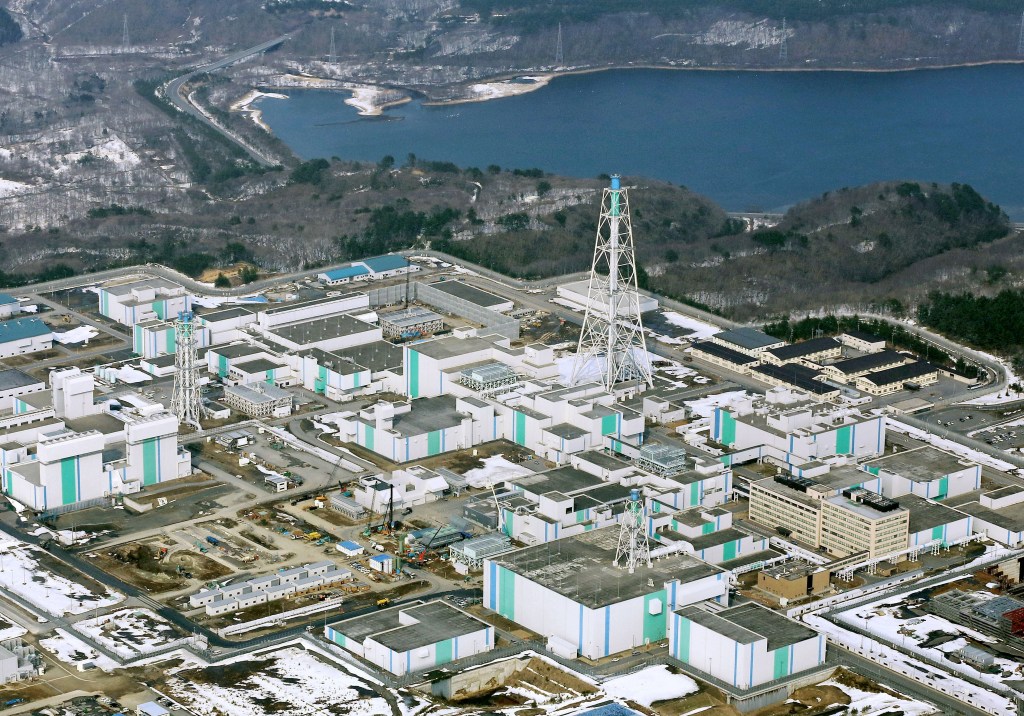
The site, which is 159 times the size of Tokyo Dome, is lined with white buildings with no windows.
Construction started 31 years ago. It was still being built in late November last year, when it was shown to reporters.
The reprocessing plant is located on the Shimokita Peninsula at the northern tip of the main Honshu island.
Crops in the area are often damaged by cold humid winds during summer, so Rokkasho village accepted the plant in 1985 for local revitalization in place of agriculture.
Employees of privately-run Japan Nuclear Fuel, which is affiliated with nine major power companies, and other industry-related personnel account for more than 10 percent of Rokkasho’s population.
After repeated readjustments to the schedule, Naohiro Masuda, president of Japan Nuclear Fuel, said in December 2022 that the plant’s completion should come as early as possible during the first half of fiscal 2024, which is April to September 2024. More specifically, he pointed to “around June 2024.”
But at a news conference on Jan. 31 this year, Masuda said it is “inappropriate to keep saying the plant will be completed in June.”
The reprocessing plant was initially scheduled for completion in 1997.
Many insiders at the plant say it will be “quite difficult” to complete the work within the first half of fiscal 2024.
If officially decided, it will be the 27th postponement of the completion.
PROLONGED SCREENING, ACCIDENTS
One of the reasons for the delay of the completion is prolonged screenings by the Nuclear Regulation Authority.
Flaws were identified one after another in the company’s documents submitted to the nuclear watchdog, and around 400 Japan Nuclear Fuel employees are working on the papers within a gymnasium at the plant site.
Mechanical problems have also hampered progress. In 2022, for example, a system to cool high-level radioactive liquid waste broke down.
Masuda visited industry minister Ken Saito on Jan. 19 to report on the situation at the plant.
Saito told Masuda about the construction, “I expect you to forge ahead at full tilt.”
Masuda stressed his company “is fully devoted to finishing construction as soon as possible,” but said safety “screening is taking so much time because we have myriad devices.”
The cost to build the reprocessing plant, including new safety measures, has ballooned to 3.1 trillion yen ($20.57 billion), compared with the initial estimate of 760 billion yen.
Including expenditures for the future decommissioning of the plant, the total budget has reached 14.7 trillion yen. (close to $97 billion)
Even if the reprocessing plant is completed, it can treat only 800 tons of spent nuclear fuel annually at full capacity, compared with 19,250 tons of spent fuel stored nationwide.
Kyushu Electric Power Co. said in January that it would tentatively suspend pluthermal power generation at the No. 3 reactor of its Genkai nuclear power plant in Saga Prefecture. The reactor uses MOX fuel.
Kyushu Electric commissioned a French company to handle used fuel, but it recently ran out of stocks of MOX fuel.
Kyushu Electric has a stockpile of plutonium in Britain, but it cannot take advantage of it because a local MOX production plant shut down.
HUGE INVESTMENT
Calls have grown over the years to abandon the nuclear fuel cycle project.
Many insiders of leading power companies doubt whether the reprocessing plant “will really be completed” at some point.
But the government has maintained the nuclear fuel cycle policy, despite the huge amounts of time and funds poured into it.
“The policy is retained just because it is driven by the state,” a utility executive said.
Hajime Matsukubo, secretary-general of nonprofit organization Citizens’ Nuclear Information Center, said the government’s huge investment explains why the fuel cycle program has yet to be abandoned.
“They have invested too much money in the program to give up on it halfway,” Matsukubo said.
Xi Jinping’s Thoughts on China’s Nuclear Weapons

Xi noted the increased readiness those new silos might provide was necessary to prepare to respond to foreign military intervention. That sounds more defensive than aggressive. ……………….. China’s long-standing commitment not to use nuclear weapons first at any time or under any circumstances.
UCS is concerned about the future direction of Chinese nuclear weapons policy. We agree with Gen. Cotton that “the PRC’s long-term nuclear strategy and requirements remain unclear.” We urge influential US voices, including the media, to refrain from encouraging the public, and especially US decision-makers, to jump to conclusions the available evidence does not support. We also urge the Biden administration, and the US Congress, to wait until they have a clearer understanding of Chinese nuclear thinking before making precipitous decisions about the future of the US nuclear arsenal.
April 1, 2024, Gregory Kulacki, China Project Manager, This blog was co-authored with UCS China analyst Robert Rust. https://blog.ucsusa.org/gregory-kulacki/xi-jinpings-thoughts-on-chinas-nuclear-weapons/
Last month UCS published a critique of a New York Times article that claimed Chinese military strategists, “are looking to nuclear weapons as not only a defensive shield, but as a potential sword — to intimidate and subjugate adversaries.” We examined the evidence and found it did not support that claim.
However, there was one piece of evidence in the article we could not examine; a speech by Chinese leader Xi Jinping to China’s Second Artillery in December of 2012. It operates China’s conventional and nuclear missiles and was renamed the People’s Liberation Army Rocket Force in 2016. We’ve since obtained a copy of that speech and found it doesn’t support the New York Times claim either. There is no language in Xi’s speech that suggests he thinks about the purpose of China’s nuclear arsenal differently than his predecessors.
We posted the original Chinese text with an English translation. It is classified as an “internal publication” that should be “handled with care.” It was printed and distributed to all Chinese military officers at the regimental level and above by the General Political Department of the People’s Liberation Army (PLA) in February 2014.
Why is this speech worth reading?
UCS first learned about the speech ten years ago when a Chinese colleague drew our attention to language in a commentary on the speech by generals Wei Fenghe and Zhang Haiyang, the commander and party secretary of the Second Artillery at the time. Our colleague noticed it contained new language describing the alert level of Chinese missiles. He thought the two officers might be trying to influence Xi’s thinking. UCS took note of that the new language in our 2016 report on a possible change in China’s nuclear posture.
That report concluded China may shift some of its nuclear forces to what is called a “launch on warning” or “launch under attack” alert status that would give Chinese leaders the option to launch those nuclear missiles quickly before they could be destroyed by an incoming attack. Traditionally, China kept its nuclear missile force off-alert, and the Second Artillery trained to launch a retaliatory nuclear strike only after being struck first. Currently, China is believed to keep most of its nuclear warheads in storage, separated from the missiles that carry them, to prevent an accidental or unauthorized launch.
Although China may still be moving to a launch on warning posture, the full text of Xi’s December 2012 speech, and the phrase it contains related to alert levels, reveals Xi did not discuss nuclear strategy or announce an intention to put Chinese nuclear forces on alert. He addresses more general concerns about the combat readiness, ideological orientation, and human qualities of Chinese military officers. Every Chinese head of state since 1842, when the United Kingdom defeated Imperial China in the Opium War, shared the same concerns. Xi did not say anything new, specific, or surprising. There is no language in his speech that justifies the suggestion he communicated aggressive new nuclear ambitions that day.
What did Xi say?
Continue reading1 This Month



26 September – International Day for the Total Elimination of Nuclear Weapons


PLEASE OPPOSE HR 8255 AND S.3639 – bills would accelerate satellite deployment, with no environmental review or safeguards – https://ncstd5li.quorum.us/campaign/169331/
To see nuclear-related stories in greater depth and intensity – go to https://nuclearinformation.wordpress.com
-
Archives
- September 2026 (206)
- August 2026 (330)
- July 2026 (355)
- June 2026 (287)
- May 2026 (306)
- April 2026 (356)
- March 2026 (251)
- February 2026 (267)
- January 2026 (308)
- December 2025 (358)
- November 2025 (359)
- October 2025 (375)
-
Categories
- 1
- 1 NUCLEAR ISSUES
- business and costs
- climate change
- culture and arts
- ENERGY
- environment
- health
- history
- indigenous issues
- Legal
- marketing of nuclear
- media
- opposition to nuclear
- PERSONAL STORIES
- politics
- politics international
- Religion and ethics
- safety
- secrets,lies and civil liberties
- spinbuster
- technology
- Uranium
- wastes
- weapons and war
- Women
- 2 WORLD
- ACTION
- AFRICA
- Atrocities
- AUSTRALIA
- Christina's notes
- Christina's themes
- culture and arts
- Events
- Fuk 2022
- Fuk 2023
- Fukushima 2017
- Fukushima 2018
- fukushima 2019
- Fukushima 2020
- Fukushima 2021
- general
- global warming
- Humour (God we need it)
- Nuclear
- RARE EARTHS
- Reference
- resources – print
- Resources -audiovicual
- Weekly Newsletter
- World
- World Nuclear
- YouTube
-
RSS
Entries RSS
Comments RSS
 nuclear-news