Videos of the 6th Citizen-Scientist International Symposium on Radiation Protection October 7 – October 10, 2016
Videos of the symposium to be watched at:
http://www.ustream.tv/channel/csrp-en
From the Reality of Chernobyl and Fukushima
Date: Friday, October 7 – Monday, October 10, 2016
Venue: Main Hall, Fukushima Gender Equality Centre 1-196-1 Kakunai, Nihonmatsu, Fukushima, 964-0904
The Citizen-Scientist International Symposium on Radiation Protection (CSRP), a politically, financially, ideologically and religiously independent non-profit organization, has been committed to keeping to minimum the damages on health and environment caused by the Tokyo Electric Fukushima Daiichi Nuclear Power Plant disaster that followed the Great East Japan Earthquake and Tsunami in March 11, 2011.
CSRP has been inviting administrative officials, researchers, NGOs, member experts of governmental inquiry commissions and international organizations working on radiation protection, etc. Since around the 3rd CSRP, this approach has started to bear fruit, because scientists and other stakeholders with different positions and paradigms began to share the same table of discussion, thus gradually making possible constructive exchange of views.
In the course of this approach, however, we began to encounter a new challenge that may concern the premise of the CSRP; the deeper we got into scientific discussion, the higher the hurdle for participation got for the general public, especially for younger generations. Also, the diversity of voices were to be alienated from pointed scientific discussions that are decisive for the decision-making of the radiation protection of the general public. This lead us to some interrogations : “Isn’t ‘science’ given too much importance in decision-making?”; “Is ‘science’ the only way for citizens to bring today’s situation under their power?”
While always continuing to examine new scientific findings with respect to health, environmental and social impacts of low-dose exposure, we added the theme of “Between Art and Science” to the 5th symposium last year, exposed various art works inspired by nuclear power and nuclear disasters, and organized a panel discussion with artists and scientists. This was the CSRP’s new attempt to question “science” and “scientificity” with a view to reexamining the relationships between science, art and philosophy before and after the modernity. The 6th CSRP of this year, held in the city of Nihonmatsu, Fukushima Pref., will collaborate with the Institute of Regional Creation by Arts, the University of Fukushima, to cosponsor the Fukushima Biennale 2016. We hope this new attempt will bring new visions to the participants.
As a place to learn and make full use of new findings exploring the effects of low-dose radiation exposure accumulating day by day, and to think together about the rights of people facing the consequences of the nuclear accident and about what epidemiology and public health should do in order to minimize the damage, we open the 6th Citizen-Scientist International Symposium on Radiation Protection.
Resuming Monju reactor operations may cost over ¥540 billion

The cost of resuming operations at Japan’s trouble-plagued Monju prototype fast-breeder nuclear reactor is estimated to top ¥540 billion ($5.2 billion), the science ministry says.
The estimate was presented Friday at a meeting of government and private-sector officials who discussed the fate of the reactor in Tsuruga, Fukui Prefecture.
More than ¥1 trillion ($9.7 billion) has been spent on Monju, but it has only operated for a total of 250 days in the past 20 years due to a series of problems, including a leak of sodium coolant.
The government is considering options, including decommissioning the reactor. It plans to make a decision by the end of this year.
The ministry said the costs may far exceed ¥540 billion if the safety screening process by regulators is lengthy. The estimate does not include expenses for decommissioning the reactor.
The science ministry wants Monju to be maintained while the industry ministry is opposed to the idea.
Opposition to keeping Monju in place is expected to grow if a massive amount of money is needed for it to go back online.
The meeting brought together science minister Hirokazu Matsuno and industry minister Hiroshige Seko as well as nuclear industry executives, including Satoru Katsuno, chairman of the Federation of Electric Power Companies of Japan.
Spiral of repeated failure in nuclear sanctions against North Korea
Nuclear conflict with North Korea: a spiral of repeated failure, DW, 9 Oct 16
 North Korea carries out a nuclear test; the UN imposes sanctions; North Korea repeats its actions. This cycle has been repeated for 10 years now and has so far proved impossible to break. North Korea has carried out five nuclear tests in the past 10 years. Five times, the UN Security Council has imposed or tightened sanctions. For years now the West has issued similar words of condemnation after each new test. And time and again North Korea has demonstrated that the international community still has not found any way of resolving this nuclear confrontation in the long term. Meanwhile, the cycle of action and reaction continues.
Monday, 9 October 2006
Exactly ten years ago, then dictator Kim Jong Il shocked the world with the first North Korean nuclear test. It was the middle of the night in Europe when the earth shook in the northeast of the country at 10:36 local time. The South Korean secret service estimated that the bomb had an explosive force of 0.55 kilotons. This was considerably smaller than the first atomic bomb ever used in conflict, dropped on Hiroshima in Japan by the United States: That had an explosive force of around 12.5 kilotons. But the message is clear – and the rest of the world is outraged.
US President George W. Bush on 9 October 2006:
“The United States condemns this provocative act. Once again North Korea has defied the will of the international community, and the international community will respond.”
It was the start of a spiral that has continued ever since, with no resolution in sight.
Five days later, the 15 members of the UN Security Council vote unanimously to impose sanctions against North Korea.
UN Resolution 1718, passed on 14 October 2006 The resolution forbids North Korea from carrying out any further nuclear tests or firing any ballistic missiles. It calls upon the country to suspend its nuclear program and return to the negotiation table. Among other things, Resolution 1718 freezes the assets of people involved in the North Korean nuclear program and imposes travel bans on them. It also imposes a trade embargo covering items such as tanks, combat vehicles, large war materials, fighter planes, helicopters and battleships. And, of course, anything connected to the further development of North Korea’s nuclear program………
Friday, 9 September 2016
Just nine months after the fourth nuclear test, North Korea carries out a fifth – and last, to date – on its Punggye-ri test site. It is also the strongest. Foreign experts estimate that it had an explosive force of around 10 kilotons.
US President Barack Obama, 9 September 2016:
“To be clear, the United States does not, and never will, accept North Korea as a nuclear state. […] Today’s nuclear test, a flagrant violation of multiple UN Security Council Resolutions, makes clear North Korea’s disregard for international norms and standards for behavior and demonstrates it has no interest in being a responsible member of the international community.”
The UN Security Council has announced that further sanctions will be imposed. http://www.dw.com/en/nuclear-conflict-with-north-korea-a-spiral-of-repeated-failure/a-35999751
Climate Change’s fearful threat to Vietnam’s Mekong Delta
WILL CLIMATE CHANGE SINK THE MEKONG DELTA?, Mongabay News, 3 October 2016 / David Brown
No delta region in the world is more threatened by climate change. Will Vietnam act in time to save it?
- Scientists say the 1-meter sea level rise expected by century’s end will displace 3.5-5 million Mekong Delta residents. A 2-meter sea level rise could force three times that to higher ground.
- Shifting rainfall and flooding patterns are also threatening one of the most highly productive agricultural environments in the world.
- The onus is now on Vietnam’s government in Hanoi to approve a comprehensive adaptation and mitigation plan.
- This is the first article of an in-depth, four-part series exploring threats facing the Mekong Delta and how they might be addressed. Read the second installment here.
IIt’s a sad fact that several decades of talk about climate change have hardly anywhere yet led to serious efforts to adapt to phenomena that are virtually unavoidable. Neuroscientists say that’s because we’re humans. We aren’t wired to respond to large, complex, slow-moving threats. Our instinctive response is apathy, not action.
That paradox was much on my mind during a recent visit back to Vietnam’s fabulously fertile Mekong Delta, a soggy plain the size of Switzerland. Here the livelihood of 20 percent of Vietnam’s 92 million people is gravely threatened by climate change and by a manmade catastrophe, the seemingly unstoppable damming of the upper reaches of the Mekong River.
Samuel Johnson famously said that “nothing concentrates the mind so well as the prospect of imminent hanging.” It’s been nine years since a World Bank study singled out the Mekong Delta as one of the places on our planet that is most gravely threatened by sea level rise. There if anywhere, I imagined, I’d find a sense of urgency. I’d find adaptive measures well advanced.
I was wrong. Vietnamese government ministries, provincial administrations, experts from Vietnamese universities and thinktanks, experts deployed by the World Bank, the Asian Development Bank and foreign governments: all have been pushing plans and policies. The problem has been to sort out the best ideas, make appropriate decisions and find the resources needed to implement them in a timely, coherent way.
Things may be coming together at last, I concluded after talking with dozens of local officials, professors, journalists and farmers in mid-June. None denied the reality of the problem. Many connected the question of what to do about climate change to older arguments over the best ways to grow more and better crops………
- No delta area, not the mouths of the Ganges, the Nile or the Mississippi, is more vulnerable than the Mekong estuary to the predictable impacts of climate change. The 1-meter sea level rise expected by the end of the 21st century, all else being equal, will displace 3.5-5 million people. If the sea instead rose by 2 meters, lacking effective countermeasures, some 75 percent of the Delta’s 18 million inhabitants would be forced to move to higher ground.
Already, said Professor Ni, there’s been a significant decrease in rainfall in the first part of the annual rainy season, and more rain toward the end. The Mekong’s annual flood peak has fallen by a third since 2000. The waters from upstream carry less silt to replenish the Delta floodplain. Also, the volume of fresh water is falling while the sea level rises. This allows salt-laden tidal water to penetrate further and further into Delta estuaries and swampy coastal areas during the dry season.
Modeling of current trends suggest that average temperatures in the Mekong Delta will rise by more than 3 degrees Celsius toward the end of the century. Annual rainfall will decrease during the first half of the century, and then rise well above the 20th century average. The area that’s flooded each autumn won’t change substantially, but the floods won’t last as long.
- All things being equal, rice yields will plummet as temperatures rise. Lighter rains in the early months of the wet season will challenge farmers’ ingenuity. Rising seas and reduced river flows will severely test the system of sea dikes. Riverbanks and the Delta coast are already crumbling; this will accelerate. Farmers who are unable to cope will head north to seek industrial and construction jobs.
That’s not all. At slide 70 (of 86) of the DRAGON presentation, attention shifts to upstream dam construction on Delta water regimes.For China, Laos and Thailand, the hydroelectric potential of the upper Mekong is a seemingly irresistable development opportunity. It may be that not all the dams they plan will be built across the Mekong mainstream. Whether a few or many, their impact on agriculture in Vietnam and Cambodia will be profoundly negative, Professor Ni, his colleagues at Can Tho University, and experts at other institutes in southern Vietnam have pounded the alarm gongs for years. The dam cascade is a nearer and more present danger, and apparently just as unstoppable as climate change.
DRAGON Institute’s slideshow concludes with a call to action. The future is bleak but not hopelessly so if appropriate adaptation and mitigation strategies are launched. What the Delta needs is revealed: sustainable development based on a triply effective foundation of water source security, food security and social security. https://news.mongabay.com/2016/10/will-climate-change-sink-the-mekong-delta/
India’s government seeking private investment for its costly Light Water Nuclear Reactors
Nuclear energy: Government to push for JVs in light water reactor projects, Economic Times By PTI | Oct 09, 2016, NEW DELHI: To meet the high cost of Light Water Reactors, the government has decided to bring in such projects, which currently involve foreign collaborators, as joint ventures (JVs)with public sector undertakings (PSUs).
Federation estimates Fukushima nuke plant cleanup costs, redress may rise to ¥8 trillion ($77.10 billion)

An industry group has estimated costs for decontamination work at the disaster-struck Fukushima nuclear plant and compensation for nuclear damage to be around ¥8 trillion ($77.10 billion) more than the current official projection, a source said Thursday.
The Federation of Electric Power Companies of Japan, which consists of the country’s 10 electric power companies, has informally asked Prime Minister Shinzo Abe’s government to use state funds to cover the extra costs, the source also said.
The costs are supposed to be covered by the utilities, including Tokyo Electric Power Company Holdings Inc., operator of the crippled Fukushima No. 1 nuclear power plant, where three reactors melted down in the aftermath of the March 2011 quake-tsunami disaster. The government is cautious about using taxpayer money to deal with the issue, the source said.
Under the current estimate, compensation payments are projected to total ¥5.4 trillion, while decontamination costs are forecast to reach ¥2.5 trillion.
Tepco and other nuclear power plant operators have paid contributions for compensation payments to a state-backed fund. As for decontamination costs, the fund will seek to retrieve that money by selling Tepco shares that it owns.
Govt. Mulls Ways to Promote Fukushima Produce
The Japanese government plans to create ways to encourage consumers to buy food from Fukushima Prefecture. The area still suffers from the perception that its foodstuffs are unsafe due to the 2011 Fukushima Daiichi nuclear power plant accident.
Reconstruction Minister Masahide Imamura and senior government officials held a meeting on Friday.
The officials reported that a lot produce and processed foods from Fukushima are forced to be sold at prices lower than their pre-accident levels.
They explained farmers and food producers from the region face numerous challenges, such as fewer sales routes and reluctance to buy their products.
They decided to offer benefits to consumers who purchase the food.
Imamura stressed simply advertising won’t be enough and he wants the officials to create a framework that will entice consumers. He noted giving them rewards in a point system is one idea.
Promoting Fukushima Rice and Sake
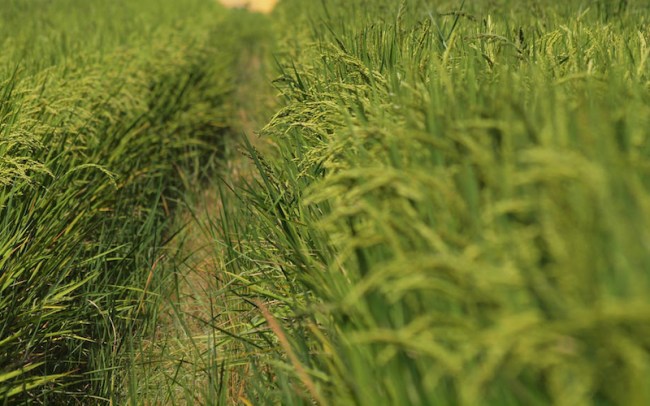
On the Issue of Japan, Fukushima and Rice
In Japan, rice is life. The word for “life” is also the word for “meal” or “food.” The importance of rice to the Japanese people cannot be overstated. The word for rice has been called “emotive.” Damage to Japan’s rice crops goes beyond simple damage to the diet. To be confronted with a shortage of rice calls forth powerful feelings of deprivation in the Japanese. Japanese rice, irradiated by the events of “3/11,” is in danger.
“3/11” is what the Japanese call the series of deadly disasters which struck northern Japan in March of 2011; the earthquake, tsunami, and the Fukushima Daiichi nuclear power plant meltdown. Northern Japan was devastated and recovery will take many decades.
When the Fukushima Daiichi nuclear power facility was badly damaged by irradiation, local crops, including batches of rice grown in Fukushima, found to be badly affected by radiation, were swiftly removed from the market.
Five years after the quake, Fukushima rice producers still have difficulty marketing their produce. But the Japanese government, working in tandem with nonprofits and private organizations, has developed a positive and creative response to the Fukushima food crisis.
The Rice Peace Project Seminar, held on September 19, 2016 in New York, was inspired by the initiatives of a Japanese government supported campaign working together with non-profits, corporate projects, and organizations, including the NPO Project 88.
The NPO Project 88, which takes name from the 88 processes of rice production, mobilizes Japanese high-quality rice as an emergency relief food. Developing tasty, nutritious, non-GMO, low pesticide, and allergen-free, organic and gluten-free rice products is also central to NPO Project 88’s mission, helping to spread peace and disaster-relief in the world through rice.
The Rice Peace Project Seminar, held to publicize the efforts of the NPO Project 88, featured three speakers from Japan. Mrs. Akie Abe, spouse of Prime Minister Shinzo Abe, Mr. Hiroshi Sakurai, President of the sake brewery Asahi Shuzo, and Ms. Nari Takahashi, President of NPO Project 88. The speeches were followed by a sushi tasting prepared by Sushi Chef Yoichi Akashi of Kappo Akashi using Eco-rice as well as a tasting of “Dassai” sake, the sake Prime Minister Abe offered President Obama during the U.S. President’s 2014 visit to Japan.
Jeff Santos, CEO of the Santos Media Group who hosted the seminar, introduced Mrs. Akia Abe. Santos described Mrs. Abe as an activist. Abe is actively engaged in supporting the NPO Project 88 and in promoting Fukushima’s agricultural industry by creating Yamato No Kokoro sake from rice produced in Fukushima.
Mrs. Akie Abe said that in 2011, in the wake of the Tohoku earthquake, she realized the importance of supporting Japanese food production, especially rice. With the encouragement of US Ambassador to Japan, Caroline Kennedy, Abe began to support the production of Fukushima rice and sake,
Abe described the production of rice in Japan as highly political. She said that 150 years ago, after extensive warring between the Chochu and Aizu clans. the two prefectures began to cultivate rice for sake and to brew sake, jointly. The joint effort was successful and the two prefectures now live in harmony.
Abe said that for Japanese, now as always, rice and sake are spiritual foods. “In Japan, we like to get our hands dirty [working the land.] We are a part of nature. We owe our gratitude to nature. It is my pleasure to work with rice producers and sake producers.”
She closed with a warm invitation: “Please enjoy the sushi and sake tasting today and please also come to Japan to enjoy them!”
Hiroshi Sakurai, President of Sake Brewery Asahi Shuzo, opened with praise for Japanese sake in general and Asahi Shuzo’s sake in particular. “Sake has to be ‘oishii’ (delicious) If it is not delicious what is the point of creating it? And our sake is especially ‘oishii!’”
Sakurai said that he wanted to show two world leaders enjoying Japanese sake, Prime Minister Abe and US President Barack Obama. Sakurai’s photo array displayed pictures from the U.S. President’s 2014 visit to Japan.
Sakurai said that his company, Asahi Shuzo, had partnered with the king of rice producers, Yamada Nishiki, accounting for 6.5 percent of total rice production in Japan. He has a staff of 100 and his employees are the best. Production is entirely by hand- they do not use machines. Production is around the clock, 24/7, to produce “oishii” sake.
Sakurai said that rice production in Japan is very eco- friendly. They recycle all that remains from rice production, such as rice husks, used to make sembei, or rice milk.
In closing, he said: “We are eager to promote our sake and we hope you enjoy the tasting.”
Nari Takashashi, President of NPO Project 88. Ms. Takahashi said that rice was the first food served to Fukushima quake victims. It was sometimes all that aged survivors could eat. And for those who could not eat plain rice she and her company developed soft rice cakes. They were very popular, as were their cream puffs.
Takahashi said that some kids with allergies couldn’t eat even the rice cookies or cream puffs. So she developed allergy-free cookies made with rice powder and delivered to the schools. Kids loved them.
Takahashi said that the application for allergy free products goes well beyond Fukushima. Survivors of the Kumamoto quake this past April are their next potential customers. She believes there is a huge market for these products world wide, especially to disaster survivors and to millennials.
After this spirited set of speeches, it was no surprise that the sushi and sake tastings were extraordinary.
http://intpolicydigest.org/2016/10/06/on-the-issue-of-japan-fukushima-and-rice/
Sendai N°1 nuclear reactor shuttered for safety work
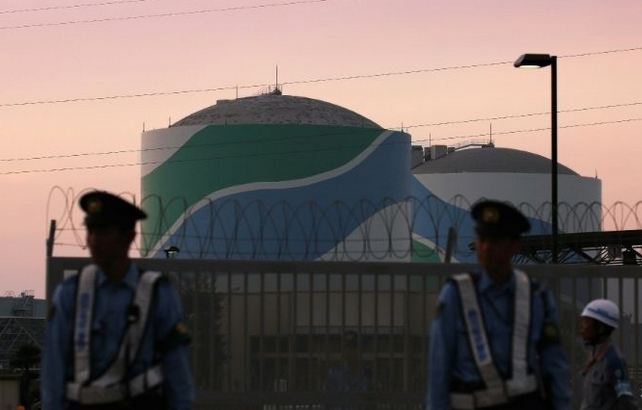
Nuclear reactor buildings of the Kyushu Electric’s Sendai nuclear power plant in southern Kagoshima in 2015.
Japan nuclear reactor shuttered for safety work
TOKYO: A reactor at the centre of Japan’s national debate over nuclear power was halted on Thursday (Oct 6) under stricter post-Fukushima safety standards, as Tokyo struggles to bring back atomic energy.
Utility Kyushu Electric is shutting down the No. 1 reactor at its Sendai plant in southern Kagoshima for a few months of inspections and maintenance, leaving Japan with just two operating reactors.
But there is speculation that the reactor’s safety work could drag on longer.
Thursday’s shutdown follows demands from the region’s top politician that Kyushu Electric conduct extra safety inspections at its two operating reactors in the Sendai plant – after deadly quakes hammered a neighbouring prefecture in April.
Last month, the company refused governor Satoshi Mitazono’s demands to immediately shut down the reactors over safety concerns.
But it agreed to what it called “special inspections” in addition to regular maintenance work. Sendai’s No. 2 reactor will be shut down for a similar review starting in December.
Dozens of reactors were switched off in the wake of the March 2011 Fukushima accident, the worst nuclear disaster in a generation.
Anti-atomic sentiment still runs high five years later, challenging a push by Prime Minister Shinzo Abe and utility companies to switch Japan’s stable of reactors back on.
The catastrophe forced resource-poor Japan to turn to expensive fossil fuels to plug its energy gap, but fears about the safety of nuclear power and radiation exposure linger.
The two Sendai reactors were restarted last year under new safety regulations brought in after Fukushima, where reactors went into meltdown in March 2011 after a huge earthquake and tsunami.
Another reactor has been restarted at the Ikata plant in western Japan.
Opposition to nuclear power has seen communities across the country file lawsuits to prevent restarts, including the Sendai plant.
The residents argued that the plant’s operator underestimated the scale of potential earthquakes and volcanic eruptions that could hit the region. A court rejected their argument and ordered restarts.
Fukushima Cleanup Talks Put Tepco Survival Risk in Focus
Tokyo Electric Power Co. is still struggling to put the Fukushima nuclear disaster behind it, admitting this week that paying for decommissioning the plant in one go risks leaving it insolvent.
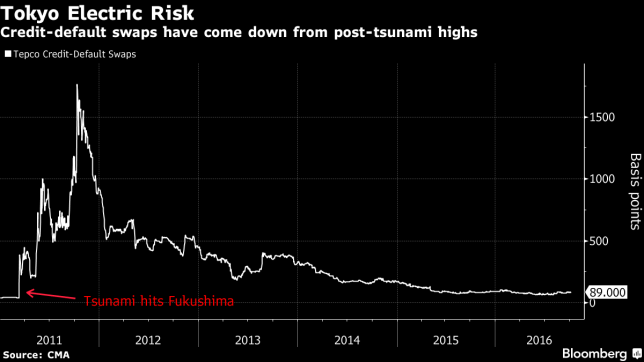
The cost to insure debt in Japan’s biggest utility climbed to a seven-month high of 89 basis points on Oct. 5 after President Naomi Hirose said after a meeting in Tokyo with a government commission that the company is asking for help in avoiding financial ruin. Tepco has already received state aid for compensation and decontamination.
The March 2011 nuclear accident and its fallout will ultimately cost more than 11 trillion yen ($106 billion), according to a study by academics including Kenichi Oshima, a professor of economics at Ritsumeikan University. Tepco has estimated that decommissioning alone will cost about 2 trillion yen. Investors should hold off buying bonds of other utilities until there is more clarity on how the government will close the Fukushima plant, according to BNP Paribas SA.
“Now is not the best time to be investing in electricity utility bonds, with discussions going on about nuclear plant decommissioning, and the potential for spreads to widen,” said Mana Nakazora, chief credit analyst at BNP Paribas in Tokyo. Even so, she added, “the government has little choice but to take measures to avoid a default by Tokyo Electric.”
While Prime Minister Shinzo Abe’s government has committed to provide up to 9 trillion yen for compensation to individuals and business hurt by the Fukushima disaster and for decontaminating areas affected, that figure doesn’t include decommissioning of the nuclear plant itself, according to a report by Moody’s Investors Service last month.
Scrapping the Fukushima reactors may take 30 years to 40 years, and Tokyo Electric will only start removing debris from the plant from in 2021, a decade after the incident, according to the utility’s road map for dealing with the remnants of the disaster.
In speaking to reporters, Tepco President Hirose was probably making a public case for more government support, according to Yutaka Ban, the chief credit analyst at SMBC Nikko Securities Inc. in Tokyo. Ban said he saw little probability that support will be withheld.
“Things will likely settle down” after the government adopts the new measures, said Ban. “Without government support, the costs would be extremely high.”
For a Bloomberg Intelligence report on Asia-Pacific utilities, click here.
Tepco’s credit-default swaps have come down from as high as 1,762 basis points in October 2011, according to data provider CMA. The utility has said it plans to return to the bond market by the end of the fiscal year to March 2017. Jun Oshima, a spokesman for Tokyo Electric, said that plan is still in place. It stopped issuing notes after the Fukushima disaster.
The extra yield on Tepco’s 1.155 percent bonds due in 2020 was 64 basis points more than sovereign debt, the lowest since before the Fukushima disaster, according to Bloomberg-compiled prices. The spread on Osaka-based Kansai Electric Power Co.’s 0.976 percent notes due in 2020 was 39 basis points.
Tokyo Electric has a Ba3 rating from Moody’s and BB- score from S&P Global Ratings, both three levels below investment grade.
“Decommissioning is currently the biggest unknown, and clarity matters in terms of credit,” said Mariko Semetko, a Moody’s analyst in Tokyo. “The lack of clarity there has been holding back the credit quality.”
Radiation Brain Moms and Citizen Scientists: The Gender Politics of Food Contamination after Fukushima
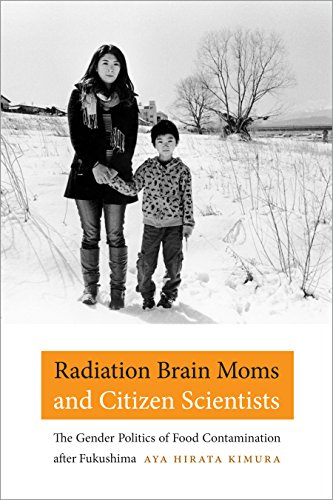
by Aya Hirata Kimura (Author)
Following the Fukushima Daiichi Nuclear Power Plant disaster in 2011 many concerned citizens—particularly mothers—were unconvinced by the Japanese government’s assurances that the country’s food supply was safe. They took matters into their own hands, collecting their own scientific data that revealed radiation-contaminated food. In Radiation Brain Moms and Citizen Scientists Aya Hirata Kimura shows how, instead of being praised for their concern about their communities’ health and safety, they faced stiff social sanctions, which dismissed their results by attributing them to the work of irrational and rumor-spreading women who lacked scientific knowledge. These citizen scientists were unsuccessful at gaining political traction, as they were constrained by neoliberal and traditional gender ideologies that dictated how private citizens—especially women—should act. By highlighting the challenges these citizen scientists faced, Kimura provides insights into the complicated relationship between science, foodways, gender, and politics in post-Fukushima Japan and beyond.
Editorial Reviews
Review
“Riveting and smart, Radiation Brain Moms and Citizen Scientists tracks the efforts made by citizens in post-Fukushima Japan to ensure the safety of their food from radioactive contamination. In the face of state neglect and criticism from fellow Japanese, these initiatives display a ‘soft’ boldness (versus activist politics). Interweaving stories of citizen scientists and ‘radiation brain moms’ with sharp theoretics that deconstruct the entanglements of science, neoliberalism, and postfeminism at work, this book is at once powerful and timely.”
(Anne Allison, author of Precarious Japan)
“Based on careful research, extensive fieldwork, and a judicious use of political and feminist theory, this book’s relevance to political and social developments extends beyond Japan’s borders. It is a reminder of the ongoing effects of the Fukushima disaster in Japan at a time when these effects are being increasingly ignored by the global media. A timely and important book, Radiation Brain Moms and Citizen Scientists will appeal to scholars of contemporary Japanese society as well as science and technology studies scholars, especially those interested in the gender dimensions of science and technology.”
(Tessa Morris-Suzuki, author of Borderline Japan: Foreigners and Frontier Controls in the Postwar Era)
About the Author
Aya Hirata Kimura is Associate Professor of Women’s Studies at the University of Hawai’i at Manoa and the author of Hidden Hunger: Gender and Politics of Smarter Foods.
Radioactive water leaks from storage tank at Fukushima plant
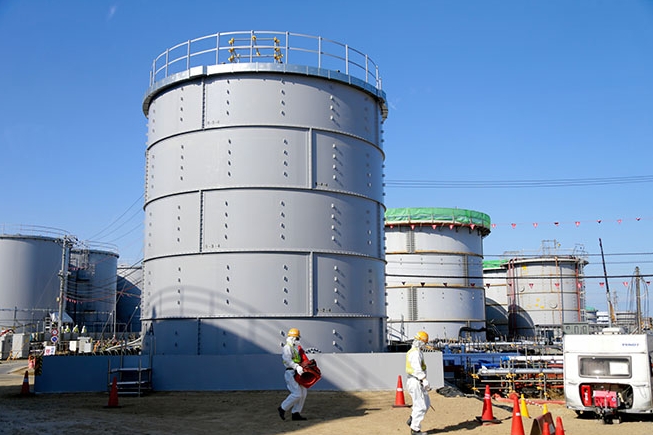
The latest contaminated water leak at the Fukushima No. 1 nuclear power plant occurred at a flange-type storage tank, whose seams are connected by bolts.
Up to 32 liters of radioactive water leaked from a storage tank at the crippled Fukushima No. 1 nuclear plant, but the contaminated liquid has been contained, Tokyo Electric Power Co. said Oct. 6.
The leaked water is currently within barriers surrounding the tank that are designed to block the flow of fluids, TEPCO, the plant’s operator, said.
The liquid contained water that had been treated to remove radioactive strontium and other substances, as well as highly contaminated water from the bottom of the tank that was stored shortly after the nuclear accident started in 2011.
A radioactivity level of 590,000 becquerels of beta ray-emitting materials was detected per liter of the leaked water.
The water seeped out of a tank with bolted seams on its sides, which are more prone to leaks than those with welded walls.
TEPCO continues to use the bolted containers despite the risk because production of welded tanks cannot keep pace with the buildup of contaminated water, mainly from groundwater entering the damaged reactor buildings, at the nuclear plant.
Japan Political Pulse: A helping hand following radiation misfortune
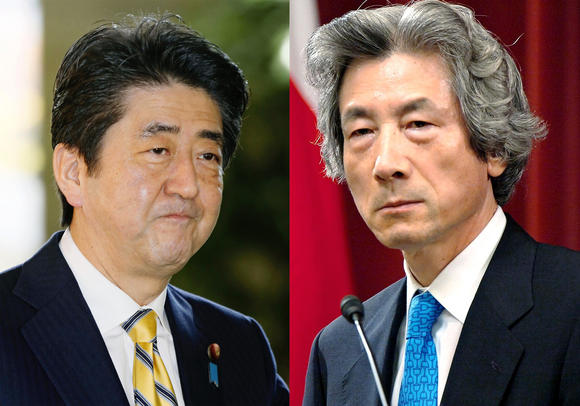
Recently former Prime Minister Junichiro Koizumi, 74, was seen talking to 62-year-old Prime Minister Shinzo Abe. Their encounter was recorded on a photo page of the Sept. 29 issue of the weekly magazine Shukan Bunshun.
The scene was Aoyama Funeral Hall in Tokyo, where they had attended the Sept. 15 funeral of former Liberal Democratic Party (LDP) Secretary-General Koichi Kato and were waiting for their cars to arrive. For about 90 seconds the “master and disciple” stood side by side. Below are the details of Koizimi’s comments and the prime minister’s reaction, which didn’t appear in Shukan Bunshun.
Koizumi: “Why don’t you totally eliminate nuclear power plants?”
Abe: (Faint smile, bow)
Koizumi: “Having zero nuclear power plants is cheaper. Why don’t you understand such a simple thing? It’s all lies, what the Ministry of Economy, Trade and Industry is saying. The things advocates of nuclear power plants are saying — they’re all lies. Don’t be fooled.”
Abe: (Wry smile, bows again, and with head kept low heads to official vehicle)
Koizumi is currently pouring his efforts into a fund to support those who say they were affected by radiation during “Operation Tomodachi,” a U.S. Armed Forces operation to support Japan in the wake of the March 2011 Great East Japan Earthquake and tsunami.
Over 400 soldiers from the USS Ronald Regan aircraft carrier and accompanying ships complained of ill-health after helping in rescue efforts following their urgent dispatch to the seas off Fukushima Prefecture in the wake of the earthquake, tsunami and ensuing meltdowns at the Fukushima No. 1 Nuclear Power Plant. Some of them are said to have died from causes including leukemia.
The aircraft carrier fleet worked intermittently in a radiation plume from the stricken power plant between March 13 and 17, 2011. After returning home from Japan, a stream of soldiers developed ailments including brain tumors and thyroid cancer. The nuclear plant’s operator, Tokyo Electric Power Co. (TEPCO), and the Japanese and U.S. governments acknowledged that they had been exposed to low-level radiation, but do not accept a causal relationship between exposure and their illnesses.
Koizumi learned that some soldiers had left the military at a young age, had no insurance and couldn’t pay their medical fees. It was in May this year that the former prime minister traveled to the United States and directly inquired about their circumstances.
Former soldiers earlier filed a lawsuit against parties including TEPCO, and oral arguments over whether jurisdiction of the case should lie in Japan or the United States were heard in an appeals court in California on Sept. 1. At the time, a Japanese government adviser is said to have supported an agent for TEPCO, stating that radiation exposure is the responsibility of the U.S. military.
Koizumi, who read a note on the hearing (carried in the Sept. 9 issue of the magazine Shukan Kinyobi), responded immediately.
“This is embarrassing. They were relief efforts for Japan, right? The American judge is said to have been appalled,” he was quoted as saying.
On July 5, Koizumi appeared in a news conference with figures including former Prime Minister Morihiro Hosokawa, 78, and Tsuyoshi Yoshiwara, 61, an adviser at The Johnan Shinkin Bank, to announce the start of fundraising activities to help the U.S. soldiers. Koizumi himself approached the Japan Business Federation (Keidanren) but was turned away on the grounds that TEPCO is a member of the federation.
Reinforcements have nevertheless appeared on the funding front. Japanese architect Tadao Ando, 75, posed the following question: “Mr. Koizumi, will you come to Osaka and give a lecture? I’ll assemble 1,000 people. With a fee of 10,000 yen per person, that’ll bring in 10 million yen.”
When Koizumi appeared at the lecture in August, 1,300 people turned up. The same style of lecture is due to be held in Tokyo on Nov. 16, organized by the head of a group of managers of small- and medium-sized enterprises. Additionally, the president of a solar power generation company provided 10 million yen.
Through these efforts, the total has climbed to 50 million yen. Koizumi apparently hopes to amass 100 million yen by next spring.
The connection between radiation exposure and the development of illness is delicate. There’s a possibility of developing cancer, but there are doubts about whether a person would suddenly die, experts say.
On Sept. 7, Koizumi spoke at the Foreign Correspondents Club of Japan in Tokyo’s Yurakucho district. He was asked if it was responsible to talk about damage from radiation exposure without presenting scientific evidence.
Below is the gist of his reply:
“I’m no longer a member of the government. I’m a civilian. There are people who are actually suffering. It’s common sense for me to support them.”
Fundraising and service instead of criticism; denial of the perception of saying, “Radiation exposure is the responsibility of the U.S. military” to protect nuclear power policies … I support this form of common sense from our former prime minister. (By Takao Yamada, Special Senior Writer)
http://mainichi.jp/english/articles/20161003/p2a/00m/0na/021000c
Storage tank leaks at Fukushima Daiichi plant
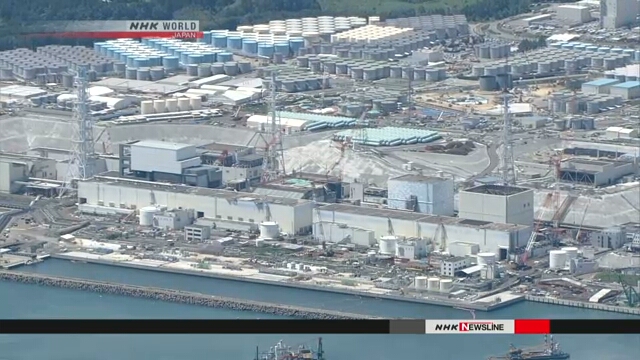
Workers at the crippled Fukushima Daiichi nuclear plant have found a leak of highly radioactive water from a waste water tank.
Its operator, Tokyo Electric Power Company, says the water likely leaked from a seam of the tank.
The leaked water was spotted on Wednesday on the side of one of an array of steel tanks holding contaminated water that is continuously generated at the site.
TEPCO’s analysis found 590,000 becquerel per liter of beta-emitting radioactive materials in the water.
Tokyo Electric estimates that 32 liters of such highly radioactive water had trickled out, mixed with rainwater, and remained within a barrier around the tank.
Workers moved water in the tank to another one to lower the water level enough to halt the leak.
The leaking cylindrical tank is made by splicing steel plates with bolts. But they have had waste water leaks in the past from seams.
The operator has been replacing these leak-prone tanks with new seamless ones. But the increasing volume of waste water makes it difficult for the utility to completely do away with the old ones.
Fire destroys Fukushima nuclear disaster evacuee housing
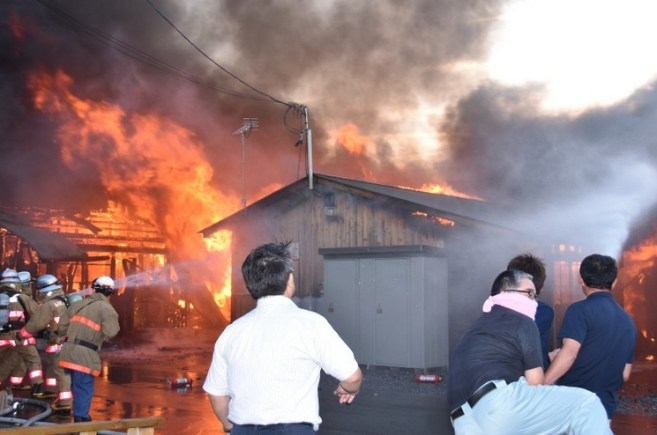
Fueled by strong winds, fire engulfs temporary housing at the Yoshima industrial park in Iwaki, Fukushima Prefecture, on Oct. 6, 2016.
IWAKI, Fukushima — A fire on Oct. 6 destroyed temporary housing for residents of Okuma, Fukushima Prefecture, who evacuated here due to the Fukushima No. 1 Nuclear Power Plant disaster, police said.
The fire broke out at around 4:25 p.m. and destroyed 19 homes in four single-story, prefabricated wooden buildings at the Yoshima industrial park in Iwaki. According to prefectural police, a 16-year-old boy was treated for smoke inhalation. The Okuma Municipal Government will supply the five households that lost their residences with housing elsewhere.
There were 72 households living in 86 of the 31-building complex’s 122 residences. Some 90 percent of Okuma residents’ original homes are within a nuclear disaster no-go zone around the Fukushima plant, and it is unknown when those living in the Yoshima industrial park might be able to return to the town.
Sho Tsukamoto, 29, an employee of a construction company who lost his residence and his possessions in the fire, said, “I even lost the picture of my dead father and other photos of my family that I brought from Okuma.”
http://mainichi.jp/english/articles/20161007/p2a/00m/0na/006000c
1 This Month





PLEASE OPPOSE HR 8255 AND S.3639 – bills would accelerate satellite deployment, with no environmental review or safeguards – https://ncstd5li.quorum.us/campaign/169331/
To see nuclear-related stories in greater depth and intensity – go to https://nuclearinformation.wordpress.com
-
Archives
- October 2026 (29)
- September 2026 (339)
- August 2026 (330)
- July 2026 (355)
- June 2026 (287)
- May 2026 (306)
- April 2026 (356)
- March 2026 (251)
- February 2026 (267)
- January 2026 (308)
- December 2025 (358)
- November 2025 (359)
-
Categories
- 1
- 1 NUCLEAR ISSUES
- business and costs
- climate change
- culture and arts
- ENERGY
- environment
- health
- history
- indigenous issues
- Legal
- marketing of nuclear
- media
- opposition to nuclear
- PERSONAL STORIES
- politics
- politics international
- Religion and ethics
- safety
- secrets,lies and civil liberties
- spinbuster
- technology
- Uranium
- wastes
- weapons and war
- Women
- 2 WORLD
- ACTION
- AFRICA
- Atrocities
- AUSTRALIA
- Christina's notes
- Christina's themes
- culture and arts
- Events
- Fuk 2022
- Fuk 2023
- Fukushima 2017
- Fukushima 2018
- fukushima 2019
- Fukushima 2020
- Fukushima 2021
- general
- global warming
- Humour (God we need it)
- Nuclear
- RARE EARTHS
- Reference
- resources – print
- Resources -audiovicual
- Weekly Newsletter
- World
- World Nuclear
- YouTube
-
RSS
Entries RSS
Comments RSS

