Clinicopathological Findings of Fukushima Thyroid Cancer Cases: October 2016
On September 26-27, 2016, the “5th International Expert Symposium in Fukushima on Radiation and Health: Chernobyl+30, Fukushima+5: Lessons and Solutions for Fukushima’s Thyroid Question” was held in Fukushima City. The symposium was organized by the Nippon Foundation, co-organized by Fukushima Medical University, Nagasaki University, and Hiroshima University, and supported by Fukushima Prefecture, Japan Medical Association, Japan Nursing Association, and Japan Pharmaceutical Association. Program PDF can be viewed here. Information on previous symposia can be found on the following web pages: 1st symposium, 2nd symposium, 3rd symposium, and 4th symposium.
The program featured the usual suspects from the pro-nuclear camp as some of the presenters who informed the audience that “Fukushima is different from Chernobyl” and emphasized the risk of overdiagnosis from cancer screening. This post focuses on clinical information for the surgical cases presented by Shinichi Suzuki, the thyroid surgeon at Fukushima Medical University in charge of the Thyroid Ultrasound Examination.
The last time Suzuki released such information was on August 31, 2015, and it was given in a narrative form on one sheet of paper (can be found here and translated here). This time it was given as a series of PowerPoint slides with more details than ever. Screenshots of some of the slides are shown below, accompanied by narrative explanations to put the information in context. Please note that this is neither the actual transcript of his presentation nor inclusive of all the slides shown during the presentation.
*****
“Childhood and Adolescent Thyroid Cancer after the Fukushima NPP Accident” by Professor Shinichi Suzuki, Fukushima Medical University (starts around 1:45:25 in the video embedded below, with Japanese interpretation).
http://www.ustream.tv/recorded/91672512
Note: Suzuki used the Thyroid Examination results released on June 6, 2016 with data as of March 31, 2016 during this presentation, although the new results as of June 30, 2016 were released on September 14, 2016.
Slide 1

This presentation covers 125 cases of thyroid cancer that underwent surgeries at Fukushima Medical University between August 2012 and March 2016. During this time period, 132 cases underwent surgeries, 126 at Fukushima Medical University and 6 at other medical facilities. At Fukushima Medical University, 1 case was post-operatively diagnosed as a benign thyroid nodule, leaving 125 cancer cases. (Note: The August 2015 report stated 7 cases underwent surgeries at facilities other than Fukushima Medical University, but now it is 6 cases. No explanation was given regarding this discrepancy).
As of March 31, 2016, 102 cases suspicious of cancer were operated from the first round (confirmed as 1 benign nodule and 101 cancer cases), while the second round yielded 30 cancer cases. Assuming the 6 cases operated at other medical facilities were from the first round, 125 cases presented here include 95 cases from the first round, leaving 30 cases to be accounted for by the second round. It is not clear how many of the first round and the second round cases were actually operated at Fukushima Medical University. 125 presented here may not include 30 cases from the second round. (Note: Previous sentence was crossed out and a new sentence added on October 11, 2016).
Slide 2
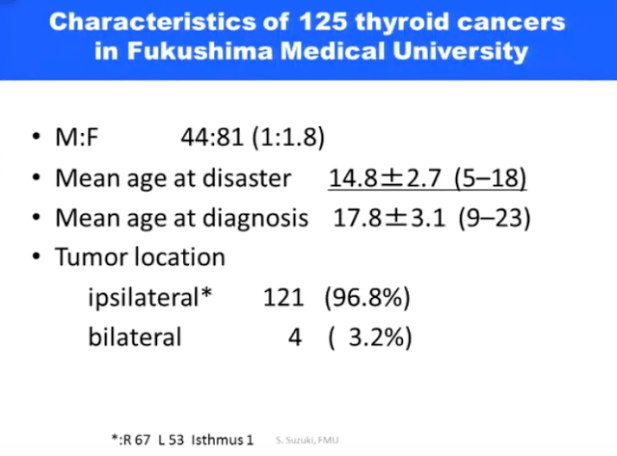
125 cases consisted of 44 males and 81 females, with the female-to-male ratio** of 1.8 to 1.
Age at the time of the accident (i.e. age at exposure) ranged from 5 to 18 years, with an average age of 14.8 ± 2.7 years. Age at diagnosis ranged from 9 to 23, with an average age of 17.8 ± 3.1 years.
Location of tumor was ipsilateral (i.e. one-sided) in 121 cases (96.8%) and bilateral (i.e. on both sides) in 4 cases. In 121 ipsilateral cases, 67 were located in the right lobe, 53 in the left lobe, and 1 in the isthmus which connects together the lower thirds of the right and left lobes.
**Thyroid cancer is known to occur more commonly in females. The female to male ratio tends to increase with age. For instance, the female to male ratio in the 2009 US study is 4.3:1 with 94.5% of cases ≥ age 10 [1] . In the 1995 study of the cancer registry data from 1963 to 1992 in England and Wales, the female to male ratio was 1.25:1 in ages 5-9 and 3.1:1 in ages 10-14 [2]. The female to male ratio is also known to decrease in the radiation exposed cases. In the 2008 study that compared thyroid cancer cases (exposed to radiation) in Belarus, Ukraine and Russia after the Chernobyl accident with unexposed cases in the same region as well as in UK and Japan, the female to male ratio was 4.2:1 overall, 2.4:1 in age <10, 5.2:1 in age ≥10 in the unexposed cases, whereas the female to male ratio was 1.5:1 overall, 1.3:1 in age <10, and 1.6:1 in age ≥10 in the exposed cases [3].
Slide 3

TNM classification is explained below. Japan has its own clinical guidelines on cancers, but the TNM classification is essentially the same with the exception of the “Ex” notation which refers to the degree of extension outside the thyroid capsule:
Ex1 means minimal extension (example: extension to sternothyroid muscle or perithyroid soft tissues) and is equivalent to T3.
Ex2 means further extension and is equivalent to T4.
Prefix “c” refers to “clinical” while “p” refers to “pathological.”
Pre-operative tumor size here refers to the largest diameter measured by ultrasound. It ranged from 5 mm to 53 mm with average of 14.0 ± 8.5 mm. (Note: The largest pre-op diameter was 45.0 mm for the first round and 35.6 mm for the second round. It is unclear where “53 mm” came from).
44 had tumor size ≤ 10 mm and limited to the thyroid.
57 had tumor size > 10 mm but ≤ 20 mm and limited to the thyroid.
12 had tumor size > 20 mm but ≤ 40 mm and limited to the thyroid.
12 had tumor size > 40 mm and limited to the thyroid, or any size tumor minimally extending outside the thyroid.
28 had metastases to the regional lymph node.
5 had lymph node metastases near the thyroid, within the central compartment of the neck.
23 had lymph node metastases to further areas of the neck.
3 had distant metastases to the lungs. This is the first time that any clinical details of the distant metastasis cases are given.
1) Male. Age at exposure 16, age at surgery 19.
Pre-operative: cT3 cN1a cM1. Tumor size > 40 mm and limited to thyroid or any size with minimal extension outside the thyroid. Metastasis to lymph nodes in the central compartment of the neck. Distant metastasis.
Post-operative: pT3 pEx1 pN1a pM1. Tumor size > 40 mm and limited to thyroid or any size with minimal extension outside the thyroid. Minimal extension outside the thyroid. Metastasis to lymph nodes within the central compartment of the neck. Distant metastasis.
2) Male. Age at exposure 16, age at surgery 18.
Pre-operative: cT3 cN1b cM1. Tumor size > 40 mm and limited to thyroid or any size with minimal extension outside the thyroid. Metastasis to the neck lymph nodes outside the central compartment. Distant metastasis.
Post-operative: pT2 pEx0 pN1b pM1. Tumor size > 20 mm but ≤ 40 mm and limited to the thyroid. No extension outside the thyroid. Metastasis to the neck lymph nodes outside the central compartment. Distant metastasis.
3) Female. Age at exposure 10, age at surgery 13.
Pre-operative: cT1b cN1b cM1. Tumor size > 1 cm but ≤ 2 cm, limited to the thyroid. Metastasis to the neck lymph nodes outside the central compartment. Distant metastasis.
Post-operative: pT3 pEx1 pN1b pM1. Tumor size > 40 mm and limited to thyroid or any size with minimal extension outside the thyroid. Minimal extension. Metastasis to the neck lymph nodes outside the central compartment. Distant metastasis.
*****
TNM classification for differentiated thyroid cancer from the American Cancer Society website.
Primary tumor (T)
T indicates the size of the primary tumor and whether it has grown into the nearby area.
T1a: Tumor ≤ 1 cm, limited to the thyroid
T1b: Tumor > 1 cm but ≤ 2 cm in greatest dimension, limited to the thyroid
T2: Tumor size > 2 cm but ≤ 4 cm, limited to the thyroid
T3: Tumor size >4 cm, limited to the thyroid or any tumor with minimal extrathyroidal extension (eg, extension to sternothyroid muscle or perithyroid soft tissues)
T4a: The tumor is any size and has grown extensively beyond the thyroid gland into nearby tissues of the neck, such as the larynx (voice box), trachea (windpipe), esophagus (tube connecting the throat to the stomach), or the nerve to the larynx. This is also called moderately advanced disease.
T4b: The tumor is any size and has grown either back toward the spine or into nearby large blood vessels. This is also called very advanced disease.
Regional lymph nodes (N)
Regional lymph nodes are the central compartment, lateral cervical, and upper mediastinal lymph nodes:
N0: No regional lymph node metastasis
N1: Regional lymph node metastasis
N1a: Metastases to level VI (pretracheal, paratracheal, and prelaryngeal/Delphian lymph nodes)
N1b: Metastases to unilateral, bilateral, or contralateral cervical (levels I, II, III, IV, or V) or retropharyngeal or superior mediastinal lymph nodes (level VII)
Distant metastasis (M)
M0: No distant metastasis is found
M1: Distant metastasis is present
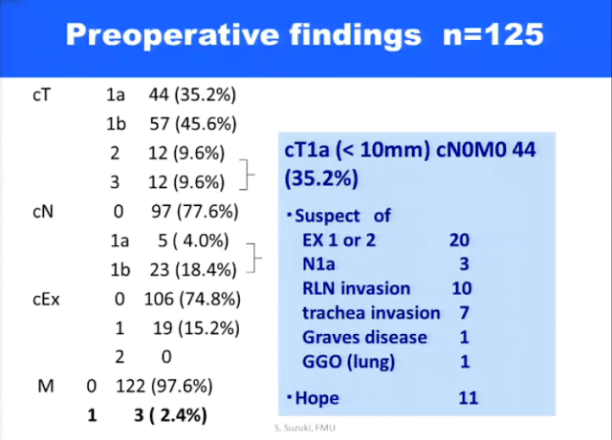
1 case: Ground-glass opacity (GGO) of the lungs

Slide 6
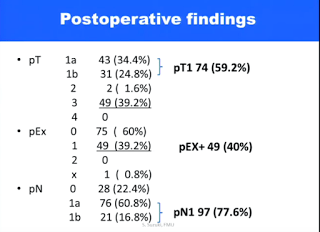
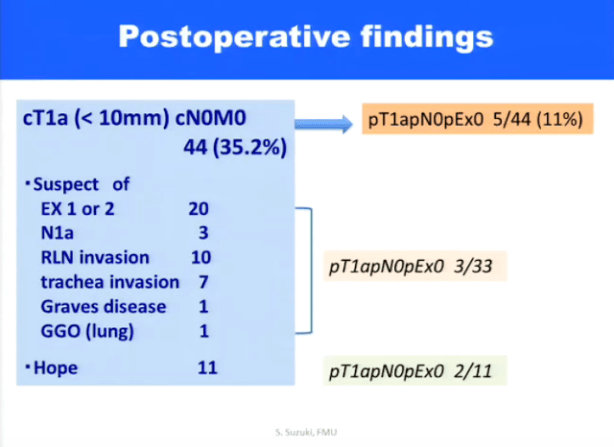
This slide shows what was found during the surgery and subsequent pathological examination of the excised tissues and lymph nodes.

Notable is the number and percentage of cases confirmed to have minimal extension outside the thyroid capsule, pEx1. This number, 49 (40%), is the same as pT3, suggesting pT3 in this group denotes any size tumor with minimal extension outside the thyroid capsule.
Even more notable is the number of regional lymph node metastases. 5 cases of cN1a turned out to be 76 cases of pN1a. Overall, 97 (77.6%) of 125 had regional lymph node metastasis.


Slide 9
This slide shows algorithms for diagnosis and treatment of papillary thyroid cancer according to the Japanese clinical guidelines.

Slide 10
This slide shows a comparison of surgical methods between Belarus and Fukushima. Most cases in Fukushima underwent hemithyroidectomy or lobectomy, whereas total thyroidectomy was the most common surgical method in Belarus.
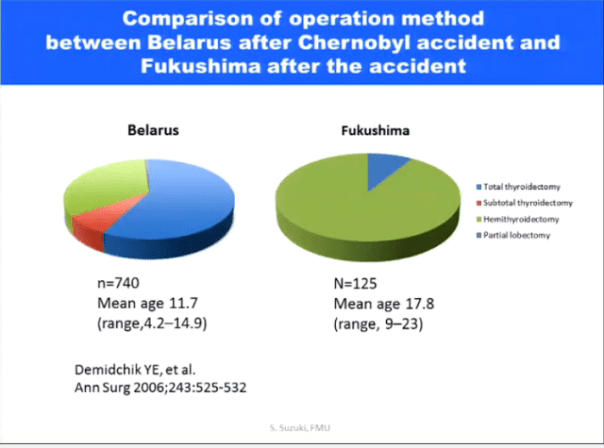
Suzuki mentioned that extra care has been taken to reduce complications from surgeries, and hemithyroidectomy was employed when possible to decrease the lifetime need for thyroid hormone supplementation. Also, this article by Japan’s top thyroid surgeons states, “At present, Western countries adopted almost routine total thyroidectomy with radioactive iodine (RAI) ablation, while limited thyroidectomy with extensive prophylactic lymph node dissection has traditionally been performed for most patients in Japan.(…) In Japan, however, limited thyroidectomy such as subtotal thyroidectomy and lobectomy with isthmectomy has been traditionally adopted as the standard. This is partially because the capacity to perform RAI therapy is limited due to legal restrictions, and RAI therapy is not considered cost effective by the healthcare system in Japan. [10]”
Slide 11
This slide shows the genetic mutation profile in different study groups. 63.2% of 52 cases from Fukushima was shown to have BRAF mutation. In the 2015 study by Mitsutake et al.[11] shown in the green box, 43 (63.2%) of 68 cases are shown to be positive for BRAF V600E point mutation. The same study also shows 10.3% was positive for RET/PTC rearrangements (6 cases of RET/PTC1 and 1 case of RET/PTC3) and 4 cases (5.9%) had ETV6/NTRK3 rearrangement. (It’s unclear where “n=52” and 8.8% of TRK fusion came from for the Fukushima column, as the Mitsutake study has n=68 and did not test for TRK fusion. It’s also unclear where the Japanese adult data came from. Literature search revealed the BRAF frequency in PTC of Japanese adults varied in a wide range: 28.8% [12], 38.2% [13], 38.4% [14] , 53% [15], and 82.1% [16]).
The official stance is that the genetic alterations observed in Fukushima cases are similar to what is seen in typical adult papillary thyroid cancer and “probably reflects genetic status of all sporadic and latent thyroid carcinomas in the young Japanese population [11].” In other words, the official assert that the genetic profile appears consistent with the official claim that screening is diagnosing spontaneous and latent cancers which might not have been detected without screening.
However, literature varies in regards to how the genetic mutations are associated with radiation exposure, age, and iodine status. RET/PTC rearrangements, frequently seen in Chernobyl, are associated with both radiation-induced and spontaneous thyroid cancer [17], more common at younger age and in iodine deficient areas [18]. BRAF mutation is known to be seen more frequently in older age, but recent studies showed BRAF V600E was present in 36.8% (median age 13.7 years) [19] and 63% (median age 18.6 years) [20] of pediatric papillary thyroid carcinoma. BRAF mutation were associated with high iodine intake in China [21], while no difference in BRAF V600E frequency was found between iodine-rich and iodine-deficient countries recently [16].

Slide 12
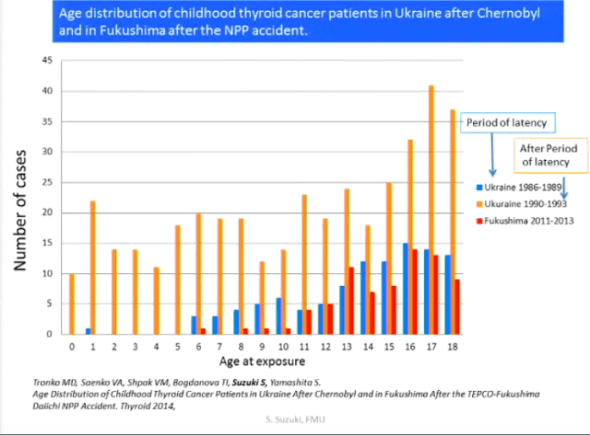
This slide shows a graph with age distribution of thyroid cancer patients in Ukraine and Fukushima in different post-accident time periods, compiled by superimposing 2 graphs from Letter to the Editor of Thyroid [21]. Blue bars are for 1986-1990 in Ukraine (first 4 years after the Chernobyl accident) and red bars are for 2011-2013 in Fukushima (first 3 years after the Fukushima accident), both time periods representing “latency” for radiation-induced thyroid cancer in children. Orange bars are for 1990-1993 in Ukraine–after the latency period–showing a large increase in thyroid cancer cases in Ukrainian residents who were 18 or younger when the accident happened. Increased number of cases in those who were age 5 or younger set this time period apart. The year 1990 is also when large-scale screening programs began, initiated by international organizations [22].
The age distribution is “strikingly similar” between the first 4 post-accident years in Ukraine (blue bars) and the first 3 years in Fukushima (red bars), as acknowledged by the letter. However, the letter is inconsistent in claiming “if thyroid cancers in Fukushima were due to radiation, more cases in exposed preschool-age children would have been expected” and defining the first 4 years as “latency.” This illogical claim is also seen in a slightly different format as a comparison between different post-accident periods [23].
*****
Classification of cervical lymph nodes by the Japanese clinical guidelines
I: Prelaryngeal nodes: LN anterior to the thyroid cartilage and the cricoid cartilage
II: Pretracheal nodes: LN anterior to trachea, dissectible posteriorly from the inferior border of thyroid
III: Paratracheal nodes: LN lateral to trachea, extending inferiorly to where it is dissectible from the neck and superiorly where recurrent laryngeal nerve enters trachea.
IV: Prethyroid nodes: LN adjacent to anterior and lateral parts of thyroid. Laterally includes LN attached to thyroid when middle thyroid artery is ligated and cut. (Equivalent to the AJCC Level IV: lower jugular nodes)
(I, II, III and IV are equivalent to the AJCC Level VI: anterior compartment LN)
V: Superior internal jugular nodes: LN along internal jugular vein but superior to the inferior border of cricoid cartilage. This is further subdivided into superior and inferior at the bifurcation of common carotid artery
Va LN: inferior to the bifurcation of common carotid artery (equivalent to the AJCC Level II: upper jugular nodes)
Vb LN: superior to the bifurcation of common carotid artery (equivalent to the AJCC Level III: middle jugular nodes)
VI: Inferior internal jugular nodes: LN along internal jugular vein, inferior to the inferior border of cricoid cartilage. Includes LN in supraclavicular fossa.
VII: Posterior triangle nodes: LN located in posterior triangle bordered by anterior border of sternocleidomastoid muscle, posterior border of trapezius muscle, and omohyoid muscle.
VIII: Submandibular nodes: LN in the submandibular triangle.
IX: Submittal nodes: LN in the submental triangle.
(VIII and IX are equivalent to the AJCC Level I)
X: Superficial cervical nodes: LN superficial to superficial layer of the deep cervical fascia enclosing sternohyoid and sternocleidomastoid muscles.
XI: Superior mediastinal nodes: LN unresectable by neck dissection
(Equivalent to the AJCC Level VII: superior mediastinal nodes)
References
[1] Hogan AR, Zhuge Y, Perez EA, Koniaris LG, Lew JI, Sola JE. Pediatric thyroid carcinoma: incidence and outcomes in 1753 patients. J Surg Res. 2009 Sep;156(1):167-72. doi: 10.1016/j.jss.2009.03.098.
[2] Harach HR, Williams ED. Childhood thyroid cancer in England and Wales. British Journal of Cancer. 1995;72(3):777-783.
[3] Williams ED, Abrosimov A, Bogdanova T, et al. Morphologic Characteristics of Chernobyl-Related Childhood Papillary Thyroid Carcinomas Are Independent of Radiation Exposure but Vary with Iodine Intake. Thyroid. 2008;18(8):847-852. doi:10.1089/thy.2008.0039.
[4] Robbins K, Clayman G, Levine PA, et al. Neck Dissection Classification Update: Revisions Proposed by the American Head and Neck Society and the American Academy of Otolaryngology–Head and Neck Surgery. Arch Otolaryngol Head Neck Surg. 2002;128(7):751-758. doi:10.1001/archotol.128.7.751.
[5] Ory C, Ugolin N, Schlumberger M, Hofman P, Chevillard S. Discriminating Gene Expression Signature of Radiation-Induced Thyroid Tumors after Either External Exposure or Internal Contamination. Genes. 2012;3(1):19-34. doi:10.3390/genes3010019.
[7] LiVolsi, VA, et al. The Chernobyl Thyroid Cancer Experience: Pathology. Clinical Oncology. 23(4):261-267.
[8] Williams ED, Abrosimov A, Bogdanova T, et al. Morphologic Characteristics of Chernobyl-Related Childhood Papillary Thyroid Carcinomas Are Independent of Radiation Exposure but Vary with Iodine Intake. Thyroid. 2008;18(8):847-852. doi:10.1089/thy.2008.0039.
[9] Nikiforov YE, Seethala RR, Tallini G, et al. Nomenclature Revision for Encapsulated Follicular Variant of Papillary Thyroid Carcinoma: A Paradigm Shift to Reduce Overtreatment of Indolent Tumors. JAMA Oncol. 2016;2(8):1023-1029. doi:10.1001/jamaoncol.2016.0386.
[12] Namba H, Nakashima M, Hayashi T, Hayashida N, Maeda S, Rogounovitch TI, Ohtsuru A, Saenko VA, Kanematsu T, and Yamashita S. Clinical Implication of Hot Spot BRAF Mutation, V599E, in Papillary Thyroid Cancers. The Journal of Clinical Endocrinology & Metabolism. 2003;88(9):4393-4397.
[13] Nasirden A, Saito T, Fukumura Y, et al. Virchows Arch (2016). doi:10.1007/s00428-016-2027-5.
[14] Ito Y, Yoshida H, Maruo R, et al. BRAF Mutation in Papillary Thyroid Carcinoma in a Japanese Population: Its Lack of Correlation with High-Risk Clinicopathological Features and Disease-Free Survival of Patients. Endocrine Journal. 2009;5(1):89-97.
[15] Fukushima T, Suzuki S, Mashiko M, et al. BRAF mutations in papillary carcinomas of the thyroid. Oncogene. 2003;22:6455–6457. doi:10.1038/sj.onc.1206739.
[16] Vuong HG, Kondo T, Oishi N, et al. Genetic alterations of differentiated thyroid carcinoma in iodine‐rich and iodine‐deficient countries. Cancer Medicine. 2016;5(8):1883-1889. doi:10.1002/cam4.781.
[17] Nikiforov YE, Rowland JM, Bove KE, Monforte-Munoz H, and Fagin JA. Distinct Pattern of ret Oncogene Rearrangements in Morphological Variants of Radiation-induced and Sporadic Thyroid Papillary Carcinomas in Children. Cancer Res. May 1997;57(9):1690-1694.
[18] Leeman-Neill RJ, Brenner AV, Little MP, Bogdanova TI, Hatch M, Zurnadzy LY, Mabuchi K, Tronko MD, and Nikiforov YE. RET/PTC and PAX8/PPARγ chromosomal rearrangements in post-Chernobyl thyroid cancer and their association with iodine-131 radiation dose and other characteristics. Cancer. 2013;119:1792–1799. doi:10.1002/cncr.27893.
[19] Givens DJ, Buchmann LO, Agarwal AM, Grimmer JF, and Hunt JP. BRAF V600E does not predict aggressive features of pediatric papillary thyroid carcinoma. The Laryngoscope. 2014;124:E389–E393. doi: 10.1002/lary.24668.
[20] Henke LE, Perkins SM, Pfeifer JD, Ma C, Chen Y, DeWees T, and Grigsby PW. BRAF V600E mutational status in pediatric thyroid cancer. Pediatr Blood Cancer. 2014;61:1168–1172. doi:10.1002/pbc.24935.
[21] Guan H, Ji M, Bao R, et al. Association of High Iodine Intake with the T1799A BRAF Mutation in Papillary Thyroid Cancer. The Journal of Clinical Endocrinology & Metabolism. 2009;94(5):1612-1617. doi:10.1210/jc.2008-2390.
[22] International Advisory Committee. The International Chernobyl Project. Assessment of radiological consequences and evaluation of protective measures.
Technical Report. Vienna: International Atomic Energy Agency; 1991.
[23] Takamura N, Orita M, Saenko V, Yamashita S, Nagataki S, and Demidchik Y. Radiation and risk of thyroid cancer: Fukushima and Chernobyl. The Lancet Diabetes & Endocrinology. 2016;4(8):647. doi:10.1016/S2213-8587(16)30112-7.
Where is the Responsibility of the Government and TEPCO?
It is up to each individuals to a carry glass badge to measure and avoid the irradiation. It is up to them to choose food. Now it is up to them to treat the nuclear waste.
Where is the responsibility of the government and TEPCO?

Special workshop to learn how to treat the waste resulting from the accident.
It takes only one day
No charge for the workshop and documents.
Open the black bags.
Separate the waste items.
Then break, burn or bury.
At Iwaki city: December 7th 2016
At Fukushima city: December 20th 2016
At Kôriyama city: January 24th 2017
Open to the people who:
Plan to return to the zone where the evacuation order has been or will be lifted or plan to get a job there;
Plan to get a job in 12 evacuated localities in the future ( Tamura city, Minamisoma city, Kawamata town, Hirono town , Naraha town, Tomioka town, Kawauchi village, Okuma town, Futaba town, Namie town, Katsurao village, Iitate village );
Plan to create firms in the 12 evacuated localities;
Are 18 years or older and;
Not belonging to a Yakuza organization
Accelerate water-purifying work at Fukushima plant to cut leakage risk
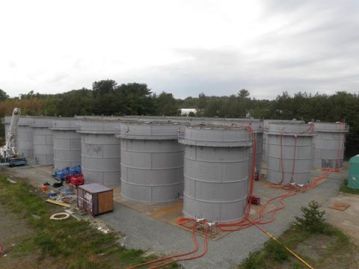
The volume of contaminated water continues to increase at Tokyo Electric Power Company Holdings Inc.’s Fukushima No. 1 nuclear power plant. Efforts to deal with this problem must be reinforced.
TEPCO has compiled a new set of measures to deal with the radioactive water. The steps are aimed at reducing to nearly zero the contaminated water inside reactor buildings, the prime source of the tainted water.
Under the new measures, the contaminated water accumulated in the basements of reactor buildings is to be purified and then transferred to storage tanks. At the same time, facilities exclusively used for purifying the tainted water are to be doubled, and the existing storage tanks will be replaced with larger ones, increasing the overall storage capacity.
Meanwhile, the volume of groundwater to be pumped up from the wells near the reactor buildings is to be increased. This is aimed at reducing the flow of underground water into the buildings, thus preventing a vicious cycle of generating more tainted water.
If all goes well, the increase in the volume of contaminated water is expected to nearly stop by 2020. We hope TEPCO will realize this goal steadily.
The measures taken so far have centered on the construction of “ice walls,” to prevent groundwater from entering the reactor buildings by freezing the underground soil around the buildings. Because this step has failed to prove effective even more than half a year after the related facilities were put into operation, TEPCO decided to shift its priority measures.
The new measures will require the approval of the Nuclear Regulation Authority. Both TEPCO and the NRA must cooperate closely so that the necessary work will not be delayed.
Consider ocean release
The reactor buildings have, in effect, turned into storage facilities for contaminated water. The volume of tainted water totals about 68,000 tons. Although the amount of radioactive material contained in the water has declined markedly when compared to the amount immediately after the nuclear accident occurred, it still remains at a high level.
The large amount of contaminated water inside the reactor buildings carries a risk of radiation exposure, posing a serious impediment to the work to decommission the plant. If highly radioactive water starts leaking underground out of the buildings and into the sea, it will create a serious situation.
Even if new measures proceed smoothly, however, tasks remain. The volume of purified water to be stored in the tanks is expected to nearly double by 2020 to about 1.2 million tons. Not only will this entail a huge maintenance cost, but there is also a danger that the water will leak if the tanks are damaged by an earthquake or other factors.
Releasing purified water that has met the existing safety criteria into the sea must be seriously considered. The discharge of purified water into the ocean has been routinely conducted at nuclear power-related facilities both at home and abroad.
It is important for both the government and TEPCO to do their utmost to explain such a plan in detail in order to win the understanding of local residents concerned. Efforts should also be made to take measures to prevent groundless rumors from adversely affecting the fisheries industry and other sectors.
It is also necessary to continuously ascertain the effect of the ice walls. Although nearly 100 percent of the walls have already been frozen, groundwater is reportedly flowing through thin gaps in the walls. Rainwater seeping through the topsoil has also increased the amount of groundwater inside the buildings.
TEPCO is proceeding with work to fill the gaps in the ice walls. If the work proves effective, the goal of reducing to zero the increase in the contaminated water will be realized two years earlier than envisaged. We hope TEPCO will strenuously work to block the flow of groundwater into the buildings.
Japan’s defense chief stands by past statement on nuclear armament
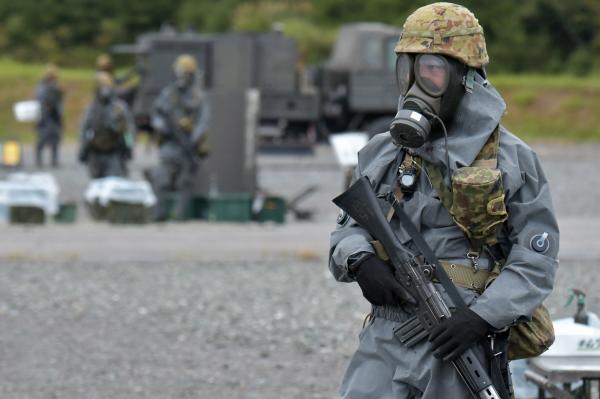
A member of Japan’s Ground Self-Defense Force takes part in a joint military exercise. Japan’s defense chief is under fire for previously suggesting a nuclear strategy for the country, and for saying a military conscription policy would not violate Japan’s constitution.
TOKYO, Oct. 12 (UPI) — Japanese Defense Minister Tomomi Inada is standing firm after opposition party politicians in Tokyo asked her to retract remarks on nuclear armament.
In an interview with Japanese magazine Seiron in March 2011, Inada had said that in the long term Japan should look into a nuclear strategy, the Tokyo Shimbun reported Wednesday.
Inada, who was appointed defense minister in August, was a lawmaker with the ruling Liberal Democratic Party at the time and has served as a Cabinet member under Japanese Prime Minister Shinzo Abe.
Shinkun Haku, a Japanese politician of the opposition Democratic Party of Japan, criticized Inada’s past statement.
“That someone with such a personal opinion became the defense chief is a problem,” Haku said, while urging Inada to retract her previous remarks.
Japan is a signatory of the Treaty on the Non-Proliferation of Nuclear Weapons and relies on the U.S. extended nuclear deterrent.
But Inada said she has no plans to withdraw the statement because the remarks were made in the context of the situation at the time, according to the Japanese newspaper.
Inada also said she is not retracting remarks she made in the interview about implementing a military conscription policy because she “doesn’t think the draft violates the constitution.”
Tokyo is concerned about North Korea’s multiple provocations and Chinese vessels that have entered Japan-claimed waters near the disputed Senkaku Islands.
In early September, a Japanese command to “destroy” incoming North Korea missiles repeatedly failed when North Korea launched three ballistic missiles that landed west of Hokkaido.
North Korea’s provocations continue to have an impact on Japanese politicians, according to a recent poll conducted by television network NHK.
A survey of Japanese citizens conducted Oct. 9-11 showed support for Abe has fallen since early September, as North Korea provocations have subsided and the country has not engaged in further tests during a national anniversary on Oct. 10.
Support for Abe was about 60 percent in September, but that figure was down by about 7 percentage points, according to the NHK poll.”
How Pasadena-based cellist and Chernobyl survivor helps children in Japan
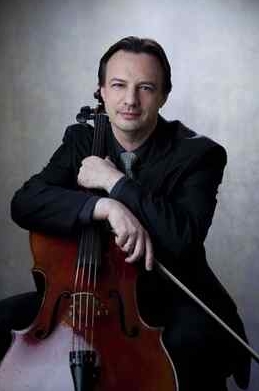
Cellist Marek Szpakiewicz will perform a recital with pianist Jiayi Shi at Azusa Pacific University in Azusa Oct. 15 to raise funds for a three-quarter sized cello for the Soma Children’s Orchestra in Fukushima, Japan.
He was only 16 in 1986, but Marek Szpakiewicz understood the impact of the nuclear reactor meltdown in Chernobyl. Though it was less than 400 miles away from his home in Lublin, Poland, his family was unable to leave. However, Szpakiewicz was a talented cello player, and in 1991 he won a scholarship to study at the Peabody Institute of John Hopkins University in Baltimore, Maryland, and later settled in Pasadena.
In 2011, the Tohoku earthquake and tsunami in Japan kept Szpakiewciz glued to the news, moved by the survivor stories and the deaths of more than 15,800 people and recalling his own memories of Chernobyl.
“In Fukushima, there is a community there living, and they are affected by this, and we have stopped talking about it, but the kids are growing and we won’t know the consequences, we don’t know the amount of devastation,” Szpakiewicz said. “What can I do? I know music, so I can bring the music, and we know the power of music is just incredible.”
In 2012 El Sistema Japan formed the Soma Children’s Orchestra in Fukushima and Szpakiewicz immediately began lending his support. Two years later, when he spent a day with the orchestra in Japan, he noticed that mostly it was only older, bigger kids that played the cello. He also learned that one student, Risa Yoshida, was heartbroken when she’d had to give her up her half-sized cello to another child.
Szpakiewicz remembered a similar experience of his own.
“As a child, I was small and in Poland the funds are not so big and the school didn’t have the quarter-size (cello), the size I should start (with),” Szpakiewicz said. “So for a year I was practicing on the broom to practice my motions. Luckily, I was growing fast so the second year I could pick up the half-sized cello. I could finally have the cello at home from school and practice and that’s how my education started. So the pain of not having the instrument, I remember.”
In 2015, Szpakiewicz held a concert and was able to raise the money to provide Risa with a half-sized cello.
“Marek’s gift means a lot to our children in terms of ensuring a young girl’s access to quality music education,” said Yutaka Kikugawa, president of El Sistema Japan. “The new cello has broadened her horizon for music passage and made it possible for her to play the Beethoven’s 5th Symphony side-by-side with the Berliner Philharmonic in March 2016, which was certainly a lifetime experience for her.”
Szpakiewicz will perform a recital with pianist Jiayi Shi at Azusa Pacific University in Azusa Oct. 15, hoping to raise money this time for a three-quarter sized cello for the Soma Children’s Orchestra. Monrovia resident Shi also came to the United States to further her education. The two perform together often and will play selections by Chopin, Rachmaninoff, Schumann, Barber and Gershwin.
In addition to Chernobyl, Szpakiewicz lived through communist rule, which had its hold on Poland until 1989.
“From the moment I was growing up, the music was a hope for a better life,” Szpakiewicz said. “Music didn’t only play a tremendous role in my education, but my development, all the dreams and hopes that music provided for me.”
Arriving in Baltimore unable to speak a word of English, Szpakiewicz worked hard and then went on to USC, earning three degrees and a doctorate. In 2008 the U.S. government granted him permanent residency as an Extraordinary Ability Artist, and he landed a job teaching cello and serving as the director of chamber music at APU. This year he was also named an assistant professor.
“I feel the power of America, a country for foreigners. I came here, I feel so good here. My roots are in Poland, but this is my home now. This is my country,” Szpakiewicz said. “I always dreamt about coming to the States, that’s the country where I pictured myself as a child. With all the tragedy that happened in my life, I have no reason to complain because I feel privileged, I feel lucky and I feel that I have to share, so that motivates me, the kindness that I came and witnessed, so I want to pass it on.”
Szpakiewicz has a full concert schedule, including a performance with Shi in Tokyo Oct. 29. There, the Soma Children’s Orchestra, along with Risa, will join him in the encore.
Data on nuclear studies, workers may have leaked from university
Hacked: a good news. Hopefully those hackers might release crucial important data, which would change us from Tepco B.S and Japanese government censored information.

OYAMA–Personal information and nuclear research, including studies concerning the crippled Fukushima No. 1 nuclear plant, might have leaked in a cyber-attack at the University of Toyama here, the school reported Oct. 10.
The leaked data could possibly affect 1,492 students, researchers and individuals from public organizations and companies who conduct joint studies with the institution’s Hydrogen Isotope Research Center.
“We apologize for causing great trouble to associated organizations,” said Yasumaru Hatanaka, the university’s vice president.
However, the research that might have leaked, such as studies on water decontamination at the Fukushima nuclear plant, had all been previously presented at academic meetings, so there was no breach in confidentiality, the university said.
No malicious use of the data has been reported since the data breach came to light in June.
According to the university, the cyber-attack targeted a computer operated by a part-time employee specializing in tritium research at the center.
An e-mail containing malware was sent to both the worker and a professor with the facility in November 2015. The professor did not open the e-mail, but the employee did, causing the computer to become infected with a virus.
As a result, the employee’s computer became remotely accessible, and it made connections with four outside servers between November and June. The university’s investigation showed that the computer sent large amounts of data to two of these servers.
A further analysis of the computer found indications that at least 1,000 archive files had been created between last November and February.
Considering their size, nearly all the data stored in the computer may have been compressed into these files. Similar archive files were created using a different method in March, the university said.
The university became aware of the cyber-attack after an outside organization warned the school about suspicious network activities made by the employee’s computer.
According to a wildlife journalist, even in Tokyo some animals suffer mutations
Already few weeks ago a Japanese friend mentioned to me that he noticed very few insects this summer in Tokyo. This article now corroborates it.
If the wild life around Tokyo is that affected, how about the health of the people living there?

Frog having one eye only (photo by Eiki Sato, from October 10, 2016)
Ravages in Tokyo from the nuclear accident at Fukushima Daiichi 250km away.
The documentary film “Paradise Phantom” just came out. This documentary is about the stationary observations on animals by Eiki Sato, a wildlife journalist. The screening of this film took place at a movie theater in Suginami-ku, Tokyo on September 25, 2016.
Sato filmed for 170 hours various animals in the wild places of Tokyo, for example the banks of the Arakawa river, the fields near sports stadiums and Tokyo plants. These are real paradises for many living creatures, such as kestrels, shrikes, bats, frogs, dragonflies, even the gray beetles, animals that are not on the global red list threatened species.
The documentary shows that since two years animals with abnormalities are being observed . The cause of these abnormalities would be the accumulated radioactivity in the soil of Tokyo, according to Eiki Sato.
During his observations Eiki Sato found many types of deformities, due to mutations: Various insects affected with malformed or missing wing, or with curled wings, or abnormal eyes, unabling them to fly. Mosquito with bent spine, dragonflies with mishaped eyes unable to fly high. Birds with affected eyes, or feathers, unable to fly. Many also cannot reproduce, their population sharply decreasing.
http://www.tokyo-sports.co.jp/entame/entertainment/602104/
Nuclear-powwered USS Ronald Reagan to join U.S.-South Korean joint naval drills
The large-scale naval drills, known as Invincible Spirit, kicked off Monday and are due to run for six days, the South’s navy said in a statement.
On Monday, the allies carried out exercises involving ship-to-ground and submarine-to-ground cruise missiles with average flight ranges of up to 1,000 km, the South Korean Defense Ministry said.
The exercises come just days after reports that the North may be making preparations for a sixth nuclear test or a long-range rocket launch…….
The reclusive nation [North Korea] also stoked concern in August when it claimed to have successfully test-fired a submarine-launched ballistic missile (SLBM). North Korean leader Kim Jong Un called that test “the greatest success” after the missile landed in Japan’s air defense identification zone, flying about 500 km — its longest test-flight by a weapon of that type.
The SLBM test has left the United States, South Korea and Japan worried that further developmental successes could give the North a difficult-to-detect weapon that would pose a serious security threat to all of them.
The U.S. and its Asian allies have responded to the North’s tests by showing off their own military muscle.
Late last month, the U.S. and South Korea conducted joint naval exercises in the Sea of Japan after Washington earlier in the month flew two supersonic bombers over the South — with one landing on the Korean Peninsula for the first time in 20 years.
One of the bombers also flew the closest a B-1B strategic bomber had ever flown to the border between the North and South. It was the second time in less than a month that the U.S., which has about 28,500 troops in South Korea, had flown bombers over the country. http://www.japantimes.co.jp/news/2016/10/10/asia-pacific/u-s-south-korean-joint-naval-drills-kick-off-nuclear-powered-uss-ronald-reagan-set-take-part/#.V__uQeV97Gg
North Korea on track to ramp up its nuclear weapons
US think tank warns North Korea could develop up to 100 nuclear weapons by 2020 http://www.ibtimes.co.uk/us-think-tank-warns-north-korea-could-develop-100-nuclear-weapons-by-2020-1585557 Rand Corporation says Pyongyang is testing nuclear missiles that can threaten targets across the Pacific Ocean. By Ananya Roy October 10, 2016 A US-based think tank has estimated that given the pace of North Korea’s nuclear programme, Pyongyang could have enough fissile material to develop up to 100 nuclear weapons by 2020. The organisation has warned ahead of the US presidential elections that the new administration would face major challenges from the East Asian country, highlighting the need to review its policy on Pyongyang.
In its latest report, Rand Corporation – an American nonprofit global policy think tank – said that Japan and South Korea are “losing faith in the US nuclear umbrella”. The think tank warned that it was upset as Washington failed to constrain North Korea’s nuclear programme, which has led to the two US allies to call for “independent nuclear arsenals”. Rand Corporation noted that the new administration that takes charge in Washington following the 8 November election would have to focus on tackling the growing security threats in the Korean peninsula.
“During the next four to six years, Pyongyang will possess a nuclear force of sufficient size, diversity, reliability, and survivability to invalidate our regional military posture and war plans by holding at risk key bases and amplifying the risk to allies.
“The most recent open-source estimates suggest North Korea may already have enough fissile material to build between 13 and 21 nuclear weapons; by 2020, it could possess enough for 50 to 100. The DPRK [Democratic People’s Republic of Korea or North Korea] can already deliver nuclear weapons by aircraft or ship and perhaps by theater ballistic missiles; it is now testing nuclear-capable missiles that could threaten targets across the Pacific Ocean, including the continental United States. “Current estimates suggest a number of these nuclear-tipped missiles—long-range, road-mobile, and submarine-launched—could be operational between 2020 and 2025,” the report warned.
It further stated: “A DPRK nuclear force approaching 100 weapons with multiple delivery means likely poses an unacceptable threat to US and South Korea [or the Republic of Korea, ROK] security, as well as a serious proliferation threat.”
The foreign policy think tank stressed that the incoming US administration will have to face “critical policy questions” involving what measures need to be taken to stop North Korea’s Kim Jong-un from pursuing their nuclear programme; what should the US do if provocation continues and what should be done if South Korea initiates a counterforce attack or begins developing its own nuclear force.
China’s plan for small floating nuclear reactors carries potentially devastating risks
Could China build the world’s smallest nuclear power plant and send it to the South China Sea?
Nuclear plant under development could fit into a shipping container and make a small island economically viable, CNBC, Stephen Chen, 11 Oct 16 SCMP A top mainland research institute is developing the world’s smallest nuclear power plant, which could fit inside a shipping container and might be installed on an island in the disputed South China Sea within five years.
Although the small, lead-cooled reactor could be placed inside a shipping container measuring about 6.1 metres long and 2.6 metres high, it would be able to generate 10 megawatts of heat, which, if converted into electricity, would be enough to power some 50,000 households……The research is partially funded by the People’s Liberation Army.

Researchers at the Chinese Academy of Sciences’ Institute of Nuclear Energy Safety Technology, a national research institute in Hefei, Anhui province, say they hope to be able to ship the first unit within five years.
“Part of our funding came from the military, but we hope – and it’s our ultimate goal – that the technology will eventually benefit civilian users,” Professor Huang Qunying,a nuclear scientist involved in the research, said.
The Chinese researchers admit their technology is similar to a compact lead-cooled thermal reactor that was used by the navy of the former Soviet Union in its nuclear submarines in the 1970s.
However, China would probably be the first nation to use such military technology on land.
While these “baby” reactors would able to generate large quantities of electricity and desalinate huge supplies of seawater for use as fresh water, they have also attracted serious environmental concerns.
If any one of them were to suffer a catastrophic problem, the radioactive waste would affect not only the countries nearby, but also spread around the world via the region’s strong sea currents…….
The lead-cooled reactor is part of China’s efforts to develop new-generation reactors for its rapidly expanding nuclear energy sector. Other technological approaches, such as molten salt reactors and high-temperature gas-cooled reactors, are also under rapid development thanks to generous government funding.
China also has been considering building small floating nuclear power plants using conventional technology to generate electricity for the South China Sea islands.
A marine environment researcher at the Ocean University of China, in Qingdao, Shandong province, has warned that the inevitable discharge of hot, radioactive water from a nuclear plant into the ocean might alter the ecological system of an entire region around an island.
“Many fish and marine creatures will not be able to deal with the dramatic change of environment caused by massive desalination and the rise of sea temperatures caused by a nuclear reactor,” said the researcher, who declined to be named.
“If a nuclear disaster happened in the South China Sea, it would not have an immediate effect on people living on the mainland owing to it being a great distance away,” the researcher said.
“But the radioactive waste would enter the bodies of fish and other marine creatures and likely end up on our dining tables. Sea currents could also carry the waste to distant shores,” she said.
Before putting any nuclear power plant on a remote South China Sea island, the Chinese government should consider not only its political, military or economic benefits, but also carry out comprehensive scientific evaluations on its potential environmental impact, the researcher said. http://www.cnbc.com/2016/10/11/could-china-build-the-worlds-smallest-nuclear-power-plant-and-send-it-to-the-south-china-sea.html
Newborn baby deaths significantly increased in areas radioactively polluted by Fukushima nuclear disaster
Increases in perinatal mortality in prefectures contaminated by the Fukushima nuclear power plant accident in Japan A spatially stratified longitudinal study
China going allout to market nuclear reactors to Asia, Europe, Africa and Middle East
 China’s nuclear plant makers seek new markets along the ancient Silk Road into Asia, Europe, Africa and Middle East SCMP, 04 April, 2016
‘One belt, one road’ policy for financing and support for infrastructure projects is helping nuclear plant constructors expand into overseas markets………The policy was first proposed in 2013 to promote infrastructure construction deals overseas along with goods and services trade along the ancient Silk Road from China to Europe and along the ancient maritime trade route linking China to southeast Asia, the Middle East and Africa. The state is offering financing at a time when China’s economy grew at the slowest rate in 25 years and its industry faces severe overcapacity problems.
Beijing has encouraged local firms to become involved in infrastructure projects in southeast Asia, Europe and Africa. Chinese nuclear reactor builders are a growing force in the global nuclear industry.
“The export of nuclear reactors will become one of the key pillars for executing China’s one belt, one road strategy,” Zheshang Securities analyst Zheng Dandan said………
Three Chinese state-backed firms are actively pursuing opportunities to export their reactor construction expertise, especially in developing nations that do not have their own construction capabilities.
Beijing-based projects developer China National Nuclear Corp (CNNC) chairman Sun Qin was quoted by state media China News Service last month as saying that 80 per cent of the up to 300 new reactors projected to be built by 2030 globally could be in ‘one belt, one road’ nations.
CNNC wants to build 30 reactors in such nations, and will use Argentina as a base to develop the South American market, Algeria for reaching out to the greater African market and Pakistan where it is building a project to develop the Asian market, Sun was reported as saying.
State Power Investment, formed via the merger of one of the nation’s “big five” power generators China Power Investment and general contractor State Nuclear Power Technology last year, is also pursuing overseas projects.
It has partnered with the US nuclear technology powerhouse Westinghouse to negotiate a potential deal to build a nuclear power project in Turkey. It has also pursued opportunities in South Africa.
Shenzhen-based projects developer China General Nuclear Power is working towards winning potential projects in Britain, Kenya and southeast Asia. It won one bid to build a plant in Romania.
The mainland leadership has made the globalisation of Chinese firms a key part of its economic reform plans, looking to establish the nation as a major provider of value-added and high-end goods and services. In a series of articles this week, the South China Morning Post examines the key industries targeting overseas expansion, beginning with the nuclear power industry.
About Fukushima
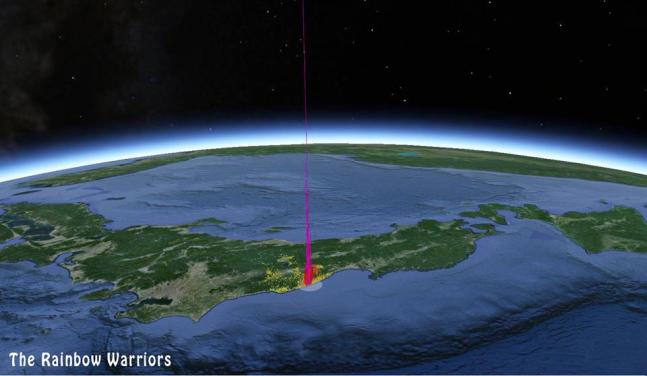
If in 2010 there was one birth and one death every 28 seconds in Japon, beginning 2014 there was one death every 25 seconds and a birth every 31 seconds: a differential of 2 seconds per year, this seems little yet it is significantly faster than in Ukraine.
Fukushima is much more severe, because there were 4 reactors instead of one, and the reactor 3 was using plutonium MOX, with at proximity a dense population. If the wind was favorable three days out of 4, it was also unfavorable 1 day out of 4.
The first 6 months of the Fukushima nuclear catastrophe in 2011, Tepco and the Japanese government were putting a lid on informations inside Japan, then gradually that omerta was broken by the people sharing informations on Twitter, Facebook, and blogs.
However, a language barrier remained. As of today there is a lot of informations in japanese circulated inside Japan, about radiation and contamination, about health issues, etc. Unfortunately those informations are not getting translated from japanese to english, due to the shortage of capable translators. As a result almost none of those important informations are getting outside of Japan reaching the outside world to teach the people everywhere the scale of the disaster and how it affects all those people lives.
The only informations coming out in english are those in the articles of the Japanese main stream media which are strongly under government influence when not just plain censorship, therefore publishing very sanitized informations, and the Western main stream media which are either under the nuclear lobby financial influence, or lacking the indepth details.
Not to mention the nonsense sensationalism of some of the American websites or Youtubers, produced only to increase visitors traffic and donations, which deals only in hyperboles, exaggerations, when not just plain lunacy.
The overall result is that we have an ongoing nuclear catastrophe now for 5 years and half, affecting millions of people on location in Japan, which outside of Japan most of the people are not aware, as it had not happened, was not happening.
The two main reasons being:
1. The sanitizing of information by the main stream media owned by the same financial interests which own the nuclear industry.
2. The language barrier which hinders the real facts, the real details to spread out of Japan.
And thanks to the continuous ignorance about the ongoing Fukushima Daiichi nuclear catastrophe, us not being capable to learn from it, its human tragedy, its harmful consequences to health and environment, it is like the whole world is ready for another new nuclear catastrophe, accepting it to come.
Why can’t we learn from our mistakes…
I wish to thank here Mochizuki Cheshire Iori of the Fukushima diary blog, Nancy Foust of Fukuleaks, and Pierre Fetet of the Fukushima blog, for their efforts year after year during the past 5 years and half to inform about Fukushima, those persons have accomplished an excellent and tremendous job, with integrity and no nonsense. My respect to you.
http://www.fukushima-blog.com/
Credit to Xavier Nast for the population statistics.
Japan Political Pulse: ‘Operation Tomodachi’ members need support amid radiation fears
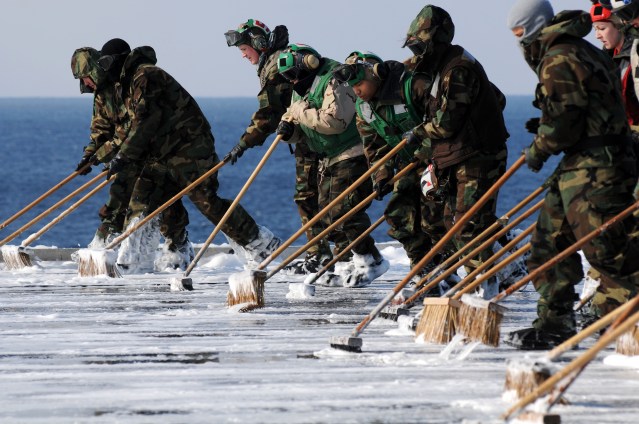
Many readers have offered support for a lawsuit filed by former U.S. servicemen and others claiming they were affected by radiation during “Operation Tomodachi,” a U.S. Armed Forces operation to assist Japan in the wake of the March 2011 Great East Japan Earthquake and tsunami. These readers reacted to last week’s installment of the Japan Political Pulse column that mentioned former Prime Minister Junichiro Koizumi’s activities to support the lawsuit.
It has not yet been proven if there is a causal relationship between so-called second-hand exposure to radiation and health problems. Critics say emotional support for those who claim their health was affected by indirect exposure to radiation without scientific proof is irresponsible. Emotional support is important but objective facts should also be clarified.
Eight former U.S. soldiers who participated in Operation Tomodachi (friend) launched the lawsuit in California in December 2012. The number of plaintiffs has since surpassed 450.
In March 2011, 16 U.S. military vessels engaged in the operation, including the aircraft carrier Ronald Reagan, were exposed to radiation off Fukushima Prefecture. These vessels and the servicemen aboard them were engaged in the operation amid a radioactive plume from the tsunami-hit Fukushima No. 1 Nuclear Power Plant.
According to the lawsuit, the plaintiffs have been suffering from such illnesses as leukemia, testis cancer, colon bleeding, ringing in their ears and a decline in eyesight since they returned home after participating in the operation.
They are suing Tokyo Electric Power Co., the operator of the nuclear plant, Toshiba Corp., Hitachi Ltd., and other Japanese and U.S. atomic power station manufacturers, demanding that a 1 billion dollar (some 100 billion yen) fund be set up to help the plaintiffs receive medical examinations and treatment.
The plaintiffs are hoping that their suit will be tried in the United States, while TEPCO is demanding that the case be heard in Japan.
In June 2015, TEPCO’s appeal over the jurisdiction over the trial was accepted, and a state appeal court is deliberating on the matter.
The aforementioned development of the case is based on interviews with former Prime Minister Koizumi, who met with some of the plaintiffs, and officials at the Foreign Ministry and the Agency for Natural Resources and Energy. TEPCO declined to comment on the matter on the grounds that the trial is ongoing.
Under the civil discovery system established by U.S. law, those involved in civil lawsuits can be forced to disclose evidence. Those who refuse to comply could be imprisoned or slapped with a huge fine for contempt of court. Critics say TEPCO demands that the suit be tried in Japan for this reason.
One cannot help but wonder what the company does not want to be exposed. There is a possibility that documents carrying information on the cause of the nuclear plant accident, TEPCO’s initial response to the disaster and observed data on aerial radiation levels — which is different from what the utility has explained — could be hidden. However, this is just a presumption without basis.
There is also an amicus curiae (court adviser) system, under which individuals or organizations appointed by courts provide information or express opinions on legal matters relating to individual court cases.
A former legislator has phoned the Mainichi Shimbun and raised questions about last week’s installment of this column, which quoted a magazine article as saying that an adviser from the Japanese government stated that U.S. forces are responsible for servicemen’s exposure to radiation while engaging in Operation Tomodachi.
Law360, a U.S.-based website specializing in information on legal affairs, lists the “Government of Japan” as the entity to which one of those who appeared in the oral proceeding on the lawsuit on Sept. 1 as court advisers belongs.
A senior official of the Agency for Natural Resources and Energy said, “The government isn’t aware of such a figure.” However, it would be no surprise if an adviser were to appear in court and develop a persuasive legal theory to pursue ways to evade legal responsibility on behalf of defendants.
Jonathan Woodson, assistant secretary of defense for health affairs who examined plaintiffs’ assertions in 2014 at the request of U.S. Congress, stated there is no objective evidence that the plaintiffs’ health hazard was caused by their exposure to radiation.
The March 13, 2016 issue of Stars and Stripes, a U.S. daily specializing in U.S. military information, covered Woodson’s report along with a comment by Shinzo Kimura, associate professor of radiation hygiene at Dokkyo Medical University, that the possibility that the plaintiffs’ symptoms were caused by their radiation exposure cannot be ruled out.
There is a long way to go before the causes of the plaintiffs’ illnesses can be clarified. However, there is no denying that many people are suffering from illnesses after participating in Operation Tomodachi.
Donations to a fundraising drive launched by former Prime Minister Koizumi are accepted at the Tokyo-based Johnan Shinkin Bank. Koizumi will deliver a speech on the matter at a lecture meeting in Tokyo on the evening of Nov. 16. Those who want to listen to his speech are required to make reservations by calling the Japan Assembly for Nuclear Free Renewable Energy at 03-6262-3623. The admission fee of 10,000 yen per person will be fully donated to former U.S. soldiers who are suffering from illnesses.
http://mainichi.jp/english/articles/20161011/p2a/00m/0na/019000c
Active Volcanoes Endanger Japan’s Operating Nuclear Power Stations: Mount Aso Awakened Explosively; Sakurajima Already Awake
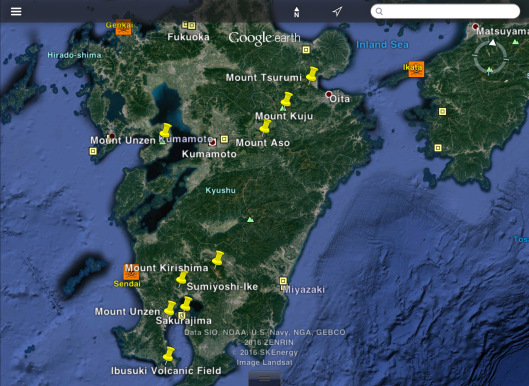
Japan’s Mount Aso volcano erupted explosively on Saturday, 8 Oct., 2016, and volcanic “ash was falling as far as 320 km (200 miles) away, … Kyushu Electric Power Co said the eruption had no impact on its Sendai nuclear plant, which is about 160 km (100 miles) south of Mount Aso“(Reuters, 8 Oct. 2016). Sendai nuclear power station has two reactors online. The other nuclear power station online is Ikata, with one reactor operating. https://en.wikipedia.org/wiki/Nuclear_power_in_Japan
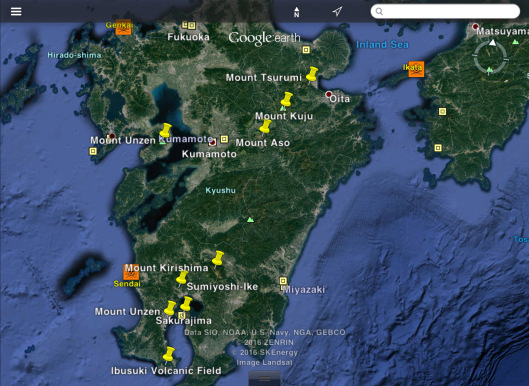
Volcano locations exported from: https://en.wikipedia.org/wiki/List_of_volcanoes_in_Japan
With a change in wind direction ashfall from Mount Aso and/or Sakurajima could endanger Japan’s operating reactors. As can be seen on the map, Ikata Nuclear Power Station is closer to Mount Aso, and Sakurajima to Sendai Nuclear Power Station. Ash plume forecasts for both appear at the bottom of this post.
Disruptions due to a major volcanic eruption, as well as ashfall could lead to nuclear meltdown: https://miningawareness.wordpress.com/2015/08/15/official-volcano-evacuation-warning-near-re-opened-nuclear-reactors-in-japan-volcanic-ashfall-could-lead-to-meltdown-spent-fuel-pool-collapse/
“Japan’s Mount Aso volcano erupts, no injuries reported
Posted:Sat, 08 Oct 2016 07:41:33 -0400
TOKYO (Reuters) – Mount Aso, a volcano on Japan’s main southern island of Kyushu, erupted early on Saturday, Japan’s Meteorological Agency said, spewing volcanic ash 11,000 meters (7 miles) into the sky. http://feeds.reuters.com/~r/reuters/environment/~3/DLFdmJfALl4/us-japan-volcano-idUSKCN12804E
“Mount Aso, a volcano on Japan’s Kyushu island, has been erupting sporadically for decades. Smithsonian’s Global Volcanism Program lists 38 separate eruptions since 1950, with the most recent beginning on December 8, 2014. All of these eruptions have occurred at Naka-dake, a cinder cone located within Aso’s massive caldera.”
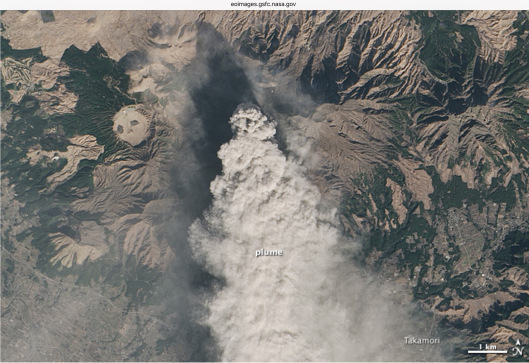
ERUPTION AT MOUNT ASO Credit: NASA Earth Observatory by Jesse Allen, using Landsat data from USGS. Caption by Adam Voiland. Date: January 13, 2015 Visualization Date: January 15, 2015
http://visibleearth.nasa.gov/view.php?id=85090
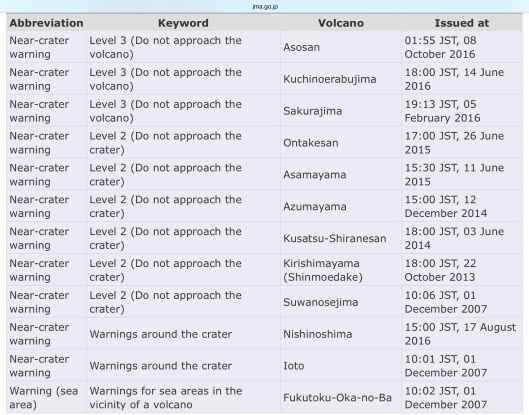
http://www.jma.go.jp/en/volcano/
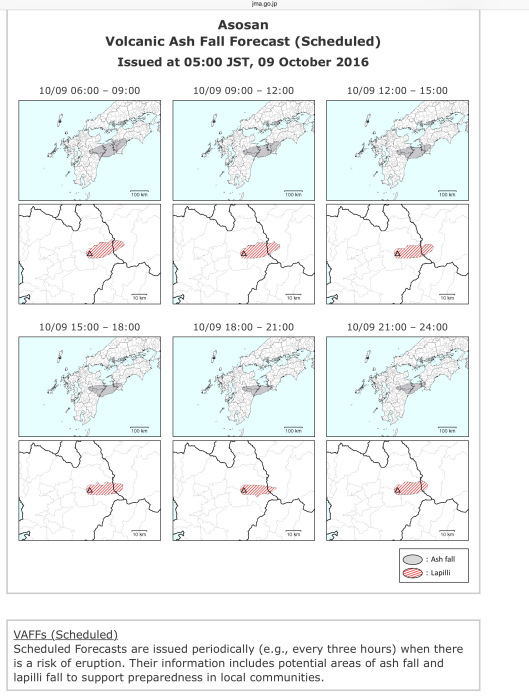
Asosan
Volcanic Ash Fall Forecast (Scheduled)
Issued at 05:00 JST, 09 October 2016 Japan Meteorological Agency: http://www.jma.go.jp/en/ashfall/scheduled_503.html
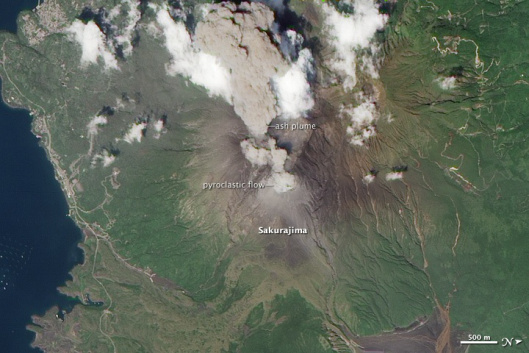
Sakurajima Aug 19 2010 NASA
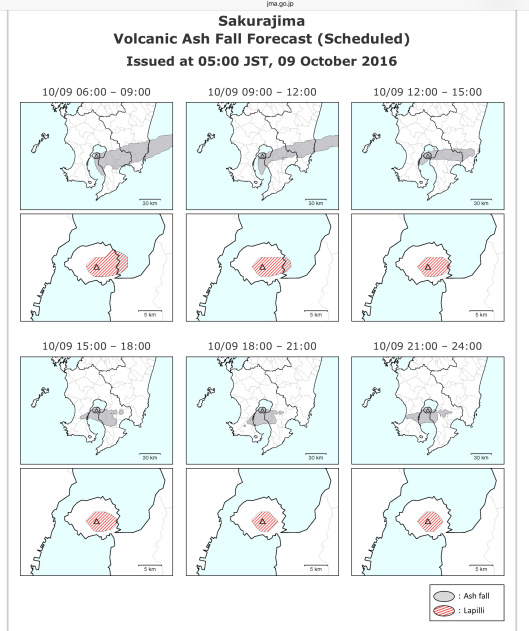
Sakurajima
Volcanic Ash Fall Forecast (Scheduled)
Issued at 05:00 JST, 09 October 2016 Japan Meteorological Agency
http://www.jma.go.jp/en/ashfall/scheduled_506.html
Source :
1 This Month





PLEASE OPPOSE HR 8255 AND S.3639 – bills would accelerate satellite deployment, with no environmental review or safeguards – https://ncstd5li.quorum.us/campaign/169331/
To see nuclear-related stories in greater depth and intensity – go to https://nuclearinformation.wordpress.com
-
Archives
- October 2026 (29)
- September 2026 (339)
- August 2026 (330)
- July 2026 (355)
- June 2026 (287)
- May 2026 (306)
- April 2026 (356)
- March 2026 (251)
- February 2026 (267)
- January 2026 (308)
- December 2025 (358)
- November 2025 (359)
-
Categories
- 1
- 1 NUCLEAR ISSUES
- business and costs
- climate change
- culture and arts
- ENERGY
- environment
- health
- history
- indigenous issues
- Legal
- marketing of nuclear
- media
- opposition to nuclear
- PERSONAL STORIES
- politics
- politics international
- Religion and ethics
- safety
- secrets,lies and civil liberties
- spinbuster
- technology
- Uranium
- wastes
- weapons and war
- Women
- 2 WORLD
- ACTION
- AFRICA
- Atrocities
- AUSTRALIA
- Christina's notes
- Christina's themes
- culture and arts
- Events
- Fuk 2022
- Fuk 2023
- Fukushima 2017
- Fukushima 2018
- fukushima 2019
- Fukushima 2020
- Fukushima 2021
- general
- global warming
- Humour (God we need it)
- Nuclear
- RARE EARTHS
- Reference
- resources – print
- Resources -audiovicual
- Weekly Newsletter
- World
- World Nuclear
- YouTube
-
RSS
Entries RSS
Comments RSS

