A-bomb survivor calls for nuclear arms ban

A survivor of the 1945 atomic bombing of Hiroshima has called for the creation of a new global treaty to prohibit nuclear weapons.
Toshiki Fujimori spoke in New York on Sunday at a meeting of the International Campaign to Abolish Nuclear Weapons. The NGO group held the meeting ahead of the start of UN negotiations on a legally binding international nuclear ban treaty.
Fujimori experienced the bombing when he was 16 months old. He is scheduled to speak on the first day of the UN negotiations.
Fujimori expressed hope for the talks, which he referred to as an attempt to draw up a treaty that has yet to arrive due to strong pressure from nuclear powers.
He said the voices of atomic bomb survivors and their numerous supporters have spurred momentum to ban the weapons. He said such voices remind the world of the inhumanity of nuclear weapons, which cause indiscriminate mass destruction of human life and inflict radiation on survivors.
He stressed that while their exposure problems are at different stages, each of the 170,000 survivors still alive in Japan has a cross to bear until death.
He urged people to listen to the cries of survivors and move a step forward toward achieving a world free of nuclear weapons
Need for America and China to work together on North Korean situation


 North Korea: Why America and China need to deal with Kim Jong-un together http://www.abc.net.au/news/2017-03-26/why-america-and-china-need-to-deal-with-kim-jong-un-together/8385362 By North Asia correspondent Matthew Carney, Nearly every week, Kim Jong-un seems to announce a successful test in his nuclear and missile program, edging him ever closer to his aim of striking America with a nuclear warhead.
Taking the North Korean leader out with military action is now being discussed, but that could lead to much bigger problems and plunge the region into years of chaos and instability. Worse still, it could force a confrontation between China and the US.
On the face of it, the North Korean military looks impressive. It has about 1.2 million troops. But the reality is that the weaponry is outdated and obsolete, much of it from the Soviet era. It’s no match for any modern army, so Mr Kim could be removed effectively.
Christopher Hill, probably the most experienced US diplomat in North Korean affairs, says with Mr Kim in power, there is no chance of dialogue. “Frankly, we don’t have a real insight into his thinking — we do know he seems to be totally uninterested in negotiation,” he said.
The real danger, said Mr Hill, is that the Trump administration has little understanding about how to deal with the North Korea threat, and the US State Department is in disarray. “We have a kind of Home Alone situation at the State Department, so we don’t have a lot of people focusing on this issue at this point,” he said.
Military action could prove costly Despite this, while visiting North Asia last week, US Secretary of State Rex Tillerson ruled out negotiation and put military action on the table. It’s action that could prove costly: a humanitarian disaster, with biological and nuclear weapons at play; a contested occupation as China and America battle for control.
Dr Euan Graham from the Lowy Institute says it could prove more destructive and costly than the Iraq war.
“Kicking in the door is the easy part; once you go in and occupy ground, then if that’s contested you can very quickly find even superpowers’ resources can become thinly spread,” he said.
Mr Hill says people like to compare the situation on the Korean Peninsula with the reunification of Germany, but this would actually be much worse. Frankly speaking, the difference between North Korea and East Germany cannot be described,” he said.
“They are just worlds apart in terms of what Germany had to do and what the South Koreans would have to do.”
These immense challenges make policymakers and experts around the world question the value of removing Mr Kim and his nuclear program.
Dr Graham says the US then has a choice: “Is it better to live with this threat and manage it through deterrence and existing sanctions like it did with China and the Soviet Union for decades? Or does it become so unacceptable that it has to accept the high cost of potential economic recession in north-east Asia and military conflict that could take several thousands if not higher numbers of lives?”
China and America are at oddsThe complicating factor is that the powers at play cannot agree on what North Korea should become. They all have competing strategic needs.
China wants a new regime that will serve its interests, and it fears US troops on its border.
Professor Cheng Xiaohe from Beijing Renmin University says China will have to deal with a flood of refugees.
“Millions of North Koreans will seek safe havens in China or across the 38th parallel into the minefields to seek protection in South Korea,” he said.
“Even hundreds of thousands will take to boats to sail boat to other countries to seek refuge.”
It’s doubtful whether America wants to lead another foreign intervention. The Iraq campaign almost bankrupted the country with little to show in return, and it left hundreds of thousands dead.
South Korea too is losing its desire for reunification. It would cost several trillion dollars at least and threaten South Korea’s thriving high tech economy which is 18 times bigger than North Korea’s.
Dr Jiyoung Song from the Carnegie Council for Ethics in International Affairs says the younger generation in the South have very little in common with their brethren in the North.
Most South Koreans are definitely worried about the economic side — the unification costs, but also the unemployment and competition for jobs and universities.
The only way forward…Mr Hill, who led the push for a negotiated solution with the six-party talks that ended in 2009 after North Korea withdrew and resumed its nuclear program, says the only way forward is to engage with China and plan how to deal with the regime and the aftermath.
“We have to have an in-depth dive deep with the Chinese to really figure out how together we can deal with that and I think we need to do it and do it a lot more,” he said.
But Mr Hill says both sides have to get over their mutual distrust.
“Many Chinese see the demise of North Korea as a Chinese defeat and a US victory,” he said.”They worry that the US might take advantage of this and put US troops right up on the Chinese border.”
Dr Cheng agrees that China is afraid of being played by the US.
“All countries need to work together to settle their differences and adopt a joint line to build that country for peace and stability and carry out post-reunification works,” he said.
But while experts may agree in a call for global engagement, the Trump administration seems to be turning inwards towards more isolationist policies.
Satellite images show hectic activity at North Korea nuclear site

 North Korea nuclear test site witnesses hectic activity, satellite images show http://www.ibtimes.co.uk/north-korea-nuclear-test-site-witnesses-hectic-activity-satellite-images-show-1613722
It is unclear whether the reported presence of vehicles indicates preparation for a potential missile launch. IBT, By India Ashok, 26 Mar 17, Satellite imagery of a North Korean nuclear test site reportedly reveals hectic activity, sparking fears of a potential missile launch or nuclear test. Images from a commercial satellite of the Punggye-ri nuclear test site in North Korea purportedly show four or five vehicles or trailers present at the entrance of the site where North Korea’s previous four nuclear tests took place.
The activity may indicate that North Korea is gearing up for its sixth nuclear test. Satellite images also indicate that some construction material, presumably sand and aggregate, remains undisturbed at the site, according to a report by US think tank 38 North.
The report stated: “That material, if it is sand and aggregate, when mixed with concrete, may be intended to ‘stem,’ that is to plug segments of the tunnel to prevent a nuclear explosion from escaping into the atmosphere.”
Satellite images also reportedly show that apart from a few mining carts and two trucks at the West Portal, there’s little to no activity at the nuclear site. According to 38 North, this lack of activity may indicate that either “Pyongyang is inthe final stages of test preparation or that the site is in a standard operating mode.”
On Friday (24 March), South Korean officials warned that Pyongyang appeared to be in the last stages of preparing for yet another nuclear test and could carry out detonations within hours of an order issued by leader Kim Jong-un.
Numerous reports surfaced last week about North Korea preparing for yet another potential missile or nuclear test, amid rising tensions with its neighbours and the West.
It remains unclear whether the reported presence of the vehicles at the Punggye-ri nuclear site is indicative of Pyongyang’s willingness to conduct yet another nuclear test.
Pakistan’s policies on nuclear weapons
How Pakistan Is Planning to Fight a Nuclear War, National Interest, Kyle Mizokami, 26 Mar 17, Sandwiched between Iran, China, India and Afghanistan, Pakistan lives in a complicated neighborhood with a variety of security issues. One of the nine known states known to have nuclear weapons, Pakistan’s nuclear arsenal and doctrine are continually evolving to match perceived threats. A nuclear power for decades, Pakistan is now attempting to construct a nuclear triad of its own, making its nuclear arsenal resilient and capable of devastating retaliatory strikes.
Pakistan’s nuclear program goes back to the 1950s, during the early days of its rivalry with India. President Zulfikar Ali Bhutto famously said in 1965, “If India builds the bomb, we will eat grass or leaves, even go hungry, but we will get one of our own.”
Experts believe Pakistan’s nuclear stockpile is steadily growing. In 1998, the stockpile was estimated at five to twenty-five devices, depending on how much enriched uranium each bomb required. Today Pakistan is estimated to have an arsenal of 110 to 130 nuclear bombs. In 2015 the Carnegie Endowment for International Peace and the Stimson Center estimated Pakistan’s bomb-making capability at twenty devices annually, which on top of the existing stockpile meant Pakistan could quickly become the third-largest nuclear power in the world. Other observers, however, believe Pakistan can only develop another forty to fifty warheads in the near future.
Pakistani nuclear weapons are under control of the military’s Strategic Plans Division, and are primarily stored in Punjab Province, far from the northwest frontier and the Taliban. Ten thousand Pakistani troops and intelligence personnel from the SPD guard the weapons. Pakistan claims that the weapons are only armed by the appropriate code at the last moment, preventing a “rogue nuke” scenario.
Pakistani nuclear doctrine appears to be to deter what it considers an economically, politically and militarily stronger India. The nuclear standoff is exacerbated by the traditional animosity between the two countries, the several wars the two countries have fought, and events such as the 2008 terrorist attack on Mumbai, which were directed by Pakistan. Unlike neighboring India and China, Pakistan does not have a “no first use” doctrine, and reserves the right to use nuclear weapons, particularly low-yield tactical nuclear weapons, to offset India’s advantage in conventional forces.http://nationalinterest.org/blog/the-buzz/how-pakistan-planning-fight-nuclear-war-19897
Japan, France confirm nuclear and security cooperation

PARIS (Kyodo) — Japanese Prime Minister Shinzo Abe and French President Francois Hollande on Monday confirmed bilateral cooperation in the research of the commercial use of nuclear power as well as in security.
The two countries agreed on joint research on a French-led fast reactor development project called ASTRID, an acronym for Advanced Sodium Technological Reactor for Industrial Demonstration.
As the leaders met, Japanese industry minister Hiroshige Seko, who is accompanying Abe, and French environment minister Segolene Royal signed a nuclear power cooperation agreement, stating that they will work together on nuclear fuel cycle and fast reactor development.
France aims to start the operation of ASTRID in the 2030s.
Abe and Hollande also attended a signing ceremony on a deal in which Mitsubishi Heavy Industries Ltd. and Japan Nuclear Fuel Ltd. will each acquire a 5 percent stake in a nuclear fuel reprocessing joint venture to be established by French atomic energy company Areva.
In the sphere of security, Abe revealed to reporters after the talks with Hollande that Japan’s Maritime Self-Defense Forces will jointly conduct naval exercises with France, the United States and Britain.
The Japanese premier welcomed the “significant” agreement on the exercises to be held in the Asia-Pacific region, including off Guam in the Western Pacific, apparently in view of China’s expansionary maritime activities.
The Japanese leader said he and Hollande shared a view that the Indian and Pacific oceans are international public goods and need to be maintained as free and open areas.
Abe said a French training squadron, including a helicopter carrier, will visit Japan in late April.
On regional issues, Abe strongly condemned North Korea’s nuclear and missile programs, while Hollande expressed Paris’ support for Tokyo on the matter.
It was the 10th and final meeting between Abe and Hollande as the latter is not running in France’s upcoming presidential election. The first round of the election is in April followed by a potential runoff vote in May.
As for economic issues, Abe and Hollande agreed on the importance of promoting free trade amid the threat of rising protectionism across the world following the inauguration of U.S. President Donald Trump.
They affirmed cooperation for the early signing of the free trade agreement between Japan and the European Union.
Abe expressed Japan’s support for “a strong Europe” to be maintained even after Britain’s forthcoming exit from the bloc.
“Japan and Europe must fly the flag of free trade high, together with the United States,” Abe said.
Hollande said the Japan-France relationship can be further strengthened.
France’s election is one of a series in Europe this year in which public unease about immigration and the functions of the European Union have fuelled speculation voters could pick populist candidates over the current political establishment.
Abe arrived in Paris on Monday after talks with German Chancellor Angela Merkel in Hanover. He is scheduled to meet European Council President Donald Tusk and Italian Prime Minister Paolo Gentiloni before returning to Japan on Wednesday.
http://mainichi.jp/english/articles/20170321/p2g/00m/0dm/030000c
Toshiba’s financial meltdown set off by nuclear power plans
 Nuclear power plants help ignite Toshiba’s meltdown, http://www.houstonchronicle.com/business/
 columnists/tomlinson/article/Toshiba-reveals-real-problem-with-nuclear-power-11019881.php , By Chris Tomlinson March 23, 2017 Toshiba Corp., one of Japan’s oldest and largest multinational conglomerates, is on the verge of bankruptcy, revealing the real problem with nuclear power plants: They cost too much.
Toshiba revealed last month that it will likely post a $4.4 billion loss because its U.S. subsidiary, Westinghouse Electric, has written off $6.3 billion from work on four new nuclear reactors in Waynesboro, Georgia and Fairfield County, South Carolina.
Toshiba’s stock price has fallen from 475.20 yen a share in December to a recent low of 178 yen. Ratings agencies have slashed Toshiba’s credit ratings and warn of an imminent default on the company’s bonds because there are likely more budget over-runs ahead at both facilities.
“The current financial strain on Westinghouse and Toshiba could lead to higher completion costs and further delays,” Fitch Rating Service reported.
And the Japanese government is in no mood to bail Toshiba out.
“Fiscal pressure rose last week as the Japanese government said it was not considering supporting Toshiba and the company missed, for the second time, a reporting deadline for its audited third quarter results,” the Fitch note added. “Its application to delay its results until April 11 was approved, but it remains at risk of being de-listed for failure to meet the requirements of the Tokyo Stock Exchange.”
Analysts at Standard & Poor’s were no less pessimistic.
“Absent unanticipated, significantly favorable changes in the issuer’s circumstances, we see a rising likelihood Toshiba will become unable to fulfill its financial obligations in a timely manner or will undertake a debt restructuring we classify as distressed in the next six months,” S&P wrote.
The Georgia and South Carolina plants were supposed to prove that nuclear power is viable in the United States. Westinghouse touts the AP1000 PWR reactor as the most advanced available based on licensed technology.
The nuclear energy industry is lobbying governments around the world to build more plants because they release no greenhouse gases and supply a steady supply of energy no matter the weather conditions. When it comes to operating costs, nuclear power is cheap.
The capital expenses, though, are huge. And if it weren’t for a regulated electricity market, there is no way these two nuclear power plants could compete with natural gas, wind and coal in a competitive electricity market like we have in Texas.
Reports emerged Tuesday that Toshiba is considering a prepackaged bankruptcy with Westinghouse’s creditors. The $500 million deal would keep Westinghouse operating until the debt is restructured.
This follows on the heels of reports that Toshiba wants out of the nuclear business altogether.
There are over 60 nuclear reactors under construction around the world. In many places they will make economic sense, while in others, they are government vanity projects.
As attractive as it might seem, though, new nuclear power plants still haven’t shown that they’re economic in the United States, and the dire status of Toshiba and Westinghouse is proof.
North Korea’s Capability Has Entered A ‘New Phase’ – warns U.N. Nuclear Inspector Yukiya Amano
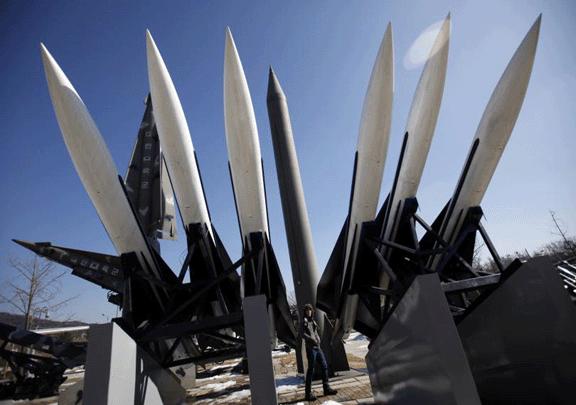 U.N. Nuclear Inspector: North Korea’s Capability Has Entered A ‘New Phase’ And while a diplomatic solution is necessary, one is unlikely to be reached, warns Yukiya Amano. WASHINGTON — North Korea’s nuclear weapons program has entered a “new phase,” with the country having doubled the size of its uranium-enrichment facility in recent years, Yukiya Amano, director general of the International Atomic Energy Agency, told The Wall Street Journal.
Japan stages mass evacuation drills, following North Korean missile launches
Yakuza hide IDs to secretly thrive in Tohoku’s disaster zones

A gang leader says he effectively controls several companies involved in rebuilding projects in the Tohoku region.
A company has been busy dispatching temporary workers for the Herculean task of rebuilding lives in the disaster-hit Tohoku region. But the company’s most important job for survival is to conceal any evidence of its true, sinister nature.
“This is a company I established,” said the leader of a gang affiliated with an organized crime syndicate based in western Japan. “I made sure that no signs of any possible association with yakuza organizations were left.”
Although the National Police Agency has tried to prevent gangsters from cashing in on the triple disaster that struck in March 2011, yakuza groups appear to be thriving in the Tohoku region and extending their reach.
Their companies not only dispatch workers and lease heavy machinery, but they are also involved in more traditional services, such as providing prostitutes and dealing drugs, with workers at the stricken Fukushima No. 1 nuclear power plant and other sites as potential targets.
Police say there is little they can do to shut down the yakuza activities.
The gang leader’s company, which was set up in a city in the Kanto region last December with a start-up cost of 5 million yen ($45,000), appears innocent on the surface.
The president named on company’s registry has no ties with organized crime, and the true leader and members of his family and group are not listed as directors.
The gang leader said he also has effective control over other companies that send workers to contractors involved in an array of projects, including decontaminating areas or dismantling abandoned houses.
“I make millions of yen a month, including about 100,000 yen per contractor and siphoning from workers’ daily allowances,” the gang leader proudly said.
Twenty days after the Great East Japan Earthquake and tsunami struck on March 11, 2011, triggering the nuclear disaster, the NPA directed all prefectural police departments to keep gangsters away from the reconstruction projects.
Similar requests were made to the construction industry, Tokyo Electric Power Co., operator of the nuclear plant, government ministries and agencies and local authorities.
But a number of yakuza organizations are now behind the companies involved in the rebuilding projects.
In some cases, they gain control of legitimate but cash-strapped companies by providing funds.
One crime syndicate reportedly advises umbrella groups on “how to set up a company by keeping others from becoming suspicious.”
Police officials dealing with crime syndicates acknowledge that it is “practically impossible” to thoroughly check for possible ties between subcontractors and gangster organizations.
In some cases, a single project is outsourced to more than 10 subcontractors.
“All we can do is check whether individuals connected to underground groups are listed in the registration papers,” a police official said.
Police say they can confirm a yakuza connection only after they scrutinize the company directors’ circle of friends and acquaintances and other relevant data.
Although anti-yakuza ordinances are believed to be depleting the finances of mobsters around Japan, the crime syndicates are systematically running operations in the Tohoku region as if it’s business as usual.
One leader of an underground group said he was ordered by its parent organization “not to lag behind others” in exploiting potentially lucrative projects.
After the 1995 Great Hanshin Earthquake, the parent organization began asking all groups under its umbrella to give “regular reports” about rental agents of heavy machinery, dump trucks and other equipment indispensable in rebuilding projects on their turfs.
The move was apparently designed to prepare for the day when they needed to quickly obtain as much machinery as possible.
That day arrived on March 11, 2011.
“There is a huge demand for such equipment in a disaster,” a former senior member of a gang group said. “We can lease it at our asking price.”
Crime organizations have also seen a potentially lucrative market in the predominantly male work force at the Fukushima nuclear plant and other reconstruction projects in the Tohoku region.
“I came to Fukushima to have fun as an adult,” said an entry, presumably by a female, on a dating site for men. “I am looking for somebody I can meet in Nihonmatsu,” said another, referring to a city in Fukushima Prefecture.
The website, set up by the head of a gangster organization in the Kanto region, targets workers at the stricken nuclear plant and elsewhere.
The gang leader said he takes women who have experience in the sex industry to disaster-stricken areas in his car and stays there for several days.
He sends the women to love hotels or the clients’ vehicles, depending on the customers’ requests. One encounter costs about 30,000 yen, he said, adding that 60 percent goes to the woman while he pockets the remainder.
“I am in fierce competition with other underground groups in this line of business,” he said. “But I can earn at least 3 million yen a month.”
Drug deals are also said to be at play in the disaster zone.
“I have seen and heard about the use and deals in stimulant drugs at the plant,” recalled the leader of a gang group based in eastern Japan who works at the Fukushima nuclear complex.
He was assigned to the plant just after a hydrogen explosion took place there.
TEPCO and Fukushima prefectural police said they are not aware of any drug use at the plant.
However, a plant worker in his 30s died at a hospital in August 2015 after he complained of sickness on a bus taking him from the nuclear plant.
He turned out to be a gang member, according to police. His urine sample showed possible signs of stimulant drug use, but his cause of death was not determined.
Between 2011 and 2016, police have busted underground groups involved in rebuilding projects in 101 cases.
Fraud accounted for 54 cases. They were primarily gangsters pretending to collect donations for disaster victims or mobsters involved in illicit borrowing.
Twenty-five cases concerned dispatches of workers to assignments that they were not allowed to perform.
In one case, a senior member of a group affiliated with the Sumiyoshi-kai, one of the largest crime syndicates in the nation, was arrested in May 2012 on suspicion of illegally sending workers to the Fukushima plant. Police uncovered that the mobster received about 40 million yen between 2009 and 2011 by sending workers to nuclear plants and thermal power plants across the country.
Visualizing nuclear radiation: Team images gamma rays to help decontaminate Fukushima

A Kyoto University team has developed a new camera to visualize radioactive hotspots
Extraordinary decontamination efforts are underway in areas affected by the 2011 nuclear accidents in Japan. The creation of total radioactivity maps is essential for thorough cleanup, but the most common methods, according to Kyoto University’s Toru Tanimori, do not ‘see’ enough ground-level radiation.
“The best methods we have currently are labor intensive, and to measure surface radiation accurately,” he says, “complex analysis is needed.”
In their latest work published in Scientific Reports, Tanimori and his group explain how gamma-ray imaging spectroscopy is more versatile and robust, resulting in a clearer image.
“We constructed an Electron Tracking Compton Camera (ETCC) to detect nuclear gamma rays quantitatively. Typically this is used to study radiation from space, but we have shown that it can also measure contamination, such as at Fukushima.”
The imaging revealed what Tanimori calls “micro hot spots” around the Fukushima Daiichi Nuclear Power Plant, even in regions that had already been considered decontaminated. In fact, the cleaning in some regions appeared to be far less than what could be measured by other means.
Current methods for measuring gamma rays do not reliably pinpoint the source of the radiation. According to Tanimori, “radiation sources including distant galaxies can disrupt the measurements.”
The key to creating a clear image is taking a color image including the direction and energy of all gamma rays emitted in the vicinity.
“Quantitative imaging produces a surface radioactivity distribution that can be converted to show dosage on the ground,” says Tanimori. “The ETCC makes true images of the gamma rays based on proper geometrical optics.”
This distribution can then be used to relatively easily measure ground dosage levels, showing that most gamma rays scatter and spread in the air, putting decontamination efforts at risk.
“Our ETCC will make it easier to respond to nuclear emergencies,” continues Tanimori. “Using it, we can detect where and how radiation is being released. This will not only help decontamination, but also the eventual dismantling of nuclear reactors.”
https://phys.org/news/2017-03-visualizing-nuclear-team-images-gamma.html#jCp
Controversial conspiracy bill approved by Abe Cabinet

Protesters stage a rally in front of the prime minister’s office in Tokyo on Tuesday as Prime Minister Shinzo Abe’s Cabinet approved an anti-conspiracy bill
The Cabinet of Prime Minister Shinzo Abe approved Tuesday a controversial bill that would revise the organized crime law so authorities can crack down on individuals and organizations who conspire to engage in serious criminal activity.
The conspiracy charges apply to groups of two or more people, where at least one person procures funds, supplies or surveys a location in preparation for committing a crime. Efforts to maintain or expand organized crime groups would also be punished, while reduced penalties would be considered for those who turn themselves in before a crime is carried out.
The government is pushing to enact the revised bill during the ordinary Diet session through mid-June, but strong objections by opposition parties are expected amid concern that the law may be used against civic groups.
The backlash against the measure has been a persistent hurdle in passing the anti-conspiracy law, which the government has attempted and failed to enact three times in the past, as it targeted “groups” in general.
The bill needs to be passed to ensure necessary counterterrorism measures are in place before the upcoming 2020 Tokyo Olympics and Paralympics, according to the government. It is also a prerequisite to ratify the U.N. Convention against Transnational Organized Crime, which was adopted by member states in 2000 and took effect in 2003.
“It is an urgent necessity for the government to ratify the treaty to promote international cooperation on counter-terrorism,” Chief Cabinet Secretary Yoshihide Suga told a news conference Tuesday, adding Japan is the only country among the Group of Seven nations that has not signed the treaty.
Suga also said the targets of the new bill would be strictly applied to terrorists and other organized crime syndicates, not ordinary citizens.
Some opposition parties and the Tokyo Bar Association denounced the revisions, which they say would still allow the possibility of government overreach and retaliation against civic groups.
“The conspiracy bill goes against the basic principles of our country’s criminal code and the legal system,” Motoji Kobayashi, president of the Tokyo Bar Association, said in a statement in January. “It threatens the function of protecting human rights.”
The government previously included 676 crimes in its original draft, but has narrowed that number down to 277 in the revised bill.
Yukio Yamashita, an attorney and member of the association, warned that 277 crimes are still too many and noted some are unnecessary.
For example, a person using forged stamps or competing in a motor boat race without a license would be subject to punishment under the revised bill, Yamashita said in a seminar held earlier in March.
Meanwhile, the Japan Federation of Bar Associations claims that only a limited number of countries, such as Norway, have newly enacted anti-conspiracy laws for the purpose of ratifying the U.N. treaty, which was adopted to crack down on organized cross-border crimes such as human trafficking, narcotics trading and money laundering.
Japan’s Diet approved the treaty in 2013, but was unable to ratify it without a law covering criminal conspiracy.
As of December, 187 countries and regions have signed the treaty.
Fukushima fishermen fight release of tainted water as tritium standoff continues

On Feb. 25, against a clear sky, fishing boats bearing colorful banners used to signal a rich haul returned to their home port of Ukedo in the town of Namie, Fukushima Prefecture. Cheers erupted as the boats, which had taken refuge in Minamisoma in the wake of the 2011 Great East Japan Earthquake and the nuclear crisis, made their way home for the first time in six years.
The Soma-Futaba fishing cooperative will soon resume fishing for konago (young lancefish), after the heads of fishing co-ops in the prefecture approved the start of experimental fishing operations 10 to 20 km from the meltdown-hit Fukushima No. 1 power plant, run by Tokyo Electric Power Co. Holdings Inc.
Despite the steady recovery moves, however, local fishermen are not optimistic because their industry still faces “concern” that radioactive fish could tarnish their reputation.
Fukushima No. 1 currently has 950,000 tons of radioactive water in storage that has been desalinated and filtered to remove some of the radioactive elements, but the volume is increasing at a pace of 150,000 tons a year.
Of the 950,000 tons, 750,000 were further treated with the Advanced Liquid Processing System, to remove most of the remaining isotopes. But even ALPS cannot remove tritium, and this has the fishing industry concerned that water tainted with tritium could ultimately be released into the ocean.
The debate over what to do about the tainted water has turned into a standoff. The central government set up a committee in September to discuss disposal and studied five options, including ocean release, underground burial and air release. But the committee could not agree on any of them because all had the potential to damage the reputation of Fukushima’s seafood.
Hiroshige Seko, head of the Ministry of Economy, Trade and Industry has jurisdiction over the issue but appears reluctant to bring the debate to a rapid conclusion.
“We have not decided on the schedule, including when to conclude (the debate),” he said in a recent interview with the Fukushima Minpo.
Tritium is a common byproduct of normal nuclear power plant operations. Its release into the ocean is permitted worldwide as long as the concentration doesn’t exceed certain levels. In Japan, the legal threshold for tritium release is 60,000 becquerels per 1 liter.
Shunichi Tanaka, chairman of the Nuclear Regulation Authority, has said “there is no solution than ocean release” for the tritium generated at Fukushima No. 1, noting that if the concentration is within legal limits, the government should go ahead with the release. Officials at related international institutions have expressed similar views.
But the prefectural association of fishing cooperatives remains opposed, worried that an ocean release could further damage the image of Fukushima’s fish and seafood.
A fisherman from Onahama in the city of Iwaki said, “The move could lead to a loss of trust in the prefecture’s seafood, which the fishermen have worked hard to build.”
On the other hand, if the disposal debate goes unresolved, the amount of tainted water at Fukushima No. 1 will continue to rise and delay the decommissioning of the plant.
Tepco has said it “will decide (on the fate of the water) in a responsible manner by watching the government debate and weighing the opinions of local residents.”
The fishery industry is watching how the central government balances the two jobs of revitalizing the industry and handling tritium-tainted water — and how it can thoroughly explain the decision in ways people both in Japan and abroad can understand, without leaving it entirely up to Tepco.

North Korea nuclear program is ‘imminent’ threat says Rex Tillerson
 Tillerson says North Korea nuclear program is ‘imminent’ threat, as China urges talks
Tillerson also said that US-China relations appear to be at a historic inflection point that must be carefully managed. Politico, By 3/18/17,
North Korea’s nuclear program poses an “imminent” threat that nonetheless requires the United States, China, and other countries to respond with a “staged approach” that includes sanctions, Secretary of State Rex Tillerson said in a rare encounter with the media.
Tillerson, speaking to the conservative Independent Journal Review in an interview published Saturday, also said that U.S.-China relations appear to be at a historic inflection point that must be carefully managed.
China’s foreign minister, meanwhile, urged the United States to remain “cool-headed” on the issue of North Korea and to consider going ahead with talks with Pyongyang.
The U.S. secretary of state is in the final stages of a trip to Asia, having made stops in Japan and South Korea and, this weekend, in China. A good chunk of his discussions have focused on how to handle the challenge posed by the government in Pyongyang, whose recent ballistic missile tests have alarmed the international community.
Tillerson repeatedly framed the North Korean threat as “imminent,” and during his trip he has ruled out negotiations with the country while leaving open the possibility of a pre-emptive military strike to eliminate its nuclear program.
But in his interview with IJR, Tillerson did not promise any imminent public response by the U.S. and others, aside from the ongoing diplomatic flurries. Instead, he said there had to be a “staged approach” to North Korea, one that involves enforcing, and possibly enhancing, international sanctions, while persuading Pyongyang that giving up its nuclear weapons would help it on other levels………
Tillerson also downplayed, but did not entirely rule out, suggestions that Japan and South Korea should develop their own nuclear weapons in a bid to stave off the North Korean threat…….
China’s sway over North Korea is perhaps the most urgent issue the two countries must tackle, Tillerson said. The secretary of state indicated that the Trump administration believes China must do more to enforce sanctions on North Korea, which relies on Beijing as an economic lifeline.
It’s the same stance taken by the Obama administration, which toward the end of its tenure also was increasingly alarmed by the threat posed by North Korea. President Barack Obama is reported to have told Trump that North Korea is the top national security priority facing his new administration. http://www.politico.eu/article/tillerson-says-north-korea-nuclear-program-is-imminent-threat-as-china-urges-talks/
Japanese companies exploit refugees for Fukushima radioactive clean-up work
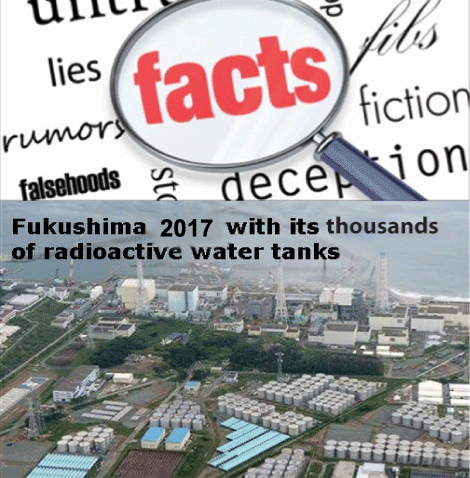 Spotlight: Fury sparked in Japan as companies found duping foreign refugees into decontamination work in Fukushima 2017-03-17 TOKYO, March 17 (Xinhua)— “Such scams are a shame to Japan,” said a reporter from Tokyo Metropolitan Television Broadcasting Corp., referring to a recently-exposed scandal involving labor dispatch agencies duping foreign refugees into doing decontamination work in Fukushima.Various local media have exposed recently that some Japanese companies have swindled foreign refugees into doing decontamination work in Fukushima with empty promises that such work might help extend their visas to stay in Japan.
Fifty-year-old Hosein Moni and 42-year-old Hosein Deroaru from Bangladesh were both caught in such a scam, according to a recent report by the Chunichi Shimbun, one of the largest newspapers in Japan.
The two came to Japan in 2013 seeking to be recognized as political refugees. In Japan, foreigners are given temporary permission to stay for up to six months at one application before they are recognized as refugees and given status as residents.
According to government data, the number of refugees actually afforded recognition as refugees in Japan is disproportionately low among developed nations, while the numbers of those applying for refugee status has been rapidly increasing in recent years in Japan.
The government received some 5,000 such applications in 2014, but only 11 were granted refugee status, according to the data.
Moni and Deroaru were told by a so-called labor dispatch agency in Nagoya that they could do decontamination work in exchange for an extension of their visa.
The two, knowing little Japanese and trying to seize every opportunity they could, accepted the job and worked in Fukushima for three months in 2015.
But when they finished their work and went to the local immigration bureau to extend their stay, they were told by officers there that they knew nothing about such a policy.
They later found out that the construction company that had hired them had changed its company name, and its Fukushima branch had closed.
Half of the 20 workers that they had worked with in Fukushima were foreigners, many of whom had been applying for refugee status in Japan, the pair later recalled. Their work mainly involved clearing away contaminated soil with spades, and while they were at work might well have been affected by high levels of radiation. “The radiation detectors we brought with us kept sounding alarms, which was rather scary,” they were quoted as saying.
The incident, after been exposed by local media, also caused a splash on social network sites. Many Japanese netizens felt indignant that such scams were happening in their homeland…….
Most of the foreign workers could hardly speak Japanese. As anti-radiation brochures provided by the plant’s operator, Tokyo Electric Power Company Holdings Inc. (TEPCO), were only available in Japanese or English, many of the workers could not understand it, Ishikawa was quoted as saying.
The foreign workers, to some extent, saved the contractors and TEPCO by pushing forward the decommissioning work of the nuclear plant, remarked the report…..http://news.xinhuanet.com/english/2017-03/17/c_136137295.htm
India’s nuclear watchdog shuts down Kakrapar Nuclear Power Plant due to “smallpox-like spots”
This 21st century atomic potboiler is actually unfolding through the hard work of scientists at the Bhabha Atomic Research Centre (BARC), whose laboratory actually shares a wall with the famous property where Raj Kapoor used to live. Here, they are working overtime to find out the real cause of the leaks at the twin reactors in southern Gujarat.
To avoid panic and further accidents, Indian nuclear watchdog Atomic Energy Regulatory Board (AERB) has shut down the affected plants till the cause has been found. Nuclear experts say the pipes, made from a rare alloy, have contracted what seems like small pox, and this contagion has spread all over the critical tubes in two Indian Pressurised Heavy Water Reactors (PHWR) at the Kakrapar facility. To make matters worse, more than a year into the investigation, the teams of scientists can’t figure out what has gone wrong.
It was on the morning of March 11, 2016, and as fate would have it, exactly five years after the Fukushima reactors in Japan began exploding, Unit Number 1 of the 220-MW PHWR at Kakrapar developed a heavy water leak in its primary coolant channel and a plant emergency was declared at the site.
The indigenously built nuclear plant had to be shut down, but no worker was exposed and there were no radiation leaks, the Department of Atomic Energy confirmed. Operator Nuclear Power Corporation of India Limited (NPCIL) said the reactor had shut down safely, and confirmed that safety systems had functioned normally.
The atomic thriller really begins when experts were trying to find out why a leak recognition system failed, when it should have raised an alarm. “There is a leak detection system in place in all PHWRs, but in this case it failed to detect the leak on March 11, 2016,” confirms AERB Chairman SA Bhardwaj. The watchdog body suspects the crack developed so rapidly that the electronic leak detection system just did not have the time to react.
Subsequent investigations revealed that the leak detection system was fully functioning and the operator had not shut it down to cut costs. Nothing in the core of a nuclear reactor can be done in a jiffy, and several weeks after the first leak, the initial probe using a specially designed tool revealed four big cracks in a coolant tube had led to the massive leak.
The mystery unfolds
The discovery of the crack was only the beginning of the mystery. Further efforts to find the cause established that the outside of the tube, the part not exposed to high-temperature heavy water, was corroded due to unknown causes.
This was a stunning discovery, since the outside of the failed tube was exposed only to high-temperature carbon dioxide and there had been no recorded case of a similar corrosion on the outside of any tube. It is also very hard to access this part since the space is tiny in the annulus.
The AERB then ordered that all tubes made of a special zirconium-niobium alloy be checked on the outside. To their surprise, they discovered that the contagion of the nodular corrosion, ‘small pox-like’ in layman’s parlance, was widespread in many of the 306 tubes. Similar tubes from the same batch used at other Indian reactors continued to operate without corrosion.
The needle of suspicion now pointed to carbon dioxide, a gas known to be very stable in high-radiation environments. A further post mortem revealed that Unit-2, which is twin of the affected reactor, had also been affected by a similar leak on July 1, 2015. Investigations into Unit-2’s failure were made but no conclusive result had been found. This back-to-back failure of two fully functional nuclear reactors befuddled engineers.
BARC begins probe
Undaunted, AERB ordered that the entire assembly and not just the affected tube be safely pulled out and brought to BARC, India’s foremost nuclear laboratory, for detailed failure analysis.
In addition, since India operates another 16 similar nuclear plants, a full-fledged investigation was carried out on coolant channels at all atomic power plants. The investigating team found the ‘small pox-like’ corrosion was confined only to the two units at Kakrapar.
While NPCIL heaved a sigh of relief, the finding made it all the more difficult to discern the true cause of the leaks at Kakrapar. Mr. Bhardwaj says investigators are wondering if the carbon dioxide used in Kakrapar may have been contaminated, which caused the nodular corrosion.
The source of the carbon dioxide was traced backwards, and it seems only the Kakrapar plant was sourcing its gas from a Naptha cracking unit, where it was possibly contaminated by hydrocarbons.
1 This Month




PLEASE OPPOSE HR 8255 AND S.3639 – bills would accelerate satellite deployment, with no environmental review or safeguards – https://ncstd5li.quorum.us/campaign/169331/
To see nuclear-related stories in greater depth and intensity – go to https://nuclearinformation.wordpress.com
-
Archives
- September 2026 (339)
- August 2026 (330)
- July 2026 (355)
- June 2026 (287)
- May 2026 (306)
- April 2026 (356)
- March 2026 (251)
- February 2026 (267)
- January 2026 (308)
- December 2025 (358)
- November 2025 (359)
- October 2025 (375)
-
Categories
- 1
- 1 NUCLEAR ISSUES
- business and costs
- climate change
- culture and arts
- ENERGY
- environment
- health
- history
- indigenous issues
- Legal
- marketing of nuclear
- media
- opposition to nuclear
- PERSONAL STORIES
- politics
- politics international
- Religion and ethics
- safety
- secrets,lies and civil liberties
- spinbuster
- technology
- Uranium
- wastes
- weapons and war
- Women
- 2 WORLD
- ACTION
- AFRICA
- Atrocities
- AUSTRALIA
- Christina's notes
- Christina's themes
- culture and arts
- Events
- Fuk 2022
- Fuk 2023
- Fukushima 2017
- Fukushima 2018
- fukushima 2019
- Fukushima 2020
- Fukushima 2021
- general
- global warming
- Humour (God we need it)
- Nuclear
- RARE EARTHS
- Reference
- resources – print
- Resources -audiovicual
- Weekly Newsletter
- World
- World Nuclear
- YouTube
-
RSS
Entries RSS
Comments RSS

