Nuclear disaster of a different kind

JAPANESE corporate giant Toshiba has announced that its Westinghouse nuclear power unit has filed for Chapter 11 bankruptcy in the US, largely due to massive cost overruns for four reactor projects the company is building in South Carolina and Georgia. The financial loss to Toshiba is estimated to be about 1 trillion yen (about $9 billion) for the fiscal year that ended yesterday (March 31), which would be one of, if not the biggest, annual loss in Japanese corporate history.
Officials at both W estinghouse and parent company Toshiba are optimistic that the collapse is not total; the financial problems are rooted in Westinghouse’s construction division, while its nuclear fuel and plant operations/maintenance segments remain relatively profitable. On the other hand, the bankruptcy filing is glaring evidence that these same people have been very wrong before; every other objective indicator suggests that Westinghouse’s fall may be a fatal blow to what nuclear advocates were hoping would be a bit of a renaissance for nuclear power worldwide.
The Westinghouse Electric Company LLC is a remnant of the fabled US corporate giant Westinghouse, which was founded in 1886. Through the mid-1990s the original company was gradually broken up and sold off; the brand is still well known worldwide – mainly in household appliances and certain kinds of industrial equipment – but is owned and produced by a variety of unrelated parent companies. The nuclear power business has historically been one of Westinghouse’s strengths, and reached its zenith during the 1970s; a majority of the several dozen operating nuclear reactors in the US were built by Westinghouse, and it built reactors in several other countries. The mothballed Bataan Nuclear Power Plant (BNPP) here in the Philippines is a Westinghouse product.
The company has over the years become embroiled in controversy at times – the BNPP being one example – but on the whole remained fairly sound, and was considered a good investment when it was purchased in 1999 by British Nuclear Fuels Limited (BNFL). BNFL in turn sold Westinghouse to Toshiba in 2006 for $5.4 billion, just at a time when the prevailing view was that nuclear power was about to undergo a resurgence; China, the US and the UK were all then planning to invest heavily in new nuclear power facilities.
Toshiba thought they had a gold mine on their hands. Westinghouse had a new, marketable reactor design – the AP1000 – which had become the first Generation III+ design to receive final design approval from the US Nuclear Regulatory Commission (NRC) in 2004. The Japanese parent company sold 10 percent of its stake to the Kazakh national uranium company (Kazatomprom) in 2007 to secure a fuel source and strengthen its supply line, and in the same year won a bid from the China National Nuclear Corporation for construction of four AP1000 reactors and transfer of the AP1000 technology. In 2008, Westinghouse won a contract from Georgia Power Company to build two AP1000 reactors in that state and a second contract to build two more in South Carolina; two years later, the US government announced it would provide $8.3 billion in loan guarantees to complete the Georgia plant.
The Fukushima nuclear disaster in March 2011 and the boom in natural gas production in the US had a chilling effect on the plans for new nuclear plants in the US. Even without Fukushima raising safety concerns, nuclear plants suddenly became unreasonably expensive compared with gas-fired plants, which put a bit of pressure on Westinghouse. What really sank the company, however, was the enormous cost and schedule overruns at its Georgia and South Carolina projects. Both were expected to cost about $14 billion each, and be operational by the end of last year; so far, they have cost $19 billion and $22 billion, respectively, and are two years or more behind schedule.
To make matters worse, the financial trouble at Westinghouse has raised old, but still not completely answered, questions from regulators – in the US, the UK, and China – about the safety of the AP1000 reactors. Up to now, most of those concerns have been deflected, but what is likely to happen now, even if Westinghouse can continue to satisfactorily convince governments and potential operators of the system’s safety, is that uncertainty over whether the company – or more likely, whoever buys the ailing unit from Toshiba – can be relied on to keep up standards is going to make big customers look elsewhere. And once they do, they are likely to prefer the more economical and less contentious path countries like the US are taking, turning to gas generation or expanding renewables.
http://www.manilatimes.net/nuclear-disaster-different-kind/320327/
China makes strongest statement yet on climate action

 This is China’s strongest statement yet on climate action, Climate Home,
  30/03/2017,
As President Trump rolls back climate policies and finance, China’s UN representative makes a detailed pitch for global leadership. By Karl Mathiesen
In the week before Donald Trump began to roll back Obama-era climate regulations, China’s government made its clearest statement yet that it sees climate action as central to its best interests.
Speaking at a New York event on 23 March, China’s permanent representative at the UN Liu Jieyi said China remained committed to openness and collaboration on climate change, “whatever the vicissitudes of the international situation”.
Under Barack Obama, the US state department expended huge effort and political capital cajoling the Chinese into a bilateral deal that laid the foundations for the Paris accord on climate change.
One of the pillars of that deal was the Clean Power Plan – which mandated emissions reductions in the US energy sector. On Tuesday, Trump signed an order that began rolling back that policy declaring he was “putting an end to the war on coal”.
But Liu’s comments make clear that China now sees climate action as a matter of national interest, independent of US policy.1 That applies not only at home, but across a range of diplomatic forums.
Senior global policy advisor at Greenpeace East Asia Li Shuo said the speech “highlights the shifting political stance of China on climate change”……..http://www.climatechangenews.com/2017/03/30/chinas-strongest-statement-yet-climate-action/
Indian nuclear power plant to use drones for surveillance
Nuclear plant to have eye in the sky http://www.thehindubusinessline.com/news/science/nuclear-plant-to-have-eye-in-the-sky/article9612475.ece MUMBAI, APRIL 2: Situated in vast areas and away from human settlement, the surveillance of nuclear power plants have been a challenge for paramilitary force CISF, which is tasked with the security of such installations.
Now, the Nuclear Power Corporation of India (NPCIL) plans to deploy drones for the purpose at the Madras Atomic Power Station (MAPS) near Kalpakkam in Tamil Nadu.
While MAPS would be the first such facility in the country to use drones for general surveillance and intrusion detection, they were famously deployed by Japanese engineers at the Fukushima Daiichi nuclear power plant after the nuclear accident of 2011.
The Kalpakkam plant, located 70 km from Chennai, is also in the vicinity of other sensitive installations of the Department of Atomic Energy (DAE) such as the Indira Gandhi Centre for Atomic Research, the Fast Breeder Reactor Project, the BARC-run nuclear desalination demonstration plant and Kalpakkam fuel reprocessing plant.
Sources close to the development said tenders are likely to be floated by the NPCIL for procuring the drones and their control systems this fiscal. The use of drones will also require clearances from the Atomic Energy Regulatory Board (AERB), the regulator for all atomic energy institutions in the country.
Both aerial and ground level drones are capable of large-scale territorial surveillance. They are fitted with video cameras and other sensors that allow continuous surveillance of facilities.
Sources said the cameras mounted on the drones could be programmed to scan for certain topographical features on the ground and if there is a mismatch between the programmed image and the live feed from drones, alarms would go off.
Lt Gen DS Hooda (Retd), who served as Chief of Northern Army Command, told BusinessLine that the Army had been using drones on the India-Pakistan border and in Kashmir region. Drones allow the forces to get a bird’s eye view of the terrain and identify intruders hiding in tall structures. Drones would prove to useful in securing large installations, he said.
Toshiba’s nuclear mess: shareholders hurl abuse at Toshiba managers
 ‘You’re trash’: Investors hurl abuse at Toshiba managers after nuclear debacle, SMH, Pavel Alpeyev and Takako Taniguchi, 31 Mar 17, Toshiba shareholders have lashed out at management and lamented the downfall of the Japanese icon before approving the sale of its memory chips division to cover the billion-dollar costs resulting from its disastrous foray into nuclear energy.
Incensed investors took turns to hurl abuse at executives during a Thursday meeting convened to take a vote on the intended disposal of its prized semiconductor business. Toshiba is looking to sell a majority stake in the unit to mend a balance sheet ravaged by billions of dollars in writedowns related to cost overruns at its nuclear subsidiary Westinghouse Electric.
Westinghouse, which Toshiba bought for $US5.4 billion in 2006, filed for bankruptcy protection on Wednesday. The Japanese company said it may now book a loss of as much as 1.01 trillion yen ($11.8 billion) in the year ending March, a record for a Japanese manufacturer.
“Toshiba is now a laughing-stock to the whole world,” one shareholder said during a question-and-answer section, raising his voice. “I think all of you are incompetent as managers. Do you even know what’s happening?”
Another shareholder addressed the executives as “trash.”……. http://www.smh.com.au/business/world-business/youre-trash-investors-hurl-abuse-at-toshiba-managers-after-nuclear-debacle-20170330-gvah2j.html
Japan’s ambitions to export nuclear technology have been dimmed by Toshiba’s U.S. unit bankruptcy
Toshiba’s U.S. unit bankruptcy dims Japan’s nuclear ambitions, Japan Times, BY AKIKO YASUHARA, KYODO , 31 Mar 17, The bankruptcy filing by Toshiba Corp.’s U.S. nuclear unit highlights the tough business climate in the sector and the scale of the challenge Japan faces in seeking to sell its nuclear technology abroad.
Westinghouse Electric Co. filed for Chapter 11 bankruptcy protection on Wednesday as its Japanese parent rushed to plug huge losses related to the nuclear business and pull out of the sector overseas.
Toshiba bought the U.S. nuclear energy company in 2006 for about ¥600 billion ($5.4 billion), aiming to expand its nuclear power business abroad as one of its core operations.
Such efforts by Japanese nuclear businesses to push exports have been taken up by Prime Minister Shinzo Abe as part of a growth strategy to revitalize the deflation-hit domestic economy…..
However, the nuclear business environment has changed dramatically since the 2011 Fukushima nuclear crisis. Stricter safety regulations introduced after the disaster have raised costs to construct plants and some countries have become more cautious about new reactors……
“It’s a high-risk business. It always has been,” Tadahiro Katsuta, a professor specializing in atomic mechanics at Meiji University in Tokyo, said. “Even before the Fukushima crisis, the nuclear business had been struggling. It’s not something one company can do on its own or can easily export like cars in terms of safety concerns.”
Toshiba said Wednesday it could post a group net loss of ¥1.01 trillion ($9.13 billion) for the fiscal year ending March 31, with massive costs related to the Chapter 11 filing. Westinghouse has $9.8 billion in total liabilities, much of which must be shouldered by Toshiba under a debt guarantee for the U.S. unit.
With the do-or-die decision on the filing, Toshiba will make all-out efforts to move out of its financial woes, Toshiba President Satoshi Tsunakawa told a news conference in Tokyo Wednesday evening.
“We are almost risk-free as we are pulling out of overseas nuclear operations, the biggest problem,” he said…….
The nuclear climbdown is not a problem specific to Toshiba.
Hitachi Ltd., another major nuclear company, said last week it will book an estimated ¥65 billion write-down for fiscal 2016 related to a laser uranium enrichment joint venture with General Electric in the United States. The company said demand for nuclear fuel in the country was unlikely to grow as strongly as it had expected…….
The nuclear climbdown is not a problem specific to Toshiba.
Hitachi Ltd., another major nuclear company, said last week it will book an estimated ¥65 billion write-down for fiscal 2016 related to a laser uranium enrichment joint venture with General Electric in the United States. The company said demand for nuclear fuel in the country was unlikely to grow as strongly as it had expected……
Mitsubishi Heavy and Japan Nuclear Fuel Ltd. said in February they will invest in Areva, which is a partner of Mitsubishi in a joint venture to develop nuclear plants.
Still, the dynamics in the energy sector have been changing drastically……..http://www.japantimes.co.jp/news/2017/03/31/business/corporate-business/toshibas-u-s-unit-bankruptcy-dims-japans-nuclear-ambitions/#.WN7B-kWGPGg
Study: S. Korean nuclear disaster would hit Japan the hardest

The projected spread of radioactive cesium-137 from a disaster at the No. 3 reactor’s spent fuel pool of the Kori nuclear plant in Busan, South Korea (Provided by Kang Jung-min)
A serious nuclear accident in South Korea could force the evacuation of more than 28 million people in Japan, compared with around 24 million in the home country of the disaster.
Japan would also be hit harder by radioactive fallout than South Korea in such a disaster, particularly if it occurred in winter, when strong westerly winds would blow radioactive substances across the Sea of Japan, according to a simulation by the Natural Resources Defense Council, a Washington-based think tank.
The simulation, based on a scenario of an unfolding crisis at the Kori nuclear power plant in Busan, South Korea, was led by Kang Jung-min, a South Korean senior researcher of nuclear physics, and his colleagues.
At events in Japan and South Korea, Kang, 51, has repeatedly warned about East Asia’s vulnerability to a severe nuclear accident, saying the region shares the “same destiny” regardless of the location of such a disaster.
The Kori nuclear complex is home to seven of the country’s 25 commercial reactors, making it one of the largest in South Korea. Its oldest reactor–and the first in the country–went online in 1978.
Spent nuclear fuel at the Kori plant is cooled in on-site storage pools next to reactors.
But the operator of the plant has ended up storing spent fuel in more cramped conditions than in the past because waste keeps accumulating from the many years of operations.
An estimated 818 tons of spent fuel was being stored at the pool of the Kori No. 3 reactor as of the end of 2015, the most at any reactor in the country.
That is because the No. 3 pool has also been holding spent fuel from the No. 1 and No. 2 reactors since their fuel pools became too crowded.
Storing spent fuel in such a manner greatly increases the risk of a nuclear accident, Kang warned.
Kang’s team simulated the series of likely events that would follow if the No. 3 reactor lost power in a natural disaster or an act of terrorism.
With no power, the spent fuel at the No. 3 reactor could not be cooled. The cooling water would evaporate, exposing the fuel rods to air, generating intensive heat and causing a fire.
Hydrogen gas would then fill up the fuel storage building, leading to an explosion that would result in the release of a large amount of vaporized cesium-137 from the spent fuel.
Assuming that the catastrophe occurred on Jan. 1, 2015, the researchers determined how highly radioactive cesium-137 would spread and fall to the ground based on the actual weather conditions over the following week, as well as the direction and velocity of winds.
To gauge the size of the area and population that would be forced to evacuate in such a disaster, the team took into account recommendations by the International Commission on Radiological Protection, a private entity, and other organizations.
The results showed that up to 67,000 square kilometers of land in Japan–or much of the western part of the country–would fall under the evacuation zone, displacing a maximum of 28.3 million people.
In South Korea, up to 54,000 square kilometers would need to be vacated, affecting up to 24.3 million people.
The simulation also found that 18.4 million Japanese and 19 million Koreans would remain displaced for even after 30 years, the half-life of cesium-137, in a worst-case scenario.
Radioactive materials from South Korea would also pollute North Korea and China, according to the study.
Nineteen reactors in South Korea are located in the coastal area facing the Sea of Japan, including those at the Kori nuclear power plant.
Kang said the public should be alerted to the dangers of highly toxic spent fuel, an inevitable byproduct of nuclear power generation.
One ton of spent fuel contains 100,000 curies of cesium-137, meaning that 20 tons of spent fuel would be enough to match the estimated 2 million curies of cesium-137 released in the 1986 Chernobyl disaster.
An average-size light-water reactor produces about 20 tons of spent fuel in one year of operation.
East Asia is home to one of the world’s largest congestions of nuclear facilities, Kang said.
Japan, China and South Korea, which have all promoted nuclear energy as state policy for decades, together host about 100 commercial reactors.
A number of nuclear-related facilities are also concentrated in North Korea, particularly in Yongbyon, north of Pyongyang.
If a severe accident were to occur in China, the pollution would inevitably spill over to South Korea and then to Japan.
“That is why people should take serious interest in not just their own country’s nuclear issues, but also in neighboring countries,” Kang said. “Japan, China and South Korea should cooperate with each other to ensure the safety and security of spent fuel and nuclear facilities.”
He said the risks of a fire would be reduced if spent fuel were placed at greater intervals in storage pools.
“Ideally, spent fuel should be moved to sealed dry casks and cooled with air after it is cooled in a pool for about five years,” he said.
Great majority of Japanese back nuke ban treaty, Why won’t Japan speak out as an A-bombed country?
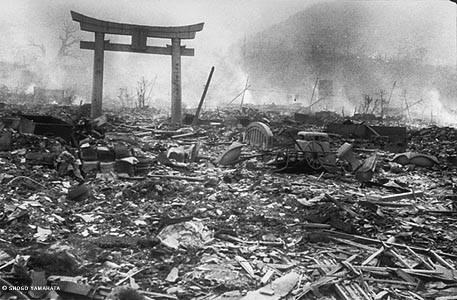
Why won’t Japan speak out as an A-bombed country?
The Japanese government has announced it will abstain from talks underway at the U.N. headquarters on establishing a convention to outlaw nuclear weapons. By abstaining from the talks, Japan is effectively abandoning its opportunity as the world’s only atomic-bombed country to serve as a bridge between nuclear and non-nuclear states.
On the reason for Japan’s abstention, Foreign Minister Fumio Kishida pointed out that the five nuclear powers of the United States, Russia, Britain, France and China are not taking part, and said that the talks “may have the opposite effect of deepening the divide between nuclear and non-nuclear states.”
In October last year, the Japanese government voted against a U.N. resolution on launching the talks. But at the time, Kishida expressed the view that Japan would actively take part in negotiations that were to begin in March.
The state of opposition between nuclear and non-nuclear states remains unchanged. It therefore makes no sense for Japan to first say it will participate and bridge the gap, only to make a turnabout and declare it will not participate, citing fears that opposition between the two camps would deepen.
The government’s decision, which overturned the foreign minister’s previous statement that Japan intended to participate, damages trust in Japanese diplomacy.
Changes in global affairs since last autumn appear to have influenced Japan’s decision not to participate. In November last year, Donald Trump won the U.S. presidential election, and the Trump administration has taken an active stance toward bolstering his country’s nuclear capabilities. The United States and other nuclear powers argue that it is not realistic in terms of security to establish a convention outlawing nuclear weapons when facing the threat of North Korea’s missile and nuclear development.
The United States is said to have pressed Japan to abstain from the talks. Some Japanese government officials took the position that even if Japan took part in negotiations, it would be limited to stressing its opposition to the convention, creating the impression of a negative stance, which would be meaningless. But this is an overly defensive position.
For Japan to participate as a bridge-builder, it needed to prepare the proper environment, by expanding the ring of like-minded countries, for example. But there is no evidence that Japan made such efforts.
Another round of negotiations is due to be held between June and July, and it is possible that a draft of the nuclear weapons convention could be compiled at that time.
It is said that such a treaty would be weak without the participation of nuclear states, but it is nevertheless possible that it would play a major role in the long run in shaping international opinion on banning nuclear weapons. It is lamentable that Japan is not taking part in that process and speaking out as a country that has suffered as an atomic-bombed country.
http://mainichi.jp/english/articles/20170329/p2a/00m/0na/006000c
Great majority of Japanese back nuke ban treaty talks: JCP head
NEW YORK — The Japanese Communist Party (JCP) chief slammed the Japanese government for abstaining from a United Nations conference to negotiate a treaty outlawing nuclear weapons despite the vast majority of Japanese supporting the treaty talks.
“It is such a shame that the Japanese government is absent from this conference. However, the vast majority of the Japanese people strongly support the negotiations,” JCP head Kazuo Shii told a March 29 session of the first round of talks on the Nuclear Weapons Convention at the U.N. Headquarters.
Shii stated that through the conclusion of the nuclear arms ban treaty and efforts among civil societies across the globe, “We can press countries that are dependent on nuclear weapons to change their policies and join efforts to abolish nuclear weapons.”
http://mainichi.jp/english/articles/20170330/p2a/00m/0na/009000c
Toshiba’s record loss: shares plummet due to nuclear failures
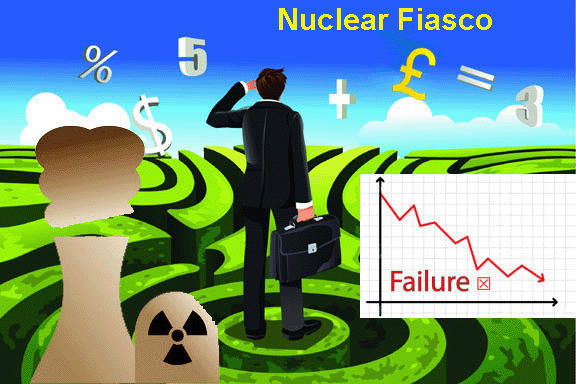 Toshiba Projects Record Loss as Nuclear Unit Files for Bankruptcy, Bloomberg, by Dawn McCarty and Pavel Alpeyev March 29, 2017,
-
Toshiba warns full year loss may widen to 1.01 trillion yen
-
Japanese company trying to sell memory chips division
-
Toshiba Corp. projected its annual loss could more than double to a record 1.01 trillion yen ($9.1 billion) as its U.S. nuclear unit Westinghouse Electricfiled for Chapter 11 bankruptcy.
The collapse of Westinghouse, once the linchpin of Toshiba’s plans to diversify away from consumer electronics, caps a disastrous run for the Japanese conglomerate as project delays crippled earnings from the nuclear plant business. The company has now put its prized memory chip unit up for sale just as it was recovering from a profit-padding scandal that claimed the scalps of senior executives……
- Toshiba listed as much as $10 billion debt for Westinghouse and another entity. The nuclear unit filed in U.S. Bankruptcy Court for the Southern District of New York and proposed to appoint Weil, Gotshal & Manges LLP as legal adviser, AlixPartners LLP as financial adviser, and PJT Partners Inc. as investment banker, subject to court approval.
Toshiba said last month it expected to write down 712.5 billion yen in its nuclear-power business, citing cost overruns and diminishing prospects for atomic-energy operations. The company has twice delayed its earnings report, with results for the December quarter now due on April 11.
- “There were warning signs when Toshiba delayed releasing financials earlier this year,” said Emmanuel Chua, senior associate at Herbert Smith Freehills in Singapore. “The big question mark is whether the restructuring plan and process presents real opportunities for a turnaround, or whether it is simply an exercise of ‘kicking the can down the road.”’
Shares of Toshiba have slumped 23 percent this year after advancing 13 percent in 2016. The loss forecast was announced after the close of trading on Wednesday.
Expectations that the company may be too big to fail for the Japanese government, and the likelihood that it will get state support is bolstering its bonds. Toshiba’s 20 billion yen of December 2020 bonds were little changed at 88 percent of face value, according to data compiled by Bloomberg……
Scana and Southern could end up facing billions of dollars in additional costs, according to Morgan Stanley. Scana faces as much as $5.2 billion in higher costs that could drag its shares down 5 percent, analysts at the bank including Stephen Byrd said in a March 22 research note, while cost overruns for utility owner Southern could reach $3.3 billion……https://www.bloomberg.com/news/articles/2017-03-29/toshiba-s-u-s-nuclear-unit-westinghouse-files-for-bankruptcy
Bankruptcy doesn’t make liabilities vanish – Toshiba wan’t be saved by Westinghouse bankruptcy
 Westinghouse Bankruptcy Won’t Save Toshiba, Bloomberg Gadfly, https://www.bloomberg.com/gadfly/articles/2017-03-29/a-westinghouse-bankruptcy-won-t-save-toshiba By David Fickling, 29 Mar 17, From the outside, Chapter 11 bankruptcy can look like an almost magical process. A company previously laden down with borrowings gets to discharge its liabilities and emerge seemingly unscathed.
U.S. miner Arch Coal Inc. had $4.5 billion in net debt and a market capitalization of just a few million dollars when it filed for Chapter 11 in January 2016. After emerging from a nine-month gestation in the courts, it’s now worth $1.73 billion and is debt free, with net cash of $31 million.
Toshiba Corp. shareholders appear to hope the same rule will hold true for Westinghouse Electric Co., the nuclear unit that’s dragged one of Japan’s oldest industrial conglomerates to the brink of insolvency. The stock has rallied 20 percent in a week, after Toshiba said Westinghouse’s board was considering bankruptcy. The unit has filed for Chapter 11 protection in New York, court documents showed Wednesday.
If the courts are about to give Westinghouse a get-out-of-jail-free card, someone ought to tell the credit markets.
Compare Toshiba’s own credit-default swaps to those on Southern Co. and Scana Corp., the two U.S. electric utilities for whom Westinghouse is under contract to build four reactors, and it’s clear that investors expect one of the three players to suffer most of the costs. Insuring $10 million of Toshiba’s debt against default for five years would set you back about $423,000, compared to $78,000 for Scana and $64,000 for Southern.
Toshiba faces a bewildering array of potential hits to its balance sheet from its nuclear foray, but most of them are either relatively small (such as its 34.6 billion yen ($311 million) in decommissioning and environmental liabilities), or already factored in (like the 713 billion yen goodwill writedown that will leave it with negative shareholders’ equity once it reports annual results).
The deal with Southern and Scana is different. Payment guarantees to subsidiaries of the two utilities constitute 90 percent of the 794 billion yen in parent-company guarantees for which Toshiba has promised to indemnify Westinghouse. Put into English: If Westinghouse fails to build the reactors on time and on budget, Toshiba is on the hook for a sum not much less than the 768 billion yen value of all its factories, machinery and land.
Aside from a bailout by the Japanese government, the sliver of hope for Toshiba shareholders is that the messy bankruptcy process will allow some of those liabilities to be taken on by other players. The U.S. government, for instance, has made an $8.3 billion loan guarantee to the owners of Southern’s reactors. That may complicate the process, the Nikkei reported earlier this month. Moody’s Investors Service and S&P Global Ratings in recent weeks have put shareholders in the plants, including Southern and Scana and associated units, on negative ratings outlooks on the possibility they will have to bear some costs.
Creditors of the two utilities seem unconcerned. It’s been more than a year since Scana’s 4.125 percent bonds due February 2022 last dipped below par, while the Southern unit that will be the main shareholder in its nuclear plant project, Georgia Power Co., managed to raise fresh debt just last month. Its $400 million of 3.25 percent notes due 2027, sold at a modest 0.113 cent discount to par, are trading at 98.56 cents on the dollar.
That should be worrying for Toshiba, because there’s no magic spell behind Chapter 11. Bankruptcy doesn’t make liabilities vanish outright. For the most part, it just reorganizes them, imposes haircuts on junior creditors, and converts a portion from the most stringent form — debt — to a milder alternative, equity. If bondholders at Westinghouse’s customers are feeling confident, Toshiba shareholders should prepare for a troublesome chain reaction.
Residents furious over high court decision to revoke Takahama nuclear plant injunction
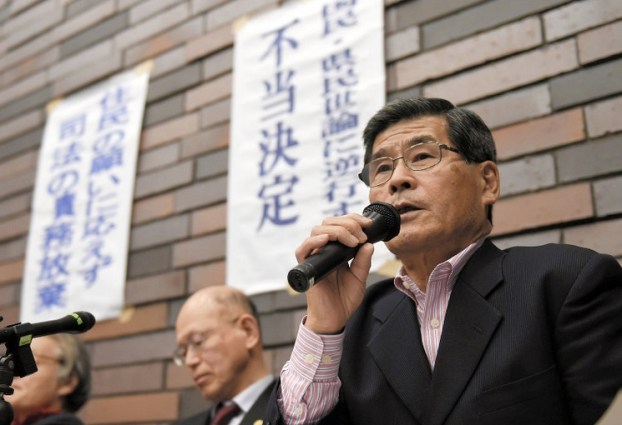
Yoshinori Tsuji, right, speaks during a news conference in Osaka’s Kita Ward on March 28, 2017, after the Osaka High Court handed down a decision on the injunction for reactors at Takahama Nuclear Power Plant
OSAKA — A March 28 Osaka High Court ruling that revoked a lower court decision to halt two nuclear reactors in Fukui Prefecture has angered plaintiffs and local residents as the high court effectively rubberstamped the state’s policy of restarting nuclear reactors.
Some 100 people demanding a halt to the reactors at Takahama Nuclear Power Plant gathered before the Osaka High Court on March 28. When they were informed of the ruling shortly after 3 p.m. with attorneys holding up banners that said, “Unjust ruling” and “The court fails to fulfill residents’ wishes,” the plaintiffs let out a sigh of disappointment.
“What are they thinking about?” “This is absurd,” they said, and shouted, “Resist the high court ruling that disregards Fukushima!” as they raised their fists.
Kenichi Ido, the head attorney for the plaintiffs, criticized the ruling during a news conference, with the over-400-page written court decision in his hand, saying, “While it’s this thick, its contents are just a copy of the views of (Takahama nuclear plant operator) Kansai Electric Power Co. and the Nuclear Regulation Authority.”
He added, “After the March 11 disaster, the judiciary is the only actor that can stop the administration that is railroading the resumption of nuclear power. But I sense that it has no self-awareness of its role or responsibility.”
Yoshinori Tsuji, the representative of the residents in the class action lawsuit, expressed frustration over the latest ruling, saying, “The decision was unjust as the high court took the policies of the central government and the utility into consideration.”
Tsuji also said the Otsu District Court’s injunction order handed down a year ago was a groundbreaking decision which reflected on the Fukushima nuclear disaster. “It further legitimized the authority of the judiciary,” he recalled.
Tsuji then slammed the Osaka High Court, saying, “The high court took a decidedly different stance from the district court with regard to listening to the people’s voices. Shame on them.”
http://mainichi.jp/english/articles/20170329/p2a/00m/0na/013000c
Japanese High Court sides with Kansai Electric, allowing restart of Takahama nuclear plant
Court overturns injunction on Takahama nuclear plant http://www.asahi.com/ajw/articles/AJ201703280059.html March 28, 2017 Kansai Electric Power Co. won a major victory in its bid to restart the Takahama nuclear plant on March 28, with the Osaka High Court overturning a lower court’s unprecedented injunction to shut down the plant in operation.
The decision came after the Osaka-based utility had appealed the Otsu District Court’s March 2016 ruling, in which it was ordered to suspend operations of the No. 3 and No. 4 reactors at the plant in Takahama, Fukui Prefecture.
In the ruling on March 28, the high court sided with Kansai Electric, which argued that its reactors met the regulatory requirements instituted in 2013 by the Nuclear Regulation Authority.
With the decision, Kansai Electric, which relies on nuclear energy more than many other utilities, is expected to begin procedures to restart the Takahama plant.
In the injunction, the district court in Shiga Prefecture concluded that merely fulfilling the new NRA requirements is not enough to secure safety at the plant, saying they were set when the investigation into the 2011 Fukushima disaster was only halfway complete.
The lower court also said a thorough survey of geological faults around the Takahama plant has yet to be conducted, and that Kansai Electric’s claim that its reactors have a sufficient safety cushion to withstand the largest tremors projected there is doubtful.
Kansai Electric countered that the new requirements fully incorporate lessons learned from the triple meltdown at the Fukushima No. 1 nuclear plant by obliging operators to prepare for a more powerful earthquake, tsunami and other natural phenomenon that could trigger an accident.
The court challenge was filed by a group of 29 residents in Shiga Prefecture, which shares a border with Fukui Prefecture, in January 2015. The injunction marked the first time a court in Japan had ordered an operating reactor to be taken offline.
Vague outlook for India-U.S. civil nuclear pact, unlikely to meet June deadline
India-U.S. civil nuclear pact likely to miss June deadline, THE HINDU, Bankruptcy of reactor maker Westinghouse clouds operationalisation of the deal.
More than two years after India and the U.S. announced that the civil nuclear deal was “done,” its actual operationalisation is in doubt over a number of developments that stretch from a “school scandal” in the Japanese parliament to the Cranberry, Pennsylvania headquarters of Westinghouse Electric, which is expected to file for bankruptcy this week.
Six reactors for A.P. According to the agreement over liability issues and the negotiations that followed former U.S. President Barack Obama’s visit to India in January 2015 and Prime Minister Narendra Modi’s visit to Washington in June 2016, the two sides had agreed to “work toward finalising the contractual arrangements by June 2017” for six reactors to be built in Andhra Pradesh by Toshiba-owned Westinghouse and the Nuclear Power Corporation of India Ltd (NPCIL).
When completed, this was to be the first operationalisation of the India-U.S. civil nuclear deal, which was announced in 2008, and proof that both sides had effectively sorted out all their issues, including over the liability that suppliers must accept in the event of an accident.
The reason for the concern is that the nuclear arrangement hinged on two major factors — the completion of the India-Japan Nuclear Cooperation Agreement (NCA), as Toshiba and other suppliers for reactor parts are bound by Japanese laws and by the actual contract to be negotiated by the U.S.-based Westinghouse…….
When contacted, the U.S. Embassy declined to comment on how the bankruptcy issues would affect the deal. Nuclear officials said it was “likely” the June 2017 commercial contract with Westinghouse would be “delayed”, given that other financial companies, insurance companies would require clarity on the company’s future before agreeing to sign on the contract.
“The truth is the picture is very hazy at the moment,” a senior official of NPCIL said, adding that in the absence of land acquisition procedures for the other India-U.S. nuclear venture with GE-Hitachi for six 1594 MW reactors, the future of the India-U.S. nuclear deal is, for the moment, pinned to the future of Westinghouse itself. http://www.thehindu.com/news/national/indo-us-civil-nuclear-pact-likely-to-miss-june-deadline/article17668572.ece
Osaka higher court backs restart of halted Takahama reactors
The Takahama reactors site is under 3 miles from Kyoto-fu, 36 miles (58K) from the cultural heritage sites in the ancient capital of Kyoto and closer to the region’s supply of fresh water, Lake Biwa.

Takahama reactors may soon restart after court overturns injunction

Plaintiffs hold banners in front of the Osaka High Court on Tuesday expressing disappointment after the court ruled in favor Kansai Electric over the restart of two Takahama reactors.
OSAKA – The Osaka High Court overturned Tuesday an injunction issued against the restart of Kansai Electric Power Co.’s No. 3 and No. 4 reactors at its Takahama facility in Fukui Prefecture, paving the way for them to be switched back on.
The landmark injunction issued by the Otsu District Court in Shiga Prefecture in March last year cited safety concerns for preventing the reactors from restarting even though they were judged to have met new safety regulations set after the Fukushima No. 1 nuclear crisis.
While the injunction had been a temporary victory for the plaintiffs in Shiga, some had predicted the Osaka High Court would adhere to a more narrow technical view of nuclear safety.
In his ruling, Judge Ikuo Yamashita said the plaintiffs had the responsibility to prove allegations of any specific dangers that would result in restarting the plant, which the judge ruled they had not.
Part of the plaintiffs’ claim relied on the alleged inadequacy of current evacuation plans in the event of an accident. Therefore, starting up the Takahama reactors, located about 60 km from the city of Kyoto, posed a significant risk, they argued.
Yamashita ruled that measures were being taken in Fukui and that official attitudes and efforts had been proactive, so he could not accept the plaintiffs’ claims.
“Kepco showed proof that they drew up emergency response measures based on the largest scale earthquake and tsunami,” the judge ruled. “The judge’s decision is extremely regrettable,”It’s clear with the decision that no progress has been made in terms of learning the lessons of March 11, 2011,” Kenichi Ido, a lawyer for the plaintiffs, said after the verdict was announced. “The attitude of the courts hasn’t changed at all since the Fukushima accident. In particular, the evacuation plans aren’t really being taken into consideration by the courts.”
Yoshinori Tsuji, one of the chief plaintiffs, said: “In America and South Korea, the courts are defying the presidents of both countries. But in Japan, the courts — which were ignoring the wishes of the people to stop nuclear power before March 11, 2011 — fail to reflect on what happened then. The courts follow the wishes of the nuclear power lobby and the government.”
Kansai electric officials welcomed the decision, saying at a Tuesday afternoon press conference in Osaka the utility would move towards preparing to restart, although they did not say when the reactors were expected to go back online.
“With safety as the top priority, the period for restarts is not yet set,” Kepco president Shigeki Iwane said. He added that once the restarts took place, the firm would move to reduce electricity prices.
In Kansai region, reaction to the court’s verdict was mixed. Fukui Gov. Issei Nishikawa, a strong supporter of nuclear power, was relieved with the decision, saying it was a return to a reasonable and correct decision by the court system.
But in neighboring Shiga prefecture, Gov. Taizo Mikazuki said that, given more immediate concerns Japan’s nuclear power industry faces, including spent fuel storage and decommissioning of old reactors, it was the wrong environment to approve reactor restarts. Kyoto Gov. Keiji Yamada emphasized that the utmost had to be done to ensure safety.
Higher court backs restart of halted Takahama reactors

The No. 3 and No. 4 reactors at the Takahama Nuclear Power Plant, from left to right, are pictured in this photo taken from a Mainichi helicopter in Takahama, Fukui Prefecture, on June 15, 2016.
OSAKA (Kyodo) — A Japanese high court on Tuesday revoked a lower court order to halt two nuclear reactors at the Takahama plant in central Japan, accepting an appeal by Kansai Electric Power Co. against the first injunction ever issued in the country to shut operating reactors.
But it is unlikely that the operation of other nuclear reactors in Japan will be resumed soon due to pending legal matters, analysts say.
The decision, made by the Osaka High Court, legally allows Kansai Electric to resume operating the Nos. 3 and 4 reactors at the nuclear power plant on the Sea of Japan coast in Fukui Prefecture. The two reactors have been idled for around a year.
The higher court said that quake-resistance standards were not overestimated under tougher regulations set following the 2011 Fukushima nuclear disaster and that necessary measures have been taken to prevent significant damage of the reactor core.
The latest decision bodes well for Prime Minister Shinzo Abe’s government, which has been promoting the restart of nuclear reactors in a bid to bolster the economy by cutting the cost of fossil fuels and exporting nuclear technology abroad.
Yoshihide Suga, the government’s top spokesman, said at a press conference in Tokyo, “We want Kansai Electric to put top priority on safety and make every effort to obtain understanding from the local government and others involved.”
Kansai Electric President Shigeki Iwane said at a news conference in Osaka that his company has yet to decide when to restart the operation of Takahama’s Nos. 3 and 4 reactors, pledging to “make safety our top priority.”
Iwane also expressed eagerness to push down electric charges as soon as possible after the resumption of the two reactors.
A group of residents in neighboring Shiga Prefecture who won the landmark injunction from the Otsu District Court in March last year are expected to consider countermeasures, including filing a special appeal with the Supreme Court.
Amid widespread concern about the safety of nuclear power following the 2011 Fukushima meltdowns, the residents in Shiga filed a request with the district court in January 2015, seeking an order halting the two reactors at the plant.
On March 9, 2016, the district court ordered operation of the two nuclear reactors to be halted, casting doubts about the utility’s safety measures and Japan’s post-Fukushima nuclear regulations set by the Nuclear Regulation Authority.
Last July, Kansai Electric filed an appeal against a district court decision rejecting its request to suspend the injunction order.
In Tuesday’s decision, the Osaka High Court determined that the post-Fukushima safety measures were “not unreasonable” because they were devised on the basis of the “latest scientific and technical knowledge” that reflects lessons learned from the nuclear disaster.
The utility has criticized the injunction, claiming it was not an objective judgment based on scientific knowledge. It also says the injunction is costing the utility 200 million to 300 million yen ($1.8 million to $2.7 million) more per day to generate power from other fuel.
Kansai Electric removed nuclear fuel from the Takahama reactors between August and September last year given the prolonged court battle.
As of Tuesday, only three of Japan’s 42 commercial reactors nationwide are now operating — the Nos. 1 and 2 reactors at Kyushu Electric’s Sendai plant in Kagoshima Prefecture, southwestern Japan, and the No. 3 reactor at Shikoku Electric Power Co.’s Ikata plant in Ehime Prefecture, western Japan, according to the Agency for Natural Resources and Energy.
On Thursday, the Hiroshima District Court is set to rule on an appeal filed to halt the operation of the No.3 reactor at the Ikata power plant, the first ruling since it resumed operations in August last year.
http://mainichi.jp/english/articles/20170328/p2g/00m/0dm/063000c
Water level rise causes shutdown in South Korea’s Kori No. 4 nuclear reactor
South Korea’s Kori No. 4 nuclear reactor shut due to water level rise, http://www.reuters.com/article/us-southkorea-nuclear-idUSKBN16Y2N6 South Korea’s Kori No. 4 nuclear reactor was manually shut down after the water level in a collection tank rose due to a coolant leak, a spokesman at the reactor’s operator said on Tuesday.
“We estimate the water level of the reactor’s collection tank increased after coolant was leaked,” said Lim Dae-hyun, the spokesman at Korea Hydro & Nuclear Power Co Ltd (KHNP).
Lim added that there was no release of radioactivity and that the cause of the water level increase was being investigated.
The 950-megawatt Kori No. 4 reactor is near Busan, a city more than 300 km (190 miles) southeast of the capital, Seoul.
KHNP, fully owned by state-run utility Korea Electric Power Corp (KEPCO), runs the country’s 25 nuclear reactors, which supply about a third of South Korea’s electricity. (Reporting by Jane Chung; Editing by Jonathan Oatis)

The Nos. 3 and 4 reactors at the Takahama nuclear power plant
Japan court rules in favor of restart of Kansai Elec’s Takahama reactors
A Japanese high court on Tuesday overturned a lower court’s order to shut two reactors operated by Kansai Electric Power, a company spokesman said, potentially ending a drawn-out legal battle and helping the utility to cut fuel costs.
The decision, while positive for Kansai Electric, is not likely to speed the broader process of getting reactors back online nationally after the Fukushima nuclear disaster of six years ago, said a former advisor to the government and others.
“The future of nuclear power is still uncertain. The decision does not mean that the courts will give a ‘yes’ to other legal cases. Political uncertainty remains strong, too,” said Tatsujiro Suzuki, a former vice chairman of the Japan Atomic Energy Commission, a government body.
The Osaka High Court overturned the first court-ordered shutdown of an operating nuclear plant in Japan. The lower court had decided last year in favor of residents living near the Takahama atomic station west of Tokyo after they had petitioned for the reactors at the plant to be shut.
Kansai Electric, Japan’s most nuclear-reliant utility before the disaster, estimates it will save 7 billion yen ($63 million) per month in fuel once it restarts both reactors.
The restart schedule for the reactors, however, is still uncertain because the utility has been conducting safety checks requested by local authorities after a large crane toppled onto another reactor building at the site due to strong winds in January, a Kansai Electric spokesman said earlier.
There are four reactors at the Takahama plant, with the earlier court order covering the two newest ones.
The company released a profit forecast after the verdict on Tuesday saying it estimates net income of 133 billion yen ($1.2 billion) in the year through March 31, 2017.
The Kansai case was one of many going through the courts after the Japanese public turned away from nuclear power following the Fukushima meltdowns of 2011, the world’s worst nuclear calamity since Chernobyl in 1986.
Just three out of Japan’s 42 operable reactors are running and the pace of restarts has been protracted despite strong support from Prime Minister Shinzo Abe’s government, which is keen to restore a power source that provided about a third of electricity supply before the Fukushima disaster.
Residents have lodged injunctions against nuclear plants across Japan and lower courts have been increasingly siding with them on safety concerns.
Contentious verdicts are usually overturned by higher courts, where judges tend to be more attuned to government policy, judicial experts say.
“We are going to win some and we are going to lose some, but the political and social situation is such that unstable prospects for restarts are here to stay,” Aileen Mioko Smith, an advisor to the plaintiffs and a co-plaintiff in other lawsuits, told Reuters by phone from Osaka.
There are more than 30 cases going through Japan’s courts in which communities are seeking to stop reactors from operating, she said.
Kansai Electric shares had ended trading before the court decision was released. They closed 0.3 percent higher on Tuesday at 1,283 yen, while the broader market rose more than 1 percent.
http://www.reuters.com/article/uk-japan-nuclear-court-idUSKBN16Z0IP
1 This Month




PLEASE OPPOSE HR 8255 AND S.3639 – bills would accelerate satellite deployment, with no environmental review or safeguards – https://ncstd5li.quorum.us/campaign/169331/
To see nuclear-related stories in greater depth and intensity – go to https://nuclearinformation.wordpress.com
-
Archives
- September 2026 (339)
- August 2026 (330)
- July 2026 (355)
- June 2026 (287)
- May 2026 (306)
- April 2026 (356)
- March 2026 (251)
- February 2026 (267)
- January 2026 (308)
- December 2025 (358)
- November 2025 (359)
- October 2025 (375)
-
Categories
- 1
- 1 NUCLEAR ISSUES
- business and costs
- climate change
- culture and arts
- ENERGY
- environment
- health
- history
- indigenous issues
- Legal
- marketing of nuclear
- media
- opposition to nuclear
- PERSONAL STORIES
- politics
- politics international
- Religion and ethics
- safety
- secrets,lies and civil liberties
- spinbuster
- technology
- Uranium
- wastes
- weapons and war
- Women
- 2 WORLD
- ACTION
- AFRICA
- Atrocities
- AUSTRALIA
- Christina's notes
- Christina's themes
- culture and arts
- Events
- Fuk 2022
- Fuk 2023
- Fukushima 2017
- Fukushima 2018
- fukushima 2019
- Fukushima 2020
- Fukushima 2021
- general
- global warming
- Humour (God we need it)
- Nuclear
- RARE EARTHS
- Reference
- resources – print
- Resources -audiovicual
- Weekly Newsletter
- World
- World Nuclear
- YouTube
-
RSS
Entries RSS
Comments RSS

