Chinese diplomat warns that talk between USA and North Korea is essential – tipping point is near
Talk or risk reaching nuclear tipping point, Chinese diplomat warns US and North Korea
Kim Jong-un has stabilised his regime and it is unrealistic to expect it to collapse under the weight of sanctions, former deputy foreign minister says, 03 May, 2017, South China Morning Post, Laura Zhou, North Korea’s missile and nuclear technology might reach a tipping point if Washington and Pyongyang refuse to negotiate, a senior Chinese diplomat has warned.
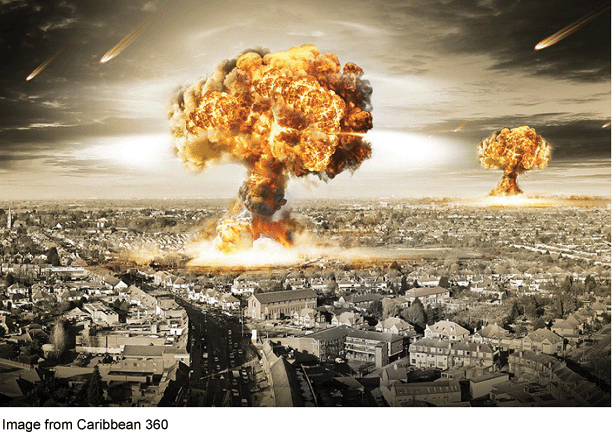
In an analysis piece published on Sunday by US think tank the Brookings Institution, Fu Ying, chairwoman of the National People’s Congress’ Foreign Affairs Committee, said it was unrealistic to expect the regime of North Korean leader Kim Jong-un to succumb to pressure of sanctions or collapse.
“Sanctions may exert huge pressure, but the country can hold up and will not give up nuclear development because of them,” wrote Fu, who is also a former deputy foreign minister.
“It is not hard to see that this situation could make the issue drag on into a spiral of intensified sanctions and continued nuclear testing until [North] Korean nuclear and missile technologies reach a tipping point.”
She said that once that point was reached, the countries opposing Pyongyang’s possession of nuclear weapons would be “faced with the hard choice of taking extreme action with unknown consequences, or tolerating it”……..
She also repeated Beijing’s call for a “double suspension” – that Pyongyang suspend its nuclear and missile tests in exchange for a halt of large scale US-South Korean military exercises.
Fu said China did not have leverage over North Korea because Pyongyang’s security concerns in the face of US military threats had not been addressed.
Trump said on Monday that he would consider meeting Kim “under the right circumstances”.
Lu Chao, from the Liaoning Academy of Social Sciences, said Trump’s offer could be “positive” to the Korean crisis.
“As Fu Ying said, the key has never been owned by China,” Lu said. “The problem can only be solved by the two sides [the US and North Korea].
“I don’t think Kim would really want to wage a war with the US.” http://www.scmp.com/news/china/diplomacy-defence/article/2092432/talk-or-risk-reaching-nuclear-tipping-point-chinese
North Korea accuses USA of planning a pre-emptive nuclear strike, with its bomber flights


 North Korea says US bomber flights signal pre-emptive nuclear strike, ABC News 3 May 17 North Korea is accusing the United States of pushing the Korean peninsula to the brink of nuclear war after a pair of strategic US bombers flew over the area in a training drill with the South Korean air force.
Key points:
- Supersonic B-1B Lancer bombers flew over Korean peninsula
- North Korea says US is practising a nuclear strike
- Mr Trump has said he would consider meeting Kim Jong-un but also warned of a “major, major conflict”
The two supersonic B-1B Lancer bombers were deployed amid rising tensions over North Korea’s dogged pursuit of its nuclear and missile programs in defiance of United Nations sanctions and pressure from the United States.
The flight of the two bombers on Monday came as US President Donald Trump said he was open to meeting North Korean leader Kim Jong-un in the appropriate circumstances, even though Pyongyang suggested it would continue with its nuclear tests……..
The North is technically still at war with the South after their 1950-53 conflict ended in a truce, not a treaty, and regularly threatens to destroy the United States, Japan and South Korea.http://www.abc.net.au/news/2017-05-02/us-bomber-flights-push-peninsular-to-the-brink-of-war/8489952
North Korea threatens a pre-emptive nuclear strike on USA
 North Korea threatens to reduce USA ‘to ruins’ with preemptive nuclear strike http://metro.co.uk/2017/05/02/north-korea-threatens-to-reduce-usa-to-ruins-with-preemptive-nuclear-strike-6611855/Tuesday 2 May 2017
The piece says, ‘Its vast territory is exposed to our preemptive nuclear strike.
‘If the U.S. shows any slight sign of provocation, just the inter-continental ballistic rockets displayed in the April military parade will fly into the U.S.
‘The reckless nuclear war provocation by the Trump administration will bring it nothing but the fall of the American empire.’ The piece says that the North Korean army is ‘waiting for the moment it will reduce the whole of the U.S. mainland to ruins with its absolute weaponry of justice.
Last week North Korea released a video showing nuclear missile attack on Washington DC.
The video, released by official state media, shows the White House in a gun-style crosshair – and a missile descending on the city and exploding in a giant fireball. Another sequence shows American warships being targeted by rockets – interspersed with videos of recent live-fire drills.
The video showed sequences from a live-fire exercise conducted this week, designed to show off the strength of Pyongyang’s million-strong army
Following its Nuclear Fiasco, Toshiba to Split into Four Subsidiaries
 http://breakingenergy.com/2017/05/02/toshiba-to-split-into-four-subsidiaries/ By MICHAEL VINCIThe four subsidiaries will be (1) infrastructure (including water treatment and railways); (2) energy (including thermal and nuclear power); (3) electronics (including data storage); (4) information and communications.
With the exception of the new energy subsidiary, the rest of the spin-offs would come into being in July 2017. Energy is set to be in effect in October.
The significant of the bankruptcy of Westinghouse is still unclear – many are concerned that the shutdown will have an effect on the nuclear power sector. As the four new subsidiaries demonstrate, the ramifications of this bankruptcy are clearly having their way with Toshiba.
The measures taken by Moody’s apply to the Vogtle entities. That is, Georgia Power, Oglethorpe Power and the Municipal Electric Authority of Georgia. Also included are the entities of the Summer project. Specifically, SCANA Corp. and the South Carolina Electric and Gas Subsidiary, as well as to the South Caroline Public Service Authority.
Moody’s justifies the new outlook as being reflective of the increased credit and regulatory risk that will be a result of the bankruptcy. The depleted financial condition of Toshiba contributes to this risk. In February, the company took a $6.3 billion write-down associated with Westinghouse’s overrun costs at the two nuclear projects in America.
Now, the bankruptcy has left Toshiba with what can amount to billions of dollars in potential losses. This presents serious struggles for the nearly 150 year old conglomerate. After the bankruptcy was announced, Toshiba shares in Tokyo stumbled nearly 4%. Moreover, losses from last year left the company with $2.1 billion of negative shareholder equity, which threatens its position on the Tokyo Stock Exchange.
More immediate concerns for the company include the expiration of construction licenses, which are needed to sell equipment to the power industry. Unfortunately, the licenses have to be renewed every five years, but require that the company meet certain equity and capital targets. Toshiba’s weakened state jeopardizes the renewal process.
Some of Toshiba’s other revenue streams offer products such as turbines for gas, hydro, and geothermal plants. These power sector products are important to the company, and so the decision to create the subsidiaries is largely to protect those businesses from the potential fall out regarding the Westinghouse bankruptcy. Otherwise, the bankruptcy might end up being a roadblock to engaging in the power sector further.
With regards to the nuclear industry, the bankruptcy has the potential to threaten the completion of two current reactor projects in progress in the Southeast. Further, there is practically zero change that any new nuclear facility in the U.S. will be built in the foreseeable future.
Simply put, nuclear facilities are no longer cost effective. They were intended as an alternative to dirty fossil fuels and expensive green energy, but neither of those are as problematic as they used to be. It seems as if the industry has no prospects left.
World Health Organization’s Flawed Fukushima Report
 Hidden Radiation Secrets of the World Health Organization, CounterPunch MAY 2, 2017
1) Evaluation of exposure
2) Likely health effects
Alex Rosen of Int’l Physicians for the Prevention of Nuclear War critiqued the two WHO Fukushima reports, found to be extremely problematic, and once again, similar to Chernobyl, shoddy work that sweeps way too much dirt under the carpet.
Here’s the problem: WHO’s estimates of Fukushima radioactive exposure are at least 50% less than any other estimates, including estimates provided by TEPCO (Tokyo Electric Power Company, the plant operator) itself. But, WHO is supposed to be the guardian of public health concerns, not TEPCO.
Also, two critical population studies are ignored in the WHO reports, i.e., all of the residents within the 20 km exclusion zone are eliminated, even though their radiation exposure would be very high, actually highest. The second group ignored is workers on site… ahem!
Additionally, WHO cavalierly approved the Japanese government’s drastic change in annual maximum radiation exposure allowed for the general population up to 20 mSv per year.http://www.counterpunch.org/2017/05/02/hidden-radiation-secrets-of-the-world-health-organization/
Japanese Government to release map of potential final nuclear disposal sites
Government to release map of potential final nuclear disposal sites this summer, Japan Times, 3 May 17 KYODO, STAFF REPORT, The government has set the criteria for a map meant to identify potential final disposal sites for high-level radioactive nuclear waste, paving the way for its release as early as this summer.
The process of finding a host for nuclear waste could face challenges amid public concerns over safety.
Based on the map, the government will approach select municipalities to allow research to be conducted for suitable sites to store waste from nuclear power generation.
For permanent disposal, high-level nuclear waste needs to be stored at a final depository more than 300 meters underground for up to about 100,000 years until radiation levels fall and there is no longer potential harm to humans and the environment.
The government plans to create a permanent underground repository somewhere in stable bedrock so the canisters can be stored for tens of thousands of years.
The map is likely to classify which areas are geologically suitable for such a structure to be built deep enough underground. This would rule out areas near active faults and volcanoes as well as oil and coal fields.
Based on waste transport criteria, the map is likely to show that zones within 20 km of the coastline are favorable to host final disposal sites.
The government hopes other municipalities — not just the ones located near nuclear power plants — may also become interested in hosting the disposal facilities. It also wants to show that a variety of places nationwide are suitable for nuclear waste management.
The map was originally planned for a 2016 release but the publication date was later postponed, as some local governments were wary that disposal sites would be imposed on them.
About 18,000 tons of spent fuel currently exist in Japan. Including spent fuel that has already been reprocessed, the country’s total jumps to about 25,000 canisters of vitrified high-level waste, all of which needs to be managed.
The process to find local governments willing to host final storage started in 2002, but little progress was made due mainly to opposition from local residents.
In May 2015, the central government introduced a plan announcing that final depository site selection would be based on scientific grounds, rather than waiting for municipalities to volunteer.
Before presenting the map, the government will hold symposiums between mid-May and June at nine cities to explain the map criteria to the public. The cities include Tokyo, Nagoya and Fukuoka…….http://www.japantimes.co.jp/news/2017/05/02/national/government-release-map-potential-final-nuclear-disposal-sites-summer/#.WQlFDEWGPGg
Lots of renewable energy news. For example: India
 Sorry. I can’t keep up with all the renewable energy news. Can only give headlines. I recommend Renewable Energy Buzz
World’s hottest market: Air conditioners for India and hundreds of new electric plants to power them.
The country is likewise poised to avoid the costs of such an explosion—including billions of tons of carbon pollution—by deploying units that are super efficient, with climate-friendly refrigerants and powered by renewable energy.
http://www.dailyclimate.org/t/-995200128361643930
Global pension funds warm to India’s solar power ambitions.
Some of the world’s biggest pension funds, seeking long-term returns on green investments, are scouting for deals in India’s solar power sector, where Prime Minister Narendra Modi is targeting $100 billion in investment in the next five years.
http://www.dailyclimate.org/t/-995200128361646659
India to make every single car electric by 2030 in bid to tackle pollution that kills millions.
Every car sold in India will be powered by electricity by the year 2030, according to plans unveiled by the country’s energy minister.
http://www.dailyclimate.org/t/-995200128361643930
Transfer sites for 610 tons of spent nuclear fuel undecided; decommissioning plans may be affected

Spent nuclear fuel is stored in a pool at the La Hague reprocessing facility in northwestern France in October. It is one of the most dangerous sites in the world, with its 10,000 tons of spent fuel. We were afraid of the Fukushima Daiichi fuel pool 4 but it was nothing: The whole fuel of the Hague corresponds to radiotoxicity 360 times greater than Chernobyl.
About 610 tons of spent nuclear fuel stored at seven of the 17 reactors in Japan that are set to be decommissioned have no fixed transfer destination, it was learned Sunday, threatening to hold up the decommissioning process.
If it remains undecided where to transfer the spent nuclear fuel, work to dismantle reactor buildings and other structures may not be carried out as planned.
The tally excludes the six reactors at Tokyo Electric Power Co. Holdings Inc.’s Fukushima No. 1 plant, which was heavily damaged by the March 2011 earthquake and tsunami.
The seven reactors are the Japan Atomic Energy Agency’s Fugen advanced converter reactor, the agency’s Monju prototype fast-breeder reactor, Japan Atomic Power Co.’s reactor 1 at its Tsuruga plant, reactors 1 and 2 of Kansai Electric Power Co.’s Mihama plant, reactor 1 of Chugoku Electric Power Co.’s Shimane plant and reactor 1 of Kyushu Electric Power Co.’s Genkai plant, according to the companies and the agency.
The Fugen reactor has 70 tons of spent mixed-oxide, or MOX, fuel, a blend of uranium and plutonium recycled from spent nuclear fuel.
The agency has abandoned its plans to move the MOX fuel out of the reactor site in the current fiscal year to March 2018. It has considered consigning the reprocessing of the fuel overseas but a contract has not been signed yet.
The agency’s schedule to finish the decommissioning work by fiscal 2033 has remained unchanged, but an official admitted that the timetable will be affected if a decision on where to transfer the spent fuel is not made.
As for the trouble-prone Monju reactor, the agency has yet to submit a decommissioning program to authorities. How to deal with 22 tons of spent MOX fuel at the reactor is a major issue.
The Mihama No. 1 reactor has 75.7 tons of spent conventional nuclear fuel and 1.3 tons of spent MOX fuel, while the No. 2 reactor has 202 tons of spent nuclear fuel. Kansai Electric plans to take them out of Fukui Prefecture, which hosts the power plant, by fiscal 2035, but the transfer location has not yet been selected.
At the Tsuruga plant’s reactor 1, Japan Atomic Power plans to transfer 31.1 tons of the reactor’s 50-ton spent nuclear fuel to the fuel pool of reactor 2, with the rest to be transported by fiscal 2026 to a Japan Nuclear Fuel reprocessing plant under construction in the village of Rokkasho in Aomori Prefecture.
After being postponed more than 20 times, the completion of the reprocessing plant is currently slated for the first half of fiscal 2018 and the blueprint is undergoing screenings by the Nuclear Regulation Authority, a nuclear watchdog.
As nuclear fuel cannot be brought into the reprocessing plant until it starts operations after receiving all necessary regulatory approval, it is uncertain whether the Tsuruga reactor fuel can be transferred as planned.
Chugoku Electric aims to transfer 122.7 tons of spent nuclear fuel at its Shimane plant’s reactor 1 to the Rokkasho reprocessing plant by fiscal 2029.
Kyushu Electric hopes to take 97.2 tons of spent nuclear fuel at the Genkai reactor 1 out of its fuel pool by fiscal 2029, but the destination has not been fixed.
At three other nuclear plants with reactors set to be decommissioned, spent nuclear fuel is mostly planned to be moved out of the current pools to other pools within the same plant.
In the case of Tepco’s disaster-stricken Fukushima No. 1 plant, the site of the 2011 triple meltdown accident, where the 2,130 tons of spent nuclear fuel will be transferred to has yet to be decided.
Still, the decommissioning work for the six reactors there will not be affected in any significant way for the time being, as more urgent tasks, such as a survey of melted fuel, have been given higher priority, officials said.
Watchdog blasts Joyo reactor restart plan as ‘unacceptable’

The Japan Atomic Energy Agency’ Joyo experimental fast reactor in Ibaraki Prefecture
The nation’s nuclear watchdog has slammed the operator of the Joyo experimental fast reactor in Ibaraki Prefecture for its approach to safety concerns in seeking an early restart.
Shunichi Tanaka, chairman of the Nuclear Regulation Authority, on April 26 labeled the Japan Atomic Energy Agency’s proposal to bring the reactor back online as “absolutely unacceptable.”
The NRA on April 25 suspended its screening of Joyo’s restart plan based on stricter safety standards introduced after the 2011 Fukushima nuclear disaster.
“Has the JAEA seriously reflected on the accident at the Fukushima No. 1 nuclear power plant?” Tanaka asked at a news conference on April 26. “It said that explaining the restart (to municipalities) would take too much trouble. Its attitude toward the communities is wrong.”
The JAEA has applied to the NRA to restart the reactor with a plan to operate it with a thermal output of 100,000 kilowatts, rather than its full capacity of 140,000 kilowatts.
On April 25, JAEA officials explained that it would be able to restart the reactor faster by limiting the thermal output because that approach would save it time and effort in providing the necessary explanations to municipal authorities.
If the reactor operates with an output of 100,000 kilowatts, only local governments within a 5-kilometer radius of the reactor are required to produce evacuation plans.
However, when operating with an output of 140,000 kilowatts, local entities within a 30-km radius of the reactor are required to come up with evacuation plans.
Using a motorcycle analogy, Tanaka said the JAEA’s plan is tantamount to saying that the operator needs a “license for a 50cc bike as long as it drives a 750cc motorcycle at a speed of 30 kph or under.”
China on denuclearization, dialogue and diplomacy

 China stresses two directions in dealing with nuclear issue on Korean Peninsula, Manila Bulletin, By People’s Daily, 30 Apr 17 UNITED NATIONS – Chinese Foreign Minister Wang Yi said on Friday that two directions must be stuck to while dealing with the nuclear issue on the Korean Peninsula.
“We must stay committed to the goal of denuclearization,” Wang said while addressing the UN Security Council Ministerial Meeting on Non-proliferation and the Democratic People’s Republic of Korea (DPRK).
“All parties should comprehensively understand and fully implement DPRK-related Security Council resolutions,” he said.
“Denuclearization is the basic precondition for long-term peace and stability on the Peninsula and what we must accomplish to safeguard the international nuclear non-proliferation regime,” Wang said.
The Security Council held a special meeting on Friday to discuss the nuclear issue on the Korean Peninsula. UN Secretary-General Antonio Guterres briefed the meeting, which was chaired by U.S. Secretary of State Rex Tillerson, as the United States holds the rotating presidency of the Security Council this month……..
All the 15 members of the Security Council addressed the meeting focusing on the nuclear issue on the Korean Peninsula and the implementation of relevant UN resolutions.
Wang said: “We must stay committed to the path of dialogue and negotiation.”
“The use of force does not resolve differences, and will only lead to bigger disasters,” he noted, adding that “as the only way out, dialogue and negotiation also represent the sensible choice for all parties.”
“Our past experience of resolving the nuclear issue on the peninsula shows, whenever dialogue and negotiation were ongoing, the situation on the peninsula would maintain basic stability and efforts toward denuclearization could make progress,” said the minister.
He recalled the period between 2003 and 2007 when the parties were engaged in dialogue and negotiation, and three joint documents were adopted……..http://news.mb.com.ph/2017/04/30/china-stresses-two-directions-in-dealing-with-nuclear-issue-on-korean-peninsula/
North Korea’s threat to sink US nuclear submarine
North Korea threatens to sink US nuclear submarine http://www.independent.co.uk/news/world/asia/north-korea-threat-sink-us-nuclear-submarine-uss-michigan-south-korea-donald-trump-kim-jong-un-a7709946.html ‘It will be doomed to face the miserable fate of becoming an underwater ghost without being able to come to the surface’ Samuel Osborne @SamuelOsborne93 30 Apr 17, North Korea , has threatened to sink a US nuclear submarine deployed in South Korean waters.
“The moment the USS Michigan tries to budge even a little, it will be doomed to face the miserable fate of becoming an underwater ghost without being able to come to the surface,” the North’s propaganda website Urminzokkiri said.
“The urgent fielding of the nuclear submarine in the waters off the Korean Peninsula, timed to coincide with the deployment of the super aircraft carrier strike group, is intended to further intensify military threats toward our republic.”
The guided missile submarine USS Michigan has been joined by the USS Carl Vinson aircraft carrier group in waters near the Korean peninsula.
The website added that “whether it’s a nuclear aircraft carrier or a nuclear submarine, they will be turned into a mass of scrap metal in front of our invincible military power centred on the self-defence nuclear deterrence.”
The aircraft carrier group began exercises with the South Korean navy on Sunday after it completed drills with the Japanese navy.
The dispatch of the Carl Vinson was a “reckless action of the war maniacs aimed at an extremely dangerous nuclear war,” the Rodong Sinmun, the official newspaper of North Korea’s ruling Workers’ Party, said in a commentary.It comes after the hermit kingdom test-fired another ballistic missile in a clear message of defiance aimed at Washington and its allies.
However, US officials said the medium-range ballistic missile disintegrated mid-flight, minutes after launch, and fell into the Sea of Japan.
President Donald Trump, asked about his message to North Korea after the latest missile test, told reporters: “You’ll soon find out”, but did not elaborate on what the US response would be.The North has been conducting missile and nuclear weapons related activities at an unprecedented rate and is believed to have made progress in developing intermediate-range and submarine-launched missiles.
Tension on the Korean peninsula has been high for weeks over fears the North may conduct a long-range missile test, or its sixth nuclear test, around the time of the 15 April anniversary of its state founder’s birth.
Small nuclear reactors not a good deal for Indonesia
 Nuclear Power and Small Modular Reactors in Indonesia: Potential and Challenges, The
  Nautilus Institute, Bernadette K. Cogswell, Nataliawati Siahaan, Friga Siera R, M. V. Ramana, and Richard Tanter Indonesian Institute for Energy Economics Nautilus Institute for Security and Sustainability April 2017
“………CONCLUSION This report has also outlined many challenges that would have to be overcome before any SMRs are constructed in Indonesia, including a lack of support for nuclear power at the highest (and lower) political levels, public opposition to nuclear power, the absence of tested SMR designs, and the higher electricity generation costs associated with SMR technology. There are also legislative regulations that could become obstacles for specific technologies, such as floating power plants, and the model of SMR construction that involve fabrication of the bulk of the reactor in factories
The first factor, the absence of widespread and sustained political support, has been the major roadblock for the establishment of nuclear power in general. The Indonesian nuclear establishment has been trying to set up nuclear power plants since the 1970s but has so far not managed to persuade government leaders. Indeed, in December 2015, then Energy and Mineral Resources Minister Sudirman Said announced publicly that the government had concluded that “this is not the time to build up nuclear power capacity. We still have many alternatives and we do not need to raise any controversies”.155 Although this decision might be revised in the future, it testifies to lack of broad-based political support. Given this context, those advocating constructing SMRs in a country like Indonesia that has no nuclear power capacity face the basic conundrum: building untested nuclear technologies that might lead to higher electricity generation costs is going to be more of a political challenge than constructing nuclear reactor designs that have been operated in other countries.
The higher electricity generation cost associated with SMRs should be seen not just in comparison with the cost of generating electricity with a large NPP but also with a range of alternatives that are available in Indonesia. Of these, the declining cost of solar photovoltaic technology is particularly relevant. Studies testify to the large potential of solar energy in Indonesia and the government has been adopting policies that promise to accelerate the construction of significant amounts of solar capacity.
The smaller power level of SMRs also implies that producing the same amount of electricity using these as opposed to large reactors would require dealing with public resistance at many more sites. Because public opposition has played a major role in stopping construction of nuclear power plants so far, constructing SMRs might be even more of a challenge than large reactors; for SMRs, the potential benefits accruing from electricity generation comes at a higher economic and social cost. As a result, it would seem that the construction of SMRs is unlikely, especially in large enough numbers to make a sizeable contribution to Indonesia’s electricity generation. http://liu.arts.ubc.ca/wp-content/uploads/2015/12/IIEE-Nautilus-SMR-Report-Final-For-Publication-April2017.pdf
Wildfires near Fukushima crippled nuclear power plant
 Fukushima authorities ask troops to help deal with forest fires near crippled nuclear power plant https://www.rt.com/news/386662-fukushima-forest-fires-soldiers/#.WQaIanZz1L8.facebook
Fukushima prefecture has asked the Japanese Self-Defense Forces for help in handling forest fires that have swept areas near the crippled Fukushima power plant, local media report. Strong winds are hindering the firefighting efforts, however.
The forest fires broke out near the town of Namie, some seven kilometers from the disabled Fukushima Daiichi Nuclear Power Plant, on Saturday evening, Japanese NHK broadcaster reported.
Namie was evacuated following the 2011 tsunami and subsequent nuclear disaster in Fukushima.
The prefecture has deployed several helicopters to extinguish the fires, which are believed to have been caused by lightning. According to police, at least 10 hectares of forest have burned in the area.
There have been no reports of injuries or damage to buildings so far, Japanese media say.
With strong winds stoking the flames, the Fukushima Prefecture has requested help from the Self-Defense Forces, Japan’s de-facto army, on Sunday.
Earlier in April, residents of Namie, as well as those from the village of Iitate and the town of Kawamata’s Yamakiya neighborhood, totaling 22,100 people in all, were told they could return home – with the exception of those with houses in so-called no-go zones, where radiation levels are still too high, according to Japanese media.
So far, the homecoming has not been as successful as the government had hoped, as few residents have been eager to go back.
Results of a Fukushima Prefectural Government survey released on April 24 show that some 78.2 percent of the evacuated households have no intention of returning to their previous residences and plan to remain in the area they evacuated to.
Do a soft sell first: that’s Malaysian government’s pathway to nuclear power
 Malaysia not in a hurry on nuclear power, to raise awareness first — Nancy, Borneo Post, May 1, 2017 KUALA LUMPUR: Malaysia will remain focused on the information and communication programme relating to nuclear power generation for the time being, and not in hurry to make any decision to introduce nuclear energy into its energy mix.
Minister in the Prime Minister’s Department Datuk Seri Nancy Shukri said emphasis needed to be given on nuclear power education first.
“Not necessarily we accept it straight away. I don’t want to commit by saying that we will look into this immediately but it is important to train and educate our people about nuclear (first).
“We have a lot of fear. We are not equipping ourselves with the correct information,” she told Bernama in Shanghai after a four-day working visit to China’s nuclear power facilities recently.
Nuclear power is a complex and sensitive issue that requires deep understanding. It also needs a long-term commitment, taking a long time to materialise, while its programme requires a long lead time in order to cultivate a critical mass of domestic talent capable of supporting any future initiatives……..
During their working visit to China recently, the Malaysian delegation not only studied safe and sustainable nuclear power technology and infrastructure, but also its implementation, especially on ways to achieve public understanding and acceptance.
The visit, which was led by Nancy, was at the invitation of the Chinese Nuclear Society, a non-profit organisation dedicated to nuclear science, technology and engineering…….
The delegation was made up of stakeholders and representatives from government agencies such as the Malaysia Nuclear Power Corporation, Energy Commission, Agensi Inovasi Malaysia, Economic Planning Unit and Malaysian Nuclear Agency, as well as academicians, and Tenaga Nasional Bhd senior executives.
Malaysia is currently exploring the option of deploying nuclear energy to meet future demand but has indicated that it is not in the rush or set a timeline for the programme……..http://www.theborneopost.com/2017/05/01/malaysia-not-in-a-hurry-on-nuclear-power-to-raise-awareness-first-nancy/
Is it REALLY a good idea to start another Korean war?
North Korea already is a nuclear power. Its first nuclear test was over a decade ago, and analysts say it probably has enough material for a dozen bombs today…… there are absolutely no good reasons to start another Korean War.
 North Korea’s Nuclear Weapons Are Not Reason Enough to Start a War, TIME, Charlie Campbell / Beijing Apr 28, 2017 More than 2 million people were killed in the 1950-3 Korean War, including almost 40,000 Americans. Some 7,000 U.S. soldiers are still listed as missing. Countless families were torn apart by the conflict, which is still officially ongoing, as it was only ended by armistice rather than a peace treaty. It remains one of modern history’s longest wars.
These facts are important to remember when a U.S. President says, “There is a chance that we could end up having a major, major conflict with North Korea,” as Donald Trump did in an exclusive Reuters interview published Thursday.
On Feb.13, it even unleashed VX nerve agent — a U.N.-certified Weapon of Mass Destruction — at Kuala Lumpur International Airport to assassinate of Kim Jong Nam, Kim Jong Un’s estranged half-brother. It has abducted possibly hundreds of foreign nationals. At home, its own citizens are subject to “crimes against humanity,” according to a 2014 U.N. report.
However, what’s spurred Trump’s saber-rattling is North Korea’s nuclear program. Pyongyang has tested five nuclear bombs to date, and appears poised for a sixth. It also frequently tests missiles that may one day be able to reach the continental U.S. “[We can] can tip new-type intercontinental ballistic rockets with more powerful nuclear warheads and keep any cesspool of evils in the earth, including the U.S. mainland, within our striking range,” Kim Jong Un said after watching a rocket test last year.
Trump says that if North Korea cannot be persuaded from dismantling its nuclear weapons then military action maybe unavoidable. On April 8, he ordered a U.S. navy strike group — an “armada,” he called it — to the Korean peninsula. The obvious problem is that Seoul — home to half of South Korea’s 50 million people, including 200,000 Americans — lies within range of North Korea’s artillery, and possibly even nuclear weapons.
Trump’s gamble is that Kim Jong Un would shy away from retaliating against a U.S. strike on his nuclear facilities, cognizant that American military superiority means any full-scale war would undoubtedly result in his regime’s complete destruction…….
Trump told Reuters that he operates under the assumption that Kim Jong Un is “rational.” But backed into a corner, is Trump willing to bet nuclear apocalypse on that?
But even if North Korea were not to retaliate, there’s no guarantee strikes would achieve their goal of permanently retarding the regime’s nuclear program. Plus there would be dire strategic consequences. Beijing would be livid. The U.S. would have started yet another 21st Century war, utterly alienating international public opinion, tearing up its hard-fought Asian security alliance and inviting Chinese hardliners to push it out of the region. According to an August 2016 study by Brown University, the wars in Iraq, Afghanistan and Pakistan — in which the U.S. military has been involved — have directly cost 370,000 lives since 2001. (Not that we’ve stopped counting.)
However, the broader point is that North Korea, for all its many and egregious faults, is a state hell-bent on survival. It might have nuclear weapons, but the regime cannot use them without guaranteeing its own destruction……..
Unfortunately, there is little chance the regime will voluntarily give up its nuclear weapons. Kim Jong Un is very aware of the fates of Libyan dictator Muammar Gaddafi and Iraqi dictator Saddam Hussein, who were both toppled after abandoning their nuclear aspirations. He believes a nuclear bomb guarantees the security of his regime. And he might be right.
For lack of any better option, the U.S. and its allies should utilize the countless strategic advantages that won the Cold War, because the tussle with North Korea is still part of that ideological reckoning. ……
North Korea already is a nuclear power. Its first nuclear test was over a decade ago, and analysts say it probably has enough material for a dozen bombs today…… there are absolutely no good reasons to start another Korean War. http://time.com/4759066/north-korea-kim-jong-un-donald-trump-nuclear-weapons/
1 This Month




PLEASE OPPOSE HR 8255 AND S.3639 – bills would accelerate satellite deployment, with no environmental review or safeguards – https://ncstd5li.quorum.us/campaign/169331/
To see nuclear-related stories in greater depth and intensity – go to https://nuclearinformation.wordpress.com
-
Archives
- September 2026 (330)
- August 2026 (330)
- July 2026 (355)
- June 2026 (287)
- May 2026 (306)
- April 2026 (356)
- March 2026 (251)
- February 2026 (267)
- January 2026 (308)
- December 2025 (358)
- November 2025 (359)
- October 2025 (375)
-
Categories
- 1
- 1 NUCLEAR ISSUES
- business and costs
- climate change
- culture and arts
- ENERGY
- environment
- health
- history
- indigenous issues
- Legal
- marketing of nuclear
- media
- opposition to nuclear
- PERSONAL STORIES
- politics
- politics international
- Religion and ethics
- safety
- secrets,lies and civil liberties
- spinbuster
- technology
- Uranium
- wastes
- weapons and war
- Women
- 2 WORLD
- ACTION
- AFRICA
- Atrocities
- AUSTRALIA
- Christina's notes
- Christina's themes
- culture and arts
- Events
- Fuk 2022
- Fuk 2023
- Fukushima 2017
- Fukushima 2018
- fukushima 2019
- Fukushima 2020
- Fukushima 2021
- general
- global warming
- Humour (God we need it)
- Nuclear
- RARE EARTHS
- Reference
- resources – print
- Resources -audiovicual
- Weekly Newsletter
- World
- World Nuclear
- YouTube
-
RSS
Entries RSS
Comments RSS

