Universal migration predicts human movements under climate change, Physics World, 12 Jun 2018
Climate change is expected to displace millions of people through impacts like sea level rise, crop failures, and more frequent extreme weather. Yet scientists still cannot predict where these expected climate-induced migrants are likely to go in the coming decades.
A new study, published today in Environmental Research Letters, seeks to address this need by incorporating climate impacts into a universal model of human mobility.
To demonstrate the efficacy of the new approach, the study focused on the case of sea level rise (SLR) and human migration in Bangladesh, where the authors estimate that more than two million Bangladeshis may be displaced from their homes by 2100 because of rising sea levels alone.
The study, led by Columbia University, New York, used a probabilistic model combined with population, geographic, and climatic data to predict the sources, destinations, and flux of potential migrants caused by sea level rise.
Lead author Dr Kyle Davis, from Columbia University, explained: “More than 40 per cent of Bangladesh’s population is especially vulnerable to future sea level rise, as they live in low-lying areas that are often exposed to extreme natural events.
“However, SLR is a very different type of migration driver from short-lived natural hazards, in that it will make certain areas permanently uninhabitable.”
The team’s results using Representative Concentration Pathway (RCP) scenarios showed that mean SLR will cause population displacements in 33 per cent of Bangladesh’s districts, and 53 per cent under more intensive conditions. By mid-century, they estimated nearly 900,000 people are likely to migrate because of direct inundation from mean SLR alone.
Under the most extreme scenario, of up to 2 metre mean SLR, the number of migrants driven by direct inundation could rise to as many as 2.1 million people by the year 2100. For all RCP scenarios, five districts – Barisal, Chandpur, Munshiganj, Narayanganj, and Shariatpur – are the source for 59 per cent of all migrants.
Their analysis considered mean SLR without normal high tides, so the results – both in terms of inundated area and displaced population – are conservative.
The researchers also estimated the extra jobs, housing and food needed to accommodate these migrants at their destinations. They found that to cope with the numbers likely to be displaced by 2050, 600,000 additional jobs, 200,000 residences and 784 billion food calories will be needed.
Nikkei Asian Review 10th June 2018, US demands Japan reduce its plutonium stockpiles. Trump-Kim summit raises
questions about Tokyo’s nuclear exemption. The U.S. has called on Japan to
reduce its high levels of stockpiled plutonium, a move that comes as the
Trump administration seeks to convince North Korea to abandon its nuclear
weapons, Nikkei has learned. https://asia.nikkei.com/Politics/International-Relations/US-demands-Japan-reduce-its-plutonium-stockpiles
The nuclear accident at Tokyo Electric Power Company’s (TEPCO’s) Fukushima Daiichi Nuclear Power Station (FDNPS) has left TEPCO under a huge pile of debt. At the time, there were arguments in favor of dissolving TEPCO, the liable party, but due to the Japanese government’s generous support, the company continues to exist to this day. In this article, we attempt to throw light on the reasons why TEPCO was not bankrupted.
Act on Compensation for Nuclear Damage
Japan’s Act on Compensation for Nuclear Damage states in Section 3, “Where nuclear damage is caused as a result of reactor operation etc. during such operation, the nuclear operator who is engaged in the reactor operation etc. on this occasion shall be liable for the damage, except in the case where the damage is caused by a grave natural disaster of an exceptional character or by an insurrection.” In Section 4, the Act stipulates that “Where nuclear damage is covered by the preceding section, no person other than the nuclear operator who is liable for the damage pursuant to the preceding section shall be liable for the damage.” Thus while imposing on the nuclear power operator unlimited no-fault liability with liability concentrated in its hands, it also provides exemptions in the form of “a grave natural disaster of an exceptional character or by an insurrection.” At the same time, Section 16 provides for necessary government assistance to pay compensation, and Section 17 states that in the case of “a grave natural disaster of an exceptional character or by an insurrection” the government “shall take necessary measures to relieve victims and to prevent the damage from spreading.”
What became a problem at the time of the FNDPS accident was whether or not it had occurred due to a grave natural disaster of an exceptional character. From the outset, the government indicated the stance of not applying the exemption, stating, “As the nuclear power operator, TEPCO should bear liability for damage caused by this nuclear power plant accident.” TEPCO insisted that the accident was due to “a grave natural disaster of an exceptional character” and that “there is a margin for judging that an exemption be invoked,” but eventually accepted liability.
Financing immediately after the accident
Since the exemption was not invoked, TEPCO faced unlimited compensation for the damage caused by the FNDPS accident. In 2011, the government estimated that compensation alone would be of the order of 4.5 trillion yen.
TEPCO’s cash and deposits as the accounts were closed at the end of the third quarter of 2010 (December 31, 2010) were 366.5 billion yen. With company bond redemptions of 500 billion yen coming up in FY2011 and the need to procure fuel worth 800 billion yen, financing from the market was fraught with difficulties after the FNDPS nuclear accident, bringing TEPCO close to bankruptcy.
TEPCO’s cash and deposits leaped up to 2.2 trillion yen at the close of accounts for FY2010 (March 31, 2011). This was almost all in long-term loans. According to news reports at the time, 1.865 trillion yen was provided in loans of three to ten years, with no warranty and at the same interest as before the accident, by eight financial institutions, including the Sumitomo Mitsui Banking Corporation (600 billion yen), the Mizuho Corporate Bank (500 billion yen) and the Mitsubishi UFJ Bank (300 billion yen). It is said that in the background to this was the statement by the then deputy minister of the Ministry for the Economy, Trade and Industry (METI), Kazuo Matsunaga, that “We must also not shirk responsibility. I would also like to see support from financial institutions.”
TEPCO thus managed to overcome the problems of March 2011, but even after that, arguments insisting that TEPCO be declared bankrupt and go into legal liquidation continued. However, in the end, it was decided to allow the company to survive from the viewpoint that if TEPCO went into legal liquidation compensation to those affected by the nuclear accident would be delayed.
Especially problematical were the electric power bonds issued by TEPCO. The Electricity Business Act allows TEPCO and the other power business operators to issue company bonds with “general collateral” that make it possible to prioritize debt repayment to other creditors. In other words, if a company goes bankrupt, those financial institutions that originally stood to make profits from the purchase of the company bonds would receive first priority in debt repayment, whereas compensation for those affected by the nuclear accident would be on the same pecking order as repayment for other debts (e.g. loans, etc.).
TEPCO’s net assets as of March 31, 2011 were 1.6024 trillion yen. It was clear that the estimate for compensation at the time of 4.5 trillion yen would put TEPCO in a situation of net capital deficiency. The balance of company debt at this time was 4.4251 trillion yen. If TEPCO were to be declared bankrupt at that time, the company debt would first have to be repaid, after which other debts, including the liabilities to those affected by the nuclear accident, would be paid out.
There was also the option of allowing TEPCO to go bankrupt, and having discharged the debts the government would, in a separate deal, then pay out compensation from the national treasury to those affected by the nuclear accident. However, since the accident was still ongoing, liquidating TEPCO might pose obstacles to the work of the post-accident clean-up. Considering this, it is not unreasonable that the government at the time decided to allow TEPCO to continue to exist. However, by allowing TEPCO to survive, the stockholders who had invested in TEPCO and the financial institutions that had provided funds, i.e. the investors who bore a certain risk for the sake of profits, suffered no losses, and in their place the greater population of Japan overall would take on the burden. That was how the current TEPCO survival scheme was born.
The TEPCO survival scheme
In August 2011, the government enacted the Nuclear Damage Compensation Facilitation Corporation Act to avoid a TEPCO bankruptcy. The scheme inherent in the act is as follows:
1) The government shall establish the Nuclear Damage Compensation Facilitation Corporation (later reorganized as the Nuclear Damage Compensation and Decommissioning Facilitation Corporation in August 2014) as the facilitating organization handling compensation payments and so on in the case of nuclear damage, and nuclear power operators are to establish a reserve fund (general contributions) to provide compensation.
2) The Corporation shall levy a special contribution from the nuclear operator that caused the accident (in this case TEPCO).
3) The Corporation shall provide financial facilitation (granting of funds, acceptance of stocks, loans, purchase of company bonds, etc.) when the Corporation’s facilitation is required for compensation by the nuclear operator. To procure the funds necessary for financial facilitation, the Corporation can issue government-guaranteed compensation bonds to borrow money from financial institutions.
4) In the case that special support is required from the government, the Corporation and the nuclear operator shall determine the amount of compensation, prepare a “special business plan” that sets out the content and value of the financial support, policies for business management rationalization and so on, and receive approval from the relevant ministers (the Cabinet Office and METI). Following approval, the government will allocate government bonds to the Corporation, the necessary funds then being granted to the nuclear operator by the Corporation.
5) The Corporation shall pay into the national treasury money up to the amount of redemption of the government bonds.
Based on this scheme, TEPCO and the Corporation devised a Special Emergency Business Plan in November 2011, following up with a Comprehensive Special Business Plan in May 2012, a New Comprehensive Special Business Plan in January 2014 and a New-New Comprehensive Special Business Plan in May 2017. On the basis of these business plans, the government established a government bond allocation limit of 13.5 trillion yen (including decontamination and mid-term storage of radioactive wastes, etc. as well as compensation) for the Corporation and it was decided to provide a grant of 10.2006 trillion yen to TEPCO. In addition to this, the Corporation accepted one trillion yen in TEPCO stocks in July 2012 (making the Corporation the holder of 54% of TEPCO stocks, which would increase to 80% if class B priority stocks were converted to class A stocks).
Furthermore, besides the above, TEPCO also estimates that that 8 trillion yen will be needed for decommissioning and as countermeasures for contaminated water. As a result, the costs involved in dealing with the FNDPS nuclear accident are therefore currently estimated to be 21.5 trillion yen.
Of this, it is presumed that the 4 trillion yen estimated for decontamination costs will be eventually supplemented by profits accruing from the sale of TEPCO stocks, the 1.6 trillion yen costs for intermediate storage facilities will be paid from the national treasury, and that 3.7 trillion yen of the total compensations will be paid by nuclear power operators from the general contributions, while 0.24 trillion yen will be borne by imposing a power distribution consignment charge on power companies that have entered the market recently due to deregulation of the power market.
it is impermissible for the government, which is spending such an enormous amount of taxpayers’ money on TEPCO, to allow the utility to give financial support to another collapsed company
If the state is rich enough to permit TEPCO to spend massive funds for unnecessary purposes, it should force the utility to take responsibility for causing the Fukushima nuclear accident and reduce the financial burden borne by the Japanese public. There is no need for TEPCO to survive any longer, because it has abdicated its responsibility for the nuclear accident and continues to support a virtually failed company.
The utility should go bankrupt and be liquidated.
* TEPCO’s annual electricity sales for 2016 totaled 241.5 billion kWh, which means each household is paying 789 yen to the utility annually. (The average electricity consumption per household in 2016 was 4,432kWh.)
Citizens’ Nuclear Information Center Create No Nukes World With Us CNIC Statement, April 11, 2018 : Liquidate TEPCO! http://www.cnic.jp/english/?p=4130, BY CNIC_ENGLISH · JUNE 4, 2018 On April 5, 2018, the government’s Nuclear Damage Compensation Dispute Resolution Center notified residents of Namie Town, Fukushima Prefecture, and TEPCO of its decision to discontinue its efforts to achieve an Alternate Dispute Resolution (ADR) on the residents’ demand for additional compensation for mental anguish caused by the 2011 Fukushima nuclear accident. Continue reading →
a minimum requirement for any form of political consent to onsite storage would be a clear commitment by the government to phase out all nuclear power by a fixed date, so that the final amount of waste can be determined and will not just keep growing, along with the burden on local people.
CNIC Seminar report: The problems with Japan’s Plutonium: What are they and how do we deal with them? http://www.cnic.jp/english/?p=4135Caitlin Stronell, CNIC BY CNIC_ENGLISH · JUNE 4, 2018 On April 20, CNIC organized a seminar with guest speaker Prof. Frank von Hippel, a nuclear physicist from Princeton University’s Program on Science and Global Security, presenting alternative ways to dispose of spent fuel instead of reprocessing, as well as options for disposal of separated plutonium. After this presentation of technical solutions, a panel discussion took place. Prof. Eiji Oguma, a historical sociologist from Keio University’s Faculty of Policy Management and a well-known commentator on the post-Fukushima anti-nuclear movement in Japan, pointed out the political barriers that must be overcome if any of these technical solutions were to be actually implemented, no matter how much more reasonable they may seem from economic and safety perspectives. CNIC’s General Secretary, Hajime Matsukubo was also on the panel and brought into the discussion the international implications of Japan’s plutonium policy including the US-Japan Nuclear Agreement.
Prof. von Hippel explained that plutonium disposal is a global problem, with more than half of the existent separated plutonium being produced as a result of civilian reprocessing, the rest produced for military purposes. Disposing of the plutonium that had been produced for weapons during the cold war has been a huge headache for the United States with planned disposal by burning it as MOX fuel in commercial reactors proving hugely expensive. America has all but abandoned its half-built MOX plant and is now looking towards the ‘dilute and dispose’ option.
This process would use glove boxes to mix 300 grams of plutonium oxide into a can of ‘star dust’ (a secret ingredient from which plutonium would be difficult to separate again). This can would then be placed in a plastic bag and another ‘outer blend can.’ Another way of immobilizing plutonium is the Hot Isostatic Pressing method, which is being developed in the UK and utilizes radiation-resistant, low-solubility ceramic. After plutonium has been immobilized, it is safer to bury it underground than keep it on the surface and Prof. von Hippel mentioned the deep borehole disposal method which uses techniques developed for drilling oil and geothermal wells that can bore five kilometers into the earth. In the US, however, plans for a demonstration project of this method of radioactive waste disposal were rejected by local governments.
Prof. von Hippel stressed that the main lesson for Japan is that separated plutonium is extremely difficult to dispose of and that it is definitely better not to separate any more than is already stockpiled. Instead of sending spent fuel from the nation’s nuclear power plants to Rokkasho for reprocessing, it would be safer and much cheaper and more efficient to set up dry cask storage for the spent fuel onsite at the plant. Prof. von Hippel showed us successful examples of this method in the US and suggested that there were moves in this direction in Japan as well.
Prof. von Hippel’s detailed technical solutions were very convincing. Yet despite the dangers of holding such a large plutonium stockpile (47 metric tons, enough for approximately 6,000 nuclear weapons), despite the massive costs involved and despite having no concrete viable plans as to how to actually use the separated plutonium, official Japanese government policy is to continue to separate even more plutonium at the Rokkasho Reprocessing Plant, which is currently due to commence operations in 2021.
In the panel discussion which followed Prof. von Hippel’s presentation, Prof. Oguma agreed that reprocessing was most certainly problematic, but, he pointed out, it will be extremely difficult to just put up onsite storage of spent fuel, no matter how reasonable a technical solution it is. Political consent must be gained from the people in communities, which will not just be hosting the nuclear power plant, but will be asked to store its radioactive waste as well. As Prof. Oguma pointed out, especially post-Fukushima Daiichi, no one trusts the Japanese Government’s nuclear policy and the likelihood that they will agree to yet another imposition that can be perceived to be long-term and dangerous, is very low. Much of the Japanese public also believes that onsite storage is merely an excuse for the nuclear industry to keep afloat. If spent fuel pools fill up, utilities will not be able to operate their plants. For many activists this is one way of closing them down, which is their main aim. Prof. Oguma argued that a minimum requirement for any form of political consent to onsite storage would be a clear commitment by the government to phase out all nuclear power by a fixed date, so that the final amount of waste can be determined and will not just keep growing, along with the burden on local people.
This is a significant difference in perspective. Prof. von Hippel’s main aim is to stop reprocessing and reduce stocks of separated plutonium, even if nuclear power generation continues, but Prof. Oguma claims that without an overall reassessment of the entire nuclear power policy it will be impossible to gain political consent for Prof. von Hippel’s proposed onsite storage.
The economics is not as straightforward as it sounds either. While it is undoubtedly cheaper, in a purely mathematical sense, to simply dispose of spent fuel as waste, instead of reprocess it and fabricate MOX fuel, the accounting systems of utilities make the more efficient alternative of direct disposal very difficult. At the moment, spent fuel is counted as an asset on utility balance sheets under the premise that it will become MOX fuel. If reprocessing is officially abandoned, all of the spent fuel ‘assets’ will become ‘liabilities’ and many utilities will be facing possible bankruptcy. Prof. Oguma suggested that the only way to overcome all these political and economic barriers is for the government to disclose all information on nuclear power and reprocessing and to conduct an open public debate on how to proceed. If a public consensus is reached, based on all the scientific, technical and economic data available, then reprocessing should be stopped.
CNIC’s Hajime Matsukubo pointed out that the Japanese government’s accountability crisis was not just domestic, but international. Building up such large stocks of plutonium at huge cost and with no credible purpose inevitably makes neighboring countries suspect Japan’s intentions. Indeed documents recently revealed show that the present Vice Minister of the Ministry of Foreign Affairs has long been an advocate of Japan becoming a nuclear weapons state. Japan’s opposition to President Obama’s proposal that the US adopt a no first-use of nuclear weapons policy, was reported in the Japanese media. Thus Japan’s credibility as a strong advocator of non-proliferation is already failing and the plan to separate even more plutonium at Rokkasho could easily provoke a regional nuclear arms race, destabilizing the region, just as hopes rise that the situation in North Korea may improve.
Mr. Matsukubo also pointed out that Japan is the only non-nuclear weapons state that is permitted to separate plutonium under the US-Japan Nuclear Cooperation (123) Agreement. This creates double standards which weaken the entire global non-proliferation regime. For example, Saudi Arabia is negotiating a 123 Agreement with the US and demands that it also be allowed to reprocess spent fuel ‘like Japan.’
For all of the above safety, economic and non-proliferation reasons, it would seem that there is plenty of ammunition for the movement against reprocessing. Indeed, Mr. Matsukubo said that in many ways it should be easier to stop reprocessing than stop nuclear power generation. Why hasn’t this happened? As well as the difficulties mentioned by Prof. Oguma, there is also the factor that the movement against reprocessing in Japan has not been as strong as the movement against nuclear power. Reprocessing seems like a more convoluted, more removed issue, perhaps difficult for people to grasp and focus on. All speakers agreed that the movement against reprocessing must be strengthened. The first thing that must be done to achieve this is to raise awareness and understanding regarding this issue within the broader anti-nuclear movement (both power generation and weapons) and the general public. Providing accurate information on the nuclear fuel cycle in a format that people can understand is the vital first step. As many people as possible must be informed about the costs, the dangers and the alternatives. The movement must be strong enough to demand that governments and utilities disclose all data, engage in an open debate and commit to implementing the consensus which emerges.
Prof. Oguma said that he and many other activists in Japan were committed to conveying the messages of Fukushima to the larger world, and to contributing to international solidarity on ending nuclear power. This also includes understanding how other countries see Japan. The plutonium issue is one that has particularly strong international impacts and implications and by pursuing this present policy the Japanese government is only damaging Japan’s international credibility, especially regarding non-proliferation.
The seminar concluded that, whether on an international level or a domestic one, the Japanese government must restore accountability and democracy, it must formulate a responsible nuclear policy that is demonstrably safe, economic and realistic and which has the consent of the people. Viable technical alternatives to reprocessing spent fuel are available but can only be implemented through raising awareness and a change in political will, which as a movement, we must focus on with added strength.
Group Introduction: No Nukes Wakayama http://www.cnic.jp/english/?p=4139 Kikuo Shimizu, No Nukes Wakayama Representative BY CNIC_ENGLISH · JUNE 4, 2018 The nuclear plant was defeated but the battle against the interim storage facility continues
It was in February 1977 that a nuclear power plant project was proposed in the former Hikigawa Town (now a part of Shirahama Town) in Wakayama Prefecture, western Japan. The town council decided to sell a block of town-owned land to Kansai Electric Power Company (KEPCO) at an ad hoc meeting. The town sold 660,000 square meters of mountainous forest land for 1.259 billion yen.
This created a profound controversy in the town. Those in favor of the project and those not in favor entered into an intense confrontation which lasted for 16 years. The town was divided into two, and even families were divided, generating conflicts between parents and children, and among siblings. In 1988, the town elected an anti-nuclear mayor, and the controversy gradually calmed down.
In Wakayama Prefecture there have been five candidate NPP sites, including Hikigawa, but all the projects were defeated by resistance from local populations. However, KEPCO’s Hikigawa NPP siting office has continued to operate, with four employees.
We, local residents against NPPs, have been concerned for more than ten years about the possibility of Hikigawa being selected as an interim nuclear waste storage facility site. However, we were almost convinced that no NPP would be built here because Hikigawa Town merged with neighboring Shirahama Town in 2006 in the course of the great Heisei merger of cities, towns and villages, and because of the Fukushima Daiichi nuclear disaster.
Concerning the issue of interim nuclear waste storage facilities, Governor Issei Nishikawa of Fukui Prefecture, which hosts many KEPCO NPPs along the Japan Sea coast, issued a statement that the prefecture would accept the restart of Ohi NPP units 3 and 4 on condition that interim nuclear waste storage facilities would be built outside the prefecture. The KEPCO president announced the company’s plan to select a facility site in 2018, to start construction in 2020, and to commence operation in 2030. In response to these announcements, Maizuru City and Miyazu City, situated along the Japan Sea shore, as well as the governor of Kyoto Prefecture in which the two cities are located, made it clear that they would not accept interim facilities in the respective municipalities. In Wakayama, located along the Pacific Ocean shore, the prefectural governor and the mayors of towns and cities have already stated that they would not admit high-level radioactive wastes, but the mayor of Shirahama Town has not ruled out hosting interim storage facilities. KEPCO and associated companies own about 1.2 million m2 of mountainous forest land on the coast in the Hikigawa area of Shirahama Town, and there is a port nearby that appears to be suitable for the transportation of nuclear fuel.
Concerned about such circumstances, residents organized a lecture gathering entitled “Say No to Interim Nuclear Waste Storage Facilities” on January 20 this year, inviting Mr. Hideyuki Koyama from Osaka Citizens Against the Mihama, Ohi and Takahama Nuclear Power Plants (“Mihama-no-Kai”) to speak. We also submitted a formal letter to the mayor of Shirahama Town on February 23, requesting the mayor to announce that the town would not accept the construction of an interim nuclear waste storage facility. Later, on April 16, the members of the Kansai Network Concerned with Evacuation Plans submitted another formal letter of similar content to the mayor. On May 23, No Nukes Wakayama, organized a general meeting in Tanabe City, Wakayama, and decided to launch further actions against the construction of interim nuclear waste storage facilities, specifically by organizing small talks and informative gatherings, and by talking to the town council, the council of area leaders, and various organizations in the town, aiming to expand the movement and stop the project by all available means. We commit ourselves to handing over the beautiful ocean, mountains and rivers safely to our children and grandchildren, and we are determined to make continued efforts to achieve this.
North Korean leader Kim Jong Un provides guidance on a nuclear weapons program in this undated photo released by North Korea’s Korean Central News Agency (KCNA) in Pyongyang September 3, 2017. KCNA via REUTERS
Why Donald Trump should stay wary about North Korea’s nuclear plans – even if Kim Jong-un promises to allow inspections
Experts say that the level of know-how and stock of easily concealed materials would make it easy for Pyongyang to start making bombs again, SCMP, Liu Zhenzhen.liu@scmp.com, 08 June, 2018, Experts believe that North Korea has the capability and knowledge to hide hundreds of kilograms of nuclear material from inspectors and could quickly resume its bomb-making programme, even if it agrees to start the denuclearisation process at next week’s summit between Donald Trump and Kim Jong-un.
A recent report by a team led by Siegfried Hecker, a former director of the America’s Los Alamos weapons laboratory, calculated that at the end of last year North Korea’s inventory contained between 250 and 500kg (550-1,000lb) of highly enriched uranium-235 (HEU) and 20 to 40kg of plutonium-239 (Pu-239), the two most important materials for making a bomb.
A single atomic bomb needs about 4-10kg of weapons-grade plutonium, or about 15kg of HEU. With additional fusion materials that are much easier to produce, more powerful hydrogen bombs can be assembled.
“With the material, the knowledge, the experienced scientists, North Korea will be able to make the weapons again,” said an expert with Chinese Academy of Engineering Physics (CAEP), the country’s nuclear weapons research and manufacturing institution, speaking on condition of anonymity. “A system of knowledge is difficult to eliminate.”
Pyongyang’s nuclear programme will be a primary topic of discussion when the US president and the North Korean leader meet in Singapore on Tuesday. Although they may disagree on what “denuclearisation” actually means, from the US perspective, it would likely require the inspection and surrender of all the fissile materials.
However, no one knows exactly how much material North Korea holds, in particular how much HEU, and enrichment facilities are easy to conceal.
“Enrichment of uranium is one capability that can be most easily hidden and made almost impossible to inspect and verify,” said Zhao Tong, a Beijing-based fellow in the nuclear policy programme at the Carnegie Endowment for International Peace.
He said the credibility of North Korea’s “denuclearisation” could be built only on mutual trust and confidence because 100 per cent transparency was impossible.
“Centrifuges can be built underground and covered up in unknown corners of the country,” he said.
Kim, the economy and why UN sanctions did not bring North Korea to the summit table
Although UN sanctions have limited growth, North Korea’s financial health – and the physical health of its people – seem to be stabilising, SCMP, Lee Jeong-ho, 03 June, 2018 If top officials in Washington and Tokyo are to be believed, the application of “maximum pressure” through United Nations sanctions was decisive in bringing North Korean leader Kim Jong-un to the summit table.
Pyongyang has been the target of a string of UN bans from trade to travel for more than a decade, the toughest coming in September when they were expanded to cover crude oil.
Just six months later Kim sent a message offering to meet US President Donald Trump with no strings attached.
Senior US and Japanese officials credited the offer in large part to the international sanctions, which they maintained had battered the already beleaguered North Korean economy.
But there is evidence – anecdotal and data – that North Korea’s economy has stabilised over the past few years, and while UN sanctions are limiting its growth, the country is far from famine or total collapse.
Reliable data on North Korea is hard to get. But information from various sources suggests that it has been making noticeable improvement since Kim came to power in December 2011 – at least before a new round of United Nations sanctions began taking effect this year.
Park En-na, South Korea’s ambassador for public diplomacy, said the general picture was that North Korea’s economy was getting better.
“Kim has introduced many new elements to the economy. To some extent, they even allowed privatisation,” Park said.
Kim has rolled out various measures to accelerate his country’s economic development and loosen the government’s grip on business and industry. In 2012, he offered factories and companies incentives to improve productivity and a year later, he established 13 new economic development zones to try to attract foreign investment. More market-oriented reforms were adopted in 2014 to further liberalise the economy. On top of that, improving living standards is now a national priority.
TICKING OVER
Although the direct effect of these decisions is hard to measure, there are some economic indicators of progress.
The Bank of Korea, the central bank in Seoul, estimated the North Korean economy had grown 1.24 per cent on average since Kim took power, expanding by 4 per cent to US$28.5 billion in 2016, the fastest growth in 17 years.
Pyongyang’s trade figures also reveal signs of economic expansion since 1996.
North Korea’s main exports are minerals, metallurgical products and manufactured goods including armaments, according to the latest Central Intelligence Agency’s World Factbook. Its main imports are petroleum, coking coal and machinery.
………
ON THE GROUND
International observers also report that conditions in North Korea appear stable.
David Beasley, executive director of the World Food Programme (WFP), made an official trip to North Korea last month, visiting Pyongyang, Sinwon county in South Hwanghae province and Sinuiju city in North Pyongan province.
Beasley said signs of hunger and malnourishment in the country had diminished.
“What I did not see was starvation. In the 1990s, there was famine and starvation, but I saw none of them,” he said…….
NUCLEAR CONFIDENCE
North Korea’s economy-first focus emerged in April when Kim said he would start moving away from the “byungjin” policy, which calls for developing nuclear weapons and the economy simultaneously, to adopt a new strategy focusing on improving the economy.
That message was reinforced – albeit indirectly – during Kim’s talks with Chinese President Xi Jinping in the northeastern Chinese city of Dalian in May. In that meeting, Kim said he anticipated taking “phased and synchronous measures” to “achieve denuclearisation and lasting peace on the Korean peninsula”. That process would involve step-by-step eradication of nuclear weapons in return for economic sweeteners and a gradual lifting of sanctions.
Many analysts said Kim was simply using the weapons as a bargaining chip for aid to offset the effect of the sanctions and thereby realise his much-needed economic goals.
But Chung Jae-heung, a researcher at the Sejong Institute in Seoul, said North Korea was emboldened by its nuclear strength rather than bowed by a sanctions-hit economy.
“It’s Pyongyang’s confidence as a nuclear state that brought Kim to the negotiating table, not solely UN sanctions, as its economy is not as bad as many of us think,” Chung said.
“The North Korean regime is not likely to collapse due to UN sanctions, as Beijing is unlikely to cut down its oil supply to the extent that may threaten the survival of the Kim regime.”
Park, the South Korean ambassador, said that having acquired nuclear technology, Kim could next turn his focus to economic development.
“It is difficult to assess how much impact UN sanctions have on North Korea,” she said. “But it is obvious that under the sanctions, they can’t make meaningful economic development as there is no investment from the outside.”
Lim Eul-chul, a North Korea expert at the Institute for Far Eastern Studies in Seoul, said that while the recent UN sanctions may have caused the North Korean economy harm, their implications were limited, and they paled in the context of recent history.
The measures taken by the UN “will never be as bad as the great North Korean famine of the 1990s”, he said.
Chennai: Brain tumour has emerged as a type of cancer that affects a large population of youngsters mostly due to exposure to ionizing radiation.
Though a large number of brain tumours can be non-cancerous, the prevalence of brain tumour of both types is rising in the country. On World Brain Tumour Day, medicos discuss various factors associated with brain tumour.
Unnecessary growth of cells within a part of brain can lead to tumours namely, malignant and benign tumours. The incidence of brain tumour has been growing and statistics on childhood cancer reveal that brain tumour is commonest in girls and even in both sexes in adults in the country, though the data may vary for different states.
“Every year 40,000 to 50,000 people are diagnosed with brain tumour. There are 120 different types of brain tumour and they exhibit different symptoms. People who have been exposed to ionizing radiation for longer periods have an increased risk of brain tumour, especially among the youngsters,” said Dr Suresh Kumar, consultant neurologist, Fortis Malar.
After the central government introduced National Cancer Control Programme, various programmes have been launched to screen and diagnose brain tumour at an early stage, and a significant part of it emphasizes on providing palliative care in end stage.
“Genetic factors are also responsible for the incidence of brain tumours, and high dosage of X-rays is also dangerous and can be a risk factor for brain tumour. Some common symptoms are seizures, headaches, blurred vision, vomiting in morning, while the patient can also have difficulty in walking, speaking and sensation,” said senior neurologist N Dinesh.
Medicos usually suggest surgery, radiotherapy, chemotherapy, steroids and anti-seizure medication as few common treatments. However, the treatment can be individualistic based on the type, location, and stage of the tumour.
World’s Biggest Nuclear Plant Is Center Stage in Rural Election, Stephen Stapczynski– 8 June 2018 (Bloomberg) — The fate of the world’s largest atomic plant may be decided by a local election this weekend in a rural Japanese prefecture better known for its skiing and sake.
The top two candidates running in the June 10 Niigata gubernatorial race are opposed to the speedy restart of Tokyo Electric Power Co. Holding Inc.’s nuclear reactors — which the utility, known as Tepco, aims to fire-up as soon as 2019. But the degree to which the candidates oppose atomic power is being watched closely by investors, voters and local media.
……..While candidates backed by Prime Minister Shinzo Abe’s Liberal Democratic Party and the opposition both want to finish investigations into atomic safety before the Kashiwazaki-Kariwa reactors restart, their views diverge after that.
Chikako Ikeda, a member of the prefecture’s assembly and backed by a coalition of opposition parties, has said she doesn’t support Tepco restarting the facility. She is also calling for a local referendum to decide the fate of the units after the prefecture finishes its investigations, which could take another three years.
Hideyo Hanazumi, a former vice-governor of Niigata backed by Abe’s LDP party, has refused to say whether he supports the restart but has insisted that the prefecture’s investigations be completed before a decision is made. Tepco shares have lost almost 14 percent since the day before May 9 when he said the nation should rid itself of nuclear power in the long-term and continue the prefecture’s investigation.
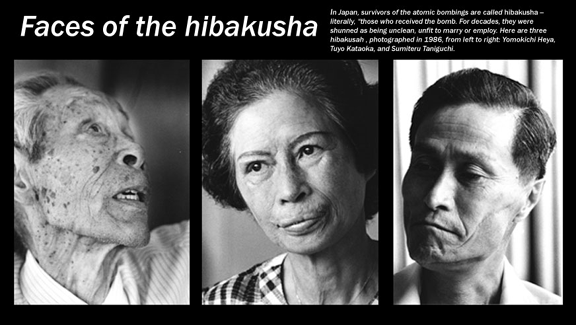
Tokyo, (Jiji Press), 7 June 18,–Japanese “high school peace ambassadors” on Thursday expressed their hopes to convey the voices of hibakusha, or atomic bomb survivors, for nuclear abolition to the world, and spread peace across the globe.
The high school students, who took part in a campaign to collect signatures with the aim of abolishing nuclear weapons, have been selected as a candidate for the Nobel Peace Prize for 2018.
At an event in Tokyo on Thursday to report the peace ambassador activities, Konami Funai, 17, a high school third-grader from Fukuyama, Hiroshima Prefecture, western Japan, spoke about her visit to the secretariat of the Norwegian Nobel Committee in March.
“It made me even prouder of our activities,” she said, referring to the nomination as a Nobel prize candidate. But Funai added that even if they win the prize, it would not be their goal. “I’ll patiently continue to call for nuclear abolition.”
The high school peace ambassadors were nominated a Nobel Peace Prize candidate by the Norwegian committee, after Japanese lawmakers recommended them for the award with the campaign marking its 20th anniversary this year.
Storage tanks of contaminated water stand at Tepco’s Fukushima No. 1 nuclear power plant. Tepco estimates that at the current rate it will run out of tank space in 2020, and a decision must be made on what to do with the water well before then.
June 5, 2018
Virtually every news story about the Fukushima No. 1 nuclear power plant acknowledges the tremendous ongoing problem of contaminated water that is accumulating in approximately 850 large tanks on-site. There are about 850,000 tons of water in the tanks at present, from which all radionuclides of concern except tritium — radioactive hydrogen — have been effectively removed. More water accumulates each day, in quantities roughly equal to the amount of groundwater that seeps into the damaged reactor buildings. Tokyo Electric Power Company Holdings estimates that at the current rate it will run out of tank space in 2020. Something needs to be done well before then, and the decision should address the concerns of all stakeholders, public and private.
The Ministry of Economy, Trade and Industry recently announced that meetings will be held where the public can hear explanations of proposed solutions and comment on them. Unless they think seriously about how to prevent this from becoming yet another clumsy exercise in DAD — “decide, announce, defend” — these meetings will be a mere fig leaf that will allow the government to claim it has adequately consulted the public.
As it is, the government’s decision-making process itself appears to be dysfunctional, and we have reason to be skeptical that it will be possible to avert very bad domestic and international public reactions if and when this water is disposed of.
The Subcommittee on Handling Water Treated by the Polynuclide Removal Facility is one of several Japanese government committees organized by METI tasked with formulating a response to the problem of the radioactive water. The planned public sessions were announced at its eighth meeting, on May 18.
This is a step in the right direction, and is long overdue. Nevertheless it may well be a case of “too little, too late.” The decision, delayed for years, will almost certainly be to dilute the water and release it to the ocean, and meanwhile, public opposition to this idea has hardened. The issue hinges on both scientific understanding and public perception.
What is tritium?
Tritium, scientifically indicated as “H3,” occurs both naturally and through man-made processes. Tritiated water (HTO), like that accumulating at the No. 1 nuclear power plant, behaves almost identically to normal water, and can be taken up easily by living organisms. The scientific consensus is that the health risks from exposure to tritium are several orders of magnitude lower than those from radionuclides like cesium, radioactive iodine or strontium. This is reflected in allowable limits in drinking water, which are generally tens or hundreds of times higher for tritium than for these others, ranging from 100 Bq/L in the European Union to 76,103 Bq/L in Australia. Nevertheless, the scientific community acknowledges some uncertainty about these risks.
Leaving the tritiated water in the tanks at No. 1 is the riskiest thing to do, due to the possibility of ruptures or uncontrolled leaks. As far back as 2014, the International Atomic Energy Agency recommended a controlled release to the ocean as the safest course of action, and Japan’s Nuclear Regulation Agency concurred.
A Tritiated Water Task Force convened by METI in 2013 examined five options in detail, and in 2016 concluded that for reasons of cost, available technology, time required, and safety, diluting and discharging it to the ocean was the least objectionable approach. The task force presented relevant monitoring data from decades of similar releases of tritium to the ocean from nuclear facilities in Japan and abroad, noting that the quantities from the No. 1 plant would be many times smaller and the tritium levels in ocean life too low to be of real concern.
Tepco has made it clear that ocean release is its preference as well. The company says that it strives to meet government recommendations, and does not intend to act without government support, but is ultimately responsible for any actual decision.
In July 2017 Takashi Kawamura, chairman of Tepco, said publicly that the decision to release the tritiated water had already been made, and the public outcry was immediate, particularly from Fukushima fishermen who expected to be consulted. The company quickly backpedaled.
Constructing the dilution facilities and pipelines that an ocean release would require is expected to require almost a year after any decision is made. At the current rate, that means the “go” signal must be given by early 2019 at the latest. That no decision has been officially announced to date can be ascribed to the very reasonable expectation of a strong public backlash, and, I believe, the reluctance of any responsible government officials to be associated with such an unpopular decision.
Fishermen’s opposition
The strongest and most meaningful opposition comes from Fukushima’s fisheries cooperatives, which have suffered tremendously due to the 2011 disaster. Representatives of Tepco, METI and other government bodies that share the mandate for dealing with the contaminated water invariably stress how important it is to them to reach understanding and agreement with all stakeholders, the fisheries cooperatives in particular.
Takahiro Kimoto, a general manager in Tepco’s nuclear power division, explained, “The policies can’t and shouldn’t be determined by Tepco alone, but we continue discussing the available options with government and other stakeholders. These discussions are taking a long time, but we consider them essential.” Put bluntly, Tepco knows they will be pilloried no matter what, and seeks broad support.
Shuji Okuda, METI’s director for decommissioning and contaminated water management, stressed that no decision has yet been made regarding which of the five options for dealing with the tritiated water will be chosen. “It will be a decision of the Japanese government as a whole,” Okuda explains, “not one made by any single agency. And it will be based on ample discussions with all stakeholders.”
Although Tepco and METI indicate that they are prepared to accommodate the fishermen’s conditions regarding the release, the cooperatives are adamant. “We are totally opposed to the planned release,” explained Takaaki Sawada of the Iwaki Office of the Fukushima Prefectural Federation of Fisheries Cooperative Associations, known as FS Gyoren. “It’s not a question of money or compensation,” he continued, “nor of any level of concentration we might accept as safe. We do not think it should be our responsibility to decide whether or not to release it. We think it will be impossible for the public in general to understand why tritium is considered low risk,” he continued, “and expect there will be a large new backlash against Fukushima marine products no matter how scientifically it is explained.”
Much hinges on public understanding of the risks, and therefore on transparency. Robust and effective two-way communication is essential, not to persuade the public that official plans are acceptable, but to better equip them to participate in the debate in an informed way, and to push back where they feel it is necessary. It is the public’s right to demand this kind of inclusion.
Communication should be aimed not only at fishermen and Japanese consumers, but internationally to all who are concerned about what the effect on the Pacific will be. The government has been sitting on the Task Force recommendations for almost two years without taking action. That it has taken this long to even begin planning to engage the public on this issue is, again, because no one in a governmental decision-making position wants to be politically associated with the consequences of a tritium release.
According to METI, the content, location and timing of the public sessions will be discussed at the next subcommitee meeting in July. People unable to attend in person will be able to submit comments and questions via email. Though hastily planned events could possibly be held before the end of this year, it seems likely they will need to happen in 2019, bumping up against the decision deadline.
While some fishermen are likely to attend, the cooperatives themselves will likely refuse. This situation requires the actual involvement of citizens in the decision making process, but it is difficult to find instances of that actually happening in Fukushima since the accident in 2011. At the central government level in particular, it has almost always been DAD.
Regardless of whether one trusts scientific opinion or Tepco, the tritiated water cannot be left in the tanks at No. 1 indefinitely, and releasing it to the ocean, though not without risk, is the least objectionable of the available options. As it stands now, given the depth of public mistrust and the nature of misinformation in our current era, the situation is ripe for the maximum misunderstanding and negative social impact to occur if and when this tritiated water is finally released.
Unfortunately, I think we should be prepared for things to be done the “Kasumigaseki way”: for the decision to be avoided until the last possible moment, and for government officials to claim then that an unavoidable emergency had arisen and it couldn’t be helped.
There will be negative social impact no matter what, but unless responsible government officials step up soon, own the decision and ensure that public engagement is genuine, broad, and effective, these negative impacts will be unnecessarily magnified.
Azby Brown is the lead researcher for Safecast, a volunteer-based NPO that conducts open, independent, citizen-run monitoring of radiation and other environmental hazards worldwide. http://www.safecast.org
How Kim Jong Un and Trump Differ on Denuclearization. Bloomberg , By David Tweed and Kanga Kong
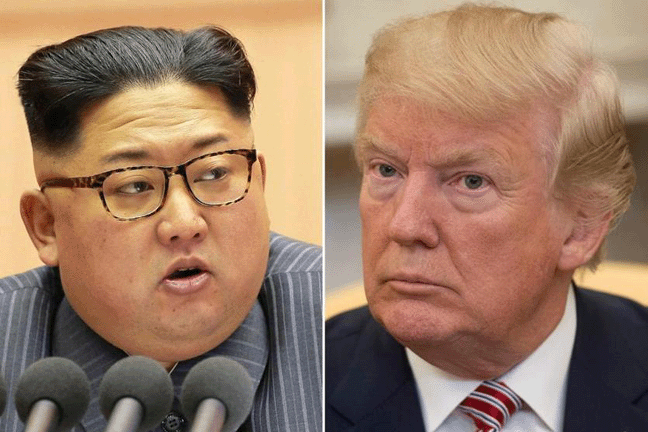
Donald Trump and Kim Jong Un are preparing to meet face-to-face in Singapore on June 12, a prospect that seemed unthinkable just a year ago when the leaders of the U.S. and North Korea were exchanging insults and threats. The main topic will be denuclearization, but they appear to have different ideas of what that means and how long it might take. Overcoming those differences will be key to reaching a historic outcome.
1. What is the U.S. stance on denuclearization?
The U.S. wants to see “complete, verifiable and irreversible denuclearization” of the Korean Peninsula. Known in the arms-control world as “CVID,” this would involve dismantling North Korea’s nuclear program and stripping Kim of the ability to make nuclear bombs in the future.
2. What does denuclearization mean for North Korea?
North Korea in April committed to work toward “complete denuclearization,” without elaborating on what that meant. In 2016, a government spokesman called for “the denuclearization of the whole Korean peninsula and this includes the dismantlement of nukes in South Korea and its vicinity.” More recently, North Korea has framed its willingness to get rid of nuclear weapons in more of a global context, implying that it will do so in concert with established nuclear powers like the U.S., China and Russia.
3. Does the U.S. have nuclear weapons on the peninsula?
The U.S. hasn’t stationed them in South Korea since 1992, but it does provide a so-called nuclear umbrella that guarantees the safety of allies South Korea and Japan. Kim may ask the U.S. to remove the nuclear bombers it has stationed in Guam and cease patrols by its nuclear-armed submarines. The U.S. would be unlikely to agree to any measures that would leave its allies vulnerable.
4. What about the time frame for removing nuclear weapons?
Speed is crucial for the U.S. to avoid a lengthy process that provides sanctions relief for North Korea as well as time to advance its nuclear program even further. Even so, North Korea has made it clear it will not accept the so-called Libya model proposed by U.S. National Security Adviser John Bolton under which the regime ships its nuclear arsenal out of the country in return for security guarantees and sanctions relief. ……….https://www.bloomberg.com/news/articles/2018-06-04/how-kim-jong-un-and-trump-differ-on-denuclearization-quicktake
Another nuclear crisis in the making? Great power competition and the risk of war in South Asia, BAS, Moeed Yusuf 5 June 18, In May 1998, India and, later, Pakistan conducted multiple nuclear tests to become the first pair to go nuclear in the post-Cold War era. Two decades on, these South Asian rivals remain locked in a deeply antagonistic relationship that constantly threatens to boil over.
The US-North Korea showdown, the upcoming summit, and the fate of the Iranian nuclear deal have consumed the global nuclear debate over the past year. During this time, India and Pakistan have slipped into an active low-level confrontation largely unnoticed.Violence on the Line of Control (LoC) that divides the Indian and Pakistani controlled parts of the disputed territory of Kashmir has been at its highest level since the two sides agreed to a ceasefire in 2003. In 2017, the bloodiest year since, there were nearly 3,000 ceasefire violations. Persistent tit-for-tat military shelling across the LoC has caused significant casualties and damage. Civilians have been targeted and killed at an unprecedented rate, as well.
Previous wars and major crises between the two sides were triggered by miscalculated military maneuvers in Kashmir or, in more recent years, by terrorist attacks. Neither can be ruled out in the current context; either could unleash a deadly escalatory spiral.
The risks involved in such a scenario would quickly remind the world why US President Bill Clinton dubbed the LoC as “the most dangerous place” on Earth at the turn of the century. India and Pakistan lack robust bilateral escalation control mechanisms. In the past, they have depended heavily on the United States and other strong third-party states with influence in the region to mediate crisis outcomes. These third parties have responded eagerly and acted with remarkable coordination in pursuit of de-escalation.
The next crisis may demand the same—but the global powers may be found wanting. The antecedent conditions that previously drove their positive engagement have already eroded. Never since South Asia’s nuclearization has global politics been so uncertain, great power relations so fraught, and competing global priorities so distracting. This reality combined with the continued absence of alternative tested crisis management experiences in South Asia may force a break from the successful crisis management patterns of the past.
A look at the past. South Asia’s nuclearization in 1998 not only ushered in a new era of regional nuclear competition but it also forced a rethink of the established norms of nuclear crisis management. The Cold War was dominated by the two superpowers. No stronger third parties able to readily influence their crisis behavior existed. Virtually all examination of nuclear contests therefore assumed bilateral contexts. While the United States and Soviet Union regularly intervened in regional crises in support of their allies, they used these moments primarily to compete and advance their global interests vis-à-vis the other.
The advent of regional nuclear dyads fundamentally altered the incentives for the United States and other strong powers to compete through regional proxies. The worry of second-age nuclear powers like India and Pakistan stumbling into nuclear war on their own proved overbearing. Crisis moments were now marked by the urge to ensure the absence of catastrophic escalation—above all prior policy preferences, no matter how important or urgent.
India and Pakistan are no strangers to crises. Since 1998, they have experienced at least three major and several modest bouts of high tension. ……
A future different from the past? The importance of third party crisis management in South Asia has only grown over time. India and Pakistan have been unable to agree on dependable risk reduction and escalation control mechanisms with a direct bearing on crisis moments. Simulation exercises continue to point to their likely inability to terminate escalated crises. In fact, as reluctant as India and Pakistan are to admit this, they have learned from previous crisis iterations and internalized third-party roles as part of their crisis planning. Worryingly, some of their doctrines and crisis strategies assume the option of third-party bailouts.
These South Asian rivals have not ruled out conflict under the nuclear umbrella. India now boasts an operational limited war doctrine, Cold Start, that envisions swift military action against Pakistan—before international actors can pressure India to forego aggression
……….. The aura of unpredictability that presently surrounds US foreign policy has brought America’s willingness to act as that leader into question. Simultaneously, the precipitous decline in US relations with surging competitors like China and Russia and increasing difficulties in transatlantic relations has tempered global confidence in the ability of the great powers to operate collectively as agents of peace. ……..https://thebulletin.org/another-nuclear-crisis-making-great-power-competition-and-risk-war-south-asia11876
Clapper says Kim’s regime doesn’t feel like a ‘supplicant’ now
Ex-DNI chief says he backs Trump’s decision to attend summit
North Korean leader Kim Jong Un’s decision to sit down with the U.S. was fueled by his regime’s view that it made significant achievements in its nuclear weapons program and would no longer be a “supplicant” in talks, former Director of National Intelligence James Clapper said.
Clapper said it may not matter whether North Korea actually has the technology to launch an intercontinental ballistic missile with a nuclear warhead that can successfully hit a U.S. target. That’s less important to the regime than the psychological boost it received from demonstrating its prowess in testing ICBMs and more powerful nuclear bombs.