Scientists say there was a significant release of radioactive particles during the Fukushima-Daiichi nuclear accident.
The researchers identified the contamination using a new method and say if the particles are inhaled they could pose long-term health risks to humans.
The new method allows scientists to quickly count the number of caesium-rich micro-particles in Fukushima soils and quantify the amount of radioactivity associated with these particles.
The research, which was carried out by scientists from Kyushu University, Japan, and The University of Manchester, UK, was published in Environmental Science and Technology.
In the immediate aftermath of the Fukushima Daiichi nuclear accident, it was thought that only volatile, gaseous radionuclides, such as caesium and iodine, were released from the damaged reactors. However, in recent years it has become apparent that small radioactive particles, termed caesium-rich micro-particles, were also released.
Scientists have shown that these particles are mainly made of glass, and that they contain significant amounts of radioactive caesium, as well as smaller amounts of other radioisotopes, such as uranium and technetium.
The abundance of these micro-particles in Japanese soils and sediments, and their environmental impact is poorly understood. But the particles are very small and do not dissolve easily, meaning they could pose long-term health risks to humans if inhaled.
Therefore, scientists need to understand how many of the micro-particles are present in Fukushima soils and how much of the soil radioactivity can be attributed to the particles. Until recently, these measurements have proven challenging.
The new method makes use of a technique that is readily available in most Radiochemistry Laboratories called Autoradiography. In the method, an imaging plate is placed over contaminated soil samples covered with a plastic wrap, and the radioactive decay from the soil is recorded as an image on the plate. The image from plate is then read onto a computer.
The scientists say radioactive decay from the caesium-rich micro particles can be differentiated from other forms of caesium contamination in the soil.
The scientists tested the new method on rice paddy soil samples retrieved from different locations within the Fukushima prefecture. The samples were taken close to (4 km) and far away (40 km) from the damaged nuclear reactors. The new method found caesium-rich micro-particles in all of the samples and showed that the amount of caesium associated with the micro-particles in the soil was much larger than expected.
Dr Satoshi Utsunomiya, Associate Professor at Kyushu University, Japan, and the lead author of the study says “when we first started to find caesium-rich micro-particles in Fukushima soil samples, we thought they would turn out to be relatively rare. Now, using this method, we find there are lots of caesium-rich microparticles in exclusion zone soils and also in the soils collected from outside of the exclusion zone”.
Dr Gareth Law, Senior Lecturer in Analytical Radiochemistry at the University of Manchester and an author on the paper, adds: “Our research indicates that significant amounts of caesium were released from the Fukushima Daiichi reactors in particle form.
“This particle form of caesium behaves differently to the other, more soluble forms of caesium in the environment. We now need to push forward and better understand if caesium micro-particles are abundant throughout not only the exclusion zone, but also elsewhere in the Fukushima prefecture; then we can start to gauge their impact”.
The new method can be easily used by other research teams investigating the environmental impact of the Fukushima Daiichi accident.
Dr Utsunomiya adds: “we hope that our method will allow scientists to quickly measure the abundance of caesium-rich micro-particles at other locations and estimate the amount of caesium radioactivity associated with the particles. This information can then inform cost effective, safe management and clean-up of soils contaminated by the nuclear accident”.
The Growing Dangers of the New Nuclear-Arms Race, The Trump Administration’s push for more nuclear weapons is part of a perilous global drive to miniaturize and modernize devices that already promise annihilation. New Yorker, By Eric Schlosser, 24 May 18, “…….On the morning of August 6, 1945, Setsuko Thurlow, then thirteen years old, was preparing to decode messages on the second floor of the Army headquarters in Hiroshima. About twenty girls from her school worked beside her, and thousands of other middle schoolers were employed at patriotic tasks throughout the city as part of the Student Mobilization Program. Thurlow noticed a bright bluish-white flash outside the window at 8:15 a.m. She never saw the mushroom cloud; she was in it. She felt herself fly through the air, blacked out, and awoke pinned in the rubble of the collapsed building, unable to move. Lying there in silence and total darkness, she had a feeling of serenity. And then she heard the cries of classmates trapped nearby: “God, help me!,” “Mother, help me!” Someone touched her, removed the debris on top of her, and told her to crawl toward the light.
She somehow made it out safely and realized that what was left of the headquarters was on fire. A half dozen or so other girls survived, but the rest were burned alive.
The smoke and dust in the air made the morning look like twilight. As Thurlow and a few classmates left the city center and walked toward the hills, they witnessed one grotesque scene after another: dead bodies; ghostly figures, naked and burned, wandering the streets; parents desperately searching for lost children. She reached an Army training ground in the foothills, about the size of two football fields. Every inch of ground was covered with wounded people begging for water. There seemed to be no doctors, no nurses, no medical help of any kind. Thurlow tore off strips of her clothing, dipped them in a nearby stream, and spent the day squeezing drops of water from them into the mouths of the sick and dying. At night, she sat on the hillside and watched Hiroshima burn.
Thurlow was reunited with her parents. But her sister and her sister’s four-year-old son died several days later. Her sister’s face had grown so blackened and swollen that she could only be recognized by her voice and her hairpin. Soldiers threw her body and that of her son into a ditch, poured gasoline on them, and set them on fire. Thurlow stood and watched, in a state of shock, without shedding a tear. Her favorite aunt and uncle, who lived in the suburbs outside Hiroshima and appeared completely unharmed, died from radiation poisoning a few weeks after the blast.
More than seven decades later on the afternoon of December 10, 2017, I watched Thurlow accept the Nobel Peace Prize on behalf of the International Campaign to Abolish Nuclear Weapons (ican). It was a remarkable moment, as she slowly walked to the podium with a cane, and the crowd in Oslo’s City Hall gave a standing ovation. After the bombing, Thurlow attended universities in Hiroshima and Lynchburg, Virginia. Later, she earned a master’s degree in social work at the University of Toronto. She married a historian and settled in Canada. She began her anti-nuclear activism in 1954, and became a leading advocate for survivors of the atomic bombings, known as the hibakusha. A few years ago, I spent time with her in Stockholm, meeting with academics and legislators to discuss the nuclear threat. In her early eighties, she was sharp, passionate, tireless, and free of bitterness. “Today, I want you to feel in this hall the presence of all those who perished in Hiroshima and Nagasaki . . . a great cloud of a quarter of a million souls,” Thurlow said in her Nobel speech. “Each person had a name. Each person was loved by someone. Let us insure that their deaths were not in vain.”………..https://www.newyorker.com/news/news-desk/the-growing-dangers-of-the-new-nuclear-arms-race
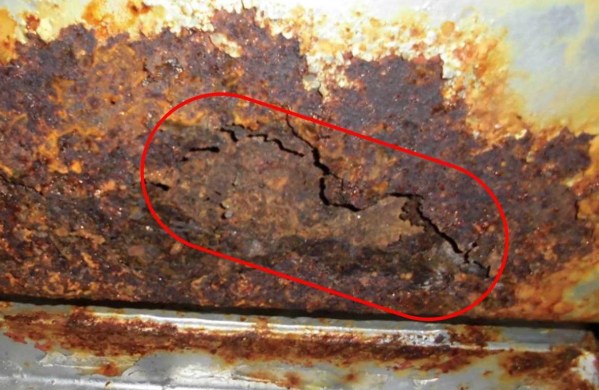
Corrosion is seen in a ventilation duct at the No. 3 unit of the Kashiwazaki-Kariwa nuclear power plant in Niigata Prefecture. | NUCLEAR REGULATION AUTHORITY
Corrosion and holes have been found in ventilation ducts at 12 reactors at seven nuclear plants across the country, the Nuclear Regulation Authority said Wednesday, raising concerns that workers could be exposed to radiation in the event of an accident.
The governmental nuclear watchdog released the results of a nationwide survey it had ordered following a revelation in December 2016 that corrosion had left multiple holes in the air ducts of the No. 2 reactor at Chugoku Electric Power Co.’s Shimane plant in western Japan. That reactor was not included in the survey.
Serious corrosion was found at the No. 3 unit of the Kashiwazaki-Kariwa plant in Niigata Prefecture operated by Tokyo Electric Power Company Holdings Inc. and may have abnormally affected ventilation of the central control room, the watchdog said.
Although the No. 7 unit at the same plant has passed a test to resume operation, the NRA said it will inspect the impact of any corrosion found at the reactor. No abnormality associated with corrosion has been found at the remaining 10 units, it said.
Corrosion or holes were found in steel or galvanized steel ducts at Tohoku Electric Power Co.’s Onagawa nuclear plant, Japan Atomic Power Co.’s Tokai No. 2 nuclear plant, Tepco’s Fukushima No. 1 nuclear plant and Kashiwazaki-Kariwa nuclear plant, Chubu Electric Power Co.’s Hamaoka plant, Hokuriku Electric Power Co.’s Shiga nuclear plant and Chugoku Electric’s Shimane plant.
If an accident occurs, radioactive materials could flow into a plant’s central control room through such holes, putting workers in danger of radiation exposure.
At the No. 3 reactor at the Kashiwazaki-Kariwa plant, a crack as large as 13 centimeters in length and 5 cm in width was found. A total of nine holes and cracks have been discovered at the Nos. 3 and 7 units at the plant.
All the reactors with corrosion were boiling-water reactors, the same type used at the Fukushima No. 1 plant, which spewed a massive amount of radioactive material into the atmosphere following the March 2011 earthquake and tsunami.
No problems have been detected at pressurized-water nuclear reactors, as filtering and other measures take place near air inlets.
The holes at the No. 2 unit at the Shimane plant were discovered when insulation materials covering the ducts were removed for inspection.
The holes, the largest of which measured about 100 centimeters wide and about 30 centimeters long, are believed to have been caused by dew condensation and rainwater that seeped inside the building, as well as salt deposits on the ducts, given that the corrosion extended about 50 meters from the air inlet and spread from the inner surface of the ducts.
Chugoku Electric has decided to increase the number of inspection points at sections near fresh-air inlets and bolster anti-corrosion measures, including the installation of a dehumidifier.
Asahi Shimbun 20th May 2018 [Machine Translation]Hitachi announced plans to delay the goal of starting
nuclear power plans planned in the UK for about two years to 2027. The collection of funds necessary for the project is difficult, and reconsideration of sharing has started between companies that undertake design and construction.
The continuation of the project itself is increasingly uncertain.
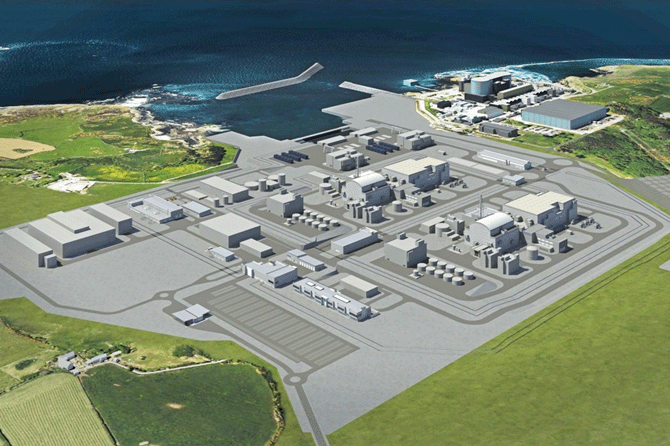
In the plan, two nuclear reactors will be built on Anglesey island in the UK. The goal of starting operation has been
announced as “early 20’s”.However, according to officials, the Hitachi side recently proposed a new goal “April 27” to companies and others involved in the plan. It is planned to decide whether to start construction in 2019,
but it seems to be assuming a case where this time is delayed. https://www.asahi.com/articles/ASL5M4HZ3L5MULFA001.html
Gov’t energy plan inflexibility on nuclear, renewables reveals lack of vision (Mainichi Japan) The government has unveiled its revised basic energy plan, though its core elements concerning the ratio of Japan’s electricity needs to be supplied by nuclear power and renewables by fiscal 2030 has not changed from the plan adopted three years ago.
In that three years, conditions surrounding energy production have changed drastically both inside and outside Japan, so it is very difficult to understand why the government has chosen to simply maintain course.
The energy plan calls for 20-22 percent of Japan’s energy mix to be made up of nuclear power in 2030, with renewables accounting for 22-24 percent — just as the 2015 version did. However, while Japan has been marking time, other advanced nations have been moving fast to expand solar and other renewable power generation. The reason is simple: measures to combat global warming simply cannot wait.
…….Renewable energy already makes up about 15 percent of Japan’s electricity production. The big utilities have also been expanding their renewable generation base as electricity market liberalization has spurred competition. Keeping the 2030 renewables target as-is could discourage this trend.
We must also question the continuing role projected for nuclear power. Around 30 reactors would be required to fill 20-22 percent of Japan’s energy needs as laid out in the plan, but only eight are now back in operation following the shutdowns after the triple-meltdown at the Fukushima No. 1 nuclear plant.
Serious questions are being raised over the economic viability of nuclear plants, as is shown by the fact that Kansai Electric Power Co. decided last year to decommission two of its larger reactors. Even experts are shaking their heads in doubt at the energy plan’s targets for nuclear power generation……..https://mainichi.jp/english/articles/20180519/p2a/00m/0na/016000c
“……….Uncertainties for Nuclear Power, Carnegie Endowment, Mark Hibbs, 14 MAY 18
China’s nuclear power wager might not indefinitely pay high dividends. Until now, the state has boosted the nuclear power industry with incentives that, in the future, may come under pressure. The electric power system is subject to reform in the direction of more transparent oversight and pricing that might disadvantage nuclear investments. President Xi Jinping supports state control of strategic economic sectors, but he also advocates market reforms that have helped lead Western nuclear power industries into crises.
The nuclear sector must withstand what Xi calls “new normal” conditions: a gradual slowing down of China’s economy, characterized by diminishing returns on capital goods investments and translating into rising debt and overcapacity. Nuclear investments may be affected by demographics, changes in electricity load profile, and technology innovations including emergence of a countrywide grid system able to wheel bulk power anywhere.
There is also political risk. Public support for nuclear power in China is volatile and may be low. Concerns since the Fukushima Daiichi accident in Japan have prompted Beijing not to proceed with long-established plans to build most of China’s future nuclear plants on inland sites. Should this policy continue into the 2020s, prospects for China’s nuclear construction sector will decline; indefinitely continuing nuclear construction at eastern coastal sites (where nearly all of China’s nuclear power is generated) may encounter resistance on economic, capacity, and political grounds.
Under Xi, China’s globalization continues but the state is assuming ever-greater liability. Political decisionmaking and corporate culture may not support an indefinite increase in the risk presented by more nuclear power investments. Some quasi-official projections before Fukushima that China by 2050 might have 400 or more nuclear power plants have been cut in half. Beijing’s risk calculus may reflect that China’s population would blame the Communist Party and the state for a severe nuclear accident. In a country with a patchy track record for industrial safety, said one Chinese planning expert in 2016, “The more reactors we have, the greater our liability.”
…….. If China merely replicates others’ collective past experience, it will reinforce the view that fast reactors and their fuel cycles are too risky, complex, and expensive to generate large amounts of electricity.
If China merely replicates others’ collective past experience, it will reinforce the view that fast reactors and their fuel cycles are too risky, complex, and expensive to generate large amounts of electricity.
Prepared for battle: China lands nuclear strike bombers on South China Sea islands CHINA raised global fears after sending nuclear bombs and warplanes above the South China Sea as part of a simulated training exercise with air force officials declaring the country is “preparing for battle”. Express UK, By LATIFA YEDROUDJ May 20, 2018 Air force personnel confirmed it had ”organised multiple bombers” to conduct “take-off and landing training” along islands and reefs in the South China Sea, as practise in light of a full-scale war.
PM Modi, Vladimir Putin May Discuss Energy, Nuclear Issues At ‘No-Agenda’ Summit
With China, reducing the tension on the border was important but with Russia, a trusted all-weather partner, increasing trade ties and stepping up defence and atomic energy cooperation could be on agenda
All India NDTV by Pallava Bagla May 20, 2018 SOCHI, RUSSIA: The laid-back balmy weather of Sochi on the coast of the Black Sea is the ideal location where the first-ever informal summit will be held between Prime Minister Narendra Modi and Russian President Vladimir Putin on Monday.
……. The meltdown of the Iranian nuclear deal after the US unilaterally pulled out of it would come up for sure, especially since India has ‘civilizational links’ with Iran. The patch up happening between North and South Korea over nuclear weapons is also going to be on the table. But closer home, atomic talks related to Kudankulam Nuclear Power Plant are also likely to be part of the summit.
PM Modi is expected to reassert India’s avowed position of complete denuclearisation of these weapons of mass destruction from the world.
Indo-Russian atomic energy cooperation could also be reviewed at the highest level. Reports suggest that India has invested nearly $5 billion in the Russian energy sector. Bilateral civil nuclear co-operation could be very high on the agenda.
……… atomic experts say, discussion on the second site for the Russian Nuclear Park would be on the anvil. In the 2014 Indo-Russian ‘Strategic Vision’ document on nuclear cooperation, the two countries have committed themselves to building in all 16 nuclear reactors in the next two decades. In all, six reactors will come up at Kudankulam and the remaining six at another site.
Today, it seems the next set of six reactors could come up in Andhra Pradesh. It is hoped that later this year in October, at the proposed formal summit, the two countries will announce the allotment of the second nuclear park site to Russia.
……… The Indo-Russian nuclear deal is well worth over Rs. 4,50,000 crores and could be the mother of all deals.
It may be worth noting that as part of the agreement for the Indo-US Civilian Nuclear Deal, India has committed to buy 10,000 MW of reactors from USA and France. But unfortunately, both the French nuclear company Areva and the American atomic giant Westinghouse ran into financial trouble and declared bankruptcy, and the new owners are still taking charge in both the countries. In all possibility, India may not order either French or American reactors for the next three to four years till these ‘new technologies’ are safely operating.
In addition and not merely as a footnote, India’s maiden nuclear venture abroad in Bangladesh could also be discussed. At Rooppur Nuclear Power Plant, almost on the Indian border, Bangladesh is making two Russian-made 1200 MW reactors.
India is getting to partner in these Bangladeshi reactors by providing training to Bangladeshi atomic engineers at Indian reactor sites. The three countries have signed a tripartite nuclear agreement on Rooppur, confirmed Anwar Hussain, Secretary of the Ministry of Science and Technology in Dhaka, who spoke exclusively to NDTV on the sidelines of the 10th edition of the Atomexpo exhibition held at Sochi. At least 3,000 participants from 68 countries presented an upbeat picture of the global nuclear industry at the exhibition. https://www.ndtv.com/india-news/pm-modi-vladimir-putin-may-discuss-energy-nuclear-issues-at-no-agenda-summit-1854710
The French stress test for nuclear power, Ft.com 18 May 18
Years late and billions over budget the first European Pressurised Reactor is set to become operational. Its success is critical for France Andrew Ward in London and David Keohane in Paris MAY 17, 2018 “….. fuel loading at Taishan — one of the last steps before it starts producing electricity — carries wider significance beyond China. Taishan, operated by China General Nuclear Power Corp, the state-owned energy company, is on course to become, within months, the first plant in the world to operate a European Pressurised Reactor — the Franco-German technology plagued by delays and cost overruns since it was designed in the 1990s. “The Taishan 1 fuel loading is a very important milestone,” says Xavier Ursat, head of new nuclear projects for EDF, the French state-backed utility which owns 30 per cent of the project. “It will bring a new image to the EPR.”
Few technologies are in greater need of a makeover. When work started on the first EPR as a joint venture of Areva of France and Siemens of Germany at Olkiluoto, Finland, 13 years ago, it was supposed to herald a new era of growth for atomic power. Instead, as construction timetables slipped and German support melted away, the EPR has become a symbol of the nuclear industry’s struggle to remain competitive. EDF, the main surviving corporate champion behind the EPR, is hoping that completion of Taishan will mark a turning point in efforts to convince sceptical investors, policymakers and potential buyers that the reactor can still be a success. At stake is the future of the wider French nuclear sector, which is relying on the EPR for long-term growth, at a time when the country’s dependence on atomic power is being questioned by President Emmanuel Macron ’s administration.
Taishan is the furthest advanced of four EPR projects around the world and, at a mere five years late, the least delayed. Olkiluoto is due to come into service next year, a decade late and nearly three times over budget at €8.5bn. It is a similar story at EDF’s flagship Flamanville plant in France, which is seven years late and €7bn over budget. A further project involving two EPRs at Hinkley Point, south-west England, is not due for completion until the end of 2025, eight years after EDF once predicted it would be finished. These setbacks have plunged France’s nuclear industry into financial turmoil. Areva, battered by its losses at Olkiluoto, was last year folded into EDF in a state-brokered deal that amounted to a bailout of the sector. A €4bn capital raising by EDF last year improved its balance sheet but the company still had €33bn of net debt at the end of 2017, only a little less than its current market capitalisation.
No country has more invested in nuclear power than France, which generates 70 per cent of its electricity from the splitting of atoms. The EPR was designed to renew the country’s nuclear fleet as many of its existing 58 reactors approach the end of their operational lives, while also generating valuable export orders. But construction delays have been seized on by those — including some inside the Macron government — who want a decisive shift in French energy policy away from nuclear and towards renewable power. A policy “road map” is due by the end of the year setting out how fast France should pursue a government target to cut nuclear’s share of domestic electricity production to 50 per cent. Similar debates are under way in many countries where nuclear power is generated, as critics argue that its high costs, safety risks and radioactive waste can no longer be justified when the costs of wind and solar power are falling rapidly. ……….
While the EPR was designed to be almost bomb and meltdown-proof, construction flaws have painted a less robust picture. France’s nuclear regulator, the Autorité de Sûreté Nucléaire, ruled last year that anomalies in the steel used at Flamanville meant the reactor’s lid, or vessel head, would need replacing — at significant expense — after just six years of operation. Separate defects have since emerged in the welding of steel pipes at the French plant. EDF is due to reveal within weeks whether it can still meet its latest timetable to be fully operational by November 2019. While the start-up of Taishan will be a welcome fillip, Flamanville remains the bigger test for EDF because of its 100 per cent ownership and because approval from the ASN — seen as a gold standard in nuclear regulation — bestows credibility on the technology internationally. ………
Setbacks at Flamanville have cast a shadow over the early stages of construction at Hinkley Point, where two EPRs are being built with an aim to meet 7 per cent of UK electricity demand. EDF insists that experience accumulated at Flamanville and Taishan will make Hinkley a smoother process. Avoiding delays in the UK will be crucial if EDF is to persuade international buyers — and its own shareholders, not least the French government — that the EPR’s teething problems are over. ………https://www.ft.com/content/7c68a702-57cb-11e8-bdb7-f6677d2e1ce8
North Korean leader Kim Jong Un provides guidance on a nuclear weapons program in this undated photo released by North Korea’s Korean Central News Agency (KCNA) in Pyongyang September 3, 2017. KCNA via REUTERS
When North Korea suddenly threw a historic summit with the United States into question on Wednesday, it cited – five times – the fate of another country and another leader, half a world away, as an example of why no one should trust American efforts to disarm another nation.
The country was Libya, and the leader was Muammar Gaddafi, who made a bad bet that he could swap his nascent nuclear program for economic integration with the USA.
That deal, executed by the Bush administration nearly 15 years ago, is a footnote to American histories of that era. But it has always loomed large for the North Koreans.
The planned June 12 meeting between US President Donald Trump and North Korean leader Kim Jong-un has been regarded by disarmament advocates as an opportunity to end decades of animosity between North Korea and the US.
But in the mind of Trump’s new national security adviser, John Bolton, who was an architect of the Libya deal, that is the model of how things should play out as the two leaders meet: Complete nuclear disarmament in return for the promise of economic integration. Bolton said as much last weekend.
In issuing its threat to back out of the summit meeting, the North referred to Bolton’s comments, calling them a “Libya mode of nuclear abandonment”.
So why is the Libya model suddenly becoming a sticking point in the meeting between Trump and Kim?
What happened in Libya
In 2003, Gaddafi saw the US invasion of Iraq and the toppling of Saddam Hussein, and may well have concluded he was next. In a lengthy, secret set of negotiations with Britain and the US, he agreed to voluntarily hand over the equipment he had purchased from Abdul Qadeer Khan, a leader of the Pakistani nuclear program. North Korea and Iran had also been customers of Khan, who was later placed under house arrest after his activities were exposed.
The Libya material was flown out of the country, much of it placed at a US weapons laboratory in Oak Ridge, Tennessee. When president George W. Bush announced the deal, he made a clear reference to North Korea and Iran when he said “I hope other leaders will find an example” in Libya’s action.
What happened less than a decade later might be at the heart of what Kim appears to fear.
The US and its European allies began a military action against Libya in 2011 to prevent Gaddafi’s threatened massacre of civilians. US president Barack Obama acceded to arguments from secretary of state Hillary Clinton to join the European-led action.
But no one in the Situation Room debated what message the decision to turn on Gaddafi might send to other countries the US was trying to persuade to relinquish their weapons, according to interviews conducted later with more than half a dozen people engaged in the discussion.
North Korea’s fear of meeting the same fate as Libya – or maybe more specifically its leader meeting the same fate as Gaddafi – has appeared to factor into North Korea’s thinking about its own weapons program for years.
In 2011, after the US and allies launched airstrikes in Libya, North Korea’s foreign minister said the denuclearisation of the North African nation had been an “an invasion tactic to disarm the country”.
After Gaddafi was killed, the narrative in North Korea became clear: Had he not surrendered his nuclear program, North Korean officials said, he might still be alive.
In 2016, shortly after North Korea conducted a nuclear test, its state-run news outlet, the Korean Central News Agency, made direct reference to Libya and Iraq. “History proves that powerful nuclear deterrence serves as the strongest treasured sword for frustrating outsiders’ aggression,” the agency said.
“The Saddam Hussein regime in Iraq and the Gaddafi regime in Libya could not escape the fate of destruction after being deprived of their foundations for nuclear development and giving up nuclear programs of their own accord,” it said.
But North Korea was also clear to draw a line between itself and the two nations. Its statement on Wednesday said it was off base to suggest that the “dignified state” of North Korea could share the same destiny as Libya or Iraq, which “collapsed due to yielding the whole of their countries to big powers”.
“The world knows too well that our country is neither Libya nor Iraq, which have met miserable fates,” the statement said. The North made explicit reference to a homegrown achievement that Gaddafi never neared: It had already become a nuclear-armed country.
Unlike North Korea, Libya was not actually a nuclear weapons state. During inspections in 2003, the Americans discovered Libya had centrifuges that could be used to produce highly enriched uranium – fuel for a bomb.
“It is absolutely absurd to dare compare the DPRK, a nuclear weapon state, to Libya, which had been at the initial state of nuclear development,” the North Korean statement said, using the initials for the country’s official name, the Democratic People’s Republic of Korea.
North Korea has tested six nuclear weapons, and US intelligence agencies believe it has 20 to 60 more, as well as intercontinental ballistic missiles capable of striking the United States.
What is the White House saying about the Libya model?
North Korea’s statement Wednesday also made direct reference to Bolton.
In his first televised interviews after becoming national security adviser last month, Bolton told Face the Nation on CBS and Fox News Sunday that Libya’s denuclearisation was what he envisioned when moving ahead with North Korea talks.
“We have very much in mind the Libya model from 2003, 2004,” he said on Fox. “There are obviously differences. The Libyan program was much smaller, but that was basically the agreement that we made.”
When a reporter asked Sarah Huckabee Sanders, the White House press secretary, specifically about the Libya model and if the administration’s approach to North Korea would be the same, she backed away from Bolton’s comparison.
“I haven’t seen that as part of any discussions, so I am not aware that that’s a model that we are using,” Sanders said Wednesday. “There is not a cookie cutter on how this works.” New York Times
Review of nuclear fuel reprocessing plant resumes https://www3.nhk.or.jp/nhkworld/en/news/20180517_32/Japan’s nuclear regulator has resumed its review of an under-construction nuclear fuel reprocessing plant, following a suspension of 8 months because of a maintenance problem discovered last summer.
The Nuclear Regulation Authority on Thursday resumed its review of the plant in Rokkasho Village in Aomori Prefecture. The resumption came after the plant’s operator, Japan Nuclear Fuel Limited, gave notice that it has worked out a plan to introduce new safety measures.
Last August, rainwater was found to have flowed into a building for emergency power generators at the plant. The rainwater leak was blamed on a failure by the company to conduct mandatory inspections of the area over a period of several years.
During Thursday’s review session, Japan Nuclear Fuel explained how it will improve its maintenance programs at the plant.
In response, officials from the Regulation Authority said the company should conduct a more rigorous assessment of its past maintenance work.
In future review sessions, the regulator is planning to ask about the company’s contingency plans for emergencies such as the fallout of volcanic ash from a nearby volcano, or a plane crash.
The company is aiming to complete the construction of the plant in 3 years.
Business Insider 16th May 2018 , Japan’s government has proposed an energy plan that sets ambitious targets
for nuclear energy use in the coming decade despite challenges after the
2011 Fukushima disaster. The draft, presented Wednesday to a
government-commissioned panel of experts, says that by fiscal 2030 nuclear
energy should account for 20-22 percent of Japan’s total power generation.
The Cabinet is expected to approve the plan within weeks.
China to help Uganda build nuclear power plants, Reuters Staff, 17 May 18 KAMPALA (Reuters) – China will help Uganda build and operate nuclear power plants under a deal signed last week.
Uganda has some uranium deposits and President Yoweri Museveni has said his government was keen to exploit them for potential nuclear energy development.
Eight potential sites have been identified in the country’s central, southwest and northern regions that could potentially host nuclear power plants, the government said on Thursday. It signed a deal with Russia last year to cooperate on nuclear power.
China is already a major investor in Ugandan infrastructure projects and China National Nuclear Corporation (CNNC) signed a memorandum of understanding on May 11 to help Uganda build capacity “in the use of atomic energy for peaceful purposes”, Uganda’s energy ministry said in a statement issued on Thursday……
Co-operation between CNNC and Uganda will involve the development of nuclear power infrastructure including the design, construction and operation of nuclear power plants.
In June last year Uganda signed a similar memorandum of understanding with Russian State Atomic Energy Cooperation (ROSATOM) to facilitate the two countries’ cooperation on nuclear power.
North Korea Threatens to Call Off Summit Meeting With Trump, NYT, By Choe Sang-Hun and Mark Landler, 查看简体中文版查看繁體中文版SEOUL, South Korea — North Korea threw President Trump’s planned summit meeting with its leader, Kim Jong-un, into doubt on Wednesday, threatening to call off the landmark encounter if the United States insisted on “unilateral nuclear abandonment.”
The warning, made by the North’s disarmament negotiator, caught Trump administration officials off guard and set off an internal debate over whether Mr. Kim was merely posturing in advance of the meeting in Singapore next month or was erecting a serious new hurdle.
The abrupt change in tone began early Wednesday, when North Korea indefinitely postponed high-level talks with South Korea over the North’s sudden objection to joint military drills by the South and the United States that began last week. The North also raised the possibility of scrapping the meeting with Mr. Trump.
Then hours later, the North broadened the source of its anger and sharpened the threat to the summit with Mr. Trump.
Kim Kye-kwan, a vice foreign minister, rejected the administration’s demand that it quickly dismantle its nuclear program as Libya had done 15 years ago, singling out John R. Bolton, Mr. Trump’s new national security adviser, for condemnation.
“If the United States is trying to drive us into a corner to force our unilateral nuclear abandonment, we will no longer be interested in such dialogue and cannot but reconsider our proceeding to the D.P.R.K.-U.S. summit,” the statement said, using the abbreviation for the North’s formal name, the Democratic People’s Republic of Korea.
Why Closing Kim’s Test Site Won’t Hinder His Nuclear Plans, Bloomberg By David Tweed and Kanga Kong May 15, 2018,
A decade ago, the last time North Korea took talks with the U.S. so far, then-leader Kim Jong Il blew up a cooling tower at the Yongbyon nuclear plant as part of a deal to limit its weapons program. Within months, he was reassembling the reactor — a key source of weapons-grade plutonium. That’s one reason why arms-control experts are watching with caution as his son, Kim Jong Un, now moves to publicly dismantle the remote subterranean testing site used by the regime to detonate six nuclear bombs.
…….Does North Korea need more tests?
Possibly not. Both India and Pakistan established themselves as nuclear powers after a similar number of tests — and neither has detonated a bomb since 1998. In his April 20 statement announcing the Punggye-ri closing, Kim said the country’s efforts to build a warhead small enough to fit on a ballistic missile had progressed to the point where tests were no longer necessary. Still, it’s unclear whether North Korea has figured out how to prevent a warhead from burning up during re-entry from space.
Would the site’s closing be permanent?
No. A 38 North analysis of satellite images taken May 7 showed that several support buildings outside the northern, western and southern portals had been razed while some mining cart rails had been removed. Such facilities can be replaced as easily as the Yongbyon cooling tower. Lewis, of the Middlebury Institute, argues that the tunnel’s horizontal layout would also make it relatively easy to “pop” open the sealed entrances and regain access after their closing.
What about building a new tunnel?
A new test site could be constructed in three to six months, depending on how much labor was thrown at the job, according to Suh Kune Y., a nuclear engineering professor at Seoul National University. Future detonations — most likely to test warhead miniaturization — might only require a simple straight tunnel with one right angle at the end, he said.
What about other sites?
North Korea, which is believed to manage a vast subterranean network in part to frustrate U.S. and South Korean spies and military planners, probably has other locations that could house tests. Suh pointed out that North Korea refers to the Punggye-ri facility as its “northern test site,” possibly implying there are others. And, of course, tests don’t need to be underground. In September, North Korea Foreign Minister Ri Yong Ho suggested that his country could detonate a hydrogen bomb over the Pacific Ocean. https://www.bloomberg.com/news/articles/2018-05-15/closing-kim-s-test-site-won-t-hinder-his-nuke-plans-quicktake
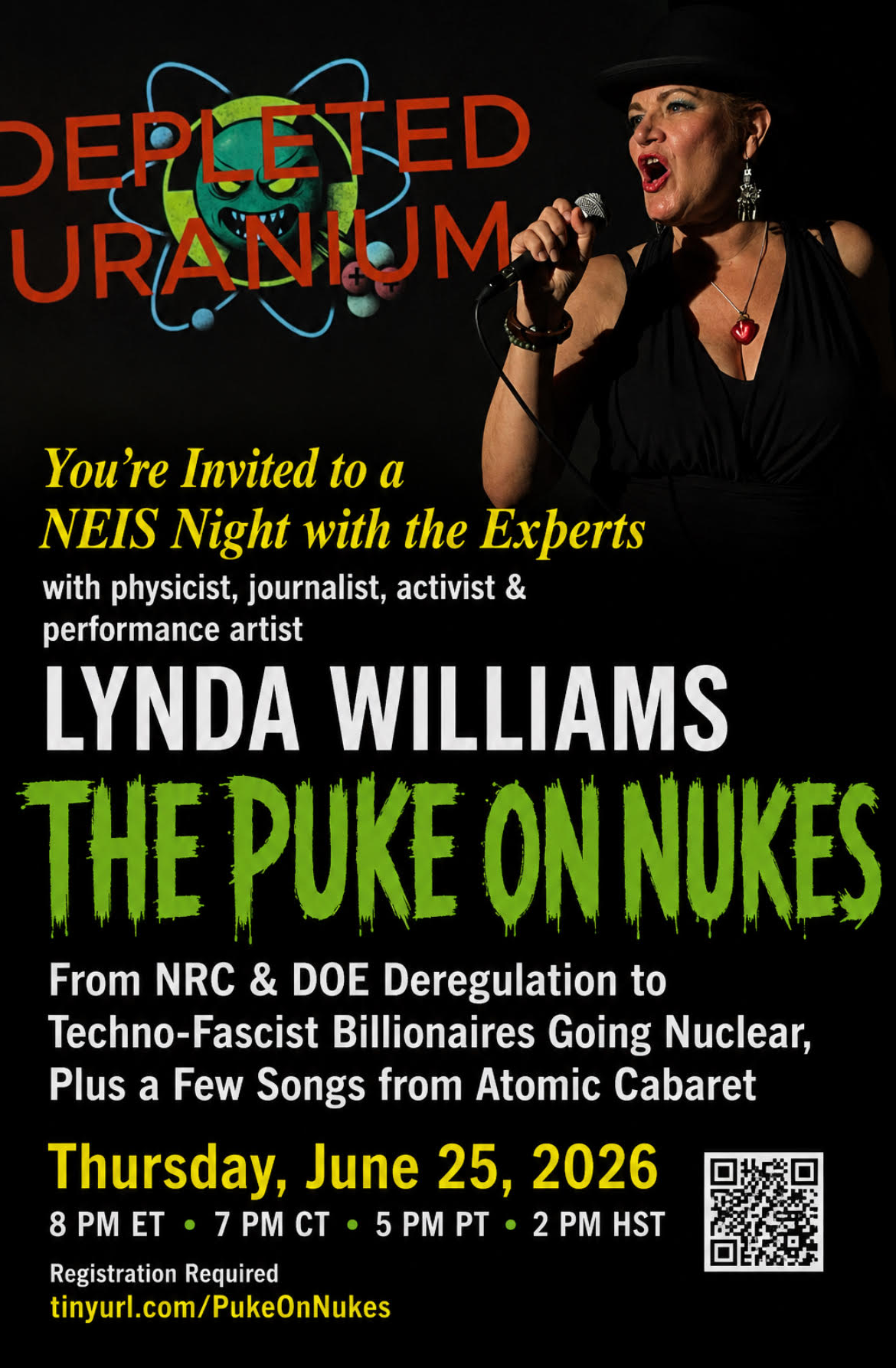
7pm Central Time (8pm ET, 6pm MT, 5pm PT) UTC – 5 From NRC & DOE Deregulation to Techno-Fascist Billionaires Going Nuclear, Plus a Few Songs from Atomic Cabaret REGISTER










 nuclear-news