Tokyo 2020 Games: Japan Olympics chief Tsunekazu Takeda quits

Limits to South Korean President Moon’s ability to negotiate US-N. Korea nuclear deal
 Moon’s inter-Korean agenda is collateral damage of US-N. Korea nuclear impasse By KIM GAMEL | STARS AND STRIPES, March 24, 2019
SEOUL, South Korea – North Korea had a clear message for the South last week – it’s us or the United States.
The North’s decision to pull out of a recently established liaison office near the border on Friday cast a spotlight on the limits facing President Moon Jae-in’s signature policy of engaging with the communist state within the confines of U.S.-led efforts to denuclearize the divided peninsula.
It also underscored concerns that Moon has reached an endpoint in his ability to play mediator after the collapse of the second summit last month between President Donald Trump and North Korean leader Kim Jong Un.
Instead, North Korea has stepped up efforts to divide the longtime allies by pressuring the South to follow through with an ambitious agenda of inter-Korean projects that have been stalled by international sanctions…..
The two Koreas opened the liaison office in the border town of Kaesong in September to facilitate a slew of economic and cultural exchanges in accordance with agreements between Moon and Kim, who held three summits of their own last year.
That was followed by a series of high-profile events, including a groundbreaking ceremony for a planned project to modernize North Korea’s railways and roads and eventually connect them with the South. But U.S.-led sanctions prevented the effort from going further……..
Moon, who took office in May 2017 promising to pursue peace with the North, has vowed to continue working to get Pyongyang and Washington back to the table.
But experts said the impasse in nuclear talks between Washington and Pyongyang has left him little room to maneuver…………..https://www.stripes.com/news/moon-s-inter-korean-agenda-is-collateral-damage-of-us-n-korea-nuclear-impasse-1.574106
To increase energy self-sufficiency after the 2011 nuclear disaster, renewables are Japan’s only option.
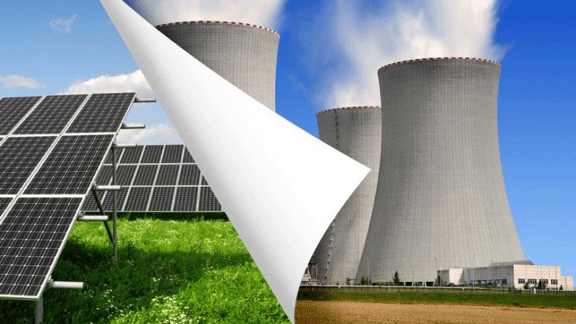 Rethinking Japan’s Energy Security 8 Years After Fukushima Rethinking Japan’s Energy Security 8 Years After Fukushima
|
|
|
Orano (makeover of bankrupt AREVA ) not getting anywhere in selling nuclear reprocessing plant to China
 Les Echos 23rd March 2019 Another place, another atmosphere. Xi Jinping’s
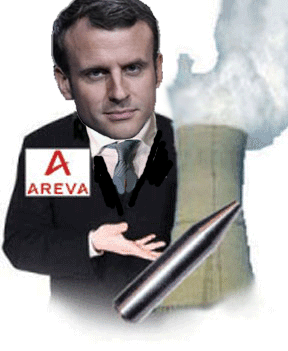 visit to France is not expected to lead to any major breakthrough on Orano’s long-awaited contract to build a used nuclear fuel processing and recycling plant in China.
Fifteen months after Emmanuel Macron’s visit to Beijing during which the French industrialist and his partner CNNC had concluded a new memorandum of understanding , Orano (the former Areva refocused on the fuel cycle) is still far from to have won the bet. At the time, Orano and CNNC had given themselves until the end of 2018 to formally agree on this mega contract of more than 10 billion dollars.
Cost of the Fukushima nuclear disaster estimated at up to 81 trillion yen

An aerial view shows workers wearing protective suits and masks working atop contaminated water storage tanks at Tokyo Electric Power Co. (TEPCO)’s tsunami-crippled Fukushima Daiichi nuclear power plant in Fukushima, in this photo taken by Kyodo August 20, 2013. Japan’s nuclear watchdog said on Wednesday it is concerned that more storage tanks at the wrecked Fukushima nuclear plant will spring leaks, following the discovery that highly contaminated water is leaking from one of the hastily built containers. Picture taken August 20, 2013. Mandatory Credit. REUTERS/Kyodo (JAPAN – Tags: DISASTER ENVIRONMENT POLITICS ENERGY)
ATTENTION EDITORS – THIS IMAGE WAS PROVIDED BY A THIRD PARTY. FOR EDITORIAL USE ONLY. NOT FOR SALE FOR MARKETING OR ADVERTISING CAMPAIGNS. THIS PICTURE IS DISTRIBUTED EXACTLY AS RECEIVED BY REUTERS, AS A SERVICE TO CLIENTS. MANDATORY CREDIT. JAPAN OUT. NO COMMERCIAL OR EDITORIAL SALES IN JAPAN. YES
Think tank puts cost to address nuke disaster up to 81 trillion yen http://www.asahi.com/ajw/articles/AJ201903100044.html By ATSUSHI KOMORI/ Staff Writer, March 10, 2019 In a startling disparity, a private think tank puts the cost of addressing the 2011 Fukushima nuclear disaster between 35 trillion yen and 81 trillion yen ($315 billion and $728 billion), compared with the government estimate of 22 trillion yen.
The calculation, by the Tokyo-based Japan Center for Economic Research, showed that the total could soar to at least 60 percent more and up to 3.7 times more than the 2016 estimate by the Ministry of Economy, Trade and Industry.
In releasing the latest estimates on March 7, the center said it is time for serious debate over the role nuclear energy should play in the nation’s mid- and long-term energy policy.
Of the highest price tag of 81 trillion yen, 51 trillion yen would go toward decommissioning the crippled Fukushima No. 1 nuclear power plant and treating and disposing of radioactive water. The ministry put the cost for these tasks at 8 trillion yen.
The center calculated the compensation to victims at 10 trillion yen, while the comparable estimate by the ministry was 8 trillion yen.
Although the center’s estimate for the decontamination operation was 20 trillion yen, the ministry’s projection was 6 trillion yen.
The biggest disparity in the estimates between the think tank and the ministry is that the former put the treatment and disposal of contaminated water at 40 trillion yen and included the cost for disposing of polluted soil produced during cleanup operations in the overall costs.
If contaminated water is released in the sea after it is diluted with water, the overall costs could be 41 trillion yen, including 11 trillion yen estimated for decommissioning and disposal for tainted water.
The least expensive way of coping with the accident–35 trillion yen–would be to encase the plant in a concrete sarcophagus, rather than undertaking the formidable challenge of retrieving melted nuclear fuel from the reactors, and releasing contaminated water into the sea. In this case, it would cost 4.3 trillion yen to close down the plant and dispose of the radioactive water.
But this scenario drew fire from residents in the affected municipalities as they view covering nuclear fuel debris with a massive structure would be tantamount to asking them to give up hope of eventually returning to their hometowns.
The center’s latest projections followed its estimates two years ago, in which the number varied from 50 trillion yen to 70 trillion yen.
It updated its projections based on the findings about treatment and disposal of radioactive water and progress in cleanup operations over the past years.
Fukushima radioactive water – a million tons, and still coming

Fukushima water headache: 1 million tons and counting http://www.asahi.com/ajw/articles/AJ201903190042.html THE ASAHI SHIMBUN,March 19, 2019The crippled Fukushima No. 1 nuclear plant reached an undesired milestone on March 18: Storage tanks at the site now contain more than 1 million tons of radiation-contaminated water.The announcement by the plant’s operator, Tokyo Electric Power Co., came as the utility and the central government continue to weigh water-disposal methods while hearing the concerns of fishermen who fear for their livelihoods.
Toyoshi Fuketa, chairman of the Nuclear Regulation Authority, has repeatedly said a decision must be made soon on how to deal with the contaminated water.
“We are entering a period in which further delays in deciding what measure to implement will no longer be tolerable,” Fuketa recently said.
Groundwater becomes contaminated when it flows into the buildings of the three reactors that suffered meltdowns in 2011 following the Great East Japan Earthquake and tsunami. Water that is used to cool the nuclear fuel debris is processed to remove radioactive substances, but the system cannot get rid of tritium.
These problems have forced TEPCO to store the contaminated water in hundreds of tanks installed at the Fukushima plant.
If more storage tanks are constructed, the overall capacity of 1.37 million tons at the site will likely be reached by the end of 2020.
Fukushima fishermen are already on alert for the one option they have already criticized–diluting the water and dumping it into the Pacific Ocean.
The economy ministry in 2016 said that measure could be implemented in the shortest time frame and at a low cost.
Fuketa has also said this is the most realistic option, but he noted that it would require years of preparation.
ome experts said the go-ahead for the dilution measure should have been given at the end of 2018 to start the process before the storage tanks reach capacity.
Economy ministry officials tried to explain various measures being considered at a public hearing in Fukushima in August 2018, including releasing the diluted water into the ocean.
“It will have a devastating effect on fishing in Fukushima,” said Tetsu Nozaki, who heads the Fukushima prefectural federation of fisheries cooperative associations.
Fukushima fishermen have slowly resumed operations since all forms of fishing were prohibited after high levels of radiation were found in fish caught off the Fukushima coast.
Fish auctions restarted at Fukushima ports in spring 2017, but the volume of fish brought in is still only about 20 percent of levels before the 2011 nuclear accident.
The last thing Fukushima fishermen want is an increase of negative publicity about their catches if the diluted water is dumped into the Pacific.
The government has spent about 34.5 billion yen ($309 million) to build a frozen underground earth wall around the three reactor buildings to divert the groundwater to the ocean. The “ice wall” has cut down the flow of groundwater, which at one time reached about 500 tons a day.
But still, groundwater continues to flow into the three reactor buildings at a rate of about 100 tons daily.
(This article was compiled from reports by Chikako Kawahara, Hiroshi Ishizuka, Toshio Kawada and Kazumasa Sugimura.)
The merits of letting North Korea keep its nuclear weapons, for now
Tohoku Electric says donation not a payoff for idle nuclear plant
THE ASAHI SHIMBUN March 20, 2019 Tohoku Electric Power Co. plans to give an estimated 400 million yen ($3.58 million) to a village that hosts one of its nuclear power plants, but denies it is compensation for losses stemming from the facility’s suspension since the 2011 Fukushima nuclear disaster.
The utility said March 19 it will make a donation to Higashidori, Aomori Prefecture, where its Higashidori nuclear power plant is located, through a corporate version of the “furusato nozei” (hometown tax payment) system.
The company did not disclose the amount, but only said it wants to donate “about half” the maximum amount that the village is allowed to receive under this system. The ceiling for the village is about 800 million yen.
The village government called for Tohoku Electric’s response because the volume of work related to the nuclear plant, such as maintenance, declined due to the suspension and a number of accommodations relying on plant workers have closed.
Satoshi Shimoyashiki, vice manager of Tohoku Electric’s Aomori branch, rejected the notion that the donation was meant as compensation for such economic losses and emphasized that it is being made as “part of corporate social responsibility (CSR).”…….. http://www.asahi.com/ajw/articles/AJ201903200054.html
TEPCO takes risk over soaring costs at Tokai nuclear plant
 The Tokai No. 2 nuclear power plant in Tokai, Ibaraki Prefecture, in July last year
March 15, 2019
Tokyo Electric Power Co. and other utilities are taking a huge gamble by providing hundreds of billions of yen (billions of dollars) to restart an aging nuclear power plant in need of safety upgrades.
Japan Atomic Power Co. intends to resume operations of the one reactor at the Tokai No. 2 nuclear plant in Ibaraki Prefecture in January 2023, but 300 billion yen–nearly double the initial estimate–is reportedly needed to ensure its safety.
TEPCO, which will be provided with electricity from the Tokai plant, will offer 190 billion yen, or two-thirds of the total cost. Tohoku Electric Power Co., Chubu Electric Power Co., Kansai Electric Power Co. and Hokuriku Electric Power Co. will also offer financial support.
But it remains unclear whether municipalities around the plant will approve the plan to restart the reactor.
If Japan Atomic Power fails to win consent from the local governments and is forced to scrap the Tokai No. 2 plant, TEPCO and other power distributors could suffer big financial losses.
TEPCO was effectively turned into a state property after the crisis unfolded at the Fukushima No. 1 nuclear power plant in March 2011. With taxpayers’ money injected into it, TEPCO’s plan to offer assistance to another operator’s nuclear facility that has no clear prospects of restarting will inevitably provoke controversy.
Read more :
Yamaguchi court rejects residents’ call to halt last Ikata nuclear reactor in Ehime Prefecture
 Supporters for the plaintiffs hold banners that read “Unjust ruling” and “Have you forgotten Fukushima?” after the Iwakuni branch of the Yamaguchi District Court rejected a plea to halt a nuclear reactor in Ehime Prefecture, on Friday in Iwakuni, Yamaguchi Prefecture.
March 15, 2019
YAMAGUCHI – A district court on Friday rejected a plea by residents to halt a reactor at the Ikata nuclear power plant in Ehime Prefecture.
The decision by the Iwakuni branch of the Yamaguchi District Court is in line with rulings made by other regional courts and allows the No. 3 reactor to continue operating. The plant is managed by Shikoku Electric Power Co.
Unit No. 3, the sole remaining reactor at the plant, passed the state safety screening process that was revamped in the wake of the 2011 Fukushima nuclear crisis. But concerns remain about its safety, which led residents to turn to the courts to seek an injunction.
Of the more than 30 reactors in Japan, excluding those set to be decommissioned, only a few are in operation.
Read more :
8 years after disaster, Japan must commit to a nuke-free future
 Visitors observe the No. 2 reactor building, left, and the No. 3 reactor building on the grounds of the stricken Fukushima No. 1 nuclear power plant in February.
March 12, 2019
GLOBAL ENERGY SHIFT
In January, the Renewable Energy Institute released a report saying nuclear power generation is losing its competitiveness globally.
While the costs of nuclear energy have risen due to enhanced safety requirements following the Fukushima accident, the report says, those of renewable energy sources such as solar and wind power have fallen, thanks to technological innovations.
Some countries, including Germany and South Korea, have decided to phase out nuclear power generation. In other major countries, including the United States and Britain, the share of nuclear power in the overall power supply has dropped because of the rise of renewable energy.
Even France, a leading nuclear power producer, plans to significantly lower its dependence on atomic energy. In China and India, where the government has been eager to promote nuclear power, renewable energy production is growing faster than nuclear power generation.
Nuclear power once accounted for 17 percent of the world’s total electricity production, but it is now responsible for only around 10 percent of the global power output. In sharp contrast, the share of renewable energy has risen to nearly a quarter of the total. The International Energy Agency predicts that renewable energy will contribute 40 percent of the world’s energy supply in 2040.
A big global energy shift from nuclear power to renewable energy is taking place.
RESPONSIBLE DECISIONS NEEDED
The Abe administration’s efforts to promote exports of nuclear power technology, a key component of its growth strategy, have run into the sands in Britain and Turkey.
It is a big irony that a nation that has suffered a catastrophic nuclear accident is making frustrating efforts to sell its nuclear technology to other countries while repercussions from the accident are driving the world toward a new energy future.
This nation’s government still continues devoting huge amounts of resources to maintaining nuclear power generation, which is clearly in decline worldwide, while putting renewable energy, which will assume growing importance in the coming years, on the back burner. Sticking to this policy would cause Japan to be left out of the emerging mega-energy trend.
To read more :
Japan’s Tepco fights for return to nuclear power after Fukushima
 The Kashiwazaki-Kariwa plant’s coastal location leaves it open to tsunamis
March 11, 2019
Eight years after the accident in Fukushima, preparations are underway to restart the Kashiwazaki-Kariwa nuclear power plant operated by Tepco. But residents fear a second disaster.
Decades ago, nuclear power was supposed to be the perfect solution for Japan’s thirst for energy and for its rural economies. And in the sleepy town of Kashiwazaki, in the prefecture next to Fukushima, the solution was supposed to be the Kashiwazaki-Kariwa nuclear power plant, run by the power company Tepco — the company responsible for the 2011 Fukushima accident.
When in full operation, the Kashiwazaki-Kariwa power plant is the biggest in the world, capable of servicing 16 million households. But all of its seven reactors have been idle since the nuclear accident at Fukushima Daiichi. This is Tepco’s only remaining nuclear power plant apart from the tsunami-stricken plants in Fukushima, in the neighboring prefecture.
Tepco has been repeatedly criticized for its negligence and has been ordered to pay compensation to the residents. The cleanup of the Fukushima power plant has been causing major headaches, while the reasons for the accident have yet to be clarified even eight years later.
Read more :
https://www.dw.com/en/japans-tepco-fights-for-return-to-nuclear-power-after-fukushima/a-47836968
Indian military confirms deployment of nuclear subs amid rising tensions with Pakistan
AMN By News Desk2019-03-17 Tensions between the two nuclear-armed Asian powers escalated last month, after an incursion into Pakistani territory in Kashmir by Indian Air Force warplanes to strike at Jihadist militants led to skirmishes in the air and small arms and artillery fire along the shaky Line of Control border.
Proposed nuclear power station at Indian village – a serious threat to living beings
Nuclear power serious threat to living beings Hans News Service https://www.thehansindia.com/andhra-pradesh/nuclear-power-serious-threat-to-living-beings-512866 18 March 2019
HIGHLIGHTS The proposed Nuclear Power Plant (NPP) at Kovvada village in Ranastalam mandal is a serious threat to all living beings in the surrounding 250 kilometers radius of north coastal AP districts and south Odisha state, said Anti-Nuclear Committee national member Dr Vivek Mantory.
1 This Month
26 September – International Day for the Total Elimination of Nuclear Weapons





PLEASE OPPOSE HR 8255 AND S.3639 – bills would accelerate satellite deployment, with no environmental review or safeguards – https://ncstd5li.quorum.us/campaign/169331/
To see nuclear-related stories in greater depth and intensity – go to https://nuclearinformation.wordpress.com
-
Archives
- September 2026 (291)
- August 2026 (330)
- July 2026 (355)
- June 2026 (287)
- May 2026 (306)
- April 2026 (356)
- March 2026 (251)
- February 2026 (267)
- January 2026 (308)
- December 2025 (358)
- November 2025 (359)
- October 2025 (375)
-
Categories
- 1
- 1 NUCLEAR ISSUES
- business and costs
- climate change
- culture and arts
- ENERGY
- environment
- health
- history
- indigenous issues
- Legal
- marketing of nuclear
- media
- opposition to nuclear
- PERSONAL STORIES
- politics
- politics international
- Religion and ethics
- safety
- secrets,lies and civil liberties
- spinbuster
- technology
- Uranium
- wastes
- weapons and war
- Women
- 2 WORLD
- ACTION
- AFRICA
- Atrocities
- AUSTRALIA
- Christina's notes
- Christina's themes
- culture and arts
- Events
- Fuk 2022
- Fuk 2023
- Fukushima 2017
- Fukushima 2018
- fukushima 2019
- Fukushima 2020
- Fukushima 2021
- general
- global warming
- Humour (God we need it)
- Nuclear
- RARE EARTHS
- Reference
- resources – print
- Resources -audiovicual
- Weekly Newsletter
- World
- World Nuclear
- YouTube
-
RSS
Entries RSS
Comments RSS

