The indigenous fight for the truth on Fukushima’ s radioactive impact on the world
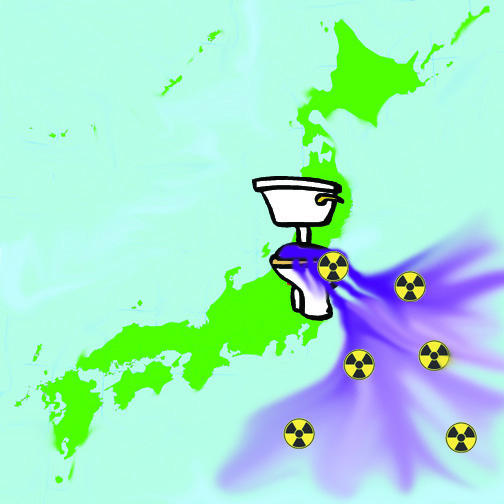
The future of all life: Indigenous sovereignty and the Fukushima nuclear disaster, Bay View, National Black Newspaper, by Harun Minhaj, March 4, 2019 In 2011, an unprecedented series of die-offs began to strike dead hundreds of millions of sea creatures in the northern Pacific Ocean. As one sailor who frequently travels the Pacific remarked in October of 2013:
The stigma continues, however much the propaganda spouts about the Fukushima nuclear ‘recovery’

The Fukushima nuclear disaster’s legacy: An inescapable stigma, Commentary: Pockets of innovation, like a drone testing field, have some hoping the region sheds its notoriety. But it’s not that simple. CNet
There’ was just one jarring thing: the utter silence throughout the facility.
It was our first night in the Fukushima region, and my photographer, James Martin, and my interpreter had arrived a little after 10 p.m. Initially, we weren’t sure if this was the right location – we seemingly had the only vehicle in the parking lot, and a quick search of those conference rooms found no staff.
It wasn’t until we located the reception desk, tucked out of sight from the main lobby, that we found another human. The employee noted that only 15 guests were staying in the 200-room hotel.
Welcome to Fukushima.
That first night proved to be one of the more memorable moments in a trip that included a visit inside one of the most radioactive hotspots in the world, a look at a massive underground ice wall and a virtual reality experience that took me to places no human could survive. It stood out because it illustrated the long way this area has to go before any semblance of normalcy can return…….
Eight years on, there’s been little progress with the actual cleanup. While three of the six reactors have been safely decommissioned, the remaining three have proven to be such a challenge that Tokyo Electric Power Company, or Tepco, just last month finally succeeded in sending a robot down to the Unit 2 reactor to pick up some of debris in the highly radioactive core. ………
there are reminders of the disaster everywhere. Drive on the nearby Joban Expressway and you’ll periodically run into signs with a readout of the radiation level. The daily weather report on the local evening news contains an update on the radiation in the area.
I periodically drove past fields containing hundreds of bags of radiated dirt.
University of California covers up the truth on Fukushima radiation
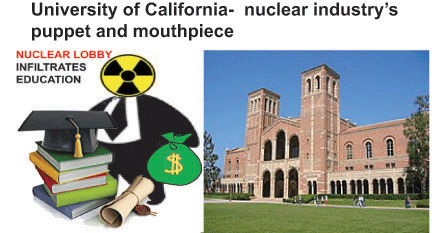
The future of all life: Indigenous sovereignty and the Fukushima nuclear disaster, Bay View, National Black Newspaper, by Harun Minhaj, March 4, 2019 “………..As the Caretakers of Mother Earth have warned, the nuclear establishment has been working tirelessly to cover up and downplay the consequences of this nuclear disaster. The University of California has long played an essential role in this establishment, as it designed the core physical package of every single nuclear warhead in the U.S. arsenal. And now, formerly secret documents show that UC played an indispensable role in the federal response to – and cover-up of – the Fukushima nuclear disaster.
The estimates secretly forecasted by the LLNL’s model predicted very high doses to children in California from radioactive iodine, which is known to cause serious thyroid illnesses. Subsequent measurements found that this model’s predictions of radiation exposure in California were far more accurate than lower estimates and actually underestimated the radiation found 30 km off the coast of Japan.
Yet the UC never issued a single health warning to anyone living on the West Coast prior to their exposure to this deadly radiation. Instead, at the very time that the UC’s LLNL was modeling “estimates of possible plume arrival times and dose for U.S. locations,” UC Berkeley scientists were at the forefront of corporate media coverage on outlets such as ABC7 proclaiming brazen falsehoods such as “there is no plume.”
The LLNL’s model was continually being refined and updated “based on meteorological analyses and available field data” to ensure its predictions were maximally accurate, yet UC Berkeley scientists were simultaneously telling the public that “you cannot predict how the weather is going to carry radiation particles over the West Coast, if anything at all.”
Even worse was the initial UC Berkeley claim that the radiation reaching California was “not harmful at all” and posed “no risk to California,” despite the LLNL’s forecast of very high doses to children in California from radioactive iodine.
Meanwhile, the head of UC Berkeley’s Nuclear Engineering Department secretly admitted that “it is possible that we will find that some people have received doses … that could exceed the levels that current Protective Action Guidelines are designed to prevent.” The Protective Action Guidelines (PAGs) are legal limits on radiation exposure set by the EPA designed to minimize the risk of harm, and this professor subsequently suggested that, should they be exceeded, “this could provide a basis for immediate action to change PAGs.”
When UC Berkeley began testing for radioactive iodine from the Fukushima fallout in California, it found levels in rainwater up to 181 times the EPA’s safe drinking water standards. And although rainwater and tap water should not be conflated, radioactive isotopes climb their way up the food chain in increasing concentrations in numerous ways, such as the soil of produce farms and the pastures of milk-giving cattle.
The UC cover-up of West Coast fallout
Far from being incidentally related to the case, the University of California’s Lawrence Livermore National Lab (LLNL) was in fact the federal contractor given the responsibility of projecting the damage or “dose” from Fukushima Daiichi’s fallout to Japan, the Pacific Ocean and U.S.-occupied Turtle Island.
And, indeed, radioactive materials from Fukushima were detected across California’s food web, while UC Berkeley’s own measurements showed that food items such as milk were regularly exceeding the EPA’s PAGs in both 2011 and 2012 until they stopped taking these measurements.
The response to these findings was once again denial and distortion. The EPA soon increased its PAG “safe limit” by more than 400 times, to such a high level that all of these findings would retroactively cease to be considered health risks.
In the meantime, UC Berkeley engineers once again asserted there was no cause to worry and falsely minimized these readings by conflating external radiation as received from plane travel with the more dangerous internal radiation received through ingesting radioactive particles, which remain in the body emitting radiation for much longer and have the ability to concentrate in specific vulnerable organs such as the thyroid.
But the initial epidemiological evidence is in, and it already shows a variety of illnesses and deaths across the West Coast significantly correlated with the arrival and presence of Fukushima fallout, such as over 100 additional fetal deaths and birth abnormalities in the state of Washington in 2011 and increased rates of congenital hyperthyroidism in California infants born shortly after the meltdowns – around 1,500 additional borderline and severe cases.
The EPA soon increased its PAG “safe limit” by more than 400 times, to such a high level that all of these findings would retroactively cease to be considered health risks.
The University of California totally failed to make public the initial LLNL projections of “very high doses” to California infants and provide adequate health warnings – such as avoiding contaminated milk or taking natural iodine supplements – despite having this legal responsibility both as a federal contractor and as the operator of California’s Poison Control System, which administers such warnings on behalf of the California Emergency Medical Services Authority for the entire state.
The UC cover-up of Pacific fallout and seafood contamination
As serious as the consequences of the fallout on California were, the radiation California and the West Coast received was only a small fraction (<2 percent) of the total, of which the majority (~80 percent) fell into the Pacific.
From the very beginning, UC scientists were involved in studying the Pacific die-offs. Indeed, it was UC scientists who declared when studying the 2011 marine invertebrate mass die-offs that “[N]o previously documented mortality event has been so severe over such a large region …” Yet these UC scientists who had been studying this epidemic from the very beginning have failed to ever monitor the sick and dead animals for radiation, despite one of the lead scientists admitting that Fukushima could not be ruled out as a cause.
When their major study was published in 2018, it included no consideration of Fukushima or radiation whatsoever. Apparently, it was a moot point – the UC’s website on the die-offs had already been claiming for years there was “no evidence” of Fukushima radiation having an impact, even though they had never looked for any despite having already admitted it couldn’t be ruled out.
To make matters worse, one of the principal UC authors of this study falsely claimed that Fukushima radiation could not have precipitated the die-off, because “many more creatures would be affected.” By this time, the unprecedented and concurrent die-offs of fish, marine mammals and sea birds had already been reported.
In denying the impact of Fukushima on the Pacific, these scientists are hardly alone. Overand over again, UC professors – frequently in leadership positions and with government ties – have minimized the impact by relying on the widely debunked fallacy of “dilution.”
Yet dilution has been known to be a false solution to radiation for over 50 years now. In 1955, a once-secret memo from the U.S. Atomic Energy Commission (AEC) – then headquartered in Berkeley – noted that the “dissipation of radioactive fallout in ocean waters is not a gradual spreading out of the activity from the region with the highest concentration to uncontaminated regions, but that in all probability the process results in scattered pockets and streams of higher radioactive materials in the Pacific.”
This is due to a variety of reasons, including the flow of currents and the role played by sediment and debris in transporting radiation. Furthermore, studies have shown that the bioconcentration of radioactive particles up the food chain increasingly amplifies its prevalence in smaller and larger marine organisms by factors ranging from 3 to 300.
While this memo may have previously been secret, the “no threshold” model of radiation has been well-established for almost as long, and is the accepted foundation of radiation protection for the Environmental Protection Agency, National Academy of Sciences, and many other institutions.
In the 1960s, UC Berkeley Nuclear Scientist John Gofman established the Biomedical Research Division of the UC’s LLNL, when he was employed by the AEC to discredit findings which showed that “low level” radiation from nuclear weapons tests was exposing infants in surrounding areas to dangerous amounts of radiation.
Instead, Gofman’s research confirmed these dangers, and at the end of the decade he gave a report showing that there is no threshold beneath which radiation exposure is “safe”: lower levels correspond to a lower – but very real – risk of disease. Consequently, dilution does nothing more than spread the impact of radiation amongst a larger population vulnerable to disease, with each individual facing a lower risk but the overall aggregate impact remaining the same.
The AEC disliked these findings and forced Gofman out of the LLNL, illustrating the reprisals nuclear scientists often face for challenging the pro-nuclear establishment.
Numerous projections of the spread of Fukushima radiation in the Pacific Ocean have predicted that, far from becoming increasingly diluted, once the radiation leaves the immediate vicinity of the Fukushima shoreline it would actually become increasingly concentrated as it approaches the West Coast due to the dynamics of ocean currents, with eventual peak concentrations reaching levels up to 10 times higher than off the coast of the rest of Japan.
There is no threshold beneath which radiation exposure is “safe”: lower levels correspond to a lower – but very real – risk of disease.
What measurements are available not only confirm these projections, showing increasing concentrations traveling east across the Pacific Ocean roughly correlating to these models, they also show that the vast quantities of radioactive particles the Nordic PSA Group predicted would kill at least 50-100 million fish were indeed present throughout large areas of the Pacific Ocean.
In other words, a vast array of scientific knowledge, regulatory precedent, expert models, and empirical data directly contradicts the denials of the UC nuclear establishment that Fukushima’s radiation is of no concern in the Pacific due to “dilution.”
Once again, these denials have serious consequences not just in terms of the ecocidal impact of Fukushima Daiichi’s radiation on Pacific sea life. Based on the thoroughly disproven dilution fallacy, several prominent UC scientists have also denied that there are any health impacts from Fukushima radiation in the Pacific, including the risks entailed in eating contaminated seafood.
The Nordic Probabilistic Safety Assessment Group, however, founded by the nuclear utilities of Finland and Sweden and therefore not at all “anti-nuclear,” concluded in its 2011 report that even if seafood radiation levels from Fukushima stay below legal limits, more than 1 million people would die from just one of the elements of concern, cesium-137. They wrote:
“The fish, seafood, whale meat and seaweed consumed may have concentrations below legal limits, but the radioactive content will be increased from normal levels. As noted in Section 3.6.3, the ingestion dose could be substantial even if the legal limits for the foodstuff are preserved. This cycle will last for many generations, because of the food chain of fish and other marine fauna, and the radioactivity will be recycled and in fact the meat content will increase rather than decreasing by decay. Even if only one one-hundredth of the radioactivity (more than 1e15 Bq of CS137) were to enter this recirculation pattern, the collective whole body ingestion dose over many generations would exceed 1e7 Sv, sufficient to kill more than 1,000,000 people.”
As predictions of mass die-offs and increasingly concentrated radiation crossing the Pacific to the West Coast have already come true, ignoring the scientific evidence about the dangers this radiation poses to us too promises to have deadly consequences. With over 1 hundred million sea creatures having already perished as predicted by the nuclear utility-founded Nordic PSA Group, this institution’s estimate that more than 1 million people could also die if human consumption of Pacific seafood continues unabated is supported by a solid track record based on the scientific method, unlike the UC’s ongoing denials and distortions of even the most basic facts of the Fukushima disaster………….https://sfbayview.com/2019/03/the-future-of-all-life-indigenous-sovereignty-and-the-fukushima-nuclear-disaster/
University of California’s role in the cover-up of radiation fallout in Japan from the Fukushima nuclear disaster

The future of all life: Indigenous sovereignty and the Fukushima nuclear disaster, Bay View, National Black Newspaper, by Harun Minhaj, March 4, 2019 “…………The UC cover-up of the fallout in Japan
Further illustrating the international stakes and genocidal consequences of the UC cover-up is the role the university has played in Japan, where approximately 18 percent of the radioactive fallout landed.
Once again, the UC failed to warn the Japanese people of how serious the dangers posed by Fukushima’s fallout were, even as its secret model indicated the need to evacuate Tokyo, the largest metropolitan area in the world.
This recommendation was subsequently given by others such as Dr. Shigeru Mita, a physician who relocated his practice from Tokyo after observing symptoms of radiation sickness since 2011, and advises that inhabitants should leave the city due to the health consequences of the radiation there.
With over 1 hundred million sea creatures having already perished as predicted by the nuclear utility-founded Nordic PSA Group, this institution’s estimate that more than 1 million people could also die if human consumption of Pacific seafood continues unabated is supported by a solid track record based on the scientific method, unlike the UC’s ongoing denials and distortions of even the most basic facts of the Fukushima disaster.
Dr. Mita’s warning is buttressed by the epidemiological evidence, which indicates that the health consequences of Fukushima radiation are already taking a serious toll in Japan – and not just in Fukushima prefecture – including:
- Thyroid cancer incidence more than doubling in Fukushima and several neighboring prefectures
- A range of heart diseases increasing throughout Japan, with a 50 percent overall increase of heart attacks and 80 percent increase in Tokyo
- Leukemia incidence more than doubling in Fukushima and several neighboring prefectures, with a 42 percent overall increase for Japan.
- Backing up this epidemiological evidence is extensive radiation measurement, including one study which found that every one of its soil samples taken from a variety of places in Tokyo were so toxic that they would all be legally treated as radioactive waste by the U.S. government.
And yet once again, the UC is at the forefront of denying that there are any serious health risks for the Japanese population, even for those with the greatest exposure still living in Fukushima.
Consider the event hosted by the Lawrence Berkeley National Lab and the Japanese Ministry of the Environment at UC Berkeley in 2017. Together, UC Berkeley and the Japanese government claimed that Fukushima had been 97 percent decontaminated of radiation, and insisted that the real issue to worry about was that “negative perception still persists across Japan and the world, causing economic and psychological damage within the region.”
- Not mentioned by either party was the epidemic increase of disease or the protests this Japanese Ministry has continuously faced in Fukushima for forcing residents to accept toxic radioactive soil repurposed for developing farmland and constructing roads. Evacuees are now being forced to return to Fukushima, despite radiation levels in their homelands measured at up to 100x the international legal limit.
One study … found that every one of its soil samples taken from a variety of places in Tokyo were so toxic that they would all be legally treated as radioactive waste by the U.S. government.
- That the UC’s priority is not the well-being of Japan was tacitly admitted in a press releaseissued by the UC-managed Los Alamos National Lab (LANL), which includes a mere single sentence acknowledging that with the disaster, “At stake are Japan’s reputation, its public health and the health of its environment.” The next three paragraphs then elaborate in great detail the UC’s grave concern about the risk the disaster poses to Japan’s nuclear industry, while highlighting the cleanup’s priority of “rebuild[ing] public acceptance of nuclear power.”
The report ends with a celebration of “the arc of Los Alamos’s history with Japan” as being “truly awesome,” neglecting entirely to mention the central role this UC lab played in committing genocide against the Japanese people with the nuclear bombing of Hiroshima and Nagasaki. Hundreds of thousands of civilians were killed then by UC-designed nuclear weapons.
Today, the UC is once again playing a central role in denying and covering up the deadly effects of the Fukushima nuclear disaster, which continues today as yet another genocide.
- Although UC Berkeley was recently ranked the “No. 1 public university” by US News in 2018, corporate media refuses to recognize how it has served as the foremost academic partner of the largest military empire in history. This shameful reality is a manifestation of the twisted vision outlined in Dr. Gray Brechin’s “Imperial San Francisco,” which describes in detail how the white supremacist founders of UC Berkeley envisioned it playing a pivotal role in extending American Empire, with the construction of Berkeley’s nuclear laboratory as the crowning fixture of its “annexation” of the Pacific.
As the U.S. military occupation of Japan continues to this day – with tens of thousands of soldiers and several bases still stationed in the country – the imperial and colonial dimension of the Fukushima disaster cannot be ignored. Fukushima Daiichi’s fuel was supplied by uranium forcibly extracted from aboriginal peoples’ land by permission of the Australian government.
Although UC Berkeley was recently ranked the “No. 1 public university” by US News in 2018, corporate media refuses to recognize how it has served as the foremost academic partner of the largest military empire in history.
And today, pressure from the U.S. government has played an important role in the Japanese government’s involvement in the cover-up, including legislation recently passed in Japan which criminalizes sharing epidemiological data and reporting or whistleblowing on the “state secrets” of the Fukushima disaster…………https://sfbayview.com/2019/03/the-future-of-all-life-indigenous-sovereignty-and-the-fukushima-nuclear-disaster/
Fukushima nuclear workers still facing radiation danger, eight years on.
 Eight years after Fukushima nuclear meltdown, workers still facing radiation risk https://www.peoplesworld.org/article/eight-years-after-fukushima-nuclear-meltdown-workers-still-facing-radiation-risk/ February 22, 2019 eight years since the nuclear meltdown at the Fukushima Daiichi Nuclear Power Plant. The NPP operator, Tokyo Electric Power Company (TEPCO), says that it will soon conduct a probe into the containment vessel of the No. 2 reactor in order to find out the condition of the melted nuclear fuel inside, which means that TEPCO has yet to obtain even such basic information.
TEPCO officials recently said to Akahata that high-risk zones in the Fukushima Daiichi plant have become smaller and that now workers do not need to wear a full-face mask and a protective suit in 96 percent of the plant premises. This is because the level of radioactive materials in the air has decreased as a larger area of the site is now covered with concrete, according to officials. At the crippled nuclear power plant, the number of workers coping with the aftermath of the 2011 nuclear accident, though, is still more than 4,000 per day.
However, the hidden reality regarding contamination risks seems to differ from the impression the utility wanted to create by citing the figure “96 percent.” In a recently published survey of Fukushima workers conducted by TEPCO, of the respondents who are anxious about their exposure to radiation, nearly half feared that their health would be damaged in the future. In another question in the same survey, more than 40 percent were concerned about working at the nuclear power plant.
The most common reason for their concern was that they have no idea how long they need to work at the plant because it is unclear how much work remains to be done. They are also worried about the risk of radiation-induced health damage in the future with no guarantee of a stable income. Without a worker-friendly environment, the decommissioning of the crippled reactors will be extremely time-consuming.
The storage of radiation-contaminated water is another major issue. Around 100-150 tons of polluted water is produced every day at the plant, which means that a 1,000-ton tank is filled up in seven to ten days. Currently, around 1.1 million tons of radioactive water are stored on the plant premises, but under TEPCO’s plan, the maximum planned storage capacity is only 1.37 million tons.
In another survey of residents conducted by municipalities near the Fukushima plant, among the respondents who decided not to go back to their hometowns and who cannot decide whether to do so, many cited worries about the safety of the plant as a reason.
The government of Prime Minister Shinzo Abe, however, is still encouraging Fukushima evacuees to return to their homes, but as the nuclear disaster drags on.
Schools refitted in Fukushima, but enrolment remains dismal
 THE ASAHI SHIMBUN, March 1, 2019 Local governments in Fukushima Prefecture have spent billions of yen to create ideal education environments, including new or renovated school buildings, high-tech classes, free lunches and uniforms, and long-distance buses.
But these schools may be forced to close down. There just aren’t enough children in areas near the Fukushima No. 1 nuclear power plant to sustain their operations.
The enrollment figures have dispirited local government officials, who agree that schools and their students are the key to recovery from the 2011 Great East Japan Earthquake, tsunami and nuclear accident…….http://www.asahi.com/ajw/articles/AJ201903010026.html
“Ice wall” – the effort to contain Fukushima’s radiation
 How Fukushima’s underground ice wall keeps nuclear radiation at bay
Think Game of Thrones, but this one is underground and defends against a far more realistic threat. CNet,
BY ROGER CHENG MARCH 8, 2019
The intricate network of small metal pipes, capped off by six-foot-high metal scaffolding, shouldn’t stand out amid the numerous pieces of industrial equipment littered throughout the Fukushima Daiichi Nuclear Power Plant. After all, it’s a power plant.
I take a closer look, and notice spheres of ice perched upon the smaller pipes, which line the center of the structure. The facility sits at the water’s edge, and there’s a brisk breeze blowing through.
e intricate network of small metal pipes, capped off by six-foot-high metal scaffolding, shouldn’t stand out amid the numerous pieces of industrial equipment littered throughout the Fukushima Daiichi Nuclear Power Plant. After all, it’s a power plant.
I take a closer look, and notice spheres of ice perched upon the smaller pipes, which line the center of the structure. The facility sits at the water’s edge, and there’s a brisk breeze blowing through
………. The structure, which cost roughly $300 million, paid for by public funds, serves as critical protection, defending the Fukushima area from one of the most radioactive hotspots in the world. While Tokyo Electric Power Co., also known as Tepco, struggles to find a way to remove radioactive material from the facility – a process the government estimates could take more than four decades — the more immediate concern is what to do with the contaminated water leaking out from the facility……….
Ice cold
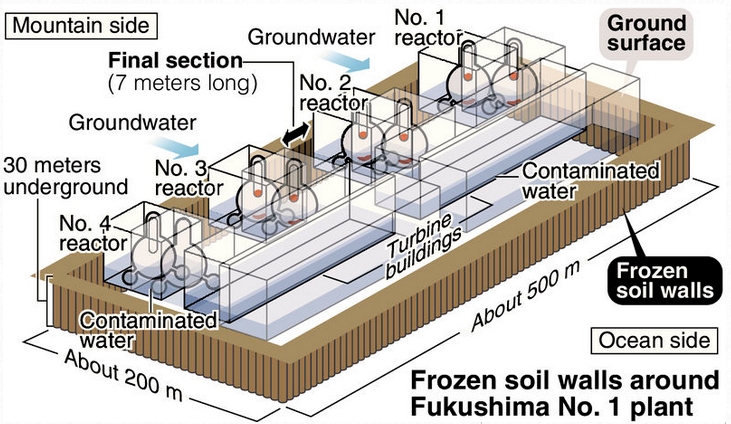
While the term “ice wall” has a colorful ring to it, engineers use the more academic-sounding term Artificial Ground Freezing.
…… calcium chloride solution is pumped down through a smaller inner pipe, and circulated back up a large outer pipe.
The coolant brings down the temperature of each pipe to -30 degrees Celsius, or -22 degrees Fahrenheit, and the pipes are spaced about three feet apart. The cold emanating from each one hardens the soil around it.
The point of the ice wall is to keep the groundwater that runs down from the mountains to the west from entering Fukushima Daiichi and mixing with the toxic water leaking out of the Unit 1, 2 and 3 reactors. That is, keep the clean water on the outside of the wall, while the contaminated water stays inside.
Tepco and manufacturing partners, such as Toshiba and Mitsubishi, are working on robots to identify and determine how to clear out the radioactive materials in each of the reactors’ primary containment vessels, essentially the heart of each facility.
Until then, they need a way to slow or stop the flow of water into the facility.
……. With the wall in place, Tepco says it has been able to reduce the level of contaminated water generated from Daiichi. But a Reuters report in March 2018 found that the wall still let a fair amount of clean water in, adding to the volume of toxic water the company needs to deal with. Tepco, however, says it’s been effective in reducing the volume.
“We know this is not the end of our effort,” says a company spokesman. “We will be continuously working hard to reduce the amount of generation of contaminated water.”
The leaky bucket
Imagine a leaky bucket that constantly needs to be filled with water. At the same time, the water from the leak needs to be collected and stored. And there’s no end in sight to this cycle.
That essentially is the problem that Tepco faces at Daiichi. The fuel rods stored in the three radioactive units constantly have to be cooled with fresh water, but leaks mean the company needs to be vigilant about keeping the tainted liquid from getting out of the facility’s grounds.
Since the accident nearly eight years ago, Tepco has collected 1.1 million tons of contaminated water in 900 tanks stored on the grounds at Daiichi. The company estimates it has enough space in the 37.7-million-square-foot facility to house an additional 270,000 tons of water, which means it would run out sometime in 2020.
“We’re conscious of the fact that we can’t keep storing more and more water,” Kenji Abe, a spokesman for Tepco’s decommissioning and decontamination unit, says through an interpreter.
……. So far, treatment technology from partner companies like Kurion and Sarry have enabled Tepco to remove 62 of the 63 radioactive elements from the water, but one, tritium, remains.
It’s this one element, which is bonded to the water at an atomic level, that means Tepco needs to keep collecting and storing the water.
…….. organizations such as Greenpeace have called for Tepco to keep storing the water, noting that much of the early batches of treated water far exceed safety limits for radioactive elements.
Given the sensitivities around Fukushima, Tepco must continue to store the water. A spokesman said the company isn’t planning to disperse the water. But it is one option being considered by the Japanese government, which ultimately makes the decision.
“Resolving the issue of the contaminated water is something we haven’t yet reached a final solution on,” Yagi says.
…….. The scientist explains that Japan has set a legal radioactivity limit of 60,000 becquerel per liter of tritium. But the treated water is still at 1.7 million Bq per liter, or roughly 30 times what’s deemed safe.
So, for now, Tepco must continue collecting the water. And the ice wall continues to stand, invisible to onlookers, as one of the most important lines of defense. https://www.cnet.com/news/how-fukushimas-underground-ice-wall-keeps-nuclear-radiation-at-bay/
Accusations of scientific misconduct concern city in Japan
 Fukushima at 8: Accusations of scientific misconduct concern city in Japan http://www.beyondnuclear.org/radiation-health-whats-new/2019/3/7/fukushima-at-8-accusations-of-scientific-misconduct-concern.html Eight years after the Fukushima nuclear reactors exploded on Japan’s Northern coast, spewing radioactive particles into the air, across the land, and into the Pacific Ocean, the country continues to struggle with decontamination and relocation efforts. Determining the health impacts resulting from the nuclear disaster has been particularly fraught. For Date City, about 60 km from the ruined Fukushima reactors, and still blanketed by radioactive contamination from the ongoing catastrophe, the struggle for protection of health continues amid accusations of scientific misconduct and betrayal.
After the nuclear catastrophe began, Date City residents received glass badges that measured radioactivity. About four and a half years of measurements collected from these glass badges were used by Ryugo Hayano, Professor emeritus from the University of Tokyo and Makoto Miyazaki from Fukushima Medical University (FMU) to initially publish two studies in the Journal of Radiological Protection (JRP). Radiation policy makers in Japan often reference the second of these two studies, indicating they trust the data and conclusions it offers. However, earlier this year, Shin-ichi Kurokawa (Professor Emeritus of The High Energy Accelerator Research Organization) and Akemi Shima (resident of Date City) contended that this research and the studies using it, are compromised by serious ethical violations and scientific misconduct.
Date City officials requested the studies subsequent to their adoption of a 5 mSv annual radiation exposure limit, which represents a huge increase of radiation exposure to residents. Date City has also limited decontamination efforts in certain areas, and the former mayor Shoji Nishida, requested that the International Atomic Energy Agency proclaim 5 mSv per year safe, instead of the current 1mSv. More detailed information is coming to light as a new mayor of Date City has been elected.
Kurokawa first raised concerns about the second study in a peer-reviewed August 2018 letter sent to JRP. The JRP, a U.K. journal, has yet to publish Kurokawa’s critique, so he published it on a Cornell University website in December 2018. Kurokawa also published a timeline and further critique of Hayano’s response to the letter in Harbor Business Online in February 2019, original article in Japanese. This research has also been reported on Retraction Watch, a website that tracks published troubled papers, although there are more serious concerns than those RW highlights.
Hayano has admitted (English translation here) to a miscalculation that underestimated doses to Date City residents by three times. Hayano also admits to destruction of the data on which the studies were based, claiming this “deletion” was in accordance with research protocol of the study. But Kurokawa disputes that, pointing out that data destruction is a violation of Japan’s ethical guidelines on handling human data – guidelines that instruct researchers to keep the data as long as possible. This destruction of data, and failure to publish a promised third study, appear to conceal evidence that found very high internal doses of radioactivity in some residents of Date City.
The Date City glass badge experiment
The research used glass badge data from approximately 59,000 Date City residents. These badges, paid for and distributed by Date City, supposedly measured the external radioactivity that each individual was exposed to beginning about August 2011, approximately 5 months after the nuclear catastrophe began, until the summer of 2015. The mayor’s office of Date City provided both the glass badge data and data on internal exposures for individual residents.
According to research protocols agreed to with FMU, Miyazaki and Hayano planned to publish three studies based on these data. The first, comparing individual external doses to survey results of airborne radiation from the Government of Japan, was published in 2016. The second, a prediction of lifetime dose and an evaluation of the effect of decontamination on doses to individuals, was published in 2017. The third study, examining the relationship between external doses and internal doses, will not be published. Instead it has been replaced by a study on a different topic.
Where things went wrong
Bad glass badge data
Perhaps the experiment was doomed from the start as the Miyazaki-Hayano studies admit some residents of Date City may not have worn the glass badges on their bodies or actually lived at the address registered for the badge. Such improper badge use would immediately compromise any conclusions reached concerning individual doses, but the researchers used the data anyway.
Mishandling and destruction of data
In addition to questionable glass badge measurements, Kurokawa contends the Miyazaki-Hayano research suffers from mishandling and destruction of data that violates ethical guidelines:
- Residents (research subjects) of Date City were not informed of the content of the research prior to the research commencing, and were not given opportunity to refuse use of their data. Miyazaki, being a municipal advisor on radiation to Date City as well as a study author, should have known how to handle this properly, yet he did not.
- Miyazaki and Hayano failed to note that some residents had not consented to use of their data, a fact obvious in the data supplied to them by Date City. They further failed to obtain consent from those residents prior to use of their data.
- Hayano presented data before the research protocol was submitted to, and approved by, an FMU Ethics review committee.
- Residents were not told of the papers once they were published, nor were they told that the Mayor’s office of Date City had requested the papers be published. This presented a conflict of interest since the Date City Mayor’s office had an agenda (see slides 21 & 26) of encouraging residents to increase “resilience” while living in a contaminated environment. For residents, this means consuming contaminated food and restricting decontamination efforts per Date City’s new 5 mSv annual exposure limit. A few months after Date Mayor Shoji Nishida announced this “resiliency” policy, Miyazaki was hired as radiation advisor to the city.
- Miyazaki and Hayano violated research protocol by replacing the third studyoriginally agreed to, with a study that said nothing about internal versus external doses.
- At the conclusion of the research, all of the data were destroyed. According to records obtained by an information request filed by Shima, Kurokawa’s co-author of the Kagaku article, Hayano created an integrated database at the request of Date City, but did not share this database with the city. Therefore, when the database was destroyed, Miyazaki and Hayano knew that Date City could not replicate it or the data it contained.
- Kurokawa points out that research conducted in Japan must follow the ethical guidelinesbased on the Declaration of Helsinki for proper protocols in handling medical and health research involving human subjects, such as valuing welfare of the research subjects over that of scientific results. FMU approved the Miyazaki-Hayano research papers under these protocols – protocols this research seriously violated by not allowing people to control use of their own data and by destroying the data after publication so that neither researchers nor the research subjects, can access it or replicate the studies.
Underestimation of dose
In addition to the mishandling of data, Kurokawa has discovered discrepancies in the values of cumulative doses in paper 2, which appear to underestimate actual doses. Hayano has, by his own admission, underestimated individual doses by three times. Professor Hayano says that he will issue a correction (corrigendum) for this dose underestimation, but has failed to completely answer the additional serious discrepancies, and the ethical violations of mishandling and destruction of data Kurokawa notes.
Why the “phantom” third study matters
The missing third study was supposed to investigate correlation between external and internal individual doses – a correlation Miyazaki and Hayano had already hypothesizedwould not exist. However, upon reviewing other data in Date City reports, the opposite was found: “[there was very] clear correlation between the external and internal doses…some cases with very high levels of internal exposure measurements.” Kurokawa offers his own hypothesis as to why Miyazaki and Hayano never published a paper on this third research question:
The true reason for not publishing Paper 3 could be the discovery of a clear correlation between the external and internal doses with some residents showing internal exposure measurements of several thousand Bq even since 2015. Not publishing inconvenient results despite receiving the internal exposure dose data from Date City would have to be considered a violation of the Ethical Guidelines. (emphasis added)
This correlation also reveals that Date City’s “resiliency” plan is not protecting its residents. Miyazaki and Hayano’s unwillingness to address internal dose evidence in the Date City data also calls into question Hayano’s other research on internal doses issues such as monitoring of food and whole body scans of children, the last publication of which appears to be in 2015.
Mistaken assumptions based on faulty studies
Japan’s Radiation Council (JRC) on setting standards for protecting people from radiation often references this ethically and scientifically compromised research in discussions, particularly the second paper, which was the focus of Kurokawa’s critical letter. Hayano’s work is often mentioned by other scientists and press as indication that doses from Fukushima radiation are low, that decontamination efforts paid for by Date City funds, might not have been necessary, and that living in an environment contaminated by “low” levels of man-made radiation is acceptable.
Where was the peer-review?
For its part JRP has now determined at this time that a correction for the dose underestimation is all that is needed, while an investigation into the consent issue is conducted. JRP claims to adhere to the Declaration of Helsinki for proper protocols in handling medical and health research involving human subjects. However, data misuse and destruction should require retraction of the papers, not correction.
Kurokawa contends that underestimating 70-year lifetime doses by three times is a severe enough miscalculation that a mere correction will not suffice, implying the conclusions of the papers are now in jeopardy. Hayano is claiming, falsely, that JRPwants a rewrite of the paper. Even if JRP did want a rewrite, it is unclear how Hayano intends to accomplish this since the Date City data on which the original papers were based have been destroyed. Kurokawa states:
There is no way to rewrite a paper when the research has already completed and all the data have been destroyed. Even if Date City were to re-supply the data to FMU, it would be considered new research and a new research proposal would have to be submitted to the Ethics Review Committee at FMU. A resulting paper would no longer be a revised version, but an entirely different paper based on new research. A scientist should never conceal such information, let alone pretend as if what was requested by JRP was a rewritten paper when it was a corrigendum that was actually requested. (emphasis in original English translation)
To date, neither Miyazaki nor Hayano have responded in the customary fashion, which would be to answer Kurokawa’s original letter criticizing their published research point-by-point. Kurokawa has published an analysis of Miyazaki-Hayano paper 1 in the March issue of Kagaku in Japanese, and will be publishing detailed analysis of paper 2 in April 2019.
Thanks to Yuri Hiranuma for input and review of this article and for the translations used to write it. See Yuri’s blog.
8 Years On: Tainted Soil Use Plan Draws Backlash from Fukushima Residents

https://www.nippon.com/en/news/yjj2019030601012/8-years-on-tainted-soil-use-plan-draws-backlash-from-fukushima-residents.html Mar 8, 2019 Minamisoma, Fukushima Pref., March 8 (Jiji Press)–A plan to use soil from decontamination work in areas tainted with radioactive substances from the March 2011 nuclear disaster in Fukushima Prefecture is facing a strong backlash from local residents.
Under an envisaged feasibility study program, the Environment Ministry aims to use the soil for public works projects and examine its safety.
The ministry apparently hopes to reduce the amount of tainted soil to be transferred to a planned final disposal facility.
But Fukushima residents continue to have strong safety concerns about radiation eight years after the triple meltdown accident at Tokyo Electric Power Company Holdings Inc.’s <9501> Fukushima No. 1 nuclear power plant, damaged in the March 2011 earthquake and tsunami
UK, Japan scientists study radioactive Fukushima particles

This sounds like a good idea. But – can we really be confident about science done by Atomic Energy Agencies , whose brief is to further develop atomic energy?
OXFORD, England (Reuters) 8 Mar 19, – Eight years after the Fukushima nuclear meltdown in Japan, radioactive particles collected from the site are undergoing new forensic investigation in Britain in an effort to understand the exact sequence of events…….
The Japan Atomic Energy Agency (JAEA) is currently collaborating with British researchers to learn more about the state of the radioactive particles created by the meltdown.
Dr Yukihiko Satou from the JAEA oversaw the transportation of particles collected from within the restricted zone, very close to the disaster site, to Britain.
“The particles were fundamentally extracted from those attached to soil, dust and debris,” Satou told Reuters.
Encased in protective tape, the samples were brought to the Diamond Light Source, Britain’s national synchrotron, or cyclic particle accelerator, near Oxford.
Here electrons are accelerated to near light speeds until they emit light 10 billion times brighter than the sun, then directed into laboratories in ‘beamlines’ which allow scientists to study minute specimens in extreme detail.
…… Understanding the current state of these particles and how they behave in the environment could ultimately determine if and when the area could be declared safe for people to return…… Writing by Matthew Stock,; Editing by Gareth Jones https://www.reuters.com/article/us-japan-disaster-radiation/uk-japan-scientists-study-radioactive-fukushima-particles-idUSKCN1QP1GF
People of Kashmir – stuck in a dangerous, potentially nuclear, conflict
In Kashmir, we’re stuck in the middle of a potentially nuclear conflict but the world looks away, ABC News, By Umar Lateef Misgar 9 Mar 19, When Adil Dar rammed a car stuffed with explosives into a paramilitary convoy in Indian-administered Kashmir last month, I didn’t make much of the news.
I was travelling across northern India at the time. Having been born and brought up amid a conflict that has defined the life of every young Kashmiri for the past three decades it just seemed more of the same: military cordons, gunfights, curfews, blown-up houses, maiming and the death of our friends and acquaintances.
But the magnitude of this attack by Dar, a 22-year-old Kashmiri, crept up on me through numbers and images. It was the worst attack against Indian forces since the armed insurgency erupted in Kashmir in the late 1980s.
At least 40 Indian paramilitary personnel had been killed, setting off a chain of events that almost brought South Asia to the brink of an all-out nuclear war.
I felt heartbroken by the loss of life that had occurred.
The Indian media instantly began to whip up a frenzy against the Kashmiris, doubling down on efforts to demonise an entire people.
The Indian population’s anger was focused against Kashmiri civilians, students and migrant businessmen, who were attacked by mobs. As many as 2000 of them were forced to flee from different Indian cities…….
I have lived in India as a student and travelled across the country throughout my life, but I have never felt as threatened as during this recent visit.
Constantly dehumanised in the Indian media as well as politics, Kashmiris have been undermined and permanently relegated as dispensable other in the Indian consciousness. Even the India’s parliamentary opposition, led by the Indian National Congress party that finds its roots in the anti-colonial struggles of the subcontinent, didn’t even dare to speak a word against this wave of anti-Kashmiri hate-crimes………
Amid rising tensions, both the countries mobilised their armed forces, leading to the worst tension in 20 years. Diplomats succeeded in persuading the two nuclear-armed nations to back-off. For now.
It is local Kashmiris whose lives were disrupted by this military posturing and brinkmanship. Civilians across the de-facto border that divides Indian and Pakistani-administered Kashmir, suffered the stress of warplanes hovering above and the impending threat of war………
Deadliest decade
The confrontation between India and Pakistan has slowly de-escalated but people continue to be killed, and while last year was the deadliest in a decade the coming year looks catastrophically bleak.
In the past week 15 people including eight Kashmiri civilians died in shelling and gunfights on the border.
As world attention shifts elsewhere the plight of Kashmiri people remains constant. Our land, our air and our bodies will remain the sites of violent confrontation and electoral bargaining.
Will anyone bat an eye before the next nuclear showdown? https://www.abc.net.au/news/2019-03-09/kashmir-is-stuck-in-the-middle-of-nuclear-tension/10878950
Nuclear threat still hangs over India and Pakistan

|
Crisis may be easing, but nuclear threat still hangs over India and Pakistan, Analysis by Brad Lendon, CNN, March 4, 2019 Hong Kong Tensions on the border between India and Pakistan last week pushed the two nuclear-powered South Asian adversaries closer to conflict than at any point in the past two decades.
|
|
|
South Korean President Moon Jae-in praised North Korea’s offer to dismantle a key nuclear production complex

 Moon Lauds North Korea’s Nuclear Offer, Splitting With Trump, Bloomberg, By Youkyung Lee, March 4, 2019,
- He says a ‘partial’ sanctions lift was discussed in Hanoi
- Moon says Trump, Kim should meet soon to reach agreement
South Korean President Moon Jae-in praised North Korea’s offer to dismantle a key nuclear production complex as an “irreversible” step to undercut its weapons program, breaking with the Trump administration.
In a meeting to discuss the summit last week in Hanoi between Donald Trump and Kim Jong Un, Moon on Monday lauded North Korea’s offer to dismantle the Yongbyon nuclear complex. He also called for pushing ahead with inter-Korean projects currently hindered by sanctions and said the two sides discussed the “partial” lifting of sanctions — backing North Korea’s version of events…….
Moon has endeavored to serve as a bridge between Trump and Kim, and has staked political capital on bringing peace to the divided peninsula. ….
Nightmarishly high radiation levels -robots the only chance to deal with Fukushima reactors’ molten fuel
For Fukushima’s nuclear disaster, robots may be the only hope, The 2011 meltdown in Japan is still too hot for humans to handle. Send in the machines. CNet BY ROGER CHENG, MARCH 4, 2019 ………. I’m inside the cavernous top of the Unit 3 reactor in the Fukushima Daiichi Nuclear Power Plant. Yes, that Fukushima Daiichi, site of the world’s worst nuclear disaster.
Unit 3 was one of three reactors crippled on March 11, 2011, after a 9.0 earthquake struck 80 miles off the coast of Japan. (Units 4, 5 and 6 at Daiichi weren’t operating at the time.) The temblor shook so violently it shifted the Earth’s axis by nearly 4 inches and moved the coast of Japan by 8 feet. Eleven reactors at four nuclear power plants throughout the region were operating at the time. All shut down automatically. All reported no significant damage.
An hour later, the tsunami reached shore.
Two 50-foot-high waves barreled straight at Fukushima Daiichi, washing over coastal seawalls and disabling the diesel generators powering the plant’s seawater cooling systems. Temperatures inside the reactors skyrocketed to as high as 5,000 degrees Fahrenheit.
Fuel rods became molten puddles of uranium that chewed through the floors below, leaving a radioactive cocktail of fuel rods, concrete, steel and melted debris. Molten fuel ultimately sank into the three reactors’ primary containment vessels, designed to catch and secure contaminated material.
Next Monday marks the eighth anniversary of the earthquake. Since then, Japanese energy giant Tokyo Electric Power Company, or Tepco, has cleared enough of the rubble on the top floor of the Unit 3 building to allow for my 10-minute visit.
I gaze up at the massive barrel vault ceiling, trying to get a handle on the sheer scale of everything. Radiation levels are too high for me to linger. My quickening pace and breath are betrayed by rapid flapping noises coming from the purple filters on both sides of my respirator mask.
At the far end of the room, there’s an enormous orange platform known as a fuel-handling machine. It has four giant metal legs that taper down, giving the structure a sort of animalistic look. Thin steel cables suspend a chrome robot in the center of the frame. The robot, largely obscured by a pink plastic wrapper, is equipped with so-called manipulators that can cut rubble and grab fuel rods. The robot will eventually pull radioactive wreckage out of a 39-foot-deep pool in the center of the room.
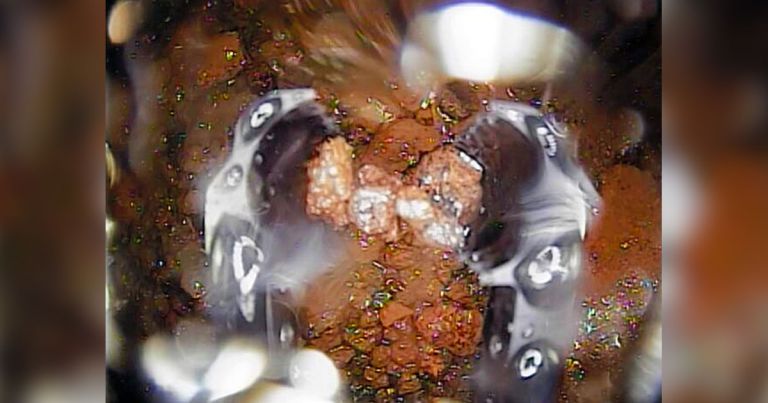
It’s just one of the many robots Tepco is using to clean up the power plant. It’s why I came to Japan this past November — to see how robots are working in one of the most extreme situations imaginable.
The Japanese government estimates it will cost $75.7 billion and take 40 years to fully decommission and tear down the facility. The Japan Atomic Energy Agency even built a research center nearby to mock up conditions inside the power plant, allowing experts from around the country to try out new robot designs for clearing away the wreckage.
The hope is that the research facility — along with a drone-testing field an hour away — can clean up Daiichi and revitalize Fukushima Prefecture, once known for everything from seafood to sake. The effort will take so long that Tepco and government organizations are grooming the next generation of robotics experts to finish the job. …….
Two years ago, Tepco erected a dome over the Unit 3 reactor and fuel pool so that engineers could bring in heavy equipment and now, us.
Roughly 60 feet below me, radiation is being emitted at 1 sievert per hour. A single dose at that level is enough to cause radiation sickness such as nausea, vomiting and hemorrhaging. One dose of 5 sieverts an hour would kill about half of those exposed to it within a month, while exposure to 10 sieverts in an hour would be fatal within weeks.
Unit 3 is the least contaminated of the three destroyed reactors.
 Radiation in Unit 1 has been measured at 4.1 to 9.7 sieverts per hour. And two years ago, a reading taken at the deepest level of Unit 2 was an “unimaginable” 530 sieverts, according to The Guardian. Readings elsewhere in Unit 2 are typically closer to 70 sieverts an hour, still making it the hottest of Daiichi’s hotspots.
The reactors’ hostile environments brought most of the early robots to their figurative knees: High gamma radiation levels scrambled the electrons within the semiconductors serving as the robots’ brains — ruling out machines that are too sophisticated. Autonomous robots would either shut down or get snared by misshapen obstacles in unexpected places.
The robots also had to be nimble enough to avoid disturbing the volatile melted fuel rods, essentially playing the world’s deadliest game of “Operation.” At least initially, they weren’t. “Fukushima was a humbling moment,” says Rian Whitton, an analyst at ABI Research. “It showed the limits of robot technologies.”………….. https://www.cnet.com/news/for-fukushimas-nuclear-disaster-robots-may-be-the-only-hope/
1 This Month
22 June – Virtual Event –Climate Change: New Data, New Debate

Monday, June 22, 2026 2:30 p.m. – 3:15 p.m. CT
YouTube. Register here

Protect Sazan Island from the Trump family! https://secure.avaaz.org/campaign/en/protect_sazan_island_from_the_trump_family_loc/?bqFCVab&v=174511&cl=22707147157&_checksum=5e9dde668860e8231c33699735e16a1fbf22ab2cb01da50c999fe8732b9775ef&utm_source=email&utm_medium=blast_email&utm_campaign=174511
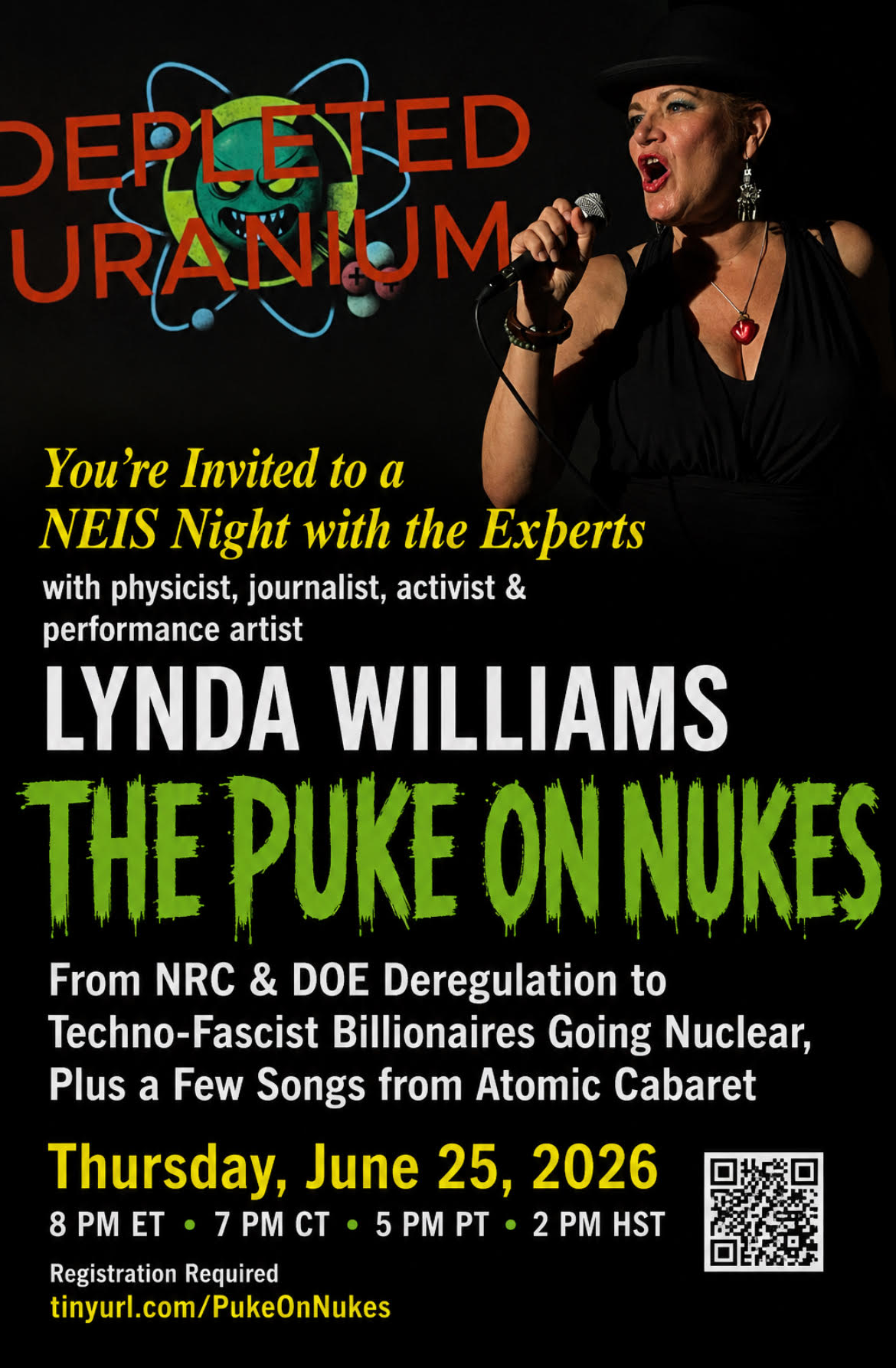
25 June- THE PUKE ON NUKES
Thursday, June 25, 2026
7pm Central Time (8pm ET, 6pm MT, 5pm PT) UTC – 5
From NRC & DOE Deregulation to Techno-Fascist Billionaires Going Nuclear, Plus a Few Songs from Atomic Cabaret REGISTER
26 June – Radiation Trainwreck at the NRC / Join the Protect Better Campaign – https://us02web.zoom.us/meeting/register/4ZlZ5_qLSHGiLSCg8FF6Bg#/registration


Cuba Is Not a Failed State – It Is a Besieged State
PETITION: “Global Appeal to Endorse Palestinian Right of Return of Refugees”
To see nuclear-related stories in greater depth and intensity – go to https://nuclearinformation.wordpress.com
-
Archives
- June 2026 (193)
- May 2026 (306)
- April 2026 (356)
- March 2026 (251)
- February 2026 (268)
- January 2026 (308)
- December 2025 (358)
- November 2025 (359)
- October 2025 (376)
- September 2025 (257)
- August 2025 (319)
- July 2025 (230)
-
Categories
- 1
- 1 NUCLEAR ISSUES
- business and costs
- climate change
- culture and arts
- ENERGY
- environment
- health
- history
- indigenous issues
- Legal
- marketing of nuclear
- media
- opposition to nuclear
- PERSONAL STORIES
- politics
- politics international
- Religion and ethics
- safety
- secrets,lies and civil liberties
- spinbuster
- technology
- Uranium
- wastes
- weapons and war
- Women
- 2 WORLD
- ACTION
- AFRICA
- Atrocities
- AUSTRALIA
- Christina's notes
- Christina's themes
- culture and arts
- Events
- Fuk 2022
- Fuk 2023
- Fukushima 2017
- Fukushima 2018
- fukushima 2019
- Fukushima 2020
- Fukushima 2021
- general
- global warming
- Humour (God we need it)
- Nuclear
- RARE EARTHS
- Reference
- resources – print
- Resources -audiovicual
- Weekly Newsletter
- World
- World Nuclear
- YouTube
-
RSS
Entries RSS
Comments RSS
 nuclear-news