North Korea warns that nuclear talks “will never be resumed” if USA continues ‘hostile acts’
 North Korea vows ‘fiercer’ response, end to nuclear talks if U.S. continues ‘hostile acts’, Japan Times, BY JESSE JOHNSON, STAFF WRITER, MAY 24, 2019 North Korea vows ‘fiercer’ response, end to nuclear talks if U.S. continues ‘hostile acts’, Japan Times, BY JESSE JOHNSON, STAFF WRITER, MAY 24, 2019
North Korea said Friday that nuclear talks with the United States “will never be resumed” unless Washington halts what Pyongyang said were “hostile acts” and demands of “unilateral disarmament,” warning of a “fiercer” response if this continues. In a statement carried by the North’s official Korean Central News Agency, an unidentified Foreign Ministry spokesman delivered Pyongyang’s latest warning to the U.S. in the wake of President Donald Trump’s failed summit with leader Kim Jong Un in Hanoi in February. “We hereby make it clear once again that the United States would not be able to move us even an inch with the device it is now weighing in its mind, and the further its mistrust and hostile acts towards the DPRK grow, the fiercer our reaction will be,” the spokesman said, using the acronym for the North’s formal name, the Democratic People’s Republic of Korea. “Unless the United States puts aside the current method of calculation and comes forward with a new method of calculation, the DPRK-U.S. dialogue will never be resumed and by extension, the prospect for resolving the nuclear issue will be much gloomy,” the spokesman said. The Hanoi talks, the second summit between Trump and Kim, collapsed without a deal due to large differences over the scope of North Korea’s denuclearization and potential sanctions relief by the U.S. Reuters reported in March that Trump had passed Kim a note bluntly calling for North Korea to surrender all its nuclear weapons and fuel, a demand he could not abide by…….. https://www.japantimes.co.jp/news/2019/05/24/asia-pacific/politics-diplomacy-asia-pacific/north-korea-vows-fiercer-response-end-nuclear-talks-u-s-continues-hostile-acts/#.XOhfUxYzbGg |
|
Comparing the radioactive pollution from Fukushima and Chernobyl nuclear accidents
|
Chernobyl vs. Fukushima: Which Nuclear Meltdown Was the Bigger Disaster? Live Science By | May 24, 2019 The new HBO series “Chernobyl” dramatizes the accident and horrific aftermath of a nuclear meltdown that rocked the Ukraine in 1986. Twenty-five years later, another nuclear catastrophe would unfold in Japan, after the magnitude 9.0 Tohoku earthquake and subsequent tsunami triggered a disastrous system failure at Fukushima Daiichi Nuclear Power Plant.Both of these accidents released radiation; their impacts were far-reaching and long-lasting. But how do the circumstances of Chernobyl and Fukushima compare to each other, and which event caused more damage? [5 Weird Things You Didn’t Know About Chernobyl] Only one reactor exploded at Chernobyl, while three reactors experienced meltdowns at Fukushima. Yet the accident at Chernobyl was far more dangerous, as damage to the reactor core unspooled very rapidly and violently, said Edwin Lyman, a senior scientist and acting director for the Union of Concerned Scientists Nuclear Safety Project. “As a result, more fission products were released from the single Chernobyl core,” Lyman told Live Science. “At Fukushima the cores overheated and melted but did not experience violent dispersal, so a much smaller amount of plutonium was released.” In both accidents, radioactive iodine-131 posed the most immediate threat, but with a half-life of eight days, meaning half of the radioactive material decayed within that time, its effects soon dissipated. In both meltdowns, the long-term hazards arose primarily from strontium-90 and cesium-137, radioactive isotopes with half-lives of 30 years. And Chernobyl released far more cesium-137 than Fukushima did, according to Lyman. “About 25 petabecquerels (PBq) of cesium-137 was released to the environment from the three damaged Fukushima reactors, compared to an estimate of 85 PBq for Chernobyl,” he said (PBq is a unit for measuring radioactivity that shows the decay of nuclei per second). What’s more, Chernobyl’s raging inferno created a towering plume of radioactivity that dispersed more widely than the radioactivity released by Fukushima, Lyman added. Sickness, cancer and deathAt Chernobyl, two plant workers were killed by the initial explosion and 29 more workers died from radiation poisoning over the next three months, Time reported in 2018. Many of those who died had knowingly exposed themselves to deadly radiation as they worked to secure the plant and prevent further leaks. Government officials relocated an estimated 200,000 people from the region, according to the International Atomic Energy Agency. In the years that followed, cancers in children skyrocketed in the Ukraine, up by more than 90%, according to Time. A report issued by United Nations agencies in 2005 approximated that 4,000 people could eventually die of radiation exposure from Chernobyl. Greenpeace International estimated, in 2006, that the number of fatalities in the Ukraine, Russia and Belarus could be as high as 93,000 people, with 270,000 people in those countries developing cancers who otherwise would not have done so…….. The extent of Fukushima’s environmental impact is still unknown, though there is already some evidence that genetic mutations are on the rise in butterflies from the Fukushima area, producing deformations in their wings, legs and eyes. [See Photos of Fukushima’s Deformed Butterflies] ……. radiation levels around Chernobyl can vary widely. Aerial drone surveys revealed in May that radiation in Ukraine’s Red Forest was concentrated in previously unknown “hotspots,” which scientists outlined in the region’s most accurate radiation maps to date. The Fukushima nuclear power plant is still open and active (though the reactors that exploded remain closed); nonetheless, ongoing concerns about safety linger. The Tokyo Electric Power Company (TEPCO) recently announced that it would not hire foreign workers coming to Japan under newly relaxed immigration rules……. https://www.livescience.com/65554-chernobyl-vs-fukushima.html |
|
|
Danger in foreign workers at Fukushim nuclear clean-up – Tepco abandons plans for them
|
The company noted that hiring foreign workers at the nuclear plant under a new specified skills visa category that took effect in April could result in work-related accidents and long-term health problems due to their lack of Japanese language skills and understanding of Japanese labor practices. The announcement followed a health ministry caution May 21 for TEPCO to carefully reconsider its policy of using foreign workers at the complex…….. The ministry had said that if TEPCO went ahead with hiring foreign workers, the company and its contractors involved in decommissioning had to take at least the same level of protective measures that apply to Japanese workers to ensure that they fully understand safety sanitation and avoid the health risk of excessive radiation exposure. Even though eight years have passed since the triple meltdown, radiation levels remain high in many areas of the Fukushima plant, especially around the reactor buildings. The decommissioning process that is expected to take years will involve a range of gargantuan tasks, one being the removal of melted nuclear fuel debris from the reactors. Under the recently revised immigration control law, foreign workers with specified skills are permitted to work at nuclear power plants. The ministry acknowledges that it is ultimately up to individual employers to decide whether or not to accept foreign workers on their payrolls. But experts in Japan and overseas who are keen for the new visa program to be a success have also voiced concerns about foreign workers at the Fukushima plant developing radiation-related health issues and being able to manage them after they return to their home countries….. Chief Cabinet Secretary Yoshihide Suga referred to the ministry’s caution at a May 21 news conference, saying that TEPCO should be prepared to fully address a range of health-related problems that may arise in the future. The utility notified dozens of its contractors at a meeting in late March that it will accept foreign workers at the Fukushima plant. Currently, about 4,000 people toil at the plant each day. Most areas of the complex are categorized as controlled areas to guard against radiation exposure. Under the law, workers at a nuclear facility must not be exposed to more than 100 millisieverts of radiation over five years and 50 millisieverts a year. http://www.asahi.com/ajw/articles/AJ201905220067.html |
|

Hibakusha: Nagasaki activist, 79, looks to entrust nuclear movement to next generation
|
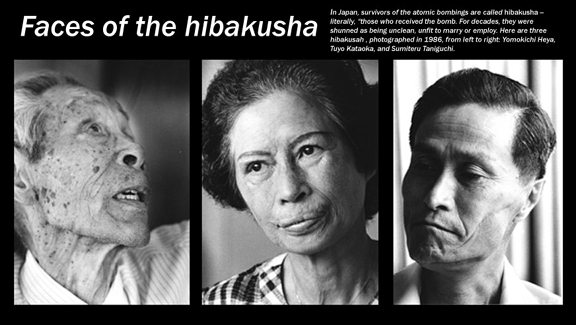
https://mainichi.jp/english/articles/20190522/p2a/00m/0na/013000c May 22, 2019 (Mainichi Japan) NAGASAKI — On May 9, there was a sit-in hibakusha gathering in front of the Peace Statue at Nagasaki Peace Park. The meeting takes place on the ninth of every month, marking the Aug. 9, 1945, U.S. atomic bombing of Nagasaki. This month’s congregation marked the 444th time for such an event. Koichi Kawano, 79, took to the microphone to speak about the stand-off between the United States and Iran. “This is a crisis,” he said to the around 100 people in attendance, continuing, “Our hearts are one when wishing for the abolition of nuclear weapons.” Born in North Pyongan Province on the Korean Peninsula, now part of North Korea, Kawano was brought back to his parents’ hometown Nagasaki as a child. Aged 5 in August 1945, he was around 3.1 kilometers away from the atomic bomb’s hypocenter. Now a resident of the nearby town of Nagayo, he has been an activist for the end of nuclear weaponry in roles including his long tenure as chairman of the Hibakusha Liaison Council of the Nagasaki Prefectural Peace Movement Center. “While enduring untold misery, we have won our rights with our own strength,” he says, looking back on the messages their hibakusha meetings have sent against the government’s constitutional amendment policies and security legislation designed to allow Japan to exercise the right to collective self-defense in a limited manner. “Perseverance is power” has been Kawano’s guiding motto in engaging in the movement’s activities, but this spring he faced a difficult reality. Masanori Nakashima, president of the Nagasaki Prefecture A-bomb Health Handbook Friendship Society, died aged 89 on March 15. The two men were allies in peace activism. Representatives of five local hibakusha groups, including Nakashima and Kawano, announced a joint statement on peace issues and handed a written request to the prime minister on Aug. 9. Of the five hibakusha group representatives who were alive in 2015 on the 70th anniversary of the bombing, three including Nagasaki Atomic Bomb Survivors Council chair Sumiteru Taniguchi have passed away. Taniguchi died in 2017 at 88 years of age. “Even with his limp, he dragged himself to that office to hear other hibakusha speak,” Kawano reminisced, while looking ahead to an uncertain future, saying, “What will happen to these groups after we die?” Kawano himself underwent surgery for esophageal cancer in 2017. Due to ill health he was forced to pull out of a survey of hibakusha in North Korea as a member of the Japan Congress Against A- and H-Bombs in fall 2018. Despite setbacks, his drive for peace remains unchanged. Kawano confronted Prime Minister Shinzo Abe over the Japanese government’s disinclination to sign and ratify the United Nations Treaty on the Prohibition of Nuclear Weapons in a face-to-face meeting in 2017, asking, “What country’s prime minister are you?” As time marches on from the events of August 1945, Kawano is putting his faith in the next generation. “The increasingly quiet voices of the hibakusha must not be drowned out,” he says. At the monthly sit-ins in Nagasaki Peace Park, the number of high school age attendees has increased. As he welcomes the last summer of his 70s, Kawano’s resolve remains strong. “Peace activism is powered by people. I want the movement to continue, to carry on the wish never to see another generation of hibakusha in this world.” (Japanese original by Yuki Imano, Nagasaki Bureau) |
Risky incident at South Korean nuclear reactor
hours when it should have been shut down manually at once.
was holding the control rods, which regulate the reactor’s output, at the
time. A continuing increase in output could have led to a thermal runaway,
potentially causing the reactor to explode.
The US demanded the closure of five atomic facilities during the Hanoi summit, but Kim offered only two
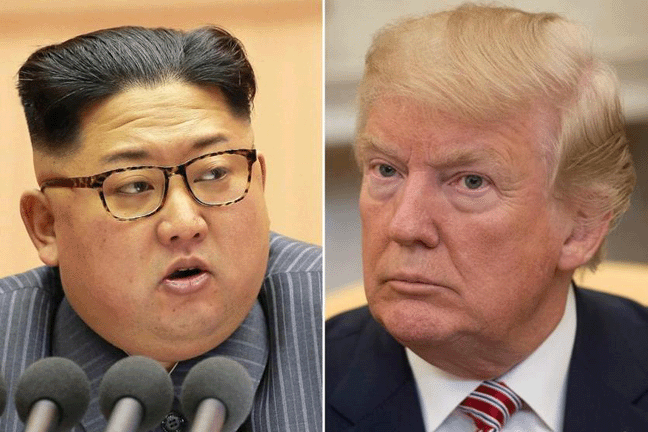 Trump clarifies nuclear gulf between US, North Korea The US demanded the closure of five atomic facilities during the Hanoi summit, but Kim offered only two, Asia Times, By ANDREW SALMON 22 May 19, President Donald Trump, speaking to US broadcaster Fox News on Sunday evening, said Washington had sought, during a February summit with North Korean leader Kim Jong Un, to shutter five nuclear sites, but Pyongyang was only willing to close two. Trump clarifies nuclear gulf between US, North Korea The US demanded the closure of five atomic facilities during the Hanoi summit, but Kim offered only two, Asia Times, By ANDREW SALMON 22 May 19, President Donald Trump, speaking to US broadcaster Fox News on Sunday evening, said Washington had sought, during a February summit with North Korean leader Kim Jong Un, to shutter five nuclear sites, but Pyongyang was only willing to close two. |
Trump and Kim “in love”, but have few options now that discussions have collapsed
|
Trump and Kim’s Cozy Relationship Makes Nuclear Talks Tougher The leaders, who “fell in love” during their first summit, have few options now that discussions have collapsed. Bloomberg, By Youkyung Lee, 20 May19,Donald Trump and Kim Jong Un often explain their surprisingly warm relationship in the language of romance. They “ fell in love” during the first-ever summit between a U.S. president and a North Korean leader in Singapore last year, Trump said. A top North Korean diplomat similarly describes the chemistry between the two leaders as “mysteriously wonderful.”
Since the breakup of the most recent round of talks in Hanoi in February, however, Kim has registered his displeasure not as a lover scorned, but as a dictator at the helm of an increasingly advanced nuclear arsenal. Over one week in May, he personally oversaw the trials of at least two short-range ballistic missiles capable of striking all of South Korea, where some 28,500 U.S. troops are based. The back-to-back launches broke an almost 17-month pause in major weapons testing and likely violated United Nations resolutions banning North Korea from firing ballistic missiles—but crucially, it didn’t violate Kim’s pledge to Trump to halt testing of long-range missiles that could strike the continental U.S. The act was both aggressive and subtle, showing the U.S. that North Korea was willing to play ball but refused to be played. In securing the unprecedented meeting with Trump and entering direct negotiations with the U.S. president, Kim left himself few options if the conversations were to go poorly. The U.S. has been in a similar position since Trump tweeted just after the Singapore meeting that North Korea was “no longer a nuclear threat.” Both leaders must now walk a delicate line to save face and avoid what neither of them wants: nuclear war. Kim’s primary goal going into the Hanoi summit was considerably more mundane. He was seeking to make North Korea a normal country in the eyes of the world and to remove sanctions that are crushing the economy and stoking popular unrest. According to the UN, its 2018 harvest was the worst in a decade, leaving 40 percent of the population in need of food assistance. …….. Current South Korean President Moon Jae-in is caught between the two leaders. Seoul is within the range of both missiles fired in early May, and Moon doesn’t want to disrupt his own fragile relationship with Kim by appearing to side with Trump. In his speech, Kim urged Moon to stop being an “officious mediator,” using a Korean slang term—ojirap—that’s rarely used by public figures in official settings and almost never by a younger person referring to an elder. The South Korean government “must defend the interest of the nation,” Kim said. Moon helped broker the first summit between Trump and Kim, in a pair of dramatic meetings with the North Korean leader on the Koreas’ militarized border, and is now pushing for a third by appealing to common human decency. …… The second missile test, on May 9, occurred while Trump’s top nuclear envoy, Stephen Biegun, was in Seoul to meet with South Korean officials. There’s been no indication that the U.S. is willing to accept what many North Korea watchers agree is Kim’s true goal: admission into the exclusive club of accepted nuclear-armed states. ………. The more time passes, the more sophisticated Kim’s arsenal becomes, shrinking Trump’s margin of error in responding to threats and increasing the danger of miscalculation. There’s also the risk that Trump and Kim learn they’re not as close as they thought they were. …. https://www.bloomberg.com/news/articles/2019-05-20/trump-and-kim-got-too-serious-too-fast-in-nuclear-discussions |
|
Donald Trump says he would not allow Iran to develop nuclear weapons
 Trump warns Iran it will never be allowed to build nuclear arsenal, US president insists he wants to avoid Tehran conflict after weeks of escalating tensions, Ft.com 20 May 19 Trump warns Iran it will never be allowed to build nuclear arsenal, US president insists he wants to avoid Tehran conflict after weeks of escalating tensions, Ft.com 20 May 19
Donald Trump said he would not allow Iran to develop nuclear weapons, while insisting he wanted to avoid war with the Islamic republic after weeks of escalating tensions. The US president has kept Tehran on edge by mixing threats with statements playing down the odds of a conflict, as foreign policy analysts speculate that Mr Trump is less keen on military conflict than some of his hawkish advisers. “I don’t want to fight. But you do have situations like Iran, you can’t let them have nuclear weapons — you just can’t let that happen,” Mr Trump said in an interview with Fox News. He had earlier warned Tehran to stop threatening America, and suggested that the US would destroy Iran if there was a military conflict. “If Iran wants to fight, that will be the official end of Iran. Never threaten the United States again!” he tweeted.
Tensions have risen sharply in recent few weeks, with Iran saying it will no longer comply with elements of the 2015 nuclear accord it signed with world powers, including the US, and Washington deploying an aircraft carrier strike group to the region. …….
Mr Trump’s key foreign policy advisers, national security adviser John Bolton and secretary of state Mike Pompeo, have referred to unspecified “escalatory action” from Tehran, fuelling speculation that the hawkish pair are trying to convince the president to go to war with Iran.
This has led some lawmakers to grow concerned that the administration is seeking to enter into a conflict without congressional approval. Several senators were last week given details of the administration’s intelligence on Iran, with more lawmaker briefings expected this week. …… https://www.ft.com/content/0192edae-7b0a-11e9-81d2-f785092ab560
|
|
|
“Denuclearization” has different meanings for North Korea and USA
|
North Korean missiles: Size does not matter, Bulletin of the Atomic Scientists, By Duyeon Kim, Melissa Hanham, May 15, 2019 When it comes to dealing with North Korea’s nuclear program, one fundamental challenge (among many) has been a gap in the definitions of very basic terms in the security lexicon. This inability to agree on the basics has complicated negotiations and communications for more than 25 years. While the vague use of the term “denuclearization” has allowed a kind of rapprochement between the United States and North Korea, denuclearization will never actually happen until the parties agree on what it means and how to achieve it.
“Denuclearization” is not the only term in contention, and diplomacy is not the only field in which semantics count. North Korea is playing another hand in this age-old word game: Missiles are being tested, but Pyongyang prefers to call them “rockets.” In North Korea, a rocket can be anything from artillery rounds to a space launch vehicle. Pyongyang fired a short-range ballistic missile, artillery, and multiple-launch rocket systems on May 4 and another barrage on May 9, revealing what the new “tactical guided weapon” they also tested on April 18 and likely November 2018 really is. The regime claims that the firing of these “rockets” is routine and defensive in nature. The activities near Wonson are indeed likely to resemble how North Korea would attempt to repel an invasion from the East. Unfortunately, this exercise included what may be a short-range missile capable of carrying a nuclear warhead. Washington does not appear to be overreacting to these latest tests, which it should not, and has chosen to focus on the short-range nature of the missile involved. But the Trump administration must not turn a blind eye either. Responses and punishments—proportionate to the significance and gravity of Pyongyang’s actions—can be taken without botching the diplomatic process. The lack of an international response only emboldens the regime to sharpen its gray-zone tactics to push the envelope and gain influence without having to explode nuclear devices or fire long-range missiles. These smaller, solid-fuel missiles matter because—tipped with nuclear warheads or chemical or biological weapons—they threaten South Korea as well as US troops and American citizens in the South. Indeed these may be the first weapons used in a large scale conflict that could pull allies in. They cannot be regarded simply as part of a sovereign country’s right to develop arms. The larger intercontinental ballistic missiles (ICBMs) are not the only enemy. Smaller missiles are just as significant. Size does not matter—it’s what you can do with a missile that counts. What’s in a name? For the first time, Washington, Pyongyang, and Seoul are reading from the same script and agree on one thing: these missiles ought not to be called “missiles.” Instead, they are being named “projectiles” and “rockets.” The common thread is to prevent the already fragile diplomatic process from unraveling…… https://thebulletin.org/2019/05/north-korean-missiles-size-does-not-matter/?utm_source=Bulletin%20Newsletter&utm_medium=iContact%20email&utm_campaign=NKmissiles_05152019 |
|
Chinese public’s trust in government means that nuclear power better able to go ahead in China
|
China and the Nuclear Debate, China’s nuclear energy sector is expanding amid the glow of positive public opinion. The Diplomat, By Layne Vandenberg, May 15, 2019 “……… The Diplomat sat down with Tobi Du, a Yenching Scholar at the Yenching Academy at Peking University to discuss nuclear issues in East Asia, how Chinese view nuclear threats, and the development of nuclear energy…….. Although China is one of the five official nuclear weapons states as designated by the Treaty on the Nonproliferation of Nuclear Weapons, China has historically supported North Korea. While China does facilitate denuclearization talks, it definitely does not feel threatened in the same way that the U.S. and Japan do considering North Korea has explicitly stated that its nuclear weapons program is intended to deter the U.S. and its allies. Because of this, people in China are not currently as sensitive to nuclear threats as they are in other countries. …… Despite the lack of public support for development of the nuclear energy industry in most other countries, research shows that the Chinese public is not strongly against nuclear power. …… [following the Fukushima nuclear accident] despite a negative outlook for nuclear energy globally, China is unique in that the public did not become as opposed to the development of nuclear energy. Trust in the government has a lot to do with this. Since Chinese citizens generally possess a low level of knowledge about nuclear energy and related issues, the public places a significant amount of trust in the government to conduct its own assessments and accepts the results. Generally, the Fukushima nuclear accident did not affect the direction of Chinese policy for nuclear energy but prompted a more careful and measured attitude towards implementation. Considering China’s unique ability to interact with and shape public discourse around sensitive topics, public input in decision-making is minimal because of this control. The central government is able to implement the nuclear energy industry in China as it sees fit. In contrast to China’s more receptive public opinion, most countries are keenly cognizant of issues related to nuclear weapons, and mostly focus on these issues and their accompanying negative connotations. ….. So while it is true that Chinese people generally have a more positive opinion of nuclear energy in China than in other countries after Fukushima, it is China’s political governance that allows the country to push forward with nuclear power.…….. https://thediplomat.com/2019/05/china-and-the-nuclear-debate/ |
|
|
How to avoid nuclear confrontation between India and Pakistan

If India’s new government has the wisdom to try once more to move away from confrontation, there is no shortage of confidence-building and nuclear risk-reduction measures to pursue. Every Indian and Pakistani diplomat worth his or her salt can quickly identify a half-dozen worthwhile measures that would not diminish security while helping to place time and space before another clash. If enough time and space are added, there may not be another clash.
Highly radioactive chimney at Fukushima No 1 plant to be taken apart
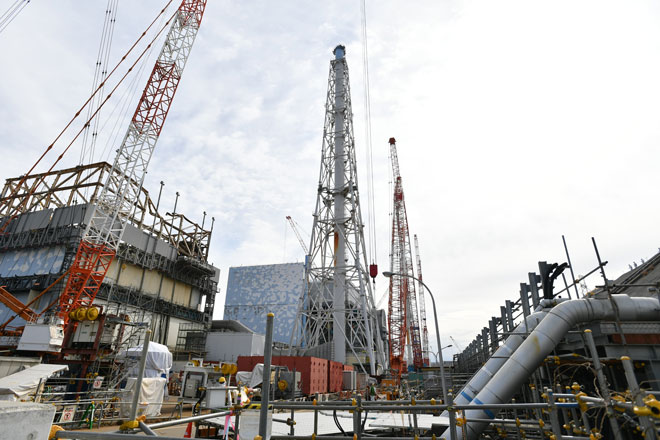
TEPCO to slice dangerous chimney at Fukushima plant http://www.asahi.com/ajw/articles/AJ201905100045.html, By CHIKAKO KAWAHARA/ Staff Writer, May 10, 2019 Tokyo Electric Power Co. plans to start work on May 20 to dismantle a 120-meter-tall, highly contaminated chimney that could collapse at the crippled Fukushima No. 1 nuclear power plant.
It will be the first highly radiated facility at the plant to be taken apart, the company said May 9.
The stack, with a diameter of 3.2 meters, was used for both the No. 1 and No. 2 reactors. TEPCO plans to remove the upper half of the chimney within this year to prevent the structure from collapsing.
The dismantling work will be conducted by remote control because the radiation level around the base of the chimney is the highest among all outdoor areas of the plant. Exposure to radiation at the base can cause death in several hours.
After the Great East Japan Earthquake and tsunami struck in March 2011, pressure increased in the containment vessel of the No. 1 reactor. Vapors with radioactive substances were sent through the chimney to the outside.
TEPCO also found fractures in steel poles supporting the chimney. The damage was likely caused by a hydrogen explosion at the No. 1 reactor building when the nuclear disaster was unfolding.
Since then, the chimney has been left unrepaired because of the high radiation levels.
Immediately after the nuclear accident, a radiation level exceeding 10 sieverts per hour was observed around the base of the chimney. In a survey conducted in 2015, a radiation level of 2 sieverts per hour was detected there.
TEPCO will use a large crane that will hold special equipment to cut the chimney in round slices from the top.
The company set up a remote control room in a large remodeled bus about 200 meters from the chimney. Workers will operate the special cutting equipment while watching footage from 160 video cameras.
Fukushima’s ghost towns
Nuclear wasteland Inside the ghost towns of Fukushima, Eight years on from the tsunami and nuclear meltdown, much of Japan’s Fukushima province remains derelict and deserted. Telegraph, 13 May 19
There was a chilling silence in the town of Tomioka in the days after the March 2011 Fukushima nuclear disaster.
Shoes were left in porches, half-read newspapers lay abandoned next to cups of tea, long gone cold. As night closed in on the seaside town, lights glared out from a few bare windows, while news of the ongoing crisis at the Fukushima No. 1 Nuclear Power Plant just six miles away drifted from a solitary radio.
Nobody was home.
Eight years on, little has changed. Before March 11, 2011 – the day the tsunami engulfed the nuclear facility, forcing the evacuation of more than 150,000 residents across the region – the town had a population of 15,960. Now, just a few hundred people have returned despite the lifting of the evacuation order in April 2017.
“Officially 835 have returned, but many are plant and other clean-up workers who are renting out abandoned houses,” says Takumi Takano, a local councillor who splits her time between Tomioka and temporary digs in Koriyama an hour’s drive away that she and her husband Kenichi have lived in since evacuating.
Of the remaining locals most are either elderly, or only return during the day, she says. Most worryingly, just 14 are children. When night falls, they return to “temporary” homes elsewhere, she says. “It’s like a ghost town.”
A similar situation is found throughout the entire evacuated region, where only 12,859 of the 100,510 residents who were living in the zone before the disasters have returned, a Cabinet Office official says. Like Tomioka, many of them are clean-up workers, local residents say.
…… After almost eight years, residents, especially those with young families, have settled elsewhere, securing new jobs and starting new schools or moving out of Fukushima entirely, says says Kenichi, a former worker at the devastated nuclear plant.. Many are put off returning by the severe shortage of medical facilities in the region.
Then there’s the radioactivity,” he says, as the couple sit outside their caravan, set up on the land of their recently demolished home, which backs on to a 130-square-mile “difficult-to-return-zone” that is still considered too highly contaminated to inhabit.
Eight years on, radioactivity levels have fallen in the reopened parts of Tomioka, though remain 20 times higher than before the disaster. “It’s much higher over there,” he says, pointing to the blockaded zone, where radiation levels exceed 3.8 microsieverts per hour – the designated threshold for issuing evacuation orders.
That zone is a legacy of the nuclear disaster, when multiple reactor meltdowns and explosions, triggered by a magnitude nine earthquake and towering tsunami, spread radioactive materials for hundreds of miles around……..
despite clean-up operations there to reduce radiation levels below the government-set target of 0.23 microsieverts (µSv) per hour, other legacies of the disaster – the crumbling houses and shops, corroding vehicles and overgrown fields, not to mention 16.5 million containers of contaminated earth collected at some 140,000 sites around the region – are impossible to avoid.
The 0.23 µSv figure is significant in that it adds up to an annual dosage level of one millisievert (mSv) (calculated on the premise that a resident spends eight hours a day outdoors), stipulated by the International Atomic Energy Agency as being safe for members of the public.
But while maintaining that level is complicated by recontamination from surrounding woodland, some experts argue the figure says little about the true dangers, or safety, of radiation exposure. That the Japanese government raised this to 20 mSv in the aftermath of the disasters adds weight to their argument…….
Misao Fujita, a doctor who performs thyroid scans at a clinic in Iwaki, about 30 miles south of the nuclear plant, says a connection between the cancers and radiation exposure cannot be ruled out and the screening effect is no reason to disregard the examinations.
“What we do know is that after Chernobyl, many children developed thyroid cancer, and if you take that into account and consider the high risk that Fukushima children were exposed to radiation then I think we should carry out such tests,” Dr Fujita says, adding that thyroid cancer normally occurs in one in one million children.
Noriko Tanaka, whose son is one of Dr Fujita’s patients, says exams revealing cysts in her son’s thyroid are a concern, not least because iodine-131 – a substance that causes thyroid cancer – was contained in the plume released by the Fukushima plant that landed on Iwaki after the disasters. At the time, she was pregnant with her son. “I worry because nobody knows for sure what the future holds,” she says……….
The issue of the one million tons of contaminated water being stored at the stricken nuclear plant is another worry for residents. After receiving assurances from Fukushima plant operator Tokyo Electric Power Company (TEPCO ) that the water had been successfully treated and stripped of all but one radioactive material, tritium, the government announced in 2017 it would start releasing the water into the ocean, despite protests, especially from local fisheries.
TEPCO released convoluted data to demonstrate the water’s safety, but was forced to backtrack last September when further tests showed the sums didn’t add up and 80 per cent of the water was in fact up to 20,000 times higher than the official safe threshold. Furthermore, it contained harmful radionuclides such as iodine, caesium and strontium.
Moreover, while the initial suggestion was that tritium was relatively harmless some studies have shown it to be a cause of infant leukaemia, says Ayumi Iida of NPO Tarachine, which independently analyses seawater samples taken from the ocean near Fukushima’s two nuclear plants.
“Tritiated water is easily absorbed and hazardous when inhaled or ingested via food or water,” she says. “There’s already data indicating infant leukaemia rates are higher near to nuclear plants, and tritium is known to cause DNA damage, so while there are claims that tritium is harmless, there are counterclaims it can adversely affect health, especially among young children.”…….
Shaun Burnie, a nuclear expert with Greenpeace says that discharging the water into the ocean is “the worst option” available, and one whose main consideration is economic.
“The only viable option, and it’s not without risks, is the long-term storage of the water in robust steel tanks over at least the next century, and the parallel development of water processing technology,” he says. ……….
“The reality is there is no end to the water crisis at Fukushima, a crisis compounded by poor decision-making by both TEPCO and the government,” says Mr Burnie.
Among more pressing issues, Mr Burnie says, is 400,000 cubic meters of sludge being stored within the Fukushima plant grounds that contains high concentrations of strontium – known as a “bone-seeker” because, if introduced into the body, it can accumulate in the bones in the same way as calcium does.
With the plant still generating waste, this sludge is expected to nearly double over the next 10 years, he adds.
Strontium releases into the environment from the plant were relatively small following the 2011 disaster, but significantly greater 30 months later, when in 2013 a large strontium-laced plume contaminated land as far away as Minamisoma – a city about 20 km from the plant, Mr Burnie says. Such an event could re-occur, he says.
“Is it a good idea to lift the evacuation orders? Absolutely not. The public are right to be concerned about the possibility of further offsite releases.”
They can also be forgiven for being sceptical over official reassurances that foodstuffs are safe, says Ms Iida of Tarachine, which also runs a produce-testing laboratory and has found “plenty” of items with levels of contamination exceeding the safe limits.
Meanwhile tests on samples of soil – which has no official safe threshold in Japan – have also revealed high levels of radiation in the area, she adds.
Namie’s Obori district, about six miles northwest of the nuclear plant and within the difficult-to-return-zone, is one place where soil radiation levels remain high. In woodland backing the pretty hamlet, which is famed for its pottery but has slowly surrendered to nature, the Telegraph recorded up to 127 µSv per hour – over 350 times the IAEA’s safe threshold……
Professor Kazuhiko Kobayashi at Sellafield, warns on nuclear radiation and danger to children
Radiation Free Lakeland 12th May 2019 Professor Kazuhiko Kobayashi has done ground breaking work with theUniversity of Tokyo on the impact of climate change on rice nutrition. This is important work and it has been widely featured in national and
international media.
Kazuhiko’s real passion however is to warn people
about the worst criminality against humankind: nuclear power and nuclear
weapons.
Kazuhiko organises respite for children and families who have been
impacted by the ongoing Fukushima disaster.
Members of Radiation Free Lakeland met up with Kazuhiko last autumn to show him the Sellafield area and he told us that there is money for climate research but not so much for
research into the impacts of radiation on our food and health. He is a kind
gentle man and he was visibly shocked to see the scale of Sellafield.
Kazuhiko broke down in tears within the shadow of Sellafield, at the
impacts the nuclear industry is having on our children’s health. His
passionate opposition to nuclear power and weapons, his work for change and
to help those impacted, is an inspiration.
Fukushima’s mothers became radiation experts to protect their children after nuclear meltdown
Key points:
- Mothers in Fukushima set up a radiation testing lab because they didn’t trust government results
- The women test food, water and soil and keep the public informed about radiation levels
- A major earthquake and tsunami caused a nuclear accident at the Fukushima power plant in 2011
They are testing everything — rice, vacuum cleaner dust, seafood, moss and soil — for toxic levels of radiation.
But these lab workers are not typical scientists.
They are ordinary mums who have built an extraordinary clinic.
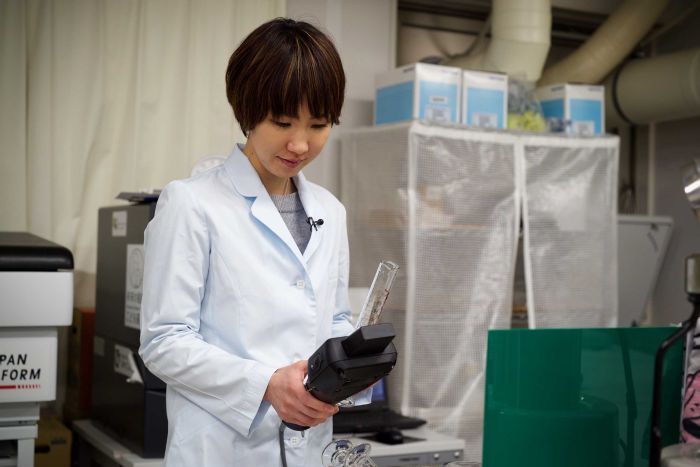
“Our purpose is to protect children’s health and future,” says lab director Kaori Suzuki.
In March 2011, nuclear reactors catastrophically melted down at the Fukushima Daiichi plant, following an earthquake and tsunami.
Driven by a desperate need to keep their children safe, a group of mothers began testing food and water in the prefecture.
The women, who had no scientific background, built the lab from the ground up, learning everything on the job.
The lab is named Tarachine, a Japanese word which means “beautiful mother”.
“As mothers, we had to find out what we can feed our children and if the water was safe,” Ms Suzuki says.
“We had no choice but to measure the radiation and that’s why we started Tarachine.”
After the nuclear accident, Fukushima residents waited for radiation experts to arrive to help.
“No experts who knew about measuring radiation came to us. It was chaos,” she says.
In the days following the meltdown, a single decision by the Japanese Government triggered major distrust in official information which persists to this day.
The Government failed to quickly disclose the direction in which radioactive materials was drifting from the power plant.
Poor internal communications caused the delay, but the result was that thousands fled in the direction that radioactive materials were flying.
Former trade minister Banri Kaieda, who oversaw energy policy at the time, has said that he felt a “sense of shame” about the lack of disclosure.
But Kaori Suzuki said she still finds it difficult to trust the government.
“They lied and looked down on us, and a result, deceived the people,” Ms Suzuki says.
“So it’s hard for the people who experienced that to trust them.”
She and the other mothers who work part-time at the clinic feel great responsibility to protect the children of Fukushima.
But it hasn’t always been easy.
When they set up the lab, they relied on donated equipment, , and none of them had experience in radiation testing. There was nobody who could teach us and just the machines arrived,” Ms Suzuki says.
“At the time, the analysing software and the software with the machine was in English, so that made it even harder to understand.
“In the initial stage we struggled with English and started by listening to the explanation from the manufacturer. We finally got some Japanese software once we got started with using the machines.”
Radiation experts from top universities gave the mothers’ training, and their equipment is now among the most sophisticated in the country.
Food safety is still an issue
The Fukushima plant has now been stabilised and radiation has come down to levels considered safe in most areas.
But contamination of food from Japan remains a hotly contested issue.
Australia was one of the first countries to lift import restrictions on Japanese food imports after the disaster.
But more than 20 countries and trading blocs have kept their import ban or restrictions on Japanese fisheries and agricultural products.
At the clinic in Fukushima, Kaori Suzuki said she accepted that decision.
“It doesn’t mean it’s right or wrong. I feel that’s just the decision they have made for now,” she says.
Most results in their lab are comparatively low, but the mothers say it is important there is transparency so that people know what their children are consuming.
Fukushima’s children closely monitored after meltdown
Noriko Tanaka is one of many mothers in the region who felt that government officials were completely unprepared for the unfolding disaster.
She was three months pregnant with her son Haru when the disaster struck.
Ms Tanaka lived in Iwaki City, about 50 kilometres south of the power plant.
Amid an unfolding nuclear crisis, she panicked that the radioactive iodine released from the meltdown would harm her unborn child.
She fled on the night of the disaster.
When she returned home 10 days later, the fear of contamination from the invisible, odourless radioactive material weighed deeply on her mind.
“I wish I was able to breastfeed the baby,” she says.
“[Radioactive] caesium was detected in domestic powdered milk, so I had to buy powdered milk made overseas to feed him.”
Ms Tanaka now has two children —seven-year-old Haru and three-year-old Megu. She regularly takes them in for thyroid checks which are arranged free-of-charge by the mothers’ clinic.
Radiation exposure is a proven risk factor for thyroid cancer, but experts say it’s too early to tell what impact the nuclear meltdown will have on the children of Fukushima.
Noriko Tanaka is nervous as Haru’s thyroid is checked.
“In the last examination, the doctor said Haru had a lot of cysts, so I was very worried,” she says.
However this time, Haru’s results are better and he earns a high-five from Dr Yoshihiro Noso.
He said there was nothing to worry about, so I feel relieved after taking the test,” Ms Tanaka says.
“The doctor told me that the number of cysts will increase and decrease as he grows up.”
Doctor Noso has operated on only one child from Fukushima, but it is too early to tell if the number of thyroid cancers is increasing because of the meltdown.
“There isn’t a way to distinguish between cancers that were caused naturally and those by the accident,” he says.Dr Noso says his biggest concern is for children who were under five years old when the accident happened.The risk is particularly high for girls.
Even if I say there is nothing to worry medically, each mother is still worried,” he says.
“They feel this sense of responsibility because they let them play outside and drink the water. If they had proper knowledge of radiation, they would not have done that,” he said.
Mums and doctors fear for future of Fukushima’s children
After the Chernobyl nuclear disaster of 1986, the incidence of thyroid cancers increased suddenly after five years….
“In the case of Chernobyl, the thyroid cancer rate increased for about 10 years. It’s been eight years since the disaster and I would like to continue examinations for another two years.” …….
Some children, whose families fled Fukushima to other parts of Japan have faced relentless bullying.
“Some children who evacuated from Fukushima living in other prefectures are being bullied [so badly that they] can’t go to school,” Noriko Tanaka said.
“The radiation level is low in the area we live in and it’s about the same as Tokyo, but we will be treated the same as the people who live in high-level radiation areas.”
Noriko is particularly worried for little Megu because of prejudice against the children of Fukushima.
“For girls, there are concerns about marriage and having children because of the possibility of genetic issues.”
1 This Month
26 September – International Day for the Total Elimination of Nuclear Weapons





PLEASE OPPOSE HR 8255 AND S.3639 – bills would accelerate satellite deployment, with no environmental review or safeguards – https://ncstd5li.quorum.us/campaign/169331/
To see nuclear-related stories in greater depth and intensity – go to https://nuclearinformation.wordpress.com
-
Archives
- September 2026 (291)
- August 2026 (330)
- July 2026 (355)
- June 2026 (287)
- May 2026 (306)
- April 2026 (356)
- March 2026 (251)
- February 2026 (267)
- January 2026 (308)
- December 2025 (358)
- November 2025 (359)
- October 2025 (375)
-
Categories
- 1
- 1 NUCLEAR ISSUES
- business and costs
- climate change
- culture and arts
- ENERGY
- environment
- health
- history
- indigenous issues
- Legal
- marketing of nuclear
- media
- opposition to nuclear
- PERSONAL STORIES
- politics
- politics international
- Religion and ethics
- safety
- secrets,lies and civil liberties
- spinbuster
- technology
- Uranium
- wastes
- weapons and war
- Women
- 2 WORLD
- ACTION
- AFRICA
- Atrocities
- AUSTRALIA
- Christina's notes
- Christina's themes
- culture and arts
- Events
- Fuk 2022
- Fuk 2023
- Fukushima 2017
- Fukushima 2018
- fukushima 2019
- Fukushima 2020
- Fukushima 2021
- general
- global warming
- Humour (God we need it)
- Nuclear
- RARE EARTHS
- Reference
- resources – print
- Resources -audiovicual
- Weekly Newsletter
- World
- World Nuclear
- YouTube
-
RSS
Entries RSS
Comments RSS

