“The ashes of half a dozen unidentified laborers ended up at a Buddhist temple in a town just north of the crippled Fukushima nuclear plant. Some of the dead men had no papers; others left no emergency contacts. Their names could not be confirmed and no family members had been tracked down to claim their remains. They were simply labeled “decontamination troops”
Addressing the issue, Japan’s environmental minister Yoshiaki Harada held a news conference (September 2019). Unfortunately, he proffered the following advice: “The only option will be to drain it into the sea and dilute it.” (Source: Justin McCurry in Tokyo, Fukushima: Japan Will Have to Dump Radioactive Water Into Pacific, Minister Says, The Guardian, Sept. 10, 2019)
“The only option”… Really?
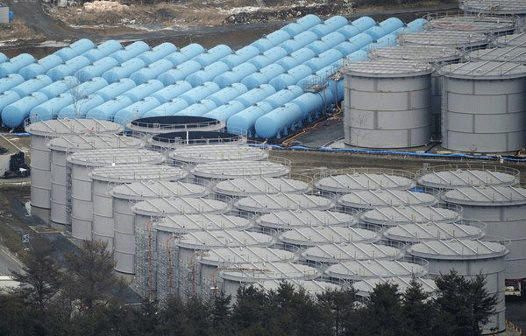
Over the past 8 years, Tokyo Electric Power (TEPCO) has scrambled like a Mad Hatter to construct emergency storage tanks (1,000) to contain upwards of one million tonnes of contaminated radioactive water, you know, the kind of stuff that, over time, destroys human cells, alters DNA, causes cancer, or produces something like the horrific disfigured creature in John Carpenter’s The Thing! That’s the upshot of a triple nuclear meltdown that necessitates constant flow of water to prevent further melting of reactor cores that have been decimated and transfigured into corium or melted blobs. It’s the closest to a full-blown “china syndrome” in all of human history. Whew! Although, the truth is it’ll be a dicey situation for decades to come.
Ever since March 11, 2011, TEPCO has scrambled to build storage tanks to prevent massive amounts of radioactive water from pouring into the ocean (still, some lesser amounts pour into the ocean every day by day). Now the government is floating a trial balloon in public that, once the tanks are full, it’ll be okay to dump the radioactive water into the ocean. Their logic is bizarre, meaning, on the one hand, the meltdown happens, and they build storage tanks to contain the radioactive water, but on the other hand, once the storage tanks run out of space, it’s okay to dump radioactive water into the ocean. Seriously?
Meantime, the Fukushima meltdown brings the world community face to face with TEPCO and the government of Japan in an unprecedented grand experiment that, so far, has failed miserably. Of course, dumping radiation into the Pacific is like dumping radiation into everybody’s back yard. But, for starters, isn’t that a non-starter?
Along the way, deceit breeds duplicity, as the aforementioned Guardian article says the Japanese government claims only one (1) death has been associated with the Fukushima meltdown but keep that number in mind. Reliable sources in Japan claim otherwise, as explained in previous articles on the subject, for example, “Fukushima Darkness, Part Two” d/d November 24, 2017, and as highlighted further on in this article.
When it comes to nuclear accidents, cover-ups reign supreme; you can count on it.
As such, it is believed the Japanese government is lying and should be held accountable for hoodwinking the world about the ravages of Fukushima, especially with the Olympics scheduled for next year.
For example, the following explains how death by radiation is shamefully hidden from the public via newspeak: Fukushima Daiichi Nuclear Power Station worker deaths “that expire at home” are not officially counted. Accordingly, how many workers on a deathbed with radiation sickness leave home to go to work (where deaths are counted) just before they die? Oh, please!
Meanwhile, the last thing the world community needs in the face of an uncontrollable nuclear meltdown, like Fukushima, is deceptiveness and irresponsibility by the host government. Too much is at stake for that kind of childish nonsense. And just to think, the 2020 Olympics are scheduled with events held in Fukushima. Scandalously, the International Olympic Committee (IOC) is A-Okay with that.
In contrast, a Greenpeace International March 8th 2019 article entitled: Japanese Government Misleading UN on Impact of Fukushima Fallout on Children, Decontamination Workers: “The Japanese government is deliberately misleading United Nations human rights bodies and experts over the ongoing nuclear crisis in areas of Fukushima… In areas where some of these decontamination workers are operating, the radiation levels would be considered an emergency if they were inside a nuclear facility.” Enough said!
“In its reporting to the United Nations, the Japanese government deliberately misrepresents the scale, complexity, and radiation risks in areas of Fukushima, the working practice and conditions for workers, and its disregard for children’s health and wellbeing. This reality should shame the government to radically change its failing policies,” said Kazue Suzuki, Energy Campaigner of Greenpeace Japan.
As such, either Greenpeace or the IOC is “dead wrong” about the conditions at Fukushima. Take your pick.
After all, the trend of misrepresentation of nuclear accidents has been established for decades. Not only Fukushima, Chernobyl (1986) is a nuclear disaster zone where the “official death count from radiation exposure” has been considerably discounted by various governmental agencies and NGOs. For inexplicable reasons (actually explicable but a long story), nuclear accidents are given Get Out Jail Free cards by the world’s press and associated governmental orgs and NGOs.
Yet, over time, the truth comes out, and when it does it’s dreadfully atrocious: A BBC special report, The True Toll of the Chernobyl Disaster d/d July 26, 2019 says: “The official, internationally recognized death toll, just 31 people died as an immediate result of Chernobyl while the UN estimates that only 50 deaths can be directly attributed to the disaster.”
That’s the official tally. Ugh! It’s so far off the mark that, if it were a baseball pitch, it’d be in the dirt, and a prime example of the public not getting the truth about the ravages of nuclear power accidents.
Of course, it is important to take note of how “wordsmiths” describe the death numbers, i.e., “died as an immediate result of Chernobyl” can only include someone standing at the site when it happened, leaving out all cases of radiation exposure that kills and cripples over subsequent days, months, and years. Or, in the case of the UN statement, “only 50 deaths can be directly attributed.” Only those standing there when it happened… ahem!
According to the BBC article, the Russian Academy of Sciences said as many as 112,000-125,000 died by 2005. That’s 2,500xs more deaths than the official reports, which also never increase in number over time as radiation takes its merry ole time blasting, destroying, and/or altering human cell structure. Ukrainian authorities claim death rates of Chernobyl cleanup workers rose from 3.5 to 17.5 deaths per 1,000 between 1988 and 2012 on a database of 651,453 cleanup workers, which equates to 11,392 deaths. Additionally, Belarus had 99,693 cleanup workers, equating to 1,732 deaths. Not only that, disability among workers shows that approximately 5% are still healthy in 2012 (only 5%, meaning 95% unhealthy) with commonality of cardiovascular and circulatory diseases and nervous system problems.
By 2008 in Belarus alone 40,049 liquidators or cleanup workers of Chernobyl were registered with cancer.
Viktor Sushko, deputy director general of the National Research Centre for Radiation Medicine (NRCRM) based in Kiev, Ukraine, describes the Chernobyl disaster as: “The largest anthropogenic disaster in the history of humankind,” Ibid.
Thus begging the most obvious of questions re Fukushima victims in the years ahead; how many cases of cancer, and how many will die? Unfortunately, radioactive isotopes don’t stop once they’re activated in a nuclear meltdown. They’re pernicious over time destroying and/or grotesquely altering human cell structure. For proof, visit second-generation Chernobyl children locked up in orphanages in Belarus.
“As of January 2018, 1.8 million people in Ukraine, including 377,589 children, carried status of victims of the disaster, according to Sushko and his colleagues. Not only that, there has been a rapid increase in the number of people with disabilities, rising from 40,106 in 1995 to 107,115 in 2018,” Ibid.
According to a USA Today article – Chernobyl’s Legacy: Kids With Bodies Ravaged by Disaster, April 17, 2016: “There are 2,397,863 people registered with Ukraine’s health ministry to receive ongoing Chernobyl-related health care. Of these, 453,391 are children — none born at the time of the accident. Their parents were children in 1986. These children have a range of illnesses: respiratory, digestive, musculoskeletal, eye diseases, blood diseases, cancer, congenital malformations, genetic abnormalities, trauma.” Many of the children are hidden away deep in the forested countryside in orphanages in Belarus.
Back to Fukushima, there are numerous instances of governmental meddling to hide the truth, starting with passage of the 2013 government secrecy act, The State Secrecy Law, aka: Act on the Protection of Specially Designated Secrets (SDS), Act No. 108, which says that civil servants or others who “leak secrets” will face up to 10 years in prison, and those who “instigate leaks,” especially journalists, will be subject to a prison term of up to 5 years. Subsequently, Japan fell below Serbia and Botswana in the Reporters Without Borders 2014 World Press Freedom Index.
Horrifically, at the end of the day, when nuclear goes bad, it takes everyone along on a daunting trip for years and years and more years, outliving life spans but continuing generation after generation, like the 453,391 Chernobyl-radiated-influence children born after the nuclear blowout in 1986. Chernobyl altered their genes before they were born…. Imagine that!
Cliodhna Russell visited children’s orphanages in Belarus in 2014: “Children rocking back and forth for hours on end, hitting their heads against walls, grinding their teeth, scraping their faces and putting their hands down their throats.” (Source: How My Trip to a Children’s Mental Asylum in Belarus Made Me Proud to be Irish, the journal.ie, March 18, 2014.)
Postscript: “It’s a real shame that the authorities hide the truth from the whole world, from the UN. We need to admit that actually many people are dying. We are not allowed to say that, but TEPCO employees also are dying. But they keep mum about it,” Katsutaka Idogawa, former mayor of Futaba (Fukushima Prefecture) Fukushima Disaster: Tokyo Hides Truth as Children Die, Become Ill from Radiation – Ex-Mayor, RT News, April 21, 2014)
Post-Postscript: “The ashes of half a dozen unidentified laborers ended up at a Buddhist temple in a town just north of the crippled Fukushima nuclear plant. Some of the dead men had no papers; others left no emergency contacts. Their names could not be confirmed and no family members had been tracked down to claim their remains. They were simply labeled “decontamination troops” — unknown soldiers in Japan’s massive cleanup campaign to make Fukushima livable again five years after radiation poisoned the fertile countryside,” (Source: Mari Yamaguchi, Fukushima ‘Decontamination Troops’ Often Exploited, Shunned, AP & ABC News, Minamisona, Japan, March 10, 2016)
September 17, 2019
Posted by Christina Macpherson |
Japan, Reference, secrets,lies and civil liberties, spinbuster |
1 Comment
 Dumping Fukushima’s Radioactive Water Into Pacific Ocean Is ‘Only Option’, Japan Says https://www.sciencealert.com/fukushima-is-running-out-of-space-to-store-contaminated-water ARIA BENDIX, BUSINESS INSIDER 12 SEP 2019 On March 11, 2011, Japan was struck by the most powerful earthquake in the nation’s history – a magnitude 9 temblor that triggered a tsunami with waves up to 133 feet (40 meters) high. The disaster set off three nuclear meltdowns and three hydrogen explosions at the Fukushima Daiichi Nuclear Power Plant.
Eight years later, Fukushima holds more than 1 million tons of contaminated water.
The water comes from two main sources. First, the tsunami caused the reactor cores to overheat and melt, so cleanup workers injected water into the cores to cool them. In the wake of the accident, groundwater also seeped in beneath the reactors and mixed with radioactive material.
To store this contaminated water, the plant currently has 1,000 sealed tanks. But the water is still accumulating. There’s enough room to keep the liquid contained through summer 2022, but after that, there will be no space left.
At a news briefing in Tokyo, Japan’s environment minister, Yoshiaki Harada, said that come 2022, “the only option will be to drain it into the sea and dilute” the contaminated water.
The Japanese government, however, is waiting on a verdict from a panel of experts before making a final decision about what to do with the water.
Meanwhile, the environmental group Greenpeace said in a statement that the “only environmentally acceptable option” would be to continue to store the water and filter it for contaminants.
But that would require more tanks and an expensive filtration process.
Dumping the water could reduce cleanup costs
Only two events have ever been designated “level 7” nuclear accidents by the International Atomic Energy Agency (IAEA): Fukushima and Chernobyl.
The majority of radiation released during the Fukushima disaster wound up in the Pacific Ocean, but the meltdown also forced the evacuation of more than 200,000 people from nearby areas – about 43,000 of whom still haven’t returned.
The Japan Centre for Economic Research has estimated that the cleanup costs of the disaster could amount to $US660 billion.
Shortly after the tsunami, Fukushima plant workers constructed storage tanks to house the contaminated water used to cool the reactor cores. But they also had to contend with the radioactive groundwater, since cracks in the downed reactors’ foundations allowed liquid to seep in from below.
This left cleanup crews with more dirty water to store and treat than they’d anticipated.
To purify all this water, plant workers at first used zeolites – volcanic materials that cling to a radioactive isotope called cesium. Then in 2013, they filtered the water for strontium, another toxic radioactive substance. But they had trouble filtering out an isotope called tritium, since it binds easily to water.
In 2016, the Japanese ministry concluded that none of the available methods for removing tritium would work on the Fukushima site.
Greenpeace later said the government had been deterred by the price tag of all the viable methods; one system from a company called Kurion would have cost around US$1 billion to set up, plus several hundred million dollars to operate each year.
‘The sea is not a garbage dump’
Water containing tritium isn’t very dangerous for humans – dumping tritium-laced water into the ocean is common practice for coastal nuclear plants. But it could endanger the local marine species, including fish, which provide a source of income for people living near the power plant.
In 2018, Fukushima’s operator, the Tokyo Electric Power Company (Tepco), also revealed that isotopes like strontium lingered in the water, which meant that about 80 percent of the plant’s treated water still had radiation levels above the government’s standard for ocean dumping.
Some tanks had radiation levels that were 20,000 times greater than the government’s safety standards.
Sending that contaminated water into the ocean could allow it to travel to nearby shores in South Korea, where it could contaminate that local seafood supply, too.
“The sea is not a garbage dump,” Jan Hakervamp, a nuclear-energy expert at Greenpeace, told Business Insider.
“The sea is a common home for all people and creatures and must be protected.” his article was originally published by Business Insider.
September 17, 2019
Posted by Christina Macpherson |
Fukushima continuing |
1 Comment
China’s gambling on a nuclear future, but is it destined to lose? By James Griffiths, CNN September 14, 2019 Hong Kong (CNN Business)Panicked shoppers thronged supermarket aisles, grabbing bags of salt by the armful. They queued six deep outside wholesalers. Most went home with only one or two bags; the lucky ones managed to snag a five-year supply before stocks ran out.
This was China in the days after Japan’s
Fukushima nuclear disaster, when people in cities up and down the country’s highly populated east coast
bought huge quantities of iodized salt in the misguided belief it would protect them from radiation.
The 2011 disaster — the worst nuclear accident in 25 years — threw a major wrench into
China’s ambitious nuclear plans. It sent authorities scrambling to reassure people that they were not at risk of a similar catastrophe and sparked an immediate moratorium on new power plants.
That ban was lifted this year. Now, China is gradually ramping up construction again.
With around a dozen nuclear power plants
in the works, China will overtake France as the number two producer of atomic energy worldwide within two years. If it continues with its aggressive plan, it will surpass the United States to become number one by 2030.
China is the
world’s largest consumer of energy, thanks mainly to industrial activity. This is only going to increase, with households expected to use nearly twice as much energy by 2040,
according to the International Energy Agency. At present, some 60% of that energy consumption is powered by coal. But China is spending heavily on natural gas and nuclear power, as well as renewables — the country accounted for almost
half of all investments in the latter globally in 2017.
Beijing’s outward enthusiasm for nuclear energy masks a multitude of challenges facing China’s atomic plans.
Surveys and protests against proposed nuclear plants suggest ordinary Chinese are a lot less enthusiastic about nuclear power than their leaders are. The potential ramifications of a nuclear disaster in the world’s most populated country are stark, to say nothing of economic or environmental fallout. And while China’s nuclear industry has a
strong safety record — and domestic regulations have tightened since Fukushima — some fear corruption and supply line issues could undercut these efforts.
Nuclear is also not the attractive clean energy solution it once was. In the years following the Fukushima disaster, renewable energy such as solar and wind have plummeted in price thanks in part to heavy Chinese investment, while new safety standards have driven up the cost of nuclear power.
“For a long time, China was basically subsidizing the (nuclear) industry, and now they’re trying to put it on a market footing,” said Miles Pomper, a Washington-based expert in nuclear energy at the James Martin Center for Nonproliferation Studies.
“When you do that, oftentimes it doesn’t meet the market test, especially competing with wind and other kinds of power.”
China’s National Energy Administration and Atomic Energy Authority did not respond to requests for comment for this report.
Nuclear panic
The Fukushima disaster was a shocking wake-up call to all countries with coastal nuclear plants. It raised concerns that other plants could be vulnerable to tsunamis and other extreme weather…….
The disaster
broke Japan’s longstanding commitment to nuclear power and prompted a four-year moratorium on the country’s atomic energy production.
The sudden aversion to nuclear energy reached China, where the State Council immediately suspended approval of nuclear power projects and ordered a comprehensive safety inspection of all existing facilities. New regulations were passed, including the 2020 Vision for Nuclear Safety and Radioactive Pollution Prevention, which set safety standards and inspection goals, as well as a Nuclear Safety Act that went into effect last year.
In particular, according to a report by the International Atomic Energy Agency (IAEA), new power supplies and water pumps were issued to all Chinese nuclear plants to protect against the flooding and power loss suffered at Fukushima. New emergency response protocols were introduced, including the need for emergency response drills.
The effect of the disaster on China’s domestic nuclear industry has been profound. Some semi-official projections that China might have more than 400 nuclear plants by 2050 “have been cut in half,” according to Mark Hibbs, an analyst with the Carnegie Endowment and co-author of “
Why Fukushima Was Preventable.”
The failure of Japan, “one of the world’s most technologically equipped and experienced” countries as regards nuclear power, raised serious questions as to whether China too was vulnerable to a serious accident, Hibbs wrote in a report on the country’s nuclear industry last year.
Safety fears
Despite China’s efforts to alleviate public concern after Fukushima with a moratorium and new safety checks, support for nuclear energy remains tepid at best and outright hostile at worst.
A government-supported survey in August 2017
found that “only 40% of the public supports the development of nuclear power in China,”
according to the Chinese Academy of Engineering. The Fukushima accident “has had the consequence that the public has become more sensitive to the possible development of nuclear energy projects, and is opposing such projects, especially near their homes.”
Plans to build a nuclear waste processing plant in the eastern province of Jiangsu resulted in violent protests from locals and the project eventually
being scrapped in August 2016, according to Chinese media. ……….
“So far, knock on wood, there hasn’t been any significant, major accident (in China),” said Pomper, the nuclear expert. “But there’s certainly a lot of skepticism and concern there, given China’s performance in other sectors in terms of safety.”
China’s industrial safety record has improved substantially in recent years, but “accident rates, death tolls and the incidence of occupational disease are all still comparatively high,” said
China Labor Bulletin, a workers’ rights organization. There were 134 work-related accidents each day on average in 2018, according to official figures.
In his report, Hibbs noted that “China faces numerous challenges from its historically weak industrial safety culture and the strain on regulatory capacity that has been exacerbated by nuclear growth.”
“Barring measures to effectively generalize safety culture, more nuclear power reactors in China means greater risk,” he said.
Legacy of disaster
Nuclear is, perhaps, the only industry where accidents in one plant or one country have a major knock-on effect worldwide……It is the long shadow of nuclear disasters that makes the risks too great to bear for many. Parts of the Chernobyl exclusion zone will remain contaminated for
at least 300 years, and it will
take decades before the Fukushima plant is fully decommissioned, with tens of thousands of residents
still displaced. Some
areas around the site may never be totally safe .
Following the Fukushima disaster, an initial exclusion zone extending 20 kilometers (12.4 miles) around the stricken plant
was established, which was later extended to 30 km (18.6 miles), though some experts said at least 80 km (50 miles) should have been considered.
In the densely populated parts of eastern and southern China where many of the country’s nuclear reactors are located, such an exclusion zone could impact huge numbers of people.
A 20 km exclusion zone around the Daya Bay nuclear plant in southern China, for example, would include much of the nearby areas of
Pingshan and
Huiyang, affecting around 1 million people. Any larger exclusion zone could effect the nearby metropolises of Shenzhen and Hong Kong, which between them are home to almost 20 million people.
“You’re also dealing with prevailing winds,” said Pomper. “Does this blow off into the rest of China, or Korea or Japan?”‘…..
in the years after Fukushima, as the nuclear industry saw its projects stalled and stringent new safety regulations introduced, renewables have continued to leap ahead, becoming cheaper and more reliable. In the United States, renewable energy, led by solar and wind, is projected to be the fastest-growing source of electricity generation
for at least the next two years.
Meanwhile, new regulations and more frequent safety inspections are driving up already the high costs of building new nuclear plants.
“A complaint of the (nuclear) industry is that regulation is costing them all this money and that’s why they’re not competitive,” Pomper said. “But some of it is just basic economics: Nuclear plants are very expensive to build … and it takes a huge (amount of) time to build them.”
He added that while “regulations don’t help, a lot of them are necessary, and (nuclear plants) were not very competitive beforehand.”
Nuclear energy remains a key part of China’s
current five-year plan. Whether it is still a priority when that economic blueprint expires next year remains to be seen.
Beijing may decide that far from being a climate panacea, the economics of nuclear energy — along with the risks — no longer make sense in a world that is leaning toward cheaper, more reliable renewable energy.
https://edition.cnn.com/2019/09/13/business/china-nuclear-climate-intl-hnk/index.html
September 16, 2019
Posted by Christina Macpherson |
China, politics |
Leave a comment
“We will be doomed if we allow another nuclear accident to occur.”
Japan’s newly appointed environment minister, Shinjiro Koizumi, held a news conference on Wednesday at his ministry in Tokyo.
Japan’s new environmental minister, Shinjiro Koizumi, called Wednesday for permanently shutting down the nation’s nuclear reactors to prevent a repeat of the 2011 Fukushima disaster, comments that came just a day after Koizumi’s predecessor recommended dumping more than one million tons of radioactive wastewater from the power plant into the Pacific Ocean.
Koizumi was appointed to his position Wednesday as part of a broader shake-up of Japanese Prime Minister Shinzo Abe’s cabinet. He is the 38-year-old son of former Japanese Prime Minister Junichiro Koizumi, a vocal critic of nuclear energy.
“I would like to study how we will scrap them, not how to retain them,” the younger Koizumi, whose ministry oversees Japan’s nuclear regulator, said during his first news conference late Wednesday. “We will be doomed if we allow another nuclear accident to occur. We never know when we’ll have an earthquake.”
In March of 2011, a powerful earthquake triggered a tsunami that caused the meltdown of three nuclear reactors at the Fukushima Daiichi power plant on Japan’s northeastern coast, forcing tens of thousands of people to flee radiation around the plant. It was the world’s second-worst nuclear disaster, after Chernobyl.
After the disaster, all 54 of Japan’s nuclear reactors were shut down. Reuters reported Wednesday that “about 40 percent of the pre-Fukushima fleet is being decommissioned” and only six reactors are currently operating. Amid drawn out legal battles over the impacts of the meltdown, campaigners have ramped up opposition to nuclear power generation in the country.
However, some Japanese politicians, including the current prime minister, have argued that nuclear energy is necessary to meet national climate goals. Japan’s new trade and industry minister, Isshu Sugawara, criticized Koizumi’s call to shutter the country’s reactors. “There are risks and fears about nuclear power,” Sugawara said. “But ‘zero-nukes’ is, at the moment and in the future, not realistic.”
According to The Guardian:
Japan’s government wants nuclear power to comprise 20 percent to 22 percent of the overall energy mix by 2030, drawing criticism from campaigners who say nuclear plants will always pose a danger given the country’s vulnerability to large earthquakes and tsunamis.
Abe, however, has called for reactors to be restarted, arguing that nuclear energy will help Japan achieve its carbon dioxide emissions targets and reduce its dependence on imported gas and oil.
Despite Abe and Sugawara’s stances, “the government is unlikely to meet its target of 30 reactor restarts by 2030,” due to local opposition and legal challenges, noted The Guardian.
The Telegraph reported Thursday that Koizumi “was a surprise addition” to Abe’s cabinet, considering that the new minister “has expressed sharp differences with senior members of the ruling Liberal Democratic Party since he was first elected in 2009 and supported a rival in the most recent election for party president.”
Polls often indicate that Koizumi is considered a popular contender to serve as the next prime minister—and Abe’s choice to appoint him to the cabinet, according to The Telegraph, is “seen as an effort to give a new generation of politicians an opportunity to learn the ropes of government.”
Koizumi replaced Yoshiaki Harada, who made headlines around the world earlier this week. Responding to a projection from Tokyo Electric Power (TEPCO) that the utility will run out of storage space for contaminated groundwater around the Fukushima plant around the summer of 2022, Harada suggested during a news conference Tuesday that “the only option will be to drain it into the sea and dilute it.”
As Common Dreams reported Tuesday, Harada’s comments were swiftly condemned by critics of nuclear energy both in Japan and around the world as well as the neighboring government of South Korea.
September 14, 2019
Posted by dunrenard |
Japan | Closing down, Nuclear Reactors |
Leave a comment
New environment minister says Japan should stop using nuclear power
TOKYO (Reuters) – Japan’s newly installed environment minister, Shinjiro Koizumi, wants the country to close down nuclear reactors to avoid a repeat of the Fukushima catastrophe in 2011.
The comments by the son of former prime minister Junichiro Koizumi, himself an anti-nuclear advocate, are likely to prove controversial in the ruling Liberal Democratic Party, which supports a return to nuclear power under new safety rules imposed after Fukushima.
“I would like to study how we will scrap them, not how to retain them,” Shinjiro Koizumi said at his first news conference late on Wednesday after he was appointed by Prime Minister Shinzo Abe.
Japan’s nuclear regulator is overseen by Koizumi’s ministry.
Three reactors at the Fukushima Daiichi station run by Tokyo Electric Power melted down after being hit by a massive earthquake and tsunami in March 2011, spewing radiation that forced 160,000 people to flee, many never to return..
Most of Japan’s nuclear reactors, which before Fukushima supplied about 30 percent of the country’s electricity, are going through a re-licensing process under new safety standards imposed after the disaster highlighted regulatory and operational failings.
Japan has six reactors operating at present, a fraction of the 54 units before Fukushima. About 40 percent of the pre-Fukushima fleet is being decommissioned.
Shinjiro Koizumi’s father, a popular prime minister now retired from parliament, became a harsh critic of atomic energy after the Fukushima nuclear crisis.
Japan should scrap nuclear reactors after Fukushima, says new environment minister
Shinjiro Koizumi says: ‘We will be doomed if we allow another accident to occur’
Japan’s new environment minister has called for the country’s nuclear reactors to be scrapped to prevent a repeat of the Fukushima nuclear disaster.
Shinjiro Koizumi’s comments, made hours after he became Japan’s third-youngest cabinet minister since the war, could set him on a collision course with Japan’s pro-nuclear prime minister, Shinzo Abe.
“I would like to study how we will scrap them, not how to retain them,” Koizumi, 38, said. “We will be doomed if we allow another nuclear accident to occur. We never know when we’ll have an earthquake.”
Koizumi faced an immediate challenge from the new trade and industry minister, who said that ridding Japan of nuclear power was “unrealistic”.
“There are risks and fears about nuclear power,” Isshu Sugawara told reporters. “But ‘zero-nukes’ is, at the moment and in the future, not realistic.”
Japan’s government wants nuclear power to comprise 20% to 22% of the overall energy mix by 2030, drawing criticism from campaigners who say nuclear plants will always pose a danger given the country’s vulnerability to large earthquakes and tsunamis.
Abe, however, has called for reactors to be restarted, arguing that nuclear energy will help Japan achieve its carbon dioxide emissions targets and reduce its dependence on imported gas and oil.
All of Japan’s 54 reactors were shut down after a giant tsunami caused a triple meltdown at the Fukushima Daiichi nuclear power plant in March 2011.
Nuclear power accounted for about 30% of Japan’s energy production before the disaster. Today, just nine reactors are back in operation, having passed stringent safety checks introduced after the Fukushima meltdown.
But the government is unlikely to meet its target of 30 reactor restarts by 2030 amid strong local opposition and legal challenges.
Although he faces potential opposition from inside the cabinet, Koizumi should at least receive the backing of his father, Junichiro Koizumi, a former prime minister who has emerged as a vocal opponent of nuclear power.
While Japan debates the future of nuclear energy, the younger Koizumi, who has been tipped as a future prime minister, is now at the centre of a controversy over the future of more than a million tonnes of contaminated water stored at Fukushima Daiichi.
On Tuesday, his predecessor as environment minister said the plant’s operator, Tokyo Electric Power, had no choice but to dilute the water and release it into the Pacific ocean rather than store it indefinitely.
The prospect of dumping the water into the sea has angered local fishermen and drawn protests from neighbouring South Korea.
September 14, 2019
Posted by dunrenard |
Japan | nuclear power |
Leave a comment
New Japanese environment minister touts end of nuclear power https://www.pv-magazine.com/2019/09/12/new-japanese-environment-minister-touts-end-of-nuclear-power/?fbclid=IwAR0wa5N2qxBhKPMOibQzKmgxNxwLF_0wOxorChWnD2uYe7w1OfH8K2aE-nI
After Fukushima, Japan’s nuclear power fleet went offline with plans to restart only when safety concerns could be addressed. On his first day at the office, the new environment minister has said he has no intention of ever restarting the reactors. The move could put Shinjiro Koizumi at loggerheads with PM Shinzo Abe, a vocal proponent of nuclear.
SEPTEMBER 12, 2019 MARIAN WILLUHN On his final day in office, Japanese environment minister Yoshiaki Harada stunned environmentalists by announcing more than a million tons of contaminated water from the Fukushima-Daiichi nuclear power station will have to be dumped in the Pacific.
A day later Japan inaugurated a new environment minister who, at his very first press conference, flew in the face of prime minister Shinzo Abe’s plans to restart the nation’s nuclear power plants.
Shinjiro Koizumi took office yesterday and within hours revealed his intentions regarding the nuclear fleet, which comes under his ministerial purview.
“I would like to study how we will scrap them, not how to retain them,” said Koizumi of the reactors. “We will be doomed if we allow another nuclear accident to occur.”
Disaster
After an earthquake and subsequent tsunami battered the Fukushima-Daiichi nuclear power station in early 2011 – causing a triple meltdown at the plant – Japan shuttered its 54 reactors. Plans have been in place to restart most of them, encouraged by Prime Minister Abe. The PM says the country’s reliance on 30% of its energy from nuclear ensures it can hit its carbon emission reduction targets. Any permanent closure of nuclear assets could mean a big push on solar and other renewables.
Many Japanese heavily oppose nuclear. Tuesday’s announcement wastewater may be dumped into the ocean immediately had fisheries voicing protest, for example. The decision to dump the waste is not final and will be reviewed by a panel of experts appointed by the government.
At 38, Koizumi is Japan’s youngest post-war minister and has been dubbed “a rising star” by Japanese media. He is the son of former PM Junichiro Koizumi and does not appear content to remain in the old man’s shadow, with political analysts predicting the new environment minister is on the path to becoming PM himself.
September 14, 2019
Posted by Christina Macpherson |
Japan, politics |
Leave a comment
North Korea willing to resume US nuclear talks, senior diplomat says, https://www.theguardian.com/world/2019/sep/09/north-korea-us-pyongyang-trump-kim-jong-un Meeting could be held in late September at mutually agreed location, deputy foreign minister tells state news agency.
North Korea is willing to restart talks with the United States in late September over its nuclear programme, but warned that chances of a deal could end unless Washington takes a fresh approach.
The North Korean leader, Kim Jong-un, agreed in a 30 June meeting with
Donald Trump to reopen working-level talks stalled since their failed February summit in Hanoi, but this has yet to happen despite repeated appeals from Washington.
n a statement carried by North Korea’s official KCNA news agency, the deputy foreign minister, Choe Son-hui, said Pyongyang was willing to have “comprehensive discussions” with the United States in late September at a time and place agreed between both sides.
Asked for comment, a US state department spokeswoman said: “We don’t have any meetings to announce at this time.”
On Sunday,
Mike Pompeo, the US secretary of state, said he hoped to return to denuclearisation talks with North Korea in the coming days or weeks.
But Choe highlighted that Washington needed to present a new approach or the talks could fall apart again.
“I want to believe that the US side would come out with an alternative based on a calculation method that serves both sides’ interests and is acceptable to us,” Choe said.
“If the US side toys with an old scenario that has nothing to do with the new method at working-level talks which would be held after difficulties, a deal between the two sides may come to an end.”
In April, Kim set a year-end deadline for the United States to show more flexibility in talks, which broke down in February over US demands for
North Korea to give up all of its nuclear weapons and Pyongyang’s demands for relief from punishing US-led international sanctions.
The end-of-September timeframe would coincide with the annual United Nations general assembly in New York, which Pompeo is due to attend. North Korea’s mission to the United Nations said last week that the foreign minister, Ri Yong-ho, would not attend “due to his schedule”.
North Korea has demanded that Pompeo be replaced with a “more mature” person in the US negotiating team, while lauding the rapport built between Kim and Trump in three meetings since June 2018.
The US special representative for North Korea, Stephen Biegun, led working-level talks with North Korea in the run-up to the failed Hanoi meeting.
September 10, 2019
Posted by Christina Macpherson |
North Korea, politics international |
Leave a comment