Hurricane Hagibis Spreads Fukushima Radiation (But No, 2,667 Bags of Decontaminated Waste were NOT Washed Away!)
 Nuclear HotSeat BY NHADMIN OCTOBER 16, 2019 Fukushima Hurricane Hagibis Flooding – deluge of water washes full bags of “decontaminated” soil, plants, and other radioactive matter into Furumichi river near the Japanese city of Tamura in Fukushima Prefecture (above). No report yet on how much radioactive material from the decomposing, torn waste bags was washed back into the environment. http://nuclearhotseat.com/2019/10/16/fukushima-hurricane-hagibis-flooding-spreads-radiation-risks/
|
Below are brief extracts – transcript from this important podcast.
Hurricane Hagibis – Alarms went off – City said an unknown number of radioactive waste bags were lost…
Each bag weighs more than one tonne…. some bags not swept away but still damaged
Nancy Faust of SimplyInfo.org. “- not enough information yet… Tepco did have time to prepare for the typhoon.
Tepco phrased it vaguely about the readings of radioactivity – equipment is monitored – readings showed that rain-water was leaking in to various facilities. They measured only the water itself, not radiation. Tepco has not talked about how much water is coming in to the reactor. We worry about how much water is coming in , and then washing things out.”
Question: Do we know how many bags of radioactive material were washed away?
“One report from one city Tamara City – has 2667 bags onsite – did not say how many were washed away -said that 6 were found….. We don’t know yet how many were washed away
We also don’t know the condition of these bags at the storage site. Older bags at higher risk of breaking. They have a lifespan of about 6 years. Also we don’t know what the level of radioactivity is in these bags.
We may get some bits of information about how much radiation was dispersed over the next weeks. Simply Info will be looking for differences in radiation level reports. Tepco not legally obliged to give this information.
From Arnie Gunderson.
Sean McGee reminds that there will be dispersal of radiatioactive material after the area dries out, and from the mountains.
The story that all 2667 bags were swept away is incorrect . That imprecision in the report was in the headline.
The Japanese government and Tepco will try to obscure the facts. It’s incumbent upon us to be accurate. |
|
China Calls for Maintaining Global Strategic Stability and Reducing Nuclear Conflicts Risks
|
China Calls for Maintaining Global Strategic Stability and Reducing Nuclear Conflicts Risks https://www.fmprc.gov.cn/mfa_eng/wjbxw/t1708327.shtml–2019/10/16 The 16th PIIC Beijing Seminar on International Security was held in Shenzhen, China on the 16th October, 2019. It is organised by China Arms Control and Disarmament Association (CACDA), Program for Science and National Security Studies (PSNSS),and Nuclear Threat Initiative (NTI). Scholars and experts from China, the U.S., Russia, the U.K.,Germany, Italy, Belgium, Japan, South Korea, Mongolia and other countries participated in this seminar. The Director-General of the Department of Arms Control of the Foreign Ministry Fu Cong attended the opening ceremony and made a keynote speech, calling for maintaining global strategic stability and reducing risks of nuclear conflicts. Fu Cong said that the global strategic security situation has dramatically worsened over the past few years. Unilateralism and hegemonism is rising in international relations, posing major threats to the international order based upon international law. Returning to the cold war mentality, the U.S. has withdrawn from or renegaded on a host of multilateral arms control agreements, with the aim of seeking unilateral and overwhelming military superiority. With these actions, mutual trust and cooperation between major powers have been severely eroded, the global strategic stability is being seriously undermined, the international norms and multilateral regimes are under severe stress, and the deficit of global security governance is becoming more prominent. Fu Cong emphasized that continued erosion of global strategic stability would inevitably lead to a relapse of nuclear arms race. And the risks of nuclear conflicts would increase. All nuclear-weapon States should take measures to diminish the role of nuclear weapons in their national security doctrines. Nuclear-weapon States should provide unconditional and unambiguous security assurances to non-nuclear-weapon States. Countries should exercise restraint in building and deploying strategic capabilities. Nuclear disarmament should be pursued in a reasonable and pragmatic manner. Nuclear-weapon States should enhance dialogue on nuclear doctrines and strategies. Nuclear non-proliferation issues should be resolved through political and diplomatic means. And the challenges created by emerging technologies should be properly addressed. Fu Cong said that China expresses its deep regret over the U.S.’s withdrawal from the INF Treaty. It is of China’s view that the U.S. withdrawal will have a direct negative impact on global strategic stability, on peace and security in Europe and Asia-Pacific region, as well as the international arms control regime. The fact that the U.S. has conducted a ground-based intermediate-range cruise missile test less than three weeks after its withdrawal from the Treaty shows that its withdrawal was meant to free its hands in developing advanced weaponry in order to seek unilateral military advantage. . China firmly opposes the U.S. deployment of ground-based intermediate-range missiles in the Asia-Pacific region. The U.S. missiles, if deployed in the region against others’ expectations, would be virtually on China’s doorsteps. Should that happen, China would have no choice but to take necessary countermeasures in defence of its national security. China urges the U.S. and other countries concerned to exercise restraint and prudence on this matter. Fu Cong also briefed on China’s efforts in maintaining global strategic stability, including China’s “no first use” policy, and stressed that China has shown maximum transparency in its nuclear strategy, exercised the utmost restraint on the development of its nuclear force, and adopted an extremely prudent attitude toward the use of nuclear weapons. China will remain committed to peaceful development and continue to advocate for multilateralism. And China will always be a positive force for international arms control and disarmament efforts and a contributor to the lofty cause of safeguarding peace and security of the mankind. |
|
Distribution of highly radioactive microparticles in Fukushima revealed
Distribution and origin of highly radioactive microparticles in Fukushima revealed, Science Daily
- Date:
- October 16, 2019
- Source:
- University of Helsinki
- Summary:
- New method allows scientists to create a quantitative map of radioactive cesium-rich microparticle distribution in soils collected around the damaged Fukushima Daiichi Nuclear Power Plant Nuclear Power Plant (FDNPP). This could help inform clean-up efforts in Fuksuhima region.
A large quantity of radioactivity was released into the environment during the 2011 Fukushima Daiichi Nuclear Power Plant accident. The released radioactivity included small, poorly soluble, cesium-rich microparticles. The microparticles have a very high radioactivity per unit mass (~1011 Bq/g), but their distribution, number, source, and movement in the environment has remained poorly understood. This lack of information has made it hard to predict the potential impact of the radioactive microparticles.
However, a study just published in the scientific journal Chemosphere, involving scientists from Japan, Finland, France, and the USA, addresses these issues. The team, led by Dr. Satoshi Utsunomiya, Ryohei Ikehara, and Kazuya Morooka (Kyushu University), developed a method in 2018 that allows scientists to quantify the amount of cesium-rich microparticles in soil and sediment samples.
Removing a nuclear arsenal from Turkish soil is a necessary step in reducing a global danger.
Why Are U.S. Nuclear Bombs Still in Turkey? The best time to get atomic weapons out was several years ago. The second best time is now. The New Republic, By ANKIT PANDAOctober 16, 2019
The American relationship with Recep Tayyip Erdoğan’s Turkey has been fraught for half a decade, but never this bad. Last week, American troops were intentionally targeted by Turkish artillery units in Northern Syria as Erdoğan’s forces advanced and President Donald Trump ordered the U.S. into a unilateral withdrawal. The Pentagon sternly warned that Turkey’s troops would face “immediate defensive action” from American forces if such an encounter were to be repeated……..
China’s huge unfinished underground nuclear facility
In the 1960s, at the height of the Cold War and amid rising tension between the Soviet and Chinese governments, the Chinese Communist Party began relocating its military installations inland, away from major targets in the large coastal cities. The 816 Nuclear Reactor was Communist China’s first foray into building its own nuclear reactor capable of producing weapons-grade plutonium without Soviet assistance.
To further protect against a nuclear attack, Premier Zhou Enlai approved a project that called for building the reactor underground, adding an extra layer of complexity to an already difficult engineering process. For the following 18 years, more than 60,000 workers were dispatched to an isolated base in the remote Sichuan mountains, at that time only reachable by boat. The tunnels were dug using only small drills, shovels, and dynamite, and official figures state that at least 100 workers died due to the harsh and dangerous working conditions, although it is suspected that the actual number is much higher.
Due largely to the changing circumstances of the Cold War, the project was abruptly called off in 1984, with construction of the doomed project only 85 percent completed. For 26 years, the site lay mostly abandoned, used for storage and as a fertilizer factory, before opening its doors to Chinese tourists in 2010………https://www.atlasobscura.com/places/816-underground-nuclear-plant
Typhoon Hagibis floods carry away Fukushima nuclear waste bags in their thousands
Ed. note. Since we published the article below, Nuclear Hotseat has corrected the misleading information about 2667 bags of radioactive debris being washed away.
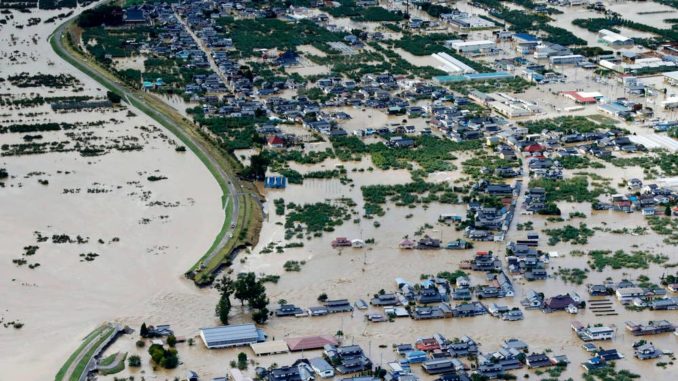
2,667 Radioactive Bags From Fukushima Swept Away By Typhoon Hagibis https://newspunch.com/1667-radioactive-bags-fukushima-swept-away-typhoon-hagibis/, October 14, 2019 Baxter Dmitry As Typhoon Hagibis hammered Japan on Saturday, thousands of bags containing radioactive waste at Fukushima were reportedly carried into a local stream by floodwaters.Experts warn the radioactive bags could have a devastating environmental impact across the entire Pacific region, reports Taiwan News.
According to Asahi Shimbun, a temporary storage facility containing 2,667 bags storing radioactive contaminants from the 2011 Fukushima nuclear disaster were “unexpectedly inundated by floodwaters brought by Typhoon Hagibis.“
Torrential rain flooded the storage facility and released the bags into a waterway 100 meters from the site.
Officials from Tamara City in Fukushima Prefecture said that each bag is approximately one cubic meter in size.
Authorities were only able to recover six of the bags by 9 p.m. on Oct. 12 and it is uncertain how many remain unrecovered while the potential environmental fallout is being assessed.
The radioactive waste swept away by Typhoon Hagibis represents the latest setback for Fukushima officials who have struggled to adequately quarantine the radiation.
StatesmanJournal reports: Seaborne radiation from Japan’s Fukushima nuclear disaster has been detected on the West Coast of the United States.
Cesium-134, the so-called fingerprint of Fukushima, was measured in seawater samples taken from Tillamook Bay and Gold Beach in Oregon, researchers from the Woods Hole Oceanographic Institution are reporting.
Because of its short half-life, cesium-134 can only have come from Fukushima.
Also for the first time, cesium-134 has been detected in a Canadian salmon, the Fukushima InFORM project, led by University of Victoria chemical oceanographer Jay Cullen, is reporting.
In both cases, levels are extremely low, the researchers said, and don’t pose a danger to humans or the environment.
Massive amounts of contaminated water were released from the crippled nuclear plant following a 9.0 magnitude earthquake and tsunami in March 2011. More radiation was released to the air, then fell to the sea.
Climate and nuclear threats join in Japan’s multibillion-dollar typhoon disaster.
|
………….As the core of the storm pulled away from Tokyo Sunday, it dumped heavy rains across Toshigi as well as Fukushima Prefecture. Floodwaters there have raised concerns about radioactive contamination following the 2011 Fukushima nuclear disaster.
Typhoon Hagibis will go down in Japanese history as a multibillion-dollar disaster. The storm’s widespread impacts and high death toll are unusual for Japan, since the country is one of the best-prepared in the world for natural disasters
Climate studies suggest that the Japanese Archipelago could see more frequent and stronger typhoons in the future, due in large part to warming seas as a result of human-caused global warming. There is evidence showing that tropical cyclones in the Northwest Pacific Ocean Basin are reaching their maximum intensities further north than they used to, a trend some scientists attribute in part to climate change. This could send more intense storms into areas that typically see weaker storms, such as Honshu and other parts of northern and northeastern Japan.
One trend that is especially clear is that damage costs from typhoons in Japan are escalating, with three of the top 10 most expensive Japanese typhoons since 1950 occurring in the past 2 years alone. Typhoon Faxai, which affected Tokyo in early September. Typhoon Hagibis is extremely likely to increase this number to four. https://www.theage.com.au/world/asia/why-typhoon-hagibis-packed-such-a-deadly-devastating-punch-in-japan-20191015-p530o7.html
|
|
|
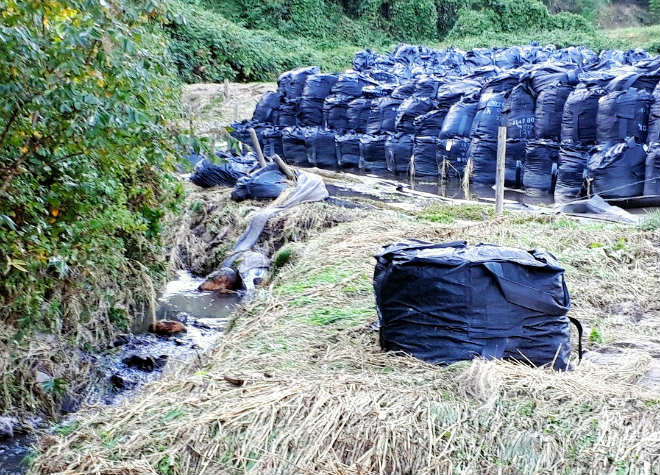
Bags of debris from Fukushima disaster swept away in typhoon
|
Bags of debris from Fukushima disaster swept away in typhoon http://www.asahi.com/ajw/articles/AJ201910140036.htmlBy TARO KOTEGAWA/ Staff Writer, October 14, 2019 Flexible bulk bags containing waste produced from decontamination work around the Fukushima No. 1 nuclear power plant were swept away in flooding during Typhoon No. 19 in Tamura, Fukushima Prefecture. (Hideyuki Miura) TAMURA, Fukushima Prefecture–Bulk bags filled with greenery collected during decontamination efforts after the nuclear disaster at the Fukushima No. 1 nuclear power plant were swept into a river during Typhoon No. 19 on Oct. 12. According to the Tamura city government, the bags were among 2,667 that have been stored temporarily at a site in the Miyakoji-machi district here. The facility was flooded after heavy rains brought by the typhoon, and the water carried an unknown number of the bags to a river about 100 meters away. A city government official received a phone call at around 9:20 p.m. on Oct. 12 from a nearby civil engineering firm, saying six of the bulk bags had been recovered from the river. Each of the bulk bags was 1 cubic meter in size. No sheets had been placed over the bags as a precaution against the rain and wind from the typhoon. A city official said consultations will be held with the Environment Ministry to determine possible effects on the environment. The decontamination effort involved removing debris, such as soil, leaves and plants, containing radioactive substances released after the 2011 triple meltdown at the Fukushima No. 1 plant. |
|
Ex-trade minister Hiroshige Seko involved in nuclear gifts scandal
 Gifts and donations link official in Kepco scandal to second nuclear plant and ex-trade minister Hiroshige Seko, Japan Times, 10 Oct 19, KYODO, JIJI OSAKA – A former senior Kansai Electric Power Co. official said Thursday he received gift coupons in the 1990s from a former deputy mayor of a town hosting one of the company’s nuclear power plants, though he was in charge of a plant outside the town.Eiji Moriyama, the late deputy mayor of Takahama in Fukui Prefecture, later hinted that a particular firm undertake regular inspection work at the utility’s Oi plant in the same prefecture, the former official said. The latest revelation suggests Moriyama was trying to involve himself in the operations of a nuclear plant in addition to the one at Takahama. Kepco has already admitted that 20 of its executives and officials received a total of ¥318.45 million worth of gifts from Moriyama……. Kepco Chairman Makoto Yagi and four other executives stepped down Wednesday amid growing criticism over the shady ties between the nuclear industry and local government officials. Also on Wednesday, former trade minister Hiroshige Seko’s office said his fund management body had received political donations from a company head linked to Moriyama. Seko’s political fund management body received ¥6 million from the head of Yanagida Sangyo, a maintenance service company based in Takasago, Hyogo Prefecture, according to the office. Moriyama served as an adviser to Yanagida Sangyo. The body accepted ¥1.5 million, the maximum amount for a personal donation, every year between 2012 and 2015 from the company head, the office said. Seko’s office said that the donations from the company head were handled appropriately as the money was reported in his political funding reports. Seko now serves as secretary-general for the ruling Liberal Democratic Party in the House of Councilors. Speaking to reporters, Seko said the contributions were “strictly” personal donations. “I’ve never received business requests (from the company head),” he said, adding that he will not return the money. He said he did not know Moriyama.https://www.japantimes.co.jp/news/2019/10/10/national/ex-takahama-deputy-mayor-also-gave-gift-coupons-kepco-official-nearby-oi-nuclear-plant/#.XaORu0YzbIU |
|
|
A million tonnes of radioactive water and nowhere to go – Fukushima
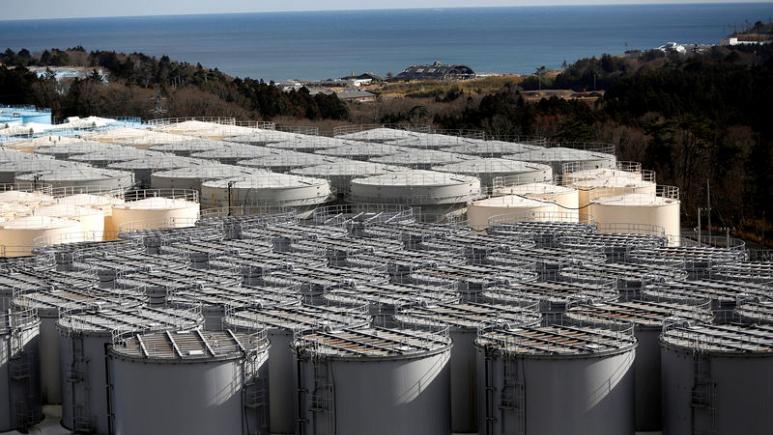
What to do with the enormous amount of water, which grows by around 150 tonnes a day, is a thorny question, with controversy surrounding a long-standing proposal to discharge it into the sea, after extensive decontamination.
The water comes from several different sources: Some is used for cooling at the plant, which suffered a meltdown after it was hit by a tsunami triggered by a massive earthquake in March 2011.
Groundwater that seeps into the plant daily, along with rainwater, add to the problem.
A thousand, towering tanks have now replaced many of the cherry trees that once dotted the plant’s ground.
Each can hold 1,200 tonnes, and most of them are already full.
“We will build more on the site until the end of 2020, and we think all the tanks will be full by around the summer of 2022,” said Junichi Matsumoto, an official with the unit of plant operator TEPCO in charge of dismantling the site.
TEPCO has been struggling with the problem for years, taking various measures to limit the amount of groundwater entering the site.
There is also an extensive pumping and filtration system, that each day brings up tonnes of newly contaminated water and filters out as many of the radioactive elements as possible.
HIGHLY RADIOACTIVE
The hangar where the decontamination system runs is designated “Zone Y” – a danger zone requiring special protections.
All those entering must wear elaborate protection: a full body suit, three layers of socks, three layers of gloves, a double cap topped by a helmet, a vest with a pocket carrying a dosimeter, a full-face respirator mask and special shoes.
Most of the outfit has to burned after use.
“The machinery filters contain radionuclides, so you have to be very protected here, just like with the buildings where the reactors are,” explained TEPCO risk communicator Katsutoshi Oyama.
TEPCO has been filtering newly contaminated water for years, but much of it needs to go through the process again because early versions of the filtration process did not fully remove some dangerous radioactive elements, including strontium 90.
The current process is more effective, removing or reducing around 60 radionuclides to levels accepted by the International Atomic Energy Agency (IAEA) for water being discharged.
But there is one that remains, which cannot be removed with the current technology: Tritium.
Tritium is naturally present in the environment, and has also been discharged in its artificial form into the environment by the nuclear industry around the world.
There is little evidence that it causes harm to humans except in very high concentrations and the IAEA argues that properly filtered Fukushima water could be diluted with seawater and then safely released into the ocean without causing environmental problems.
“ABSOLUTELY AGAINST IT”
But those assurances are of little comfort to many in the region, particularly Fukushima’s fishing industry which, like local farmers, has suffered from the outside perception that food from the region is unsafe.
Kyoichi Kamiyama, director of the radioactivity research department at the regional government’s Fisheries and Marine Science Research Centre, points out that local fishermen are still struggling eight years after the disaster.
“Discharging into the ocean? I’m absolutely against it,” he told AFP.
At the national government level, the view is more sanguine.
“We want to study how to minimise the damage (from a potential discharge) to the region’s reputation and Fukushima products,” an Industry Ministry official said.
The government is sensitive to fears that people inside Japan and further afield will view any discharge as sending radioactive waste into the sea.
No decisions are likely in the near-term, with the country sensitive to the international spotlight that will fall on Japan as it hosts the Olympic Games next year.
Environmentalists are also resolutely opposed to any discharge into the sea, and Greenpeace argues that TEPCO cannot trusted to properly decontaminate the water.
The solution, said Greenpeace senior nuclear specialist Shaun Burnie, “ultimately can only be long-term storage and processing.”
North Korea threatens to resume nuclear, long-range missile tests
 North Korea threatens to resume nuclear, long-range missile tests
Pyongyang’s warning follows the weekend breakdown of North Korea-US nuclear talks in Sweden. Aljazeera, 10 Oct 2019 North Korea has called outside condemnation of its weapons launches a “grave provocation” and has threatened to resume nuclear and long-range missile tests.
The warning on Thursday by Pyongyang’s foreign ministry followed the weekend breakdown of North Korea-United States nuclear negotiations in Sweden, the first such talks between the two countries in more than seven months.
North Korea said the talks collapsed because the US didn’t have any new proposals, and whether it maintains its moratorium on major weapons tests was up to Washington………
US-led diplomacy aimed at stripping North Korea of its nuclear programme had been stalemated since the second summit between President Donald Trump and North Korean leader Kim Jong Un in Vietnam in February ended without any agreement.
That summit fell apart after Trump rejected Kim’s demands for major sanctions relief in return for limited steps towards denuclearisation. https://www.aljazeera.com/news/2019/10/north-korea-threatens-resume-nuclear-long-range-missile-tests-191010091337349.html
Continued strong public opposition to nuclear power in India
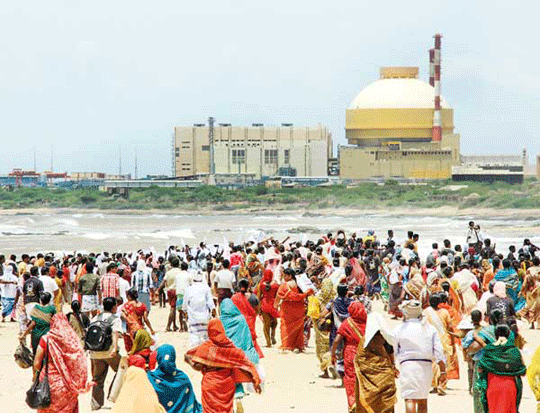
Now, an in-principle approval given by the Indian government to initiate exploratory mining for more uranium across the two southern provinces of Andhra Pradesh and Telangana has locals up in arms.
The location also includes a nature reserve not only rich in flora and fauna, but also with a large tiger population. The technical go-ahead was given a few months back for Uranium Corporation of India Limited (UCIL) to begin exploration for uranium, but an earlier protest led to a temporary pause in the process.
Andhra Pradesh is the largest producer of uranium in India. Tummalapalle village, located in the Kadapa district of Andhra Pradesh, is considered to have one of the largest uranium reserves in the world.
Next to the mine there is a processing plant that converts the uranium ore into sodium diuranate for use in nuclear power plants. Over the years, local farmers and environmentalists have alleged that it had led to the contamination of soil and groundwater, in addition to the destruction of water bodies.
A rethink by the government to go ahead with the fresh exploration has once again raised the hackles of environmentalists in India, who argue that whatever the procedure used to extract uranium, the wholesale mining for uranium would produce large amounts of radioactive waste that would pollute a major river nearby (as well as the surrounding areas).
They claim even if the waste is treated before disposal, uranium mining can still lead to the contamination of water and soil, eventually harming the flora and fauna of the region.
Officials of the Atomic Minerals Directorate tried to take samples after drilling a bore well for exploration and research, but were prevented by villagers, according to the News Minute.
The villagers have also been joined by opposition parties in the protests.
India’s nuclear plants are controlled by Nuclear Power Corporation of India (NPCIL), a state-owned corporation. India currently has seven nuclear power plants, but there are plans to add more.
But toward that goal, the government faces an uphill task………. https://oilprice.com/Alternative-Energy/Nuclear-Power/The-Biggest-Hurdle-In-Indias-Nuclear-Energy-Push.html
Appeal against acquittal of Tepco executives over Fukushima nuclear disaster
Plaintiffs have appealed a ruling handed down by the Tokyo District Court in mid-September that found three former Tokyo Electric Power Co. executives not guilty of professional negligence. A class action lawsuit against the executives claimed they had failed to apply the proper safety measures to prevent the 2011 disaster at the Fukushima No. 1 nuclear power plant, despite being aware of the devastating effect tsunami would have.
Ruiko Muto, the 66-year-old leader of the class action lawsuit against former Tepco executives, has tirelessly conducted talks around the country since the nuclear disaster in 2011, which saw three of the six core reactors of the Fukushima No. 1 power plant go into meltdown after massive tsunami struck the facility.
“Grassroots efforts are what pushes forward the social change we need to see,” she said, adding, “awareness spreads only when each individual starts to think about the issue at hand.”
Muto has campaigned for the end of nuclear power for over 30 years. Seeing the devastating effects of the 1986 Chernobyl nuclear accident in the former Soviet Union catapulted her into the anti-nuclear movement…..
The disaster upended daily life as local residents knew it and tore apart the social fabric of societies and communities around the area. Eight and a half years on, the victims are still grappling with the loss of their homes, and are turning to the courts for answers and closure….https://www.japantimes.co.jp/news/2019/10/11/national/tepco-acquittal-fukushima-nuclear-disaster-closure/#.XaDi30YzbIU
A-bomb survivor Toshiki Fujimori urges nuclear haves and have-nots to join hands on abolition
Fujimori, 75, assistant secretary-general at the Japan Confederation of A- and H-Bomb Sufferers Organizations (Nihon Hidankyo), urged both sides to join forces to bring about a peaceful world.
Fujimori was exposed to radiation from the atomic bomb dropped on Hiroshima on Aug. 6, 1945, while his mother was carrying him on her back to a hospital. After the bombing, six of his 12 family members died, Fujimori said.
Three days after, the second U.S. atomic bomb devastated Nagasaki.
NEW YORK – Hibakusha Toshiki Fujimori called for nuclear states and non-nuclear states to cooperate on abolishing atomic weapons as a meeting on the subject was held at U.N. headquarters in New York on Thursday.
Fujimori, 75, assistant secretary-general at the Japan Confederation of A- and H-Bomb Sufferers Organizations (Nihon Hidankyo), urged both sides to join forces to bring about a peaceful world.
Fujimori was exposed to radiation from the atomic bomb dropped on Hiroshima on Aug. 6, 1945, while his mother was carrying him on her back to a hospital. After the bombing, six of his 12 family members died, Fujimori said.
Three days after, the second U.S. atomic bomb devastated Nagasaki.
Nuclear industry in Japan – as corrupt as ever?
Hidden gold, ‘murky’ payoffs threaten Japan nuclear revival, Straits Times, TOKYO (BLOOMBERG) 9 Oct 19, – A payoff scandal has struck Japan’s nuclear world, threatening to delay the restart of idled reactors in what’s becoming the industry’s biggest crisis since the Fukushima meltdown of 2011.The issue, which emerged at the end of last month, centres around how an influential municipal official in a town that hosts a nuclear plant spent years doling out large gifts to executives of its operator, one of the country’s biggest power producers.
It’s an example of how big business and small towns work together, sometimes at the expense of corporate governance.
The payments to senior management at Kansai Electric Power Co included hundreds of millions of yen, US currency, vouchers for tailored suits and even gold coins hidden in a box of candy.
To make matters worse, the official in question was close to – and received money from – a company that won construction work from the utility.
The news is a blow to an already deeply unpopular industry as it seeks to resume operations at plants that were shuttered after Fukushima. It’s likely to have an impact beyond Kansai Electric, with the government’s top spokesman, who called the payoffs “murky,” vowing to investigate whether there are similar cases at other companies.
It’s also a headache for Prime Minister Shinzo Abe, who has set his stall as a proponent of nuclear power, a cheaper source of energy than imported fuels such as oil, coal and natural gas. And questions in Parliament about the scandal may delay Mr Abe’s efforts to pass a US trade deal and proceed towards changing the country’s pacifist Constitution.
…….The scandal is the latest exposure of governance issues at Japanese companies, which include the arrest last year of Nissan Motor Co’s chairman for concealing more than US$140 million (S$193 million) in compensation and Kobe Steel’s indictment in 2018 for falsifying quality data.
Kansai Electric chairman Makoto Yagi and president Shigeki Iwane bowed in apology at a three-hour public briefing last week as they detailed how they and 18 other executives received almost 320 million yen (S$4.12 million) in cash and presents from 2006 to 2018 from Mr Eiji Moriyama, the former deputy mayor of Takahama town, where a nuclear power plant is located. Mr Moriyama died at the age of 90 in March……..
The immediate risk for Kansai Electric is that the issue may delay the restart of three of its reactors, including two in the town in question, Takahama. Every month a reactor stays offline saddles the utility with extra fuel costs of 3.6 billion yen ……….
Kansai Electric’s investigation will leave no stone unturned to determine the cause and events surrounding the payments, the company said in an e-mailed response. The utility will also make efforts to ensure that this type of incident doesn’t happen again, it said.
In a sense, the goings-on at Kansai Electric suggest things haven’t changed in the nuclear industry. They mirror what independent investigators said in a 2012 report led to the scale of the Fukushima meltdown: collusion between government officials and a power company.
“This is the nuclear village at its worst,” Temple University’s Mr Kingston said, referring to the nexus of companies, politicians, bureaucrats and others that promote atomic power. “The cosy and collusive ties are a hotbed of corruption and raise questions about other plants.” https://www.straitstimes.com/asia/east-asia/hidden-gold-murky-payoffs-threaten-japan-nuclear-revival
1 This Month



19 November – Webinar – The Reality of Reprocessing
Time: 11:00 AM Pacific Time (US & Canada) / 2:00 PM Eastern / 7:00 PM UK / 8:00 PM CET
Register for the Zoom Event Here



Shut down the radiation-damaged Heysham nuclear reactors now
To see nuclear-related stories in greater depth and intensity – go to https://nuclearinformation.wordpress.com

Say No to NASA’s Reckless Nuclear Reactor on the Moon
Say No to NASA’s Reckless Nuclear Reactor on the Moon
-
Archives
- November 2026 (32)
- October 2026 (302)
- September 2026 (339)
- August 2026 (330)
- July 2026 (355)
- June 2026 (287)
- May 2026 (306)
- April 2026 (356)
- March 2026 (251)
- February 2026 (267)
- January 2026 (308)
- December 2025 (358)
-
Categories
- 1
- 1 NUCLEAR ISSUES
- business and costs
- climate change
- culture and arts
- ENERGY
- environment
- health
- history
- indigenous issues
- Legal
- marketing of nuclear
- media
- opposition to nuclear
- PERSONAL STORIES
- politics
- politics international
- Religion and ethics
- safety
- secrets,lies and civil liberties
- spinbuster
- technology
- Uranium
- wastes
- weapons and war
- Women
- 2 WORLD
- ACTION
- AFRICA
- Atrocities
- AUSTRALIA
- Christina's notes
- Christina's themes
- culture and arts
- Events
- Fuk 2022
- Fuk 2023
- Fukushima 2017
- Fukushima 2018
- fukushima 2019
- Fukushima 2020
- Fukushima 2021
- general
- global warming
- Humour (God we need it)
- Nuclear
- RARE EARTHS
- Reference
- resources – print
- Resources -audiovicual
- Weekly Newsletter
- World
- World Nuclear
- YouTube
-
RSS
Entries RSS
Comments RSS

