China plans giant underground lab to research nuclear waste, By Julie Zaugg and Nanlin Fang, CNN, September 6, 2019 China is building a laboratory up to 560 meters (1,837 feet) underground in the middle of the Gobi desert to carry out tests on nuclear waste, officials have confirmed.
The facility, in remote Beishan, Gansu province, will be used by scientists and engineers to test the suitability of the area for the long-term storage of the highly radioactive waste generated by nuclear power plants. Construction begins next year and will finish by 2024. ……..
The site was selected in Gansu because it presents ideal conditions to prevent leaks: there is no seismic activity nearby and the bedrock the lab will be housed in is made of granite, which reduces the risk of groundwater seepage or fractures, according to a paper published in The Journal of Rock Mechanics and Geotechnical Engineering last year.
Construction begins next year, with the facility expected to be completed by 2024. Research will be carried out until 2040 — and if the results are positive, a long-term storage facility will be built.
Underground disposal is considered to be the best solution for nuclear waste, as radioactive material takes thousands of years to decay, according to the World Nuclear Association (WNA). The spent fuel should be packaged in sealed copper canisters and placed in underground tunnels or caverns, surrounded by cement or bentonite clay to provide another barrier…….
Nuclear waste is currently stored in cooling pools at reactor sites, but these are not foolproof, says Greenpeace. “They lack secondary containment and are vulnerable to loss of cooling, and in many cases lack independent back-up power,” the environmental organization said in a January report.
The International Atomic Energy Agency estimates that 250,000 tons of spent fuel is in storage worldwide.
The only underground storage facility currently in operation is based in New Mexico, US, but it is used exclusively for defense-related waste. Finland has identified a site, on an island 143 miles northwest of Helsinki. Other sites have been discussed in Nevada, Sweden and France but face strong local opposition, according to the WNA.
Tokyo Electric Power Co.’s Fukushima No. 2 nuclear power plant
September 2, 2019
Japan’s nuclear policy-setting body adopted a report Monday saying the country is entering an era of massive nuclear plant decommissioning, urging plant operators to plan ahead to lower safety risks and costs requiring decades and billions of dollars.
Twenty-four commercial reactors–or 40 percent of Japan’s total–are designated for or are being decommissioned. Among them are four reactors at the Fukushima No. 1 nuclear power plant that were severely damaged by the massive 2011 earthquake and tsunami that struck northeastern Japan.
The annual nuclear white paper, adopted by the Japan Atomic Energy Commission, urges utilities to learn from U.S. and European examples, especially those of Germany, France and Britain. Japan hasn’t yet completed the decommissioning of any reactors and doesn’t have concrete plans for the final disposal of radioactive waste.
“Taking into consideration further increase of nuclear facilities that will be decommissioned, new technology and systems need to be developed in order to carry out the tasks efficiently and smoothly,” the report said. “It’s a whole new stage that we have to proceed to and tackle.”
Japanese utilities have opted to scrap aged reactors instead of investing in safety requirements under post-Fukushima standards. The decommissioning of a typical reactor costs nearly 60 billion yen ($560 million) and takes several decades.
Before the Fukushima disaster, Japan had 60 commercial reactors that provided about 25 percent of the country’s energy needs.
Despite the government’s renewed ambitions for nuclear power, reactor restarts are proceeding slowly as nuclear regulators spend more time on inspections. Meanwhile, anti-nuclear sentiment persists among the public and makes it more difficult for plant operators to obtain local consent in making revisions to their facilities. Any plan related to nuclear waste storage tends to get strong resistance.
Since the Fukushima accident, only nine reactors in Japan have restarted, accounting for about 3 percent of the country’s energy supply, compared to the government’s ambitious 20-22 percent target.
In July, Tokyo Electric Power Holdings Co., or TEPCO, announced plans to decommission all four reactors at its second Fukushima plant, Fukushima No. 2, which narrowly avoided meltdowns in 2011. The move followed eight years of demands by the local government and residents for the reactors’ closure.
TEPCO said the decommissioning of Fukushima No. 2 alone would cost 410 billion yen and would take four decades, but experts have raised concerns about whether those estimates are realistic for a company already struggling with the ongoing cleanup of the wrecked Fukushima plant, estimated to cost about 8 trillion yen.
Japan Atomic Power Co., which has been decommissioning its Tokai nuclear plant since 2001, announced in March that it was pushing back the planned completion of the project by five years, to 2030, because the company still has been unable to remove and store highly radioactive materials from the core. The decommissioning of the government’s Tokai fuel reprocessing facility is expected to take 70 years and cost 770 billion yen.
The white paper stated that Japan is pursuing its divisive spent-fuel reprocessing ambitions and a plan to develop a fast-breeder reactor despite international concerns over the country’s plutonium stockpile of 47 tons, though the commission calls for more efforts in reducing the stockpile and increasing transparency.
France’s recently reported move to abandon ASTRID, its next-generation fast reactor that would theoretically produce more plutonium while burning it as fuel, could be a setback for Japan, which was hoping to jointly develop the technology.
some analysts and many members of the public remain sceptical about whether it is really safe.
China earmarks site to store nuclear waste deep underground
Researchers will conduct tests at the location in Gansu to see whether it will make a viable facility to store highly radioactive waste safely Scientists say China has the chance to become a world leader in this field but has to find a way to ensure it does not leak, SCMP, Echo Xie September 06, 2019 China has chosen a site for an underground laboratory to research the disposal of highly radioactive waste, the country’s nuclear safety watchdog said on Wednesday.
Officials said work would soon begin on building the Beishan Underground Research Laboratory 400 metres (1,312 feet) underground in the northwestern province of Gansu.
Liu Hua, head of the National Nuclear Safety Administration, said work would be carried out to determine whether it was possible to build a repository for high-level nuclear waste deep underground. …….. [China] needs to find a safe and reliable way of dealing with its growing stockpiles of nuclear waste. …..
Some Chinese scientists said the country had the chance to lead the world in this area of research but others have expressed concerns about safety. ……
Despite broad scientific support for underground disposal, some analysts and many members of the public remain sceptical about whether it is really safe.
Lei Yian, an associate professor at Peking University’s school of physics, said there was no absolute guarantee that the repositories would be safe when they came into operation…….
China is also building more facilities to dispose of low and intermediate-level waste. Officials said new plants were being built in Zhejiang, Fujian and Shandong, three coastal provinces that lack disposal facilities.
Vietnamese trainees sue Fukushima firm over decontamination work, September 5, 2019 (Mainichi Japan, TOKYO (Kyodo) — Three Vietnamese men on a foreign trainee program in Japan have sued a construction company for making them conduct radioactive decontamination work related to the March 2011 nuclear disaster in Fukushima Prefecture without prior explanation, supporters of the plaintiffs said Wednesday.
The lawsuit, dated Tuesday and filed with a branch of the Fukushima District Court, demanded that Hiwada Co., based in Koriyama in the northeastern Japan prefecture, pay a total of about 12.3 million yen in damages, according to the supporters.
The case is the latest in a string of inappropriate practices under the Japanese government’s Technical Intern Training Program which has been often criticized as a cover for cheap labor.
According to Zentouitsu Workers Union, a Tokyo-based labor union that supports foreign trainees, Hiwada made the plaintiffs conduct decontamination work in the cities of Koriyama and Motomiya in Fukushima Prefecture between 2016 and 2018……. https://mainichi.jp/english/articles/20190905/p2g/00m/0na/014000c
Diplomats from 22 countries and regions attended a briefing at the Foreign Ministry, where Japanese officials stressed the importance of combating rumors about safety at the plant, which was decimated by a 2011 earthquake and tsunami, while pledging transparency.
The plant’s operator, Tokyo Electric Power Co., or TEPCO, said last month that it would run out of storage space for the water in 2022, prompting South Korea to raise safety questions amid tensions with Japan that have intensified over trade and history. South Korea was among those represented at Wednesday’s briefing.
Water must be continuously pumped into the four melted reactors at the plant so the fuel inside can be kept cool, and radioactive water has leaked from the reactors and mixed with groundwater and rainwater since the disaster.
The plant has accumulated more than 1 million tons of water in nearly 1,000 tanks. The water has been treated but still contains some radioactive elements. One, tritium — a relative of radiation-emitting hydrogen — cannot be separated.
Tritium is not unique to Fukushima’s melted reactors and is not harmful in low doses, and water containing it is routinely released from nuclear power plants around the world, including in South Korea, officials say.
The water has been a source of concern, sparking rumors about safety, especially as Japan tries to get countries to lift restrictions on food imports from the Fukushima area ahead of the 2020 Tokyo Olympics. Import restrictions are still in place in 22 countries and regions, including South Korea and China.
“In order to prevent harmful rumors about the Fukushima Dai-ichi plant from being circulated, we believe it is extremely important to provide scientific and accurate information,” Yumiko Hata, a Ministry of Economy, Trade and Industry official in charge of the Fukushima accident response, said at the briefing. “We appreciate your understanding of the situation and continuing support for the decommissioning work at the Fukushima Dai-ichi plant.”
Officials said there were no complaints from the diplomats Wednesday about Japan’s handling of the water.
More than eight years after the accident, Japan has yet to decide what to do with the radioactive water. A government-commissioned panel has picked five options, including the controlled release of the water into the Pacific Ocean.
As disputes between Japan and neighboring South Korea escalated over export controls and colonial-era labor used by Japanese companies, Seoul last month announced plans to step up radiation tests of Japanese food products, and asked about the contaminated water and the possibility of its release into the sea.
Experts say the tanks pose flooding and radiation risks and hamper decontamination efforts at the plant. Nuclear scientists, including members the International Atomic Energy Agency and Japanese Nuclear Regulation Authority, have recommended the water’s controlled release into the sea as the only realistic option scientifically and financially. Local residents oppose this, saying the release would trigger rumors of contamination, which would spell doom for Fukushima’s fishing and agriculture industries.
The panel recently added a sixth option of long-term storage.
Japan’s Tepco weighs retiring some reactors at massive plant
Dismantling one or more units geared to easing local opposition to resuming operations
When fully operational, Tepco’s Kashiwazaki-Kariwa facility is the largest nuclear power plant in the world.
August 24, 2019
TOKYO — Tokyo Electric Power Co. Holdings is considering decommissioning one or more of the seven reactors at a key nuclear power plant in northern Japan, Nikkei has learned, as it attempts to ease community pushback against restarting it.
Tepco will not aim to reactivate all of the No. 1 through No. 5 reactors at Kashiwazaki-Kariwa in Niigata Prefecture — meltdown-hit Fukushima Prefecture’s western neighbor. It will instead pick at least one of them to dismantle after restarting the No. 6 and No. 7 reactors, as approved by the central government. Tepco President Tomoaki Kobayakawa is expected to convey that intent to Masahiro Sakurai, mayor of the city of Kashiwazaki, in meetings on Monday.
The plant — the world’s largest when fully operational — is undergoing separate checks led by the prefectural government, leaving the time frame for a restart unclear.
The utility hopes that offering a plan for decommissioning down the road, as Sakurai has demanded, will help win over locals for its efforts to restart the two greenlit reactors, an important step in improving its financial health.
Tepco decided in late July to retire all its remaining reactors in Fukushima Prefecture on top of the ongoing decommissioning of disaster-stricken Fukushima Daiichi, the site of the 2011 meltdown resulting from a massive earthquake and tsunami. Coming on the heels of July’s move, the utility judged that issues of manpower and finance would preclude immediately moving to dismantle parts of Kashiwazaki-Kariwa.
In June 2017, Sakurai asked that Tepco present a plan for dismantling at least one of reactors No. 1 through No. 5 within two years as a condition for restarting No. 6 and No. 7. Tepco has missed that deadline. Restarting the two reactors, which passed central-government safety inspections in December 2017, would likely create an easier environment for tackling the problem.
Tepco aims to shoulder the costs of decommissioning Fukushima Daiichi and paying out compensation. An outflow of customers on its capital-area home turf has left it in worsening financial straits. It hopes for relief from Kashiwazaki-Kariwa, where each reactor it restarts is expected to provide a roughly 100 billion yen ($939 million) shot in the arm per year.
India–Pakistan nuclear escalation: where could it lead? India says its ‘no first use’ nuclear policy could change. Nature examines what that means for the country’s fraught relationship with Pakistan. Nature Priyanka Pulla 29 Aug 19, Nuclear tensions are escalating between south Asia’s two superpowers — India and Pakistan — following the Indian defence minister’s announcement earlier this month that India may revoke its current commitment to only use nuclear weapons in retaliation for a nuclear attack, known as ‘no first use’.
Some experts watching the situation have told Naturethat the risk of a conflict between the two countries has never been greater since they both tested nuclear weapons in 1998………
What is no first use and who else has adopted it?
Of the world’s eight declared nuclear-weapons states, only China and India have an unambiguous no first use nuclear weapons policy. This is a commitment only to use nuclear weapons in response to a nuclear attack and never in retaliation for one using conventional weapons. Such a policy also includes comprehensive protocols in which activating nuclear weapons would only ever be a last resort.
India tested its first nuclear weapon in 1974 and the government committed to no first use in 2003, five years after conducting a second set of nuclear-weapons tests on 11 and 13 May 1998. The intention in declaring no first use was partly to help defuse tensions with its neighbour, which had responded to India’s second test with its own nuclear tests the same month.
Over the past two decades, Pakistan has amassed 150–160 nuclear missiles, to India’s 130–140, according to the Stockholm International Peace Research Institute. Both countries, moreover, have advanced nuclear weapons, as well as ballistics research and development programmes.
Why doesn’t Pakistan have a no first use policy?
According to Feroz Hassan Khan, who teaches security studies at the Naval Postgraduate School in Monterey, California, if Pakistan were to adopt the same policy, that would negate its reason for developing nuclear weapons in the first place……..https://www.nature.com/articles/d41586-019-02578-5
Fukushima tragedy: The day of black snow https://www.greenpeace.org/international/story/23925/fukushima-tragedy-the-day-of-black-snow/ by Sean Lee 30 August 2019 Toru Anzai is a former resident of Iitate, a small village in Fukushima, Japan, and dearly missed the bamboo shoots that grew in his hometown. During autumn, the bamboo shoots would blanket the mountains that overlooked the residents’ homes in the village. The residents would climb the mountains, gather the plants, and prepare them for dinner. But ever since that tragic day, no one climbed the mountains, and the wild plants vanished from their dinner tables. For Anzai, the bamboo shoots became sad reminders of what used to be.
Anzai remembers the day as the “black snow” day. He heard the explosions on 12 March, 2011. Black smoke rose from the Fukushima nuclear power plant, and the smell of burning iron pervaded the village. It started to rain. The rain turned into snow. The snow was black.
The black snow filled Anzai with an ominous dread, and soon, his fears became reality.
After the black snow shrouded the village, Anzai described in an interview how he started to feel throbbing pain on his skin. It was almost like being sunburned after sunbathing for too long. Both of his legs darkened then peeled in white patches. The only remedy to the peeling was applying medicinal ointment.
Soon after, his entire body began to suffer. The headaches came, followed by shoulder pains. Then the hair loss occurred. Three months after the disaster, he left behind his home and evacuated to survive. Unfortunately, the tragedy did not end there.
Three years later, Anzai started having strokes and heart attacks. A stent was placed in his blood vessel; the tube held open his narrowed blood vessel and kept the blood flowing to his heart. With treatment, his pain somewhat subsided, but whenever Anzai visited Iitate, the pain throughout his entire body relapsed. While these symptoms have not been conclusively connected to the radiation exposure, Anzai believed that they were the realities of the black snow day.
Anzai’s temporary housing was very narrow and consisted of a living room and a bedroom. He had moved into this subsidised housing complex eight years ago. He was one of the first of the 126 families. Often, evacuees gathered around the common area and shared fond memories of their hometowns with each other. Whatever solace could be found, the evacuees found it in each other.
Since allegedly completing the decontamination operation in Iitate, the Japanese government have been urging people to return to their village. In fact, Fukushima prefectural government had ended housing subsidies this past March, and by the end of the month, most people had left the complex. Only around ten families were still looking for a new place to live.
Absently gazing into the dark, clouded sky, Anzai spoke bitterly. “I was kicked out of my hometown for doing nothing wrong. It was heartbreaking. Now, Iitate is polluted, and some of my neighbours have died. When the government asked me to evacuate last minute, I left. Now, they want me to go back. Back to all of the radioactive contamination. I’m so angry, but I don’t know what to do. We have repeatedly petitioned the government, but they’re not willing to listen. Our government has abandoned us.”
Prior to the nuclear incident, there were about 6,300 residents in Iitate. Eight years later, only a little over 300 evacuees have returned at the government’s persistent urging. Most of the returning residents were elderly, aged 60 or older. Even counting the non-natives who had recently relocated to the village, the total figure hovered around only 900 residents.
Iitate’s old and new residents are exposed to radioactive substances on a daily basis. The Japanese government claimed to have completed the decontamination work, but a full decontamination is impossible due to the village’s terrain. More than 70% of Iitate is forest, and unlike in the farmlands, the removal of contaminants that have fallen among the mountainous forest is nearly impossible.
Each year, Greenpeace Germany conducts extensive research on Fukushima villages including Iitate. The findings confirm that the radiation exposure in these villages exceeds the established international safety standards. Anzai believes that the Japanese government is behind the forced homecoming of the Iitate residents.
“The government hopes to publicise good news: the nuclear accident has been dealt with, and the residents have returned home. People who had no choice but to leave are now being pressured to return and put their lives on the line,” lamented Anzai.
The Japanese government hopes to release more than one million tonnes of highly radioactive water into the Fukushima coast. If the contaminated water becomes flushed into the ocean, the contamination will only add to the harm already inflicted by the Fukushima accident. Furthermore, the ocean currents will shift the radioactive materials through the surrounding waters including the Pacific Ocean.
The industrial pollution and toxins have already caused much distress to our oceans. Discharging the Fukushima’s radioactive water will only worsen the situation, and we cannot, and should never, let this happen.
Plant operator Tepco says it may start decommissioning at least one reactor five years after restarting two others. Japan‘s Tokyo Electric Power Company (Tepco) said on Monday it may start to decommission at least one nuclear reactor at its Kashiwazaki-Kariwa power plant, the world’s biggest nuclear plant by capacity, within five years of restarting two of the reactors at the site.Tepco President Tomoaki Kobayakawa made the comments in a statement outlining its response to a request for plans on the station’s future by the government of the city of Kashiwazaki in Niigata prefecture, where the plant is located.
In 2017, Tepco received initial regulatory approval from the Japanese government to restart reactors 6 and 7 at Kashiwazaki-Kariwa, each with a capacity of 1,356 megawatts (MW). The plant site has seven reactors with a total capacity of 8,212MW, equal to 20 percent of Japan’s nuclear capacity.
The facility is Tepco’s last remaining nuclear plant after it announced plans to shut its Fukushima Daini station, near the Fukushima Daichi plant where a massive earthquake and tsunami caused the meltdown of three of the site’s reactors in 2011.
Kashiwazaki’s Mayor Masahiro Sakurai demanded in 2017 that Tepco submit plans to shut at least one of reactors 1 to 5 in return for approval of the restart of reactors 6 and 7, a city official told the Reuters news agency by phone on Monday. The Kashiwazaki mayor will take about a month to evaluate Tepco’s plan, the official said.
Tepco said on Friday that Kobayakawa would brief local officials on Monday about its answers to the city’s request.
Tepco may take steps to decommission more than one of reactors 1 to 5 within five years after the restart of reactors 6 and 7 if it is confident it can secure enough non-fossil fuel energy sources, according to the statement.
A Tepco official said on Monday the company is aiming to have renewable and nuclear power produce 44 percent of total output by 2030.
Tepco has been trying to convince local authorities near Kashiwazaki-Kariwa, who have sign-off rights on nuclear restarts, that it has overcome operational failings revealed at Fukushima.
Eight years ago, nearly 20,000 people died in an earthquake and tsunami that precipitated what became Japan’s worst nuclear disaster. At least 160,000 people were forced to leave their contaminated homes.
In April, Japan partially lifted an evacuation order in one of the two towns, Okuma, for the first time since the disaster, but many former residents are still reluctant to return.
The other town, Futaba, remains off-limits, as are several other towns nearby.
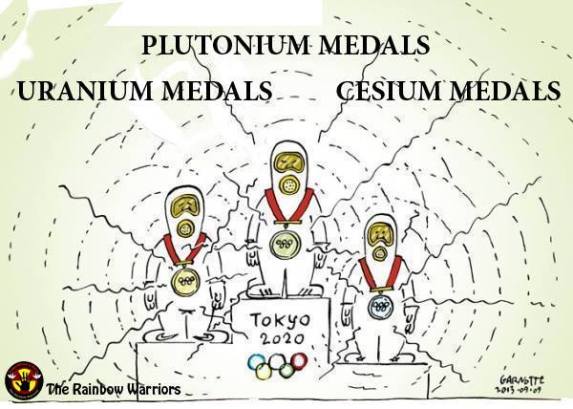
The danger of sourcing food and material from the Fukushima region Ground-level nuclear disasters leave much more radioactive fallout than Tokyo is willing to admit Hankyoreh By Seok Kwang-hoon, energy policy consultant of Green Korea Aug.25,2019 International concerns are growing over the Japanese government’s plans to provide meals from the Fukushima area to squads participating in the 2020 Tokyo Olympics. The starting point for the Olympic torch relay, and even the baseball stadium, were placed near the site of the Fukushima Nuclear Power Plant. It seems to be following the model of the Tokyo Olympics in 1964, where Japan’s rise from the ashes of the atomic bombs was underscored by having a young man born the day of the Hiroshima bombing act serve as the relay’s last runner. Here we can see the Shinzo Abe administration’s fixation on staging a strained Olympic reenactment of the stirring Hiroshima comeback – only this time from Fukushima.
But in terms of radiation damages, there is a world of difference between Hiroshima and Fukushima. Beyond the initial mass casualties and the aftereffects suffered by the survivors, the atomic bombing of Hiroshima resulted in little additional radiation exposure. Nuclear technology being as crude as it was back then, only around one kilogram of the Hiroshima bomb’s 64kg of highly enriched uranium actually underwent any reaction, resulting in a relatively small generation of nuclear fission material.
Whereas ground-based nuclear testing results in large quantities of radioactive fallout through combining with surface-level soil, the Hiroshima bomb exploded at an altitude of 580m, and the superheated nuclear fission material rose up toward the stratosphere to spread out around the planet, so that the amount of fallout over Japan was minimal. Even there, most of the nuclides had a short half-life (the amount of time it takes for half the total atoms in radioactive material to decay); manganese-56, which has a half-life of three hours, was the main cause of the additional radiation damages, which were concentrated during the day or so just after the bomb was dropped. The experience of Nagasaki was similar. As a result, both Hiroshima and Nagasaki were able to fully resume as functioning cities by the mid-1950s without additional decontamination efforts.
Ground-level nuclear disasters leave much more radioactive fallout than Tokyo is willing to admit
nternational concerns are growing over the Japanese government’s plans to provide meals from the Fukushima area to squads participating in the 2020 Tokyo Olympics. The starting point for the Olympic torch relay, and even the baseball stadium, were placed near the site of the Fukushima Nuclear Power Plant. It seems to be following the model of the Tokyo Olympics in 1964, where Japan’s rise from the ashes of the atomic bombs was underscored by having a young man born the day of the Hiroshima bombing act serve as the relay’s last runner. Here we can see the Shinzo Abe administration’s fixation on staging a strained Olympic reenactment of the stirring Hiroshima comeback – only this time from Fukushima.But in terms of radiation damages, there is a world of difference between Hiroshima and Fukushima.
Beyond the initial mass casualties and the aftereffects suffered by the survivors, the atomic bombing of Hiroshima resulted in little additional radiation exposure. Nuclear technology being as crude as it was back then, only around one kilogram of the Hiroshima bomb’s 64kg of highly enriched uranium actually underwent any reaction, resulting in a relatively small generation of nuclear fission material. Whereas ground-based nuclear testing results in large quantities of radioactive fallout through combining with surface-level soil, the Hiroshima bomb exploded at an altitude of 580m, and the superheated nuclear fission material rose up toward the stratosphere to spread out around the planet, so that the amount of fallout over Japan was minimal. Even there, most of the nuclides had a short half-life (the amount of time it takes for half the total atoms in radioactive material to decay); manganese-56, which has a half-life of three hours, was the main cause of the additional radiation damages, which were concentrated during the day or so just after the bomb was dropped. The experience of Nagasaki was similar. As a result, both Hiroshima and Nagasaki were able to fully resume as functioning cities by the mid-1950s without additional decontamination efforts…… http://www.hani.co.kr/arti/english_edition/e_editorial/907055.html
The danger of sourcing food and material from the Fukushima region Ground-level nuclear disasters leave much more radioactive fallout than Tokyo is willing to admit Hankyoreh By Seok Kwang-hoon, energy policy consultant of Green Korea Aug.25,2019 “…………..Fukushima’s radiation increases over time. The Fukushima disaster did not result in mass casualties, but the damages from radiation have only increased over time. The nuclear power plants experiencing core meltdowns had the equivalent of around 12 tons of highly enriched uranium in nuclear fuel – roughly 12,000 times more than the amount of uranium that underwent nuclear fission in the Hiroshima bomb. At one point, the Japanese government announced that Fukushima released 168 times more cesium than the Hiroshima bomb. But even that was merely a difference in emissions; there’s an immeasurable difference between the amount of fallout from Hiroshima, which was left over from a total spread out over the planet at a high altitude, and the amount from Fukushima, which was emitted at ground level.
Hiroshima also experienced little to no exposure to cesium-137 and strontium-90 – nuclides with half-lives of around 30 years that will continue to afflict Japan for decades to come. Due to accessibility issues, most of the forests that make up around 70% of Fukushima’s area have been left unaddressed. According to Japanese scholars, around 430 square kilometers of forest was contaminated with high concentrations of cesium-137. The danger of this forest cesium is that it will be carried toward residential or farm land by wind and rain, or that contaminated flora and fauna will be used in processing and distribution. Indeed, cedar wood from Fukushima remains in distribution in the region, and was even shipped off recently to serve as construction material for the Tokyo Olympics. Meanwhile, the incidence of thyroid cancer in children – a rare condition – has risen all the way from one to two cases before the incident to 217 in its wake. Yet the Abe administration has only impeded a study by physicians, using various government-controlled Fukushima-related investigation committees as vehicles for sophistry and controlling media reporting on the issue. http://www.hani.co.kr/arti/english_edition/e_editorial/907055.html
Abe administration hoping to cut costs in nuclear waste disposal The economic consequences have been astronomical as well. From an expert group’s analysis, the Japan Center for Economic Research estimated that the 14 million tons of radioactive waste from collecting Fukushima’s cesium-contaminated soil would result in a financial burden of 20 trillion yen (US$187.98 billion) based on the acceptance costs at the Rokkasho-mura radioactive waste disposal center. Contaminated water from the Fukushima Nuclear Power Plant – which already amounts to 1.2 million tons and is expected to increase to 2 million – was predicted to cost fully 51 trillion yen (US$479.35 billion) in tritium and strontium removal costs alone. Factor in the 10 trillion yen (around US$94 billion) in resident compensation, and the amount is close to the Japanese government’s total annual budget. Hoping to cut costs, the Abe administration announced plans to reuse soil waste in civil engineering, while the contaminated water is expected to be dumped into the Pacific after the formalities of a discussion. But few if any Japanese news outlets have been doing any investigative reporting on the issue.
When Abe declared the situation “under control” during the Olympic bidding campaign in 2013, this truthfully amounted to a gag order on the press and civil society. Having the world’s sole experience of filing and winning a World Trade Organization (WTO) case on Fukushima seafood, South Korea may be in the best position to alert the world to the issue of radioactivity and the Tokyo Olympics. I look forward to seeing efforts from the administration.By Seok Kwang-hoon, energy policy consultant of Green Korea
Assessing the possible safety issues in the second nuclear era, by Bob Yirka , Phys.org 25 Aug 19, A team of researchers with the Chinese Academy of Sciences has carried out an assessment of possible safety issues tied to the rise of the second nuclear era. In their paper published in Proceedings of the National Academy of Sciences, the group describes the factors that led to the rise of a second nuclear era and possible safety concerns that need to be addressed……
now, the researchers claim, a new nuclear era has begun—this time, driven by less-developed countries such as India and China, and to some degree, Russia. The researchers suggest this new, unexpected second nuclear era is fraught with great risk. They note that despite efforts by the parties involved in implementing nuclear power plants in the first era, major accidents occurred. They further note that recent history suggests that safely producing nuclear energy has still not been fully realized. In their paper, they outline some of the safety issues involved with the second nuclear era.
The researchers note that unlike most advanced countries, less-developed countries suffer from poor infrastructure and the means for safely maintaining a complex nuclear plant. They also note that the laws in some of the countries developing nuclear plants are less stringent, and that there is more corruption. They also note there is often less political stability. And there are differences in social values regarding risk and the need for safety practices. They also note that many such countries do not have well-established communications channels between those operating nuclear facilities and the public at large. The recent nuclear accident in Russia highlights why such communications are needed—to protect those in the path of radiation leaks.
South Korea concerned over food safety at Olympics with events slated for Fukushima
Talks to take place over food provision at Tokyo Games
Fukushima to host baseball and softball games next year, Guardian Justin McCurry in Tokyo, Thu 22 Aug 2019South Korea is considering making its own arrangements to feed its athletes at next year’s Tokyo Olympics, citing concerns over the safety of food from Fukushima, media reports said.
In addition, South Korean sports authorities have requested that international groups be permitted to monitor radiation levels during the 2020 Games.
Food safety concerns in South Korea have grown since Fukushima city was chosen to host six softball games and one baseball game next summer. Fukushima prefecture will also be the location for the start of the domestic leg of the Olympic torch relay, beginning next March.
Tokyo Olympics organisers said South Korea’s National Olympic Committee had sent a letter expressing concern at the possibility of produce grown in Fukushima prefecture being served to athletes in the Olympic village. ……
NORTH KOREA’s contentious nuclear programme has allegedly leaked tonnes of toxic waste into rivers used for drinking water.
By JOEL DAY, Aug 23, 2019 Disturbing satellite photos have emerged that appear to show the leakage of a uranium plant in the north of country that has contaminated a river with huge amounts of toxic waste. The river in question provides water for drinking and crops for an estimated 400,000 people and could lead to extremely debilitating illnesses such as cancer and birth defects. The potential radioactive leak was revealed by US blogger and North Korea analyst, Jacob Bogle, who has created the largest publicly accessible map of North Korea. By examining satellite images on the Pyongsan uranium site, Mr Bogle brought attention to the sudden deep black hue of the river.
He believes that the leakage has been covered up by the highly secretive insular state, and the true scale of disaster is only now unfolding.
Mr Bogle thinks that North Korea will struggle to keep the claimed leakage under wraps for any longer, as the river eventually leads into the Yellow Sea that North Korea shares with neighbouring South Korea and China.
If true, the scale of those affected could grow to nearly 600million people and end up being the world’s worst man-made disaster.
The photos shared by Mr Bogle appear to show a pipeline, built to carry toxic water from the facility to a nearby waste reservoir, digressing its intended route and leaking into the river instead.
Mr Bogle said: “I was able to review high-resolution historical satellite imagery for multiple years going back to 2003.
“Each of the images shows an ever-growing pile of leaked material on either end of the pipe that takes waste material from the plant to an unlined reservoir.
“Some of the images also show fluids being actively spilled directly into the river.
“The plant is one of two declared uranium milling facilities in the country. It takes low-quality coal and processes it to create yellowcake, which then contains around 80 per cent uranium.
“The extraction and milling requires multiple chemical processes and leaves behind a very toxic mix of waste materials.
“That toxic waste is then sent to the nearby reservoir, leaking and travelling into the Ryesong River in the process.”
The Pyongsan facility is the largest in North Korea, and is built next to its largest uranium mine, and has recently undergone a ramped-up level of production of nuclear fuel for electricity generating purposes.
Many have pointed out that the Conowingo Dam 16 miles downstream might be sufficient enough to trap and prevent any toxic waste from getting out – although experts told The Sun that the dam is “no longer capable of trapping sediment”.
[Herald Interview] Sports bodies need to make own assessments of Fukushima: Greenpeace nuclear specialist, http://www.koreaherald.com/view.php?ud=20190821000749By Kim Bo-gyung (lisakim425@heraldcorp.com) Nuclear specialist warns of unknown long-term health, environmental risks from Japan’s radioactive water disposal plan Aug 21, 2019 With less than a year to go until the Tokyo 2020 Summer Olympics, concerns are growing over the safety of the baseball and softball venues in disaster-hit Fukushima.
Seeking to break away from Japan’s association with high levels of radioactivity, the Abe government has branded the 2020 Olympics the “Recovery Games.”
But health and environmental risks from high levels of radiation persist in parts of Fukushima after the 2011 nuclear meltdown.
According to Shaun Burnie, a senior nuclear specialist with Greenpeace Germany, those visiting Fukushima for the Summer Games next year should take a proactive approach to educating themselves on which areas of Fukushima are affected by radiation and on the impact of exposure to radiation.
“In terms of safety, there are certain areas of Fukushima where we would certainly not advise athletes or spectators to spend any time. Those are areas particularly close to the Fukushima Dai-ichi plant, including where the torch processions will be taking place,” Burnie said in an interview with The Korea Herald at Greenpeace Korea’s office in central Seoul last week.
“They are areas that are not safe for people to live. If you visit, you need to follow a radiation protocol. It is a bizarre situation that you are having Olympic events where people are concerned about radiation,” he added.
While noting that not all parts of Fukushima should be off limits, Burnie said athletes and sports bodies need to seek independent assessments on Fukushima, rather than relying on information provided by the Japanese government.
“It’s dangerous to just dismiss the whole of Fukushima as a radioactive disaster zone. It’s much more complex than that. The first thing is … don’t trust the Japanese government, educate yourself. If you’re an organizing body, get independent verification and independent information about what the relative radiation levels are, what the risks are,” Burnie said.
As the senior nuclear specialist with Greenpeace Germany, Burnie has followed the Japanese government’s handling of the tsunami and earthquake in March 2011 that resulted in the meltdown of three nuclear reactors at the Fukushima Dai-ichi power plant.
In a report published in January, Burnie alleged that Tokyo plans to dispose of some 1 million metric tons of contaminated water by discharging it into the Pacific Ocean after the Summer Olympics.
If Japan follows through with the move, radioactive water is expected to be present in Korea’s East Sea a year later.
“For the past five years we’ve been accessing the process, the discussions, the documents submitted by Tepco (Tokyo Electric Power Company) … we were reviewing some of Tepco’s data (last year) and we looked at it and went ‘there is something wrong here with Tepco’s processing,’” Burnie said.
“It became very clear there has been bad decisions made, not really surprising, by Tepco, by the (Japanese) government over the last five or six years and how to manage the water crisis.”
Last year Tepco acknowledged its Advanced Liquid Processing System, or ALPS, had failed to purify contaminated water stored in tanks at the Dai-ichi power plant.
A committee under Japan’s Ministry of Economy in 2016 put together five scenarios for the Japanese government to deal with the massive volume of pollutants stored at the Fukushima No. 1 plant.
The amount of water stored at the plant is to reach its full capacity of 1.3 million tons by the end of 2020, with about 170 tons accumulating daily.
According to Burnie, Tokyo has chosen to discharge the radioactive water instead of acting on any of the other four suggestions because “it is the most cheap and fast.”
Besides increased levels of radioactive cesium found in Fukushima and in the East Sea, Burnie warned of “cesium-rich micro particles” extremely small in size and inhaled through breathing.
Cesium is one of the largest sources of radioactivity from the 2011 disaster and has a half-life of 30 years.
“There is evidence from samples … some scientific literature has published the results and they found concentrations of these particles in areas 20-30 kilometers from the plant. … The problem is these particles can be inhaled. Then some of them lodge inside your lung at which point you are getting an internal dose, a very focused, very localized, relatively high-exposure dose to individual cells,” Burnie said.
“That’s a real problem because there is very little known about how cesium in that form will affect your long-term health. … Again, the people most at risk are those returning to live in areas of Fukushima affected by these particles. But the Japanese government has not taken into account in any of its assessments what those risks are,” he added.
Stressing that the risks of exposure to radiation should not be exaggerated, Burnie noted there is no safe level of radiation exposure and the long-term effects are unknown.
“The effects you will only see over decades. It won’t be instant, it’s not an acute radiation exposure, it’s low-level radiation,” Burnie said.
“The country that will be next impacted will be Korea, because it’s the geographically closest. … There is no safe threshold for radiation exposure. … Why should you be exposed when there is a clear alternative, which is you store?”